Haiti: Another Crisis on the Anniversary of a Crisis

By Emma Fawcett*

Cinco anos depois do terremoto que devastou o Haiti / Agência Brasil Fotografias / Flickr / CC BY-NC 2.0

Cinco anos depois do terremoto que devastou o Haiti / Agência Brasil Fotografias / Flickr / CC BY-NC 2.0

Haiti recently marked the five-year anniversary of the devastating 2010 earthquake and missed yet another deadline for reaching an agreement on the country’s long-overdue elections.  On January 12, the parliament was effectively dissolved as the terms of all but 10 senators expired.  Without quorum or a new electoral law, President Martelly now rules by decree.  Many in the opposition, whose protests in the last several months forced the resignation of Prime Minister Lamothe, now also seek Martelly’s resignation.  Martelly has asked protesters to be patient, but some claim the electoral impasse is part of the president’s larger strategy for consolidating his power.  The U.S. Embassy in Haiti has expressed commitment to continue working with him and “whatever legitimate Haitian government institutions remain,” and hopes that Martelly will use his “powers responsibly to organize inclusive, credible and transparent elections.”  U.S. Vice President Joe Biden spoke with Martelly by phone, reiterating support for his administration and acknowledging his “efforts to work with the Haitian parliament and political parties to resolve outstanding issues.”  On Sunday, the UN Security Council concluded its three-day visit by urging politicians to work together to ensure elections can proceed, and refrained from commenting on whether the planned cuts to UN peacekeeping forces would take place in June.

Although there is continued handwringing over how $13.5 billion pledged in earthquake relief has been spent, there are some signs of economic growth.  Capacity in the apparel and hospitality sectors has increased dramatically, priming the pump for further private-sector development, but the results to date are weak.  Caracol Industrial Park (in the northeast) and the Lafito Industrial Free Zone (outside Port-au-Prince) are moving forward, though Caracol has thus far generated just 5,000 of the 65,000 jobs it was expected to create.  Minister of Tourism Stephanie Villedrouin has pushed tourism hard to attract foreign direct investment (FDI).  Tourism was a natural outgrowth of earthquake recovery: hotels rooms were urgently needed first for relief workers, now for engineers and businesspeople, and eventually (Haitians hope) for tourists.  Pétionville, located in the hills above Port-au-Prince and home to much of the country’s elite, has received a remarkable facelift.  It now boasts several renovated or newly-constructed international class hotels, though guests remain elusive.  Some of the tent cities have been cleared.  In Jalousie, one of the slums above Pétionville, concrete homes were painted in bright tropical shades, designed to evoke the work of Haitian artist Préfète Duffau.  (Critics of the project pointed out the neighborhood has more pressing needs than cans of paint, and wryly noted that while Port-au-Prince’s hillsides are covered in slums, only those overlooking Pétionville’s wealthiest residents received cosmetic treatment.)

Despite the political uncertainties and stalled reconstruction efforts, there is a sense among Haitian and international private-sector actors that moving forward is “now or never.”  Many point to Martelly’s unprecedented focus on attracting FDI and willingness to create incentive frameworks.  In field interviews, investors in Haiti and neighboring countries speak of hope that the country’s natural, cultural, and historical resources will make it a viable destination – as well as hope that U.S. and other foreign backing continues to expand the apparel and tourism sectors.  There are enormous challenges ahead, to be sure, compounded by the political crisis and potential for instability.  The government-led strategic planning process has been described as “opaque” and “accelerated” without much room for consultation with either the private sector or local communities.  Carnival Cruise Lines’ plans to build a new port on Ǐle de la Tortue have become mired in land tenure issues.  And inclusive growth – strategically targeted and yet expansive enough to lift Haitians out of poverty – will be hard to come by without improved institutional capacity, made all the more difficult by the events of the last three weeks. 

January 29, 2015

* Emma Fawcett is a doctoral candidate in International Relations at American University.
U.S. Elections: Latino Vote Not Decisive

By Eric Hershberg and Fulton Armstrong

Rob Boudon / Flickr / CC BY-NC 2.0

Rob Boudon / Flickr / CC BY-NC 2.0

Preliminary estimates indicate that Latino voter participation and support for Democratic Party candidates on Tuesday were similar to the 2010 mid-terms – but not enough to overcome the Republicans’ gains across the broader population.  Before Tuesday, Latino observers were excited that 1.2 million Latinos had registered to vote since the last mid-term elections (2010) and, with an estimated 66,000 American Latinos turning 18 each day, they would have some new clout.  Latino Decisions, the leading polling organization focused on Latinos, found that two-thirds of Latino voters in Texas supported Democrats in House races on Tuesday, and 74 percent in Georgia supported Democrats.  Their broader impact as a bloc, moreover, is hard to assess because most of the competitive races for the U.S. Senate and House of Representatives were not in states with concentrated Hispanic populations.  Gerrymandering also blunted their impact on House races, and new voter identification laws appear to have discouraged participation as well.  The Dallas Morning News reported last weekend that Texas state officials estimated that the laws would render more than 600,000 registered black and Latino voters unable to cast ballots (without breaking out the size of each group).

Latino Decisions had warned before the elections that enthusiasm for Democratic candidates was 11 percent lower than it was during the general elections two years ago.  Many Latinos were angry that President Obama backed off his plan to use executive authority to begin immigration reform, while at the same time, ironically, they were frustrated that the Democrats saw them as a one-issue constituency and did not include them on other issues.  Indeed, Voto Latino, a voting rights organization, and others have been warning that Latinos care as much or more about the economy, health care, and women’s rights but feel ignored.  (The polls show that Latinos feel even more shut out by the Republicans.)  The great pool of young voting-age Latinos has been “hardest to reach,” according to Voto Latino, because they are busy and turned off by the stereotyping.  The Democrats also seem to have communicated priorities poorly.  Colorado Senator Mark Udall played up his support for comprehensive immigration reform, but Latino Decisions says only 46 percent of Latino voters there knew it.  On the other hand, Nevada Governor-elect Brian Sandoval – a Republican – attracted Latino voters with a platform emphasizing Medicaid expansion, English-learning education initiatives, while downplaying his party’s rhetoric on immigration.

The margin of Republican victory was wide enough that even high Latino turnout wouldn’t have flipped the outcome in places like Colorado, North Carolina, and Georgia.  Tuesday’s results notwithstanding, however, polls by Latino Decisions and other research indicate that the Latino voice at the polls will grow and, when mobilized, be potentially decisive.  Despite strains with the Democrats, it’s hard to see Latinos jumping to the Republican Party unless it significantly shifts policies on immigration, social programs, voter-ID laws, and the economy.  It would be unfair to blame President Obama alone for the lack of a Latino surge this year, but his decision to back off on immigration clearly hurt his party badly.  He wanted to take heat off vulnerable Democratic senators but helped neither the candidates nor his party’s ability to mobilize Latinos.  Latino Decision’s data on low enthusiasm and dismay about the delay of executive action mean that if the administration doesn’t take real action soon – and work to build Latinos’ enthusiasm over the course of the next two years – it will diminish prospects for the Democrats to have a big Latino edge in the presidential race in 2016.  With a Republican-controlled Senate, Obama faces the same dilemma as before – to risk the Senate’s wrath by taking executive action on immigration or continue to alienate a key constituency – but the answer should be clearer in view of Tuesday’s results. 

November 7, 2014

Uruguay: Another Center-Left Victory

By Aaron Bell

Frente Amplio Uruguay / Flickr / CC BY-NC 2.0

Frente Amplio Uruguay / Flickr / CC BY-NC 2.0

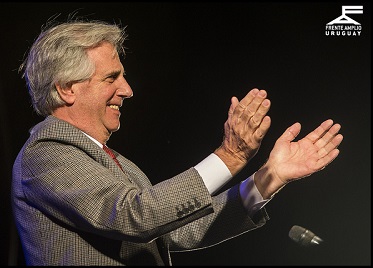
The Frente Amplio (FA) emerged from Sunday’s general elections in Uruguay looking stronger than observers had forecast – and signaling Latin Americans’ confidence in the center-left.  Despite a rough campaign season, which included polls showing the FA’s support stuck in the low 40s, and public sniping between the party’s leaders – candidate Tabaré Vázquez and current president José Mujica – just days before the election, the FA gained last-minute momentum in the polls and won 47.9 percent of the vote.  As expected, Vázquez received less than the outright majority needed to avoid a second round of voting on November 30 against the candidate of the Partido Nacional (PN), Luis Lacalle Pou, who won 31 percent of the vote.  But the FA preserved its majority in the lower chamber of parliament, and it can have the edge in the senate if Vázquez wins in November, as his vice president, Raúl Séndic, would hold the deciding vote.  The Partido Colorado (PC) candidate, Pedro Bordaberry, won only 12.9 percent of the vote and placed third in every department.

The elections revolved around Vázquez and Lacalle Pou’s leadership identity and policies; neither candidate argued for substantial structural changes.  In exit interviews, those who voted for the FA credited it with positive changes in its decade at the helm.  The 41-year-old Lacalle Pou has run as a youthful leadership alternative to the 74-year-old former president Vázquez, and he promised fresh ideas for taking on crime and education, considered leading concerns for Uruguayan voters.  While exit interviews suggest that this message appealed to his party’s voters, it did not translate into substantial youth support.  Polling by Factum prior to the election showed that 51 percent of voters aged 18-37 preferred the FA.  Public security has been the leading concern for Uruguayan voters, and both traditional center-right parties, the PN and PC, supported a referendum (also held on Sunday) that would have lowered the age of criminal responsibility for major crimes from 18 to 16.  But long-term polling trends have shown a decrease in the number of Uruguayans prioritizing security from its peak last year, and indeed the referendum failed with 47 percent of the vote; almost the entirety of undecided voters ultimately chose to oppose it.

The FA now has momentum and is well positioned to win the second round and enjoy the support of a parliamentary majority.  A likely PN-PC voting bloc in the second round once held a slight lead over the FA but now appears likely to fall short because of tensions between them.  The PC’s underwhelming performance at the polls has been compounded by Bordaberry’s decision on Sunday night to support Lacalle Pou without consulting PC officials, and his offensive off-the-cuff verbal attack on the Vázquez camp during a conversation with a PN official that same night, for which he has since apologized.  The left-leaning Partido Independiente, which came in fourth place with 3.1 percent of the vote, will make a decision on which candidate to support this week; their votes alone would be enough to push the FA over the top.  As a result, barring a major turn of events, it appears as though the incumbent pink tide will prevail in Uruguay – with implications, perhaps, beyond.  Indeed, a second-round FA victory will be the sixth this year for a left-leaning party, following the pattern set by Chile, Costa Rica, El Salvador, Bolivia, and Brazil.  While the citizenry may be impatient with the pace of progress in Latin America following nearly a decade of left-leaning governance, voters seem to be eschewing the right and maintaining the modestly but consistently leftward tilt that has characterized the region’s politics for much of the 21st century.

October 30, 2014


Brazil: Implications of Dilma’s Victory

By Eric Hershberg and Matthew Taylor

Sala de Imprensa / Flickr /  CC BY-NC 2.0

Sala de Imprensa / Flickr / CC BY-NC 2.0

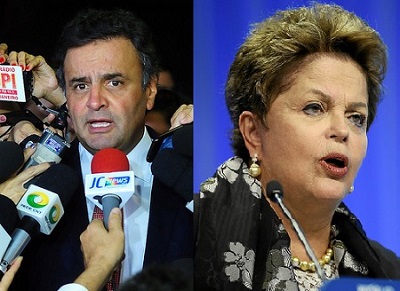
President Dilma Rousseff’s reelection – by a tight 3.28 percent of the vote – sets the stage for a period of challenges and political uncertainty.  The Social Democratic Party (PSDB) candidate, former governor Aécio Neves, was truly a formidable contender, and Dilma and the Worker Party (PT) showed new weaknesses.  The battle was marked by a strong desire for change – even Dilma’s campaign slogan was “Governo Novo, Ideias Novas” (New Government, New Ideas) – and the big question now is what sort of change will come from the PT’s fourth consecutive turn in office.

  • Dilma lost overwhelmingly in the Worker Party’s (PT) old stomping grounds of the southeast (by 2-1 margins), but picked up support in Neves’s state of Minas Gerais and thoroughly dominated the northeast (by 3-1 margins in many places), including Pernambuco, which had gone to Marina Silva in the first round.
  • The lower middle class, known widely as Classe C, ultimately appears to have thrown its lot to Dilma – apparently driven by the PT’s relentless message that only it could be trusted to protect their interests and social programs like the Bolsa Família.
  • The PT emerges from the battle bloody and bruised. The Rousseff campaign’s systematic deconstruction of Marina Silva in the first round buys the resentment of a solid fifth of the electorate.  Former president Luiz Inácio Lula da Silva was an uneven participant in the campaign, inexplicably absent at critical moments and losing his cool at others.
  • The PT won 19 of 27 governorships, and Dilma’s alliance did well in the Chamber of Deputies and Senate, but the opposition is likely to be far more assertive, as the combined issues of the economy, public services and corruption proved during the campaign to be useful wedges to drive between the middle class and the PT. A newly combative and forceful Aécio will be the clear leader of the opposition.

Dilma faces formidable challenges.  The economy was moribund for almost all of her first term, and fairly urgent work is needed to cope with a deteriorating current account, the weak fiscal results, resurgent inflation, and declining personal credit, especially among the politically influential Classe C.  Management of public services – theoretically manager Dilma’s strong suit – needs attention, and she actually has little hope of driving meaningful change singlehandedly.  The corruption story, moreover, is an immediate threat.  If the testimony of foreign exchange dealer Alberto Yousseff, who was given whistleblower protection in exchange for testifying to the police, is to be believed, this is an enormous scandal that may shake the administration to its core.  In light of this political scenario, it is perhaps not surprising that Dilma’s victory speech focused on building consensus, suggesting she would push political reform via plebiscite, promising anti-corruption reforms, and suggesting, after largely downplaying the issue on the campaign trail, that inflation and fiscal balance will be key priorities during her second term.  Whether she can actually accomplish these goals on her own timetable is a big question.

October 27, 2014

Bolivia: Evo Wins Again

By Fulton Armstrong

Photo credit: Eneas / Foter / CC BY

Photo credit: Eneas / Foter / CC BY

President Evo Morales’s landslide election to a third term – fueled by a combination of moderate policies and fiery leftist rhetoric – portends continued stability in the near term, with still no indication of how his party will continue its project after him.  Although official results have yet to be announced, and some preliminary data show Evo garnering around 54 percent of the vote, exit poll estimates gave Evo a massive lead of 60 to 25 percent over the next closest candidate, a wealthy cement magnate named Samuel Doria Medina.  Regardless, the enormous margin separating Evo from his competitors precludes a runoff race.  Doria, who also ran against Evo in 2005 and 2009, claimed that OAS praise for the elections before the polls closed was “not normal,” but he is not disputing the results and has conceded defeat.  Congratulations to Evo poured in first from his left-leaning allies – Presidents Maduro (Venezuela), Mujica (Uruguay), Fernández de Kirchner (Argentina), and Sánchez Cerén (El Salvador) – but other voices soon followed.  The victory set Evo on track to be the longest-serving president in Bolivian history since national founder Andrés de Santa Cruz lost power in 1839.  His party, the Movement Toward Socialism (MAS), is also reported to have expanded its control of the Chamber of Deputies and the Senate, although vote tallies are not final.

Evo has achieved things his domestic and foreign detractors said were impossible.  While his rhetoric has been stridently leftist and anti-U.S. – he even dedicated his “anti-imperialist triumph” to Hugo Chávez and Fidel Castro – his policies have been decidedly pragmatic and disciplined, and the results have curried favor for him among foes.  His economic czar has emphasized Bolivia’s commitment to “have socialist policies with macroeconomic equilibrium … applying economic science.”  The economy grew 6.8 percent last year and is on course to grow another 5 percent this year.  Foreign reserves have skyrocketed; Bolivia’s are proportionately the largest in the world.  Poverty has declined; one in five Bolivians now lives in extreme poverty, as compared to one in three eight years ago.  IMF and World Bank officials, whose policies Evo largely rejected, have grudgingly conceded he has managed the economy well.  Some of his projects, such as a teleférico cable car system linking La Paz with the sprawling city of El Alto, have garnered praise for their economic and political vision.  He even won in the province of Santa Cruz, a cradle of anti-Evo conspiracy several years ago.  In foreign policy, he has good ties across the continent, but strains with Washington continue.  The two countries have been without ambassadors in each other’s capital since 2008, and talks to resolve differences over the activities of DEA and USAID failed and led to their expulsion from Bolivia.

Sixty-plus percent in a clean election for a third term – rare if your initials aren’t FDR – signals that Evo, like Roosevelt, is a transformative figure.  No matter how brilliantly Evo has led the country, however, the big gap between his MAS party and the opposition suggests political imbalances that could threaten progress over time if he doesn’t move to spread out the power.  Evo has given the MAS power to implement his agenda, but he has not given space to rising potential successors.  He has said he will “respect the Constitution” regarding a now-disallowed fourth term, but it would take great discipline not to encourage his two-thirds majority in the Senate to go ahead with an amendment allowing him yet another term.  It would be naïve, moreover, to dismiss out of hand the opposition’s allegations of corruption by Evo’s government, but his ability to grow his base above the poor and well into the middle class suggests that, for now, the fraud and abuse do not appear to be very debilitating … yet.  Washington, for its part, seems content with a relationship lacking substance rather than joining the rest of the hemisphere in cooperating with Bolivia where it can.

Other AULABLOG posts on this and related topics:  ALBA Governments and Presidential Succession; Lessons from the MAS; and Will Bolivia’s Half Moon Rise Again?

October 14, 2014

Elections in Brazil: The Force of the Latin American Left

By Eric Hershberg and Luciano Melo

Aécio Neves – Senador & World Economic Forum / Foter / CC BY-NC-SA

Aécio Neves – Senador & World Economic Forum / Foter / CC BY-NC-SA

The first round of Brazil’s presidential election has set the stage for a runoff playing primarily to class differences.  By the eve of the election, polls hinted at the real possibility that the center-right candidate Aécio Neves of the Brazilian Social Democratic Party (PSDB) would edge out the other principal opposition contender, former Minister of the Environment Marina Silva.  Silva enjoyed a spike in the polls after she replaced the late Eduardo Campos, who perished in a plane accident in August, as the Brazilian Social Party (PSB) candidate.  Sunday’s results confirmed Silva’s decline, as she captured only 21.3 percent of the votes compared to 33.5 percent for the PSDB and 41.6% for incumbent President Dilma Roussef of the Worker’s Party (PT).  The PT used its potent propaganda machine to portray Silva as a potentially dangerous candidate – an indecisive leader who could not be trusted to sustain popular social programs such as the Bolsa Familia conditional cash transfer program, which has helped lift millions of Brazilians out of poverty.  Also, Aécio and Rousseff built their images upon two iconic ex-Presidents – the former on Fernando Henrique Cardoso (FHC) – seen by the middle and upper classes as the leader who managed to defeat hyperinflation and putting Brazil on track for economic growth – and the latter on Lula, Rousseff’s mentor, who is idolized among the most disadvantaged parts of Brazilian society as the President who helped the poor become less poor.

To win the runoff on October 26, Aécio needs at least 70 percent of Silva’s votes – she has only hinted at supporting him – while Rousseff would succeed with only half of that.  It is clear that Dilma and the PT will double down on their negative advertisements, now aiming at Aécio rather than Marina.  The PT’s barrage over the airwaves will highlight the risks of abandoning the course set out by Lula and followed by Rousseff.  Voters will be told that the opposition may underfund cash transfers, privatize the state oil company Petrobrás or treat it as a profit-making enterprise rather than as a development bank, thus increasing unemployment as occurred during the Cardoso years.  And the PT will no doubt remind voters of its consistent efforts to boost minimum wages and chip away at the vast inequalities that had long characterized Brazil.  Surely they will portray Neves as an elitist out of touch with the majority that has benefited from the PT’s redistributionist agenda.  Aécio and the PSDB, by contrast, will highlight the worrisome slowdown in growth under Rousseff, the failure to significantly improve public services – it was frustration over health, education and, particularly, urban transportation that drove the social protests that began in mid-2013 – and the over-regulated and over-taxed economy.  Most of all, Neves’ campaign will harp on the persistent scandals that have bedeviled the PT over the past decade and that have helped to fuel popular disdain for politicians.

The election results in Brazil are likely to become increasingly polarized in terms of class.  Dilma appears poised to prevail in the poorest states of North and Northeast, where Bolsa Familia and other cash transfer programs, subsidies, wage increases and Lula’s image are compelling.  In turn, Aécio should come out ahead in the richer states such as São Paulo, which offer the largest pool of voters and where highly educated and middle- and upper-income Brazilians are concentrated.  We make divergent predictions: Hershberg anticipates a PT victory, since for all the speculation about the travails of the Latin American left, it has built very substantial foundations of support in societies that credit the left with finally making some advances to tackle Latin America’s yawning inequalities.  Warnings that Aécio represents a return to elite rule will resonate among the PT’s electoral base, and the PT’s success will be nourished by its powerful organizational capabilities.  Melo, by contrast, anticipates a PSDB triumph.  In this scenario, the corruption, disappointing growth rates over the past two years as the commodity boom has slowed, and widespread frustration about the quality of public services will generate an anti-incumbent dynamic that will bring to an end a dozen years of PT rule.

October 10, 2014

Elections in Uruguay: A Bellwether for the Latin American Left?

By Aaron T. Bell

Photo credit: Frente Amplio (FA) / Foter / CC BY-NC-SA

Photo credit: Frente Amplio (FA) / Foter / CC BY-NC-SA

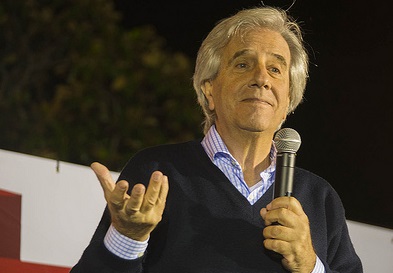
Uruguay’s elections on October 26 – once seen as a sure bet for the ruling Frente Amplio’s presidential candidate, former president Tabaré Vázquez (2005-2010) – have become a tight race, perhaps signaling challenges for other left-leaning Latin American governments as well.  The FA’s slight slip in the polls since the beginning of 2014 has been matched by sustained growth by the Partido Nacional, led by Luis Lacalle Pou, the son of a former president.  While Vázquez still holds a ten-point lead, he’s well below the absolute majority needed to avoid a run-off election, whose numbers look even bleaker for the ruling party.  In February, Lacalle Pou was running twenty-five points behind Vázquez in a head-to-head matchup, but the latest polls now show him only two points back.  Lacalle Pou will need the support of his party’s long-time rival, the Colorado Party, to win a second round against the FA, but Colorado candidate Pedro Bordaberry has thus far refused to concede the first round to the PN despite trailing them by 17 points.  Nonetheless, Vázquez was defeated by just such a second-round alliance in 1999.  Complicating things for him, polling strongly suggests that FA could lose control of both houses of the national legislature this fall.

The Lacalle Pou campaign has focused on public security and education.  Uruguay’s homicide rate remains one of the lowest in the region, but a modest increase in crime in recent years has spurred both urban and rural Uruguayans to rank security as the principal problem facing the nation – well ahead of the second leading concern, education.  The October elections will coincide with a referendum on lowering the age of criminal responsibility from 18 to 16 for serious offensives, with polls showing Uruguayans closely divided but leaning toward approval.  On the education front, the FA’s Plan Ceiba has helped provide laptops to every student, but 2012 assessment data from the Organization for Economic Cooperation and Development still place Uruguay’s students well below the international average in math, science, and reading.

The FA’s political situation is paradoxical: it has presided over major socioeconomic improvements in the last decade and won international acclaim, but earned a more tepid response at home.  Uruguay’s decision to legalize marijuana was widely celebrated abroad as a step toward a more progressive drug policy in the region, but polls continue to show that a majority of Uruguayans oppose legalization, and it has not won the FA much support even among proponents of cannabis, who have resisted the creation of a registry of buyers.  (Vázquez recently suggested the registry would be used to develop rehabilitation programs.)  The FA seems to have not yet figured out how to respond effectively to the perception of insecurity, nor has it overseen a decided improvement in education, which is central to long-term development prospects.  With Brazil’s Partido dos Trabalhadores facing an uncertain future, and political crises in Argentina and Venezuela simmering, the FA may be the first case of a larger regional rollback of the first wave of 21st century leftwing movements.

September 30, 2014

Brazil: Is Marina Silva the PT’s Nemesis?

By Luciano Melo

MarinaSilva

Photo courtesy of the Marina Silva campaign website

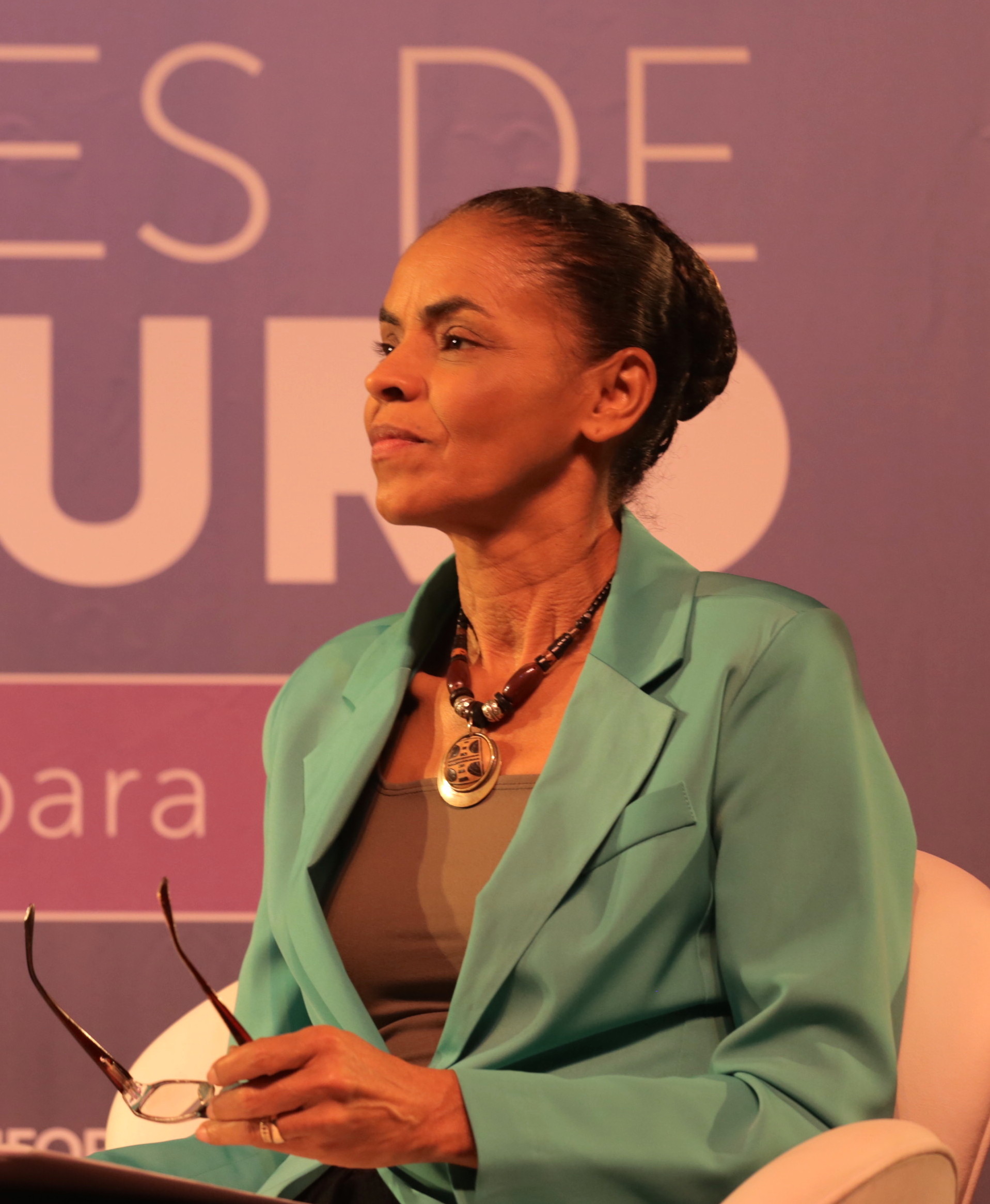
No politician in recent years has been able to shake and polarize Brazilian politics as Marina Silva has since becoming the Brazilian Socialist Party (PSB) presidential candidate after its original nominee, Eduardo Campos, died in a plane crash last month. She has an alluring biography: born into an extremely poor family and illiterate until she was 16, she worked as a rubber tapper and rose to become one of the most prominent ecologists and defenders of the Amazon region alongside Chico Mendes, a true Brazilian hero. After earning a degree in history, Silva entered politics in the mid-1980s. Several years later she received the most votes as a state representative for Acre, served twice as a senator, and later became the Minister of Environment in Lula’s administration (a position from which she resigned due to fundamental divergences with the Workers Party and Dilma Rousseff). In 2007 she won the UN’s Champions of the World award, and three years later she ran for President under the Green Party banner, amassing 20 million votes on a platform emphasizing environmental issues and education.

Recent polls find roughly a third of Brazilian voters favoring Silva in the first round of balloting scheduled for October 5, and running even with or slightly ahead of President Rousseff in an anticipated run-off election three weeks later. The Brazilian media suggest that a large part of Silva’s appeal comes from a personal aura of transparency and rectitude – a refreshing change from others competing for Brazil’s top job. She has also demonstrated an old-fashioned ability to compromise in order to form alliances. A committed environmentalist, Silva teamed up with Eduardo Campos, a titan of agribusiness, and now, heading up the PSB ticket, her running mate is Beto Albuquerque, a moderate farmer who can bring a certain level of balance in the economic-environmental equation. On the separation of church and state, however, Marina may face a difficult balancing act. She is an evangelical Christian, winning a large chunk of religious voters in 2010, and she has defended the teaching of creationism in schools, saying that God created even Darwin. She rolled out an agenda for advancing LGBT rights recently, but criticism by Pastor Silas Malafaia, one of Brazil’s main evangelical leaders, forced her to reverse course and abandon her position 24 hours after having presented it.

Although Brazil is a religious country, laïcité – a French version of secularism – is a serious matter for the upper and middle classes, and Silva’s religiosity may cost her votes. She has exposed her core weak spot, which the other candidates will exploit in the upcoming debates and electoral campaigns. But popular concerns about corruption run much deeper in the eyes of the Brazilian people. The fact that presidents Dilma and Lula and the PT have become synonymous with misconduct in general, and mismanagement regarding Petrobrás in particular – a scandal involving 40 PT members in a multi-million real scheme – weakens their ability to counterattack amidst Silva’s continuous rise. What we will see in the elections in October is therefore a battle between the PT’s Bolsa Família – one of the most successful social programs in the history of Brazil – and a candidate who theoretically embodies honesty and honor. Whatever the outcome, it seems that PT has met its biggest challenge in 12 years.

Bolivia: Lessons from the MAS

By Santiago Anria*

Joaquín Eguren / Flickr / Creative Commons Attribution-NonCommercial 2.0 Generic (CC BY-NC 2.0)

Joaquín Eguren / Flickr / Creative Commons Attribution-NonCommercial 2.0 Generic (CC BY-NC 2.0)

As Bolivian President Evo Morales’s Movimiento al Socialismo (MAS) prepares for the October 12 general election – which opinion polls indicate it will win by wide margins – the MAS appears to be a remarkably diverse organization capable of adapting operations to different regions of the country.  It fits neither the typical journalistic portrayal of Latin American social and political movements as clashing with political parties and elected governments, nor political scientists’ characterization of parties as unitary actors under the control of a unified leadership.  Founded by coca growers in the mid-1990s as their “political instrument” to contest power, the MAS has become the collective political expression of grassroots organizations now in power – to this day having diffuse boundaries and multiple faces, combining features of a grassroots movement and a party, and being a remarkably successful instrument for exercising rule.

The MAS’s regional diversity is one of its greatest strengths.  As an organizational actor, it looks and operates differently in different contexts depending on how the political space is structured.  In the Bolivian central region of the Chapare, where strong peasant unions are aligned with the MAS and control the territory, civil society and party are fused.  Grassroots organizations monopolize the political space, and local decision-making structures are embedded in the union structure.  Their success is rooted in “agrarian union democracy,” which emphasizes that “bases” exert control on the leadership – that the rank and file should lead and leaders should follow.  In the eastern city of Santa Cruz, on the other hand, the MAS has made inroads in traditionally hostile territory by developing an unusually strong local party organization with remarkable mobilization capacity, and that capacity gives it a central role in local governance.  As in other cities with large informal economies, the local structure draws support from two powerful urban sectors – transportation workers and street venders – and is organized territorially in districts that operate both during and between elections.  Rather than having the features of a movement, in Santa Cruz the MAS looks and works more like a conventional political party.  In the Chapare, Santa Cruz and elsewhere, the MAS organization has considerable latitude to operate locally within alliances and policies usually defined at the national level.  As a result, the MAS and its governmental counterparts are not often, or by necessity, in tension.

Latin American history offers many examples of political movements becoming personalistic vehicles for charismatic leaders.  More than 10 years since it became a credible electoral vehicle, the MAS may offer a more promising organizational alternative.  Morales is certainly a charismatic leader, with significant popular legitimacy and authority within the MAS.  His leadership cannot be overstated, and he is the dominant figure binding a wide array of grassroots movements and organizations.  Yet, the MAS has remained permeable to popular input in areas where civil society is strong and has mechanisms to arrive at collective decisions.  In the last general elections in 2009, grassroots influence was consequential: it led to the massive entrance of individuals and members of allied grassroots organizations into the highest level of political representation.  Their participation in Congress (the Plurinational Legislative Assembly) has pushed to diversify the legislative agenda still largely subordinated to the executive.  New MAS leaders willing or able to challenge Morales’s leadership have not emerged but, as the candidacies for the upcoming elections are defined, the strong regional dynamics could alter the composition of the new parliamentary group.  Whether the MAS will remain open, and whether it will manage to outgrow its dominant leader figure, will depend on the continuing strength of allied groups in civil society.

*Santiago Anria is a Ph.D candidate in political science at the University of North Carolina at Chapel Hill.

Building State Capacity in Brazil

By Katherine Bersch, Sérgio Praça, and Matthew M. Taylor*

Photo Credit: Metrix X / Foter / Creative Commons Attribution-NonCommercial-NoDerivs 2.0 Generic (CC BY-NC-ND 2.0)

Photo Credit: Metrix X / Foter / Creative Commons Attribution-NonCommercial-NoDerivs 2.0 Generic (CC BY-NC-ND 2.0)

As the World Cup fades out and Brazilians turn their focus to the October elections, public debate will shift back to economic growth, social services, corruption, and – central to them all – the role of the state.  Is the federal government too big, inefficient and meddlesome, as the opposition argues, or does it need to be strengthened to play a leading role in Brazil’s state capitalist economy, as the incumbent Workers Party has sought?  In a recent paper (click here for draft), based on publicly available data of about 326,000 civil servants working within the 95 most important federal agencies in Brazil, we found a very diverse federal government, with agencies distributed widely on both capacity and autonomy.

Our findings empirically confirm a long literature that highlights the coexistence of so-called “islands of excellence,” with high capacity and high autonomy, alongside low-capacity, low-autonomy laggards.  “Islands of excellence” include Brazil’s Foreign Ministry (Itamaraty), the Central Bank, the Finance Ministry, the Justice Ministry, and the relatively young Comptroller General’s Office (CGU), created in 2001.  Laggards include almost all of the infrastructure agencies, as well as the Ministry of Sports, perhaps helping to explain the recent World Cup construction snafus.  Also interesting are the agencies with high capacity and low autonomy (such as the Federal Highway Police, which most state governors seek to empower and control within their own states), as well as agencies with low capacity and high autonomy, which few politicians seek to control (such as the Public Defenders Office).

We found solid evidence that agency corruption – one of the driving forces behind last year’s political angst and popular protests – is correlated with lower capacity and lower autonomy.  This finding could help frame debate in the upcoming campaigns and beyond: the keys to reducing corruption are to build agencies’ capacity and increase their autonomy from political partisans.  The debate over the role of the state has been ongoing since the return to democracy in the 1980s.  No matter who wins the October elections, the expansion of this data set and measurement effort will provide useful empirical data to more realistically evaluate the evolving performance of the Brazilian state, as well as to recognize the enormous differences and best practices within that state. 

*Katherine Bersch is a doctoral candidate at the University of Texas at Austin.  Sérgio Praça teaches Public Policy at the Federal University of the ABC in São Paulo.  Matthew Taylor, a regular contributor to AULABLOG, teaches at American University.