A Post-Correa Ecuador?

By Catherine Conaghan*

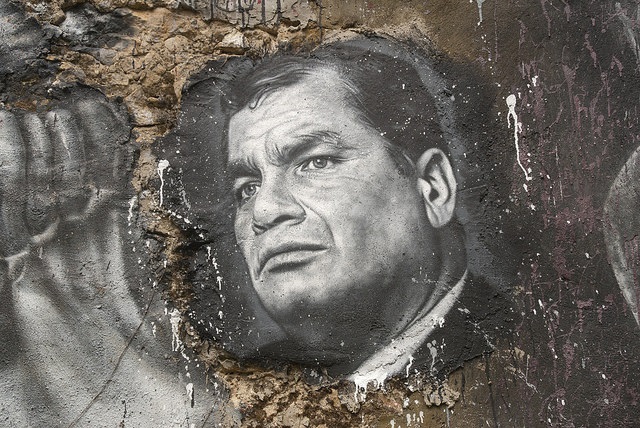
Photo Credit: Thierry Ehrmann / Flickr / Creative Commons

Photo Credit: Thierry Ehrmann / Flickr / Creative Commons

What seemed like a certainty less than a year ago – Ecuadorian President Rafael Correa as a shoo-in for reelection in 2017 – now has given way to competing scenarios as the country’s economic crisis deepens.  The game-changer has been the collapse in revenues from Ecuador’s principal export: petroleum.  With prices for Ecuadorian crude hovering 50 percent below their 2014 average, Correa has had little choice but to slash the abundant government spending that has been the hallmark of his presidency.  Ecuador’s use of the U.S. dollar greatly handicaps its capacity to adjust.  Further aggravating the recession is the economic downturn of Ecuador’s principal external lender, China.  Over $2 billion have been cut from the 2015 budget, and plans to shrink the size of the public bureaucracy are now under way.  His decision in April to suspend the central government’s obligatory payments to the national social security system stoked anxiety about the fund’s future, and an announcement in June of plans to hike taxes on inheritance and real estate transactions sparked street demonstrations around the country.  Indigenous and labor organizations mobilized in mid-August to protest these and other aspects of Correa’s style of governing.  An estimated crowd of 100,000 people marched in Quito.  Scores of protestors were detained and face charges related to the August mobilizations.

The months ahead will not be easy for a president accustomed to buoyant budgets and strong polls.  As one of Latin America’s left-turn leaders, he pushed a state-centric economic model under which poverty declined and the middle class grew.  His approval ratings since he took office in 2007 consistently scored among the highest of any Latin American president.  (They dipped below 50 percent – as low as 42 percent – for the first time in 2015.)  While Correa waxes and wanes on whether he really will pursue reelection, his party is pushing to amend the Constitution through legislation – without a referendum supported by over 80 percent of the public – to allow him a third term.  The opposition strenuously opposes the move.  The National Assembly appears headed toward a final vote on the matter in December.

From now until December, the reelection maneuvering and two possible outcomes will dominate conversations.  Under one scenario, Correa and Alianza País will push ahead with the amendment, ignoring negative public reaction and repressing protests if necessary, and Correa will decide on his candidacy depending on his view of the economy and the state of the opposition.  In a second and perhaps less likely scenario, Correa and his party may just abandon the reelection plan, concluding that the political costs are just too high.  This would set off power struggles within Alianza País over who would head the ticket.  Among the prospective frontrunners are former Vice President Lenín Moreno, current Vice President Jorge Glas, Production Minister (and former Ambassador to the United States) Nathalie Cely, and former Industry Minister-turned-critic Ramiro González.  In the process, Correa will be looking to anoint someone loyal and capable of governing the country until he can return as a candidate in 2021.  Under both of these scenarios, Ecuador is bracing for a volatile year ahead.  Natural disasters – a possible volcanic eruption of Mount Cotopaxi and El Niño – could also fuel uncertainty, giving Correa a chance to shine and rally, or to fail and deepen doubts about his leadership.  After eight years of relative political stability and economic good times, Ecuadorians are pondering whether a post-Correa era could be at hand and what it would mean.

September 8, 2015

* Catherine Conaghan is the Sir Edward Peacock Professor of Latin American Politics at Canada’s Queen’s University and a former CLALS Research Fellow.

Guatemala’s Crisis is Not Over

By Eric Hershberg*

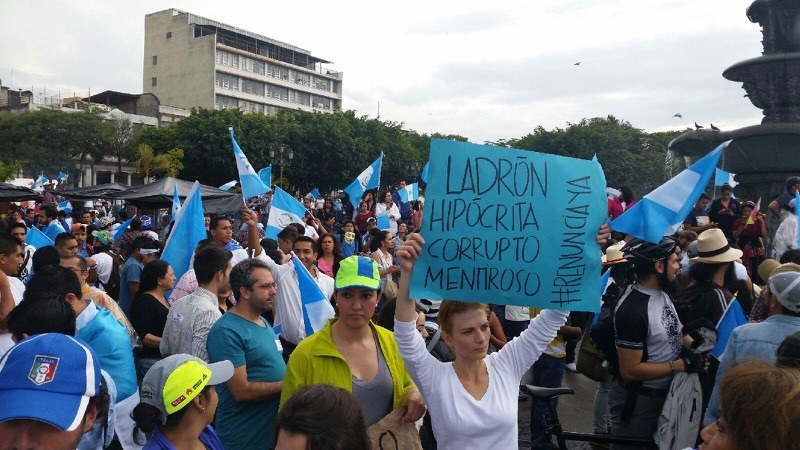
Guatemala City, August 2015. Photo Courtesy of Eric Hershberg.

Guatemala City, August 2015. Photo Courtesy of Eric Hershberg.

With President Otto Pérez Molina’s resignation early this morning, Guatemala lurches into a new phase in its long-running political crisis, with little prospect that this weekend’s elections will resolve much.  The investigations into the Pérez Molina administration’s corruption, the national assembly’s unanimous vote to suspend his immunity, and the peaceful surge in popular protests demanding that he step down all suggest progress in the country’s efforts to build a functioning democracy.  The UN-sponsored Comisión Internacional Contra la Impunidad en Guatemala (CICIG) fulfilled its mandate, and its example and training were arguably important factors in the ability of judicial officials in Pérez Molina’s own government to support the processes that led to his downfall.  (Click here for an AULABLOG assessment of CICIG in May.)  The Congressional vote to strip him of immunity was unanimous, including even his most loyal supporters, who until then had rejected popular clamoring for the president’s ouster.  By the end of last week societal disgust with the political elite had reached the point that even the most recalcitrant of incumbents realized that their own survival required ditching the president.  The comptroller’s office called on him to resign “to avoid greater social unrest that could have unpredictable consequences” – a sentiment echoed by powerful business groups and the Catholic Bishops Council.

The Guatemalan Constitution and laws lay out the next steps.  The Congress has accepted the resignation, clearing the way for Vice President Alejandro Maldonado – who replaced Vice President Roxana Baldetti after she was jailed in connection with the same corruption scandal – to take office.  The first round of Presidential elections, with 15 candidates in the running, will proceed as scheduled this Sunday, despite calls from some civil society organizations to delay the balloting on grounds that the campaign regulations reflect the influence and interests of criminal elements.  In all likelihood, a runoff round will be necessary six weeks later (October 25).  The convulsions of recent months and deep distrust in government suggest that tensions will be high between now and then, but there’s no indication yet that civil unrest could threaten the electoral process, and military intervention appears to be a thing of the past.  There is every reason to expect that a new President will be inaugurated on January 14.

The elections are unlikely, however, to lead Guatemala into an era of less corruption and greater accountability, or to install leadership willing or able to spearhead economic and social policies to enable the majority of the population to live with dignity.  The slogans on the banners of the tens of thousands of protestors in Guatemala City’s central square lacked any message beyond a rejection of the status quo.  “Throw them all out” and “I have no president”are potent rallying cries but do not address the core challenges of a country where the elite pay no taxes, half of all children are malnourished and tens of thousands of young people desperately seek better lives anywhere other than Guatemala.  

The reputations of the leading candidates and their failure to articulate coherent governing platforms give little room for optimism.  Leading in the polls is a wealthy businessman, Manuel Baldizón, whose running mate is already being investigated for corruption and whose own closet is widely understood to contain plenty of skeletons.  Protestors have already singled out Baldizón as unacceptable, taunting him with chants of “it’s your turn next.”  In second place is a comedian named Jimmy Morales, who enjoys the support of the economic elites and media but has advanced no policy platform whatsoever.  Former first lady Sandra Torres appears to be running third.  She divorced President Álvaro Colom in 2011 to circumvent a court ruling that, as First Lady, she couldn’t run for office.  (The Constitutional Court put a final stop to her campaign a month before elections that year.) 

Electoral victory by any of these candidates would leave Guatemala with weak leadership at a time that most government institutions desperately need revitalization.  Corruption is too deep-rooted for CICIG and its few allies in government to face down alone, and these candidates won’t use the presidency to carry out the needed purge.  The organized criminal groups that traffic drugs and persons through the country and permeate governing institutions stand to grow only stronger, and the misery that plagues a population deprived of education, health care and jobs will continue unabated.  U.S. Vice President Joe Biden’s billion-dollar aid package for Guatemala, Honduras and El Salvador, already in trouble in Washington, may have nowhere good to go.

September 3, 2015

*Eric Hershberg, director of the Center for Latin American & Latino Studies at American University, witnessed the protests in Guatemala City last week.

Maduro Cites Security to Suspend Rights on the Border

By Michael M. McCarthy*

Photo Credit: Globovisión / Flickr / Creative Commons

Photo Credit: Globovisión / Flickr / Creative Commons

The Maduro government’s closure of a key border crossing into Colombia and declaration of a state of emergency in nearby towns mark not only a low in relations with Colombia but also in efforts to manipulate the playing field ahead of legislative elections slated for December 6.  President Maduro blamed Colombian “paramilitaries” for an August 19 firefight in which three Venezuelan soldiers were wounded.  He announced the deployment in the area of the “Operations for the Liberation and Protection of the People” (OLP), which are heavily armed military and police units specially created to force out alleged paramilitaries, and security forces swept through the area forcibly deporting more than a thousand undocumented Colombians.  Last week, the pro-government coalition of the Venezuelan National Assembly called for expanding the emergency measures to two other important border states.  The two countries’ foreign ministers met on August 26 for what Colombian Minister Holguin called a “positive, frank and realistic” exchange, but there was no agreement to reopen the border.

Maduro’s objectives seem to go far beyond stemming border violence.  Two reputable polls put his popularity in the lower 20s and project the opposition as likely to win a Congressional majority in the December 6 legislative elections.  His Chavista political movement is bleeding supporters amid a mounting economic crisis. Skyrocketing inflation and acute shortages of basic goods and services have created daily hardships for the popular sectors that once served as Chavismo’s base.  The opposition coalition Mesa de Unidad Democrática called the state of emergency a diversionary tactic – “to cause a situation of intense conflict and internal confusion” – and claimed that the maneuvering shows Maduro fears the election and may suspend it.  The state of emergency in Táchira, which is a renewable in 60 days, restricts the right to public assembly and gives Maduro powers to seize assets and limit the sale of basic goods and services.  The value of the annual illegal border trade is estimated to have grown to roughly $5 billion.  The order may become a mechanism for intensifying government controls over industry, which Maduro regularly accuses of waging war against the government.

Maduro’s political objectives in declaring the state of exception are obvious to reset the political agenda in line with a government narrative of external threats.  This security rationale appears greatly exaggerated, suggesting he’s more interested in scapegoating Colombia for the sorry state of affairs in Táchira than in sparking a diversionary armed conflict.  He also recently escalated an historic border dispute on his eastern flank with Guyana after Exxon discovered oil in Guyanese territory claimed by Venezuela.  So far, Maduros actions have not seemed to threaten the soft truce between Washington and Caracas, which has led to a toning down of mutual recriminations.  Over the weekend, the U.S. State Department issued a mild statement that noted “continuing concern about the situation along the border between Venezuela and Colombia,” although Washington did take him to task for the deportations.  The real implications of the emergency decree are internal to Venezuela. Maduro’s state of emergency not only raises human rights concerns in the affected territories; it suggests the specter that the government will resort to increasingly desperate measures to maintain control as its credibility, like the economy, collapses.

August 31, 2015

* Michael McCarthy is a Research Fellow with the Center for Latin American and Latino Studies.

Can the Republicans Close Their Gap with Latinos?

By Eric Hershberg and Robert Albro

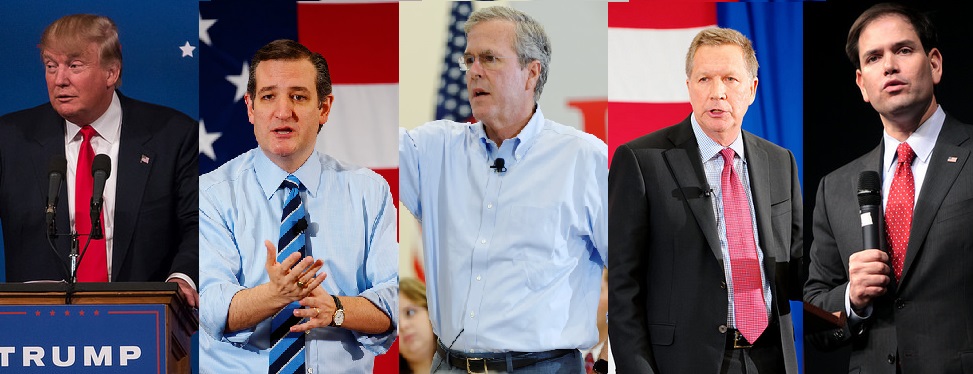
Photo credits: Iprimages, Michael Vadon, Gage Skidmore / Flickr / Creative Commons

Photo credits: Iprimages, Michael Vadon, Gage Skidmore / Flickr / Creative Commons

Remarks about immigration made by flamboyant New York billionaire and aspiring presidential candidate Donald Trump have embarrassed many Republicans – and angered many Latinos – but also opened the way for several of his competitors to appear more moderate on the issue.  Echoing comments he made in a televised debate on 6 August, Trump on Sunday issued a policy paper claiming, “For many years, Mexico’s leaders have been … using illegal immigration to export the crime and poverty in their own country (as well as in other Latin American countries).”  He demands that Mexico pay for an impenetrable wall along the border and that Washington deport many migrants, beef up border patrols and narrow opportunities for legal immigration.  Although Trump has often claimed he could win the Latino vote, a poll by Huffington Post/YouGov in June found that 82 percent of Latinos don’t take Trump seriously as a candidate, and subsequent surveys indicate that his rhetoric has damaged the Republicans’ image among them.  (Other polls indicate that Democrats’ immigration proposals, in contrast, have the support of some 60 percent of Latinos.)  The views of the country’s fastest-growing demographic group are significant when considering their prominence in “swing” states such as Florida (24 percent of the population and 14.6 of registered voters), Colorado (21 and 14.2), Nevada (27 and 16) and Virginia (8 and 5).

Most of the 15 other major Republican candidates have tried to ignore Trump’s remarks and the immigration issue overall.  Texas Senator Ted Cruz said he “salutes” Trump and, eschewing “Republican-on-Republican violence,” refused to criticize his views.  But two others – former Florida governor Jeb Bush and Ohio governor John Kasich – have staked out somewhat more moderate positions.

  • Bush stresses the need for more aggressive border enforcement and a crackdown on undocumented residents of “sanctuary cities,” but he also called for an immigration policy that included “documented status” – but not citizenship – for an unspecified number of them. Having a Mexican-born wife and mixed-race children also sets him apart.
  • Kasich last week noted that undocumented migrants are “people who are contributing significantly” to the United States. He said, “A lot of these people who are here are some of the hardest-working, God-fearing, family-oriented people you can ever meet,” and he said he favors a pathway to legal status for people already in the country, adding that such provisions could be part of an immigration reform package.
  • Florida Senator Marco Rubio, who was ostracized by his Republican colleagues in 2013 for proposing reforms along the same lines, has appeared reluctant to criticize Trump, Bush or Kasich – making him possibly the biggest loser on the issue for now.

The elections are still 14 months off, and electoral dynamics change.  Latinos don’t figure in the Republican primaries, and it’s too early to speculate how their voices will play until next year – at which point Donald Trump probably will be seeking celebrity through other endeavors.  Republican strategists have already said that their candidates won’t try hard to court Latinos – and risk alienating the roughly 20 percent of their base in swing states who hold hard-core anti-immigration positions.  Nonetheless, Bush and Kasich’s rhetoric, while still vague on actual policies, may give the party a chance to claim to Latinos that not all Republicans are out to get them.  No Republican on the front line today appears likely to attract majority support among Latinos, but a moderate-sounding approach to immigration could take the rough edges off the party’s image, reduce Latino opposition to it and diminish the issue as a Democratic Party advantage.

August 18, 2015

Argentina Presidential Campaign: Harbinger of Deep Change?

By Federico Merke*

Candidates, left to right: Daniel Scioli, Mauricio Macri, and Sergio Massa. Photo Credits: Cgazzo, Inés Tanoira, and Tigre Municipio, respectively / Wikimedia Commons / CC BY 2.0

Candidates, left to right: Daniel Scioli, Mauricio Macri, and Sergio Massa. Photo Credits: Cgazzo, Inés Tanoira, and Tigre Municipio, respectively / Wikimedia Commons / CC BY 2.0

As the 2015 presidential race begins to take shape in Argentina, the leading candidates – Daniel Scioli (Frente para la Victoria, FPV), Mauricio Macri (Propuesta Republicana, PRO), and Sergio Massa (dissident Peronist faction Frente Renovador, FR ) – have already begun to outline their visions, but sweeping change doesn’t yet appear on the horizon.  According to early polls, Massa had a strong start in the runup to the August 5 presidential primary, but his popularity has faded, making Scioli and Macri appear to be the real contenders.  Originally considered an unexciting three-way race, it has now become a polarized contest.  It should come as no surprise if campaign speeches start to follow a continuity-versus-change line.

Several developments suggest the presidential race will be close:

  • The fact that Scioli has named Carlos Zannini, President Cristina Fernández de Kirchner’s legal secretary, as his running mate has been a game-changer. The Scioli-Zannini effort to bridge two different factions of the FPV, namely the left-wing Kirchnerites with more business-friendly Peronists, will demand tons of rhetoric.  This ticket casts them as guarantors of continuity: el modelo with some modifications.  Yet in electoral politics, almost everything is about framing – explaining to core and potential supporters how new decisions, which for all their twists and turns, remain faithful to the flags of the party.  This is when Peronism gets real.
  • The Zannini gambit on the Peronist side prompted Macri to follow a pure PRO formula, naming Gabriela Michetti, a former deputy-major of Buenos Aires City, as his vice-presidential candidate. This ticket bets on the idea that most Argentine voters reject the government and want substantial change, while polls suggest that many just opt for moderate adjustments.  Macri’s record indicates that he would propel a more pro-business government than that of Fernández de Kirchner, but his victory would not portend a return to the neoliberal heyday of the Menem years during the 1990s.
  • Sergio Massa, on the other hand, is the plain-speaking candidate of the dissident Peronist faction who’s challenged by the FPV and PRO candidates to duke it out over the issues. Polls indicate that he will draw 15 percent of the votes in the election – making him an important powerbroker.

These early stages of the campaign reflect a recurrent pattern in Argentina’s political landscape: a tendency of ruling party candidates to move away from incumbents with lofty rhetoric but little specificity on the one hand, as opposition candidates issue harsh criticism while at the same time manifesting a reluctance to embrace radical change.  Scioli seems to be going all-out Kirchnerite, but it’s too soon to judge whether the electorate will follow, or whether once in office he would govern as if it were Cristina’s third term.  He and Macri both aspire to grab Massa’s 15 percent, as it could enable them to win the presidency in the first ballot rather than having to contest a second round of voting between the two top vote-getters.  But he hasn’t stated a credible price, and neither Scioli nor Macri seems ready yet to begin bargaining with him.   President Fernández may have avoided plunging the economy into crisis before she steps down, but her successor will definitely have to make tough choices because the country is mired in recession and cannot access foreign investment.  Macri might initially enjoy some leeway to introduce austerity measures that would clean up a good part of the macro-economic mess and reopen Argentina to international capital markets, but even he – like Scioli – is likely to be constrained by embedded Kirchnerism in Congress and in the ministries.  Those in Argentina and beyond who have dreamed that Kirchnerism’s days are numbered will have to wait to see.  Kirchnerism, Argentina’s latest “ism,” has profoundly altered the political and ideological landscape – and, at this early point in the campaign, it appears likely to continue to be part of the country’s political ethos into the future.  It could even turn out to be the dominant force in the administration that takes office in 2016.

July 2, 2015

*Federico Merke directs the Political Science and International Relations Programs at the Universidad de San Andrés in Buenos Aires.

Mexico Elections: Successful Balloting, Mixed Results

By Eric Hershberg and Fulton Armstrong

Preparing for elections in Chiapas, Mexico last week.  Photo Credit: Dimitri dF / Flickr / Creative Commons

Preparing for elections in Chiapas, Mexico last week. Photo Credit: Dimitri dF / Flickr / Creative Commons

Mexico’s mid-term elections last Sunday to select governors, mayors, and local and federal legislators confirmed popular engagement in the democratic process, but deep frustration with the country’s political parties.  Voter turnout – 47 percent of eligible voters cast ballots – was high  despite violence, isolated ballot-burnings, attacks on election board offices, and calls for boycotts.  The elections were carried out under highly adverse conditions. Some 1,400 murders were recorded nationwide in April – the highest rate in a year – and a clash between privately supported vigilantes and suspected cartel members left 13 dead in Guerrero state the day before voting.  Four assassinated candidates remained on Sunday’s ballots (and at least one won).  Pre-election polls showed that some 90 percent of citizens distrusted the political parties, and over half expressed disapproval for President Peña Nieto half-way into his six-year term.  According to press reports, voters were motivated by concern about the government’s inability to deal with the resurgence of violence or even satisfactorily explain massacres, such as the disappearance last September of 43 students who were last seen in police custody.  Mexico’s sluggish economy may have driven people to the polls as well; the government cut growth estimates in May because of lower than expected oil revenues and U.S. growth.

As predicted, the President’s Institutional Revolutionary Party (PRI) and its partners won a parliamentary majority – winning about 40 percent of the votes and, as a coalition, 260-plus seats in the 500-member Congress.  The PRI and the Party of Democratic Revolution (PRD) lost governorships in the country’s two most violent states – Guerrero and Michoacán – in what’s widely seen as a rebuke to both.  The opposition National Action Party (PAN) held largely steady, garnering about 20 percent of the votes.  By most accounts, the big winner on Sunday is Governor-elect Jaime Rodríguez of Mexico’s second-richest state, Nuevo León.  Running as an outsider, El Bronco took advantage of an electoral reform allowing independent candidacies and waltzed to victory with 48 percent of the vote despite a modest campaign and opposition from local media.  He has pledged that his election marks “the start of a second Mexican Revolution.”

El Bronco can legitimately claim to embody rejection of the traditional parties, and in that respect his rise to prominence is not unlike that of many charismatic politicians in Latin America’s recent and not-so-recent past.  Given his campaign’s lack of programmatic clarity, it is not clear that he or the votes cast in his favor represent anything more than that.  President Peña Nieto achieved important reforms during his first three years in office, particularly in energy and education, but these have neither generated enthusiastic support nor their anticipated benefits.  Whether the President has any new compelling ideas to offer for the remainder of his term remains to be seen.  The relatively high turnout last Sunday despite popular cynicism toward the parties and myriad security challenges does testify to Mexicans’ resilient democratic aspirations, but the election also reflects widespread public disillusion with the available options – incumbent as well as opposition.  The ruling PRI failed to offer (or even project) a credible agenda for Mexico during what are clearly times of trouble, and the country suffers from a lack of coherent alternative visions for either conservative modernization (the PAN) or progressive transformation (PRD or its former standard-bearer, Andrés Manuel López Obrador, with his newly established Morena party).  Across the ideological spectrum, Mexico’s politics are stuck, and it’s going to take more than one Bronco to drive out the dinosaurs.

June 11, 2015

Haiti: Yet More Lost Opportunity

By Emma Fawcett*

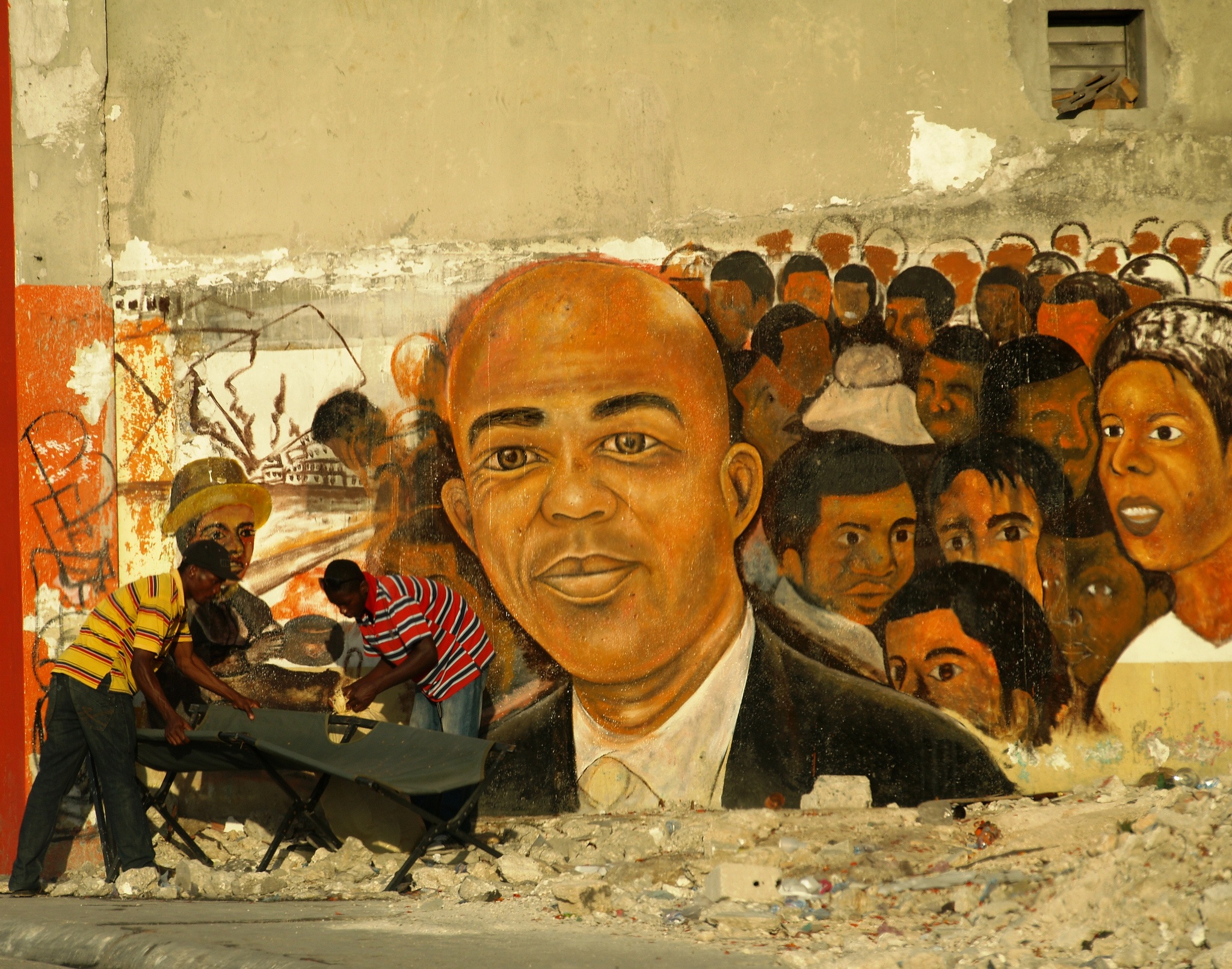
Photo Credit: Nacho Fradejas Garcia / Flickr / Creative Commons

Photo Credit: Nacho Fradejas Garcia / Flickr / Creative Commons

Six months into Haiti’s most recent political crisis, popular uncertainty and frustration are palpable – amid indications that even the Obama Administration may be tiring of corruption and mismanagement under President Martelly.  Officials in Washington in April expressed concerns over the abrupt release of gang leaders alleged to have ties to Martelly who had been held on kidnapping charges.  Recent U.S. Embassy tweets have focused on the importance of press freedom and free and fair elections.  Protests are a regular occurrence, and anti-government graffiti covers buildings throughout Port-au-Prince.  Martelly’s network of old friends – whom some long-time Haiti-watchers have called “nefarious characters” – has been politically useful to him, and various press reports indicate that criminal prosecutions against them for drug trafficking, kidnapping, and worse have mysteriously dropped off the books.  Criticism of his record on other issues is also strong.  A visit from Beyoncé on May 16 led the US Embassy to ask its Facebook followers: “Where should she go to see the progress in Haiti? Let us know!”  Social media users mocked, “What progress?” and derided the embassy for asking.  Washington politics, such as criticism of Bill and Hillary Clinton’s role in Haiti, is further casting a shadow on Martelly and his government.

The country has made partial progress towards holding its long overdue elections, but – if history and Martelly’s record are any guide – obstacles could easily arise.  A list of candidates has been approved, and dates have been set – August 9 for Parliamentary elections (all 118 seats in the Chamber of Deputies and 20 of the 30 seats in the Senate).   Presidential elections will take place on October 25, with a December 27 runoff if necessary.  But the process has not been without controversy: a quarter of the 2,039 who had registered to be candidates have been disqualified for various reasons.  (First Lady Sophia Martelly wanted to run for Senate but was not accepted because she is a U.S. citizen.)  As the government has not provided explanations in most instances, accusations that the exclusions were politically-motivated abound.

Martelly’s carefully calculated consolidation of power over the last four years has led many observers in Haiti to wonder whether he will actually make elections happen and leave office on schedule.  Many of them are perplexed by what they perceive as steadfast U.S. support for him.  Even in January, when an agreement on elections fell through once again and Martelly commenced to rule by decree, the State Department’s admonishment was widely seen as weak.  Rather than building bridges at home, Martelly has often appeared more externally focused – capitalizing on his ties to the Clintons, who along with the OAS helped him secure the contested presidency in the first place; declaring that Haiti is “open for business”; and holding his historic meeting earlier this month with French President Francois Hollande.  Indeed, the Hollande visit resulted in yet more protests in Port-au-Prince’s streets from those frustrated by France’s refusal to pay reparations for past abuses – such as the “independence debt” that France demanded, which consumed 80 percent of Haiti’s budget for 125 years (the equivalent of $17 billion dollars today).  Predictions about the elections and transition of power at the end of the year would be premature, but Martelly already seems to have squandered his chance to leave a legacy of progress, institution-building, and stability for the nascent Haitian democracy. 

June 1, 2015

*Emma Fawcett is a PhD candidate in International Relations at American University.  Her doctoral thesis focuses on the political economy of tourism and development in four Caribbean case studies: Haiti, Dominican Republic, Cuba, and the Mexican Caribbean.

The Venezuelan Opposition: Can the Center Hold?

By Michael M. McCarthy*

Leopoldo Lopez (R) being escorted by the National Guard after turning himself in on February 18, 2014.  Photo Credit: Juan Barreto via Globovisión / Flickr / Creative Commons

Leopoldo Lopez (R) being escorted by the National Guard after turning himself in on February 18, 2014. Photo Credit: Juan Barreto via Globovisión / Flickr / Creative Commons

The leaked video of jailed Venezuelan opposition leader Leopoldo López declaring a hunger strike and calling for a renewal of street demonstrations this Saturday threatens to reopen splits within the Venezuelan political opposition.  With Venezuela experiencing an economic crisis – the bolívar lost a quarter of its value on the black market last week and shortages of basic goods plague daily life – the opposition, a disparate group of 29 political parties organized under the Mesa de Unidad Democrática (MUD), seems poised to score a pivotal victory in this year’s legislative election.  But López’s call to protests could renew divisions between those supportive of last year’s La Salida street demonstrations and the moderate camp, led by Governor Henrique Capriles, eager to punish the government at the polls for its poor management of the economy.

  • On May 17 the MUD held open primaries for 37 candidacies, and turnout (8 percent of all registered voters) exceeded expectations, despite very little media attention being devoted to the races. Capriles’s First Justice (PJ) and López’s Popular Will (VP) parties won 13 and 10 candidacies with 19.7 percent and 18.2 percent of the votes, respectively.  Regionally-based parties Democratic Action, strong in rural areas, and A New Time, strong in western Zulia state, performed well, with other small parties winning the remaining candidacies. The results consolidated the negotiating leverage of the PJ and VP as the MUD began internal talks about selecting the remainder of its candidates by consensus and campaign tactics – whether to use a tarjeta única ticket or let individual parties be listed on the ballot on voting day.  (The National Election Council has yet to announce the date.)

The López video, first leaked on government media outlets before going viral on social media late last Saturday, was forceful.  It emerged after news broke that López’s cellmate, VP politician Daniel Ceballos – the former mayor of San Cristobal, an epicenter of the street demonstrations last year – would be transferred to a public jail for common criminals where security guarantees are considerably weaker.  In the video, López mentions the U.S. investigation into chavista National Assembly President Diosdado Cabello for alleged involvement in narco-trafficking; condemns the “permanent repression of our rights”; and demands “the liberation of all political prisoners,” the “halt to persecution, repression, and censorship,” and the setting of an official date for the legislative elections, with OAS and European Union observers.  On Monday, a leader of López’s party endorsed his call for a rally on Saturday, and Lopez’s wife and spokeswoman declared that Venezuela is entering “a new stage of struggle.”

The countrys situation is palpably worse than a year ago, when López went to jail, but opening a new front is not what most of the opposition had in mind.  Capriles and the MUD have issued statements of support since the video leaked, and the MUDs Executive Secretary Jesus Chuo” Torrealba posted a call for unity on Twitter.  Going to the elections divided is a loss, he said.  Going to the street divided is suicide.  Will we learn?  Unanswered, however, is the question of the oppositions ability to avoid becoming bogged down in a leadership struggle just as the campaign season kicks off.  Oppositionists had finally found a political middle ground based on prioritizing the elections and the narrative of ordinary Venezuelans facing daily hardships to find food and other basic necessities.  However legitimate the oppositions fury at the governments repression and mismanagement, the call to the streets risks changing that narrative and diminishing prospects of opposition unity going into the election season. 

May 27, 2015

* Michael McCarthy is a Research Fellow with the Center for Latin American and Latino Studies.

Honduras: Dare Anyone Criticize?

By Fulton Armstrong

Hernandez Honduras

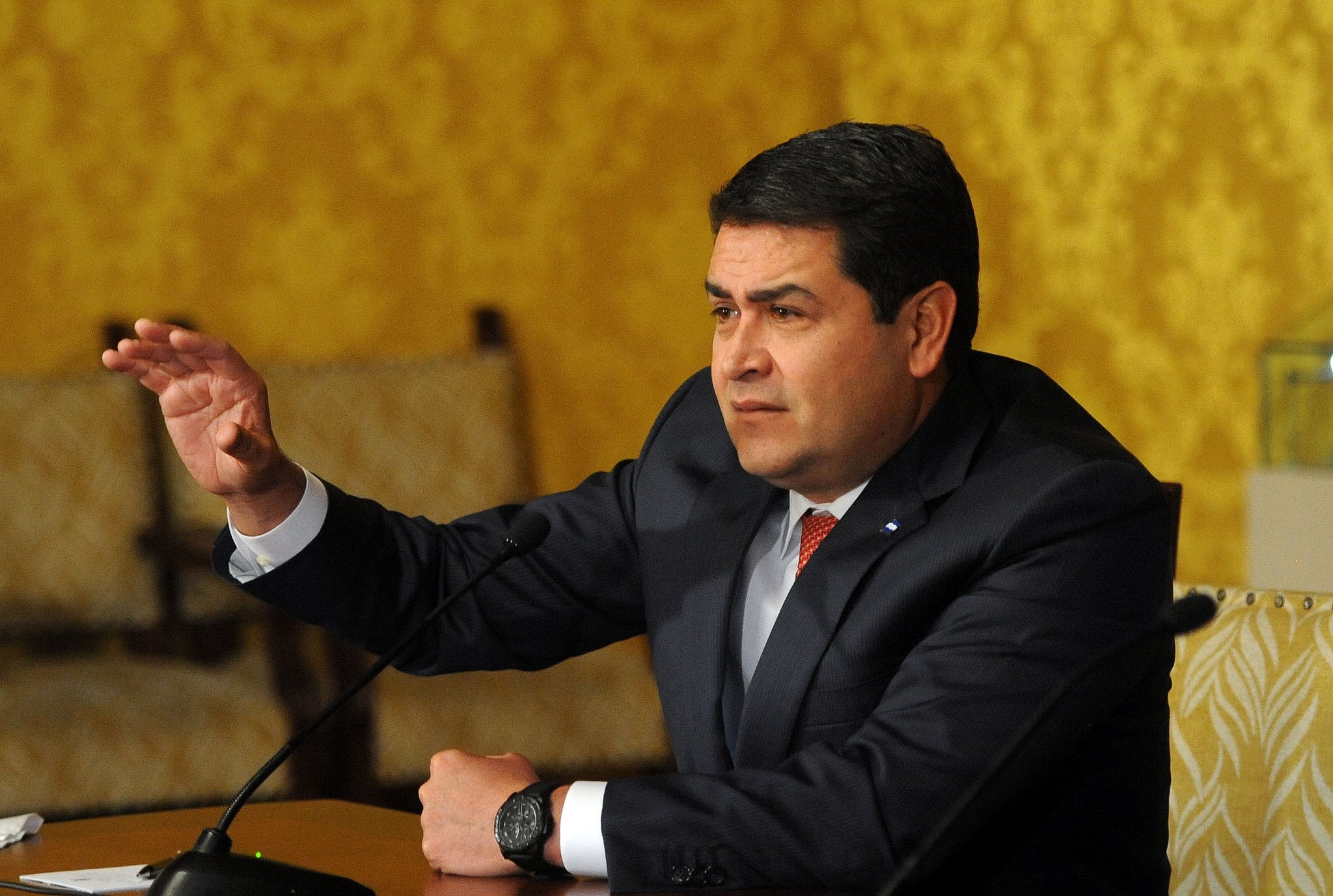
Honduran President Juan Orlando Hernandez. Photo Credit: Presidencia de la Republica del Ecuador / Flickr / Creative Commons

The decision last week by the Constitutional Chamber of the Honduran Supreme Court to legalize presidential reelection appears to have benefited a man – current President Juan Orlando Hernández – whose political fortunes got a shot in the arm from the 2009 coup that removed President Mel Zelaya for proposing a constitutional assembly to consider just such an action.  A Liberal Party magistrate said he wanted to recant his vote the next day, but the ruling party published the decision in the Gaceta Oficial before he could.  The Supreme Court, ruling in favor of petitions by former Nationalist President Rafael Callejas and several members of Hernández’s National Party, repealed two key articles of the Honduran Constitution, including one that says “the citizen who has served as the head of the executive power cannot be president or presidential candidate.”  Callejas immediately announced that he was resurrecting his Callejista movement, called MONARCA, which won him the presidency in 1990, and his campaign literature appeared in the streets of Tegucigalpa soon after.

The Court did not explicitly overturn Article 4 of the Constitution, which states that an “alternation in the exercise of the presidency of the republic is obligatory.”  That action reportedly will fall to the National Party-led Congress, but President Hernández is almost universally seen as the big winner from the Court decision, culminating his effort to continue as President.  After the coup that removed Zelaya from power, Hernández had a hand in congressional strategies to give a constitutional and legal framework – widely debunked – to Zelaya’s military ouster and later, while serving as president of the Honduran Congress and while campaigning for president, Hernández engineered the removal of four of the five justices of the constitutional chamber of the Supreme Court and replaced them with more sympathetic judges.  He subsequently had a role in selecting a replacement for the fifth, who became Attorney General – making for a court unanimously indebted to him.  (He was sworn in as national President in January 2014.)  Reacting to the court decision last week, Hernández noted that “reelection is something that is a general rule around the world … Prohibition of it is the exception … [and] Honduras has to make progress.”  His opponents have vowed to fight the repeal.  Leaders of the Partido de Libertad y Refundación (LIBRE) have accused the justices of “betrayal of the fatherland.”  One said the court “guaranteed the impunity” of the Hernández government, but the opposition’s legislative strategies have failed before.

Representing Central America’s most violent and most corrupt nation, President Hernández is seen in Washington as essential to success of U.S. policy in Central America and initiatives such as the “Alliance for Prosperity of the Northern Triangle.”  With a request for a billion dollars on its way to the U.S. Congress, the Obama administration can ill afford to point out Hernández’s hypocrisy for doing what he condemned former President Zelaya for trying to do in 2009.  Political inconveniences aside, the political cynicism and tensions that his and former President Callejas’s maneuvering will incite in violence-ravaged Honduras can hardly be seen as helpful to the goals of good governance and democratic consolidation that all profess.  When Nicaraguan President Daniel Ortega engineered a similar judgment by his Supreme Court in 2009, allowing him to run for an additional term, the State Department did not mince words about its “concern” for its implications.  Hernández, in contrast, was in Washington securing support for funding when his court announced its decision.  The U.S. Southern Command’s new task force of some 250 Marines is expected to arrive in Honduras and begin training of security forces involved in “fighting the drug traffickers.”

May 1, 2015

Bolivia’s Elections and Evo’s Surprising Political Malaise

By Robert Albro

Previous elections in La Paz. Photo credit: Pablo Andres Rivero / Flicker / CC BY-NC-ND

Previous elections in La Paz. Photo credit: Pablo Andres Rivero / Flicker / CC BY-NC-ND

Departmental and municipal elections in Bolivia last week dealt a significant setback to President Evo Morales’s party, the Movement Toward Socialism (MAS).  Benefiting from strong economic growth, broad-based support from among the country’s many social movements, and the absence of major controversy, last October Morales was elected to a third term as Bolivia’s president with an impressive 61 percent of the vote.  He is on track to be in office until 2020, making him the longest-serving leader in Bolivian history.  Last week, however, the party won just four of nine races for departmental governor and two of the races for mayor in Bolivia’s ten largest cities, reversing a trend of sustained MAS dominance since Evo’s election in 2006.  Most alarming for the MAS is that it lost across the board in the previous strongholds of La Paz and El Alto.  This unexpected outcome has touched off speculation that the MAS is running out of steam.

The MAS emerged as a national political force during the sustained social ferment of the early 2000s.  It reaped the benefits of widespread popular disenchantment with government as a movement for change and indigenous enfranchisement, and it built a successful coalition across ethnic, class, rural-urban, and to some extent, regional differences.  The MAS’s rise coincided with the collapse of the country’s established political parties.  As the only remaining national political movement, the MAS has since often identified its approach to governance as a bottom up, participatory, or popular plebiscite – a multiethnic and plurinational vision of local autonomy that it has successfully enshrined in the country’s constitution.  Addressing last week’s upset, Vice President Alvaro García Linera noted the MAS had done a poor job of cultivating new local leaders.  Evo suggested it was a “punishment vote” in response to recent corruption scandals involving MAS candidates.  Nor did Morales do his candidates any favors when he threatened not to work with opposition politicians in El Alto or La Paz if they were elected.

Despite this setback for the MAS, local opposition at the polls does not necessarily lead to national opposition.  The political opposition remains fragmented, and the MAS remains the country’s only truly national political party.  Even where it lost races for governor or mayor, in most cases the MAS enjoys a majority in the state legislatures or city councils.  However, several factors – corruption scandals, continued dependence on the extractive industries, and the party’s habit of co-opting right-wing non-masistas as candidates where it thinks they will win – point to the stubborn persistence of different national and local political realities.  When the MAS has run into problems in recent years, as with recent controversy over a plan to build a highway through the TIPNIS indigenous territory and national park, it is because it misread local political terrain, chose poor candidates, and ran afoul of regional or local autonomies.  The horizontal and plural coalition-building that has been the MAS’s hallmark can be a clunky local political instrument.  Last week highlighted that local electorates are less driven by social movement ferment, ideology, or historical change; are notably distrustful of MAS impositions from above; and are more interested in prosaic matters of good governance and candidates they know and trust. It was certainly not the beginning of the end of the MAS.  But if the national party continues to struggle in the face of diverse local political realities, it could signal for the MAS a gradual death by a thousand cuts.

April 9, 2015