The TecnoLatinas: A Start-Up Revolution

Foro de Ahorro de Energía Eléctrica, México | Photo credit: Alejandro Castro | Foter.com | CC BY-NC-SA

Foro de Ahorro de Energía Eléctrica, México | Photo credit: Alejandro Castro | Foter.com | CC BY-NC-SA

Latin America is experiencing a full-fledged start-up movement amid rapid growth of an innovation and information economy.  Over the last several years the region’s online population has grown faster than in any other part of the world – with approximately 255 million internet users as of last year.  Half of the top 10 markets worldwide, ranked by time spent on Facebook and other social media, are in Latin America.  Clusters of innovation start-ups, such as those around Monterrey, Mexico, are springing up with astonishing speed.  In 2012 Mexico was among the largest exporters of information technology services in the world.  Google is currently building a data center in Chile, while Amazon Web Services opened a data center in Sao Paolo last December.  But these are not information-era maquiladoras. Instead, Latin American entrepreneurs are combining the availability of open-source innovation tools and the emergence of cloud computing with effective bridge building in Silicon Valley to bring collaboration, expertise, and capital to their home markets.

  • Latin America offers multiple advantages for tech start-ups: a low cost of development, an educated and growing talent pool with the necessary technical and entrepreneurial skills, and increasingly available and affordable broadband and internet access.
  • In particular, Mexico, Chile, Brazil, Argentina, and Colombia, along with metropolitan areas across the region, are incentivizing the development of a competitive start-up ecosystem – an advantage attracting a growing number of “angel investors.”
  • Start-Up Chile, a national program begun in 2010 with 22 start-ups from 14 countries, offers seed capital, grants, tax protection, space, mentoring, and networking to “accelerate” promising ventures.  Its most recent competition drew 1421 applicants from 60 countries, including from Singapore, London, and San Francisco.

The lack of tech innovation and incentives for start-ups has been an Achilles’ heel of Latin American economies for decades.  If the start-up trend continues, the region could make significant, lasting progress toward narrowing the sizable gap between itself and the most dynamic developing countries, mostly in Asia.  Latin America’s start-up movement is both top-down and bottom-up, with a tech-savvy generation of entrepreneurs not afraid to take risks and to leverage government support, as part of a collaborative business model built on multiple ties to Silicon Valley.  A core challenge will be whether these initiatives are scalable, and whether governments can move away from stale policy debates rooted in antiquated paradigms to move their economies toward the frontiers of innovation of the information age.  Old elites with a lock on traditional industries are poorly positioned to obstruct the phenomenon, but if these emerging innovation hubs are to succeed, at some point they are likely to confront  the entrenched and oligopolistic business practices still prevalent in the region’s energy, telecom, and other sectors.

Venezuela: A New Start?

By Fulton Armstrong and Eric Hershberg

Memorial for Hugo Chavez | by Steve Rhodes | Flickr | Creative Commons

Memorial for Hugo Chavez | by Steve Rhodes | Flickr | Creative Commons

The death of President Hugo Chávez yesterday, as has been duly noted, marks the beginning of a new era – new opportunities and new challenges – for Venezuela.  In view of the country’s history and institutional weaknesses through the 1990s, some of the convulsions of his 13 years in power may have been inevitable, but the need is now compelling, across the political spectrum, to take a sober look at the future, set aside some of the stalemated grudge matches, and get serious about becoming something better.

It’s easy to predict at least some short-term instability, bombastic rhetoric, and jejune nationalism, such as some fringe Chavistas’ allegation that the United States was responsible for Chávez’s death.  It’s harder for Venezuelans and outsiders alike to figure out how this country, hindered by the original sins that plague all rentier economies, learns how to do politics in a transparent, inclusive manner.  For analysts like us, the key thing is to set aside wishful thinking and keep our eye on the fundamental drivers of change.  Some thoughts:

  • For better or worse, Chávez had an impact that – if not as transcendental as he wished – dismantled the key institutional pillars of the sclerotic Venezuelan political system.  Beyond that, his legacy includes the profound and intentional division of Venezuelan society and politics into two camps – a tense split that did not exist (or was sublimated) 20 years ago and will take a long time to heal, as has the cleavage around Peronism in Argentina.  Like Peronism, over time chavismo need not necessarily have a standard left-right quality, and it is likely to retain a cult around Chávez’s persona, larger in death than in life.  Evita a la venezolana.
  • Chávez wasn’t the regional or global threat that the Bush Administration made him out to be, but he did open space for a particular species of Latin American populism – call it radical, “socialist,” or clientelist – that coincided with a broader U.S. withdrawal from Latin America.  Few observers could have imagined that this former military colonel – a failed putschist – could capitalize on the region’s crisis of representation and development to bring about the emergence and prosperity of the ALBA coalition and the identities it fostered.  The lifeline of petro-dollars that Chavez opened, a tool that, it is often forgotten, had been deployed by previous Venezuelan governments to gain outsize presence on the international stage, explains some of his influence, but his forceful personality and the siren song of his peculiar Bolivarian ideology multiplied his impact.  His model was not replicated elsewhere, but his fervent regional pride was.
  • Chavez’s successors, of any political stripe, will test Washington’s capacity to keep its hands off.  Venezuela – even the opposition – has changed, and United States policymakers will hear rhetoric and see things, such as a relationship with Cuba that’s likely both to shape and to survive both countries’ transitions, that will test their self-discipline.  Chávez is gone, and chavismo, though certain to endure, will inevitably change.  But Venezuela’s need for space – space granted by its neighbors and the United States – to grow and even make mistakes remains a constant.  Over the 15 years in which Chávez dominated the scene, from his first election in 1998, Washington sometimes resisted the temptation to play into the game, but more than occasionally took the bait.  Washington has often misread Latin America and, by endorsing the 2002 coup against Chávez and other actions, actually strengthened the Venezuelan president domestically and regionally.  Chávez’s passing presents an opportunity for a fresh start for the United States, too.

Correa’s Second Term

By Rob Albro, CLALS Faculty Affiliate

President Rafael Correa, Ecuador | by: "el quinto infierno" | Flickr | Creative Commons

President Rafael Correa, Ecuador | by: “el quinto infierno” | Flickr | Creative Commons

Little drama accompanied results of the February 17 election in Ecuador, where center-left incumbent Rafael Correa retained the presidency by a wide margin. Correa enjoys the highest approval rating – nearly 80% late last year – of any Latin American head of state. He will be the first Ecuadoran president to complete his term since 1996, and his resounding victory at the polls will in principle keep him in office until 2017. Most pre-election polls had projected Correa to win decisively, and he did just that with 56.7% of the popular vote. The opposition is fractured, with seven different candidates running against him. His nearest rival, banker Guillermo Lasso, garnered only 23.3% of the vote. A testament to Correa’s dominance is that the right-leaning Lasso offered a vision little different from the president’s own policies and even adopted key elements of Correa’s discourse. The title of Lasso’s recent book, Another Ecuador is Possible, references the World Social Forum.

Correa’s political base was consolidated during the anti-neoliberal protests of 2005, and his “citizen’s revolution” represents an unorthodox combination of nationalist populism, robust social welfare spending and rhetorical flourishes in defense of Ecuador’s national sovereignty. Correa’s social spending – increasing the health budget, minimum wage, pensions, and access to medical care; offering micro-credit and free school lunches; providing new housing and anti-poverty subsidies –is highly popular, especially with the urban poor. These programs, dependent upon a commodity-led export strategy, have enabled Correa to marginalize once important political actors of the left and right. Organized labor and indigenous movements on the left, like economic and media elites on the right, have picked fights with Correa, objecting to his authoritarian style, attacks on the press, petroleum policies in the Amazon, poor record on crime, and outbursts directed toward foreign investors. But this has made little dent in his popularity.

If Correa is certain to face resistance to his agenda in his new term, the political fragmentation and lack of dramatic choices evident during the campaign suggest that it will not necessarily be effective.  Despite potential fiscal headwinds, redistributive social welfare policies are likely to continue to expand. Questions do remain: regular social investment has been enabled by ramping up an extraction-based economy dependent on oil, which has also generated some social conflict.  But there is mounting evidence that aside from being popular these policies are also measurably successful. Ecuador’s election comes on the heels of Venezuela’s, where opposition candidates also found it necessary to tout redistributive policies. If the economy turns south, a splintered opposition might find common cause. But as in a number of other South American countries, the redistributive politics of an incipient social welfare state will inform the agenda of Correa’s eventual successor. The long-term management of these policies, and whether the President will seek to alter the Constitution to permit indefinite re-election, are matters that could prove vexing during the coming years.

Central American Elites Are Evolving But Cling to Power

From left to right: Manuel Torres, Ricardo Barrientos, Hugo Noé Pino, Aaron Schneider and Elizabeth Oglesby participating in the project seminar in Costa Rica

From left to right: Manuel Torres, Ricardo Barrientos, Hugo Noé Pino, Aaron Schneider and Elizabeth Oglesby participating in the project seminar in Costa Rica

The sources of Central American elites’ wealth are evolving, as are their fundamental interests and the ways they wield political power.  Land‑intensive production – the focus of decades of insightful scholarship – continues to prevail in Guatemala and Honduras, but the economically powerful now maintain their position through a growing array of service-sector activities and by capturing rents from public coffers.  Changes in their economic foundations are but one of several transformative processes that swept the region beginning during the 1980s, making the past three decades a period of fundamental rupture with the past.

  • Civil wars in El Salvador, Guatemala and Nicaragua during the 1980s transformed the economies in all three countries and had spillover effects in Costa Rica and Honduras.  Most striking is the case of El Salvador, where elites abandoned the countryside upon which they had depended from time immemorial, never to return.
  • Structural adjustment programs, implemented throughout the region during the 1990s, changed the role of the state in Central American economies and thus the ways in which the public sector intersected with the elites’ wealth-accumulation strategies.  Hasty and corruption-ridden privatizations, in particular of energy and telecommunications and of an array of public services, created a reformist façade but gave private-sector groups a piñata that helped to ensure uninterrupted enrichment.
  • During that same decade, transitions to electoral democracy contributed to elite reliance – albeit with some important exceptions – on political parties, campaign strategies and legislative lobbying to protect their interests.  Ties to military and death squad enforcers are no longer the principal vehicles for the enforcement of elite imperatives, though Honduras today is increasingly reminiscent of the worst times in Guatemala and El Salvador.

Central America’s elites have yet to offer the region a vision of reform that will enable the isthmus to overcome misery, exploitation and predatory rule.  While dominant groups have embarked on aggressive state-building strategies, experts question whether these are producing the virtuous dynamics that advance the general welfare of the population and ensure effective governance. 

Scholars from across Central America have reached these conclusions through research and seminars under a multi-year AU program on Central American elites and power.  To foster better understanding of the shifting landscape in the region, and thus to illuminate plausible paths toward more equitable distribution of power and resources, the Ford Foundation is supporting this effort, undertaken in partnership with more than two dozen researchers from institutions throughout the isthmus and the United States.  The project was the focus of a recent workshop at FLACSO Costa Rica, and several publications will result over the course of 2013 and 2014.  Click here for more information.

Cuba: Change in the Wind

Three American University professors recently traveled to Cuba for research and discussions on Cuba’s reform process – called “Updating Socialism” – and the island’s relations with the United States.  Today’s entry looks at the economic changes.

Photo by: Globovisión | Flickr | Creative Commons

Photo by: Globovisión | Flickr | Creative Commons

In offices, shops and on the street in Havana, “change” seems to be one of the most commonly used words.  Billboards proclaim “The changes in Cuba are for more socialism” and “Updating socialism is the answer.”  But the words “reform” and – in some conversations – “privatization” pop up with significant frequency.  Party members previously reluctant to talk about change now speak of introducing “elements of capitalism” to make Cuba a “mixed economy” patterned closely after the “Vietnam model,” with its economic loosening but one-party rule.  Previous reforms have brought better, if sometimes expensive, food to many Cuban dinner tables, but the strong consensus in and outside the party is that a lot more needs to be done.

  • The law-decree on “non-agricultural cooperatives” provides a politically correct way ahead for the formation of small and medium private enterprises.  Cuentapropistas were given a prominent place in the May Day parade, and some are being nominated for office on the Communist Party slate.
  • The government is making another run at tearing down the barriers between hard-currency and peso purchases, with an eye to unifying the currency in the future.  Price tags at at least one major Havana store list prices in both convertible and national currency, at a 23-to-one conversion rate.
  • The law already allows Cubans to hire workers – a right previously given only to the state – and a draft labor law will further legalize private workers’ activities and integrate them into the economy.
  • Some 200-plus state enterprises are being put on a sink-or-swim program in which new management selected by the workers will be given a year to transform the firms into businesses closely resembling private cooperatives.
  • In January, the National Assembly will take up amendments to foreign investment laws.  Under consideration are direct foreign sales to non-state cooperatives and the direct hiring, firing, and paying of Cuban workers by foreign companies.
  • The travel reform law that goes into effect on January 14, ending the necessity for an exit visa and removing restraints on most Cubans from obtaining a passport, will also stimulate interaction with foreign countries.

The macro situation is still a mess, and the reforms have a long way to go to attain even the level of Vietnam’s prosperity.  Cuban stores sell Vietnamese cookies, not vice versa.  As the rhetoric indicates, the government – long expert at managing popular expectations – continues to emphasize continuity as the changes proceed.  But while no one is expecting a fast shift to capitalism, many middle-aged and elderly Cubans have a renewed sense of hope that life ahead will be better, which has political benefits and risks for the government.  One thing for sure is that the socialism that is being “updated” is a far cry from the communism that Cuba attempted in the 60s, 70s and 80s.

Cumbritis and Prospects for Latin American Regionalism

By Carlos Portales
Washington College of Law and Center for Latin American and Latino Studies

UNASUR Cumbre by  Globovisión | Flickr | Creative Commons

UNASUR Cumbre by Globovisión | Flickr | Creative Commons

Latin America has experienced a veritable proliferation of presidential summits (cumbres) in recent years, an indication of how the hemisphere’s complex web of regional ties is shuffling the landscape of multilateral organizations. This trend was manifested in the Nov. 16-17 Iberoamerican Summit in Cadiz, Spain, followed in quick succession by summits for UNASUR on Nov. 30 and MERCOSUR on Dec. 7. The New Year will witness two summits in Santiago, Chile, the first between the European Union and Latin American and Caribbean States, the second among Latin American and Caribbean States (CELAC).  While sometimes useful in isolation, the cumulative impact of these meetings may be less than the sum of its parts. Indeed, the region may be suffering a bout of cumbritis that is as distortive as it is productive.

The Cadiz summit reflected Spanish determination to sustain an Ibero-American bloc amidst its own profound crisis. Spain’s investments in Ibero-America, particularly in banking and telecommunications, are keeping alive important sectors of the Spanish economy. When the VI UNASUR Summit met in Lima two weeks later, the Presidents of Argentina, Brazil, Venezuela and suspended Paraguay were all absent. Still, the meeting reaffirmed UNASUR’s role in political and military matters: UNASUR was active in the crisis in Paraguay, sent its first-ever electoral mission to Venezuela, the South American Defense Council provides coordination in defense industries and natural disaster responses, and aspires to support protection of human rights.

The following week in Brasilia, MERCOSUR formally incorporated Venezuela and signed an adhesion protocol with Bolivia. However, as Tom Long wrote in “Mercosur’s future: Whither economics?” on Dec. 18, MERCOSUR’s expanding breadth masks a lack of depth. The trade bloc has not agreed on a common external tariff, and integration has stalled as Argentina and Brazil adopted unilateral protectionist measures both during and after the global financial crisis. Though its market is growing, MERCOSUR’s ability to negotiate with third parties is limited. The countries most interested in boosting trade have split off on their own under the loose Pacific Alliance (PA), whose Presidents met on the sidelines during the Cadiz summit. Chile, Colombia, Mexico and Peru have set high targets for the reduction of customs duties and plan on reducing visa requirements for their citizens while already having FTAs with the US and Europe.  Chile and Peru have reached similar accords with China and other main Asian countries. However, the Alliance is primarily an informal gathering of free-trade-minded presidents, and so far institutionalization is minimal.

Brazil is leading South America-centered institutions (UNASUR and MERCOSUR) when it perceives that these suit its interests; The Venezuela-led ALBA has lost steam due in part to President Chavez’s illness; the PA process remains low-key and trade centered. Meanwhile, the Organization of American States risks irrelevance. Its robust human rights system has come under attack from ALBA countries and others, while four ranking members of the U.S. Senate Foreign Relations Committee have lambasted its leadership publically. The OAS may not be unsalvageable, and it remains potentially useful, though that potential will only be realized if the United States endeavors to support rather than undermine its efforts.

And Summits alone will not ensure the success of any of these multilateral forums: increasingly ubiquitous conversations among presidents can be effective for defusing immediate crises and for establishing guidelines for cooperation, but their long-term impact on policy coordination will be limited if they are not matched by analogous cross-national dialogue among key government ministries. The symptoms of chronic cumbritis lie in the failure of many presidential declarations to result in concrete advances in cooperation.

Mercosur’s Future: Whither Economics?

By Tom Long

Mercosur’s December 6 meeting in Brasilia might seem to be a watershed. The organization formally integrated Venezuela and signed adhesion agreements with Bolivia. Ecuadorean President Rafael Correa was in attendance, too, along with officials from other South American countries. The bloc was established starting in 1991, with goals of removing internal tariffs, setting a common external tariff, coordinating commercial policies, and harmonizing regulations. An unwritten objective was to spur industrialization and decrease dependence on foreign manufactures. Yet more than twenty years on, Mercosur appears to be further than ever from establishing a common market. The Inter-American Development Bank notes that Brazil and Argentina have traded protectionist measures, and that “Buy Brazil” provisions in government procurement have been a bilateral irritant.

Mercosur

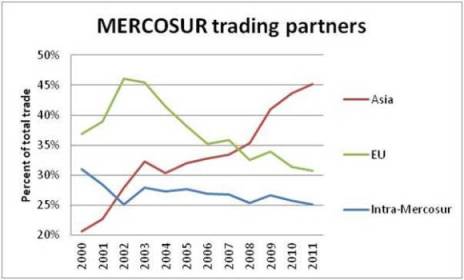
Expanding breadth masks decreasing depth. While both Mercosur’s total trade and trade among its members have grown greatly over the past decade, the former has outpaced the later.  WTO data show that intra-regional trade as a percentage of total trade has declined from 31 percent in 2000 to 25 percent in 2011. Instead of being driven by integration, MERCOSUR’s trade patterns are propelled by skyrocketing trade with Asia, led by Argentine and Brazilian commodity exports. In this light, the failure of late October meetings between Mercosur and the European Union suggest that China has taken the place of Europe.

Evaluated from a strictly economic perspective, Mercosur’s recent expansion represents a step backwards. The inclusion of Bolivia will not add much economic heft to the pact, and with the addition of each new member, reaching consensus will become even more difficult. The full membership of Venezuela increases the bloc’s size, but also its dependence on natural-resource exports. Neither newcomer—nor the two original heavyweights—appear committed to the original common market mission. Is the bloc’s raison d’etre shifting from the economic to the political? If so, what will be Mercosur’s relation to ALBA and UNASUR? Whereas Brazil was never fully comfortable with the Bolivarian Alliance—in part because of the anti-U.S. tone—it has now brought ALBA’s two most committed members to its own table. Inside Mercosur, Brazil has a greater voice than it does in UNASUR, but the hijacking of a potentially important trade alliance masks a lack of economic leadership for South America.

Brazil’s Protest: If You Get QE3, We Get Tariffs

Photo by “SqueakyMarmot” | Flickr | Creative Commons

For two years Brazilian voices have complained that U.S. policies of near-zero interest rates and “quantitative easing” have been damaging its economy.  Lax monetary policies in the U.S. and Japan are blamed for the high valuation of the Brazilian real, which further suppresses Brazil’s  languishing manufacturing sector.  Tensions escalated following the September 2012 announcement of the U.S. Federal Reserve’s third round of quantitative easing.  Now the debate has spilled over into discussions about Brazilian restrictions on trade.  As Finance Minister Guido Mantega warns of a “currency exchange war,” Brazil is increasing tariffs on U.S. goods and foresees the imposition of taxes on inflows of foreign capital, which further inflate the Real.  Writing in Folha de São Paulo, Luiz Carlos Bresser-Pereira argues that Brazil is acting in self-defense.  The tariffs Brazil is contemplating are by his account not protectionist but simply an effort to compensate for the unfair advantage that the U.S. seeks to achieve through its monetary policy.

The tension is spreading beyond Brazil, as currency appreciation is portrayed as a drag on manufacturing in much of South America.   In an interview with CNN, Chilean President Sebastián Piñera criticized “QE3,” asserting that “printing money” would not solve U.S. economic woes.  So far, Andean countries are responding by purchasing dollars and cautiously reducing interest rates, but the Brazilians, in particular, present protectionist measures as counter-cyclical tools of their own, necessitated by American attempts to “drive down” the dollar.

The Brazilian and South American claims may be overdrawn somewhat; many experts believe that overvaluation is primarily a consequence of Chinese demand for South American commodities and the decision by most Latin American countries to maintain high interest rates in order to forestall inflation.  But U.S. policies meant to boost job growth are indeed having unintended consequences in the hemisphere.  There has been little thought in the United States of the external implications of Fed policy—beyond a belief that a reinvigorated U.S. economy would be good news for everyone.  Brazil has been the first, and most vocal, challenger of a stance that always frowns on tariffs while presenting monetary policy as a purely domestic matter.  It is a bit much for Brazilians to expect that U.S. monetary policy should be crafted with an eye to its impact on the region, particularly when conventional fiscal policy measures are thwarted by Congressional dysfunction, but Washington should not be surprised when efforts to tamp down its currency – not unlike Chinese policies that Washington condemns  – are seen abroad as aggressive threats to competition.

Mexico: Expecting More of the Same

This is the first of a series of entries examining how the U.S. presidential campaign is being viewed in different Latin American countries.

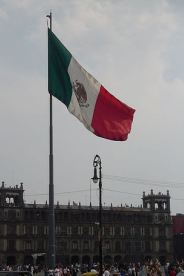
Photo: Zocalo, Mexico City | Luis Lobo Borobia (“Cromo”) | Flickr | Creative Commons

A survey of Mexican media indicates that, despite the considerable attention the U.S. presidential campaign is getting, few Mexicans expect the November election to result in significant shifts in bilateral relations.  Unlike in U.S. coverage of Mexico’s recent presidential contest, the Mexican press has not focused on bilateral drug cooperation.  Some commentators have stated general preferences.  “For the economy, demography, and proximity, a second term for Barack Obama would be good for Mexico,” wrote Enriqueta Cabrera in El Universal.  But most opinionmakers appear focused on particular issues.

There is a broad recognition in Mexico that the campaign is primarily about the U.S. economy, and the potential impact of continued stagnation has driven wide coverage.  The Mexican media are also tracking the candidates’ immigration policies.  President Obama’s executive order to halt deportation of young people who would be eligible for legal status under the long-stalled DREAM Act helped his image in the Mexican press.  The coverage of Republicans has been harsher, with El Universal saying that immigration has been “the taboo topic” for the GOP and that Governor Romney had “forgotten” about Hispanics.  The role of Latinos in the campaigns has drawn attention, mostly positively for the Democrats.

The Mexican media’s treatment of the campaign – and assumption that relations will not change much – reflects the fact that neither American candidate has brought new ideas to the table in one of the United States’ most important bilateral relationships.  On drug policy, bloody continuity seems far likelier than change, regardless of who wins in November.  Although Romney has tipped his hat – as Obama has – to the need to reduce U.S. consumption of narcotics, his main message is “to help Mexico as we did Colombia, with intelligence and surveillance.”  The greater variable is on the Mexican side, where new President Enrique Peña Nieto’s promise to refocus the drug fight on citizen security – instead of cartel interdiction – has drawn criticism from some in the United States.  Allegations that the “old PRI,” tolerant of the drug trade, is back are not far behind and could poison the relationship.

Fiscal Policies Worsen Security Crisis in Central America

From left to right: Aaron Schneider, Maynor Cabrera and Hugo Noe Pino at the June 5 event on Central American fiscal policy.

Economists are warning that Central America – unlike some South American countries and Mexico – has still not rebounded from the 2007 global economic crisis, and that current fiscal policies dim prospects for improvement.  After making progress reducing poverty prior to 2007, the subregion has been stymied by static tax policies, insufficient investment in physical infrastructure, corruption, and natural disasters induced by climate change.  This is the assessment of Hugo Noe Pino, Ricardo Barrientos and Maynor Cabrera, economists from the Central American Institute on Fiscal Studies (ICEFI), and Aaron Schneider, Professor of Tulane University, who presented their work at a CLALS-sponsored seminar at the Woodrow Wilson Center on June 5.

The specialists’ research indicated that political resistance to fiscal reform is strong and comes from both new and traditional political and economic interests.  Elites have not found common ground with the middle and lower class in most of Central America – a key element of Costa Rica’s success prior to the financial crisis.  Absent an enduring fiscal pact, countries in the region are likely to remain plagued by persistently slow growth and unusually skewed income distribution.

Violence and security dominate Washington’s agenda on Central America, but this focus largely misses the underlying dynamic between economic decline and crime throughout the subregion.  Elites favor policies that discourage effective state‑building – including investment in security forces paid well enough that they are less vulnerable to corruption – and that exacerbate social inequalities.  Political fragmentation and low citizen confidence in government institutions have dire consequences for national security, and countries get caught in the Catch‑22 of being unable to attract investment from abroad and encourage development from within as long as fiscal policies fail to promote an educated, healthy and skilled workforce.

CLALS currently has a program investigating how traditional, renewed and emerging elites shape the political and economic landscape of Central America.  For more information click here.  And click here for a video of the ICEFI presentation and discussion at the Woodrow Wilson Center.