Honduras: No Solution in Sight

Photo Credit: OAS / Flickr / Creative Commons

Photo Credit: OAS / Flickr / Creative Commons

CLALS and the Inter-American Dialogue this week hosted a conversation on the crisis in Honduras with experts Hugo Noé Pino, of the Instituto Centroamericano de Estudios Fiscales, and Carlos Ponce, of Freedom House, and about a dozen of some 80 participants spoke up.  The following are key analytical points that were broadly accepted during the 90-minute session.

Honduras is experiencing a multi-faceted crisis – economic, political, judicial, and security– that has grown steadily worse since the 2009 coup and shows no sign of abating.

  • Economic growth (1.5 percent per capita) is too low to alleviate the country’s severe employment problem (affecting half of the working-age population) and poverty (62 percent). Recent polls indicate that some 63 percent of all Hondurans would leave the country if they could.

Violence, corruption scandals, and the steady weakening of institutions dim prospects for a turnaround.

  • The over-concentration of power in the Executive, the remilitarization of law-enforcement and other security services, and the politicization of the judiciary have undermined what democratic foundation Honduras had built since the last military government stepped down in 1980. The economic and political elites, as well as the media they control, have further stifled political discourse.
  • The Sala Constitucional of the Supreme Court and the National Electoral Tribunal have been stacked to tightly control preparations for elections scheduled for November 2017, apparently with the intention of ensuring the reelection of President Juan Orlando Hernández.

The Honduran political class lacks the will to root out corruption, and is united in resisting developing the capacity and programs to do so.

  • The embezzlement of more than $300 million from the Social Security Institute – funneling part of these funds to the ruling National Party and a variety of fronts – led to the flight of the investigating fiscal (who left the country because of death threats to himself and his family) but little else. Indeed, the most significant law-enforcement actions, such as the indictment of members of the Rosenthal family on money-laundering charges, have come from the United States. Some 80 percent of crimes in Honduras go uninvestigated and unpunished; some reports put the figure as high as 96-98 percent.
  • A Comisión Internacional Contra la Impunidad en Honduras (CICIH), adapted from the successful CICIG model in Guatemala, would be a healthy way of addressing ongoing impunity while building investigative and prosecutorial institutions. The economic and political elites solidly oppose it.  Even if Honduras accepted a CICIH, alone it probably would not be a silver bullet.
  • The OAS’s planned “Mission to Support the Fight Against Corruption and Impunity in Honduras” (MACCIH) – announced in late September jointly with Honduran President Juan Orlando Hernandez – shows little promise of success. Its mandate will be to diagnose problems and write reports, not take action or facilitate a serious, inclusive national dialogue.

Opposition to the current Honduran government is strong and growing, but it has not yet institutionalized.

  • Peaceful marches organized by the Indignados and other organizations have mobilized tens of thousands of citizens outraged by government corruption and its inability to provide even basic citizen security. Among the masses have been an unprecedented number of middle-class and upper-middle-class persons – not seen during previous crises.
  • Opposition groups are still struggling, however, to coalesce into a viable, institutionalized political force. Sustaining effective leadership and overcoming pressure from the government and Honduras’s two traditional parties are difficult challenges for them.

There are no magic or quick solutions to the crisis.

  • Any solution would have many moving parts, including recognition by elites that their own assets are threatened by the deepening chaos. The government will have to be held accountable for corruption.  The judiciary will have to be strengthened and made independent.  The military will have to return to the barracks.  The media will have to be professionalized.  Civil society will have to be empowered.
  • The U.S.-sponsored “Alliance for Prosperity” is unlikely to help Honduras – and could make things worse if it doesn’t challenge the status quo. Honduran observers believe that the $250-plus million dollars from the program should focus on deep change – the product of a broad national dialogue – and should be conditioned on deep reforms, rather than working with just the sitting government, which has shown no willingness to reform.
  • U.S. cooperation in counternarcotics and other security operations might in some cases expose partnered services to U.S. respect for human rights and democratic institutions, but the resources transferred in the process also serve to strengthen them and make them more independent of civilian authority.

October 15, 2015

* Correction: The first sentence of the article originally stated “CLALS and the Inter-American Dialogue this week hosted a conversation on the crisis in Honduras with experts Hugo Noé Pino, of the Instituto Centroamericano de Estudios Fiscales, and Carlos Ponce, of Freedom House, and a dozen speakers from among over 80 participants.” It was edited to clarify that “about a dozen of some 80 participants spoke up.”

A Post-Correa Ecuador?

By Catherine Conaghan*

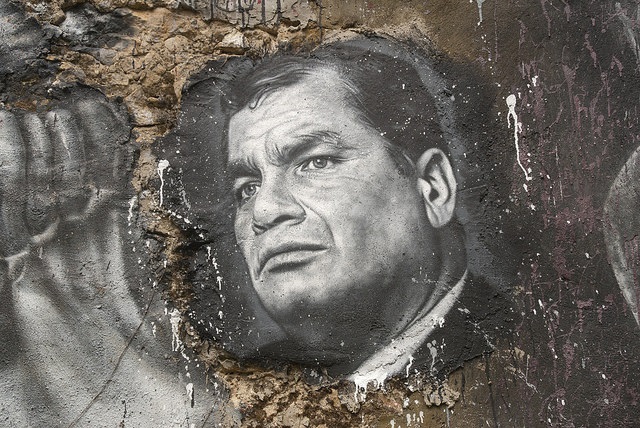
Photo Credit: Thierry Ehrmann / Flickr / Creative Commons

Photo Credit: Thierry Ehrmann / Flickr / Creative Commons

What seemed like a certainty less than a year ago – Ecuadorian President Rafael Correa as a shoo-in for reelection in 2017 – now has given way to competing scenarios as the country’s economic crisis deepens.  The game-changer has been the collapse in revenues from Ecuador’s principal export: petroleum.  With prices for Ecuadorian crude hovering 50 percent below their 2014 average, Correa has had little choice but to slash the abundant government spending that has been the hallmark of his presidency.  Ecuador’s use of the U.S. dollar greatly handicaps its capacity to adjust.  Further aggravating the recession is the economic downturn of Ecuador’s principal external lender, China.  Over $2 billion have been cut from the 2015 budget, and plans to shrink the size of the public bureaucracy are now under way.  His decision in April to suspend the central government’s obligatory payments to the national social security system stoked anxiety about the fund’s future, and an announcement in June of plans to hike taxes on inheritance and real estate transactions sparked street demonstrations around the country.  Indigenous and labor organizations mobilized in mid-August to protest these and other aspects of Correa’s style of governing.  An estimated crowd of 100,000 people marched in Quito.  Scores of protestors were detained and face charges related to the August mobilizations.

The months ahead will not be easy for a president accustomed to buoyant budgets and strong polls.  As one of Latin America’s left-turn leaders, he pushed a state-centric economic model under which poverty declined and the middle class grew.  His approval ratings since he took office in 2007 consistently scored among the highest of any Latin American president.  (They dipped below 50 percent – as low as 42 percent – for the first time in 2015.)  While Correa waxes and wanes on whether he really will pursue reelection, his party is pushing to amend the Constitution through legislation – without a referendum supported by over 80 percent of the public – to allow him a third term.  The opposition strenuously opposes the move.  The National Assembly appears headed toward a final vote on the matter in December.

From now until December, the reelection maneuvering and two possible outcomes will dominate conversations.  Under one scenario, Correa and Alianza País will push ahead with the amendment, ignoring negative public reaction and repressing protests if necessary, and Correa will decide on his candidacy depending on his view of the economy and the state of the opposition.  In a second and perhaps less likely scenario, Correa and his party may just abandon the reelection plan, concluding that the political costs are just too high.  This would set off power struggles within Alianza País over who would head the ticket.  Among the prospective frontrunners are former Vice President Lenín Moreno, current Vice President Jorge Glas, Production Minister (and former Ambassador to the United States) Nathalie Cely, and former Industry Minister-turned-critic Ramiro González.  In the process, Correa will be looking to anoint someone loyal and capable of governing the country until he can return as a candidate in 2021.  Under both of these scenarios, Ecuador is bracing for a volatile year ahead.  Natural disasters – a possible volcanic eruption of Mount Cotopaxi and El Niño – could also fuel uncertainty, giving Correa a chance to shine and rally, or to fail and deepen doubts about his leadership.  After eight years of relative political stability and economic good times, Ecuadorians are pondering whether a post-Correa era could be at hand and what it would mean.

September 8, 2015

* Catherine Conaghan is the Sir Edward Peacock Professor of Latin American Politics at Canada’s Queen’s University and a former CLALS Research Fellow.

Dilma – and Brazil – in Crisis

By Eric Hershberg

Photo Credit: Ministério da Ciência, Tecnologia e Inovação / Flickr / Creative Commons

Photo Credit: Ministério da Ciência, Tecnologia e Inovação / Flickr / Creative Commons

Brazil’s corruption scandals and deepening recession have raised doubts about not only the viability of President Dilma Rouseff’s government, but also about the national renaissance and global role that Brazilians have long strived for and seemed only recently to have achieved.  The commodity boom of the past decade propelled Brazil to become the world’s sixth largest economy and make major inroads against its historically obscene levels of poverty and inequality.  Often working in tandem, Brazil’s leading public and private enterprises, assisted by the generous state development bank, prospered immensely and fueled growth in Brazil itself and elsewhere in Latin America, building infrastructure from Ecuador to Cuba.  Four Partido dos Trabalhadores (PT) presidential victories in a row (two each for President Lula da Silva and for Dilma) appeared to validate a development strategy built upon government alliances with ambitious large firms and generous cash-transfer programs for needy segments of the population, which became reliable sources of electoral support.  Brazil, the country that skeptics considered unlikely to ever fulfill its aspiration of becoming more than “the country of the future,” seemed to have turned a historic corner – until it all came crashing down.

With the commodity boom now over, the economy is contracting at an annual rate of more than 2 percent, and a Central Bank survey released last week forecast that the recession will continue into 2016.  The past decade’s extraordinary gains in formal sector employment and wage rates are being rapidly eroded.  The dire macro-economic situation forced Dilma to shift course earlier this year, when to the dismay of her PT base, she appointed pro-austerity economist Joaquim Levy as Finance Minister.  His mandate – to tackle fiscal deficits – required dealing with the end of the commodity-driven cycle of growth and problems with the state capitalist model pursued by the PT since 2004.  Levy’s strategy will take time to bear fruit, probably through most of Dilma’s term, and will be painful.

But the President’s biggest challenges stem from the vast corruption scandals that have devastated her credibility and the reputation of the enormous companies that were the protagonists of Brazil’s latest miracle.  Although Dilma has not been charged with any wrongdoing, the scandalous actions at state oil firm Petrobras, which at its height accounted for as much as 10 percent of Brazil’s GDP, were in full flourish when she was Lula’s Energy Minister and nominally in charge.  Prosecutors have filed evidence of bribery and kickback schemes that bilked billions of dollars from the company’s coffers, and officials in both the PT and allied parties have been charged with serious crimes.  Dilma’s popularity ratings are now in single digits, with little prospect of improvement.  Street protests calling for her impeachment are more focused than those that tormented her in 2013 and 2014, when popular discontent focused less on corruption than on the poor quality of transportation, education, health care, and other public services at a time when the government was making huge investments to prepare for the 2014 World Cup and the 2016 Olympic games.

Further damaging revelations are likely as investigations continue, and they will affect an ever-wider array of political actors and major economic enterprises.  Many of the president’s political foes support either impeachment or resignation, while others are inclined to let her government wither in place.  The key alternative parties – the PSDB of former President Cardoso and the PMDB (the latter rumored to be closer than ever to breaking its tenuous alliance with the President) – are not aligned in a way that establishes a clear path to push Dilma out.  The most optimistic scenario for the President entails remaining, terribly wounded, in office, but this could change if, as many observers believe, the Auditing Court (TCU) determines that Dilma has misused public funds, or if the TSE should press forward with investigations of illegal financing of Dilma’s campaign.  

If two or three years ago it seemed plausible that history would credit the PT for having transformed Brazil into a high-quality democracy with improved social inclusion, today that appears to have been a pipe dream.  Beyond the immediate factor of Dilma’s ineffectual leadership, there are broader, systemic reasons for this tragedy.  Brazil’s fractured party system and the coalition-building it requires engenders corruption-fueled legislative bargaining, as evidenced by the Mensalão scandal.  Brazilian state capitalism has blurred lines between state economic policies and corporate beneficiaries, further fueling a culture of corruption evident by the fact that roughly 40 percent of members of Congress are under investigation, according to the New York Times.  Regardless of whether Dilma survives in office, the current moment has drawn Brazilians’ attention to the deep political and economic roots of their current situation, and dashed their hopes of soon becoming “O País do Futuro.” 

August 24, 2015 

Remittances and Sustainable Community Development in Latin America

By Aaron T. Bell and Eric Hershberg

Photo Credit: Futureatlas.com / Flickr / Creative Commons

Photo Credit: Futureatlas.com / Flickr / Creative Commons

Remittances to Latin America hit a record high in 2014 at $65.3 billion, according to the Multilateral Investment Fund of the Inter-American Development Bank, but their impact on development would be much greater with better coordination between sending  and recipient communities.  Mexico receives over one third of those funds, but remittances represent a significant component of GDP for many countries across the region.  The bulk comes from the United States, where 54 million Hispanics include 19 million first-generation immigrants, according to 2013 U.S. census figures.  In several Central American and Caribbean countries, funds sent home by migrants represent the largest single source of foreign exchange.

  • Remittances alleviate poverty by contributing to household income, helping to satisfy basic consumption needs, and sometimes enabling savings and investments in education.
  • Groups of migrants from particular communities sometimes pool resources through hometown associations to support shared objectives back home. A paved road or a new soccer field affects quality of life in tangible ways, and émigré financing of local political campaigns can determine the results of elections for mayors and other officials.
  • But remittances seldom promote local economic development initiatives that will generate sustainable incomes and opportunities for wide segments of the population – missing opportunities to address the causes of migration in the first place.

Some governments, development agencies, and philanthropies look to remittances as a potential mechanism for ensuring that Latin American citizens enjoy living conditions that afford them the “right not to migrate” from home communities.  Last month the Inter-American Foundation (IAF) and the Center for Latin American & Latino Studies (CLALS) convened a workshop to explore the challenges and opportunities for linking diaspora organizations in the United States, their communities of origin in Latin America and the Caribbean, and potential philanthropic partners to advance community development in the region through the effective deployment of remittancesParticipants identified several challenges.

  • Cooperation between immigrant-led diaspora organizations and their sending communities and governments is not a given.
  • Despite some research into hometown associations – created in the United States by migrants to connect with their communities of origin – we have relatively limited knowledge about how they function and the conditions that enable them to support community development.
  • Effective transnational cooperation requires broad multi-sectoral partnerships aligning immigrant-led groups, sending community organizations, and possibly governments and international funding institutions.

Despite information gaps and practical obstacles, there are successes to celebrate, such as the Salvadoran Fundación para la Educación Social, Económico y Cultural, with which the IAF has partnered.  Technical training on how to handle incoming funds and face-to-face meetings between participants and supporters in the United States and El Salvador have promoted transparency and trust.  Participants in the CLALS/IAF workshop offered several potential avenues for community organizations and philanthropic foundations to build enduring institutional connections.  It was agreed that further research should be conducted on hometown associations and other forms of diaspora organization to better understand how they function, how they relate to their affiliated sending communities, and how they can be catalysts to promote local development.  Policy-based research institutions in Latin America should be brought into the conversation, as should mainstream Latino organizations in the United States.  And immigrant associations and their counterparts in Latin America should not have to grapple with complex development challenges alone.  Indeed, U.S.-based community organizations and philanthropies could play a valuable role in catalyzing cooperation aimed at promoting development by making the case for public policies and transnational collaborative efforts that support “the right not to migrate.” Such development-supporting initiatives could, at least in theory, gain resonance across political groupings in the United States, appealing both to those interested in fostering global development and those concerned about immigration.

August 4, 2015

The Venezuelan Opposition: Can the Center Hold?

By Michael M. McCarthy*

Leopoldo Lopez (R) being escorted by the National Guard after turning himself in on February 18, 2014.  Photo Credit: Juan Barreto via Globovisión / Flickr / Creative Commons

Leopoldo Lopez (R) being escorted by the National Guard after turning himself in on February 18, 2014. Photo Credit: Juan Barreto via Globovisión / Flickr / Creative Commons

The leaked video of jailed Venezuelan opposition leader Leopoldo López declaring a hunger strike and calling for a renewal of street demonstrations this Saturday threatens to reopen splits within the Venezuelan political opposition.  With Venezuela experiencing an economic crisis – the bolívar lost a quarter of its value on the black market last week and shortages of basic goods plague daily life – the opposition, a disparate group of 29 political parties organized under the Mesa de Unidad Democrática (MUD), seems poised to score a pivotal victory in this year’s legislative election.  But López’s call to protests could renew divisions between those supportive of last year’s La Salida street demonstrations and the moderate camp, led by Governor Henrique Capriles, eager to punish the government at the polls for its poor management of the economy.

  • On May 17 the MUD held open primaries for 37 candidacies, and turnout (8 percent of all registered voters) exceeded expectations, despite very little media attention being devoted to the races. Capriles’s First Justice (PJ) and López’s Popular Will (VP) parties won 13 and 10 candidacies with 19.7 percent and 18.2 percent of the votes, respectively.  Regionally-based parties Democratic Action, strong in rural areas, and A New Time, strong in western Zulia state, performed well, with other small parties winning the remaining candidacies. The results consolidated the negotiating leverage of the PJ and VP as the MUD began internal talks about selecting the remainder of its candidates by consensus and campaign tactics – whether to use a tarjeta única ticket or let individual parties be listed on the ballot on voting day.  (The National Election Council has yet to announce the date.)

The López video, first leaked on government media outlets before going viral on social media late last Saturday, was forceful.  It emerged after news broke that López’s cellmate, VP politician Daniel Ceballos – the former mayor of San Cristobal, an epicenter of the street demonstrations last year – would be transferred to a public jail for common criminals where security guarantees are considerably weaker.  In the video, López mentions the U.S. investigation into chavista National Assembly President Diosdado Cabello for alleged involvement in narco-trafficking; condemns the “permanent repression of our rights”; and demands “the liberation of all political prisoners,” the “halt to persecution, repression, and censorship,” and the setting of an official date for the legislative elections, with OAS and European Union observers.  On Monday, a leader of López’s party endorsed his call for a rally on Saturday, and Lopez’s wife and spokeswoman declared that Venezuela is entering “a new stage of struggle.”

The countrys situation is palpably worse than a year ago, when López went to jail, but opening a new front is not what most of the opposition had in mind.  Capriles and the MUD have issued statements of support since the video leaked, and the MUDs Executive Secretary Jesus Chuo” Torrealba posted a call for unity on Twitter.  Going to the elections divided is a loss, he said.  Going to the street divided is suicide.  Will we learn?  Unanswered, however, is the question of the oppositions ability to avoid becoming bogged down in a leadership struggle just as the campaign season kicks off.  Oppositionists had finally found a political middle ground based on prioritizing the elections and the narrative of ordinary Venezuelans facing daily hardships to find food and other basic necessities.  However legitimate the oppositions fury at the governments repression and mismanagement, the call to the streets risks changing that narrative and diminishing prospects of opposition unity going into the election season. 

May 27, 2015

* Michael McCarthy is a Research Fellow with the Center for Latin American and Latino Studies.

Peru: The Shuffling Continues

By Eric Hershberg and Fulton Armstrong

Pedro Cateriano (l) and President Humala Ollanta. Photo Credit: Galería del Ministerio de Defensa de Perú

Pedro Cateriano (l) and President Humala Ollanta. Photo Credit: Galería del Ministerio de Defensa de Perú

President Humala Ollanta’s new prime minister – his seventh in less than four years – won a vote of confidence in Congress two weeks ago, but odds are that his government won’t be much more popular than those of his six predecessors.  Pedro Cateriano, who had served for three years as Humala’s Minister of Defense, was sworn in on April 2, after the Congress turned against Prime Minister Ana Jara over a spy scandal involving Chile.  (The Chileans, whose intelligence service allegedly recruited several Peruvian Marines in 2005-2012, ended the crisis last week after providing what the Peruvians said were “satisfactory explanations” and pledges to “cease old practices” that have been negative for bilateral relations.)  Fulfilling constitutional requirements, Cateriano and his cabinet presented their program to the Congress on April 28 for the vote of confidence, in which there were 73 votes in favor, 10 against, and 39 abstentions.  The government team reiterated a commitment to reduce inequality, remove obstacles to investment, and improve education, health care, and other social services.

Like Humala’s first four years in office, his remaining 14 months (he can’t run again) appear likely to feature a mix of successes and stubborn challenges.

  • Peru’s economy is doing better than most others in Latin America – 2.4 percent growth in 2014 and slightly more than 3 percent projected for this year – but a drop in Chinese demand for Peruvian copper has depressed prices 6.4 percent last year and more than 13 percent this. (Metals account for 60 percent of Peru’s export earnings.)  This has been a drag on growth and caused the trade deficit to rise to $2.5 billion in 2014 and even higher in 2015.  Humala has increased spending, and poverty reduction programs have lifted about a million Peruvians out of “extreme poverty” since he took office, while inflation remains low – about 3 percent a year.
  • Under Humala, Peru is also grappling with image problems abroad. His administration has strenuously rejected a decision by the Inter-American Commission on Human Rights to take up the cases of 64 persons tried for terrorism during previous governments – a process that threatens to disrupt delicate political balances in Peru.  Press freedom in Peru was also downgraded in Freedom House’s most recent report.  With a score of 47, the country is still ranked ahead of others in the region (Ecuador has 64; Bolivia 47; Honduras 68; and Venezuela 81), but it slipped three points because of “an increase in death threats and violence against journalists, ongoing impunity for past crimes, and a lack of political will to address the problem.”
  • The decline in metals earnings has fueled internal tensions as the government has attempted increasingly aggressive policies to open new areas to mining and accelerate mining projects in the pipeline. The mobilization of military troops last week to quell protests over a new $1.4 billion mining project in the south, which have already resulted in the death of three police and several civilians, poses a real problem.

Humala is by no means unique in suffering a contradiction between basically sound economic performance and chronic inability to sustain domestic political support.  His predecessors have suffered variations of the same malady, rooted in part in the country’s notorious lack of a functioning political party system.  But with seven different prime ministers, his government has looked particularly disorganized.  He has arguably been a competent manager but an ineffective leader – muddling through rather than executing a vision for a better future for Peru.  In the runup to winning his vote of confidence, Cateriano showed strong, consultative political skills in garnering the support of most former Peruvian Presidents, but overcoming the administration’s lame-duck status amidst growing conflict over metals extraction and the beginning of campaigning for the 2016 election will be a constant challenge.  And this government’s experience, like that of its predecessors, suggests that his successor will also face powerful headwinds in a persistently fragmented political landscape.

May 11, 2015

Puerto Rico: Debt and Budget Crisis

By Fulton Armstrong

Photo Credit: Erica Feliciano / Flickr / Creative Commons

Photo Credit: Erica Feliciano / Flickr / Creative Commons

Puerto Rico’s debt and budget crises – worsened by the legislature’s rejection last week of the governor’s proposed fiscal reforms – threatens to plunge the island into a deeper, longer-term depression and is already causing tensions with Washington.  The government and state-run corporations are $73 billion in debt, with little prospect of paying it off.  The Puerto Rican Electric Power Authority (PREPA) alone owes investors, mostly based on Wall Street, about $9 billion.  Last year, the government restructured about $19 billion of PREPA, the water company, and the highway administration’s debt – giving itself barely a year’s breathing room.  The inability to make good has caused internal political tensions and thrust the government into the danger of defaulting, which would shut off access to much-needed credit for potentially years to come.  Hedge funds and others have been buying Puerto Rican paper at deeply discounted rates.

No solution seems possible to make good on such monstrous debt.  Governor García Padilla last year took steps to rein in spending and dramatically reduce the deficit – from $2.2 billion to $200 million a year.  Government personnel have declined by 16,000 positions without disruptive layoffs.  But such measures have barely made a dent in the $73 billion in outstanding liability.  García Padilla has been reluctant to fight PREPA over its inefficient management structure, force it to shift away from expensive hydrocarbons (which account for 98 of electricity production), and adopt renewable energy sources.  The legislature last week killed the centerpiece of his budget reform – a 16 percent value-added tax – and further complicated efforts to persuade lenders that the debt will be paid.  A broader economic slowdown over the past decade, with even tourism registering declines, has been a key factor.  The Governor’s biggest hope at this time seems to be legislation in Washington, introduced by Puerto Rico’s non-voting member in the U.S. House of Representatives, that would allow the corporations to declare Chapter 9 bankruptcy – which Puerto Rico (unlike the 50 states) is forbidden to do under current federal law.

The economic crisis is triggering a political crisis on the island and potentially in relations with Washington.  As Argentina’s failure to make good on its debts has demonstrated, U.S. hedge funds have extraordinary clout and will use it to block anything that lets Puerto Rico off the hook, reducing the chances that Representative Pedro Pierluisi’s bill will pass to practically nil.  The United States may press the island harder to reform its inefficient corporations, but it will ultimately have no option but to watch the crisis deepen.  The situation will give greater urgency to another referendum on Puerto Rico’s status, which the Governor said will take place in 2016, with two contradictory trends at play.  While many Puerto Ricans undoubtedly resent aspects of Washington’s attitudes toward the island, polls show no change in single-digit support for independence.  Most Boricuas, if nothing else, value their U.S. citizenship and the ability to move stateside if conditions on the island get much worse.  Even if the debt crisis frays relations with Washington, inertia argues for no redefinition of the relationship.  There is little indication that Washington will clarify the island’s status unless Puerto Ricans become a factor in Florida during the 2016 presidential campaign.

May 7, 2015

Why Is Madrid Not in the Game in Latin America?

By Fulton Armstrong

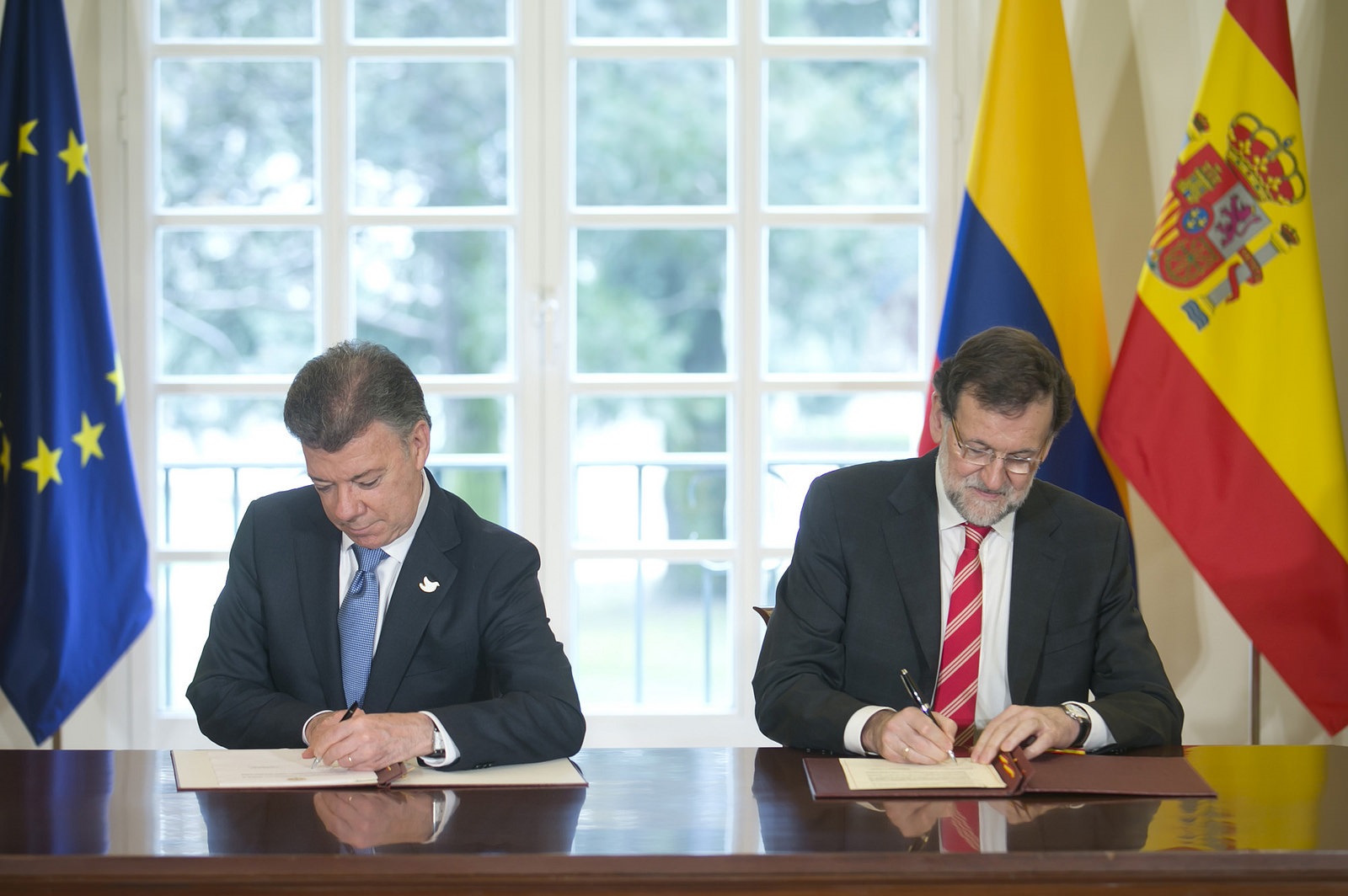
Pres. Mariano Rajoy (Spain) y  Juan Manuel Santos (Colombia), signing an agreement at the Palacio de La Moncloa. Photo Credit: La Moncloa Gobierno de España / Flickr / Creative Commons

Pres. Mariano Rajoy (Spain) y Juan Manuel Santos (Colombia), signing an agreement at the Palacio de La Moncloa. Photo Credit: La Moncloa Gobierno de España / Flickr / Creative Commons

Spain’s media, government ministries and academic specialists watch what they call Iberoamérica closely, but President Rajoy and other political leaders have adopted a lower policy profile in the region than in the past – and they appear unlikely to raise it soon.  Local observers stress that Spain’s interests in the region – preserving historic leadership and influence and building commercial relations – remain the same.  The Foreign Ministry’s website emphasizes the goal of achieving “relations based on equality and balance with all of the countries” in Latin America and to be the European Union’s “key agent” in relations with the region.  Spain also puts great stock in the annual Iberoamerican Summits, even though attendance can fall short of what it hopes for, such as in Veracruz, Mexico, last December.  Madrid rolled out the red carpet for Colombian President Juan Manuel Santos in February, during which both countries’ leaders spoke of their unstinting friendship and backing.  Spanish investment in Latin America has rebounded from the setbacks of the 2008 crisis and the bad odor left by Argentina’s nationalization of Repsol’s shares in the YPF oil corporation in 2012.  Trade has never been the mainstay of the bilateral relationship, but it too has been steady, according to local experts.

Neither of Spain’s two leading parties, however, has shown much interest in making relations as “special” as they like to say.  The frisson of excitement from President Obama’s decision to restore diplomatic relations with Cuba – arguably a validation of longstanding Spanish policy that engagement is better – did not last long.  Observers in Madrid say the government is neither concerned about new U.S. competition on the island, such as in the hotel industry, nor excited that Spanish companies will win big when U.S. tourists flood in.  After former President Zapatero met with Cuban President Raúl Castro late last month, current Foreign Minister García-Margallo accused him of “extraordinary disloyalty and … inappropriateness,” apparently for violating several Spanish protocols for former heads of government.  But Margallo’s pique was consistent with the Partido Popular’s longstanding chilliness toward Cuba (particularly under former President Aznar) and almost certain was aggravated by the fact that Raúl had stood him up for a meeting in Havana in November.  The two parties use similar rhetoric to condemn Venezuelan President Maduro’s increasingly abusive policies, but neither has provided creative leadership in finding solutions to the country’s impasse.  Former President Felipe González, of the Socialist Party (PSOE), has agreed to join the legal defense team of jailed oppositionists but apparently not counseled them on broader strategies.

Transient issues, such as frustration that investments might be nationalized, and widespread perceptions that Venezuela and other problem cases in Latin America are intractable probably lie at the heart of Spain’s preference to stay on the sidelines.  The shift probably also reflects Spanish leaders’ focus on internal priorities – an economy still reeling from the 2008 crisis and youth unemployment so high (over 40 percent in some regions) that there’s fear of a “lost generation.”  In important ways, Spain’s posture toward the region parallels Washington’s – showing fatigue or doubt at a crucial juncture in Latin America’s search for political and economic models as well as effective trading alliances.  Even though Latin American rhetoric tends to reject outside models for democratic transition and institution-building – including Spain’s – Madrid’s historical experience gives it potential advantages in dealing with the region’s political challenges.  Spain and the United States approach in Latin America are quite different – Washington tends to rely on programs to strengthen regime opponents as agents of change – but their strategic objectives in Latin America are complementary.  It would make sense for the two to team up in the region, cooperate in diplomatic strategies, and provide the sort of respectful partnership that many Latin Americans seem to yearn for.

March 31, 2015

Honduras: Charter Cities Lurch Forward

By Fulton Armstrong

Choluteca, Honduras Photo Credit: Jonathan D. / Flickr / Creative Commons

Choluteca, Honduras Photo Credit: Jonathan D. / Flickr / Creative Commons

The Honduran government expects to get the green light this month from a Korean consulting firm for a master plan to hand governance of several small communities over to private investors to develop them, but concerns about the plan run deep and appear unlikely to fade.  Called ZEDEs – the Spanish acronym for “Employment and Economic Development Zones,” the specially designated areas are also called by their proponents charter cities, model cities, and startup cities.  The first tranche of towns facing conversion are in the southern Honduran departments of Valle and Choluteca, with a new port built on the Gulf of Fonseca.  The government says that the affected communities will remain an “inalienable part of the Honduran state,” but amendments to the Constitution, laws, and regulations permit their governing body – which is unelected – to establish “policies and regulations” and their own police and other public services.  Called the “Committee for the Adoption of Best Practices,” the board is dominated by representatives of Honduran millionaires and an even greater number of non-Hondurans of predominantly libertarian ideology.  Among them are American anti-tax crusader Grover Norquist; former President Reagan’s son Michael; and Michael Strong, chief executive of Radical Social Entrepreneurs.  The ZEDEs’ guiding principle is to liberate communities from government taxation, oversight, and corruption in order to attract investment and stimulate prosperity.

The ZEDEs initiative has been plagued by opposition since its inception, however.  Numerous reports underscore that the affected communities were never consulted, and demands for a referendum have repeatedly been rebuffed.  Honduran implementation of the model has been rejected by the U.S. economist who proposed it, Paul Romer (formerly of Stanford University; currently at New York University).  He withdrew because of the lack of Honduran transparency, including secret deals with interested U.S. parties.  The Honduran Supreme Court initially voted 4-to-1 against a Constitutional amendment allowing creation of ZEDEs in 2012, but the Congress impeached the four dissenters and replaced them with supporters who voted unanimously in favor.  There are numerous reports of intimidation of local civil society leaders, who deem them credible in view of clashes between wealthy businessmen and campesinos in other areas resulting in hundreds of deaths in recent years.

Honduras has a desperate need for economic growth – two-thirds of the population lives below the poverty line – and its model of national governance, riddled with corruption and non-transparency, is indeed in crisis.  But there’s no evidence that fighting one form of corruption with another non-transparent system will help anyone but the big investors.  Indeed, Honduras has ranked among the most violent countries in the world for several years, with the term “failed state” looming darkly over it – making it perhaps the worst place to experiment with provocative new models of governance without popular consultation or support.  Critics seem to have a good case: real reform and economic stimulus would focus on cleaning up the government and holding accountable the elites that have brought the country to ruin and now are trying to impose this model on their fellow citizens, rather than usurping the affected communities’ sovereignty.

March 19, 2015

Nicaragua’s “Great Canal” Draws Opposition

By Fulton Armstrong

9036608152_a199acb183_z

Protestors opposing the Chinese-Nicaraguan canal confront police / Jorge Mejía Peralta / Flickr / Creative Commons

Although questions continue to swirl around whether the Chinese-Nicaraguan canal – which its main investor called the “most important [project] in the history of humanity” – will be built or not, its opponents are taking it all very seriously.  A CID-Gallup poll in January showed that 41 percent of Nicaraguans interviewed strongly support the project, while another 21 percent and 17 percent back it somewhat and a little, respectively.  But another poll by the same firm suggested ambivalence:  asked if they supported the National Assembly vote giving the Chinese firm leading the project, HKND, a concession for the 278-km right of way for up to 100 years, some 39 percent of respondents said no.  Some political voices are growing more sharply opposed as well.  The powerful business group COSEP, for example, has gone from agnosticism about the project to a position of open disapproval.

Groups concerned about the project’s impact on the environment and rural residents have already held protests involving up to several thousand participants, and – despite the government’s promise that the canal will bring prosperity throughout the country – organizing efforts appear unlikely to fade.  Skepticism about HKND and the government’s commitment to protecting the environment, fueled by their off-the-cuff dismissal of concerns, is so deep that even a balanced comprehensive impact study by the British Environmental Resources Management, due next month, may fail to calm nerves.  Environmentalists cite studies warning that dredging Lake Nicaragua from its current depth of nine meters to the 27 meters necessary for cargo ships will stir up many layers of toxic materials, with catastrophic consequences for marine life and surrounding agricultural areas.  Other groups are rallying behind the 29,000 residents who are to be evicted from properties along the canal route.  Demonstrations have turned violent, with protestors injured by tear gas and rubber bullets.  Graffiti and banners demanding “fuera chinos” are common.

In the hemisphere’s second poorest country, the promise of growth spurred by the $40-50 billion project is still a powerful card in the government’s hand.  Many skeptics still wonder, however, if the whole scheme is a ruse to fleece the Chinese investors, who’ll bring in a couple billion dollars before realizing that the project will get bogged down in Nicaraguan political quicksand.  But opposition to the canal goes far beyond the usual Managua political game of fighting over corruption dollars and obstructing each other’s priorities.  President Ortega’s endorsement of the canal contradicts his own statements years ago that he wouldn’t compromise the lake’s eco-system “for all the gold in the world.”  According to The Guardian newspaper, the dredging will move enough silt to bury the entire island of Manhattan up to the 21st floor of the Empire State Building – which no one is prepared to deny will have serious environmental implications.  China’s Three Gorges Dam, completed five years ago, displaced 1.2 million inhabitants – proportionally twice as many Nicaraguans displaced by the canal – but Nicaragua’s ability to resettle them, give them jobs, and suppress their dissent is small compared to China’s.  The project may not be the greatest in the history of mankind as HKND claims, but it may provoke a crisis as great as any in Nicaragua.  For starters, if COSEP’s opposition persists, it threatens to unravel the modus vivendi under which Daniel Ortega has stayed in power, and could portend much deeper tensions.

March 5, 2015

Click here to see our previous article about the canal.