Increasing the Benefits of Trade Agreements

By Antoni Estevadeordal and Joaquim Tres*

Trade 1993-2016

Source: IDB (Full-sized images at bottom of page)

Latin American and Caribbean countries were major players in global trade liberalization in the 1990s but have since been held back by complex rules, infrastructural obstacles, and the poor flow of information.  The successful conclusion in 1994 of the Uruguay Round of multilateral trade negotiations and the establishment of the World Trade Organization (WTO) fueled growth and optimism in the region, but the slow progress of the Doha Round drove the region into the silent tide of regional trade agreements (RTAs), which now govern about half of world trade.  Latin American and Caribbean countries have concluded some 70 RTAs – a far cry from the handful of sub-regional customs unions and free trade areas in place in 1994.  As a result, tariffs applied by Latin American countries have dropped from an average of 40 percent to 10 percent during this period.

Despite these policy advances, Latin America and the Caribbean’s participation in international trade is still limited.  Whereas the region and the developing nations of Asia had a similar share of world trade in 1962 (around 6 percent), Latin America’s global trade share has remained relatively unchanged – and that of Developing Asia has grown to nearly three times its previous size.  Latin America registers lower levels of intra-regional trade – 18 percent – compared to 37% in Developing Asia and 61% in the European Union.  Our research indicates that Latin America and the Caribbean could close this gap through a series of measures:

  • Harmonizing the different rules of origin in the RTAs and the wide array of sanitary, phytosanitary, and technical standards that qualify market access.
  • Improving infrastructure and reducing inefficiencies at border crossings to reduce transportation and logistics costs, which amount to three times more than existing tariffs.
  • Harnessing the power of information and communications technology to reduce costs through one-stop shops and process automatization, such as the trade single windows being introduced in several countries in the region. The cost of information about consumer preferences, market demand, and foreign regulations is the first barrier that potential exporters face.
  • Simplifying and reducing administrative burdens through expedited and secure customs and other trade facilitation measures. Some experts estimate that, worldwide, some 75 percent of delays are due to inefficient processes (compared to 25 percent due to inadequate infrastructure).

The main lesson for Latin America and the Caribbean is that trade agreements are a necessary – but not sufficient – condition to achieve economic development potential.  Increasing companies’ participation in international value chains is key to unleashing trade as an engine for economic growth and poverty reduction.  Trade-driven growth in the region, much of it from South American commodities, enabled a reduction of poverty from 22 percent in 2002 to 12 percent by creating new employment opportunities and the fiscal capacity to fund poverty reduction initiatives such as conditional cash transfers (Mexico’s Programa Oportunidades, for example).  By our calculation, trade facilitation measures such as customs and border simplifications can increase Latin American and Caribbean exports by as much as 15 percent, translating into a 5 percent increase in export-supported jobs that pay almost 20 percent more than jobs at non-exporting firms.  It is within policymakers’ grasp to create the enabling environment for firms to export, especially for the small and medium-sized enterprises that may represent the next generation of exporters.

May 9, 2016

*Antoni Estevadeordal and Joaquim Tres are, respectively, the manager and principal specialist of the Integration and Trade Sector of the Inter-American Development Bank.  Click here to access the IDB’s new course on trade agreements, and here and here for related studies.

Trade 1993-2016 v2

Source: IDB

The Critical Role of Universities in Latin America’s Future

By Rodrigo Arocena*

Tec de Monterrey

University students in Monterrey, Mexico. Photo Credit: ·júbilo·haku· / Flickr / Creative Commons

As the latest commodity boom winds down, universities in Latin America can play a leading role in helping the region rebound from the resulting economic slowdown and build itself a more prosperous and equitable future.  The consequences of the boom for economic, political, and social conditions in the region are hotly (and rightly) contested.  But one inescapable conclusion is that inadequate attention was paid to raising societies’ knowledge and qualifications in the production of goods and services.  This matters greatly, because knowledge gaps and skill deficits lie at the heart of what underdevelopment means today.  If the focus in the decades following World War II was on addressing disparities in industrialization, one of the challenges now is over-specialization in productive activities with low added-value of knowledge and qualifications.  When such specialization persists, social and environmental problems are not manageable in the long term.  Differences concerning knowledge and higher education are also one of the main factors behind inequality, in both North and South.  In Latin America, traditionally considered the most unequal region in the world, inequality in recent years has been reduced in a handful of countries and so has poverty in almost all of them.  But such social progress may be jeopardized soon not only because of economic and political changes but also because of quite weak progress made expanding knowledge capabilities and applying them to collective problems.

Universities are at the heart of the solution.  In the knowledge-based and innovation-driven economies that emerged in the North during the last decades of the 20th century, universities obviously made a difference.  They were fundamental actors in the accelerated expansion of advanced education that is closely connected with that type of economy.  They generated new scientific and technological knowledge and often channeled its use into productive activities.  Even then, in the advanced economies of the North private sector firms perform a quite larger proportion of total research and development than universities.  Moreover, Northern universities are mainly oriented by market demand, meaning that actors who are already knowledge-strong obtain most of the benefits of what universities do, fostering what could be called knowledge-based inequality.  This is different from Latin America in several ways:

  • Public universities in Latin America are the main generators of new knowledge, which is why they should get priority when thinking about the future of the region’s development.
  • They are frequently well plugged into National Innovation Systems, the web of actors and institutions responsible for upgrading productivity through the generation and effective use of new knowledge.
  • They represent a continuation, although at a weakened level, of the tradition of the socially committed university forged by the Latin American University Reform Movement.

In any country of the world, knowledge democratization deserves high priority in every progressive agenda – and Latin American universities are, at least potentially, fundamental actors in this task.  Democratizing access and success in higher education, and thus trying to overcome an ancient social divide that stymies development, is key.  The task also means fostering research in all disciplines and applying it to collective problems, as has occurred with research and innovation oriented to social inclusion.  The Latin American ideal highlights merging the modern university’s two long-established missions – teaching and research – with a third one, called “extension,” which entails cooperation with external actors in knowledge generation, cultural creation, and problem-solving, with priority given to the situation of deprived sectors.  As motors for knowledge expansion, and thus for social inclusion, Latin American universities make an invaluable contribution to development and the deepening of democracy.

April 28, 2016

* Rodrigo Arocena served as Rector of the Universidad de la República, Uruguay, from 2006 to 2014.


Cuba: Raúl Clarifies the Lack of Clarity on Future

By Fulton Armstrong

raul pcc congress

Photo Credit: Alexandre Seltz and Sarumo74 (modified) / Google Images / Creative Commons

The report that Cuban President Raúl Castro delivered to the 7th Party Congress last weekend walked a tightrope between pressing harder for change – embracing the importance of the small, emerging private sector – and reassuring party conservatives that the basic tenets of the revolution will not be touched.  He reiterated his commitment to step down in 2018 and promote younger cadre, but he left unclear what he proposes the Cuban system look like in the future.  He defended his decision to normalize relations with the United States, but used Washington’s continuation of the embargo and “democracy promotion” and immigration policies as a rationale for not letting down the Party’s guard.  Among key points:

On Conceptualización.  Castro said this Congress was basically to give “confirmation and continuity” to policies set five years ago to update Cuba’s economic and social model,  but it kicks off a process of consensus-building around a conceptualización, which he said “outlines the theoretical bases and essential characteristics of the economic and social model that we aim for as result of the updating process.”  Private property is a major topic, and Raúl sought to reassure the party that respect for it does not mean – “in the slightest bit” – a return to capitalism.

On reforms approved previously.  The road has been difficult, he said, held back by “an obsolete mentality that gives rise to an attitude of inertia and an absence of confidence in the future.”  He referred to the foot-draggers as “having feelings of nostalgia for other, less-complicated moments in the revolutionary process,” such as when the USSR and socialist camp existed.  But he insisted that the reforms have continued advancing at a steady pace – “without hurry but without pause.”

On upcoming reforms.  Castro talked more about what will not happen rather than any new vision.  He firmly ruled out “shock therapies,” and he said that “neoliberal formulas” to privatize state assets and health, education, and social security services “will never be applied in Cuban socialism.”  Economic policies can in no case break with the “ideals of equality and justice of the revolution.”  But he confirmed that one of the potentially most disruptive reforms – unifying currencies and exchange rates – must be done as soon as possible to resolve and many distortions.  On foreign investment, he called on the party “to leave behind archaic prejudices about foreign investment and to continue to advance resolutely in preparing, designing, and establishing new businesses.”

On Cuba’s economic model.  Castro acknowledged “the introduction of the rules of supply and demand” and claimed they didn’t contradict the principle of planning, citing the examples of China and Vietnam.  “Recognizing [the role of] the market in the functioning of our socialist economy,” Castro said, does not imply that the party, government, and mass organizations stand by and watch abuses occur.

On private and state enterprises.  He said the “non-state sector” – which includes “medium, small, and micro-enterprises” – is providing very important goods and services, and expressed hope for its success.  This sector will continue to grow, he said, “within well-defined limits and [will] constitute a complementary element of the country’s economic framework.”  Castro also called for greater reform efforts to strengthen the role of – and, simultaneously, the autonomy of – state companies, telling managers to overcome “the habit of waiting for instructions from above.”    He noted that the creation of cooperatives outside agriculture “continues in its experimental phase,” with some achievements and shortfalls.

On U.S. policies and intentions.  Castro criticized Washington’s efforts to drive political change in Cuba, which he called “a perverse strategy of political-ideological subversion against the very essence of the revolution and Cuban culture, history, and values.”  He said, “We are neither naive nor ignorant of the desires of powerful external forces that are betting on what they call the ‘empowerment’ of non-state forms of management as a way of generating agents of change in hopes of ending the revolution and socialism in Cuba by other means.” Castro said that U.S. officials recognize the failure of past policy toward Cuba but “do not hide that the goals remain the same and only the means are being modified.”

Rhetoric about forever rejecting capitalism (and multi-party democracy) is standard, especially for a Party event meant to assuage anxieties of conservative factions reluctant to give up their familiar, if failed, models.  The re-election of 85-year-old Vice President Machado Ventura is another sop to the aging right as the country inches each day to its biologically imposed transition, as Fidel Castro made explicit in his closing remarks.  The pace of change in Washington is also slow in some areas, particularly the embargo and the Administration’s “democracy promotion” strategies,  but pro-normalization voices cannot be faulted for lamenting that Cuba could more effectively influence U.S. policy through simple regulatory measures encouraging business deals that will give momentum to embargo-lifting initiatives in the U.S. Congress.  All politics is local, however, and both governments seem content holding off on changing their paradigms for now.

April 21, 2016

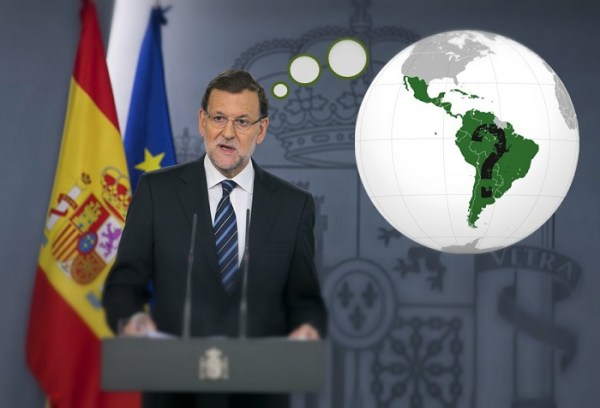
Spain: Too Distracted to Play in Latin America?

By An Observer*

Rajoy Latin America

Photo Credit: La Moncloa Gobierno de España and Heraldry (Modified) / Flickr & Wikimedia / Creative Commons

Spain’s political crisis and problems facing the European Union have undermined Madrid’s ability to pursue interests in Latin America at a time of new opportunities.  Amidst countless months of lameduck government and the failure of either the Partido Popular (PP) or the Partido Socialista (PSOE) to form a government, the country is also tied in knots over corruption scandals, including some touching a Cabinet member and the royal family, and Cataluña’s persistent challenges to central authority.  Even before the current mess, Prime Minister Rajoy had shown only modest interest in Latin America, and King Felipe hadn’t yet demonstrated the mettle of his father, who once famously told Venezuelan President Chávez to shut up at an Ibero-American Summit.  Adding to Spain’s distractions are a series of EU challenges, ranging from refugee crises to terrorism and the Mediterranean countries’ debt overhang.  Spanish elites, who remain committed to the EU vision, are seized with concerns about Brexit, the UK’s flirtation with withdrawal, and perplexed by the absence of a renewed integration project.

Madrid’s declining role coincides with changes in Latin America that would normally grab its attention.  President Obama and Raúl Castro’s historic normalization of diplomatic relations has opened the door to at least one major U.S. hotel firm signing contracts to refurbish and manage several Cuban hotels – an industry in which Spain previously had extraordinary advantages.  Having played “good cop” with Cuba for many years, compared to Washington’s “bad cop,” Madrid’s future role on the island is at most uncertain.  The election of market-friendly President Macri in Argentina, where the previous government nationalized a Spanish energy company and adopted other policies causing bilateral estrangement, also represents an opportunity for Spain.  The near-completion of peace talks between the Colombian government and guerrillas should be the crowning jewel of a foreign policy in which Spain made a strong political investment early on, but Madrid has receded to the role of bit player.  At a time that Latin Americans continue to espouse support for CELAC and other regional organizations that exclude Spain (and the United States), Spain-sponsored Cumbres Iberoamericanas since 1991 have – even more than the U.S.-sponsored Summit of the Americas – lacked dynamism and produced little as the beacon of the Spanish transition was dying down

By turning inward, Spain risks losing what remains of its special cachet as Latin America’s link to Europe and as a country that made a successful transition to democracy with inclusion, human rights, vibrant media, and increasing transparency.  Its political capital in the region is running low, and budgetary constraints have diminished its aid budgets (from 0.5 percent of GDP to 0.13 percent).  But opportunities remain.  Big Spanish companies – Telefónica, Banco Santander, BBVA, Repsol, and others – and numerous mid-sized firms have shown interest in Latin America.  Cuba’s reluctance to embrace U.S. ties too tightly and too fast gives Spain important space to play a role if it wants.  Moreover, Spain’s diplomatic skills, critical for Central America’s peace processes and elsewhere, could still be a positive force in that subregion.   If it weren’t for former Spanish Prime Ministers’ contradictory roles in Venezuela, where U.S. baggage undermines Washington’s approach to political, economic, and security problems, Spain could be active there too.  But the Prime Minister and his cabinet have not given the Foreign Ministry the green light to get more deeply involved.  It’s not too late for Spain to turn things around and get back into the game in Latin America.  For that to happen Spain needs more consistent governance.

April 18, 2016

* The writer is long-time non-academic observer of Spanish foreign policy in Latin America.

How are the Americas Faring in an Era of Lower Oil Prices?

By Thomas Andrew O’Keefe*

Gas Station Guatemala

Photo Credit: Josué Goge / Flickr / Creative Commons

The sharp drop in global oil prices – caused by a combination of a slowing Chinese economy hurting commodities sales and efforts by Saudi Arabia to retain market share – has both downsides and advantages for Latin America and the Caribbean.  By keeping production levels steady, despite decreased demand, so that a barrel of crude remains below US$40, the Saudis’ hope is to put U.S. shale oil producers and Canadian tar sands producers out of business.  The drop in oil prices has had a varied impact elsewhere in the Americas:

  • The effect in Venezuela, already reeling from over a decade of economic mismanagement, has been catastrophic. The ripple effect is being felt in those Caribbean and Central American countries that grew to depend on PetroCaribe’s generous repayment terms for oil imports that allowed savings to be used for other needs.  In 2015, for example, this alternative funding mechanism in Belize was slashed in half from the previous year.  The threat of interest rate hikes on money that must eventually be repaid for oil imports also pushed the Dominican Republic and Jamaica to use funds raised on international capital markets to reduce their debt overhang with Venezuela.  (For those weening themselves off PetroCaribe dependency, however, the lower prices are a silver lining.)
  • Low oil prices have also knocked the wind out of Mexico’s heady plans to overhaul its petroleum sector by encouraging more domestic and foreign private-sector investment.
  • In South America, the decline has undermined Rafael Correa’s popularity in Ecuador because the government has been forced to implement austerity measures. The Colombian state petroleum company, Ecopetrol, will likely have to declare a loss for 2015, the first time since the public trading of its shares began nine years ago.  In Brazil, heavily indebted Petrobras has seen share prices plummet 90 percent since 2008, although that is as much the result of the company being at the center of a massive corruption scandal that has discredited the country’s political class.
  • On the other hand, lower petroleum prices have benefitted net energy importers such as Chile, Costa Rica, Paraguay, and Uruguay.

The one major oil producer in the Americas that has not cut back on production and new investment is Argentina – in part because consumers are subsidizing production and investment by the state petroleum firm YPF, which was renationalized in 2012 and now dominates domestic end sales of petroleum products.  Prices at the pump remain well above real market values.  While successive Argentine governments froze energy prices following the 2001-02 implosion of the Argentine economy, this time policy is keeping some energy prices high.  This encourages conservation and efficiency and spurs greater use of renewable alternatives, but it becomes unsustainable during a prolonged dip because it will, among other things, make the country’s manufacturers uncompetitive.  The Argentine example underscores that predictions of a pendulum shift in Latin America in favor of private-sector investment in the hydrocarbons sector over state oil production are still premature.

The lower prices do not appear likely to harm the region’s continuing substitution of natural gas for coal and oil as a transitional fossil fuel to greener sources of energy.  Natural gas prices remain at their lowest levels in over a decade, and the expansion of liquefied natural gas plants allows for easier transport of natural gas to markets around the world.  They are also unlikely to dent the global shift to greater reliance on renewable energy resources driven by the international consensus that climate change can no longer be ignored and something must be done to address it.  At the UN climate change talks in Paris last December, for example, countries agreed to keep temperature increases “well below” 2 degrees centigrade above pre-industrial levels and made a specific commitment “to pursue efforts” to achieve the much more ambitious target of limiting warming to no more than 1.5 degrees centigrade.  The year 2015 was the second consecutive year in which energy-related carbon emissions remained flat in spite of 3 percent economic growth in both years. 

March 24, 2016

*The author is the President of San Francisco-based Mercosur Consulting Group, Ltd.  He chaired the Western Hemisphere Area Studies program at the U.S. State Department’s Foreign Service Institute between July 2011 and November 2015.

Behind Argentina’s Making up with its Creditors

By Arturo C. Porzecanski*

Pensive Macri

Photo Credit: Mauricio Macri / Flickr / Creative Commons

A recently concluded agreement in principle between Argentina and most of its holdout creditors is part of a 180-degree turn in economic policy that the new administration of Mauricio Macri is attempting to make in order to end five years of economic stagnation, 10 years of double-digit inflation, and 15 years of isolation from the international capital markets.  President Macri has to navigate very carefully, however.  First, he does not have a majority in either congressional chamber, so he has to work hard to persuade legislators to support his policy initiatives.  Second, the judiciary and the Executive branch are packed with political appointees from the Néstor and Cristina Kirchner administrations, and while some of them have been fired, Macri and his economic team must still tread cautiously.  Third, all the key economic institutions, such as the government’s commercial and development bank (BNA), the central bank (BCRA), and the social security administration (ANSES) have been stuffed to the gills with either risky or unprofitable assets (from bad loans to government IOUs), thereby compromising their effectiveness.  Last but not least, Macri must be mindful of his very fickle electorate: over the past seven decades, Argentines have periodically voted non-Peronists into office to clean up the mess left behind by the Peronists, but then they have soured and yanked their support.  It is a sobering fact that not a single non-Peronist government has ever made it to the end of its constitutional term in office.

This is why the Macri administration is going for some “quick wins” rather than for major structural reforms or the necessary dose of fiscal austerity and monetary restraint.  And this is the context within which his willingness to “bury the hatchet” with private and official creditors must be understood.  As a former businessman, Macri realizes that if one takes over a money-losing enterprise – in this case the public sector, which is running a deficit equivalent to more than five percent of GDP – one needs to cultivate sources of interim financing until the enterprise can be turned around.  After all, the prior government had been living hand-to-mouth on loans from the BNA, the BCRA, and ANSES, with increasingly inflationary consequences.  Having lost official international reserves and seen the currency depreciate rapidly after abolishing capital controls, the authorities are now under great pressure to obtain interim financing from abroad to help stabilize international reserves and support the weak currency.

President Macri faces a very difficult governance challenge in the months and years ahead.  His ability to mend fences with private creditors – Argentina has been in arrears to all its bondholders since mid-2014 – as well as with the IMF, multilateral development banks, and official creditors such as the Ex-Im banks – is crucial to the restoration of financing to the private and public sectors and the fostering of an investment-friendly climate.  Macri’s agreement in principle with most holdout creditors is a big step in the right direction, but he must now secure the requisite congressional approvals to dismantle Kirchner-era legislation inimical to a settlement and obtain interim financing at reasonable interest rates to clear all overdue debts.  These are early and relatively easy tests for a government that is yet to adopt most of the divisive and unpopular austerity measures that circumstances warrant.

March 10, 2016

*Dr. Porzecanski is Distinguished Economist in Residence at American University and Director of the International Economic Relations Program at the School of International Service.

Brazil: Crises Hindering Foreign Policy

Dilma 2016

Photo Credit: Marcelo Camargo / Agência Brasil / Flickr / Creative Commons

by Tullo Vigevani*

The pace of Brazil’s rise in international affairs since 2000 is likely to be slowed by the multiple crises facing President Dilma Rousseff’s government and the private sector, but Brasilia will strive as best it can to maintain its global and regional priorities.  Political tensions are soaring amid corruption indictments and severe economic contraction – the nearly 4 percent decline in GDP in 2015 is expected to be repeated this year, with increasingly negative social consequences.  The government faces growing criticism that extends beyond the principal opposition parties: its own party base and supportive labor unions and social movements criticizing Rousseff’s administration.  The corruption investigations have spread far beyond the national oil company, Petrobras, and into corporate networks across economic sectors, exacerbating a climate of growing anxiety.  Major media are railing against the President and her predecessor, Luiz Inacio Lula da Silva, whose detention for questioning by a judge last week deepens the crisis and further dims the already faint prospects for a restoration of stability in 2016.

These developments have created an element of paralysis in foreign policy.  Foreign minister Mauro Vieira, like his two immediate predecessors – Luis Alberto Figueiredo (2013-2015) and Antonio Patriota (2011-2013) – has been unable to sustain the “active and proud” policy of Lula-era Foreign Minister Celso Amorim (2003-2010).  After basking not long ago in the fruits of its assertive foreign policies – including selection as host of the 2016 Olympics – Brazil’s government now is dealing with matters such as the Zika virus and microcephaly taking front stage.  Rousseff on one hand is barraged by criticism of a lack of macroeconomic rigor and the failure to better integrate Brazil’s economy into global production chains, and on the other she is criticized for slow investments and development policies.  Her ambition to promote South American trade and economic integration is being undermined by the recessionary pressures confronting Brazil and neighboring economies buffeted by the end of the commodities boom.

  • MERCOSUR remains a priority for the administration. Criticism by liberal economists will mount, however, that Mercosur, as a customs union, discourages potential agreements with developed economies, particularly the United States, thus exacerbating Brazil’s de-industrialization.  There is evidence that Mercosur helps companies that produce high value-added goods: whereas in 2014 manufacturing accounted for 77 percent of Brazilian exports within Mercosur, it accounted for only 4 percent of exports to China.  (The figures for the European Union and the U.S. were 37 and 55 percent, respectively).  Progress on trade agreements with the United States and other developed countries appears unlikely, but agreements on trade promotion seem likely.
  • Cooperation with UNASUR will remain a priority as well, but plans that rely on Brazil’s ability to provide resources face new political and economic restraints. The Ministries of Finance and Planning and the Central Bank reportedly are going to rein in contributions of the Brazilian Development Bank (BNDES), and funding for the South American Council of Infrastructure and Planning (COSIPLAN).  Initiatives such as the South American Defense Council will continue.  Clearly, state enterprises such as Petrobras and private-sector conglomerates will face limits on their foreign activities, reducing Brazil’s influence in the region.

The relationship between domestic and international affairs is inescapable, and Brazil is no exception.  But even as the domestic political and economic conditions deteriorate for a period, the country will not turn inward or abandon its interest in the international arena, particularly with China and the BRICS.  However rough the road ahead, President Rousseff’s government appears likely to remain steadfast in its approach to regional diplomatic and political organizations – including the Community of Latin American and Caribbean States (CELAC) and the OAS – even though resources will be tight.  It will remain active, within its diminished capacity, in an array of multilateral settings ranging from UN peacekeeping operations and the FAO, to the G-20, WTO and IMF.  Moreover, senior officials in Brasilia, including in the Foreign Ministry, appear committed to stronger bilateral ties with core partners, particularly the United States, and continued Brazilian support for democratic stability throughout Latin America, including in resolution of the Venezuelan crisis.  Even though resources and performance may suffer, a robust role in the hemisphere appears likely to remain a pillar of Brazil’s foreign policy.  The idea of Brazil’s autonomy in the international arena has deep roots, and whatever the domestic criticism leveled against the Rousseff administration, these will be matters of interpretation rather than a fundamental questioning of Brazil’s greater insertion into global processes and of political and economic interdependence.

March 7, 2016

*Tullo Vigevani is Professor of Political Science and International Relations at the State University of São Paulo (UNESP) and a researcher at the Center for Studies on Contemporary Culture (Cedec) and the Brazilian National Institute of Science and Technology for Studies on the United States (INCT-INEU), in São Paulo.

Venezuela: Trying to Stay Afloat

By Michael McCarthy* and Fulton Armstrong

Venezuela Oil Maduro

Photo Credit: Democracy Chronicles and Charles Henry (modified) / Flickr / Creative Commons

Venezuelan President Nicolás Maduro continues to receive increasingly bleak economic news, and his modestly positive policy responses seem unlikely to help.  Oil revenues dropped 293 percent from 2014 (US$37 billion) to 2015 (US$12.5 billion).  The value of oil exports, which account for 95 percent of the country’s export earnings, has dropped to a 30-year low ($30 a barrel), accelerating a recession, paralyzing shortages, and soaring inflation.  The Central Bank reported that inflation reached 180.9 percent in 2015, and that the GDP contracted for the second consecutive year (5.7 percent).  Maduro blamed an “imperialist strategy in a petroleum war” aimed at destroying OPEC.  He also asserted that Venezuela suffered from an “international financial blockade” that – by obstructing the country’s efforts to refinance its debt – was intended to force it “to its knees” and to “take over” its wealth.

Several days after celebrating a Supreme Court decision reaffirming his authority to declare an “economic emergency,” which the opposition challenged last month, Maduro this week announced several modest economic measures aimed at stemming the slide.

  • He ordered a 60-fold increase in gasoline prices – dramatic-sounding but preserving Venezuelan gas (about US$0.23 per gallon at the black-market exchange rate) as one of the cheapest in the world – but the decision is significant as the first increase in about 20 years. An increase in 1989 triggered riots – the famous Caracazo that most analysts cite as the beginning of the end of the old order that Hugo Chavez toppled definitively when elected President in 1998.  In allusion to this past, Maduro said he “hoped people on the streets would understand.”  (Caracas-based consultancy Ecoanalítica estimates that the existing fuel subsidy costs the Venezuelan government US$12 billion a year.)
  • Maduro also announced a 37 percent devaluation of the bolívar – from 6.3 to 10 to the U.S. dollar – for official exchange rates used for the essential goods like food and medicine. The bolívar trades at about 1,000 to one on the black market, but the decreased subsidy implicit of the official rate for necessities is nonetheless significant.
  • Venezuela’s proposal for an OPEC freeze in oil production, in hopes of driving oil prices back up, drew supportive remarks from Qatar, the United Arab Emirates, Russia, Saudi Arabia, and even Iran, but the scheme has lacked traction. Industry observers said one reason is that Tehran is eager to increase exports to regain market share as sanctions against it are lifted.
  • Maduro replaced economic czar Luis Salas – known as a hardline leftist – just five weeks after appointing him, and appointed in his place a more business-friendly economist, Miguel Pérez Abad, who had been serving as Minister of Commerce. Pérez Abad, whose appointment the President of the Venezuelan Chamber of Commerce described as a “friendly sign,” has publicly (and accurately) said that Venezuela must simplify its byzantine exchange rate system.
  • These changes come amid Maduro’s increasingly frank self-criticism about state corruption. He recently described a government food distribution company as “rotten” while calling for a restructuring of state-run food import and distribution outlets.

In a four-hour speech replete with foul language and insults against opposition leaders, the President argued that the measures are “a necessary action to balance things,” and he said, “I take responsibility for it.”  But his measures are piecemeal at best.  As opposition leaders have pointed out, he has not explained how he is going to pay Venezuela’s debt, obtain the foreign exchange to import sufficient amounts of basic goods, and guarantee food for the people.  With US$10 billion in bond payments coming due this year, the country has no clear path for avoiding default.  However painful for the population and politically costly for the government, measures such as gasoline price increases will have little impact.  The government wanted the opposition to share some of the costs for economic policy changes, but opposition politicians say that the gas price increase and devaluation are too little, too late. Most believe economic revival depends on dismantling the entire chavista system.  They are once again talking about removing Maduro through a referendum or other means – with one leader, Henrique Capriles, openly calling for a presidential recall, and another, Henry Ramos, the President of the National Assembly, calling for a constitutional amendment to cut the presidential term from six to four years.  The government’s measures suggest a welcome change from Maduro’s previous strategy of buying time through diversionary tactics.  However, the economic measures are likely to fail and, moreover, they increase the chances political temperatures will surge once again.

February 19, 2016

* Michael McCarthy is a Research Fellow with the Center for Latin American & Latino Studies.

Ignoring MERCOSUR and UNASUR at Your Peril

By Thomas Andrew O’Keefe*

Mercosur map

Participating countries in MERCOSUR. Image Credit: Immanuel Giel (modified) / Wikimedia / Creative Commons

Pundits who dismiss MERCOSUR and the Union of South American Nations (UNASUR) as failed attempts at Latin American economic integration should look again.  MERCOSUR has presided over an explosion in intra-regional trade among its four original member states (Argentina, Brazil, Paraguay, and Uruguay) from just over US$ 5 billion at its launch in 1991 to US$ 43 billion by 2014.  UNASUR, for its part, is credited with thwarting a coup attempt against Evo Morales in 2008 and putting a damper on continental arms races.

  • MERCOSUR and UNASUR member countries have taken additional important steps toward convergence since 2014, when MERCOSUR’s highest governing body adopted “CMC Decision 32,” which allows initiatives pursued by either collective to be binding on both if they arise from a set of goals and objectives common to both. The document reaffirms the UNASUR founding treaty stipulation that “South American integration shall be achieved through an innovative process that includes all of the achievements and advances by the processes of MERCOSUR and CAN [Andean Community].”  Chile has spearheaded this effort as a means of reducing duplication of efforts, and is also attempting to bridge ideological differences between the Pacific Alliance (Chile, Colombia, Mexico, and Peru) and MERCOSUR to further build Latin American unity.

Given the relentless negative assessment of both integration projects, multinational pharmaceutical companies were caught off guard when MERCOSUR and UNASUR forced them late last year to make substantial price cuts for public-sector purchases of Darunavir, an antiretroviral to combat HIV-AIDS, as well as Sofosbuvir, used with other medications to treat Hepatitis C.  Both drugs are on the World Health Organization’s List of Essential Medicines.  As a result of CMC Decision 32/14, the Ministers of Health of all the South American nations met in Montevideo on September 11, 2015, and launched a joint MERCOSUR/UNASUR committee to negotiate with multinational pharmaceutical companies on the prices for bulk purchases of certain high-priced drugs.  The committee, made up of representatives from each government’s agency responsible for purchasing medicines, won major price cuts last November – a steep reduction for Darunavir from Hetero Labs as well as lower prices with Gilead for Sofosbuvir.  The new costs were premised on the lowest amount charged to any one of the member governments, and enabled Chile’s Ministry of Health to pay 90 percent less than what it previously paid for Darunavir.  The South American governments as a whole are expected to save US$ 20 million in 2016 on purchases of this anti-retroviral.  A proposed 14 percent reduction in the cost of the combination Sofosbuvir-Ledispaver drug for Hepatitis C – if accepted by the MERCOSUR/UNASUR committee – would enable further savings.

The South American governments have their eyes set on several additional high-priced medications, with a particular focus on drugs used to treat cancer.  In order to aid the committee’s work, UNASUR is creating a data bank of the prices charged by the multinationals for specified medicines purchased by the public health sector in each member state.  The fact that the purchases are made jointly through the Pan American Health Organization’s already existing Strategic Fund opens the possibility that countries in Central America and the Caribbean can benefit as well.  It also means that all these countries can access the Fund’s capital account and do not need to have the cash in hand to acquire medications required to address public health emergencies.  MERCOSUR and UNASUR – often dismissed as ineffective – are demonstrating that integration produces tangible results.

February 11, 2016

* Thomas Andrew O’Keefe is President of San Francisco-based Mercosur Consulting Group, Ltd. and is former chair of Western Hemisphere Area Studies at the U.S. State Department’s Foreign Service Institute (2011-15).

Correction: Due to an editing error, an earlier version of this post mistakenly stated that “a 14 percent reduction in the cost of its combination Sofosbuvir-Ledispaver drug for Hepatitis C will enable Chile’s Ministry of Health to pay 90 percent less than what it previously paid for Darunavir.”  The outcomes of the cost negotiations for the two medications are unconnected.

U.S.-Colombia: Launching “Peace Colombia”

By Eric Hershberg and Fulton Armstrong

Kerry Santos

Photo Credit: U.S. Department of State / Flickr / Public Domain

The United States, buoyed by good feelings about what President Obama called Colombia’s “remarkable transformation,” last week pledged $450 million a year in continued aid for the next five years, but it’s not clear yet whether “Peace Colombia” will be very different from Plan Colombia, to which the United States contributed some $10 billion.  The new spending includes unspecified amounts to support the reintegration of FARC combatants who lay down their arms as part of a peace accord expected next month, but much of the emphasis appears to be on old priorities, such as “consolidating and expanding progress in security and counternarcotics.”

  • Obama and Colombian President Santos announced the new program in Washington events marking the 15th anniversary of the launch of Plan Colombia. Amid the many remarks about Colombia’s progress, indicators such as homicide rates (down 50 percent since 2002), kidnapping rates (down 90 percent), economic growth (averaging 4.3 percent), and poverty and unemployment (down slightly) stand out.  By most accounts, moving around core regions of Colombia is easier and safer than it’s been in decades.

Some of these gains of the past 15 years remain tenuous, and “Peace Colombia” will face new challenges as well.  In speeches and backgrounders, government officials have acknowledged that coca eradication and crop substitution programs have failed to reverse Colombia’s role as the world’s biggest producer of coca.  Moreover, programs supporting the demobilization of the FARC will be more difficult to implement than those given to the rightwing paramilitaries in 2002-2006.  Tens of thousands of former paramilitaries are now active in bandas criminales (BACRIMs), which President Santos recently referred to as “2,500 miniscule criminal organizations scattered throughout the country.”  Changing economic circumstances could also complicate efforts to advance peace.  During the years of Plan Colombia, the country got a healthy bump from both domestic and foreign investment – because of the improved security environment as well as the external economic environment, including the U.S.-Colombia Free Trade Agreement and Chinese demand for commodities.  Investment remains strong, but the export boom is over, which is lowering growth and squeezing government budgets.

The creation of economic opportunity is at least as important to the success of Peace Colombia as continued support for the Colombian military and security system, although last week’s speeches and press releases did not shed much light on that.  Achieving peace and building democracy will also require addressing infrastructure deficits, educational inequality, inadequate job training, and poverty.  Several Florida congressmen, arguing that “Peace Colombia” supports an accord that’s overly generous to the FARC, say they’ll oppose Obama’s pledged aid.  The assistance will almost certainly advance, however, because of the strong Washington consensus that Colombia is its biggest (if not only) success worldwide in beating back irregular armed groups.  Moreover, as President Santos and U.S. Secretary of State Kerry emphasized in a press conference, there are no conditions on the new assistance – which should assuage Congressional opponents’ concerns that the relationship will get held up by investigations into alleged human rights violations in the past.  The Presidents spoke of pulling Colombia back from the “verge of collapse” in the 2000s to the “verge of peace” now.  A broadening of strategies in both capitals, including a reassessment of the emphasis on military options, could push the country toward becoming a more inclusive democracy, which ultimately may be what is required in order to achieve lasting peace.

February 8, 2016