U.S.-Cuba Diplomatic Ties: Beyond Symbolism

By William M. LeoGrande*

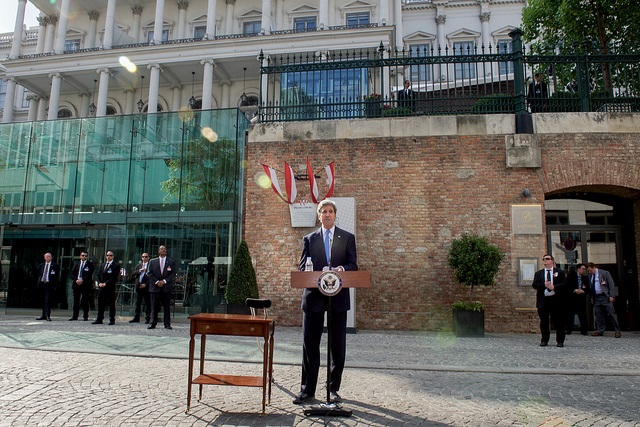
U.S. Secretary of State John Kerry delivers a statement to the international media after President Obama announced plans to re-open a U.S. Embassy in Cuba. Photo Credit: U.S. Government / Public Domain

U.S. Secretary of State John Kerry delivers a statement to the international media after President Obama announced plans to re-open a U.S. Embassy in Cuba. Photo Credit: U.S. Government / Public Domain

The reopening of embassies in Washington and Havana is symbolic of the change in U.S. policy that President Obama announced last December 17—replacing the hostility and subversion dating back to the break in diplomatic relations 54 years ago with engagement and cooperation.  As he declared on July 1, “This is what change looks like.”  Beyond symbolism, reopening the embassies has important practical benefits.

  • Cuba and the United States have had diplomatic representation in each other’s capitals since 1977, but those “Interests Sections” were restricted in their operations. Having full embassies will create better channels of communication between the two governments, facilitating negotiations on other issues that must be resolved before bilateral relations are fully normal.
  • Diplomats will have greater freedom to travel and speak with citizens of the host country.  Diplomats’ travel has been restricted to the capital regions of both countries since 2003, when the George W. Bush administration imposed controls on Cuban diplomats, and Cuba reciprocated.  Negotiations on opening the embassies were delayed by Cuban concerns that U.S. diplomats would travel around the island promoting opposition to the government—a common practice during the Bush administration.  The restoration of diplomatic relations returns to the pre-2003 status quo, when diplomats could travel freely upon simply notifying the host government.
  • For Washington, the move will have benefits beyond Cuba ties.  The policy of hostility persisted through ten U.S. presidential administrations, gradually isolating the United States from allies in Latin America and seriously endangering U.S. relations with the entire region.  It was no coincidence that President Obama noted that the new approach to Cuba would also “begin a new chapter with our neighbors in the Americas.”

Congressional opponents of the opening to Cuba can do nothing to stop the re-establishment of diplomatic relations, but they can slow down broader normalization processes.  The Constitution vests the power to recognize foreign countries with the president alone.  But whoever the president nominates as the new U.S. ambassador to Cuba will face tough sledding in the Senate Foreign Relations Committee, where Senators Marco Rubio (R-Fla.) and Robert Menendez (D-NJ) have declared unwavering opposition to normalizing relations.  In the House of Representatives, Republicans have introduced legislation to deny funds to upgrade the Interests Section to a full embassy—a move that only punishes U.S. diplomats in Havana, prospective Cuban immigrants, and visiting and U.S. citizens who need consular services.  Moreover, opponents will not allow any legislation in the next 18 months that would make Obama’s Cuba policy look like a success.  That means U.S. economic sanctions—the embargo and ban on tourist travel—will remain in place at least through the next presidential election since lifting them entirely requires changing the law.

Although full normalization—with robust trade, social, cultural, and political ties—will take a long time, there is more that can be done to expand government ties.  Washington and Havana have a half-dozen working groups on a wide range of topics, and we could soon see bilateral agreements on issues of mutual interest like law enforcement cooperation, counter-narcotics cooperation, environmental protection in the Caribbean, the restoration of postal service, and more.  President Obama also could use his licensing authority to further expand commerce with Cuba, in particular, licensing U.S. banks to clear dollar-denominated international banking transactions involving Cuba, a prohibition that is today one of the major impediments to Cuba’s international commerce with the West.  The president could restructure democracy promotion programs so that they support authentic exchanges in education, the arts, and culture, rather than promoting opposition to the Cuban government.  The issues between the United States and Cuba are complex and multi-faceted.  Resolving them will require overcoming half century of mutual distrust.  But the re-establishment of normal diplomatic relations constitutes the first necessary—symbolic and practical—step toward the future.

July 14, 2015

*William M. LeoGrande is professor of government in the School of Public Affairs at American University.  This blog is adapted from his op-ed on Fox News Latino.

Brazil on the Global Stage: Power, Ideas, and the International Order

By Matthew Taylor and Oliver Stuenkel*

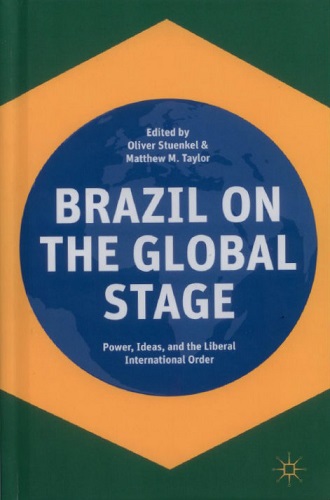
Now available via Palgrave Macmillan.

Now available via Palgrave Macmillan.

Brazil has risen to become the seventh largest economy and fourth largest democracy in the world – yet its rise challenges the conventional wisdom that capitalist democracies will necessarily converge to become faithful adherents of a U.S.-led global liberal order.  Indeed, Brazil demonstrates that middle powers, even those of a deeply democratic bent, may offer important challenges to prevailing conceptions of the world order, differing in their views of what democracy means on the global stage and how international relations should be conducted among sovereign nations.  For Brazil, successful diplomacy involves an increased voice for the developing world, greater accountability in multilateral institutions, and a desire to reduce emphasis on coercive instruments.

  • Because the role of middle powers such as Brazil is often less easily understood in the realist terms that dominate U.S. foreign policy circles, its foreign policy stances are often portrayed by frustrated Washington officials as quixotic and naïve, or ridiculed as puerile and petulant third-worldist jabs at a stereotypical Tío Sam, intended only to win popular approval from a nationalistic and anti-American electorate. In fact, Brazilian foreign policy positions usually have deeper and more enduring origins, embedded within a deeply held set of beliefs that together shape Brazil’s rational strategic perspective on the structure of power in the world today.
  • Brazil’s new role on the world stage has much to do with the country’s success in addressing its own domestic challenges under a succession of democratically elected presidents. Over the past three decades, Brazil has left behind its history of economic disarray, established a robust democracy, and begun to address its record-setting inequality.  It has found paths past the hyperinflation and financial crises of the 1980s and 1990s, undertaken substantial institutional reforms to overhaul the gargantuan and inefficient public sector, and implemented highly regarded social policies.  Even its recent stumbles can be seen in the positive light of democratic progress: the demonstrations that took hold in many Brazilian cities in 2013 and 2014 can largely be attributed to a growing middle class impatient with the pace of change and increasingly conscious of its political rights, a direct consequence of the important successes of the past generation.  Although the country continues to face a number of domestic challenges, the gains of the past generation appear to have fostered an enduring intent to play a role on the world stage.

These conclusions and others are presented in a book entitled Brazil on the Global Stage: Power, Ideas, and the Liberal International Order (Palgrave Macmillan, 2015), co-edited by Professors Matthew Taylor and Oliver Stuenkel.  The book is based on a conference sponsored jointly by American University’s Center for Latin American & Latino Studies and School of International Service, and includes contributions by eight faculty members from AU and Fundação Getulio Vargas (FGV), as well as experts from the Washington community.  It offers a general evaluation of Brazil’s stance toward global order, while also addressing its postures on specific aspects of governance, including trade, foreign and environmental policy, humanitarian intervention, nuclear proliferation, and South-South relations, among other topics.

May 21, 2015

*Professors Matthew Taylor and Oliver Stuenkel teach at American University’s School of International Service and the Fundação Getulio Vargas in Brazil, respectively.

The Summit of the Americas: Important Progress

By Aaron Bell and Eric Hershberg

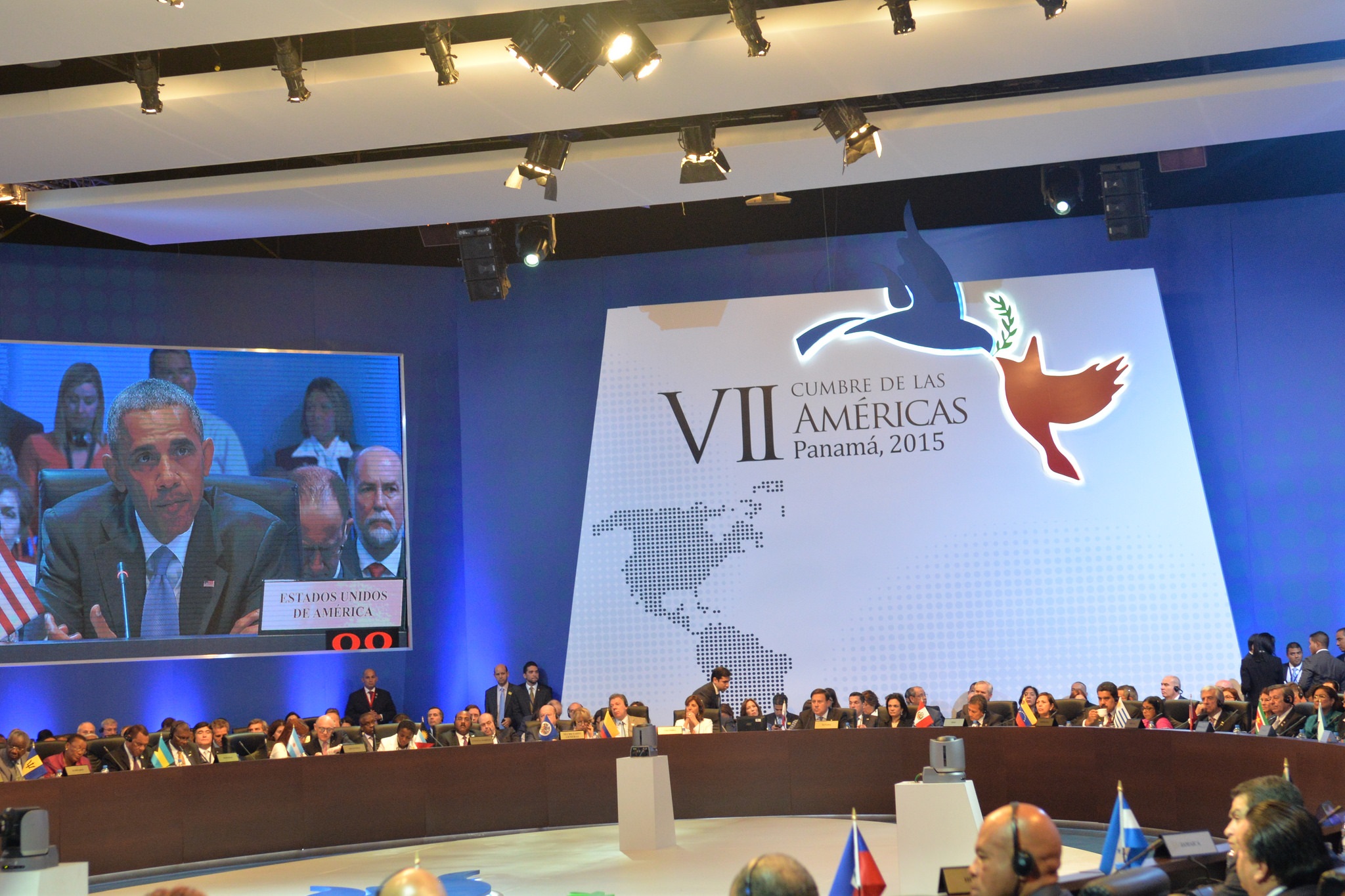
VII Summit of the Americas Photo Credit: OEA-OAS / Flickr / Creative Commons

VII Summit of the Americas Photo Credit: OEA-OAS / Flickr / Creative Commons

The U.S.-Cuba rapprochement has returned the Summit of the Americas (SOA) to the way it was before George W. Bush turned it into a forum in which the U.S. was increasingly isolated – a community of vibrant but respectful debate reflecting the varied perspectives of the hemisphere.  The event in Panama this past weekend was dominated by Cuba’s attendance at its first SOA and Presidents Raúl Castro and Barack Obama’s cordial public encounter and hour-long meeting, the first of its kind between the two nations’ leaders in over half a century.  The next step in improving relations will be for Obama to formally announce Cuba’s removal from Washington’s list of “state sponsors of terrorism,” which the State Department reportedly recommended last week.  Regrettably, the leaders did not take advantage of the Summit as an occasion to announce a target date for the formal restoration of diplomatic relations and the appointment of Ambassadors.  But that, presumably, will come soon, and regardless, in the plenary session Obama set a new tone for U.S. policy when he acknowledged that “the days in which our agenda in this hemisphere so often presumed that the United States could meddle with impunity — those days are past.”  Obama clearly articulated a desire to move beyond not only the legacy of U.S. intervention in the region but also the stale ideological debates that, he observed pointedly, pre-dated his birth.

Statements and activities surrounding the SOA also reaffirmed the broad range of perspectives in the hemisphere,  including in attitudes toward the United States.  The “People’s Summit,” held parallel with the SOA, provided a forum for left-wing critiques aimed primarily at U.S. meddling in the region, in particular its foreign military bases and its recent allegation – which it subsequently backed away from – that Venezuela poses an “extraordinary threat to U.S. national security.”  The sanctions it imposed on senior officials drew critiques from around the region, including from Argentina, Colombia, and from Brazil’s Dilma Rousseff, who summarized regional sentiment in characterizing them as “counterproductive and inefficient.”  The criticism was overshadowed, however, by widespread applause for changes in U.S.-Cuba relations.  Obama also won points from observers for meeting with Venezuelan President Nicolás Maduro, who used the Summit to denounce the 1989 U.S. invasion of Panama and present to Obama a list of 11,000 signatures opposing Washington’s sanctions.  Maduro praised the meeting as the “Summit of Truth” and even “cordial,” noting that it opened the door to further discussions on the bilateral relationship.  Obama also seemed to subscribe to a different role for civil society representatives – as opponents of sitting governments – at the summit, choosing to meet privately, for example, with Cuban dissidents opposed to the Raúl Castro and his government.

Obama’s steps to remove the festering U.S.-Cuba issue from the hemispheric agenda have been game-changing, even if some presidents criticized Washington’s continued enforcement of the economic embargo and the Administration’s bewildering inability to move faster to remove Cuba from its highly politicized terrorist list.  This summit may signal a return to the values and respectful debate that Obama, and before him Bill Clinton, espoused at past Summits, and may pave the way for cooperation over contemporary issues rather than Cold War-era ideological hang-ups.  In the final days before the Summit, senior White House advisors had intervened to ease tensions over the State Department’s national security rhetoric vis-à-vis Venezuela, emphasizing with regret that assertions regarding Venezuela’s posing a security threat were an unfortunate procedural necessity rather than a genuine assessment of the situation.  This recognition that “words matter” turned on their head the words used earlier in the week by Assistant Secretary of State Roberta Jacobson in lamenting that Latin American governments were not using language similar to Washington’s to characterize the deteriorating political situation in Venezuela.  While the correctives from the White House and the focus on the transformation of U.S.-Cuba relations were both conducive to a successful SOA, these developments did overshadow both the official theme of this year’s summit – Prosperity with Equity – and related discussions on energy, the environment, and education.  These crucial issues, all ripe for regional cooperation, are the core of what should become the focus of U.S.-Latin American relations for the remainder of this administration and beyond.

April 13, 2015

Why Is Madrid Not in the Game in Latin America?

By Fulton Armstrong

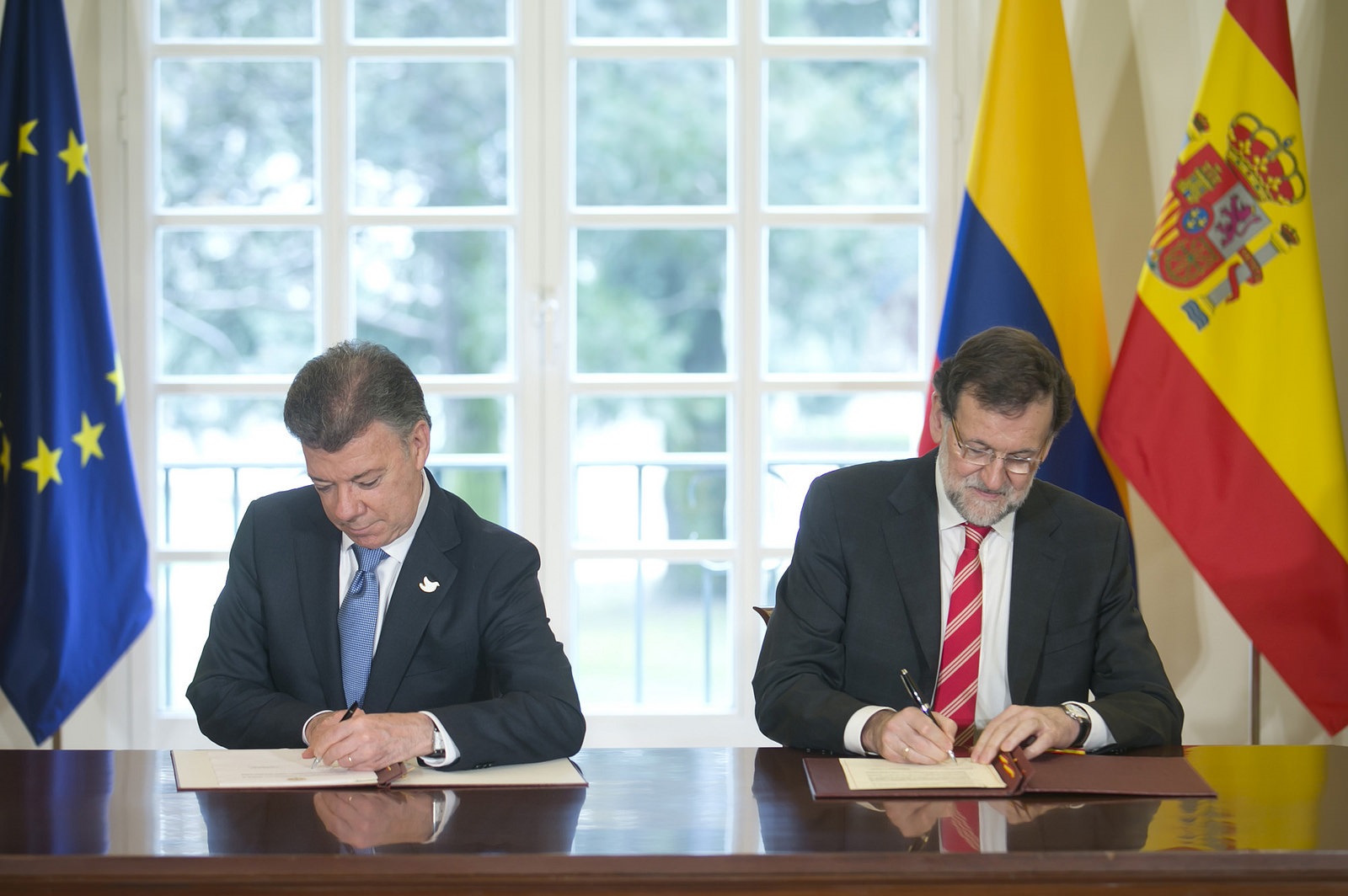
Pres. Mariano Rajoy (Spain) y  Juan Manuel Santos (Colombia), signing an agreement at the Palacio de La Moncloa. Photo Credit: La Moncloa Gobierno de España / Flickr / Creative Commons

Pres. Mariano Rajoy (Spain) y Juan Manuel Santos (Colombia), signing an agreement at the Palacio de La Moncloa. Photo Credit: La Moncloa Gobierno de España / Flickr / Creative Commons

Spain’s media, government ministries and academic specialists watch what they call Iberoamérica closely, but President Rajoy and other political leaders have adopted a lower policy profile in the region than in the past – and they appear unlikely to raise it soon.  Local observers stress that Spain’s interests in the region – preserving historic leadership and influence and building commercial relations – remain the same.  The Foreign Ministry’s website emphasizes the goal of achieving “relations based on equality and balance with all of the countries” in Latin America and to be the European Union’s “key agent” in relations with the region.  Spain also puts great stock in the annual Iberoamerican Summits, even though attendance can fall short of what it hopes for, such as in Veracruz, Mexico, last December.  Madrid rolled out the red carpet for Colombian President Juan Manuel Santos in February, during which both countries’ leaders spoke of their unstinting friendship and backing.  Spanish investment in Latin America has rebounded from the setbacks of the 2008 crisis and the bad odor left by Argentina’s nationalization of Repsol’s shares in the YPF oil corporation in 2012.  Trade has never been the mainstay of the bilateral relationship, but it too has been steady, according to local experts.

Neither of Spain’s two leading parties, however, has shown much interest in making relations as “special” as they like to say.  The frisson of excitement from President Obama’s decision to restore diplomatic relations with Cuba – arguably a validation of longstanding Spanish policy that engagement is better – did not last long.  Observers in Madrid say the government is neither concerned about new U.S. competition on the island, such as in the hotel industry, nor excited that Spanish companies will win big when U.S. tourists flood in.  After former President Zapatero met with Cuban President Raúl Castro late last month, current Foreign Minister García-Margallo accused him of “extraordinary disloyalty and … inappropriateness,” apparently for violating several Spanish protocols for former heads of government.  But Margallo’s pique was consistent with the Partido Popular’s longstanding chilliness toward Cuba (particularly under former President Aznar) and almost certain was aggravated by the fact that Raúl had stood him up for a meeting in Havana in November.  The two parties use similar rhetoric to condemn Venezuelan President Maduro’s increasingly abusive policies, but neither has provided creative leadership in finding solutions to the country’s impasse.  Former President Felipe González, of the Socialist Party (PSOE), has agreed to join the legal defense team of jailed oppositionists but apparently not counseled them on broader strategies.

Transient issues, such as frustration that investments might be nationalized, and widespread perceptions that Venezuela and other problem cases in Latin America are intractable probably lie at the heart of Spain’s preference to stay on the sidelines.  The shift probably also reflects Spanish leaders’ focus on internal priorities – an economy still reeling from the 2008 crisis and youth unemployment so high (over 40 percent in some regions) that there’s fear of a “lost generation.”  In important ways, Spain’s posture toward the region parallels Washington’s – showing fatigue or doubt at a crucial juncture in Latin America’s search for political and economic models as well as effective trading alliances.  Even though Latin American rhetoric tends to reject outside models for democratic transition and institution-building – including Spain’s – Madrid’s historical experience gives it potential advantages in dealing with the region’s political challenges.  Spain and the United States approach in Latin America are quite different – Washington tends to rely on programs to strengthen regime opponents as agents of change – but their strategic objectives in Latin America are complementary.  It would make sense for the two to team up in the region, cooperate in diplomatic strategies, and provide the sort of respectful partnership that many Latin Americans seem to yearn for.

March 31, 2015

Will Washington’s Attention to Latin America Last?

By Fulton Armstrong

Photo Credit: Prensa Presidencial Venezuela

Vice President Biden meets with Venezuelan President Maduro / Photo Credit: Prensa Presidencial Venezuela

U.S. President Obama, Vice President Biden, and Secretary of State Kerry gave Latin America increased priority in 2014, including at least two efforts to open channels to countries previously off their calling lists.  Issues combining domestic politics and foreign policy– such as immigration, Cuba, and drug policy – saw noteworthy breakthroughs.

  • President Obama’s highest profile action was his announcement in December that the United States and Cuba would normalize relations. He said he would travel to Panama in April for the Summit of the Americas – the venue of his pledge to seek a “new beginning” with Cuba in 2009 and his isolation over the Cuba issue in 2012.  Last May, his trip to Mexico and Costa Rica, where he met with Central American presidents, signaled a shift on counternarcotics strategy – downplaying militarized efforts – in response to the region’s concerns about surging violence.  His November announcement of executive measures on immigration, offering temporary legal status to millions of undocumented migrants, also steeped him in Latin America policy.
  • Vice President Biden greatly expanded his Latin America portfolio, at times as stand-in for Obama but also putting a deep imprint on policy. On an extended trip in June, he met with heads of state during the World Cup and attended a summit in Central America.  In November he participated in a followup meeting with the Honduran, Salvadoran, and Guatemalan Presidents hosted by the Inter-American Development Bank, where he announced U.S. measures to prevent another crisis involving migrant children as was seen last summer.  He met with and telephoned Latin American Presidents more than a dozen times over the year and, on the margins of Brazilian President Rousseff’s reinauguration last week, even met with Venezuelan President Maduro, with whom he agreed that it was time to restore ties.
  • Secretary Kerry traveled to the region several times – to Mexico, Panama, Peru, and Colombia – and met with Latin American Presidents and foreign ministers in Washington. Some critics judged his broad policy speeches as unexciting, but he clearly has confidence in his Latin America team, and sources say his support for the President’s initiative on Cuba was strong.

We Latin America watchers in Washington tend to complain that our region doesn’t get enough attention, but it’s clear that the Administration’s level of engagement in 2014 was deeper and more sustained than in years past.  Senior advisors at the National Security Council, Vice President’s office, and State Department – Ricardo Zúñiga, Juan González, and Assistant Secretary Roberta Jacobson, respectively – got their bosses’ to act despite the many competing demands in other regions occupying the front pages of U.S. newspapers.  Several ongoing processes promise continued senior-level attention in at least the first half of the new year.  The normalization process with Cuba could entail a visit there by Secretary Kerry, and preparations for the Summit of the Americas in Panama in April afford opportunities to give momentum to U.S. engagement – in addition to rebuilding U.S. credibility in the Summit process lost at the Summit in Cartagena in 2012.  Continued political crisis in Venezuela, nose-diving oil prices, progress in the Colombian peace talks, and the ever-evolving drug threat suggest 2015 will also be a challenging year.  For now at least, Washington’s senior team is engaged.

January 7, 2015

U.S.-Cuba: Rhetoric and Reality

By Fulton Armstrong

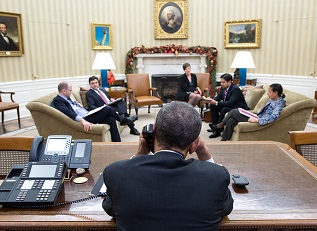
Obama speaks to Raul Castro / Official White House Photo by Pete Souza / Public Domain

Obama speaks to Raul Castro / Official White House Photo by Pete Souza / Public Domain

The decision by Presidents Obama and Castro to normalize relations is truly historic – for which they and their advisors deserve enthusiastic applause – even though both leaders’ rhetoric seems intended to suggest that they don’t know how deep the uncharted waters ahead run.  Their statements since last Wednesday sound solicitousness toward their right flanks.  President Obama launched his statement by proclaiming that the United States of America is changing its relationship with “the people of Cuba” and, while conceding that past strategies to “push Cuba toward collapse” have failed, cast his new policy as a better way of helping the Cuban people “enjoy lasting transformation.”  President Castro told the National Assembly this last weekend that he wasn’t jettisoning Cuba’s revolutionary project either.  Cuba is not going to give up, he said, “the ideas for which it has fought for more than a century and for which its people have spilled much blood and gone through the greatest risks.”

It’s true that the nature of the relationship is unlikely to change fast, and that neither President can ignore the legal strictures built up during 54 years of tensions.  Obama can’t lift the embargo and permit, for example, tourist travel without Congressional approval.  Cuba’s “Law 88 for the Protection of National Independence and the Economy of Cuba” remains on the books, and Castro’s not about to welcome the U.S. Government’s “democracy promotion” activities soon.  But normalization will significantly reduce both governments’ ability to restrain nongovernmental contacts and will unleash forces that will make the Presidents’ rhetoric look old-fashioned and unnecessary.  Both countries have to learn how to talk to each other, and time-tested people-to-people contacts show that citizens with shared interests are better than governments at learning the language of cooperation and problem-resolution – without ideological agendas.  It stands to reason that pressure will grow on Obama and Castro to pursue concrete interests, especially trade, and to manage their dreams, respectively, of “lasting transformation” and “updated communism.”

No model for this new bilateral dance is perfect.  China and Vietnam show that trade-driven economic change – even with U.S. most-favored-nation status – doesn’t necessarily drive a country to democracy.  An educated and healthy people with strategic needs, the Cubans are prepared to work hard to build their country, but they’re not going to work in factories with anti-suicide nets under the dormitory windows.  That sort of political awareness argues for change, but the Cuban revolution implanted in the Cuban psyche a certain set of values and expectations – ranging from social programs to an almost obsessive sense of dignity – that won’t always coincide with U.S. values.  The Cubans will want to go a la carte with us on political matters, and they, like every country of Asia and Latin America emerging from difficult times, will almost certainly expect us to give them the space to do change their own way.  The United States worked with Mexico under one-party rule for 70 years last century.  If Washington and Havana approach the challenge of building a healthy relationship with respect and open minds, they should able to find a middle ground and grow together a lot faster than that.

December 22, 2014

Who Will Attend the OAS Presidential Summit in Panama?

By Fulton Armstrong and Eric Hershberg

OAE-OAS & tgraham / Flickr / Creative Commons Attribution-NonCommercial-ShareAlike 2.0 Generic (CC BY-NC-SA 2.0)

OAE-OAS & tgraham / Flickr / Creative Commons Attribution-NonCommercial-ShareAlike 2.0 Generic (CC BY-NC-SA 2.0)

The Summit of the Americas isn’t until next April, but interest in how Panama as host handles near-unanimous pressure from Latin America to invite Cuban President Raúl Castro, and how the United States and Cuba will respond, is growing fast.  Speaking to reporters at the United Nations last week, U.S. Assistant Secretary of State Roberta Jacobson answered several questions on the U.S. position.  Key excerpts follow:

  • Asked “if the United States is still opposed to Cuba attending.”  On the Summit of the Americas, I think we’ve been pretty clear in our position on the summit, which is that obviously Panama is the host country for the summit, and as the host country they will make the decisions on invitations to that summit.  …  And the fact of the matter is we have said from the start that we look forward to a summit that can include a democratic Cuba at the table.  We also have said that the summit process, ever since Quebec in 2001, has made a commitment to democracy, and we think that’s an important part of the summit process.  But the decision about invitations is not ours to make, and obviously there’s been no invitations formally issued to the United States and other countries. And so there is no acceptance or rejection yet called for or made. …
  • Asked “is there a chance that the U.S. might refuse going.”  Again, I think you won’t be surprised to hear me say that we’re really not going to answer hypotheticals in the future yet.  Obviously, the Summit of the Americas is in April and that’s not a situation that we can answer, although I think we have made clear that we believe the summit process is committed to democratic governance and we think that the governments that are sitting at that table ought to be committed to the summit principles, which include democratic governance. And therefore that’s our position at this point.  Obviously, we have a position on Cuba which does not at this point see them as upholding those principles.

Panama’s likely invitation to Cuba – reflecting the consensus of 32 hemispheric nations at the last Summit – will draw protests from official quarters in Washington.  But it’s far from certain that the Obama Administration would risk blame for torpedoing the 20-year Summit process.  Obama survived a handshake with Raúl Castro at Nelson Mandela’s funeral last December, and being in the same room with him again as a President in the second half of his second term will have little political consequence.  A workshop in Mexico City in June, in which CLALS researchers participated, and another in Ottawa in September, sponsored by the Center and the University of Ottawa, explored likely outcomes.  Mexican international relations specialists speculated that a reasonable outcome was for the United States to show up like a polite guest, and thus avoid having the anachronism of U.S. antagonism toward Cuba overshadow its broader relations with Latin America.  Canadian experts were deeply concerned that Cuba’s inclusion might undermine the centrality to the OAS of the Inter-American Democratic Charter, but they agreed that failure to convene a Summit would constitute a serious blow to the OAS and to the regular summits that provide Canada a seat at the inter-governmental table.

The reality is that Cuba does not conform to the Democratic Charter or to the broader OAS criteria of democratic rule, but equally real is that Latin America sees Cuba as a full member of the hemisphere and has lost all patience with those in Washington who would deny that.  Either Washington — and Ottawa — set aside their objections to Cuba’s inclusion or they bid farewell to such fora and their constructive impact on regional relationships that ought to matter to them.  Moreover, if they acquiesce to Cuban participation but then try to commandeer the agenda and make the Summit a seminar on democracy and human rights, it will only reinforce the widespread sense in the region that Washington cannot move beyond its obsession with the trivial matter of Cuba and get on with a serious conversation among equal partners.  They would thus sacrifice an opportunity to discuss issues on which significant, substantive advances are possible through dialogue among leaders of countries throughout the hemisphere.  The value of the Summit rests with the capacity of all involved to act like grownups.  President Obama did so at Mandela’s funeral, and it will be telling whether he can do it again in Panama this coming April.

October 2, 2014

Latin America United Against Violence in Gaza

By Aaron T. Bell

Sergio / Flickr / Creative Commons Attribution-NonCommercial-ShareAlike 2.0 Generic (CC BY-NC-SA 2.0)

Sergio / Flickr / Creative Commons Attribution-NonCommercial-ShareAlike 2.0 Generic (CC BY-NC-SA 2.0)

Israel’s assault on Gaza this summer provoked sharp criticism from Latin American governments.  Condemnation came not only from Cuba, a long-time critic of Israel, and from Bolivia, Venezuela, and Nicaragua, which have been without diplomatic ties to Israel since cutting them after previous conflicts in Gaza in 2009 and 2010.  This summer’s UN-estimated 1,500 civilian deaths also provoked outrage from center-left governments, as Brazil, Chile, Ecuador, El Salvador, and Peru all withdrew their ambassadors.  At the Mercosur summit at the end of July, Brazil, Venezuela, Uruguay, and Argentina issued a joint statement in which they criticized Israel’s “disproportionate use of force…which has almost exclusively affected civilians.”  And one of the largest popular demonstrations worldwide against the Israeli action took place in Chile, home to hundreds of thousands of Palestinian descendants.

Latin American interest in Israeli-Palestinian affairs is deeply rooted in the past.  Waves of immigration beginning a century ago have made the region home to the largest Palestinian diaspora outside the Arab world.  Latin American governments provided crucial support for the 1947 UN Partition Plan for Palestine that led to the creation of the state of Israel, but they roundly condemned the occupation of the Gaza Strip 20 years later.  In the Cold War era, Israel provided military hardware to rightwing military regimes in the region while the Palestine Liberation Organization, more leftist than Islamic in its revolutionary views, lent political and economic support to the Sandinista government in Nicaragua.  Contemporary Latin American governments have taken a balanced approach in their relations with Israel and the Palestinians.  All but Colombia, Mexico, and Panama have recognized a Palestinian state based on national borders prior to the 1967 Arab-Israeli war, and trade with Israel has flourished.  Brazil is the top destination for Israeli exports, totaling over $1 billion per year.  In addition, Israel signed free trade agreements with Mercosur in 2007 and 2010; became an official observer to the Pacific Alliance (Chile, Colombia, Mexico, and Peru) in 2013; and in May 2014 approved a four-year, $14 million plan to boost trade with the PA nations and Costa Rica.  Israel’s recent efforts to further trade in Latin America ironically developed out of a desire to shrug off some of its dependency on Europe, where criticism of Israeli policy has become widespread and boycotts of Israeli goods are being organized by advocates of the Palestinian cause.

This summer’s fighting in Gaza chilled diplomatic relations between Latin American governments and Israel.  The Israeli Foreign Ministry described the withdrawal of Latin America ambassadors as a “hasty” decision that would only encourage Hamas radicalism, and it struck a nerve in Brazil when dismissing its “moral relativism” as an example of “why Brazil, an economic and cultural giant, remains a diplomatic dwarf.”  But both Israel and Latin America stand to gain from stronger economic ties, and with the exception of Chile’s suspension of trade talks, there are no pending signs that economic relations will suffer further now that this round of fighting in Gaza has come to an end.  The significance of this summer’s events lies instead in the autonomous decision by Latin American governments of all political stripes to act in favor of peaceful conflict resolution and the protection of civilians enveloped by the violence of war.  The Assad regime’s massacre of its own citizens in Syria in recent years provoked a more reticent condemnation from Latin America’s center-left governments and regional blocs, which backed a negotiated solution to the conflict while strongly opposing the possibility of foreign military intervention.  Without the specter of a wider conflict looming over this summer’s Gaza crisis, Latin American governments seized the opportunity to stake out a firmer position.  The region’s reaction to future atrocities – which may come sooner rather than later as the US prepares to battle the “Islamic State” in Syria and Iraq – will show how durable this new approach will be.

Sanctions on Venezuela: Why?

By Eric Hershberg and Fulton Armstrong

Photo credit: NCinDC / Flickr / Creative Commons Attribution-NonCommercial-ShareAlike 2.0 Generic (CC BY-NC-SA 2.0)

Photo credit: NCinDC / Flickr / Creative Commons Attribution-NonCommercial-ShareAlike 2.0 Generic (CC BY-NC-SA 2.0)


The sanctions against Venezuela that the Obama Administration announced last week respond to political pressure to punish alleged human rights violators in Caracas, but they have no immediately apparent policy objective.  The State Department announced that it has suspended the U.S. visas of “a number of Venezuelan government officials who have been responsible for or complicit in … human rights abuses” during protests earlier this year, which resulted in the deaths of at least 40 people, injury of hundreds more, and jailing of dozens of activists.  The Department did not release a list of sanctioned individuals nor divulge the information used to compile the list, but press reports indicate that 24 officials have been targeted and include cabinet members, presidential advisers, police, and military officials.  The sanctions do not affect bilateral trade or Venezuela’s place as the United States’ fourth biggest foreign supplier of oil.

U.S. condemnation of the Venezuelan government and the blacklisted officials has been strident, but there has been no public explanation of what Washington expects the sanctions to achieve.  The statements of U.S. Principal Deputy Assistant Secretary of State John Feeley, made to a Colombian radio station and reported by El Universal in Caracas, strongly suggest the sanctions are intended to show solidarity with the Venezuelan opposition and U.S. disapproval of the government of President Nicolás Maduro.  “Social protests have been a genuine war cry from people oppressed by the lack of democracy,” Feeley is reported as saying.  “The [sanctions] were intended to note that the U.S. cannot allow, for the sake of its values, that a supposedly democratic government represses the legitimate expression of the people’s voice.”  The State Department has not demanded, however, any particular action by Caracas to lift the sanctions, such as an investigation into the abuses, re-launching a national dialogue, or compensating victims.  Feeley suggested that the governments of Colombia and Brazil – with which he said the U.S. government had “meditated” about the issue – supported the sanctions, but regional support for them has been muted at best.  Indeed, the Administration had responded to last May’s House of Representatives vote in favor of sanctions by indicating that these would be counterproductive and could undermine efforts at mediation by these same countries.  The one dissenting voice in the House, Congressman Greg Meeks (D-NY), explained his vote as opposing unilateralism, adding that its passage was a message to Latin American governments that we don’t care what they think.

The Venezuelan government has repeatedly and credibly asserted that a significant portion of the violence has been perpetrated by protestors rather than the state or government supporters, and a number of officials have been charged.  Nonetheless, no U.S. sanctions have been brought against opposition members who planned or participated in violent actions.

Some observers have attributed the U.S. action to pique that Aruban and Dutch officials several days earlier rejected its request that they extradite to the U.S. Venezuela’s new consul in Aruba, a former chief of intelligence whom Washington suspects of trafficking in drugs with the Colombian FARC – despite Vienna Convention provisions regarding diplomatic immunity.  More likely, the sanctions are a reaction to a realization that the quixotic “salida” campaign, which many in Washington somehow imagined could bring down the Maduro government only months after it had won an election, had all but petered out, leaving the opposition in disarray and the government in a renewed position of strength.  Sanctions also are a bow to congressional pressure on the Obama Administration to act against Caracas, which has continued to grow even after the salida campaign has run out of gas.  Just hours after the sanctions were announced, Senator Marco Rubio issued a press release taking credit for them, and other conservatives – led by the Cuban-American congressional delegation – called for even tougher measures.  Without clear objectives, however, the sanctions seem to be mostly a moral and political statement – pushing relations into yet another dead end from which neither government is disposed to find a way out.  Indeed, Venezuelan officials, calling the sanctions “a desperate cry from a nation that realizes the world is changing,” are turning the diplomatic adversity to domestic political advantage, just as administration officials had wisely predicted in pushing back against the Congressional saber rattling last spring.

Venezuela: Vicious Cycle Continues

By CLALS Staff

Photo Credit: Cancillería Ecuador / Flickr / Creative Commons Attribution 2.0 Generic (CC BY 2.0)

Photo Credit: Cancillería Ecuador / Flickr / Creative Commons Attribution 2.0 Generic (CC BY 2.0)

UNASUR has shown energy and flexibility as a facilitator during the Venezuela crisis, but neither the government, nor its opponents, nor the opposition’s allies in Washington have matched it – prolonging the vicious cycle that’s been plaguing the country for years.  Speaking as UNASUR, the foreign ministers of Colombia, Brazil and Ecuador reflected the continent’s frustration when they threw up their hands this week and left Caracas after another failed attempt to get a national dialogue on track.  Their statements represented a balance between the UNASUR members that are generally perceived as tolerant of the Venezuelan government’s “Bolivarian” revolution and those perceived as opposing it.  They reiterated calls, issued officially in Suriname on 16 May, for both sides to “achieve a broad dialogue that permits Venezuelans, without interference, to reach an accord that guarantees peaceful coexistence and stability in the country.”

The government, opposition and Washington have not heeded the appeal by UNASUR and the Vatican’s nuncio to be constructive and patient.  The government’s attack on opposition and student camps in early May and subsequent arrest of more than 200 protestors highlighted the authoritarian tendencies that have given momentum to the demonstrations.  The Mesa de Unidad Democrática (MUD), representing important sectors of the opposition, gave the foreign ministers yet another list of demands – including a Truth Commission investigating rights violations (and not headed by the pro-government president of the National Assembly, Diosdado Cabello) and the selection of an entirely new National Elections Council.  The MUD’s executive secretary declared that he has no interest in participating in a peña or chit-chat session, and said, “The ball is in the government’s court.”  Although U.S. Assistant Secretary Roberta Jacobson said during a hearing that sanctions were premature (a statement that she attributed to “confusion”), the foreign affairs committees in both house of the U.S. Congress – without objection from the Obama Administration – have passed bills authorizing an array of punitive measures against Venezuelan officials.  The legislation also authorizes an additional $15 million dollars in aid to the government’s opponents.

The less overtly political agenda that first sparked the protests in February – soaring crime rates, rocketing inflation, and shortages of basic goods and services – has been overshadowed by the shouts of opposition leaders eager to force President Maduro from office and by Maduro’s defenses from the plotting against him.  Demands that Maduro negotiate with a foreign-funded opposition that has as its clear goal his removal as constitutionally legitimate president – something no head of state in the hemisphere would accept – naturally keep his bases on edge.  Political leaders on both sides manipulate popular opinion and claim el pueblo as supporting them.  Another of each side’s real strengths is its ability to portray itself as a victim of the unfairness of the other – because their victimhood rationalizes whatever actions they wish to take.  In that regard, the U.S. sanctions against the government and subsidies to the opposition play into Maduro’s hand.  Washington’s extra $15 million is a drop in the bucket for the well-funded opposition, but the U.S. support is as clear a signal as any of its desired outcome.  With both the United States and important segments of the opposition appearing to aim for nothing short of regime change, UNASUR is wise to step aside and see if anyone decides to get serious about ending the crisis.  Should the situation on the ground deteriorate further, however, UNASUR will probably ramp up its engagement and press both sides to make concessions in exchange for regional support.