Lula Is Back, But What About Brazilian Democracy?

By Fábio Kerche and Marjorie Marona*

Rally in Support of Lula/ Ricardo Cifuentes/ Wikimedia Commons/ Creative Commons License

Former Brazilian President Lula da Silva recovered his political rights last month when the Supreme Court overturned his convictions on corruption charges, but Brazil will need more than a simple court decision to restore the country’s confidence in its democracy and institutions after years of political turmoil.

  • The court ruled that the conduct and decisions of then-Judge Sergio Moro and the Operação Lava Jato (Carwash) investigators that landed Lula in prison were not impartial and, therefore, the justices invalidated the conviction of the former president (2003-2011). The case began to unravel in 2019 when a Brazil-based U.S. journalist, Glenn Greenwald, published leaked private conversations between Moro and the prosecutors showing a highly politicized agenda. The ruling reinforced the public perception that Lula was innocent and that Lava Jato was used as a political weapon against him and his Workers’ Party (PT).
  • The action opened the door for Lula to be a presidential candidate in 2022. It also demands restarting the trial from ground zero, but the consensus among legal experts is that a re-trial cannot be mounted before the election.

Lula’s return coincides with a period in which President Jair Bolsonaro faces enormous difficulties. The Senate is currently investigating his government’s alleged negligence in the 400,000 deaths caused by its COVID policies. Furthermore, the Brazilian economy is not recovering, as the Bolsonaro team asserts. Unemployment is over 14 percent, and hunger has reemerged as a perverse reality for millions of Brazilians. According to a Datafolha poll, only 24 percent of Brazilians consider the government to be good. Bolsonaro suffers from the lowest polls among presidents in the democratic period, except for Fernando Collor as he resigned in the face of impeachment.

  • The same poll shows that Lula would handily beat Bolsonaro in a presidential election – 41 percent to 23 percent among intending voters. In a second round, Lula would beat Bolsonaro 55 percent to 32 percent. Moreover, the public narratives pushed by Bolsonaro supporters trying to identify Lula as a radical left-winger are being put aside. The press, despite repeated attacks by the current government, portrays Lula as a much more reasonable alternative than Bolsonaro. Lula is emerging as a conciliator and a moderate center-left politician.
  • Attempts to build a center-right candidacy, a so-called terceira via (third way), seem to be getting little traction so far. The growth of center-right parties in the 2020 municipal elections is not being reflected at the national level, and the TV pop stars cited as potential 2022 Presidential candidates are not gaining momentum.  

Far from radicalizing him, Lula’s 580 days in prison seem to have softened his sharp edges, and his immediate full-time focus on looking for solutions to the COVID crisis fits his strategy of reminding the public that Brazil was a better country under his government. He is not in a rush to officially launch his candidacy, but he’s talking to several parties and leaders – even those in favor of Dilma Rousseff’s controversial impeachment and of Lava Jato, which portrayed the Workers’ Party as a criminal enterprise. He is also looking into possible alliances in state elections in exchange for broad support for his candidacy. There are indications that his vice-presidential running mate will be someone closer to the center-right, signaling that his government will be of reconstruction and not of polarization. But the path ahead isn’t necessarily easy for Lula. Bolsonaro has a group of loyal supporters and, even with a slow pace of vaccinations, there is a chance that all Brazilians will be protected from COVID by the end of this year, bringing hope for better times. Bolsonaro is also providing financial aid to the poor, which will help him recover voter share.

  • The 2022 election is perhaps the most critical test for Brazil’s fragile democracy since redemocratization. The Bolsonaro government, whose handling of national challenges has been highly problematic, continues to flirt with authoritarian measures. Civil and human rights are being weakened. Whether Bolsonaro ultimately succeeds in consolidating a regime of his own design or becomes merely a stumbling block in Brazil’s democratic history now looks likely to depend on a 75-year-old former president and former union leader who’s returned from prison to provide, yet again, an alternative to the status quo.

May 19, 2021

* Fábio Kerche is a professor at the Federal University of the State of Rio de Janeiro (UNIRIO) and former CLALS Research Fellow. Marjorie Marona is a professor at the Federal University of Minas Gerais (UFMG).

Chile: Will the Constitutional Assembly Move Democracy Forward?

By Patricio Navia*

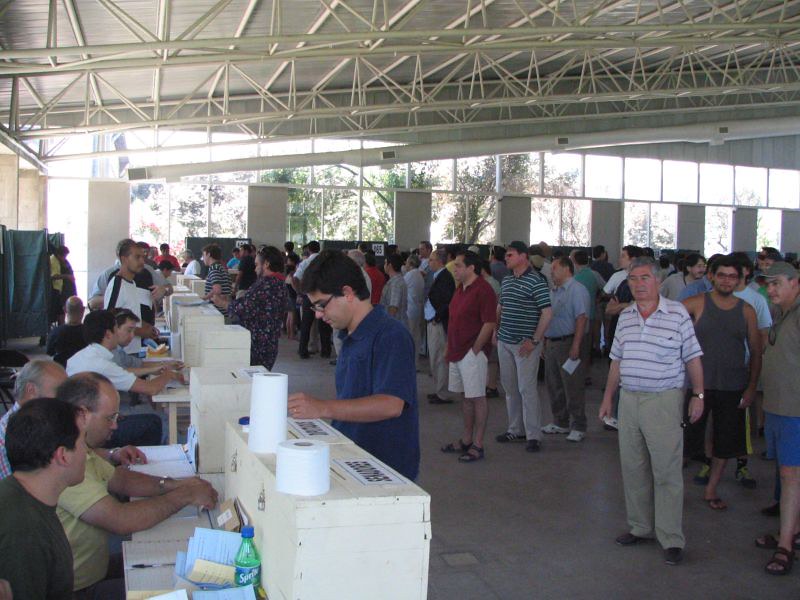
Polling place in Chile/ Atina Chile Elecciones 2005/ Flickr/ Creative Commons License

Chileans go to the polls this weekend to elect members of a constitutional assembly – empowered to write a new Constitution by a plebiscite last October – but unrealistic popular expectations in a highly political year appear likely to complicate its work and could result in a flawed document.

  • Almost 80 percent of the Chileans who voted last October (i.e., 80 percent of half of the country’s eligible voters) supported a rewrite of the Pinochet-era Constitution, promulgated in 1980. Voters also chose to elect a new 155-member assembly for the task, rather than form one from among prominent political and social leaders. The assembly will have nine months to draft the document (with an option for one three-month extension), which will be voted on in mid-2022.
  • Chile’s busy election calendar is likely to complicate the assembly’s work. Saturday and Sunday’s voting will also choose governors, mayors, and city councilors, and there are elections in November for Congress and a new President – threatening to create tensions and a perfect political storm that undermine the quality of the new magna carta. Some parties have already held internal primaries for their presidential candidates, and coalition primaries are scheduled for July 18. If no candidate receives at least 50 percent plus one of the votes in the first round of voting on November 21, the two leading candidates will compete in a runoff on December 19.

The flaws of the constitutional process itself are clear. One is that the guaranteed gender-parity condition (50 percent representation for men and 50 percent for women) risks a situation in which higher vote-getters are not seated. The assembly’s mandate also includes guaranteed representation for the indigenous – a noble goal that nonetheless could lead to distracting recriminations in a convention that, per the plebiscite, will require approval by two-thirds of delegates for every element of the new Constitution. The objective is to achieve what Chilean authorities have called “a high degree of consensus” but could actually put agreement out of reach.

  • In addition, the assembly will begin deliberations in late June, when the Presidential and Legislative campaigns will be underway. The new government will take office in March 2022, but the new Constitution will not be ready until the second half of 2022 – and ratified by an exit plebiscite even later. The new government will have to wait for over six months after its inauguration for the new Constitution to be finalized before it can begin to govern, and, even worse, the offices of those elected might not exist.
  • Another major challenge is disunity and, in some cases, a lack of vision in the traditional political parties. Parties of the right, which finally got out from under the shadows of the Pinochet dictatorship and problematic market reforms, now appear ill-prepared to lead as Chile enters a transition period. Despite two terms in office (2010‑14 and 2018‑22), President Piñera has not constructed a new model for the right in Chile and now, having lost much momentum, is unable to lead rightist parties sorely lacking leadership.
  • Polls indicate, however, that Chileans do not embrace the more state-oriented options espoused by the left. Citizens want robust social rights and a reliable social safety net – which the assembly will find easy to give them without having to identify funding sources – but studies show they strongly prefer a society based on competitive markets with the protections they get as consumers, preventing abuses and guaranteeing individual rights. The right has been unable to capitalize on these views and, ironically, has never been in such a position of weakness as it is now. When Chileans realize that the many promises of the Constitution cannot be materialized, they will feel cheated.

The plebiscite creating the constitutional assembly increasingly appears to have been an effort to exorcise the Pinochet government that wrote the 1980 Constitution – rather than a mandate for a new left-leaning model of governance. Neither will the new magna carta be a magic pill that will solve all of Chile’s problems, including inequality and deficient public health and private pension systems, as many voters undoubtedly wish. These unfulfillable expectations will weigh heavily on the assembly throughout this political year.

  • Failure of the assembly is not a foregone conclusion, of course. Even after we analyze the results of this weekend’s votes, we cannot rule out that the political parties and civil society might rise to the occasion of making the debate and drafting into a healing process. If President Piñera commits all his energy to leading his government and party until he steps down 10 months from now – a historic but difficult task for a lame duck with a checkered legacy – one challenge will be the balancing act between promoting his base’s agenda and reassuring others that their interests will be respected and included. For now, however, it’s hard not to conclude that Chileans underestimated the complexities that writing a new Constitution would entail, especially producing one that meets the high expectations of a people hungry for solutions.

May 14, 2021

* Patricio Navia is a sociologist and political scientist at New York University and professor of political science at Universidad Diego Portales in Santiago.

El Salvador: Eastern Region’s Weak Democratic Political Culture

By Rodolfo Mejía-Dietrich and Adán Mendoza*

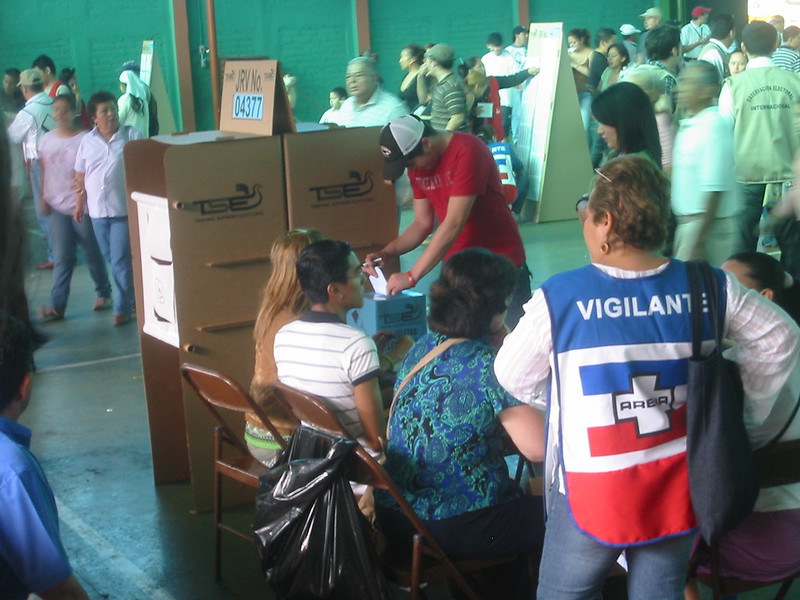
Polling place in El Salvador/ Amber/ Flickr/ Creative Commons License

El Salvador has made important democratic progress since the peace accord ending its bloody civil war in 1992, but the country still suffers from a profound deficit in citizens’ exercise of their rights and fulfillment of their democratic obligations – creating a serious risk of authoritarian practices and impunity by groups in power.

  • While President Nayib Bukele’s actions have catalyzed debate in the capital about democratic stability, surveys and research in the four departments of El Salvador’s eastern region show that low levels of interest in essential elements of democratic culture – community organizing; oversight of government operations; requests for public information; demands for public accountability; and efforts to root out corruption – are limiting direct and institutional democracy. This is among the key findings of surveys of 1,073 persons of diverse demographic groups by our center, the Centro de Investigación para la Democracia (CIDEMO) at the Universidad de Oriente.

Salvadorans have not lost faith in democracy as a system that, despite imperfections, would best serve their and the nation’s interests. But our surveys, conducted in September 2019, confirm that citizens are deeply frustrated with the country’s failure to achieve it. The country has at times shown the trimmings of democracy, but its political culture remains largely unchanged.

  • Confidence in democracy has been battered by citizens’ belief that the government is unable or unwilling to grapple with their daily challenges. Crime and personal insecurity, at 42.5 percent, are the problems at the top of citizens’ concerns. Poverty and unemployment are also major problems, respectively ranking 13.7 percent and 11.5 percent in the survey.
  • Despite the scourge of crime, the government institutions charged with combating criminal groups enjoy significant popular legitimacy; our polls show the military enjoys 81.2 percent popular confidence and the National Civilian Police, 72.2 percent. But those responsible for building and ensuring democratic practice do not. The Asamblea Legislativa polled at the time as the institution with the lowest level of confidence, and the Tribunal Supremo Electoral, upon which the credibility of elections depends, scored 56 percent.
  • At a little less than 5 percent, corruption ranked significantly lower as people’s greatest immediate concern, but other research indicates that it causes broad citizen apathy toward civic participation. There are widespread perceptions that opportunities to reduce corruption have been repeatedly blocked by those who most benefit from it. These conclusions coincide with those of Transparency International, which in 2019 ranked El Salvador 113 out of 180 countries (with 34 of 100 possible points). Among relatively stable countries, it is among the most corrupt in the world. Slightly more than 90.6 percent of citizens CIDEMO polled support the creation of an international commission against impunity (CICIES), which President Bukele promised during his campaign.

Nearly 30 years after the country started its juridical-institutional transformation, the same hindrances to effective democracy – high levels of poverty, precariousness (vulnerability), and inequality – remain colossal challenges to building a system of social participation, civic education, and inclusion. The country’s relative stability over the past two decades, certainly compared to the war years, disguise the underlying popular sense that the system has failed to serve them. The Oriente of El Salvador is far from the capital, San Salvador, and thus does not benefit from much of the country’s economic activity, and it has lost a great number of migrants seeking a dignified life elsewhere. But other research around the country shows its citizens’ frustration is not unique, as further documented by the World Bank and others that have found that about half of all households countrywide lack the conditions of dignified wellbeing.

  • The fundamental challenge for CIDEMO is to promote dialogue between citizens and emerging leaders to encourage citizen participation and to build capacities in civic education aimed at favoring the goal of expanding the exercise of citizens’ rights and duties. Our wager is that equality and freedom are critical wellsprings of advancing toward optimal levels of democratic governability.

* Rodolfo Mejía-Dietrich and Adán Mendoza are, respectively, the director and fulltime researcher at the Centro de Investigación para la Democracia at the Universidad de Oriente in San Miguel, El Salvador. This article is adapted from their recent study, Democracia, gobernabilidad y corrupción: Estudio de la cultura política en la región oriental de El Salvador. CLALS is providing technical assistance to CIDEMO under a USAID subaward that has made this UNIVO initiative possible.

Latin America: Impact of the January 6 Insurrection at the U.S. Capitol

By Ilka Treminio Sánchez, Fábio Kerche, and Esteban De Gori*

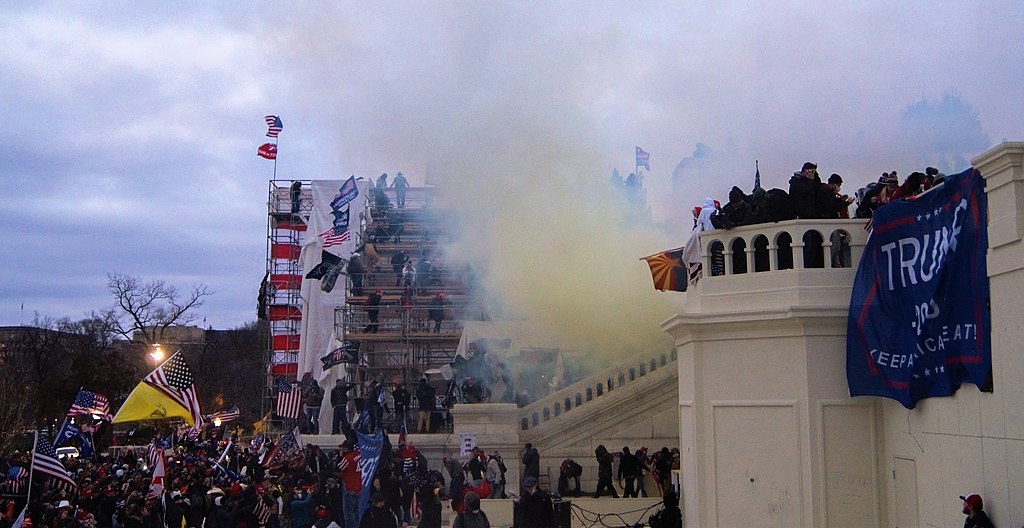
Tear gas outside the U.S. Capitol on January 6, 2021/ Tyler Merbler/ Wikimedia Commons/ Creative Commons License

AULABLOG invited three Latin American experts to comment on the impact of the events in Washington, DC, last month on U.S. relations with the region.

Ilka Treminio Sánchez*

During the Trump Administration, the United States revealed regrettable signs of institutional erosion and democratic backsliding. The political engine that allowed and promoted these actions was based on polarizing political discourse that shaped a hostile atmosphere toward Trump’s and his supporters’ opponents. This behavior escalated to the point of attacks on the electoral results and the violent assault on the Capitol by Trump’s followers on January 6, the day Joe Biden’s victory was certified. The insurrection failed as institutions upheld the legitimacy of the electoral process and the popular will of the citizens.

For Latin America, and for Central America specifically, this episode signifies the rupture of the myth of democratic exceptionalism in the United States. It reveals U.S. fissures and defects that are characteristic of the hemisphere’s weakest democracies. Central America has many times experienced authoritarianism, populism, violence against the adversary, social violence against ethnic groups, attacks on Congress, and attempts to alter electoral results. The Trump Administration’s actions have seriously damaged the United States’ image as a country that guarantees democracy – and its future governments could lose moral authority in the region on this matter.

  • The January 6 assault could give new life to undemocratic “zombie ideas” in Central America, undermining progress in political and civil rights made in the last decades. It could further embolden efforts to weaken election processes and increase presidential authoritarianism already present in the region.

Fábio Kerche*

The insurrection at the U.S. Capitol and President Trump’s campaign to overturn the electoral results were a sad scene for more than just the United States. Democracy is the regime in which a government can be defeated in an election and then leaves office peacefully. The events in Washington revealed that, even in a country in which democracy was a consolidated regime, it is vulnerable – with profound implications for younger and more fragile democracies worldwide. This includes Latin America and particularly Brazil.

  • It is important to remember that the Brazilian political crisis started when the runner-up in the 2014 presidential elections challenged the results. Fortunately, the U.S. political institutions were still strong enough to overcome the impasse in Washington. The United States’ most recent crisis gives Latin Americans cause to consider what should and should not be done to protect and consolidate democracy across our continent. In Brazil, where President Jair Bolsonaro is trying to reproduce Trump’s style, the failure of the U.S. Capitol insurrection – and the triumph of the country’s Constitutional order – should discourage any imagining that there is a way out of democracy.

Esteban De Gori*

The insurrection was undoubtedly shocking for South America. No government and no citizenry had imagined that a group of persons could occupy the U.S. Capitol as they did, nor that challenges to U.S. electoral processes could be so intense. Among the most powerful events: persons supported by the President overrunning the building and deepening the runaway polarization; the struggle of the democratic system to overcome the challenges to the electoral competition; and, perhaps most profoundly, the erosion of popular faith in the system. Leaders in most of Latin America, with the exception of Venezuela and perhaps others, showed concern and surprise. A crisis afflicting a great geo-economic player in the context of a pandemic and trade war with China could bring greater uncertainties and risks and, especially now, few opportunities.

  • The insurrection and the singularly belligerent government of Donald Trump are not the only things driving reassessment of the United States as a promoter of democracy and the rule of law. Since 2008, to take the financial crisis as a point of reference, doubts about the effectiveness of the country’s political system have deepened. That discomfort helped bring Trump to power as it eroded faith in the political system and its ability to balance desires and demands. The early statements and actions of the Biden Administration suggest awareness of this discomfort and willingness to begin addressing it.
  • The events (and Biden’s efforts to overcome them) do not appear likely to significantly change the U.S. relationship with Latin America. The pandemic and other challenges to democracy have placed extraordinary pressure on the region’s leaders, for whom the images of U.S. insurrection may have engendered even a certain empathy. They now know that parliaments and democratic institutions can be illegally occupied; that debate can go horribly awry; that polarization can seriously deepen in any country of the hemisphere.
  • More than the turmoil in Washington, the pandemic and its economic consequences appear likely to influence U.S.-Latin America relations. Joe Biden will probably remain focused on the country’s customary interests in the region – no great changes – although with less belligerence than Donald Trump. China, the other great regional power, will continue to promote its position without big conflicts or stridency. Even if the United States retains its economic edge in Latin America, its problems – and China’s gradual expansion in the region – put Washington on the downward path typical of a great power in decline.

February 11, 2021

* Ilka Treminio Sánchez is the director of La Facultad Latinoamericana de Ciencias Sociales (FLACSO) in Costa Rica, and a lecturer and researcher at the University of Costa Rica, specializing in electoral processes, political behavior, presidential reelection, and Latin American comparative politics.
* Fábio Kerche is a professor at UNIRIO and IESP-UERJ in Rio de Janeiro. He was a CLALS Research Fellow in 2016-2017.
* Esteban De Gori teaches sociology at La Universidad de Buenos Aires and is a researcher at Argentina’s Consejo Nacional de Investigaciones Científicas y Técnicas (CONICET).

Chile: Finding a Path to a New Social Pact

By Pablo Rubio Apiolaza*

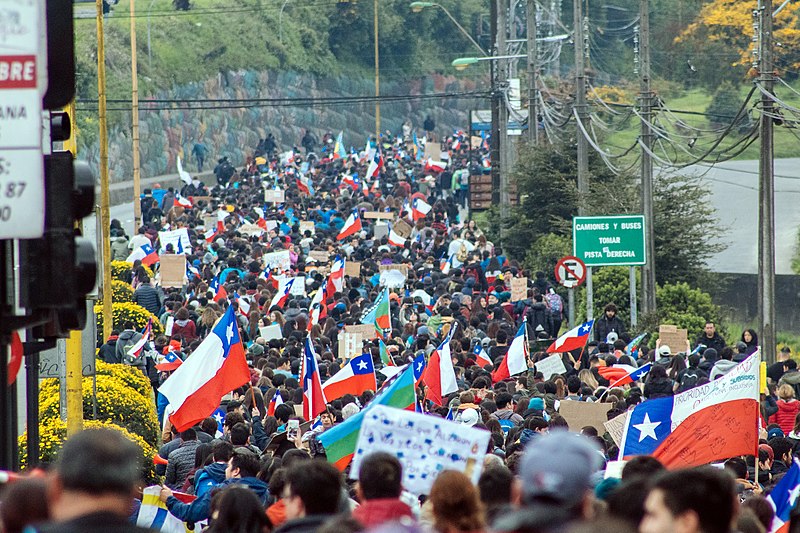
Chileans demand constitutional reform/ Jose Pereira/ Public Domain/ Creative Commons License

Chile’s constitutional plebiscite on October 25 has calmed the aftershocks of the political earthquake that began with social protests one year earlier, and optimism is currently high that the two-year process of drafting and approving a new Constitution will help the country establish a much-needed new social pact.

  • The October 2019 demonstrations and the government’s response – including violence perpetrated by both sides – were a shock to Chilean society. The Carabineros were found to have committed serious human rights violations. A political negotiation between the government and opposition signed the following month included an agreement to hold a national referendum on the country’s Constitution, which has remained in force since 1980, when Gen. Augusto Pinochet ruled the country.
  • That accord and the COVID‑19 pandemic that hit Chile several months later diminished the social protests. The plebiscite originally was to take place in April, but was delayed, initially without contention, due to coronavirus. Nevertheless, in the campaign in the runup to the vote, social conflict flared up between the supporters of changing the Constitution (Apruebo) and those who wish to preserve it (Rechazo). Clashes between protesters and Carabineros ensued. The violence has little support among Chileans, however. According to a mid-October survey by Plaza Pública Cadem, a Chilean polling firm, around 73 percent “reject the violence in the protest,” and only 25 percent think “violence is legitimate for achieving social change.”

The October referendum provides an institutional framework and legitimizes mechanisms for resolving the social conflict or at least reduce it. The overwhelming margins of the vote eliminated challenges. According to official results, Apruebo won 78.2 percent, with landslides in all 16 regions of the country, even in conservative and right-wing areas like La Araucanía in the south. Overall, Apruebo won in 341 of the 346 comunas of the country.

  • The vote also showed Chilean people support an elected “Constitutional Convention” (79 percent in favor) to draw up a new Constitution, rather than a “mixed” convention with current members of Congress comprising half its delegates. The convention will have 155 members, with equal amounts of men and women, elected by popular ballot next April.
  • While only 50 percent of eligible voters turned out for the referendum, there is no doubt that the results reflect the preferences of the population. The most votes in Chilean political history were cast, with 7.5 million electors. According to an exit poll by Plaza Pública Cadem, 85 percent of young voters supported Apruebo. In the same poll, supporters said their primary reason was to “guarantee fundamental social rights like health, education and pensions.”
  • Congress is discussing some changes to the Convention scheme approved by the plebiscite, such as assigning a number of “reserved seats” to indigenous, who the last census determined to be 12.8 percent of the Chilean population. There apparently is a consensus to move this reform forward.

The referendum has dealt a peaceful but grievous blow to the legacy of Pinochet 30 years after he left office, and opens the way for Chile to achieve a new social pact. The plebiscite has helped reduce protests and violence in the short term, and it represents the beginning of a long process ushering in a new era for Chile. Between now and the 2022 scheduled date for another referendum on the text of the new Constitution, the country will have to elect delegates, in April, whose work will include between nine and 12 months of debate and negotiation.

  • Meanwhile, President Sebastián Piñera, who steps down in March 2022, has to grapple with the immediate needs and social demands resulting from the pandemic and Chile’s other challenges. He remained neutral in the referendum, but his administration has been seriously weakened by the protests and their aftermath; his support in the polls is about 18 percent. He is trying to reform the Carabineros, pressing it to improve its human rights record and accept greater civilian and democratic control, and he recently replaced the senior commander and the Minister of Home Affairs, but reform implies a radical change in the force’s institutional culture.

November 11, 2020

* Pablo Rubio Apiolaza is a Chilean historian and researcher at the Library of Chilean Congress. Until recently, he was Visiting Researcher at Georgetown University.

Why Are Chile’s Protests Continuing?

By Pablo Rubio Apiolaza*

protests in chile

Protests began in Chile October 2019/ Diego Correa/ Flickr/ Creative Commons License

Chile’s political agreement in November to hold a referendum on the country’s Constitution in April reduced protests for a while, but the underlying causes of discontent – deep-seated frustration among many Chilean citizens – continue to fester and drive an array of peaceful and violent protests. Since November, President Sebastián Piñera has promoted an aggressive social agenda, including raising the minimum wage and improving the pension system. A survey by the Center for Public Studies (CEP) in Santiago in early January, however, found that Piñera’s approval rating was around 6 percent – the lowest of any president since Chile’s return to democracy. By almost all accounts, distrust in the government and anger at the corruption of politicians and corporations remains deep. People want solutions “here and now” to many of their demands. Both peaceful and violent protests have continued through the traditionally quiet summer break.

The mobilizations are not as spontaneous as they were in October and November, according to many observers, but there’s little evidence of a conspiracy to disrupt the referendum agreement.

  • Trade unions and traditional social movements organized under the banner of the Mesa de Unidad Social have become important actors, but new activists have also emerged. The loosely organized “Primera Línea” (front line) has engaged in violent clashes with the Carabineros, mainly in Santiago. Anthropologist Magdalena Claude observed and interviewed some members of Primera Línea in January and called them the “ACAB clan,” borrowing an acronym popularized by British punk rockers proclaiming that All Cops Are Bastards. According to Claude’s research, the group is composed of young workers of the service sector, not members of political parties. They do not have a recognized leadership and organize in horizontal networks.
  • Some conservative Chileans are denouncing the protests as the result of “foreign intervention” and a “coup d’état” provoked by the “extreme left.” They cite as evidence a New York Times report on January 19 that the U.S. State Department estimated that nearly 10 percent of all tweets supporting the October protests originated with Twitter accounts that appeared to have links to Russia. Allegations of foreign intervention by Venezuela and other countries have been endorsed by Chilean Foreign Minister Teodoro Ribera and President Piñera. Neither the U.S. nor Chilean government has provided evidence to support any of these claims.

Damage to the government’s credibility and reputation since October seems likely to continue to embolden opponents in the runup to the referendum. Carabinero abuses have been verified and condemned by a host of observers, including Human Rights Watch, Amnesty International, the Inter-American Commission on Human Rights, and various Chilean organizations. The UN High Commissioner for Human Rights, led by former Chilean President Michelle Bachelet, has detailed “multiple allegations of torture, rape and other forms of sexual violence by the police against people held in detention.” More than 30 people have died in protests and, although the great majority of the tens of thousands of protestors detained have been released, anger over their arrest is fresh. The government has convened 15 experts to develop recommendations to reform the Carabineros – to enable them to move “forward with urgency the recovery of the public security with absolute respect for human rights” – but challenge of building public trust will be monumental.

  • A prestigious Chilean polling firm, Cadem, reported two weeks ago that 63 percent of the Chilean population approved of the protests and – importantly – 80 percent believe that Chile will be a better country after this critical situation. In any case, the plebiscite in April will take a place in an unstable context, with an uncertain outcome. For the Piñera administration, the challenges seem unlikely to abate, and pressures may surge when the school holidays end in March.

February 19, 2020

* Pablo Rubio Apiolaza is a historian, visiting researcher in the Department of History at Georgetown University, and researcher at the Library of Chilean Congress.

Chile: Can the Constitutional Plebiscite Lead to a New Social Contract?

By Peter M. Siavelis*

An agreement between the Chilean government and opposition to hold a referendum in April on whether to scrap the current Constitution — legacy of the Augusto Pinochet dictatorship — has helped reduce tensions throughout the country and signaled that stakeholders are willing to compromise in order to reestablish Chile as a model of stability in a tumultuous region.

  • The most significant, violent, and deadly protests since the end of the Pinochet era exploded in Chile on October 20, after several years of simmering protests and social discontent. The protests, accompanied by looting, attacks on property and infrastructure, and 23 deaths, represented a turning point. Widely billed in the press as sparked by opposition to increased transport fees, this social mobilization represents a much wider demand for a fundamental rewriting of Chile’s prevailing social contract. It shocked the international community and Chileans alike, challenging the idea that Chile was a model of peace and economic development in a regional sea of economic crisis and social conflict.
  • The initial response of center-right President Sebastián Piñera’s government only created more conflict. Calling protestors delinquents and terrorists, and contending the country was at war with itself, he conjured uncomfortable parallels with the dictatorship. Widespread evidence of human rights abuses by police and security forces reinforced these parallels.

Piñera eventually bowed to public and elite pressure and announced a set of immediate reforms, including boosting the minimum wage and pension payments, cutting the price of medicines, lowering public transportation costs, slashing electricity prices, implementing higher taxes for the rich, and reducing the salary of members of congress, who are the highest paid in the region. For the longer term, Piñera acquiesced — one month after the initial explosion of protests — to a process to potentially scrap Chile’s 1980 Constitution, which was also the target of protesters’ ire. The agreement, dubbed acuerdo por la paz y una nueva constitución, grew from intense negotiations between the government and political parties. It was approved in Congress by a wide margin (127 in favor, 18 against, and 5 abstentions).

  • The legislation establishes that on April 26 a nationwide plebiscite will ask Chileans whether they want a new constitution and how it is to be drafted, with two simple questions: if the voter wants a new constitution, and, if so, if the voter prefers a “Constitutional Convention” or a “Mixed Constitutional Convention.” The former will entail a constituent assembly of citizens elected by the population, and the latter a body of one-half members of Parliament and one-half private citizens.
  • Most polling shows over 80 percent of Chileans in favor of a new constitution, and a large majority of those preferring a constitutional convention — an indication of the low regard in which Chilean politicians are held by the public. Whatever mechanism is eventually used, a second plebiscite will be held at a date to be determined for ratification of the new constitution.

The agreement left elements of both sides dissatisfied. The right grudgingly accepted the arrangement, but its more extreme elements remained concerned that a Constitutional Convention will establish social guarantees similar to those of Venezuelan Chavismo and undermine social peace and Chile’s development. More progressive signatories of the agreement added their support, thrilled at the prospects of doing away with the authoritarian constitution, but were concerned it did not go far enough to offer guarantees of gender parity or reserve representation for Indigenous groups and independents.  The Communist Party and a smattering of small parties refused to sign because they wanted deeper reforms.

For now, the immediate reforms and the acuerdo have calmed the pace and tenor of protests, and most accounts point to a peaceful plebiscite in April. This constitutional moment is a big one for Chile. Given the government’s recognition of the severity of the crisis, there is no reason to doubt its sincerity to make the plebiscite go smoothly and provide a framework for moving peaceably forward. If the plebiscite is successful, Chileans will achieve what was nowhere on the horizon only months ago: a definitive end to the Pinochet constitution, one of the dictatorship’s most objectionable legacies. This change will be followed by a reconfiguration of Chile’s fundamental social pact and reforms to its extreme form of neoliberalism, which has created staggering economic and social inequality at the root of these protests. However, for Chile to reestablish its status as model of economic development and social peace, it will have to walk a careful line between reform between competing interests and reestablish some sense of order and predictability after what undoubtedly has been Chile’s most significant social convulsion since the end of the dictatorship. The strength of Chile’s democratic institutions and its political class — which is fundamentally different than others in the region in terms of political skill, respect for the rule of law, and relative probity enhances the possibilities that the country will be able to walk this line.  

January 9, 2020

* Peter M. Siavelis is Chair and Professor in the Department of Politics and International Affairs, and Associate Director of the Latin American and Latino Studies Program at Wake Forest University. His most recent edited book on Chile, with Kirsten Sehnbruch, is Democratic Chile: The Politics and Policies of a Historic Coalition.

Latin America: Total Chaos?

By Carlos Malamud*

47389747662_9be46749b5_z

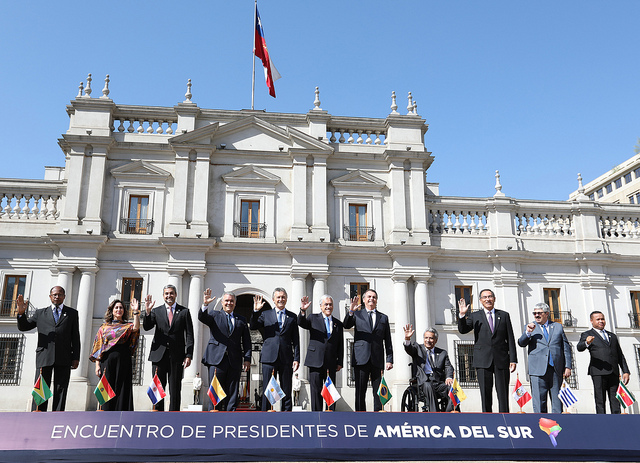
South American Presidents waving to the cameras in Santiago, Chile / Flickr / Creative Commons

Democracy and democratic values are in crisis throughout South and Central America, but the causes – and solutions – vary across the region, with rays of hope that at least some countries will find their way forward. The Bolivian elections, plagued by suspicions of fraud, reflect some of the problems that affect all of Latin America. The previously unbeaten President Evo Morales, in government since 2006, has now shown his limits and, even if his election is confirmed, will govern without the parliamentary majorities he enjoyed in the past.

  • Latin America witnessed violent protests almost simultaneously in Ecuador and Chile; Mexico blinked during a confrontation with the son of narcotics kingpin Chapo Guzmán; the Congress was dissolved in Peru; an ex-President in the Dominican Republic denounced as fraudulent the primary election he lost and joined another party to be its candidate; and a massive exodus continued pouring out of Venezuela, whose crisis is terminal but without an expiration date.
  • The Argentine and Uruguayan elections on October 27 marked the end of a three-year cycle of elections during which 14 countries voted to elect or re-elect their presidents. Speculation was originally that a swing to the right would counteract the Bolivarianism of the previous swing to the left. That shift never happened. In its place, a more heterogeneous and divided Latin America emerged, reflected in the outcome of the Argentine and Uruguayan elections, and in the not-insignificant fact that Mexico is governed by Andrés Manuel López Obrador while Brazil, the other regional power, has Jair Bolsonaro.

The causes of this wave of divisiveness are the subject of different theories. Many observers speak of a Castro-Chavista conspiracy, orchestrated by Venezuelan President Nicolás Maduro and the leftist São Paulo Forum. Others think it’s a popular reaction to the drastic adjustment programs of the IMF. Yet others argue about a contagion factor and the impact of social networks, which enable real-time communication and the transfer of vivid images of events. Nonetheless, any theory that tries to harness all of these theories will be flawed because each national reality is responding to different logic and dynamics.

  • All of the countries of the region are experiencing inequality, poverty, corruption, violence and narco-trafficking, unhappiness with democracy and its institutions, rejection of politicians, and the impact of the “new politics” of social media and fake news. But they are not present to the same proportions.
  • Neoliberal, Bolivarian, and populist governments are all suffering from rebellions. The Chilean protests over transportation fees under neoliberal President Piñera were preceded by protests in Brazil in 2013 under progressive President Dilma Rousseff. If Piñera resorts to military force to stop the protests, Nicaraguan President Daniel Ortega did something similar in 2018, killing more than 300. The IMF might have been behind the reduction of fuel subsidies in Ecuador, but it had no role in Chile. While elections went as normal in Argentina and Uruguay, in Bolivia, like in Venezuela, the allegations of fraud have been constant.

The solutions to each country’s challenges will have to be as different as their causes. While one country needs deeper economic adjustment, another needs to fix its political institutions. Each is going to have to find its way through the crises. Latin America will find little solace, moreover, in the fact that this high level of conflict is not exclusive to its region. From Hong Kong to Cataluña, or in Libya and Lebanon, similar challenges are disrupting national life.

  • Amid the many indications that representative or liberal democracy is under direct attack – that we may be facing the end of an era with potentially dire implications – some positive notes are visible in Latin America. In addition to the orderly contests in Argentina and Uruguay, the local and regional elections in Colombia in late October were an effective exercise in democracy – won by the center and lost by the extremes. Uribismo on the right and Gustavo Petro on the left were the big losers. The emerging symbol was Claudia López, the first woman elected mayor of Bogotá, who is also a lesbian, environmentalist, and leader against corruption. The path ahead is certainly not going to be easy for Latin America, but there is evidence that, with a big dose of tolerance and respect for each other’s reality, Latin Americans can do a lot better.

November 5, 2019

* Carlos Malamud is Senior Analyst for Latin America at the Elcano Royal Institute and Professor of Latin American History at the Universidad Nacional de Educación a Distancia (UNED), Madrid. A version of this article originally was published as Turbulencias latinoamericanas in El Clarín of Buenos Aires.

Brazil: How Long the Nightmare?

By Luiz Carlos Bresser-Pereira 

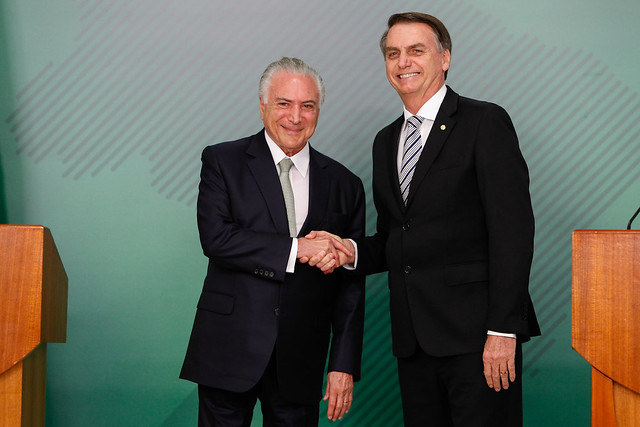
Current Brazilian President Jair Bolsonaro shaking hands with former President Michel Temer

Jair Bolsonaro (right) meeting with former Brazilian President Michel Temer (left)/ Flickr/ Creative Commons/ https://www.flickr.com/photos/micheltemer/45044560194

The decline of Brazil’s democratic culture since 2013 has thrust the country into nightmarish times from which only its ample civil society, if mobilized, can rescue it. The media daily reveal evidence that many Brazilians now celebrate violence, irrationality, torture, racism, and the demeaning of education, science and culture. We are witnesses to a blend of authoritarianism and radical economic liberalism, explicit subordination to the United States, and abnormality and evil.

  • Many Brazilians long nostalgically for the 20 years behind us, when two parties – one left- and another right-of-center – alternated as incumbents. They were subject to hits and misses, achieved good and bad outcomes. Each side swore that its policies and results were the best, but they were democratic, and they knew the meaning and rules of politics. Until 2013, politics was not a bitter fight between enemies that hated each other, but a compassionate fight between mutually respectful adversaries.

The two adversaries were the Social Democracy Party (PSDB) and the Workers’ Party (PT) – one standing for liberal orthodoxy, the other for distributive orthodoxy. The former put its chips on the markets, the latter on industrial policy. The PT achieved greater growth because it increased public investment and benefitted from the commodities boom of the 2000s, but the two administrations fell into the macroeconomic trap of high interest rates and an appreciated exchange rate that prevented private-sector investment.

  • On the fiscal level, after the financial crisis of 1998, the two administrations posted satisfactory primary surpluses up until 2013. Crisis in 2014 changed all that. Commodities prices plunged; a fiscal crisis ended surpluses and caused a large primary deficit; manufacturing firms were unable to turn a profit because of an overvalued real that flooded the domestic market with imports and caused excessive corporate indebtedness.

The political crisis might have been resolved or partly addressed if the opposition had won in 2014. The reelection of President Dilma Rousseff deepened it instead as her new term began with no support whatsoever from the economic elites.

  • During his brief period as Minister of Finance, Nelson Barbosa attempted to counter the fiscal crisis with a sharp current-spending cut, while increasing investment. Instead, the country returned to an absurd procyclical policy that persists to this day and keeps unemployment at unacceptable levels.
  • These mistakes were the fruit of the deep political crisis that since 2013 put hatred at the heart of political life. Although classic liberalism is defined by tolerance and some level of relativism concerning truth in politics, a form of intolerant liberalism emerged among the liberals, and Luiz Inácio “Lula” da Silva (president in 2003-2010) and the PT were turned into enemies, even if they were simply adversaries. The leaders of the Lava Jato (Car Wash) investigations took advantage of this hatred for self-promotion. Michel Temer, vice president under Lula’s successor, Dilma Rousseff, took advantage of it to take over, using his “A Bridge to the Future” plan as an instrument. President Jair Bolsonaro, who took office on January 1 this year, harnessed the hatred to win last year’s elections, while relying on economist and investment banker Paulo Guedes as an assurance of a neoliberal economic policy.

For nine months, governmentlessness has resulted, with little or no prospect of a return to right-of-center liberalism or left-of-center developmentalism. Brazil does not appear headed back to the path of normalcy and a healthy alternation of moderate and democratic parties. Brazilians do not know where they are headed, but one thing for sure is that the rule of law and democracy are facing very severe risks. Only a far-right minority truly identifies with the incumbent administration’s policies. But Brazil’s civil society is already well organized, with a working class, a middle class, and a varied and qualitative business class. These are the assets that could help the country overcome the nightmare into which it has plunged. 

September 24, 2019

* Luiz Carlos Bresser-Pereira is emeritus professor of the Getulio Vargas Foundation, has served as government minister in several Brazilian administrations, and is author of numerous books and articles catalogued at www.bresserpereira.org.br.


Latin America: The Perils of Judicial Reform

by Aníbal Pérez-Liñán and Andrea Castagnola*

Former President of Chile and current head of the United Nations OHCHR Michelle Bachelet addresses the Chilean Supreme Court in 2015

Former President of Chile and current UN High Commissioner for Human Rights Michelle Bachelet addresses the Chilean Supreme Court in 2015/ Gobierno de Chile/ Flickr/ Creative Commons/ https://www.flickr.com/photos/gobiernodechile/22180910394

Conventional wisdom that institutional reforms always strengthen the judiciary is not supported by the facts. A constitutionally fixed number of justices is widely thought to make “court packing” more difficult, and longer terms in office supposedly protect judges from partisan trends. Nomination processes that involve multiple actors should produce moderate justices; high requirements for impeachment should protect judges from legislative threats; and explicit powers of judicial review should assure politicians’ compliance with judicial decisions. Our research, however, shows that institutional reforms often undermine judicial independence, even when they appear to improve constitutional design along these crucial dimensions.

  • Countries with longer democratic traditions such as the United States, Chile, Costa Rica, and Uruguay display low turnover: few justices leave office in any given year, and their exits appear to follow a random pattern. But countries like Bolivia, Honduras, Guatemala, El Salvador, and Paraguay – all of which nominally protect judges from political pressures – display abrupt patterns of judicial turnover. On repeated occasions, a majority of the court has left in the same year, allowing for a complete reshuffle. About half of all exits in our sample took place in years when more than 50 percent of a court left at once, mostly due to political pressures.
  • Some constitutions create turnover by design. Until 2001, for example, Honduran justices served for four years, concurrent with the presidential term. However, less than 30 percent of court reshuffles can be explained by constitutional rules. In Argentina, even though the Constitution grants Supreme Court justices life tenure, presidents forced a majority of justices out of office in 1947, 1955, 1958, 1966, 1973, 1976, and 1983.

Our project analyzed the tenure of almost 3,500 justices serving in Supreme Courts and Constitutional Tribunals in the Western Hemisphere since 1900. We found – against our expectations – that several constitutional reforms increased the likelihood of turnover in the high courts. Because major reforms produce turnover in Supreme Courts and Constitutional Tribunals, they create new opportunities for parties to appoint loyal judges and politicize the courts.

  • Constitutional reforms that involve more actors in the nomination of justices (i.e., “multilateralize” the process) also increase turnover in the high courts. Reforms that constrain the removal of justices (for example, requiring supermajorities for their impeachment) paradoxically have prompted the exit of justices in democracies. Constitutional reforms that granted courts explicit powers of judicial review of government actions increased judicial instability, and reforms that grant life tenure to justices on average created turnover in the high courts, particularly when adopted under dictatorships.
  • Two basic reasons seem to explain these paradoxes. In the short run, reformers exercise (and abuse) “constituent” power, restructuring the courts in ways that force the resignation of incumbent justices or create new vacancies. In the long run, formal constitutional protections for the judiciary create a strategic trap. If parties can use informal instruments, such as threats and bribes, to induce the resignation of judges, their incentives to deploy those blunt instruments are greater when justices are completely isolated from other forms of political influence.

Some features of constitutional design – including life terms and supermajority requirements to impeach judges – do explicitly protect justices against purges. Other constitutional features, however, create incentives for the political capture of high courts. Greater powers of judicial review, for example, make courts politically relevant and, therefore, more important targets. A constitutionally fixed number of seats prevents court “packing” but encourages purging as an alternative. Appointment procedures controlled by the President and Congress make purges profitable for them. Irrespective of their stated goals, constitutional amendments and replacements offer a window of opportunity to reorganize the composition of the judiciary.

  • Judicial purges occasionally pursue desirable goals, like the removal of judges who have been corrupt or obstructed transitions to democracy, but a recurrent pattern of politicized replacements inevitably produces a weak judiciary, creating an unstable interpretation of the laws and the Constitution.

July 9, 2019

* Aníbal Pérez-Liñán teaches political science and global affairs at the University of Notre Dame, and Andrea Castagnola teaches judicial politics at the Universidad Torcuato Di Tella, in Buenos Aires. Their project was supported by the National Science Foundation. Conclusions expressed here do not necessarily reflect the views of the NSF.