
By Ernesto Castañeda
American University
Matthew Hayes looks in depth at a population that moves from one country to another without asking for permission. They expect to keep their cultures and worldviews intact and to be respected. They live together in the same part of town. They talk to each other in their native language and are slow to learn the local language. Some start new businesses. They increase economic activity and revitalize urban areas, sometimes pushing long-time residents out.
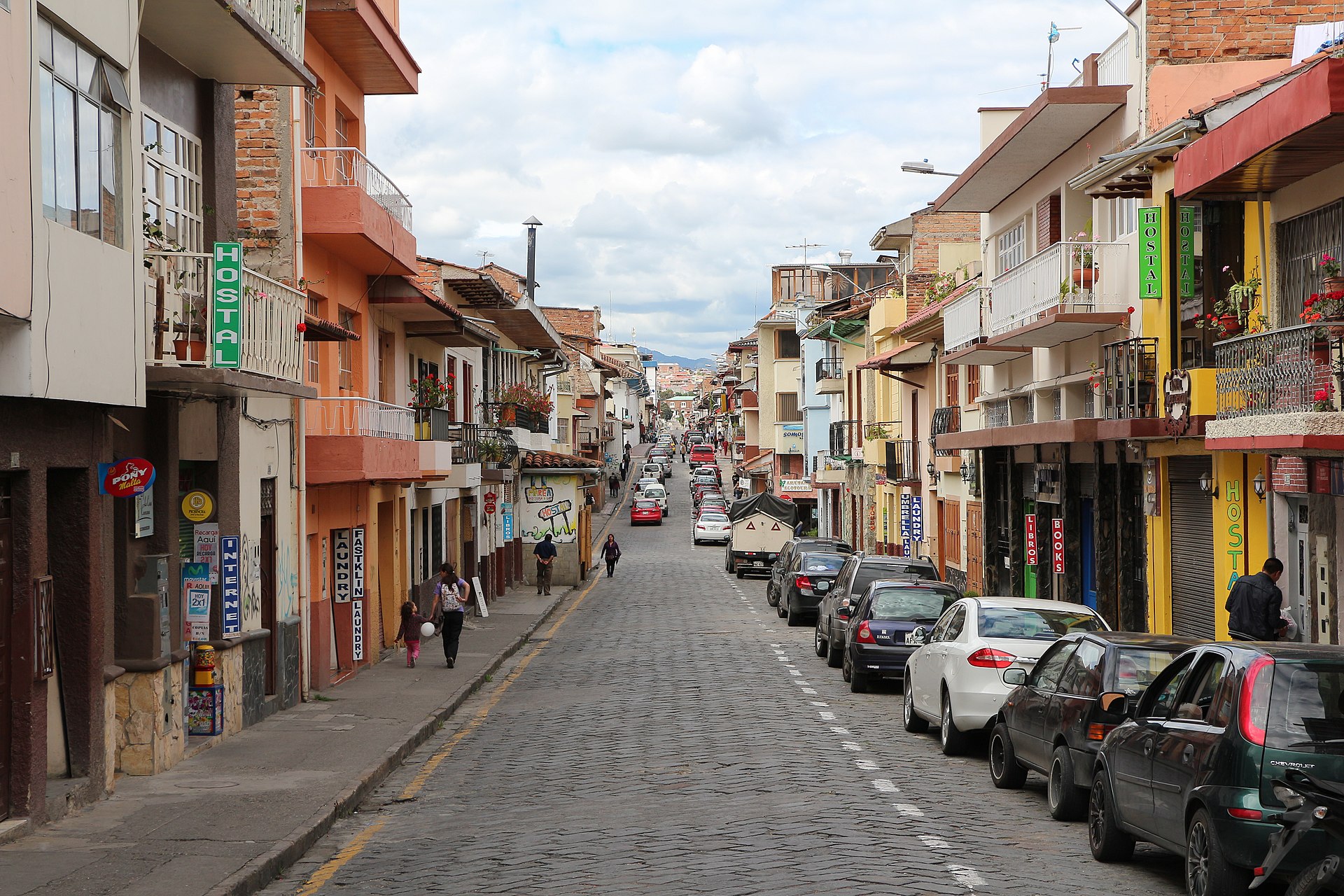
A street in Cuenca, Ecuador
We are talking about the many North Americans that have moved to an area of Cuenca, Ecuador, as described by Hayes in his original book: Gringolandia: Lifestyle Migration under Late Capitalism (University of Minnesota Press, 2018). The author interviewed 108 American and Canadian retirees in Cuenca and a rural area also favored by them, along with Ecuadorians, while conducting ethnographic fieldwork during visits across seven years – all before the COVID-19 pandemic and the acceleration of this phenomenon. This book vividly describes an interesting case study and helps improve our overall understanding of human migration and how race affects immigrant reception.
These North American communities are not unique to Ecuador. For example, well over one million Americans live in Mexico today. Some estimate that, currently, more people move from the United States to Mexico than the other way around; this includes white retirees receiving social security benefits to finance their stay and many tourists overstaying their visas. Therefore, the discussions in this book are relevant for other expatriate communities. Many interviewees in Ecuador frame their migration as an adventure, a way to stay active and gain new experiences, or a bold instance of individual freedom and self-expression.
Many of the participants in Hayes’s study call themselves gringos or expats; others call themselves ‘‘economic refugees’’ because they needed to move abroad to find a place with a lower cost of living. Yet others see themselves as ‘‘medical refugees’’ because they would be unable to afford healthcare in the United States, but can access health services and other subsidies and social programs in Ecuador (p. 109). Therefore, inequality, economic and geopolitical reasons motivate the decision to migrate, justifications that are similar to those offered by many people moving from the global South to the global North.
Nevertheless, these retirees not only benefit from a retirement income that goes further in their new location, but also from their whiteness. This arrangement is what allows them to frame precarity-led displacement as an adventure and a personal decision. Hayes finds that ‘‘North Americans think of their relocations mostly in terms of their own lives, even as they continue to be rooted in unequal global social relations’’ (p. 7). Problems created by neoliberal policies are met with individual neoliberal solutions that transfer the burden of some of those individuals aging into poverty in North America to the global South.
Another big difference between Latin American immigrants in the United States and U.S. emigrants in Ecuador is that the latter group can easily obtain immigration papers. One can get an Ecuadorian residency visa by demonstrating at least 800 dollars of continuous income, which can include Social Security payments. Indeed, most of Hayes’s respondents reported monthly incomes between $800 and $1,500. Foreigners can also get an investor visa if they deposit $25,000 in an Ecuadorian bank. Many others choose to overstay their tourist visa, and they rarely face consequences for this. Local officials are welcoming, offering integration courses and help with relocation.
By receiving income from the global North and moving to a place with a lower cost of living in the global South, these retirees profit from ‘‘geoarbitrage.’’ Migration allows them not only to make ends meet but to be financially better off. Retirees have been doing this within the United States for decades, but as retirement incomes and inequality in the U.S. increase, even retirement communities in Florida or Arizona can be unaffordable to many. Thus, some people move to places in the global South. Colonial cities in Latin America such as San Miguel de Allende, Mexico, Cusco, Peru, or Cuenca, Ecuador, offer the appeal of Mediterranean European-like cities but are much more affordable.
The book includes a fascinating discussion about who benefited from UNESCO’s designation of Cuenca as a World Heritage City. Hayes discusses the intermediaries that have popped up to lure North Americans into Cuenca and other areas, as they profit from it. They lure customers with neoliberal phrases such as ‘‘Half the Cost, Double the Freedom’’ or ‘‘Living a Six-Figure Life . . . on Much Less.’’ Interestingly, the relocation of North Americans leads to price increases in Cuenca and helps to propel the gentrification of certain downtown neighborhoods and areas in the idyllic countryside, resulting in the relocation of poorer Ecuadorians, often of indigenous origin. Hayes cites work calling these processes ‘‘transnational gentrification.’’
By moving to South America, working class retirees, burnt out professionals tired of their work schedules, recent widows, and new single mothers a few paychecks away from homelessness in the U.S., are suddenly closer to the top of the social hierarchy in Ecuador and are able to afford many comforts that they could not in the global North. They cannot pass as local white elites, though; they are identified everywhere and mostly benignly as gringos. Hayes shows how self-conscious long-time gringos are about how locals perceive their group, as their numbers increase, and why they themselves openly critique ‘‘obnoxious gringo’’ behavior (p. 93).
North Americans benefit from white privilege in Ecuador, but ‘‘the visibility of their somatic whiteness contrasts with its invisibility in North America’’ (p. 95). Furthermore, some interviewees felt that increased numbers of North Americans might change ‘‘gringoness from something unique and interesting into something humdrum and even somewhat of a hassle’’ (p. 105). One interviewee complained about being increasingly seen as a part of a group. This sense of the loss of individuality racialized their whiteness and deeply bothered those who were used to being in the majority and in the dominant racial group in North America. They became concerned about the behavior of other gringos in Cuenca because they felt it could affect them. Many respondents saw their new home in Cuenca as like America in the 1950s, partly implying nostalgia for a white-dominant America with a stronger social safety net and economic security.
One takeaway is that migration creates change in the short term, but overall and in the middle and long-term, it is good for migrants and locals (See Castañeda 2026); another is that short- and long-distance relocations cannot be understood outside the context of population growth, capitalism, global inequality, and power dynamics. Thus, the book is not only about expats but also about political economy and whiteness. It is a captivating read and a solid contribution to the growing body of academic work on migration, global inequality, and race.
References
Castañeda, Ernesto. 2026. “Immigration and Urban Vitality: How Newcomers Make
Cities Strong.” Washington, DC: Center for Latin American and Latino Studies and the
Immigration Lab, American University.
Hayes, Matthew. 2018. Gringolandia: Lifestyle Migration under Late Capitalism.
Minneapolis: University of Minnesota Press.
Ernesto Castañeda is Professor and Director of the Immigration Lab and the Center for Latin American and Latino Studies at American University
Edited by Vincent Iannuzzi-Sucich
*This post continues an ongoing series, as part of CLALS’s Ecuador Initiative, examining the country’s economic, governance, security, and societal challenges, made possible with generous support from Dr. Maria Donoso Clark, CAS/PhD ’91.


