Lobbying Washington: Does it Work?

By Aaron T. Bell*

LatAm Lobbying

Photo credits: Jack Says Relax & AlexR. L., respectively / Flickr and Wikimedia Commons / Creative Commons

Latin American governments, political parties, and business associations have a long history of turning to U.S.-based lobbying, legal, and public relations firms to advance their interests in the United States – with mixed results.  Both national and multinational groups have been utilizing lobbyists since at least the 1940s, when the U.S. government began registering foreign agents.  Their most consistent goal over the decades has been to influence U.S. policy on foreign trade and investment, but they have also aimed to improve governments’ sagging reputation and protect them from adverse policies.  In the 1970s, a number of military regimes and right-wing political groups in Central and South America hired lobbyists to devise and implement strategies to counter criticism of their human rights record – to preserve trade and military assistance.

  • Some 30 Latin American countries and interests groups in 2010-14 registered foreign agents to influence U.S. policies. The Bahamas Ministry of Tourism spent the most, paying $128.9 million to promote tourism – as well as to monitor and speak with Congressional representatives about U.S. legislation related to transnational financial activities in which they are involved, such as the regulation of offshore tax havens and online casinos.
  • In 2013, Mexico ranked fifth worldwide, at $6.1 million. Both federal and local governments pay firms to burnish the image of their respective constituencies.  From 2010-12, for example, Mexico City worked with a firm to “enhance the image of Mexico City in light of recent negative media reports.”  In 2014, the Consejo de Promoción Turístico de México hired another company to “make Mexico an attractive destination.”
  • Ecuador, which at $1.1 million ranked twenty-second in 2013, spent nearly half a million dollars lobbying in support of the ultimately failed Yasuni rain forest oil drilling initiative.
  • More recently, the government of Honduras – burdened with the image as one of the most violent, corrupt, and crime-ridden countries in the world – hired lobbyists to “provide ongoing strategic counsel, media relations (proactive and reactive outreach), and third-party relations.” The firm, winning an initial one-year contract for $420,000, had just completed a nine-year relationship representing Russia.

A review of the U.S. Foreign Agents Registration Act (FARA) records indicates that foreign lobbyists represent almost exclusively governments, state agencies, and the private business sector, and that more popular civil-society actors – such as labor unions and indigenous organizations – are notably absent.  Even though foreign governments obviously judge the investment worthwhile, the impact of foreign-funded lobbyists is difficult to measure.  The Honduran government’s new push to burnish its image has paid off on Capitol Hill, according to observers, but a new initiative to reduce Honduran corruption doesn’t appear to have gone exactly as Tegucigalpa hoped.  Forced to respond to a protest wave calling for the creation of an independent investigative body similar to the Comisión Internacional contra la Impunidad en Guatemala (CICIG), the Honduran government agreed with the OAS to create the Misión de Apoyo Contra la Corrupción y la Impunidad en Honduras (MACCIH) as a collaborative effort.  MACCIH indeed lacks the independence – and the potential bite – that CICIG had, but it is significantly tougher than the Honduran President Juan Orlando Hernández initially proposed.  In this case at least, lobbyists have helped the government gain access and public relations points in Washington but didn’t get it off the hook entirely.

January 22, 2016

* Aaron Bell is an adjunct professor in History and American Studies at American University.

Brazil: Not-so-Happy New Year

By Matthew Taylor*

Brazil Basta

Photo Credit: Antonio Thomás Koenigkam Oliveira / Flickr / Creative Commons

A vicious combination of corruption scandal and economic malaise suggests a troubled new year awaits Brazil.  Economists estimate gross domestic product has contracted 3 percent this year and will decline a similar amount in 2016, while inflation and weak government finances hamper efforts to stimulate growth.  Two of three big rating agencies have cut Brazilian debt from investment grade to junk. Unemployment has risen from under 7 percent a year ago to nearly 10 percent, with forecasts of 12 percent on the horizon.  Efforts to reform fiscal policy are getting nowhere, and the champion of fiscal reform, Finance Minister Joaquim Levy, has just resigned.  The bonanza launched by the 2003-2010 presidency of Lula da Silva – seemingly setting Brazil on a unique path of state capitalist development – is long over.

The country’s interconnected scandals cast shadows on many of the leading players on the national stage, including President Dilma Rousseff.

  • Petrobras, the crown jewel of Brazil’s state capitalist model, is at the center of allegedly massive corruption schemes. Rousseff, who was chair of the Petrobras board at the time of the alleged wrongdoing, has claimed absolute ignorance.  But the charges implicate Brazil’s leading political and business elites, many of whom have been jailed in recent months.
  • A feud between Dilma and the president of the Chamber of Deputies, Eduardo Cunha, reached a new low this month after Cunha’s approval of impeachment proceedings against her. (His own ethics problems continue to fester.)  The charge against Dilma is not of personal corruption but rather that Rousseff flouted budget laws by using public banks to cover up unauthorized debt issuance and off-books spending.  Rousseff supporters have argued that the impeachment charges represent the worst of golpismo, or coup-mongering, and a constitutional overreach that threatens to undermine democracy.

For Brazil, 2016 will be dramatic and unpredictable – as the country weathers the most dangerous political crisis since the impeachment and resignation of President Fernando Collor in 1992.  Dilma’s opponents will have difficulty convincing two-thirds of the Chamber and Senate to oust her, but the crisis is already creating significant fissures in the democratic system.  The parties have been turned upside down.  Even if Dilma survives in office, she faces nearly impossible odds in restoring the credibility of her administration and party, the Partido dos Trabalhadores, or PT.  There are early indications that the PT will face a bloodletting in the 2016 municipal elections, and former President Lula, the party’s once-ironclad standard-bearer, has the highest rejection rate (55 percent) of any potential candidate in the 2018 presidential contest.  The PMDB, Dilma’s coalition partner, is threatening to break with the government, but is internally divided. The opposition PSDB is facing scandals, protests, and troubles of its own in the states it governs.  The newfound proactivity of prosecutors and judges is making democratic checks and balances work as never before – and is largely welcomed by Brazilians – but Brazil’s old party system may not be able to keep pace.  Rumblings for a rethinking of the political system will grow louder in the new year, as the crisis deepens.

December 21, 2015

*Matthew M. Taylor is associate professor at the School of International Service at American University.

Tax Reform or Governance Revolution?

By Andrew Wainer*

Photo Credit: Reuniones Anuales GBM / Flickr / Creative Commons

Photo Credit: Reuniones Anuales GBM / Flickr / Creative Commons

Taxation to fund development is becoming central to U.S. foreign assistance policy, but it would be a mistake for USAID and other foreign assistance agencies to view tax reform solely through the technical lens of financing for development.  In September, USAID Assistant Administrator Alex Thier penned an article subtitled, “Why Taxes Are Better than Aid.”  This follows the announcement in July of the Addis Tax Initiative at the UN Financing for Development Conference, where the United States and other donors pledged to double the amount of technical assistance for taxation in developing nations.  By most accounts, the potential fiscal benefit of increasing taxation –“domestic resource mobilization” (DRM) in development parlance – is huge.  The World Bank and International Monetary Fund estimate that in 2012 DRM in emerging and developing nations generated a combined $7.7 trillion.  This dwarfs average annual foreign assistance outlays, which in recent years have averaged about $135 billion.  One of many examples cited by USAID is El Salvador, where a $660 million increase in annual tax revenues has been channeled to health, education, and social services, as well as other development programs.

The issues of fair and transparent taxation are often a secondary component in discussions of DRM but – as events in Guatemala and elsewhere demonstrate – can also generate revolutionary transformations in governance.   Even as U.S. agencies emphasize the technical side of DRM assistance, organizations that monitor taxation are sparking historic citizen revolutions through revelations of governmental tax corruption.

  • The UN-sponsored International Commission against Impunity in Guatemala (CICIG) was created in 2006 to strengthen the rule of law through “investigation of crimes committed by members of illegal security forces and clandestine security structures.” But it was CICIG’s revelations of a customs tax corruption network that brought 100,000 Guatemalans into the street in a single day.  The protests led to the forced resignation and jailing of President Pérez Molina as well as a surge in citizen engagement unseen in the country’s modern history.

The intimate link between taxation and governance should be a central factor in how the U.S. government and others think about DRM.  As the OECD states, “The payment of tax and the structure of the tax system can deeply influence the relationship between government and its citizens.”  DRM should place a high premium on the governance impact of tax reform, where appropriate.  Tax reform not only increases government revenues, but as the case of Guatemala demonstrates, it can also strike at the heart of ossified structures of governance and can spark revolutionary changes in the relationship between citizens and states.   

November 12, 2015

* Andrew Wainer is the Director of Policy Research in the Public Policy and Advocacy Department of Save the Children USA.

Honduras: No Solution in Sight

Photo Credit: OAS / Flickr / Creative Commons

Photo Credit: OAS / Flickr / Creative Commons

CLALS and the Inter-American Dialogue this week hosted a conversation on the crisis in Honduras with experts Hugo Noé Pino, of the Instituto Centroamericano de Estudios Fiscales, and Carlos Ponce, of Freedom House, and about a dozen of some 80 participants spoke up.  The following are key analytical points that were broadly accepted during the 90-minute session.

Honduras is experiencing a multi-faceted crisis – economic, political, judicial, and security– that has grown steadily worse since the 2009 coup and shows no sign of abating.

  • Economic growth (1.5 percent per capita) is too low to alleviate the country’s severe employment problem (affecting half of the working-age population) and poverty (62 percent). Recent polls indicate that some 63 percent of all Hondurans would leave the country if they could.

Violence, corruption scandals, and the steady weakening of institutions dim prospects for a turnaround.

  • The over-concentration of power in the Executive, the remilitarization of law-enforcement and other security services, and the politicization of the judiciary have undermined what democratic foundation Honduras had built since the last military government stepped down in 1980. The economic and political elites, as well as the media they control, have further stifled political discourse.
  • The Sala Constitucional of the Supreme Court and the National Electoral Tribunal have been stacked to tightly control preparations for elections scheduled for November 2017, apparently with the intention of ensuring the reelection of President Juan Orlando Hernández.

The Honduran political class lacks the will to root out corruption, and is united in resisting developing the capacity and programs to do so.

  • The embezzlement of more than $300 million from the Social Security Institute – funneling part of these funds to the ruling National Party and a variety of fronts – led to the flight of the investigating fiscal (who left the country because of death threats to himself and his family) but little else. Indeed, the most significant law-enforcement actions, such as the indictment of members of the Rosenthal family on money-laundering charges, have come from the United States. Some 80 percent of crimes in Honduras go uninvestigated and unpunished; some reports put the figure as high as 96-98 percent.
  • A Comisión Internacional Contra la Impunidad en Honduras (CICIH), adapted from the successful CICIG model in Guatemala, would be a healthy way of addressing ongoing impunity while building investigative and prosecutorial institutions. The economic and political elites solidly oppose it.  Even if Honduras accepted a CICIH, alone it probably would not be a silver bullet.
  • The OAS’s planned “Mission to Support the Fight Against Corruption and Impunity in Honduras” (MACCIH) – announced in late September jointly with Honduran President Juan Orlando Hernandez – shows little promise of success. Its mandate will be to diagnose problems and write reports, not take action or facilitate a serious, inclusive national dialogue.

Opposition to the current Honduran government is strong and growing, but it has not yet institutionalized.

  • Peaceful marches organized by the Indignados and other organizations have mobilized tens of thousands of citizens outraged by government corruption and its inability to provide even basic citizen security. Among the masses have been an unprecedented number of middle-class and upper-middle-class persons – not seen during previous crises.
  • Opposition groups are still struggling, however, to coalesce into a viable, institutionalized political force. Sustaining effective leadership and overcoming pressure from the government and Honduras’s two traditional parties are difficult challenges for them.

There are no magic or quick solutions to the crisis.

  • Any solution would have many moving parts, including recognition by elites that their own assets are threatened by the deepening chaos. The government will have to be held accountable for corruption.  The judiciary will have to be strengthened and made independent.  The military will have to return to the barracks.  The media will have to be professionalized.  Civil society will have to be empowered.
  • The U.S.-sponsored “Alliance for Prosperity” is unlikely to help Honduras – and could make things worse if it doesn’t challenge the status quo. Honduran observers believe that the $250-plus million dollars from the program should focus on deep change – the product of a broad national dialogue – and should be conditioned on deep reforms, rather than working with just the sitting government, which has shown no willingness to reform.
  • U.S. cooperation in counternarcotics and other security operations might in some cases expose partnered services to U.S. respect for human rights and democratic institutions, but the resources transferred in the process also serve to strengthen them and make them more independent of civilian authority.

October 15, 2015

* Correction: The first sentence of the article originally stated “CLALS and the Inter-American Dialogue this week hosted a conversation on the crisis in Honduras with experts Hugo Noé Pino, of the Instituto Centroamericano de Estudios Fiscales, and Carlos Ponce, of Freedom House, and a dozen speakers from among over 80 participants.” It was edited to clarify that “about a dozen of some 80 participants spoke up.”

Transparency in Brazil: More Progress than Meets the Eye

By Vanessa Rodrigues de Macedo*

Photo Credit: Antonio Thomás Koenigkam Oliveira / Flickr / Creative Commons

Photo Credit: Antonio Thomás Koenigkam Oliveira / Flickr / Creative Commons

Amid all the corruption scandals shaking Brazil in recent months, positive signs about future prospects for accountability – in a country where it has historically been lacking – are easy to overlook.

  • The judicial system is improving and – since the historic conviction of 25 of 37 defendants in the notorious mensalão bribery case in 2012 – has shown commitment to meaningful outcomes in corruption cases.  Prominent offenders who in the past would have been untouchable today face a significantly higher probability of conviction and imprisonment.  In March, the Supreme Court authorized investigations into more than 50 high-ranking officials, including the leaders of both legislative houses.  In July-August, prosecutors launched investigations into former President Lula da Silva (as an informant) and senior Petrobras officials.
  • Important transparency initiatives are also taking hold. On paper, these are some of the most demanding standards in the world.  The Freedom of Information Act (FOIA) enacted in 2011 ranks among the top 20 FOIA laws in the world, according to the Global Right to Information Rating.  Since 2012, more than 300,000 FOIA requests have been made through the online request system (e-sic) created by the law. No fewer than 98.34 percent of these requests have been replied to, with an average response time of 14 days.
  • Brazil has been at the forefront of promoting transparency globally.  Together with the United States, it was the founding co-chair of the Open Government Partnership (OGP), a multi-stakeholder partnership that now involves more than 60 countries.

The impact of such initiatives has been limited, however, because they were launched as a result of the mobilization of a handful of NGOs, journalists and international actors, rather than broad societal pressure.  Street protests against government policies have had massive turnouts over the past couple years, but mobilizations in favor of concrete transparency measures and similar reforms have not involved wide swaths of citizens.  Cultural change at the popular level has been slow, reflecting a lack of social maturity to accept responsibility to monitor public policy and demand transparency.  Nonetheless, some important initiatives, such as joint government-citizen policy conferences to discuss public policies, are attracting significant citizen participation. Between 2003 and 2010, 70 such conferences drew 6.5 percent of the Brazilian population, according to academic tallies, and from 2010 to 2014 there were 26 more conferences.

That these achievements haven’t ended corruption is not a sign that they’re useless. Rather, the consolidation of transparency norms and institutions; the continued assertiveness of Brazilian prosecutors and judges; and the expanding opportunities for citizen engagement suggest that the prospects for inculcating a culture of accountability in Brazil are not as bleak as might appear in the almost-daily headlines about endemic corruption in politics and big business. Having transparency initiatives in place has the potential over time to make corruption less frequent, and the more engaged that Brazilian society becomes in the implementation of transparency norms the more likely it is that massive scandals such as those around Petrobras and Lava Jato will become the exception rather than the rule.

*Vanessa Macedo is a CLALS research fellow and political science PhD candidate at the Instituto de Estudos Sociais e Políticos at the Universidade do Estado do Rio de Janeiro (IESP/Uerj).

Is a “CICIH” the answer to Honduras’ Crisis?

By Fulton Armstrong and Eric Hershberg

Photo Credit: US Embassy Guatemala / Flickr / Creative Commons

Photo Credit: US Embassy Guatemala / Flickr / Creative Commons

The success of the Comisión Internacional Contra la Impunidad en Guatemala (CICIG) in driving anti-corruption efforts there – culminating in the resignation of President Pérez Molina – has stoked debate in neighboring Honduras on the wisdom of creating a “CICIH” with the same mission to root out the rot that permeates state institutions and perpetuates the misery of the citizenry.  President Juan Orlando Hernandez has stated categorically that no such entity is needed in Honduras given advances in the country’s own institutions and his own putative commitment to good governance.  Some civil society organizations are at least implicitly concurring by taking part in accountability initiatives involving collaboration with the government.  Other voices from civil society are objecting vociferously, however.  Most notable among them are the indignados, a largely youth-based movement that insists that the President himself and virtually the entire institutional system in Honduras is so rotten that only an international body can be trusted to root out endemic corruption.  The argument rages on, with the indignados staging regular demonstrations and the government – occupied simultaneously with promoting its credibility at home and abroad and maneuvering to secure authorization for presidential re-election – holding fast to its opposition to any such international role.  The debate will continue for the foreseeable future.  We sketch below our understanding of the competing arguments.

Arguments in favor of a CICIH:

By nearly all accounts, corruption has rendered the public and private sectors chronically ineffective – from the President (who admitted that millions from Social Security made it into his campaign coffers and who engaged in nepotism), through the government ministries and even the judicial bureaucracies (where political pressure, intimidation, and bribery are rampant), and companies large and small (for whom payoffs are merely an added budget item).  The country has topped the charts in non-war homicides, including targeted killings, and other violence for several years, further discouraging investigations and prosecutions.  The flood of narcotics and cash through Honduras has thrown fuel onto the flames.  Only an independent, UN-endorsed entity like a CICIH – with its unique ability to train, protect, and motivate judicial personnel, issue indictments, and put powerful people in jail, and shame local government into taking action – can help the country climb out of this deep hole, this argument goes.

Arguments against:

Steven Dudley of InSight Crime notes that the call for a CICIH comes at a time that the Attorney General’s office is showing some signs of life.  Its anti-corruption efforts have led to the indictment and arrest of the former head of the Social Security Institute on charges of embezzlement and illegally financing political parties (although some charges were dropped).  Combating crime, cheaper homemade solutions are showing results in Honduras in terms of training and cases resolved.  Organizations like the Asociación para una Sociedad más Justa (ASJ) are doing groundbreaking work to keep homicide levels down in some of the worst neighborhoods at a fraction of the cost of a CICIH.  Expense is another important factor.  In Guatemala the CICIG costs between $12 million and $15 million annually, which even that country, far wealthier than Honduras, cannot afford.  CICIG has provided valuable assistance and training to Guatemala’s Attorney General’s Office, but its foreign investigators, who move around in armored vehicles with armed bodyguards, leech massive resources that might otherwise go to fortify local prosecutors’ offices.  Moreover, according to this argument, the investigators don’t need foreign prosecutors to tell them what they’re doing wrong.

Skeptics further contend that international donors and pro-reform Hondurans arguably will not get the quick fix and public relations victory they want from a CICIH.  It took over a decade for CICIG to set up in Guatemala and nearly eight years to get the right mix of cases.  Its greatest strategic goal – fortifying Guatemala’s justice system – remains a work in progress.  The Guatemalan Attorney General’s Office has not yet executed a complicated, forensic investigation leading to a high-level prosecution.  Honduras’s greater reliance on foreign assistance, according to this argument, suggests a CICIH would actually enable its dependency, rather than break it.

The weakness and rot within Honduran institutions and the venality of national leadership strongly suggest that neither approach – a foreign-backed entity like CICIH or a home-grown solution – could quickly reverse the tsunami of corruption and violence that the isthmus’s poorest country has been experiencing since the 2009 coup.  Ideally, the best of Honduras’s own efforts could be buttressed by a Honduran version of the CICIG model, but the knack of the country’s leaders for overwhelming even the best of intentions, as they did the “Truth Commission” charged with determining accountability for the coup and rights abuses carried out in its aftermath, argues for extreme caution in forming expectations.  The debate therefore may boil down to the moral argument of whether the international community, witnessing Honduras’s descent into utter lawlessness and destitution, can stand idly by or should at least offer its help in what form it can, such as a CICIH.  Even if a CICIH is not a panacea, it at least would send a powerful message to Honduran elites that the world is watching.

September 15, 2015

Guatemala’s Crisis is Not Over

By Eric Hershberg*

Guatemala City, August 2015. Photo Courtesy of Eric Hershberg.

Guatemala City, August 2015. Photo Courtesy of Eric Hershberg.

With President Otto Pérez Molina’s resignation early this morning, Guatemala lurches into a new phase in its long-running political crisis, with little prospect that this weekend’s elections will resolve much.  The investigations into the Pérez Molina administration’s corruption, the national assembly’s unanimous vote to suspend his immunity, and the peaceful surge in popular protests demanding that he step down all suggest progress in the country’s efforts to build a functioning democracy.  The UN-sponsored Comisión Internacional Contra la Impunidad en Guatemala (CICIG) fulfilled its mandate, and its example and training were arguably important factors in the ability of judicial officials in Pérez Molina’s own government to support the processes that led to his downfall.  (Click here for an AULABLOG assessment of CICIG in May.)  The Congressional vote to strip him of immunity was unanimous, including even his most loyal supporters, who until then had rejected popular clamoring for the president’s ouster.  By the end of last week societal disgust with the political elite had reached the point that even the most recalcitrant of incumbents realized that their own survival required ditching the president.  The comptroller’s office called on him to resign “to avoid greater social unrest that could have unpredictable consequences” – a sentiment echoed by powerful business groups and the Catholic Bishops Council.

The Guatemalan Constitution and laws lay out the next steps.  The Congress has accepted the resignation, clearing the way for Vice President Alejandro Maldonado – who replaced Vice President Roxana Baldetti after she was jailed in connection with the same corruption scandal – to take office.  The first round of Presidential elections, with 15 candidates in the running, will proceed as scheduled this Sunday, despite calls from some civil society organizations to delay the balloting on grounds that the campaign regulations reflect the influence and interests of criminal elements.  In all likelihood, a runoff round will be necessary six weeks later (October 25).  The convulsions of recent months and deep distrust in government suggest that tensions will be high between now and then, but there’s no indication yet that civil unrest could threaten the electoral process, and military intervention appears to be a thing of the past.  There is every reason to expect that a new President will be inaugurated on January 14.

The elections are unlikely, however, to lead Guatemala into an era of less corruption and greater accountability, or to install leadership willing or able to spearhead economic and social policies to enable the majority of the population to live with dignity.  The slogans on the banners of the tens of thousands of protestors in Guatemala City’s central square lacked any message beyond a rejection of the status quo.  “Throw them all out” and “I have no president”are potent rallying cries but do not address the core challenges of a country where the elite pay no taxes, half of all children are malnourished and tens of thousands of young people desperately seek better lives anywhere other than Guatemala.  

The reputations of the leading candidates and their failure to articulate coherent governing platforms give little room for optimism.  Leading in the polls is a wealthy businessman, Manuel Baldizón, whose running mate is already being investigated for corruption and whose own closet is widely understood to contain plenty of skeletons.  Protestors have already singled out Baldizón as unacceptable, taunting him with chants of “it’s your turn next.”  In second place is a comedian named Jimmy Morales, who enjoys the support of the economic elites and media but has advanced no policy platform whatsoever.  Former first lady Sandra Torres appears to be running third.  She divorced President Álvaro Colom in 2011 to circumvent a court ruling that, as First Lady, she couldn’t run for office.  (The Constitutional Court put a final stop to her campaign a month before elections that year.) 

Electoral victory by any of these candidates would leave Guatemala with weak leadership at a time that most government institutions desperately need revitalization.  Corruption is too deep-rooted for CICIG and its few allies in government to face down alone, and these candidates won’t use the presidency to carry out the needed purge.  The organized criminal groups that traffic drugs and persons through the country and permeate governing institutions stand to grow only stronger, and the misery that plagues a population deprived of education, health care and jobs will continue unabated.  U.S. Vice President Joe Biden’s billion-dollar aid package for Guatemala, Honduras and El Salvador, already in trouble in Washington, may have nowhere good to go.

September 3, 2015

*Eric Hershberg, director of the Center for Latin American & Latino Studies at American University, witnessed the protests in Guatemala City last week.

Dilma – and Brazil – in Crisis

By Eric Hershberg

Photo Credit: Ministério da Ciência, Tecnologia e Inovação / Flickr / Creative Commons

Photo Credit: Ministério da Ciência, Tecnologia e Inovação / Flickr / Creative Commons

Brazil’s corruption scandals and deepening recession have raised doubts about not only the viability of President Dilma Rouseff’s government, but also about the national renaissance and global role that Brazilians have long strived for and seemed only recently to have achieved.  The commodity boom of the past decade propelled Brazil to become the world’s sixth largest economy and make major inroads against its historically obscene levels of poverty and inequality.  Often working in tandem, Brazil’s leading public and private enterprises, assisted by the generous state development bank, prospered immensely and fueled growth in Brazil itself and elsewhere in Latin America, building infrastructure from Ecuador to Cuba.  Four Partido dos Trabalhadores (PT) presidential victories in a row (two each for President Lula da Silva and for Dilma) appeared to validate a development strategy built upon government alliances with ambitious large firms and generous cash-transfer programs for needy segments of the population, which became reliable sources of electoral support.  Brazil, the country that skeptics considered unlikely to ever fulfill its aspiration of becoming more than “the country of the future,” seemed to have turned a historic corner – until it all came crashing down.

With the commodity boom now over, the economy is contracting at an annual rate of more than 2 percent, and a Central Bank survey released last week forecast that the recession will continue into 2016.  The past decade’s extraordinary gains in formal sector employment and wage rates are being rapidly eroded.  The dire macro-economic situation forced Dilma to shift course earlier this year, when to the dismay of her PT base, she appointed pro-austerity economist Joaquim Levy as Finance Minister.  His mandate – to tackle fiscal deficits – required dealing with the end of the commodity-driven cycle of growth and problems with the state capitalist model pursued by the PT since 2004.  Levy’s strategy will take time to bear fruit, probably through most of Dilma’s term, and will be painful.

But the President’s biggest challenges stem from the vast corruption scandals that have devastated her credibility and the reputation of the enormous companies that were the protagonists of Brazil’s latest miracle.  Although Dilma has not been charged with any wrongdoing, the scandalous actions at state oil firm Petrobras, which at its height accounted for as much as 10 percent of Brazil’s GDP, were in full flourish when she was Lula’s Energy Minister and nominally in charge.  Prosecutors have filed evidence of bribery and kickback schemes that bilked billions of dollars from the company’s coffers, and officials in both the PT and allied parties have been charged with serious crimes.  Dilma’s popularity ratings are now in single digits, with little prospect of improvement.  Street protests calling for her impeachment are more focused than those that tormented her in 2013 and 2014, when popular discontent focused less on corruption than on the poor quality of transportation, education, health care, and other public services at a time when the government was making huge investments to prepare for the 2014 World Cup and the 2016 Olympic games.

Further damaging revelations are likely as investigations continue, and they will affect an ever-wider array of political actors and major economic enterprises.  Many of the president’s political foes support either impeachment or resignation, while others are inclined to let her government wither in place.  The key alternative parties – the PSDB of former President Cardoso and the PMDB (the latter rumored to be closer than ever to breaking its tenuous alliance with the President) – are not aligned in a way that establishes a clear path to push Dilma out.  The most optimistic scenario for the President entails remaining, terribly wounded, in office, but this could change if, as many observers believe, the Auditing Court (TCU) determines that Dilma has misused public funds, or if the TSE should press forward with investigations of illegal financing of Dilma’s campaign.  

If two or three years ago it seemed plausible that history would credit the PT for having transformed Brazil into a high-quality democracy with improved social inclusion, today that appears to have been a pipe dream.  Beyond the immediate factor of Dilma’s ineffectual leadership, there are broader, systemic reasons for this tragedy.  Brazil’s fractured party system and the coalition-building it requires engenders corruption-fueled legislative bargaining, as evidenced by the Mensalão scandal.  Brazilian state capitalism has blurred lines between state economic policies and corporate beneficiaries, further fueling a culture of corruption evident by the fact that roughly 40 percent of members of Congress are under investigation, according to the New York Times.  Regardless of whether Dilma survives in office, the current moment has drawn Brazilians’ attention to the deep political and economic roots of their current situation, and dashed their hopes of soon becoming “O País do Futuro.” 

August 24, 2015 

Haiti: Yet More Lost Opportunity

By Emma Fawcett*

Photo Credit: Nacho Fradejas Garcia / Flickr / Creative Commons

Photo Credit: Nacho Fradejas Garcia / Flickr / Creative Commons

Six months into Haiti’s most recent political crisis, popular uncertainty and frustration are palpable – amid indications that even the Obama Administration may be tiring of corruption and mismanagement under President Martelly.  Officials in Washington in April expressed concerns over the abrupt release of gang leaders alleged to have ties to Martelly who had been held on kidnapping charges.  Recent U.S. Embassy tweets have focused on the importance of press freedom and free and fair elections.  Protests are a regular occurrence, and anti-government graffiti covers buildings throughout Port-au-Prince.  Martelly’s network of old friends – whom some long-time Haiti-watchers have called “nefarious characters” – has been politically useful to him, and various press reports indicate that criminal prosecutions against them for drug trafficking, kidnapping, and worse have mysteriously dropped off the books.  Criticism of his record on other issues is also strong.  A visit from Beyoncé on May 16 led the US Embassy to ask its Facebook followers: “Where should she go to see the progress in Haiti? Let us know!”  Social media users mocked, “What progress?” and derided the embassy for asking.  Washington politics, such as criticism of Bill and Hillary Clinton’s role in Haiti, is further casting a shadow on Martelly and his government.

The country has made partial progress towards holding its long overdue elections, but – if history and Martelly’s record are any guide – obstacles could easily arise.  A list of candidates has been approved, and dates have been set – August 9 for Parliamentary elections (all 118 seats in the Chamber of Deputies and 20 of the 30 seats in the Senate).   Presidential elections will take place on October 25, with a December 27 runoff if necessary.  But the process has not been without controversy: a quarter of the 2,039 who had registered to be candidates have been disqualified for various reasons.  (First Lady Sophia Martelly wanted to run for Senate but was not accepted because she is a U.S. citizen.)  As the government has not provided explanations in most instances, accusations that the exclusions were politically-motivated abound.

Martelly’s carefully calculated consolidation of power over the last four years has led many observers in Haiti to wonder whether he will actually make elections happen and leave office on schedule.  Many of them are perplexed by what they perceive as steadfast U.S. support for him.  Even in January, when an agreement on elections fell through once again and Martelly commenced to rule by decree, the State Department’s admonishment was widely seen as weak.  Rather than building bridges at home, Martelly has often appeared more externally focused – capitalizing on his ties to the Clintons, who along with the OAS helped him secure the contested presidency in the first place; declaring that Haiti is “open for business”; and holding his historic meeting earlier this month with French President Francois Hollande.  Indeed, the Hollande visit resulted in yet more protests in Port-au-Prince’s streets from those frustrated by France’s refusal to pay reparations for past abuses – such as the “independence debt” that France demanded, which consumed 80 percent of Haiti’s budget for 125 years (the equivalent of $17 billion dollars today).  Predictions about the elections and transition of power at the end of the year would be premature, but Martelly already seems to have squandered his chance to leave a legacy of progress, institution-building, and stability for the nascent Haitian democracy. 

June 1, 2015

*Emma Fawcett is a PhD candidate in International Relations at American University.  Her doctoral thesis focuses on the political economy of tourism and development in four Caribbean case studies: Haiti, Dominican Republic, Cuba, and the Mexican Caribbean.

Civics Lessons from Guatemala

By Robert Brenneman*

Former Vice President of Guatemala Roxana Baldetti (l) and a protestor with sign "We demand justice" Photo Credits: Surizar / Flickr / Creative Commons

Former Vice President of Guatemala Roxana Baldetti (l) and a protestor holding sign that proclaims “We demand justice.” Photo Credits: Surizar / Flickr / Creative Commons

Guatemala’s popular movement for justice and transparency is suddenly and happily discovering that nothing breeds success like success.  Many Guatemalans have grumbled for years about rampant corruption among the political class, but in recent weeks a surging popular movement has finally emerged giving voice and energy to years of that frustration with impunity and graft.  The movement picked up steam after a public exposé of a shadowy tax fraud and contraband network called “La Línea,” orchestrated out of Vice President Roxana Baldetti’s office by her private secretary.  The report was produced by the International Commission against Impunity in Guatemala (CICIG).  (Click here for analysis of the Commission’s renewal.)  President Pérez Molina not only renewed CICIG’s term until 2017; on May 7 he also accepted the resignation of Baldetti and her secretary, who had served as the key money-raising dealmakers for his administration.  The U.S. Embassy suspended the visas of many of the officials named in the report, including the luckless former vice president herself.

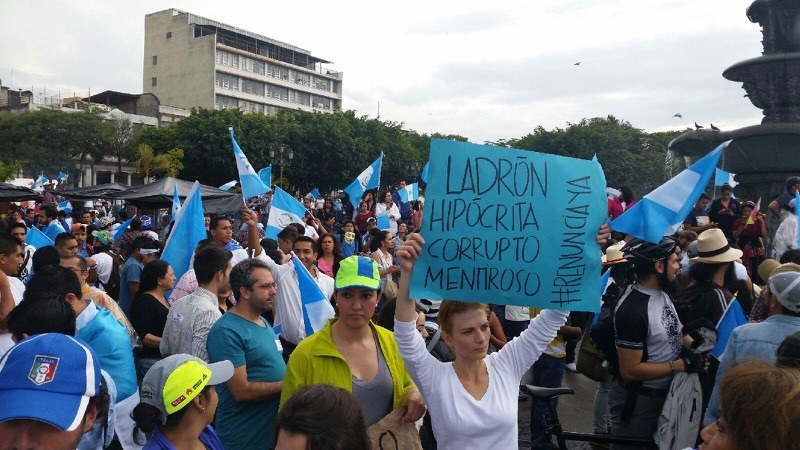
These actions have not been enough to appease the appetite for justice and transparency sought by the growing crowds of flag-waving nonviolent protestors converging each Sunday afternoon in front of the Guatemala City’s Municipal Palace.  An estimated 57,000 gathered under thunder and pouring rain on May 17.  Empowered by the relatively swift impact of their movement, and outraged by the mounting evidence pointing to the president’s personal connections to the corruption network, the crowds of protestors  led principally by students of the public university  have shifted to demanding that the president himself step down.  Pérez Molina, sensing that the wheels are coming off his administration, has requested the resignations of his closest advisors and top officials, including his Interior Minister and his Chief of Strategic Intelligence.  He has revoked or rescinded several of the most lucrative (and obviously corrupt) government contracts that he had vociferously defended only a few weeks ago.

President Pérez Molina’s political future remains up in the air.  Many Guatemalan political analysts believe he should step down.  José Rubén Zamora, founder of Guatemala’s influential daily El Periódico, argues that resigning is “the only way out of an impossible labyrinth” of the president’s own making.  But many others view the president’s fate as less important than whether the country takes advantage of the opportunity to use public pressure to pass sorely needed structural reforms.  For years Congress has ignored several bills that would tighten campaign finance rules and bring transparency to government contracting.  Since pay-to-play politics is not unique to this administration, fixing the problem will require legal and structural changes, not merely changing the nameplate on the presidential suite.  One hopeful sign is that Manuel Baldizón, leader of the opposition Renewed Democratic Liberty Party (LIDER), has not managed to coopt the popular outrage to kickstart his own election campaign.  A popular banner at the protests warns him “¡No te toca!” (“It’s not your turn!”).  The leaders of the movement recognize that Baldizón – who has many skeletons in his own closet and heads another investment-financed party – is hardly the answer.  The protesters’ focus on reform rather than politics suggests that the most certain – and long-lasting – outcome of all is the strengthened civic sphere that appears to have emerged as the protests grow and the newspapers report daily arrests and resignations.  In this civics lesson, the Guatemalan public is both pupil and teacher.

May 26, 2015

*Dr. Brenneman teaches sociology at St. Michael’s College and is author of Homies and Hermanos: God and Gangs in Central America (Oxford University Press 2012).