
By CLALS Staff
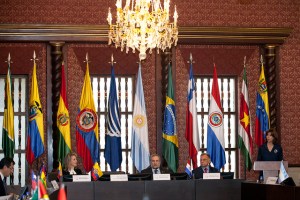
Photo Credit: Cancillería Ecuador / Flickr / Creative Commons Attribution 2.0 Generic (CC BY 2.0)
UNASUR has shown energy and flexibility as a facilitator during the Venezuela crisis, but neither the government, nor its opponents, nor the opposition’s allies in Washington have matched it – prolonging the vicious cycle that’s been plaguing the country for years. Speaking as UNASUR, the foreign ministers of Colombia, Brazil and Ecuador reflected the continent’s frustration when they threw up their hands this week and left Caracas after another failed attempt to get a national dialogue on track. Their statements represented a balance between the UNASUR members that are generally perceived as tolerant of the Venezuelan government’s “Bolivarian” revolution and those perceived as opposing it. They reiterated calls, issued officially in Suriname on 16 May, for both sides to “achieve a broad dialogue that permits Venezuelans, without interference, to reach an accord that guarantees peaceful coexistence and stability in the country.”
The government, opposition and Washington have not heeded the appeal by UNASUR and the Vatican’s nuncio to be constructive and patient. The government’s attack on opposition and student camps in early May and subsequent arrest of more than 200 protestors highlighted the authoritarian tendencies that have given momentum to the demonstrations. The Mesa de Unidad Democrática (MUD), representing important sectors of the opposition, gave the foreign ministers yet another list of demands – including a Truth Commission investigating rights violations (and not headed by the pro-government president of the National Assembly, Diosdado Cabello) and the selection of an entirely new National Elections Council. The MUD’s executive secretary declared that he has no interest in participating in a peña or chit-chat session, and said, “The ball is in the government’s court.” Although U.S. Assistant Secretary Roberta Jacobson said during a hearing that sanctions were premature (a statement that she attributed to “confusion”), the foreign affairs committees in both house of the U.S. Congress – without objection from the Obama Administration – have passed bills authorizing an array of punitive measures against Venezuelan officials. The legislation also authorizes an additional $15 million dollars in aid to the government’s opponents.
The less overtly political agenda that first sparked the protests in February – soaring crime rates, rocketing inflation, and shortages of basic goods and services – has been overshadowed by the shouts of opposition leaders eager to force President Maduro from office and by Maduro’s defenses from the plotting against him. Demands that Maduro negotiate with a foreign-funded opposition that has as its clear goal his removal as constitutionally legitimate president – something no head of state in the hemisphere would accept – naturally keep his bases on edge. Political leaders on both sides manipulate popular opinion and claim el pueblo as supporting them. Another of each side’s real strengths is its ability to portray itself as a victim of the unfairness of the other – because their victimhood rationalizes whatever actions they wish to take. In that regard, the U.S. sanctions against the government and subsidies to the opposition play into Maduro’s hand. Washington’s extra $15 million is a drop in the bucket for the well-funded opposition, but the U.S. support is as clear a signal as any of its desired outcome. With both the United States and important segments of the opposition appearing to aim for nothing short of regime change, UNASUR is wise to step aside and see if anyone decides to get serious about ending the crisis. Should the situation on the ground deteriorate further, however, UNASUR will probably ramp up its engagement and press both sides to make concessions in exchange for regional support.



 AULA Blog