
By Robert Albro
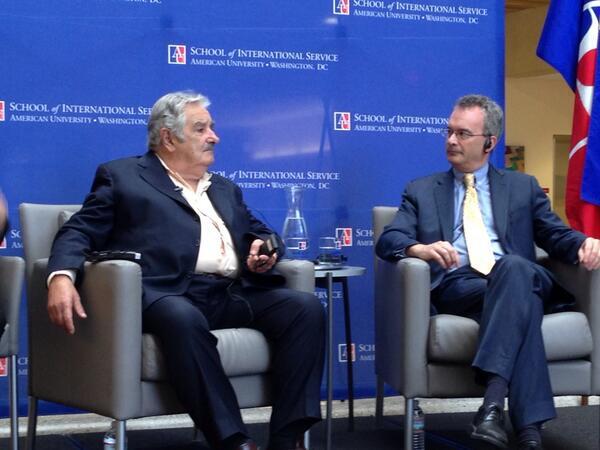
President José Mujica on stage with SIS Dean James Goldgeier
Uruguayan President José “Pepe” Mujica, whose recent trip to Washington included a stop at American University, is doubtless Latin America’s most unconventional president. A former leftist guerrilla who spent 14 years in prison, Mujica gives away 90 percent of his salary, refuses to live in the presidential mansion, grows chrysanthemums, and has twice been nominated for the Nobel Peace Prize. He was elected in 2009 as candidate of the center-left Frente Amplio, and his accomplishments have transformed him into an international figure – and turned Uruguay into an intriguing experiment in social liberalism. He has avoided the populist tendencies and overt anti-Americanism of other Latin American leftists, while promoting programs of social inclusion alongside a pro-business economic agenda. Under Mujica, Uruguay has enacted an affirmative action law, legalized abortion in the first trimester, and legalized gay marriage. Most discussed has been his administration’s controversial launch this year of a legal government-licensed and -regulated marijuana market.
Mujica is notably less popular at home than abroad, however. After plunging to 36 percent in late 2012, his approval rating has since hovered around 47 percent. With national elections (in which he cannot run) looming in October, a poll last month showed the Frente Amplio losing significant ground to the opposition. Mujica has consistently dismissed the polls. He went ahead with legalizing pot, for example, despite a September 2013 poll indicating that 63 percent of Uruguayans still did not support the measure. His asylum offer for up to six Guantanamo detainees, based on humanitarian concerns, has also not been popular, with only 23 percent of Uruguayans approving. Uruguay ranks among the safest countries in the Americas, with 5.9 homicides per 100,000 people, and yet the perception of insecurity is widespread. In a 2012 poll 56 percent of Uruguayans still reported crime and violence to be the country’s most pressing problem. If celebrated by advocates of social liberalism, Mujica’s policy measures often appear out of kilter with popular perceptions and priorities.
Mujica is often cited as offering a potential alternative to the Bolivarian brand of “21st century socialism.” But, in what is arguably Latin America’s most socially liberal country, the former Marxist has governed as a pragmatist. Uruguay has a lot going for it, including: a stable banking system, free and secular education, low levels of corruption and social inequality, robust press freedoms, and stable governance with functional political parties. It is second in South America behind Argentina on International Living’s quality of life index. It has the third highest GDP per capita – triple that of Ecuador and Bolivia – and under Mujica has sustained stable economic and wage growth, and increased foreign investment in farming, forestry and pulp mills. However, while he gets points for his international celebrity, austere lifestyle, and colorful persona, Mujica risks alienating the many citizens who care more about unemployment, inflation, crime and insecurity than about the environment, cannabis and gay marriage. It is not clear whether over time Uruguayans will support Mujica’s particular left-liberal pragmatic brand of governance and whether his is a model embraced by other Latin American leaders.



 AULA Blog