OAS: New Leadership, Old Challenges

By Aaron Bell and Fulton Armstrong

José Miguel Insulza and Luis Almagro Lemes Photo Credit: OEA - OAS / Flickr / Creative Commons

José Miguel Insulza and Luis Almagro Lemes Photo Credit: OEA – OAS / Flickr / Creative Commons

Uruguayan diplomat Luis Almagro, elected secretary general of the Organization of American States (OAS) last week, says he wants to revitalize the hemispheric organization – a herculean, if not impossible, task.  Almagro was the only candidate remaining after Guatemalan Eduardo Stein and Peruvian Diego García-Sayán withdrew from the race – the former for health concerns, and the latter due to a perceived lack of support from his government.  Almagro previously served as Foreign Minister under former president José Mujica and is a member of his Movimiento de Participación Popular, whose left-leaning sympathies led observers to wonder whether Almagro could draw sufficient backing even running unopposed.  But Almagro received formal support from several prominent nations ahead of time, including Brazil, Argentina, Mexico, and the United States, and he got 33 of 34 votes (Guyana abstained) to secure his election.  Following the election, U.S. Deputy Secretary of State Antony Blinken called for the new Secretary General to “lead the OAS through this genuine reform process by helping to refocus the OAS on its core pillars – democracy, human rights, sustainable development, and citizen security,” all while resolving its fiscal challenges.  “We look to [him] for his leadership, but we want him to know that he does not stand alone.”  His five-year term begins in May.

In his acceptance speech, Almagro stated that he intends to rise above the role of crisis manager and facilitate “the emergence of a revitalized OAS,” but major challenges await him:

  • The political crisis in Venezuela has long challenged the OAS, and an escalation in sanctions and rhetoric from the United States has made its balancing act harder. Current Secretary General José Miguel Insulza criticized the Obama administration’s national security warnings while also calling out the Maduro government for the arrest of opposition leader Antonio Ledezma and its resistance to dialogue with the opposition.  Almagro has been critical of U.S. sanctions as well, and quietly worked behind the scenes to encourage negotiations between political opponents in Venezuela, but his public silence on abuses by the Maduro government worries his critics.
  • The Cuba issue will also put Almagro in a tight spot. Havana’s participation in the Summit of the Americas is likely to build pressures for its readmission to the OAS, and Almagro’s record shows he’ll be sympathetic.  But the process could be fraught with risks for the new Secretary General.  Outgoing Secretary General Insulza bears scars attesting to U.S. Senators’ penchant for personalizing attacks when the OAS doesn’t go their way.
  • Any reform agenda is going to get battered from both sides. The OAS mandates are broad and expensive, and members don’t agree on priorities.  As Deputy Secretary Blinken’s comments suggest, Washington wants the organization to focus on its agenda, but much of South America, particularly the ALBA countries, wants the OAS to pull away from U.S. influence.  Nor do differences lie strictly along North-South lines, as made clear by protests during last year’s general assembly against Brazil’s resolution condemning discrimination based on sexual orientation and gender identity.

Almagro seems to have the experience and temperament to be an excellent choice for the job, and his coming from Uruguay, whose good offices have credibility virtually everywhere, may serve the OAS well.  But the challenges will be daunting.  He faces several ongoing crises, particularly in Venezuela, and ongoing splits within the region over the OAS’s role.  One tempting option would be for Almagro to try to distance himself and the organization from Washington – a difficult task at best.  Not only is his headquarters several hundred meters from the White House and the State Department, but the United States government (and to a lesser extent Canada) provides substantially more funding for the OAS’s general fund and through special donations than any other member state.  Almagro’s actions will also be watched closely by U.S. conservatives who, stung by President Obama’s move toward diplomatic relations with Cuba, are looking for a fight over Venezuela, Ecuador, Argentina, and even on some issues with Brazil.  Whatever Almagro does, it will be with the black cloud of the OAS’s financial difficulties over him, and the possibility that failing to successfully balance all of these issues may weaken the OAS and benefit regional organizations like CELAC and UNASUR, which are smaller and less well established, but independent of North American influence.

March 23, 2015
Honduras: Charter Cities Lurch Forward

By Fulton Armstrong

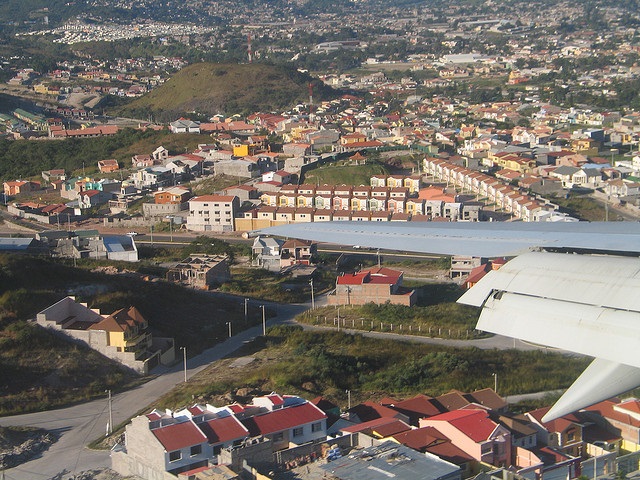
Choluteca, Honduras Photo Credit: Jonathan D. / Flickr / Creative Commons

Choluteca, Honduras Photo Credit: Jonathan D. / Flickr / Creative Commons

The Honduran government expects to get the green light this month from a Korean consulting firm for a master plan to hand governance of several small communities over to private investors to develop them, but concerns about the plan run deep and appear unlikely to fade.  Called ZEDEs – the Spanish acronym for “Employment and Economic Development Zones,” the specially designated areas are also called by their proponents charter cities, model cities, and startup cities.  The first tranche of towns facing conversion are in the southern Honduran departments of Valle and Choluteca, with a new port built on the Gulf of Fonseca.  The government says that the affected communities will remain an “inalienable part of the Honduran state,” but amendments to the Constitution, laws, and regulations permit their governing body – which is unelected – to establish “policies and regulations” and their own police and other public services.  Called the “Committee for the Adoption of Best Practices,” the board is dominated by representatives of Honduran millionaires and an even greater number of non-Hondurans of predominantly libertarian ideology.  Among them are American anti-tax crusader Grover Norquist; former President Reagan’s son Michael; and Michael Strong, chief executive of Radical Social Entrepreneurs.  The ZEDEs’ guiding principle is to liberate communities from government taxation, oversight, and corruption in order to attract investment and stimulate prosperity.

The ZEDEs initiative has been plagued by opposition since its inception, however.  Numerous reports underscore that the affected communities were never consulted, and demands for a referendum have repeatedly been rebuffed.  Honduran implementation of the model has been rejected by the U.S. economist who proposed it, Paul Romer (formerly of Stanford University; currently at New York University).  He withdrew because of the lack of Honduran transparency, including secret deals with interested U.S. parties.  The Honduran Supreme Court initially voted 4-to-1 against a Constitutional amendment allowing creation of ZEDEs in 2012, but the Congress impeached the four dissenters and replaced them with supporters who voted unanimously in favor.  There are numerous reports of intimidation of local civil society leaders, who deem them credible in view of clashes between wealthy businessmen and campesinos in other areas resulting in hundreds of deaths in recent years.

Honduras has a desperate need for economic growth – two-thirds of the population lives below the poverty line – and its model of national governance, riddled with corruption and non-transparency, is indeed in crisis.  But there’s no evidence that fighting one form of corruption with another non-transparent system will help anyone but the big investors.  Indeed, Honduras has ranked among the most violent countries in the world for several years, with the term “failed state” looming darkly over it – making it perhaps the worst place to experiment with provocative new models of governance without popular consultation or support.  Critics seem to have a good case: real reform and economic stimulus would focus on cleaning up the government and holding accountable the elites that have brought the country to ruin and now are trying to impose this model on their fellow citizens, rather than usurping the affected communities’ sovereignty.

March 19, 2015

Venezuela: Obama into the Fray

By Michael M. McCarthy

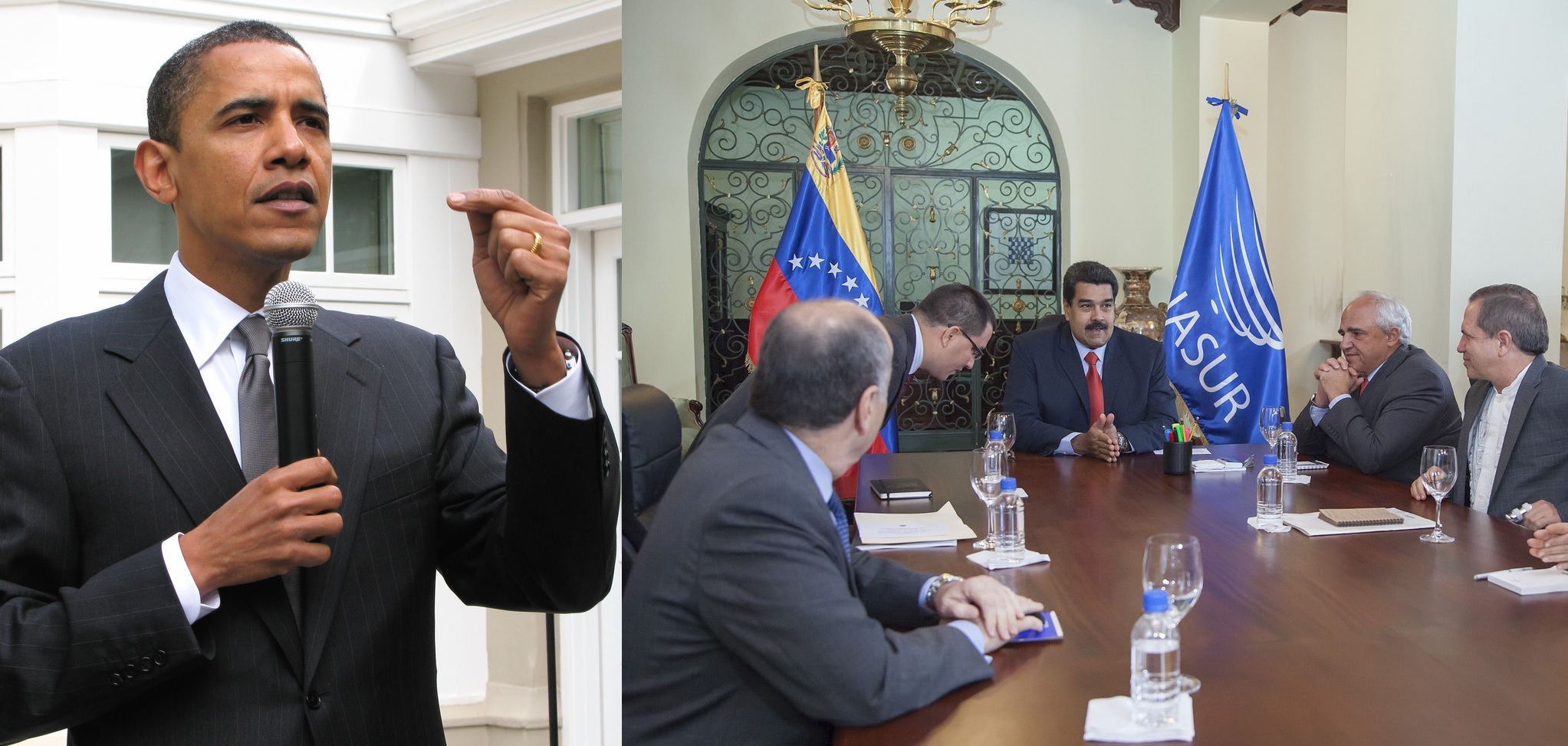
(l) President Obama, (r) UNASUR Commission Visits Venezuela. Photo Credits: Steve Jurvetson and Cancillería de Ecuador / Flickr / Creative Commons

(l) President Obama, (r) UNASUR Commission Visits Venezuela. Photo Credits: Steve Jurvetson and Cancillería de Ecuador / Flickr / Creative Commons

The March 9 decision by the Obama Administration to sanction Venezuelan government officials – this time freezing the U.S.-based assets of seven of them – appears to be drawing Washington into a conflict it recently viewed as a problem for Latin America to solve.  Implementing the “targeted sanctions,” the U.S. government made the determination that Venezuela’s “situation” was a threat to its national security.  Such a determination is not unique – Washington continues to declare Colombian narco-trafficking a national security threat – but the language in this case is widely seen as inflammatory because the cited source of the threat is President Maduro’s government itself.

  • The action generated a predictably exaggerated reaction from Caracas.  Maduro, who faces an economic crisis with no end in sight and has approval ratings of 22 percent, took the sanctions as an opportunity to change the conversation.  He branded them as “hypocritical,” describing Washington as the “real threat” to world order and criticizing Obama as returning to Cold War-style tactics.  On March 14 the armed forces conducted hyped-up exercises to “counter” the U.S. threat and the day after Congress granted Maduro Decree Powers through an “Anti-Imperialist Ennabling Law for Peace” that lasts through the end of the year.
  • Reactions to the U.S. measure varied greatly among opposition leaders. Governor Henrique Capriles, the opposition’s candidate in the last two presidential elections, echoed the U.S. position that the sanctions are targeted against “the corrupt government elite,” rather than the country or the Venezuelan people.  Governor Henri Falcón, a former military officer who left chavismo’s ranks in 2010 criticized them as “disrespectful.”  The Mesa de Unidad coalition stressed that Venezuela is “not a threat to any country.”  Whereas more hardline opponents are behind the scenes happy about stepped-up U.S. involvement, the more moderate camps – including Capriles’s – appear puzzled about the timing because Washington’s actions effectively moved Maduro to the safer ground of defending sovereignty.
  • The sanctions ignited strong criticism from some regional players.  Nonetheless, they renewed UNASUR’s efforts to mediate, which had gotten off to an unpromising start in Caracas on March 6.  An emergency March 14 UNASUR meeting in Quito issued two declarations – one strongly rejecting the sanctions, even calling for Obama to rescind them, and another reiterating support for the UNASUR Secretary General Ernesto Samper’s pursuit of “the most open dialogue possible” in Venezuela.

The Obama Administration’s stated reasons for the sanctions – measures similar to those proposed in the “Venezuela Defense of Human Rights and Civil Society Law” last year – are not surprising.  Washington has watched with dismay as Maduro has cracked down on opponents, alleged U.S.-supported coup-plotting, and hemmed in U.S. embassy personnel and even tourists with increasingly tough limitations on their activities.  With the opening to Cuba ongoing, the Obama administration may have calculated it could try to appease conservatives in the U.S. Congress and endure a hit to its regional image for imposing sanctions.  Emboldened by UNASUR’s criticism of the sanctions and Europe’s unwillingness to follow Obama’s lead, Maduro will almost certainly continue efforts to play the anti-imperialist card for a while.  The U.S. has shifted the action back into the bilateral relationship, breathing new life into a previously closed chapter in the Venezuelan crisis.

March 16, 2015

* Michael McCarthy is a Research Fellow at the Center for Latin American and Latino Studies.

Ecuador: Stacking the Deck Against Democracy

Enlace Cuidadano

Ecuadorian President Rafael Correa during one of his weekly broadcasts Enlace Ciudadano / Mauricio Muñoz / Flickr / Creative Commons

By Catherine M. Conaghan*

Taking a page from Hugo Chávez’s playbook, Ecuadorian President Rafael Correa is intimidating and steadily increasing controls on his opponents.  He regularly uses his Saturday morning broadcasts to name and shame them.  Actors from all walks of Ecuador’s civil society – journalists, lawyers, activists, academics, bloggers, union and social movement leaders – have been the target of his insults and thinly veiled threats on the weekly program, Enlace Ciudadano.  In February, Correa’s show was skewered by HBO comedian John Oliver – and, to Oliver’s delight, Correa fired back by tweeting insults (click here and here).  Journalists and civil society leaders applauded Oliver for drawing attention to the continuing deterioration of civil liberties in Ecuador.  Correa’s virulent rhetoric and intimidating use of media is part of a larger matrix of policies endangering freedom of expression and association in Ecuador.  Over the last two years, the Correa administration has worked methodically to mount a legal framework allowing for greater government control over the media and civil society organizations.

  • The 2013 Law of Communication and a new oversight agency, the Superintendence of Information and Communication, are intended to ensure that all print and broadcast media provide “truthful information” that is “verified, contrasted, precise, and contextualized.”  Superintendent Carlos Ochoa was selected from a short-list of nominees provided by Correa.  Among alleged violations recently singled out for sanctions are items in the leading newspaper El Universo and its accomplished political cartoonist, Xavier ‘Bonil’ Bonilla.
  • Issued in 2013, Executive Decree 16 also has civil society – from neighborhood associations to think tanks, business chambers, unions, and advocacy groups – under pressure. In addition to elaborate regulations for the legal registration of organizations, the decree stipulates conditions allowing the government to “dissolve” them.  These include group involvement in “partisan activity” and “interfering in public policies.”  To date, only one organization – the Fundación Pachamama involved in environmental activism – has been dissolved, but civic leaders fear that the decree will induce ”self-censorship” and stifle participation.

The new laws amount to a project – unprecedented for Ecuador – of surveillance and regulation.  They provide the government with a tempting arsenal of weapons to use, if necessary, in upcoming battles on other important legal matters, especially on the issue of presidential re-election.  After years of pledging that he would not seek a third term in office, Correa reversed course and has tasked his legislative super-majority with finding a swift route to amending the constitution.  Most public opinion polls show, however, that a majority of Ecuadorians would prefer a referendum to decide whether or not yet another consecutive re-election should be allowed.  The road to re-election may be more difficult than Correa and his advisors imagine, but they enter the fray with the weight of the law on their side.  With powers to control the media and limit the activity of civil society, the Correa administration enjoys the upper hand as 2017 approaches.

March 12, 2015

*Catherine Conaghan is the Sir Edward Peacock Professor of Latin American Politics at Queen’s University in Kingston, Ontario.  She specializes in Andean politics.  She is the author of an article, “Surveil and Sanction: The Return of the State and Societal Regulation in Ecuador,” in the April issue of the European Review of Latin American and Caribbean Studies.

Argentina: Wild Tales, Indeed

By Jeffrey Middents*

Photo Credit: inigo_montoya_es4 / Flickr / Creative Commons

Photo Credit: inigo_montoya_es4 / Flickr / Creative Commons

The Latin American film of the moment – Relatos salvajes or Wild Tales – is not just a cultural phenomenon in Argentina, but perhaps a political touchstone as well  Damián Szifrón’s madcap dark comedy about revenge won this year’s Goya Award for Best Iberoamerican Film and was nominated for this year’s Best Foreign Film Oscar.  It has also been a box-office powerhouse, easily becoming the top-grossing movie of the year at home in Argentina and gaining significant financial success in Spain, Italy and throughout South America.  In the United States, the film’s slow roll-out over the last two weeks since Oscar weekend earned a remarkable $385,000 in just 28 theaters nationwide.  This is particularly impressive since its format – an anthology of six short films that are narratively unrelated – historically results in a somewhat uneven cinematic experience that plays poorly with audiences.  Relatos salvajes bursts at the seams with the hottest Argentine movie stars of the moment: Ricardo Darín from El secreto de sus ojos/The Secret in Their Eyes, Dario Grandinetti from Almodóvar’s Hable con ella/Talk to Her, Leonardo Sbaraglia from Plata quemada/Burnt Money and especially Érica Rivas from Coppola’s Tetro.

The film’s real impact, however, comes from its contemporary themes, which resonate strongly, especially with Argentine audiences.  It has inspired new slang: on the streets of Buenos Aires, “Bombita,” the nickname of the character played by Darín, now refers to the welcome rage against an impossible system.  “Pasternak” also has taken on special meaning that, without spoiling one of the most delicious segments of the film, refers to a low-flying plane involved in a hilarious act of ultimate revenge.  So memorable is this name that, in a public speech about a new train project around the Buenos Aires airport, President Cristina Kirchner last September 8 used it when joking with reporters about the number of low-flying Aerolineas Argentinas flights.  Szifrón even noted her “official support” by posting the clip on his Facebook page.

Kirchner may be ruing the day Relatos salvajes ever appeared in theaters.  Although the film is explicitly unpolitical, commercial cinema – yielding its sharpest dagger against the most universal circumstances of contemporary society writ large – it has steered directly into Argentine politics.  The mysterious death of whistleblower prosecutor Alberto Nisman, blamed on the President, has prompted calls for revenge against her.  The film’s premise – people exacting revenge on the powers they cannot otherwise fight – has surfaced as a common point of departure in several biting op-eds in Argentine newspapers in the last month, referring to the “wild tales” the Kirchner government has been telling to cover up the growing scandal.  “Like the memorable film that arrived on the red carpet this year from the points of the cinematic world,” Federico Sánchez Chopa wrote in Tandil Diario, “Kirchner’s regime wants to launch the last act of its tale in a wild way.”  Nelson Salvidio takes the concept even further in a scathing indictment: “Cristina, Néstor [her husband, and the former president] before her, and their quarrelsome followers can be credited for crafting images and acts so that half the country believes their tales.”

With his midnight-dark, hyper-stylized fable, Szifrón may have inadvertently captured Kirchner in his lens.  In the last segment of the film, the bride exhorts the videographer at her wedding to capture the mayhem she has caused, resulting in another line that has become an Argentine catchphrase: “Shoot this, Néstor!”  We shall see whether Argentina’s real-life revenge narrative will be as entertaining.

March 9, 2015

*Jeffrey Middents is an Associate Professor of transnational cinema and literature at American University, with a particular interest in Latin American narrative. He is currently working on a book on director Alfonso Cuarón.

Nicaragua’s “Great Canal” Draws Opposition

By Fulton Armstrong

9036608152_a199acb183_z

Protestors opposing the Chinese-Nicaraguan canal confront police / Jorge Mejía Peralta / Flickr / Creative Commons

Although questions continue to swirl around whether the Chinese-Nicaraguan canal – which its main investor called the “most important [project] in the history of humanity” – will be built or not, its opponents are taking it all very seriously.  A CID-Gallup poll in January showed that 41 percent of Nicaraguans interviewed strongly support the project, while another 21 percent and 17 percent back it somewhat and a little, respectively.  But another poll by the same firm suggested ambivalence:  asked if they supported the National Assembly vote giving the Chinese firm leading the project, HKND, a concession for the 278-km right of way for up to 100 years, some 39 percent of respondents said no.  Some political voices are growing more sharply opposed as well.  The powerful business group COSEP, for example, has gone from agnosticism about the project to a position of open disapproval.

Groups concerned about the project’s impact on the environment and rural residents have already held protests involving up to several thousand participants, and – despite the government’s promise that the canal will bring prosperity throughout the country – organizing efforts appear unlikely to fade.  Skepticism about HKND and the government’s commitment to protecting the environment, fueled by their off-the-cuff dismissal of concerns, is so deep that even a balanced comprehensive impact study by the British Environmental Resources Management, due next month, may fail to calm nerves.  Environmentalists cite studies warning that dredging Lake Nicaragua from its current depth of nine meters to the 27 meters necessary for cargo ships will stir up many layers of toxic materials, with catastrophic consequences for marine life and surrounding agricultural areas.  Other groups are rallying behind the 29,000 residents who are to be evicted from properties along the canal route.  Demonstrations have turned violent, with protestors injured by tear gas and rubber bullets.  Graffiti and banners demanding “fuera chinos” are common.

In the hemisphere’s second poorest country, the promise of growth spurred by the $40-50 billion project is still a powerful card in the government’s hand.  Many skeptics still wonder, however, if the whole scheme is a ruse to fleece the Chinese investors, who’ll bring in a couple billion dollars before realizing that the project will get bogged down in Nicaraguan political quicksand.  But opposition to the canal goes far beyond the usual Managua political game of fighting over corruption dollars and obstructing each other’s priorities.  President Ortega’s endorsement of the canal contradicts his own statements years ago that he wouldn’t compromise the lake’s eco-system “for all the gold in the world.”  According to The Guardian newspaper, the dredging will move enough silt to bury the entire island of Manhattan up to the 21st floor of the Empire State Building – which no one is prepared to deny will have serious environmental implications.  China’s Three Gorges Dam, completed five years ago, displaced 1.2 million inhabitants – proportionally twice as many Nicaraguans displaced by the canal – but Nicaragua’s ability to resettle them, give them jobs, and suppress their dissent is small compared to China’s.  The project may not be the greatest in the history of mankind as HKND claims, but it may provoke a crisis as great as any in Nicaragua.  For starters, if COSEP’s opposition persists, it threatens to unravel the modus vivendi under which Daniel Ortega has stayed in power, and could portend much deeper tensions.

March 5, 2015

Click here to see our previous article about the canal.

Panama: A Central American Singapore?

By Tom Long*

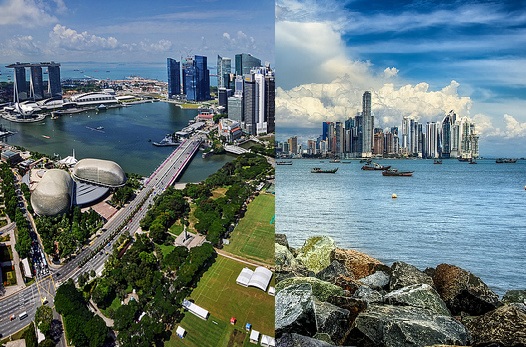
Singapore (left) and Panama City (right) / William Cho and Jim Nix / Flickr / Creative Commons

Singapore (left) and Panama City (right) / William Cho and Jim Nix / Flickr / Creative Commons

As a transportation hub, logistics center, and regional financial player, Panama has long been painted by investment bankers and Panamanian politicians as a potential “Singapore of Latin America,” but that vision still seems a way off.  In some respects, Panama’s story has been quite impressive.  For a decade, it has boasted GDP growth far beyond the regional average, even surpassing 10 percent in some recent years.  Unlike many of its neighbors, its dollar-based economy relies on services, not exports of commodities or low-value-added light manufacturing.  Since the 1989-1990 U.S. invasion to unseat General Manuel Noriega, the total size of the Panamanian economy has quadrupled in constant dollars.  It is also different from Singapore in important ways.  Singapore’s approach to planning and public housing might be helpful in Panama City, which has suffered traffic, environmental degradation, and inadequate housing for the poor as a consequence of poorly planned growth.

In other important ways, however, the Panama-Singapore comparison is less apt.

  • Singapore is a city, with nearly two million more people than Panama has spread across 100 times the landmass. Urban-rural divides are wide in Panama, with poor delivery of health and education services outside the cities, exacerbating inequality.  A Singapore-style strategy in Panama would leave the countryside behind – and indigenous and Afro-Caribbean populations would benefit much less.
  • Differences between the two countries in governance – for better and worse – are profound. The Panamanian people are much freer under the country’s democracy than they would be under a single-party-dominated system like Singapore’s.  In other ways, though, Panama’s governance leaves much to be desired.  Corruption is a massive problem, and watchdog groups highlight weakness in the rule of law, judicial independence, and press freedom.  Projects to expand the Panama Canal and build a capital city subway are over budget and behind schedule, and have suffered from strikes, contract disputes, and questionable bidding practices.  While it may seem easy to blame the corruption on former President Martinelli, who faces criminal charges, the problem has much deeper roots.
  • The two countries have very different policies toward education. Singapore invested, and continues to invest, heavily in world-class universities.  Panama lacks these, weakening its ability to compete globally in industries where innovation is key.  While Panama’s primary education has improved, its research and development lags.
  • A final difference is where the countries find themselves in their political and economic evolution. Singapore became independent 50 years ago, but it has been only a quarter century since Panama ended its kleptocratic, military rule.  It has been just 15 since the United States officially turned control of the canal over to Panamanian authorities.  The roots of its problems cannot be easily or quickly extirpated.

Panama’s boosters often use the comparison to highlight the areas in which Panama excels – economic growth, unique geography, and infrastructure crucial to global shipping and air transit.  The comparison might be more helpful in highlighting areas where Panama needs to improve.  These include dedicating resources to higher education and R&D, addressing inequality, rooting out corruption, and enhancing political and bureaucratic accountability.  Singaporean scholar Alan Chong argues that Singapore’s attempt to present itself as a model, global city is in part a foreign policy strategy of “virtual enlargement.”  The city-state’s wealth, reputation, and active role in international organizations allow it to “punch above its weight” in Southeast Asia and beyond.  Some chapters of Panama’s recent economic story might be the envy of neighbors with their own canal dreams, but the country will need to focus on governance and accountability if even its logistics-hub strategy is in fact going to deliver shared welfare at home and enhanced influence abroad – let alone become a Latin American equivalent of an Asian Tiger.

March 2, 2015

* Dr. Long is a visiting professor in International Relations at the Centro de Investigación y Docencia Económicas in Mexico City.  He is the author of Latin America Confronts the United States: Asymmetry and Influence, which is forthcoming with Cambridge University Press.

Pension Reform: Uneven Progress

By Christina Ewig*

Two Women

Nathan Gibbs / Flickr / Creative Commons

Recent pension reforms in Latin America show promise for greater gender equity across the region, but progress remains uneven in coverage and generosity.  Since 2007, 13 countries have either introduced or expanded some form of non-contributory pension, offered to defined groups as a social right, while others have made reforms to their existing pension systems that specifically compensate for gender inequalities.  These reforms in several instances were conceived with the participation of gender equity advocates.

  • The introduction of non-contributory pensions has equalized pension coverage between women and men in the region, according to a comprehensive study by the Organización Iberoamericana de Seguridad Social.
  • The equalization of men’s and women’s retirement age in the Dominican Republic, Mexico, and Uruguay makes it easier for women to attain the minimum number of working years for eligibility for a minimum pension.
  • The use of gender-neutral mortality tables in Bolivia and a return to the state-run defined-benefit system that treats men and women equally in Argentina, are also improvements.
  • More innovatively, in the 2007 expansion of the non-contributory pension in Bolivia and the 2008 reforms of the traditional pension systems in Chile and Uruguay, women were given credit toward their pensions for children born or adopted, to compensate for time out of the labor market.

The need for such reforms is great globally and in Latin America.  Women face much greater risks than men of poverty in old age due to workplace discrimination and gender imbalances in family carework responsibilities – the “motherhood wage gap” – during their working years.  Women are employed in smaller numbers than men in the formal economy, and they are often concentrated in the lower-paid and less-stable informal sector.  Domestic workers, primarily women, are in a sector notorious for employers’ evasion of pension payments.  Women in Latin America are also more likely than men to be found among the ranks of the unemployed or partially employed.  When employed full time in the formal sector, they face a diminishing but still substantial wage gap, earning 17 percent less on average than similarly educated men, according to the Inter-American Development Bank.  While the original pay-as-you-go pension systems were based on a male-breadwinner model that envisioned women as “dependents,” the 1990s push toward pensions that relied entirely on individual earnings magnified the effects of these discriminatory employment contexts and carework imbalances.  Moreover, in the individual capital account model, practices such as the use of differential mortality tables to determine monthly payments further reduced women’s income in old age, due to their greater expected longevity.

Despite the progress toward greater gender equity in pension policy, the issue deserves wider attention because advances have been uneven.  For example, while most countries in the region have adopted some form of non-contributory pensions, the percentage of the population eligible for these varies dramatically – as does the monthly payment.  Moreover, while the gap in pension coverage between men and women has narrowed, the compensation levels remain dramatically unequal.  Reforms, like those of Bolivia, Uruguay and Chile, that build-in compensation for market and carework inequalities deserve wider replication. 

February 26, 2015

*Dr. Ewig is Associate Professor of Gender and Women’s Studies and Political Science at the University of Wisconsin-Madison.  She is the author of Second-Wave Neoliberalism: Gender, Race and Health Sector Reform in Peru.

Venezuela: Crossing the Line

By Eric Hershberg and Fulton Armstrong

Marcos Oliveira / Agência Senado / Flickr / Creative Commons

Marcos Oliveira / Agência Senado / Flickr / Creative Commons

Venezuelan President Maduro’s arrest of Caracas Mayor Antonio Ledezma reflects a new level of vindictiveness and almost desperation at home – and threatens to leave his government more isolated than ever in Latin America.  In a three-hour televised speech, Maduro alleged that the mayor, whom he called a vampire and fascist, was plotting with military officers to remove him from office.  Ledezma has been a strident opponent – playing a prominent role in last year’s salida movement – and the Associated Press cites unnamed sources as acknowledging the existence of identified coupists.  But Maduro’s evidence against Ledezma was negligible, mostly a document on a national transition accord.  Other Maduro opponents are also reportedly to be arrested soon.  At the same time, the President said that the U.S. Embassy was trying to turn the military against him by, he alleged, calling generals’ wives to say their U.S. visas were being revoked.

The increasingly repressive nature of the Maduro regime is drawing scorn from throughout Latin America, including countries that previously tolerated the excesses of deceased President Hugo Chávez.  UNASUR has announced it will hold an extraordinary meeting soon on the deepening crisis caused by Ledezma’s arrest, and the Foreign Ministers of Brazil, Colombia and Ecuador will make an urgent visit to Caracas this week.  Chilean President Bachelet and Senate President (and daughter of the assassinated President) Isabel Allende expressed their “concern” over the arrest.  Colombian President Santos, heretofore restrained in his criticism, told the press he was “worried.”  Amnesty International also condemned the action.  Washington’s vehement denials of Maduro’s allegations that it was involved have not been challenged.

Maduro’s Latin American neighbors are likely to continue hewing to traditional non-interventionism, but even the left appears to regret that recent events confirm the monumental squandering of the Chávez revolution’s opportunity to carry out a radical project of redistribution and propose an alternative model for the region.  Chavismo had a social base, but Chávez and, to a much greater extent, Maduro have failed to develop a democratic or economically coherent approach to their revolutionary project.  Venezuela is now paying the price and, as many predicted, the situation is getting worse before getting better.  It is impossible to say how and when the impasse will break, and hard to identify who’s capable of ending the misery – be it the military or a faction within Maduro’s own party.  It’s clear, though, that this crisis is not sustainable and regional patience with it is growing thin.

February 23, 2015

Bracing for Economic Pain in Brazil and Beyond

By Kevin P. Gallagher*

Brazilian Real

Mark Hillary / Flickr / Creative Commons

Brazilian President Dilma Rousseff’s warning to U.S. Fed Chairman Ben Bernanke in 2012 – that his monetary-easing policies were creating a harmful tsunami of financial flows to emerging markets – was spot-on.  U.S. growth and interest rates have been appreciating currencies, causing asset bubbles, and exporting financial instability to the developing world.  Brazil and other emerging-market countries may soon be facing capital flight and exchange rate depreciation that could lead to financial instability and weak growth for years to come.  From 2009 to 2013 countries like Brazil, South Korea, Chile, Colombia, Indonesia and Taiwan all had wide interest rate differentials with the U.S. and experienced massive surges of capital flows.  The differential between Brazil and the U.S. was more than 10 percentage points for a while.  According to the latest estimates by the Bank for International Settlements (BIS), emerging markets now hold a staggering $2.6 trillion in international debt securities and $3.1 trillion in cross-border loans – the majority in dollars.

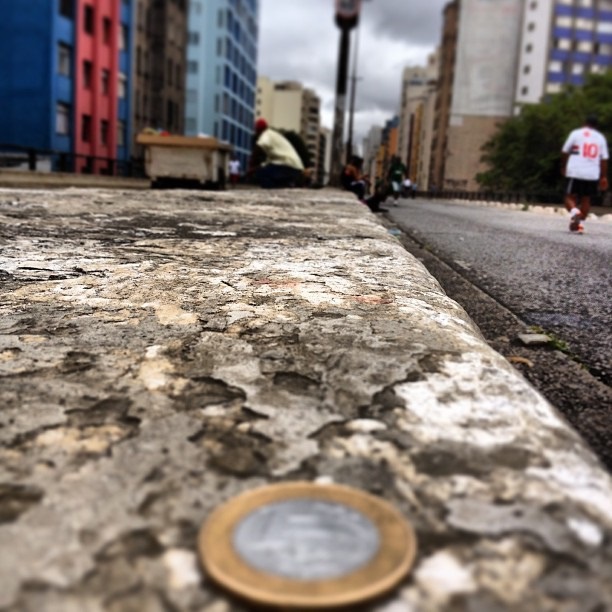
Now the tides are turning.  Many emerging market growth forecasts are continually being revised downward.  China’s economy is undergoing a structural transformation that necessitates slower growth and less reliance on primary commodities.  The prices of oil and other major commodities are stabilizing or declining.  As growth and interest rates pick up in the United States, the dollar gains strength – and emerging market currencies fall.  Brazil’s real hit a 10-year low last week, down to 2.87 to the dollar, amid continuing predictions of zero growth for the country this year.

The traditional tools for weathering the storm may not be available or enough for developing economies.  Floating exchange rates and the resulting depreciation can cause the debt burden on firms and fiscal budgets can bloat overnight, especially in a lower growth environment.  Increasing competitiveness would have helped boost exports, but an IMF study shows that Latin America failed to use one of the biggest commodity windfalls in its history to invest, hindering competitiveness to ride out the tsunami in short-term inflows.  Local bond markets help, but most debt is indeed in dollars, and most local debt is held by foreigners who are always the first to dump such debt.  Interest rate hikes can also be dangerous; they don’t reverse flight and can choke off what little growth there is to be had in a downturn.  Depleting foreign exchange reserves doesn’t always work; increasing debt could bring financial instability but threaten prospects for growth and employment.  Having no good options, emerging-market and developing countries may need to resort to regulating the outflow of capital alongside these other measures.  Such moves have traditionally been shunned by international institutions and capital markets, and new U.S. trade agreements such as the Trans-Pacific Partnership have stripped out balance-of-payment exceptions that allow nations to regulate capital.  But new research in cutting edge of economics by the IMF and others now justifies such measures to prevent or mitigate a full-blown crisis.  If we have learned anything from the global financial crisis since 2008, it is that nations need as many tools at their disposal to prevent and mitigate financial instability.  Instability anywhere can lead to instability everywhere, so we need all tools and hands on deck.

February 19, 2015

* Kevin P. Gallagher is an associate professor of global development policy at Boston University’s Pardee School for Global Studies, where he co-directs the Global Economic Governance Initiative.  His new book is Ruling Capital: Emerging Markets and the Reregulation of Cross-Border Finance.