OAS Secretary General’s Third Way Stumbles

By Stefano Palestini Céspedes*

34627298223_325ea7fb41_k

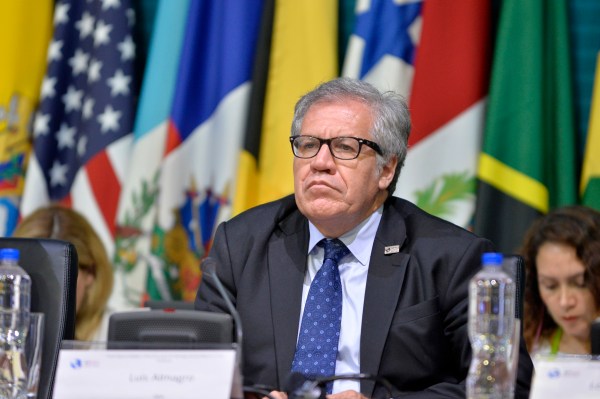
Luis Almagro, OAS Secretary General, at the first day of General Assembly in Cancún, June 2017. / Juan Manuel Herrera / OAS / Flickr / Creative Commons

OAS Secretary General Luis Almagro’s effort to drive the organization’s actions on Venezuela through international mobilization appears to have run its course without success during the recent General Assembly.  From the outset, Almagro faced the tough dilemma of what to do when OAS members did not want to fulfill their commitments and were reluctant to invoke the Inter-American Democratic Charter against the Venezuelan government.  As in most international organizations, the OAS Secretary General does not have strong authority to enforce its legal instruments and essentially had two options to cope with the dilemma:

  • To admit his lack of authority – and thereby signal to the world that the organization’s commitments, such as the Democratic Charter, are not credible. In the international system, there are plenty such non-credible and non-enforceable commitments, ranging from the EU Treaty (Article 7) to the Kyoto Protocol.
  • To use his limited powers to persuade member states from within – persuading national representatives to take action. This approach risks to be perceived from outside as inaction.  If persuasion succeeds and member states decide to enforce their commitments, the credit will most likely go to the member state playing the role of leader, and not to the institution.

Faced with Venezuelan President Maduro’s rejection of the OAS’s good offices and with member states’ preference to assign diplomatic leadership to UNASUR (over which Maduro had influence), Almagro chose a third way:  to drive OAS internal processes by pressing member states from outside via international public mobilization.  Through a series of actions in his own name – issuing reports, statements, and posts on social networks – Almagro called the attention of the international community and media to the OAS’s naming and shaming of Venezuela.  By doing so, he indirectly raised the cost of inaction of member states reluctant to take a strong stand.  Maduro’s increasingly undemocratic behavior, and the election of new governments in some key states, particularly Argentina and the United States, improved the odds of success.  Indeed, the OAS gave the Venezuela crisis unprecedented salience, and on April 3 the Permanent Council passed a resolution (approved by consensus but with only 17 states in the room) that, for the first time in OAS history, demonstrated that a democratically elected government could be condemned because of “unconstitutional alterations of the constitutional order.”  A core group of 14 countries – representing more than 90 percent of the hemisphere’s population – coalesced to back up the activist Secretary General.

  • The 47th General Assembly in Cancún was supposed to crown the strategy’s success by moving the OAS from a condemnation of Venezuela towards a common plan for engagement – specifically one embracing the anti-Maduro opposition’s demands. Venezuelan diplomats managed to convince some Caribbean states – dependent on Venezuela’s Petrocaribe program to withhold support of the resolution, causing the OAS-14’s plan to fail to achieve the two-thirds majority by only three votes.  (An alternative resolution put forward at the last minute by San Vicente also failed.)

Secretary General Almagro’s “third way” approach was risky, made under the assumption that the two traditional options would fail.  Reasonable observers can second-guess him, but there is little evidence that either of the other options would have fared any better.  The crisis in Venezuela is a hard case for the Inter-American Democratic Charter, and the OAS’s strict intergovernmentalism militates against decisive action.  Almagro’s public relations pressure from outside arguably worked with the larger states, but alienated the smaller.  A more cautious approach (as I argued here) perhaps would have helped to bring CARICOM states on board.  For now, what is clear is that the OAS will not play a major role in managing Venezuela’s democracy crisis – unless the already severe situation in the country shakes even the OAS fence sitters.  A pending question is whether the OAS might succeed in inventing a role for itself in post-crisis Venezuela.

June 30, 2017

Stefano Palestini Céspedes is a former CLALS Research Fellow and Postdoctoral Fellow at the Department of Political and Social Sciences at the Freie Universität Berlin, where he specializes in international organizations and regional governance.

Colombia’s Peace Accord and the Prospects of the War System

By Nazih Richani*

33721864614_983a255990_k

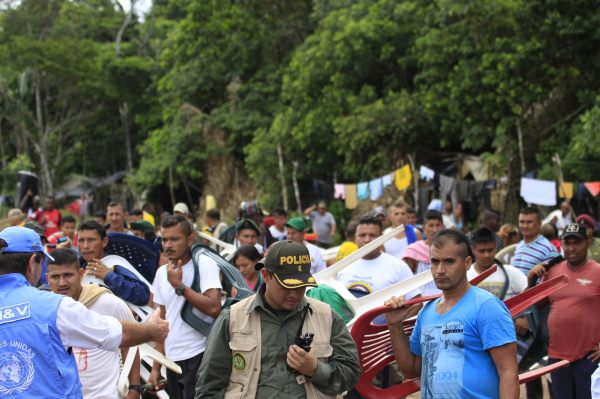
A FARC demobilization zone is visited by the UN Security Council Field Mission. / UK Mission to the UN / Lorey Campese / Flickr / Creative Commons

The Colombian peace accord has achieved another historic landmark, but the process has been anything but easy – and continues to face serious impediments.  The Revolutionary Armed Forces of Colombia (FARC) have deposited 60 percent of their weapons in UN containers to be destroyed, a watershed in the history of Colombia, as the 53-year-old insurgent group enters a new phase.  A coalition of political and social groups, however, continues efforts to stymie implementation of the accord.  It includes large landowners, cattle ranchers, agribusinesses, ultra-right religious groups, and extractive multinational corporations.  Its leading spokesmen are former President Álvaro Uribe and former Attorney General Alejandro Ordóñez, who are spearheading a vigorous campaign arguing that President Juan Manuel Santos and his government conceded too much to the FARC, compromising private property rights, the prevailing land-tenure system, and the country’s Christian values.  (The official line of the Colombian Catholic Church, which has strongly conservative factions, has been “neutral” on the peace accord, although Pope Francis has expressed strong support for it.)

These forces have flexed their muscles before.  They were instrumental in mobilizing opposition to the referendum on the accord last October, which forced the government to incorporate their demands by making the language of the accord clear that property rights and the agribusiness-extractive-rentier economic model remained dominant.  The opposition remains on the offensive, this time using the Public Prosecutor’s Office and the Constitutional Court.  While Public Prosecutor Nestor Humberto Martínez was going after FARC money, alleging that the rebels did not declare all their assets, the Constitutional Court challenged the “Fast-Track” process by which passage of bills related to implementation of the peace accord could be accelerated by reducing the number of parliamentary debates and the time required for approval.  This opened the door for the opposition coalition in parliament to challenge the accord repeatedly with protracted debate and amendments.  Its main goal has been to prevent any change in the rural land tenure system and block the inclusion of the FARC in the political process.

The opponents’ ability to tip the political balance against the accord is likely to grow as Colombia prepares for its presidential election in May 2018.  The Santos government, the left, and center-left have already looked weak while trying to make even modest reforms necessary to create conditions for a lasting peace and facilitating a transition from a war system political economy to a different one.  The paramilitaries, including old groups that remained operative after the formal demobilization of 2005-06 (such as the “Urabeños,” mutated from the former United-Defense Forces, AUC); the drug cartels and organized crime; the dramatic expansion of coca plantations; and mining of dubious legality are important components of the “old” war system that are still potent and fuel the reactionary coalition.  The exit of the FARC (and possibly the National Liberation Army, ELN, as well) are certain to change the composition and political economy of the war system that has shaped Colombia for more than four decades, but new actors (the Urabeños and others) are emerging and mutations are taking place.  These forces will persist and wield considerable power as long as Colombia is not willing or capable of addressing the countrys need for agrarian reforms and pursuing sustainable economic development based on a more equitable distribution of wealth and income.

June 27, 2017

* Nazih Richani is an Associate Professor of Political Science and Director of Latin American Studies at Kean University.  In 2014, the State University of New York Press published a revised and updated version of his 2002 study entitled Systems of Violence: The Political Economy of War and Peace in Colombia.

Perspectives on U.S.-Cuba Relations Under Trump

Trump and Cuban Americans

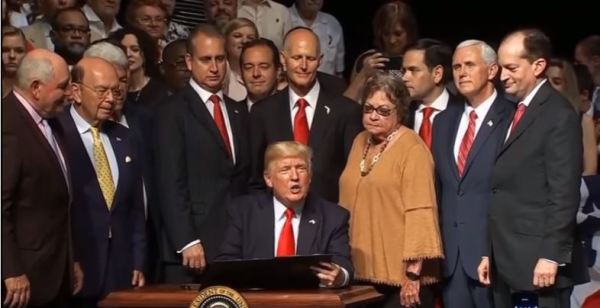
President Trump announces his administration’s policy toward Cuba. / YouTube / Livestream TV News / Creative Commons

Reversing Obama’s Cuba Policy?

By William M. LeoGrande*

In the two years after President Barack Obama and Cuban President Raúl Castro agreed to normalize relations, Obama tried to make his policy of engagement “irreversible” by opening up travel and trade that would create constituencies with a self-interest in defending engagement. He half-way succeeded. Despite the incendiary rhetoric in which Donald Trump cloaked his new policy when he rolled it out at a rally of Cuban-American hardliners in Miami, the sanctions he announced were limited.

Obama granted general licenses for all 12 categories of legal travel and relaxed other restrictions on who could visit Cuba. Trump rolled back only individualized people-to-people educational travel, so people-to-people visitors must once again travel on organized tours. But they can still go, and bring back rum and cigars.

Obama opened the Cuban market to U.S. businesses by licensing contracts with state enterprises in the travel, telecommunications, pharmaceuticals, construction, agriculture, and consumer goods sectors. Trump prohibited only contracts with Cuban enterprises managed by the military, and even then he exempted all existing contracts, and future contracts involving ports, airports, and telecomm – the sectors in which all but a handful of current U.S. businesses operate.

Trump did not impose any restrictions on Cuban–American family travel and remittances. He did not break diplomatic relations or put Cuba back on the State Department’s terrorism list. He did not restore the wet foot/dry foot policy that gave Cuban immigrants preferential treatment after reaching the United States. He did not abrogate the bilateral agreements on issues of mutual interest negotiated by the Obama administration.

Why such a flaccid set of sanctions from a president who stood on the stage in Little Havana and demonized the Cuban regime as brutal, criminal, depraved, oppressive, murderous, and guilty of “supporting human trafficking, forced labor, and exploitation all around the globe”?

Because Obama’s strategy of creating constituencies in favor of engagement worked. In the weeks leading up to Trump’s announcement, he was deluged with appeals not to retreat from engagement. The U.S. Chamber of Commerce argued in favor of expanding business opportunities, not constricting them. Farmers argued for expanding agricultural sales. Travel providers argued for expanding travel. Fifty-five U.S. Senators cosponsored a bill to lift all travel restrictions. Seven Republican members of Congress and 16 retired senior military officers argued that disengagement would damage national security by boosting Russian and Chinese influence on the island. Polling data showed that large majorities of the public, of Republicans, and even of Cuban Americans support engagement.

Even the executive bureaucracy was won over by the successes scored by the policy of engagement. During the last two years of Obama’s presidency, Cuba and the United States signed 23 bilateral agreements. When Trump ordered an inter-agency review of Cuba policy, the consensus of the agencies involved was that engagement was working and ought to be continued. Trump rejected that conclusion because it did not fit with his political strategy of currying favor with the Cuban-American right, but the agencies fought back successfully against more extreme proposals to roll back Obama’s policies entirely.

Trump’s vicious rhetoric and his open embrace of the goal of regime change – through sanctions, support for dissidents, and “democracy promotion” – risks destroying the atmosphere of mutual respect and good faith that made the gains of Obama’s policy possible. Already, hardliners in Havana who saw engagement as a Trojan Horse for subversion are saying, “We told you so!” Cuba’s private entrepreneurs, who Trump’s policy purportedly aims to help, will be hurt the most by the prohibition on individual people-to-people travel. However, the overall economic impact of his sanctions will be limited, both on U.S. businesses and in Cuba.

Cuba’s official response has been pragmatic but firm. A statement released shortly after Trump’s Miami speech declared, “The Government of Cuba reiterates its willingness to continue respectful dialogue and cooperation on issues of mutual interest, as well as the negotiation of pending bilateral issues with the United States Government…. But it should not be expected that Cuba will make concessions inherent to its sovereignty and independence, nor will it accept any kind of conditionality.”

In all likelihood, political pressures from the constituencies Obama’s policy created will continue to constrain Trump’s impulse to beat up on Cuba, but his loyalty to the exile right and his penchant for bullying will make it impossible to realize further progress toward normalizing relations. That will have to wait until the White House has a new occupant motivated by the national interest rather than by a political IOU given to Miami’s most recalcitrant Cuban-American minority.

*William M. LeoGrande is Professor of Government at American University in Washington, DC, and co-author with Peter Kornbluh of Back Channel to Cuba: The Hidden History of Negotiations between Washington and Havana (University of North Carolina Press, 2015).

Cuba: Trump’s “New Policy”


By Ricardo Torres*

The “new policy” toward Cuba that President Trump announced to great fanfare in Miami last Friday features little that is new while seeking to restore oxygen to a failed approach advocated by extreme sectors of the Cuban-American community. While adopting language reflecting the worst traditions of American foreign policy, Trump’s declaration implicitly blessed much of the rapprochement between the two countries introduced by President Obama – diplomatic relations will remain intact, for example. But the new measures he announced have symbolic and practical implications. His Cuban-American backers expended great political capital to change the policy in hope of accelerating regime change on the island, but the Trump approach will instead retard change – while increasing the pain of the Cuban people. Moreover, it will undermine the activities of legitimate U.S. citizens, companies, and groups interested in contact with the island and compromise U.S. citizens’ freedom to travel. They have acted against Trump’s campaign promise to create jobs (threatening thousands of workers who depend on U.S.-Cuba interaction) and increase national security (putting U.S.-Cuba cooperation in counternarcotics, counterterrorism, and illegal migration at risk). The new approach also runs counter to Secretary of State Tillerson’s repeated assertion that U.S. policy is not to impose its values and standards on others.

U.S. national interests seem to have taken a back seat to internal U.S. political factors, particularly the opposition to Obama’s policies among certain groups of the Cuban Americans that had seen their political influence decline over the past decade.

In addition to its symbolic weight, the Trump approach is likely to be felt most strongly in several principal areas. Despite continuing differences between the two countries, both governments had decided to move ahead together. It is difficult to overstate the sense of hope created during the Obama era, with immediate and tangible benefits for both.

Cuba’s internal situation has been changing recently, due to a gradual opening internally and to other nations. A steady increase in visits by foreign businessmen and Cuban travel overseas are evidence of this change. Trump’s rhetoric and actions will only strengthen those sectors inside Cuba that exaggerate the external threat and want to reduce the space for debate in the country.

The economic impact that Trump and his backers want – to hurt the Cuban government – cannot be separated from the harm it will cause the Cuban people. The new measures will probably reduce tourism, which provides a significant flow of revenue to vast sectors of the Cuban population that, in formal or informal jobs, benefit from that industry. Indeed, the much bandied-about private sector has been one of the principal beneficiaries of tourism development.

The Cuban government will assess its options in relations with the United States as well as in domestic policies. It will naturally have to let the U.S. government know that cooperation has yielded mutual benefits to both countries and that this step backward will not be limited to areas that Washington prefers. Havana might look for more ambitious ties with alternative partners, including both allies and competitors of the United States. Internally, rather than slow down, Cuba’s transformation should accelerate. The legitimate needs of the Cuban people should not be postponed in the face of this new adversity. The pace of Cuban reform should never be tied to external threats. As for the Cuban people, they will once again tell all who will listen that they themselves – not those on the other side of the Florida Strait – represent their interests. President Trump has empowered a small group of Cuban Americans to speak for people in Cuba whom they do not know, at the cost of sacrificing U.S. prestige and an array of its national interests. The absurd has become the accepted norm in American politics.

*Ricardo Torres is a Professor at the Centro de Estudios de la Economía Cubana at the University of Havana and a former CLALS Research Fellow.
Peru’s “New” Drug Strategy: Déjà Vu?

By Paul Gootenberg*

Eradicacion de la coca

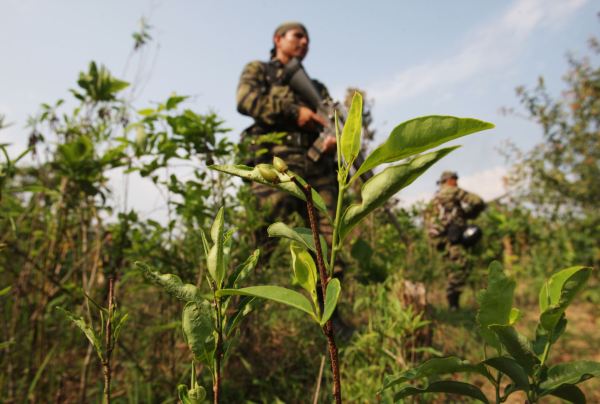
“Peru’s national drug control agency just released a four-year counter-drug strategy in April that warns of the urgency to reverse the ongoing surge in cocaine production.” / Editora Perú / Creative Commons

Peru, with a capacity to produce about 350-450 tons of cocaine a year, has been approaching Colombia as the world’s top exporter since around 2011, but its new drug strategy is not likely to reverse that trend.  Most Peruvian coca now comes from the Valle de los Ríos Apurímac, Ene y Mantaro (VRAEM), and most cocaine flows towards Brazil not the United States.  Peru’s national drug control agency, DEVIDA (National Commission for Development and Life Without Drugs), just released a four-year counter-drug strategy in April that warns – again – of the urgency to reverse the ongoing surge in cocaine production but offers few compelling or new ideas on what to do.  The report notes the “high risk for Peru that our country will repeat the cases of Colombia and Mexico” in violence, corruption, and other costs of a massive illicit narcotics trade.  The strategy has some serious flaws, however.

  • Although the report touts itself as a “Plan Integral,” military spending and eradication far outstrip “alternative development.” Coca “supply control” is the core of the program, though development efforts (mainly with cacao) are offered. Peru’s plan is mechanically sequenced – Pacification, Eradication, Services, and Development – and its rigid militaristic strategy draws criticism.  The latter seems basically directly against VRAEM peasants.  In 2014, a similar plan was announced to eradicate “50 percent” of the VRAEM coca in just one year, but nothing occurred because of the risky security environment.
  • The sources of some key data are unclear. The report cites UN information but apparently without taking into account the substantial flow of cocaleros and cocaine traffickers deeper into Amazonia, near the Brazilian and Colombian borders.  It generally treats the VRAEM, Peru’s main producing area, as an isolated containable “world apart” – poised for national “recuperation.”  Security threats in the area, including guerrillas, actually made holding off eradication since 2014 a wise move – it would have pushed cocaleros into the arms of guerrillas – but the new report fails to consider any blowback from its plan.
  • It glosses over the shortcomings of Peru’s security services to carry out what remains a heavily security-based strategy. It makes the startling admission that only 1.5-2.0 percent of VRAEM cocaine and 3-8 percent of cocaine nationally is seized – one of the lowest interdiction rates in the world.  (Colombia’s improved intelligence enables it to grab about half of cocaine in-country, and even weak Bolivia does better policing illicit cocaine.)  The ease of smuggling in Peru is directly related to the open corruptibility of Peru’s police, military, and politicians.  But except for money laundering, DEVIDA’s report barely addresses the corruption problem.
  • Peru, unlike Colombia and Bolivia, has never questioned the UN/U.S. international drug regime, nor does this report. But Peru should expect little overseas eradication aid in the Trump era, raising big doubts about the sustainability of a long-term program.

As Colombians learned after decades of drug war against coca growers, including Plan Colombia, forced eradication is one of the most inefficient and futile ways to combat drugs. Studies by Colombian economist Daniel Mejía show that the marginal cost of eliminating a kilo of cocaine from markets by aerial spraying is a whopping $247,000 – far more than a kilo’s price on the street.  Eradication also provokes violent conflict and propels growers to new areas, and Peru has many tropical basins ripe for raising coca.  Effective intelligence to hit labs and intermediary layers of cocaine trades pays bigger dividends.  So does enlisting cocalero unions on the side of the state – to self-police as in Bolivia (now with the region’s least illicit cocaine) and Colombia (where the 2017 peace accord now recognizes cocalero rights).  Peru marginalizes cocaleros, precluding the sort of socio-political strategy needed for success.  All in all, DEVIDA’s strategy makes it interesting to see whose plan will produce the best results by 2021 – Peru’s, Colombia’s, or Bolivia’s?

June 13, 2017

* Paul Gootenberg is Chair of the Department of History at Stony Brook University and author of Andean Cocaine: The Making of a Global Drug (University of North Carolina Press, 2008).

Macri in the Next 100 Days

By Nicolás Comini*

32919903642_2bd30877a1_k

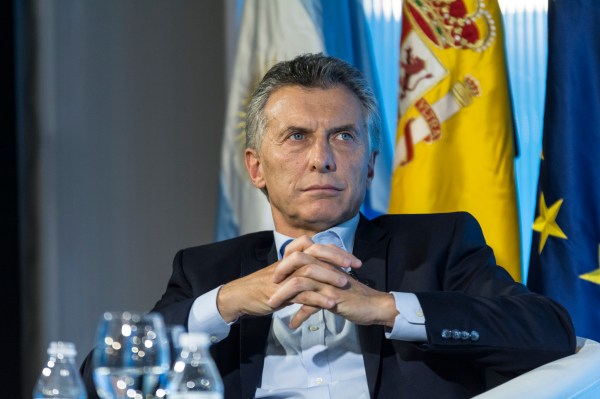
Argentine President Mauricio Macri. / Casa de América / Flickr / Creative Commons

Everybody seems to love President Mauricio Macri outside Argentina – it’s not hard to understand why – but he faces tough challenges at home.  Foreign supporters have plenty of reasons to believe in him.  First, he is not Cristina Fernández de Kirchner, the former president whom they branded a populist too close to Venezuela, Bolivia, or Ecuador.  Like many conservatives inside Argentina itself, they see Macri as the person who avoided the “Venezuelization” of the country, and his market-friendly credentials were sealed through his campaign promise of a “rain of investment” and his government’s implementation of a package of measures aimed at financial liberalization, regulatory flexibility, liberalization of foreign trade, and stronger fiscal discipline.  He has been less confrontational in diplomacy.  “Return to the world,” “de-ideologization,” “pragmatism,” and “transparency” are the continuous slogans that draw the foreign accolades.

Things look different at home, however.  The federal government confronts a convoluted scenario in the next 100 days, during which it will face at least three sets of sensitive issues in the run-up to Legislative primaries in August and elections in October.

  • Domestic issues. The government will have to deal with a hostile internal front.  One challenge will be resolving a long-running pay dispute with teacher unions – especially in the province of Buenos Aires.  Another is quelling complaints about steep increases in the costs of government services and deep slashes in funding for Science and Technology, Culture, Human Rights, Health, Production, and Energy.  Macri’s failure to meet inflation reduction targets (prices rose by 40 percent in 2016); the need to stimulate the economy; and debates on tax reform are a daunting agenda.
  • Controversy over human rights and immigration. One of the Achilles’ heels of the current administration is the imprisonment of social activist Milagro Sala in the northwestern province of Jujuy.  An ally of former President Fernández de Kirchner, Sala was arrested in January 2016 – one month after Macri took office – on highly contested charges: initially of “instigate criminal activity disorder” and later of “illicit association, fraud, and extortion.”  Pope Francis, Canadian Prime Minister Trudeau, and UN officials have expressed concern, fueling tensions inside Argentina.  An immigration reform decree facilitating deportations and restricting access at border crossings has been rejected by social movements, international organizations, and much of the Argentine political opposition.  The repudiation is not only felt in the formal political arena but also on the streets.
  • External dynamics with internal consequences. Brazil’s Lava Jato scandal is splashing as much onto Macri’s government as his predecessor’s.  Officials from both administrations are being accused of receiving bribes from Odebrecht, the largest Brazilian construction company, and no one knows how this process will develop hereafter.  Congresswoman and Macri ally Elisa Carrió claims the whole political elite is complicit in the Odebrecht mess.  The “Panama Papers” – leaked from the law firm Mossack Fonseca, which allegedly was involved in helping companies hide bribes paid to a number of South American leaders – has so far not touched Macri, whose family has links to firms cited in the documents.

The August primaries, followed by full legislative elections in October, are a potential inflection point for both Macri and his opponents.  Neither side has yet announced its slate of candidates, but one essential factor is already clear: the candidacy (or not) of Cristina Fernández de Kirchner.  The primary election will define how the pieces of the political chessboard are placed, and Macri’s handling of his economic, political, and social challenges will be decisive.  Achievement of his reform agenda – including the overhauling the National Institute of Statistics and Census (INDEC, accused of cooking data during previous governments), an ambitious “Plan Belgrano” infrastructure program, and the end of currency controls – may not be enough.  The potential reunification of his key Peronist opponents, increased social unrest, splits in his own coalition, and the spillover from the Brazilian crisis suggest a sobering future.  True love cannot be achieved from one day to the next, but in the domestic political arena it is simple to lose it suddenly.

June 8, 2017

* Nicolás Comini is Research Fellow at CLALS; Director of the Bachelor and Master Programs in International Relations (Universidad del Salvador, Argentina); and Professor at the New York University-Buenos Aires.

Venezuela: Stalemate in a War of Attrition?

By Michael McCarthy*

33792960765_7a1d866299_h

Members of Venezuela’s opposition march against President Maduro at a demonstration in April 2017. / A. Davey / Flickr / Creative Commons

The pace of provocation and counter-provocation in Venezuela has reached a new high, and there does not seem to be a stabilizing force that can induce a de-escalation.  It’s unclear if the country’s power struggle is experiencing a new cycle in its multi-year confrontation, or if two months of protests mark the start of a downward spiral that will plunge the country into even deeper crisis.  Neither the government nor opposition appears near the point of exhaustion that would make efforts at a meaningful negotiated settlement fruitful.  An examination of their agendas, moreover, paints a picture of an intractable conflict.

  • President Nicolás Maduro is in raw survival mode – perhaps driven by fear of disgrace as the man who lost the Chávez legacy entrusted to him – and is forcing a rewrite of the Constitution as he lurches toward outright dictatorship. He deeply resents that the opposition never acknowledged the legitimacy of his election, and he was shaken when jeered and egged at a public rally recently.  He has condoned violence by his party’s vigilantes and the Guardia Nacional, but almost certainly grasps its political cost, including within the government and military.  Faced with the certain prospect of persecution by an opposition-dominated government, he probably sees no incentive to negotiate his denouement.
  • The opposition remains heterogeneous and is united almost exclusively in the fervent belief that Maduro – through evil and incompetence – is destroying the country. Government repression and their own self-inflicted wounds have precluded development of a sophisticated strategic planning capacity.  Although opponents’ preferred option is to remove Maduro at the ballot box, some also apparently believe that ratcheting up the violence will force the military – reluctant to intervene – to lean on Maduro to depart.
  • The senior ranks of the military, compromised by corruption and narco-trafficking during the Chávez-Maduro era, show no signs of wavering, but discontent among field-grade officers at the Regional Commands – who will have to serve under a successor government – may become palpable during the military promotion season that formally concludes July 5. As the Guardia Nacional soils its reputation, the military wants to stay off the streets as long as possible.  There’s no evidence of sympathy with the opposition; their primary concern is avoiding being part of the bloodshed.  How the military would orchestrate a post-Maduro era is unknowable.
  • The country’s economic and financial crises have devastated oil production, making it impossible for Maduro to pump his way out of the crisis and increasing his reliance on foreign capital. Indebting itself further at an extremely high cost, the government bought some time by selling $2.8 billion in bonds to Goldman Sachs – through a counterparty – for $865 million in cash.
  • The sectores populares are highly agitated but lack leadership. The working class has largely fallen into poverty, now estimated at 80 percent nationally, and neighborhoods previously home to chavismo’s base have shown tolerance for the opposition and outright disdain for the ruling coalition, including knocking down statues of Hugo Chávez.

Neither the government nor opposition has yet shown concern that its resources and energy are nearing exhaustion – and the military, so far, is not prepared to tell one or the other to give up the struggle.  As long as both sides think that they can break the other, moreover, the prospects for either regime collapse or a mediated settlement seem unlikely, and it is hard to imagine the emergence of a stabilizing force that can mitigate conflict.  External forces may try to facilitate a resolution but are unlikely to succeed.  Brazil’s corruption scandals have removed it as a player; UNASUR’s failures have rendered it irrelevant; and Maduro preempted any final OAS censuring by announcing withdrawal from the organization (though his foreign minister will attend its General Assembly this month).  Washington continues to rely on sanctions – most recently freezing the assets of eight members of Venezuela’s Supreme Court – but seems reluctant to get more deeply involved, and given the turmoil that characterizes the Trump administration, it may in any event be incapable of doing so.  Absent the emergence of a viable formula within Venezuela to overcome the costly stalemate, the war of attrition between regime and opposition will likely continue without meaningful involvement of external actors.

June 5, 2017

* Michael McCarthy is a Research Fellow with the Center for Latin American & Latino Studies.  He is International Associate for Venebarómetro polling and publishes Caracas Wire, a newsletter on Venezuela and South America.

Haiti: Yet More Challenges Ahead for President Moïse

By Emma Fawcett*

12366883915_49c37e2c7c_k

A group of peacekeepers from the UN Stabilization Mission in Haiti (MINUSTAH) prepare for departure from the island. / UN Photo / Isaac Billy / Flickr / Creative Commons

Haiti’s new president, Jovenel Moïse, has helped the country overcome the long political crisis that preceded his election, but he faces losing two long-running forms of support from the international community.  MINUSTAH, the UN peacekeeping operation that has been in place for 13 years – successor to similar missions since 1994 – will depart this autumn, necessitating an expansion in Haiti’s domestic police force.  The U.S. Temporary Protected Status (TPS) program, providing temporary legal residency to some 58,000 Haitians in the United States since the 2010 earthquake, appears likely to end in January 2018.

  • MINUSTAH has long been the backbone of Haitian internal security, for which Haiti’s own forces lack competence and credibility. The UN’s demobilization began in May, when units from Chile, Uruguay, and Peru returned home.  Brazilian units remain in the country to oversee the return of equipment and disassembly of base facilities.  Operations will officially cease on October 15.  MINUSTAH is one of the United Nation’s longest running peacekeeping missions, and its loss will have a significant impact even though its operations have been plagued by tragic (and criminal) missteps.  It was responsible for bringing cholera to Haiti; the epidemic has since killed more than 10,000 people.  In addition, an Associated Press investigation revealed nearly 2,000 accounts of sexual abuse and exploitation by UN peacekeepers, including about 300 perpetrated against minors.  While the UN has a “zero tolerance” policy against sexual exploitation, it does not have the power to prosecute perpetrators – and holding troops accountable is the responsibility of their home governments.  Sri Lanka has declined to investigate more than 100 of its soldiers, who were sent home in 2007 after sexual abuse allegations.
  • The Haitian government requested an 18-month extension to the TPS program, but U.S. Secretary of Homeland Security John F. Kelly opted to extend by just six months. While Kelly said the program will be reevaluated before the current extension expires, his statement has effectively signaled the end of the program, noting that the short extension “should allow Haitian TPS recipients … time to attain travel documents and make other necessary arrangements for their ultimate departure from the United States” and give the Haitian government time to prepare for their repatriation.  The Haitian government has argued that it is ill equipped to manage an influx of returnees, and that the remittances provided by those in the TPS program are vital to Haiti’s continued recovery.

More than seven years after the deadly earthquake, Haiti’s recovery remains elusive, and the departure of MINUSTAH and potential end of the TPS program portend a rocky road ahead for a new government that is just barely getting some traction.  The end of both forms of support for Haiti represent donor fatigue – not Haitian achievement of benchmarks of progress.  Port-au-Prince couldn’t reasonably expect the UN to continue providing it security support for another 20 years, but Moïse is about to bear the brunt of series of predecessors who failed to prepare the nation for the UN’s departure.  The support Haiti has received from the international community has always fallen short of promises; nearly $10 billion in pledges for post-earthquake assistance never materialized.  But donors also point out that Haiti has often failed to uphold its end of the bargain; the protracted election crisis caused many to withdraw budgetary support.  While both the UN peacekeeping mission and U.S. immigration policy have been at times poorly executed, their absence will be a major blow, if nothing else because changes on both fronts are proof that Haiti is no longer anyone’s priority.  Moïse’s administration has much to tackle – bolstering the national police force and preparing for the arrival of potentially tens of thousands of TPS returnees without adequate resources for either task – while he addresses 14 percent inflation and a bloated civil service.  Looking for homegrown solutions would be a huge challenge for any country, especially one struggling with as many fundamentals as Haiti.

May 31, 2017

* Emma Fawcett is an Adjunct Professorial Lecturer at American University and a monitoring and evaluation specialist with an international NGO.  Her doctoral thesis focused on the political economy of tourism and development in four Caribbean countries: Haiti, Dominican Republic, Cuba, and the Mexican Caribbean.

AULABLOG: Mission and Invitation

As this blog hits its five-year mark in July, we thought we’d take a moment to restate its purpose and invite you to comment on its effectiveness and even to contribute articles.

We established AULABLOG in 2012 to contribute clear, concise information and analysis to the debate about contemporary Latin American affairs and U.S. engagement with the region.  Drawing on the findings of research undertaken by analysts at American University and scholars elsewhere in the United States, Latin America, Canada, and beyond, we have aspired to put forth “non-gratuitous provocations” that – using an accessible format that eschews both academic jargon and the platitudes of much punditry – intervenes constructively and fosters a more informed debate about the region and its linkages to the United States and the rest of the world.  Also, the blog has served as a vital instrument for disseminating the findings of research projects undertaken at the Center with support from a wide array of donor agencies.

As we approach the summer season, when we reduce our typical output from two posts per week to a single item, we are taking stock of what we have accomplished and what we might set our sights on for the coming year.  We welcome your views on how well we have achieved our goal of informing both practice and scholarship.  Have we covered the right balance of topics, and have we recruited the best analysts to share their insights with you?  Should we do more to encourage readers’ posts commenting on articles, which has not been a priority (even if fruitful when it has occurred), to enrich discussion?

We now have roughly 2,160 subscribers and a good many more readers who read AULABLOG through the Center’s Facebook and Twitter platforms, but we want to find out more about who you are, and to seek out ways to expand this readership further.  We’re also keen to find potential sources of financial support to defray the costs associated with producing the blog, and we welcome donations (click here):  The Center refuses to indulge in the all too widespread practice of exploiting unpaid student interns.  However, it’s an ongoing challenge for us to secure those resources with which to reward the people who perform the backroom tasks of posting our work.

Answers to these questions and others must come not only from parsing out the data available to us and thinking internally about what we’ve covered well and where we continue to suffer gaps. We also solicit input from you, our readers.  The feedback we get is positive – as feedback tends to be – we’d like to hear from other readers – like you.

What do you think about the blog? Is the intellectual and visual content appropriately provocative?  In what ways is it useful to you, your colleagues, or your students?  Is it a potential tool for class curricula, for informing preparation of policy briefs at advocacy organizations, government agencies or think tanks, or for preparing journalistic analyses?  Please share your comments with us, either directly (by clicking on our names below) or right here, in our comment section, perhaps stimulating an open exchange of ideas among our readership.

We would also like to invite you to contribute articles to AULABLOG – if you’ve done new research or have an appropriately provocative but well-argued line of analysis to share with us and the blog’s readers.

With thanks for your ideas and continued support!

Fulton Armstrong, CLALS Research Fellow and Director/Editor, AULABLOG

Eric Hershberg, CLALS Director and Associate Editor, AULABLOG

Alexandra Vranas, CLALS Communications and Partnerships Staff

Brazil: The Day after Temer

By Marcio Cunha Filho*

34622412041_b5ddcca3d7_k

Demonstrators in São Paulo demanded the resignation of Brazilian President Temer on May 17, 2017. / Mídia NINJA / Flickr / Creative Commons

Brazil’s political turmoil has reached new heights with the leaking of audio recordings of President Temer allegedly authorizing bribes to prevent the former Speaker of the House, Eduardo Cunha, from concluding a plea bargain arrangement with investigators.  Although the recordings were inconclusive and Temer alleges that they were fabricated, their emergence was enough to push an already fragile government to the verge of collapse in less than 24 hours.  The day after the leak, according to press reports, four of Temer’s ministers were already discussing his replacement at a closed meeting with current Speaker of the House Rodrigo Maia, who is the next in line for succession. Some parties, such as the PPS, have already left Temer’s coalition. The PSDB, Brazil’s largest center-right party and Temer’s main coalition partner, is also discussing a possible withdrawal from government.  (The party’s former President and one of Temer’s closest allies, Senator Aécio Neves, was removed from office by a Supreme Court decision as part of Operation Car Wash.  (See here and here for previous articles about the Lava Jato investigations.)

  • Temer has denied the possibility of resigning, but there are a few ways he could be forcefully removed from office. Most observers argue that, however he departs, the Constitution would require his successor to be indirectly elected by Congress within 30 days.  Others posit, however, that if the Superior Electoral Court condemns Dilma and Temer together for illicit funding in the 2014 Presidential campaign – the trial is in early June and is likely to be the fastest possible way to remove Temer – then the electoral code dictates that new direct popular elections be held (as long as annulment is not declared within the last six months of their term, which ends in December 2018).
  • Key political actors seem to be favoring the scenario in which Congress indirectly elects the successor. Although very fragmented, the Brazilian Congress is mostly conservative or right-leaning, and many of its members fear that former President Luis Inácio Lula da Silva, who polls currently indicate would easily defeat any other candidate, might be elected in a popular election.

In this context, indirect election would put Brazil’s political system on the very edge of legality.  During a similar crisis in 1964, Congress’s ousted left-wing acting Vice President João Goulart and elected another itself, without popular approval, in an act almost universally seen today as illegal.  That act ended up throwing Brazil into a violent military dictatorship that lasted for more than two decades.  In the current political crisis, if Congress were to act against the current rules of the electoral code and without popular approval, this could again be another step towards the establishment of an illegal regime, which could further curtail accountability and democratic mechanisms in the country.  Placing the destiny of the country in the hands of a Congress, with many of its members under investigation themselves, might be a mistake with profound consequences.  Popular elections would also entail great uncertainty as well, but the uncertainty of elections is an inherent element of democratic systems.  When political actors try to limit or manipulate electoral outcomes in the name of predictability or security, this is when democracy dies.

May 19, 2017

* Marcio Cunha Filho is a Ph.D. candidate at the University of Brasília; federal auditor in Brazil’s Office of the Comptroller General; and CLALS Research Fellow.

Who Really Benefited from the Commodities Supercycle – and Who Loses with Its End?

By Carlos Monge*

2017-05-13 AULABLOG_Carlos_Monge_graphic

Latin American governments and business associations have tended to overstate the benefits of extractive industries during the commodities supercycle that ended in 2014-15.  Resource-rich Latin American countries did experience high rates of economic growth and diminished poverty and inequality during the boom years.  On the surface, this would appear to strengthen arguments that – despite their negative environmental impact – extractive industries are the key to progress, especially in resource-rich areas.  Nevertheless, a closer look at data from household surveys in Bolivia, Chile, Colombia, Ecuador, and Peru shows that things are a bit more complicated.

  • The inequality gap between individuals, as measured on the GINI Index, has narrowed, but the gaps between groups of the population have not evolved evenly. For example, the National Resource Governance Institute (of which I’m regional director) recently completed a study of the performance of social indicators during the supercycle that concluded that the poverty gap between urban and rural populations has increased in all countries.  (The report is available in English and Spanish.)  In Peru and Chile, the gap increased more in territories where extractive territories are located, while in Colombia, Bolivia, and Ecuador less so.  The gap between indigenous and non-indigenous populations increased only in extractive territories in Ecuador, decreasing in both extractive and non-extractive settings in the rest of the countries considered.  Regarding gender, in all five countries the gap between men and women increased slightly in non-extractive territories and decreased a bit more in extractive ones.

This report establishes correlations between the increase in extractive activities, the availability of extractive rents, and patterns of inequality reflected in social indicators, but it does not establish a causal relation between such variables.  For example, the data show that urban populations in Peru’s extractive regions have benefited more than rural ones – which some very preliminary research shows is probably because urban centers provide extractive projects with the goods and services they need, while less sophisticated rural areas do not.  At the same time, rural populations have to compete with the extractive projects for those same urban goods and services, and with local governments for the labor force that the public sector contracts to develop infrastructure projects that are paid for through increased revenues delivered by the extractive sector.  This is what we have called the “Cholo Disease.”  A variation of the “Dutch Disease,” it reflects a loss of competitiveness resulting not from large exports of raw materials causing the currency to appreciate, but rather from increases in the cost of labor and of urban goods and services consumed by campesinos.  However, a more definitive explanation regarding exactly how this happens in Peru and in other countries certainly needs further research.

While our data clearly show the impact of mining and hydrocarbons extraction and the resulting expenditure of extractive rents on the poverty gaps between urban and rural populations, men and women, and indigenous and non-indigenous populations, further investigation into the causes and consequences is needed.  The end of the supercycle has already meant a fall in growth rates and extractive revenues, leading to a worrisome rebound in poverty rates.  We are still unable to answer, however, the question of how broadly it will impact the substantial segments of Latin America’s population that emerged from poverty but remains in a vulnerable position – and how it will aggravate poverty gaps among individuals and between groups in extractive and non-extractive territories.

May 16, 2017

* Carlos Monge is Latin America Director at the Natural Resource Governance Institute in Lima.