Iran in Latin America: An Exaggerated Threat

By Aaron Bell

Former Presidents Hugo Chavez and Mahmud Ahmadinejad / Photo credit: chavezcandanga / Foter.com / CC BY-NC-SA

Former Presidents Hugo Chavez and Mahmud Ahmadinejad / Photo credit: chavezcandanga / Foter.com / CC BY-NC-SA

During his campaign for the U.S. presidency, Republican Mitt Romney referred to Russia as the United States’ number one geopolitical foe, but in the Latin American context he and his fellow conservatives have focused much more on another perceived competitor – Iran. Alongside China and the EU, Russia has indeed taken greater interest in Latin America in the past decade, investing in energy, selling military hardware, and even offering an alternative to Washington’s counternarcotics programs. But Romney and major elements of his party have given more attention to the newer, more enigmatic go-to threat of Iran and its former president, Mahmoud Ahmadinejad. The 2012 Republican Party Platform warned that Venezuela had become “an Iranian outpost in the Western Hemisphere,” issuing visas to “thousands of Middle East terrorists” and providing a safe haven to “Hezbollah trainers, operatives, recruiters, and fundraisers.” This past spring, former Assistant Secretary of State Roger Noriega told a Congressional committee that Hezbollah was working alongside the Sinaloa Cartel to fund and organize terrorist activities. He claimed the organization had infiltrated the Venezuelan government so the Iranian government could launder money through Venezuelan banks to avoid international sanctions.

Relations between Iran and some members of ALBA expanded during Ahmadinejad’s presidency, during which he spent more time in Latin America than either Presidents Bush or Obama. He shared the stage with Hugo Chávez and Daniel Ortega in denouncing the United States and its policies toward both Iran and the ALBA nations, and he pledged to invest in Venezuela, Bolivia, and other countries. The warmth of that contact gave credibility to rumors that Iran has used elite Quds soldiers and Hezbollah agents to create a web of Latin American agents available for terrorist strikes in the United States.  As required by the Republican-sponsored “Countering Iran in the Western Hemisphere Act,” the State Department released a report this summer analyzing Iran’s regional activities. While it expressed concern over Iran’s political and economic links, it concluded that Tehran’s regional commitments had largely gone unfulfilled. Nonetheless, a handful of U.S. Congressmen and the media continue to warn of the looming Iranian threat along what conservative commentators call the “‘soft belly’ of the southern border.”

The Obama Administration has not dismissed entirely the negative impact that a country like Iran can have in Latin America, if nothing else by encouraging political leaders to sustain their anti-U.S. rhetoric campaigns. But the Administration has not subscribed to the right wing’s exaggerations about Iranian activity and indeed is seeking pragmatic agreements with Iran to resolve a series of concerns about its activities, particularly its nuclear program. A handful of members of Congress led by Rep. Ileana Ros-Lehtinen (R-FL), former Chairman of the House Foreign Affairs Committee, have accused the Obama administration of putting politics over national security by failing to challenge Venezuela and other Iranian allies, though the political advantage the president supposedly achieves with such a policy is unclear. Some xenophobic nationalists on cable TV believe the Iranian activities are part of Islamic imperialism, which poses a threat to Western civilization. Others see the threat as being embodied by Barack Hussein Obama, accusing the administration of hyping the Iranian issue as a pretext to justify the expansion of a U.S. military presence in South America. Today’s paranoia about Latin America is different from during the Cold War years, but only in the identity of the villain. Latin America’s role in the new narrative remains unchanged: it exists primarily as a base of operations for foreign enemies of the United States that must be monitored and pressured to ensure U.S. national security. While the rhetoric of ALBA leaders and their efforts to establish friendly relations with regimes like Iran fuel such paranoia, Washington would be wise to respond to actions rather than empty rhetoric. Fortunately, the Obama administration appears to be doing just that.
Venezuela: The True Scope of Chávez’s Legacy

By Andrés Serbin and Andrei Serbin Pont*

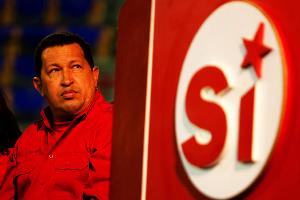
Hugo Chávez / Photo credit: ¡Que comunismo! / Foter / CC BY-NC-SA

Hugo Chávez / Photo credit: ¡Que comunismo! / Foter / CC BY-NC-SA

Chávez’s legacy for Venezuela goes well beyond the Bolivarian government he left in Nicolás Maduro’s hands.  Three conflicts overshadow the country’s future and contribute to many uncertainties:

  • The first, and most urgent, is the standoff between the two main factions of the ruling PSUV over how to overcome the current economic crisis, characterized by the IMF as “difficult and probably unsustainable.”  The pragmatists focus on making currency controls more flexible, and the ideologues are oriented toward increasing state control over the economy.
  • The internal party conflict between President Maduro and his supporters, committed to building the “socialismo del siglo XXI,” on the one hand, and the pragmatic sector of the governmental party (pragmatic in the sense of ensuring their businesses operate without interruption) led by the President of the General Assembly, former army officer Diosdado Cabello, with the support of high ranking military and businessmen who benefited from the “revolutionary” process through legal and illegal business.
  • The conflict between the PSUV, wielding the power of the government, and the opposition, which it accuses of being an “enemy of the revolution” linked to the “external enemies” (basically the United States) who want to derail the revolutionary process.

The dire state of the economy is aggravating each of these conflicts.  By the end of September, according to government data, inflation rates hit 4.4 percent per month, and rose to 38.7 percent in 2013 so far.  The opposition estimates an annual inflation rate of 49.4 percent—the highest since 1997.  According to the 2012 UN Economic Commission for Latin America and the Caribbean (ECLAC) report, an increasing number of Venezuelans are living under the poverty line – with a 29.9 percent increase in the poverty rate last year – with income no longer enough to fulfill basic needs.  Shortages of food and other necessities are severe; the depreciation of the Bolívar has accelerated in the currency black market, and the Central Bank is printing paper currency in an attempt to cope with the financial deficit.  Within this context, the struggle between the pragmatic and the ideological fronts of the PSUV only contributes to the chaos.

Caracas’s international relations are also a factor in the internal tensions and are fueling concerns within the armed forces, according to NGOs and others with good contacts in the military.  The economic crisis has affected the government’s ability to continue its “petro diplomacy” – diminishing its influence – and the opposition has continued persistent accusations of inadequate management of the relationship with Guyana and the claim over the Essequibo, contested territory along their common border.  In addition, a recent incident involving a maritime exploration ship of Panamanian flag with a U.S. crew detained by the Venezuelan Navy in waters under dispute with Guyana aggravated the current national and international political scenario.  The government usually resorts to nationalist appeals, but criticism of its handling of these problems is likely to grow.

The core issue in all of these situations continues to be the potential scenario of a social outbreak driven by the shortages, rising inflation, the broad sense of insecurity, and perceptions of blatant corruption in government.  These frustrations appear to cut across all sectors of Venezuelan society regardless of ideological identity.  Given the historical reluctance of the armed forces to intervene (particularly since the experience of the “Caracazo” of 1989), most observers still wonder when and if a social explosion will move them to action.  The economic and social crises, the internal tensions in the government, and the polarization with the opposition, along with the possibilities of an international incident, may add up to enough to move the military, perhaps with the support of several state governors, to act, but determining that breaking point – the Venezuela analyst’s greatest challenge – remains elusive.

* Andrés Serbin and Andrei Serbin Pontare members of the analysis team of the Coordinadora Regional de Investigaciones Económicas y Sociales (CRIES), a Latin-American think tank.

ALBA’s Future: Continuity or Break Down?

By Marcela Torres

ALBA Emblem | public domain

ALBA Emblem | public domain

The death of Hugo Chávez last March and the increasingly severe economic dislocations inside Venezuela have raised serious questions about the sustainability of the Bolivarian Alliance for the Peoples of the Americas (or ALBA).  Born out of an agreement between the Venezuelan and Cuban governments in 2004, the alliance was intended as a response to the U.S. goal of a Free Trade Area of the Americas (FTAA), as well as a vehicle for Chávez to project his Bolivarian vision for Latin American solidarity around a socialist project.  The regional bloc won its first symbolic battle at the Fourth Summit of the Americas in 2005, where Argentina, Brazil, Uruguay, and Paraguay definitively halted negotiations led by U.S. allies to create a single hemispheric free trade area (excluding Cuba, of course).  Over time, ALBA and its oil-based extension, Petrocaribe, have had a significant impact on economies in the region, providing crucial underpinning for presidents who signed on to Chávez’s vision for ideological or pragmatic reasons.  Among the greatest beneficiaries have been the Castro government in Cuba and the Ortega government in Nicaragua, which have received petroleum in exchange for food, in the case of Nicaragua, and doctors and teachers, in the case of Cuba. Ecuador and Bolivia, along with several states in the greater Caribbean, have also become key players in the ALBA network.

Venezuela’s leadership of ALBA, frequently described as “petro diplomacy,” has repeatedly come under fire from the country’s political opposition and from government critics in other ALBA-friendly nations.  The critiques in Venezuela rarely acknowledge the degree to which petro diplomacy has been a recurring feature of that country’s foreign policy, most notably during the governments of Carlos Andrés Pérez in the 1970s and 1980s.  Critics inside Venezuela and beyond frequently accused Chávez of building dependent clientelistic networks with countries desperate for energy resources. However, ALBA activities have transcended ideological divides, a fact demonstrated by Misión Milagro in Colombia, where Cuban doctors indirectly supported by Venezuela provide medical services in conflict zones.  If Chavez’s oil and charisma initially defined ALBA’s possibilities, the alliance has also fostered economic ties and investments among member countries, independent from Venezuela.

Though the election of Nicolás Maduro as Chávez’s successor might appear to guarantee political continuity, lacking Chávez’s charisma, Maduro might not be able to continue Chávez’s level of oil-fueled investment in ALBA.  Public spending in Venezuela continues to increase dramatically, with the fiscal deficit at 9-12 percent, inflation exceeding 40 percent, and the scarcity of dollars contributing to shortages of basic consumer goods.  To sustain its financial backing for ALBA, Maduro will have to stabilize the economy at home lest he lose the  popular legitimacy — no simple challenge.  Following the Twelfth Presidential Summit of ALBA in July, the presidents of Ecuador, Bolivia and Nicaragua joined Maduro in reaffirming their shared commitment to a socialist project in the region and a desire to maintain the international exchanges initiated by Chávez, suggesting that the alliance will not disappear at least in rhetoric in the medium term.  It is possible, however, that Maduro’s leadership will be challenged.  After the airplane in which Bolivian President Evo Morales was traveling was not allowed to land in France and Portugal this summer,  he proposed creating an ALBA army and convening another anti-imperialist summit.  Recently re-elected Rafael Correa of Ecuador has also hinted he might want to lead ALBA.  Without Venezuelan oil and sweeteners like Petrocaribe, it’s hard to see how ALBA will amount to more than a platform for personalistic agendas.


Venezuela Update: Confusion in Caracas…and Washington

Photo credit: INTERNATIONAL REALTOR / Foter.com / CC BY

Photo credit: INTERNATIONAL REALTOR | Foter.com | CC-BY

Three weeks after elections to choose Hugo Chávez’s successor, confusion still reigns in both Caracas and Washington.  The Venezuelan opposition has rejected the results of the election, which the electoral tribunal says Chávez’s handpicked man – Nicolás Maduro – won by only 1.8 percent.  Opposition candidate Henrique Capriles originally asked only for a vote recount – considered reasonable by many because of the narrow margin – but his lawyers upped the ante on 2 May when they officially demanded that the vote be invalidated and new elections be held.  Isolated incidents of political violence turned up the heat in Caracas, although the Götterdämmerung scenarios in the streets that some analysts predicted have not yet materialized.

Every major country of the hemisphere has recognized Maduro as President – except the United States.  (Canada wavered at first but seems to have moved on.)  Washington has invested millions of dollars in “democracy promotion” programs over the years and has provided Capriles and the opposition enduring political support in their efforts to beat Chávez at the polls and later to beat Maduro as his hand-picked successor.  Since the April election, the U.S. government has endorsed the opposition’s call for a vote recount.  So has the OAS, which offered experts to assist in the process.  But only Washington has said that while it is “working with” the Maduro Government, it doesn’t recognize its legitimacy.  The State Department spokesman dodged the issue repeatedly last week, and in an interview with Univisión broadcast at the conclusion of his visit to Mexico last Friday, President Obama himself refused to say whether his Administration officially recognized Maduro as President.  He left little doubt as to his real position, however, when he said that basic principles of human rights, democracy, press freedom and freedom of assembly were not observed in Venezuela following the election.

As AULABLOG pointed out on 23 April, the irony of the United States demanding a hand-count of the ballots is not lost on millions of Latin Americans who remember Washington’s performance in the 2000 Bush-Gore vote – and that it was a politically divided Supreme Court that made the final decision.  The tightness of the vote, Venezuelan electoral realities (past and present), and President Maduro’s over-the-top rhetoric – last week he again accused Washington of backing “neo-Nazis” allegedly trying to overthrow his government and accused a filmmaker of being a spy – make it hard for observers to argue that the elections are legitimate.  President Obama’s statements, including his remark that the spying charge was “ridiculous,” have been measured and continue a noteworthy shift since the near-hysteria about Venezuela during the Bush Administration.  But the fact remains that the U.S. Government’s posture on Venezuela – perhaps unique in its bilateral relations with Latin America since the Cold War – has made it once again the outrider and, among people who remember the Bush-Gore decision, the butt of many jokes.  Importantly, Capriles may be reading Washington’s stance as an endorsement of his own increasingly puzzling demands.  As our 23 April post suggested, Capriles ought to see himself as having a historic chance to lead, poised to challenge Chavismo easily at the polls the next time around.  Yet, like Mexico’s Andrés Manuel López Obrador in 2006, he may be squandering an opportunity to present himself to the Venezuelan electorate as the responsible grownup in the room.

Chavismo Wins a Battle But the Tide May Have Turned

By Eric Hershberg

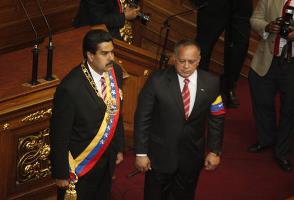
Inauguration of Nicolás Maduro | Photo credit: Presidencia de la República del Ecuador / Foter.com / CC BY-NC-SA

Inauguration of Nicolás Maduro | Photo credit: Presidencia de la República del Ecuador / Foter.com / CC BY-NC-SA

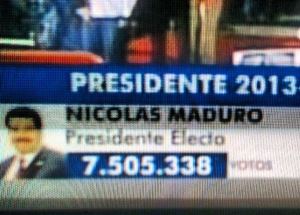
President Nicolás Maduro’s inauguration last Friday marked a new stage in the contest between chavistas and the Venezuelan opposition.  Maduro’s surprisingly weak showing at the polls – winning by a meager 1.8 percent margin despite the huge (and abused) advantages of incumbency – plus tensions within his party and his own rhetorical excesses, suggest that chavismo without Chávez confronts challenging odds.  Chávez attracted more votes alive than he could in death, as his hand-picked successor could not match his patron’s appeal at the ballot box.  Looking forward, Maduro and the Partido Unido Socialista de Venezuela (PSUV) will be judged on the basis of their performance.  The road ahead will not be easy for Maduro, as the government  confronts growing economic and security problems, and his ineffective campaign may energize potential competitors from within Chavismo.

Henrique Capriles’s strong showing in the election bodes well for the opposition.  However, athough Maduro’s blanket reference to them as “fascists” is absurd, their apparent eagerness to use the vote recount – reluctantly agreed to by the electoral council hours before Maduro’s inauguration – to remove him from office could breathe life into his allegation that the opposition consists of  golpistas obsessed with taking power.  Overreaching could be their undoing, as it has been in the past.

Latin American presidents, through a UNASUR statement of support and participation in the inauguration, have endorsed Maduro’s ascendance to the Presidency.  Their strong interest, for a variety of reasons, is in a balance between continuity and change in Venezuela. Although there are signs that both Chile and Colombia wavered momentarily, South American governments overall were united in their preference for a chavista government, as this would favor both  internal and regional stability.The United States, on the other hand, has appeared timid.  Maduro’s accusations of U.S. attacks on him and the presence of Iranian leader Ahmadinejad at the inauguration made it impossible for Washington to send a senior emissary to the swearing-in.  Yet the evident absence of the United States, even after the UNASUR endorsement, was petty.  Through statements calling for a recount of 100 percent of the votes both the State Department and the U.S. Ambassador to the United Nations came across as unable to outgrow a grudge match with Chávez or to grasp that the American position would isolate Washington once again from prevailing sentiment in South America.

There were two winners in the Venezuelan election:  Maduro, who is now the elected President, and Capriles, who managed to secure nearly half the votes in the face of overwhelming odds.  The latter comes out ahead in the long run, but only if he manages his cards wisely.  Washington, meanwhile, seems still not to understand two things:  First, after Bush v. Gore, it will be at least another generation until Americans can say anything about how to count votes.  It was legitimate and appropriate for the OAS to demand a recount, as its record in election monitoring is impeccable.  Secretary General Insulza achieved the core objective of the Organization and should be recognized for having done so.  For the American government to have taken the position that it did suggests an inability to understand the consequences of the 2000 election in Florida for its credibility in election-related issues in the region.  Second, democratic change in Latin America is typically an evolutionary process.  This may be less satisfying to some policymakers who would prefer to see a foe’s outright defeat, but it may be better, for Chavismo’s enemies in both Washington and Caracas, than having their favorite step in at this particular time of high tensions.  If Capriles and his coalition can brand themselves as democratic reformists rather than golpistas, they have a good chance of coming to power when Maduro’s six-year term is exhausted, or even before, and if they convey a message of responsible opposition, key South American governments might well approve of an alternation in power the next time around.

The Danger of Dependence: Cuba’s Foreign Policy After Chávez

By William M. LeoGrande, World Politics Review

Photo credit: ¡Que comunismo! / Foter.com / CC BY-NC-SA

Photo credit: ¡Que comunismo! / Foter.com / CC BY-NC-SA

On March 8 in Caracas, Raúl Castro, looking somber, stood in a place of honor beside Hugo Chávez’s casket during the late Venezuelan president’s state funeral. Castro was no doubt pondering what Chávez’s death means for Cuba’s ambitious economic reform program — or “updating” of the economic model, as Cubans prefer to call it. Not long after Chávez’s first election victory in 1998, he and Fidel Castro signed the first of what would become more than 100 bilateral cooperation agreements. By the time Chávez died, Venezuela was providing Cuba with some 110,000 barrels of oil daily at subsidized prices, worth $4 billion annually and representing two-thirds of Cuba’s domestic oil consumption. In exchange, Cuba provided some 40,000 skilled professionals, working mostly in health, enabling Chávez to extend health care into the poor barrios of Venezuela, thereby solidifying his political base.

With the Venezuelan economy foundering under a huge fiscal deficit, will Chávez’s successor continue this barter arrangement on the same preferential terms? If not, will the resulting oil shock derail Raúl Castro’s plan to move Cuba from a hyper-centralized planned economy, which even its architect Fidel Castro admitted no longer works, to a socialist market economy modeled on Vietnam and China?

Full article available on the World Politics Review site.

South America and the United States after Chávez

By Tom Long

Banco del Sur | Photo by: Presidencia de la N. Argentina | Foter.com | CC BY

Banco del Sur | Photo by: Presidencia de la N. Argentina | Foter.com | CC BY

In many depictions, South America’s relations with the United States have been structured around Hugo Chávez for much of the last decade.  So it is natural for the region to wonder where U.S. policy will head now that he is gone.  In the Bush Administration’s framework – which the Obama Administration has largely continued – Chávez and his closest allies in Ecuador, Bolivia, and Argentina were an emerging anti-American axis.  Colombia and Chile were considered Washington’s last bastions of support, and Brazil under Presidents Lula and Dilma variously positioned itself as a quiet moderator or, on occasion, private fan of the estrangement between the unruly ALBA countries and the United States.  With Chávez’s passing, the narrative will change.

Although Chávez’s charisma, boundless energy, seductive regional pride, and resumption of Venezuela’s traditional oil subsidies made him larger than life, the depth and endurance of his influence was exaggerated by friends and foes alike.  Elements of his vision of a “Bolivarian” Latin America united in resisting U.S. influence have always been present and always will be, but the dynamic Chávez sought, with himself at its center, seems likely to fade fast.  Bolivia’s President Morales was the closest to being a protégé, but even he has been compelled by domestic politics to give priority to relations with Washington. Ecuador’s President Correa was never as close to Chávez and largely steered his own independent course. Chavez’s detractors had tired of using him as a foil as well.  For years no Latin American leader had found tangling with Caracas – thereby giving Chávez the attention he craved – to be worthwhile.  Since Álvaro Uribe’s departure, even Colombia, apparently taking a cue from the oil-hungry United States, has made trade a bigger priority than criticizing its erratic neighbor.  Many high-profile Venezuelan initiatives for the continent, such as the Banco del Sur, fizzled.  Despite Chávez’s role in their founding, even UNASUR and CELAC had grown away from his personal leadership.

Concerns in Washington that someone will take Chávez’s place as counterweight to U.S. influence seem at least five years out of date.  There is no candidate with both the desire and ability to assume Chávez’s mantle.  Just as the benefits of close cooperation with the United States have declined, most leaders have little to gain from overt conflict.  South American international relations have already grown considerably more complex, as countries developed their own responses to Chávez without taking orders from either Washington or Caracas.  The trend of increasing autonomy is natural and, in ways, inevitable – even though it may be irksome to some in Washington, who are skeptical of Latin Americans’ commitment to what Washington thinks should be a shared interpretation of democracy, trade and counternarcotics policy.

Chávez’s Passing: In the Hemisphere’s Words

"Chavez" | by Donmatas1 | Flickr | Creative Commons

Chavez | by Donmatas1 | Flickr | Creative Commons

Below are excerpts from statements made by leaders of the Western Hemisphere upon learning of the passing of Venezuelan President Hugo Chávez.  The tone of the U.S. President and Canadian Prime Minister’s remarks is different from the Latin Americans’.

Barack Obama (U.S.A.)
“As Venezuela begins a new chapter in its history, the United States remains committed to policies that promote democratic principles, the rule of law, and respect for human rights.”

Stephen Harper (Canada)
” I would like to offer my condolences to the people of Venezuela on the passing of President Chávez.

“Canada looks forward to working with his successor and other leaders in the region to build a hemisphere that is more prosperous, secure and democratic.

“At this key juncture, I hope the people of Venezuela can now build for themselves a better, brighter future based on the principles of freedom, democracy, the rule of law and respect for human rights.”

Enrique Peña (México)
“Lamento el fallecimiento del Presidente Hugo Chávez. Mis más sentidas condolencias a su familia y al pueblo venezolano”.

Ollanta Humala (Perú)
“Adiós Comandante y amigo Hugo Chávez. Mis sentidas condolencias a su familia y a todo el pueblo venezolano”.

Ricardo Martinelli (Panamá)
“Deseamos expresarle nuestro pésame al Pueblo Venezolano y a la Familia Chávez por el sensible fallecimiento del Presidente Hugo Chávez”.

Evo Morales (Bolivia)
“Duele, pero también queremos decir a los pueblos, fuerza y unidad ahora más que nunca. Estamos destrozados”.

Juan Manuel Santos (Colombia)
“Lamento profundamente la muerte del presidente de Venezuela Hugo Chávez Frías. Nuestras sinceras condolencias”

Dilma Rousseff (Brasil)
“Estamos de luto por la pérdida de un gran amigo. Va a dejar un hueco en ‘la historia y en las luchas’ de América Latina”.

Sebastián Piñera (Chile)
“Fue un hombre profundamente comprometido con la integración de América Latina. …  Sin duda teníamos diferencias, pero siempre supe apreciar la fuerza, el compromiso y la voluntad con la cual el Presidente Chávez luchaba por sus ideas”.


Venezuela: A New Start?

By Fulton Armstrong and Eric Hershberg

Memorial for Hugo Chavez | by Steve Rhodes | Flickr | Creative Commons

Memorial for Hugo Chavez | by Steve Rhodes | Flickr | Creative Commons

The death of President Hugo Chávez yesterday, as has been duly noted, marks the beginning of a new era – new opportunities and new challenges – for Venezuela.  In view of the country’s history and institutional weaknesses through the 1990s, some of the convulsions of his 13 years in power may have been inevitable, but the need is now compelling, across the political spectrum, to take a sober look at the future, set aside some of the stalemated grudge matches, and get serious about becoming something better.

It’s easy to predict at least some short-term instability, bombastic rhetoric, and jejune nationalism, such as some fringe Chavistas’ allegation that the United States was responsible for Chávez’s death.  It’s harder for Venezuelans and outsiders alike to figure out how this country, hindered by the original sins that plague all rentier economies, learns how to do politics in a transparent, inclusive manner.  For analysts like us, the key thing is to set aside wishful thinking and keep our eye on the fundamental drivers of change.  Some thoughts:

  • For better or worse, Chávez had an impact that – if not as transcendental as he wished – dismantled the key institutional pillars of the sclerotic Venezuelan political system.  Beyond that, his legacy includes the profound and intentional division of Venezuelan society and politics into two camps – a tense split that did not exist (or was sublimated) 20 years ago and will take a long time to heal, as has the cleavage around Peronism in Argentina.  Like Peronism, over time chavismo need not necessarily have a standard left-right quality, and it is likely to retain a cult around Chávez’s persona, larger in death than in life.  Evita a la venezolana.
  • Chávez wasn’t the regional or global threat that the Bush Administration made him out to be, but he did open space for a particular species of Latin American populism – call it radical, “socialist,” or clientelist – that coincided with a broader U.S. withdrawal from Latin America.  Few observers could have imagined that this former military colonel – a failed putschist – could capitalize on the region’s crisis of representation and development to bring about the emergence and prosperity of the ALBA coalition and the identities it fostered.  The lifeline of petro-dollars that Chavez opened, a tool that, it is often forgotten, had been deployed by previous Venezuelan governments to gain outsize presence on the international stage, explains some of his influence, but his forceful personality and the siren song of his peculiar Bolivarian ideology multiplied his impact.  His model was not replicated elsewhere, but his fervent regional pride was.
  • Chavez’s successors, of any political stripe, will test Washington’s capacity to keep its hands off.  Venezuela – even the opposition – has changed, and United States policymakers will hear rhetoric and see things, such as a relationship with Cuba that’s likely both to shape and to survive both countries’ transitions, that will test their self-discipline.  Chávez is gone, and chavismo, though certain to endure, will inevitably change.  But Venezuela’s need for space – space granted by its neighbors and the United States – to grow and even make mistakes remains a constant.  Over the 15 years in which Chávez dominated the scene, from his first election in 1998, Washington sometimes resisted the temptation to play into the game, but more than occasionally took the bait.  Washington has often misread Latin America and, by endorsing the 2002 coup against Chávez and other actions, actually strengthened the Venezuelan president domestically and regionally.  Chávez’s passing presents an opportunity for a fresh start for the United States, too.

After Chávez?

Photo by:     UKBERRI.NET Uribe Kosta eta Erandioko agerkari digitala | Flickr | Creative Commons

Photo by: UKBERRI.NET Uribe Kosta eta Erandioko agerkari digitala | Flickr | Creative Commons

Venezuelan President Hugo Chávez’s solemn appearance on national television on December 8 may have marked more than his departure for a fourth round of cancer treatment in Cuba.  His designation of Vice President and former Foreign Minister Nicolás Maduro as his successor in the event he could not continue his duties indicated an initial farewell from politics as well – with wide-ranging implications in- and outside Venezuela.  Chávez asked “with all my heart” that his supporters elect Maduro to continue the Bolivarian revolution in the event of his death or inability to continue his mandate, with a clear eye to the constitutional requirement for emergency elections to be held within just 30 days should the president die or become incapacitated within the first four years of the term.  On Tuesday, Maduro announced that the president was recuperating after a six-hour procedure in Havana.  He did not declare a sure and speedy recovery but rather asked for Venezuelans’ prayers.

Speculation about the domestic scenario, including struggles within the ruling party, is intense.  Maduro’s most frequently mentioned rival to succeed Chávez is Diosdado Cabello, who was also alongside Chávez as he made the announcement last week.  While Maduro and Cabello both have had years of government experience and demonstrated political loyalty, questions remain about whether they – or anyone else – could replicate Chávez’s connection with poor voters and keep their weak political party together.  Informed speculation about the long-term impact on the region, if the succession stumbles, ranges from predictions of a cutoff of subsidies and subsidized oil, that would destabilize Cuba, Nicaragua and others to, among those who never saw Chávez as effective regionally, shrugged shoulders.

An even greater unknown is how well the opposition would do in the event of a snap election.  It is far from certain that these forces would re-unite around former candidate Henrique Capriles so shortly after he lost the October 2012 election.  The new system of primary elections that produced the single candidate last year would be difficult to replicate so quickly.  With both the ruling and opposition parties vulnerable to tensions and splits, a scenario of instability could easily result.  If Chávez’s health permits, he could conceivably resign the presidency and oversee elections that, although probably skewed, will help maintain the institutional order. If Venezuela is indeed on the brink of a succession process, the fortunes of both Chavismo and the opposition, and indeed of the Venezuelan population, will depend in large part on the capacity of both sides to maintain unity around alternative candidates for the Presidency.