Venezuela: Globovisión Doesn’t Show Strong Pro-Government Bias

By Mike Danielson, Michael McCarthy, and Paula Orlando*

Photo Credit: CLALS and Rodrigo Suarez / Flickr / Creative Commons

Photo Credit: CLALS and Rodrigo Suarez / Flickr / Creative Commons

A study conducted by CLALS has revealed that, contrary to popular perception in Venezuela, Globovisión – standard bearer in news television for the opposition’s political agenda until a May 2013 ownership change – does not exhibit a strong pro-government bias.  Our report, Bias or Neutrality? An Assessment of Television News Coverage in Venezuela by Globovisión, concludes that Globovisión’s framing of the issues has tended to be neutral, and that there was no significant bias in favor of the government or the opposition.  To examine the station’s performance during the first 15 months of new ownership (May 2013-August 2014) – the previous owners felt compelled to sell after mounting fines caused them to operate at a loss – the study examined content during four critical junctures: the 2013 municipal elections, street demonstrations in 2014, the international attempts to mediate Venezuela’s internal political crisis, and shortages of basic goods.  Using content analysis to examine coverage of government and opposition representatives, the favorability of the presentation and portrayal of prominent individuals and organizations, and the choice of issues and perspectives receiving coverage, the review concluded:

  • Non-partisan actors received most coverage (45.3 percent), and pro-government and pro-opposition partisans were equally likely to receive attention (28.4 and 26.3 percent, respectively).  Even in the instances that a small pro-opposition bias was found, pro-opposition voices received only slightly more visibility in terms of total on-air minutes – receiving 37.5 percent, while 33.6 percent went to pro-government partisans, and 28.9 percent went to nonpartisan actors.
  • Pro-opposition perspectives were favored in the periods focused on the municipal elections and street demonstrations, and coverage was more neutral when focused on the international dimensions of the crisis and the shortages of basic goods.
  • There was, however, a pro-government slant regarding story placement, as stories that were more favorable to the Administration of President Nicolás Maduro tended to “lead” as the first stories in a news broadcast.

Privately owned news media in Venezuela face numerous challenges to providing visibility and fair depiction to sharply different perspectives on enormously controversial events.  Although this report calls attention to the need to reassess the perception that Globovisión is strongly biased in favor of the government, notable holes in the channels news coverage suggest international concerns about press freedom issues in Venezuela remain justified.  For example, the case of jailed opposition leader Leopoldo López received less attention from Globovisión than from international outlets such as CNN en español or NTN24.  Additionally, footage of former presidential candidate and Governor of Miranda state Henrique Capriles was shown 11 times in the studys sample, but Capriles was not an interview guest on any of the Globovisión programs.  President Maduro, on the other hand, appeared 42 times (beyond government-controlled network broadcasts called cadenas). In spite of Venezuela’s chronic political crisis and extremely difficult political circumstances and the related pressures on news media, Globovision coverage, on balance, was not significantly biased either in favor or against the government.

May 19, 2015

*Mike Danielson (Visiting Assistant Professor of International Affairs at George Washington University), Michael McCarthy, and Paula Orlando are CLALS fellows.  Click here to see their full report and here to see their interview with Voice of America.

OAS: New Leadership, Old Challenges

By Aaron Bell and Fulton Armstrong

José Miguel Insulza and Luis Almagro Lemes Photo Credit: OEA - OAS / Flickr / Creative Commons

José Miguel Insulza and Luis Almagro Lemes Photo Credit: OEA – OAS / Flickr / Creative Commons

Uruguayan diplomat Luis Almagro, elected secretary general of the Organization of American States (OAS) last week, says he wants to revitalize the hemispheric organization – a herculean, if not impossible, task.  Almagro was the only candidate remaining after Guatemalan Eduardo Stein and Peruvian Diego García-Sayán withdrew from the race – the former for health concerns, and the latter due to a perceived lack of support from his government.  Almagro previously served as Foreign Minister under former president José Mujica and is a member of his Movimiento de Participación Popular, whose left-leaning sympathies led observers to wonder whether Almagro could draw sufficient backing even running unopposed.  But Almagro received formal support from several prominent nations ahead of time, including Brazil, Argentina, Mexico, and the United States, and he got 33 of 34 votes (Guyana abstained) to secure his election.  Following the election, U.S. Deputy Secretary of State Antony Blinken called for the new Secretary General to “lead the OAS through this genuine reform process by helping to refocus the OAS on its core pillars – democracy, human rights, sustainable development, and citizen security,” all while resolving its fiscal challenges.  “We look to [him] for his leadership, but we want him to know that he does not stand alone.”  His five-year term begins in May.

In his acceptance speech, Almagro stated that he intends to rise above the role of crisis manager and facilitate “the emergence of a revitalized OAS,” but major challenges await him:

  • The political crisis in Venezuela has long challenged the OAS, and an escalation in sanctions and rhetoric from the United States has made its balancing act harder. Current Secretary General José Miguel Insulza criticized the Obama administration’s national security warnings while also calling out the Maduro government for the arrest of opposition leader Antonio Ledezma and its resistance to dialogue with the opposition.  Almagro has been critical of U.S. sanctions as well, and quietly worked behind the scenes to encourage negotiations between political opponents in Venezuela, but his public silence on abuses by the Maduro government worries his critics.
  • The Cuba issue will also put Almagro in a tight spot. Havana’s participation in the Summit of the Americas is likely to build pressures for its readmission to the OAS, and Almagro’s record shows he’ll be sympathetic.  But the process could be fraught with risks for the new Secretary General.  Outgoing Secretary General Insulza bears scars attesting to U.S. Senators’ penchant for personalizing attacks when the OAS doesn’t go their way.
  • Any reform agenda is going to get battered from both sides. The OAS mandates are broad and expensive, and members don’t agree on priorities.  As Deputy Secretary Blinken’s comments suggest, Washington wants the organization to focus on its agenda, but much of South America, particularly the ALBA countries, wants the OAS to pull away from U.S. influence.  Nor do differences lie strictly along North-South lines, as made clear by protests during last year’s general assembly against Brazil’s resolution condemning discrimination based on sexual orientation and gender identity.

Almagro seems to have the experience and temperament to be an excellent choice for the job, and his coming from Uruguay, whose good offices have credibility virtually everywhere, may serve the OAS well.  But the challenges will be daunting.  He faces several ongoing crises, particularly in Venezuela, and ongoing splits within the region over the OAS’s role.  One tempting option would be for Almagro to try to distance himself and the organization from Washington – a difficult task at best.  Not only is his headquarters several hundred meters from the White House and the State Department, but the United States government (and to a lesser extent Canada) provides substantially more funding for the OAS’s general fund and through special donations than any other member state.  Almagro’s actions will also be watched closely by U.S. conservatives who, stung by President Obama’s move toward diplomatic relations with Cuba, are looking for a fight over Venezuela, Ecuador, Argentina, and even on some issues with Brazil.  Whatever Almagro does, it will be with the black cloud of the OAS’s financial difficulties over him, and the possibility that failing to successfully balance all of these issues may weaken the OAS and benefit regional organizations like CELAC and UNASUR, which are smaller and less well established, but independent of North American influence.

March 23, 2015

Venezuela: Obama into the Fray

By Michael M. McCarthy

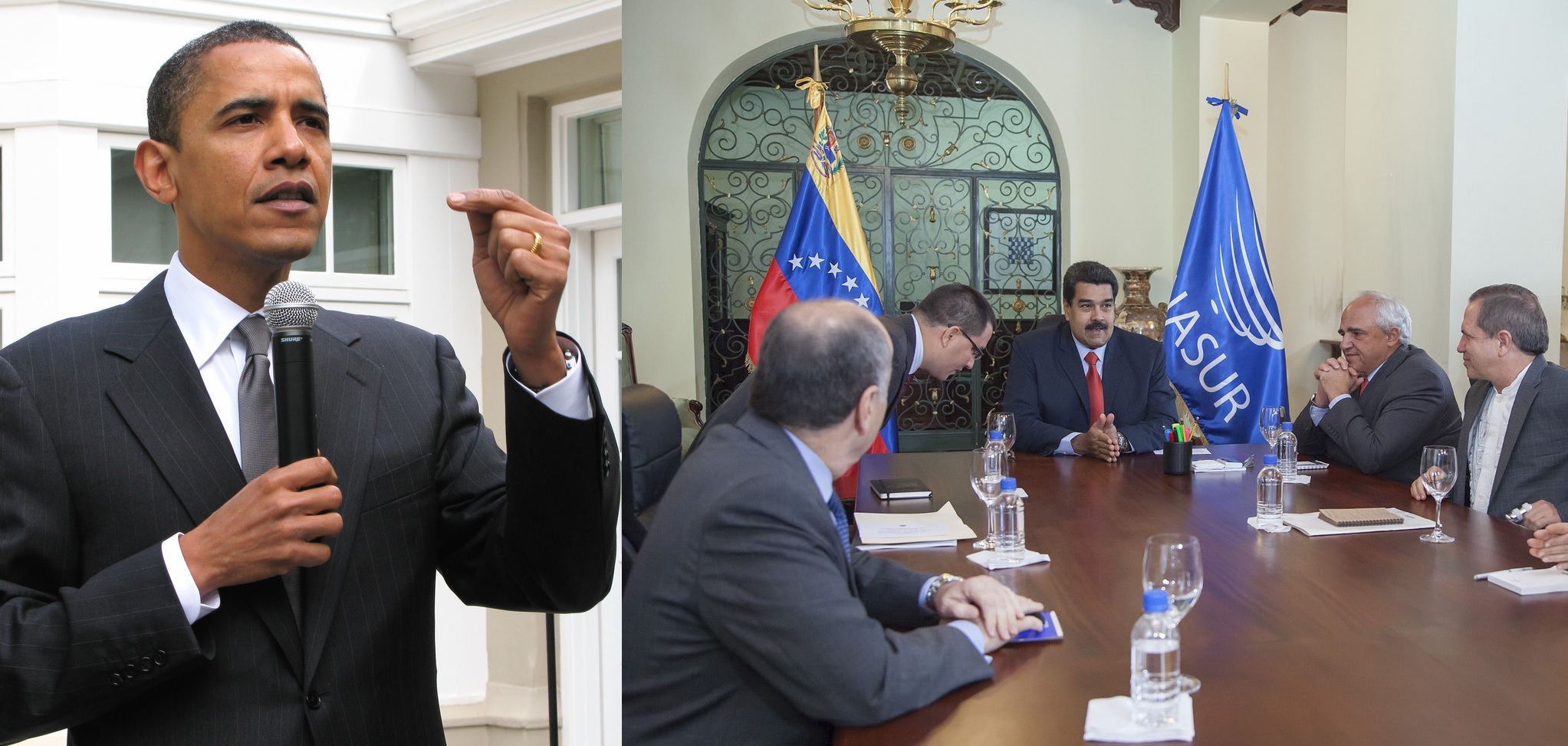
(l) President Obama, (r) UNASUR Commission Visits Venezuela. Photo Credits: Steve Jurvetson and Cancillería de Ecuador / Flickr / Creative Commons

(l) President Obama, (r) UNASUR Commission Visits Venezuela. Photo Credits: Steve Jurvetson and Cancillería de Ecuador / Flickr / Creative Commons

The March 9 decision by the Obama Administration to sanction Venezuelan government officials – this time freezing the U.S.-based assets of seven of them – appears to be drawing Washington into a conflict it recently viewed as a problem for Latin America to solve.  Implementing the “targeted sanctions,” the U.S. government made the determination that Venezuela’s “situation” was a threat to its national security.  Such a determination is not unique – Washington continues to declare Colombian narco-trafficking a national security threat – but the language in this case is widely seen as inflammatory because the cited source of the threat is President Maduro’s government itself.

  • The action generated a predictably exaggerated reaction from Caracas.  Maduro, who faces an economic crisis with no end in sight and has approval ratings of 22 percent, took the sanctions as an opportunity to change the conversation.  He branded them as “hypocritical,” describing Washington as the “real threat” to world order and criticizing Obama as returning to Cold War-style tactics.  On March 14 the armed forces conducted hyped-up exercises to “counter” the U.S. threat and the day after Congress granted Maduro Decree Powers through an “Anti-Imperialist Ennabling Law for Peace” that lasts through the end of the year.
  • Reactions to the U.S. measure varied greatly among opposition leaders. Governor Henrique Capriles, the opposition’s candidate in the last two presidential elections, echoed the U.S. position that the sanctions are targeted against “the corrupt government elite,” rather than the country or the Venezuelan people.  Governor Henri Falcón, a former military officer who left chavismo’s ranks in 2010 criticized them as “disrespectful.”  The Mesa de Unidad coalition stressed that Venezuela is “not a threat to any country.”  Whereas more hardline opponents are behind the scenes happy about stepped-up U.S. involvement, the more moderate camps – including Capriles’s – appear puzzled about the timing because Washington’s actions effectively moved Maduro to the safer ground of defending sovereignty.
  • The sanctions ignited strong criticism from some regional players.  Nonetheless, they renewed UNASUR’s efforts to mediate, which had gotten off to an unpromising start in Caracas on March 6.  An emergency March 14 UNASUR meeting in Quito issued two declarations – one strongly rejecting the sanctions, even calling for Obama to rescind them, and another reiterating support for the UNASUR Secretary General Ernesto Samper’s pursuit of “the most open dialogue possible” in Venezuela.

The Obama Administration’s stated reasons for the sanctions – measures similar to those proposed in the “Venezuela Defense of Human Rights and Civil Society Law” last year – are not surprising.  Washington has watched with dismay as Maduro has cracked down on opponents, alleged U.S.-supported coup-plotting, and hemmed in U.S. embassy personnel and even tourists with increasingly tough limitations on their activities.  With the opening to Cuba ongoing, the Obama administration may have calculated it could try to appease conservatives in the U.S. Congress and endure a hit to its regional image for imposing sanctions.  Emboldened by UNASUR’s criticism of the sanctions and Europe’s unwillingness to follow Obama’s lead, Maduro will almost certainly continue efforts to play the anti-imperialist card for a while.  The U.S. has shifted the action back into the bilateral relationship, breathing new life into a previously closed chapter in the Venezuelan crisis.

March 16, 2015

* Michael McCarthy is a Research Fellow at the Center for Latin American and Latino Studies.

Venezuela: Crossing the Line

By Eric Hershberg and Fulton Armstrong

Marcos Oliveira / Agência Senado / Flickr / Creative Commons

Marcos Oliveira / Agência Senado / Flickr / Creative Commons

Venezuelan President Maduro’s arrest of Caracas Mayor Antonio Ledezma reflects a new level of vindictiveness and almost desperation at home – and threatens to leave his government more isolated than ever in Latin America.  In a three-hour televised speech, Maduro alleged that the mayor, whom he called a vampire and fascist, was plotting with military officers to remove him from office.  Ledezma has been a strident opponent – playing a prominent role in last year’s salida movement – and the Associated Press cites unnamed sources as acknowledging the existence of identified coupists.  But Maduro’s evidence against Ledezma was negligible, mostly a document on a national transition accord.  Other Maduro opponents are also reportedly to be arrested soon.  At the same time, the President said that the U.S. Embassy was trying to turn the military against him by, he alleged, calling generals’ wives to say their U.S. visas were being revoked.

The increasingly repressive nature of the Maduro regime is drawing scorn from throughout Latin America, including countries that previously tolerated the excesses of deceased President Hugo Chávez.  UNASUR has announced it will hold an extraordinary meeting soon on the deepening crisis caused by Ledezma’s arrest, and the Foreign Ministers of Brazil, Colombia and Ecuador will make an urgent visit to Caracas this week.  Chilean President Bachelet and Senate President (and daughter of the assassinated President) Isabel Allende expressed their “concern” over the arrest.  Colombian President Santos, heretofore restrained in his criticism, told the press he was “worried.”  Amnesty International also condemned the action.  Washington’s vehement denials of Maduro’s allegations that it was involved have not been challenged.

Maduro’s Latin American neighbors are likely to continue hewing to traditional non-interventionism, but even the left appears to regret that recent events confirm the monumental squandering of the Chávez revolution’s opportunity to carry out a radical project of redistribution and propose an alternative model for the region.  Chavismo had a social base, but Chávez and, to a much greater extent, Maduro have failed to develop a democratic or economically coherent approach to their revolutionary project.  Venezuela is now paying the price and, as many predicted, the situation is getting worse before getting better.  It is impossible to say how and when the impasse will break, and hard to identify who’s capable of ending the misery – be it the military or a faction within Maduro’s own party.  It’s clear, though, that this crisis is not sustainable and regional patience with it is growing thin.

February 23, 2015

U.S. Sanctions on Venezuela: To What End?

By Michael M. McCarthy

Common Cause -Embassy of Venezuela DC / Flickr / CC BY-NC 2.0

President Obama plans to sign the “Venezuela Defense of Democracy and Civil Society Act” into law, but its lack of clear objectives seems likely to muddle Washington’s desired outcome.  The bill, approved last week by voice vote in the Senate and House, calls for punishing Venezuelan government officials involved in human rights abuses, an authority the White House already has.  It includes national security waivers that allow the President final say on which officials will have their visas revoked – denying them entry into the United States – and have any U.S. assets they own frozen.  After initially voicing skepticism about the wisdom of such measures, the Obama administration came around to supporting them.  Senators Robert Menendez and Marco Rubio and Congresswoman Ileana Ros-Lehtinen pushed the bill hard in May after episodes of violent suppression of anti-government street demonstrations painted a grim picture of the human rights situation.  The Venezuelan foreign ministry’s reaction to the legislation has been strident, and President Maduro said, “If the crazy path of sanctions is imposed, President Obama, I think you’re going to come out looking very bad.”

President Obama wasn’t alone in switching positions over the bill.  Senator Bob Corker, who’s expected to become chairman of the Senate Foreign Relations Committee in the new Congress that begins next month, had embraced the State Department’s earlier view that sanctions would undermine international talks engineered by UNASUR and the Vatican.  The Caracas government’s refusal to make concessions in the talks undermined that argument, however, and a three-way diplomatic dustup between the U.S., Aruba, and Venezuela over another issue – Aruba’s refusal to extradite Venezuela’s designated ambassador, a former Venezuelan army official, to the United States on narco-trafficking charges – further frustrated Washington players.  Corker asserted that the incident showed that Venezuela’s “complicity with criminal activity” could not go unchecked since it directly undermined U.S. interests.  Immediately after the extradition episode, the Obama administration imposed unilateral sanctions – travel and visa bans – on a dozen unnamed Venezuelan officials, laying the groundwork for Menendez and Rubio to reintroduce their legislation and drive it home before Congress adjourned for the holidays.  Corker endorsed the bill, although he highlighted that a “regional dialogue” remained the best option for finding a “negotiated, democratic way forward” to address human rights issues.

Other than punishing reported human rights offenders and making an example of them the new bill is unclear on how it could help resolve the deep political crisis that has given rise to the protests and subsequent abuses.  With Maduros popularity plummeting to new lows, strident rhetoric condemning U.S. intervention could give him a modest boost by bolstering his claim that Washington is part of an economic war against Venezuela.  It is far too early to tell whether that nationalistic narrative will work in the governments favor as the countrys dire shortages have become permanent and economic suffering is increasingly blamed on Maduros policies and declining oil prices.  If human rights really are the U.S. top concern, Washington might want to be more sensitive to the positions of PROVEA and other Venezuelan human rights groups, which have denounced the legislation despite its inclusion of funding for Venezuelan civil society groups. If punishing rights abusers is Washingtons way of pressing for sustainable change in Venezuela, then it needs to state the case that penalizing measures imposed since 2008 have made a difference.  Another option, contained in Senator Corker’s observation about a “negotiated, democratic way forward,” could be to renew support for talks sponsored by South American countries, as these are more likely to reduce tensions, improve rights, and give moderates space to promote electoral solutions.

December 18, 2014

Venezuela: More of the Same Tragedy

By Michael McCarthy*

Embed from Getty Images

The gruesome murder of a pro-government Socialist Party deputy and the decision by the opposition coalition’s Mesa de Unidad Democrática (MUD) to suspend a rally in light of the tragedy foretold an opportunity to restart a national dialogue.  But unlike in January 2014, when the murder of beauty queen Monica Spears and her family created momentum for talks on security between the government and opposition, an unfortunate and familiar downward spiral has begun.  High-level government officials’ provocative accusations that the murder of Robert Serra, one of the Venezuelan Parliament’s youngest members, was the work of right-wing actors have deepened yet again the political polarization in Venezuela.  UNASUR’s new Secretary General, former Colombian President Ernesto Samper, surprisingly weighed in, strongly implying that Colombian paramilitaries were involved in Serra’s murder.  The government has long attempted to link members of Venezuela’s opposition with paramilitary groups, and Samper’s impartiality will forever be questioned by the opposition if the allegation is not proven. At Serra’s funeral, President Maduro described the MUD’s new Executive Secretary, Jesús “Chuo” Torrealba, as a piece of “garbage.”  Maduro’s name-calling is another example of the government using polarization as a tool to encourage supporters to close ranks.

Before the stabbing deaths of Serra and his female companion by unidentified assailants, the government was attempting to build momentum to resume the UNASUR-sponsored talks that had been frozen since May 3.  Samper had informed the MUD and opposition members of his intention to restart talks, and had described Maduro as “a man of dialogue, a man of peace,” adding that there were good prospects for “working a lot of things for the good of the region.”  But at this point any good will among the parties seems to have evaporated.  Moreover, for MUD secretary Torrealba, who originally said his goal was to change the MUD’s profile to mobilize a wider base of support, the primary task remains building MUD unity at a moment when different factions of the opposition are promoting widely varying initiatives.  Torrealba has little negotiating experience and does not enjoy the same access to elite sectors as his predecessor did.  His precarious position calls into question whether the MUD could negotiate as a coalition even if talks restarted.

Once again, centrifugal forces seem to be prevailing in Venezuela.  This trend raises the question of whether Venezuelan society is not only “wounded and resentful,” as Jesuit Political Scientist Arturo Sosa says, but on the verge of an estallido social – social explosion.  Mechanisms for mediating conflict through political discussion remain in place and appear unlikely to disappear completely, but confrontations are likely to continue flaring up regularly.

*Michael McCarthy is a CLALS Research Fellow.

October 7, 2014

Resources and the New Developmentalism

By Paul A. Haslam*

María del Carmen Ortiz / Flickr / Creative Commons Attribution-NonCommercial-ShareAlike 2.0 Generic (CC BY-NC-SA 2.0)

María del Carmen Ortiz / Flickr / Creative Commons Attribution-NonCommercial-ShareAlike 2.0 Generic (CC BY-NC-SA 2.0)

Resource nationalism is driving the most significant shift in Latin American development policies of the past decade.  It is rarely talked about yet is constituting a new developmental model that is being adopted by governments of diverse ideological inclinations.  It has involved reforming taxation regimes dating from the 1990s to extract more “rent” from natural-resource intensive industries; strengthening and extending state capacity; using rents to support social spending by the state, including anti-poverty programs; and – most importantly – linking resource abundance with industrial policy.  It is the basic framework of the post-neoliberal development model, and examples are many.  The splashier headlines in the past decade focus on various instances of nationalization, including the expropriation of YPF in Argentina (2012); Venezuela’s erratic nationalization program; and Bolivia’s dramatic military occupation of foreign-owned gas facilities in 2006 – all intended to achieve these goals.  Early this month, the provincial government of San Luis, Argentina, presented a project-law to create a new provincially owned mining company, San Luis Minera (SAPEM) – joining many fellow provinces that have created or breathed new life into state-owned enterprises (SOEs), particularly in the mining sector.

By and large, these enterprises exist to associate with multinationals, following the trail blazed by Argentina’s YMAD (in Catamarca) and Fomicruz (in Santa Cruz) during the dawn of Argentina’s mining boom in the late 1990s.  The SOEs typically offer the rights to prime potential lands claimed by the state, handle the administrative and regulatory requirements of the province, and in some cases, negotiate the social licence with nearby communities.  In exchange, they get a small net profits interest (typically around 8-10 percent), which results in rent for the province.  The multinational does everything else: raises the money; plans, builds and operates the mine, and sells the mineral.

These are not the rent-seeking policies typical of low-capacity governments.  The enduring principles of the liberal regime (such as low royalty rates) have pushed revenue-hungry governments to explore creative options such as these to capture rent from their mining sectors.  The new SOEs are also an institutional innovation that aims at leveraging natural resource wealth for economic development, as governments also expand resource-funded social spending.  One of the objectives of Morales’s “nationalization” of Bolivia’s oil and gas resources, for example, was to “revitalize” the state-owned YPFB (Yacimientos Petrolíferos Fiscales Bolivianos) as an engine of development.  Nor is this “resource nationalism” exclusively a project of the left: Chile increased royalty rates in a “Special Tax” on the mining sector in 2005, and Colombia and Peru have hiked taxation on mining as well.  Brazil has continued to use of SOEs like PETROBRAS.  It’s still an open question, however, how successfully the rents generated by this new model can be combined with industrialization or development strategies that deliver enduring benefits. 

*Dr. Haslam teaches at the School of International Development and Global Studies, University of Ottawa, Canada.

Sanctions on Venezuela: Why?

By Eric Hershberg and Fulton Armstrong

Photo credit: NCinDC / Flickr / Creative Commons Attribution-NonCommercial-ShareAlike 2.0 Generic (CC BY-NC-SA 2.0)

Photo credit: NCinDC / Flickr / Creative Commons Attribution-NonCommercial-ShareAlike 2.0 Generic (CC BY-NC-SA 2.0)


The sanctions against Venezuela that the Obama Administration announced last week respond to political pressure to punish alleged human rights violators in Caracas, but they have no immediately apparent policy objective.  The State Department announced that it has suspended the U.S. visas of “a number of Venezuelan government officials who have been responsible for or complicit in … human rights abuses” during protests earlier this year, which resulted in the deaths of at least 40 people, injury of hundreds more, and jailing of dozens of activists.  The Department did not release a list of sanctioned individuals nor divulge the information used to compile the list, but press reports indicate that 24 officials have been targeted and include cabinet members, presidential advisers, police, and military officials.  The sanctions do not affect bilateral trade or Venezuela’s place as the United States’ fourth biggest foreign supplier of oil.

U.S. condemnation of the Venezuelan government and the blacklisted officials has been strident, but there has been no public explanation of what Washington expects the sanctions to achieve.  The statements of U.S. Principal Deputy Assistant Secretary of State John Feeley, made to a Colombian radio station and reported by El Universal in Caracas, strongly suggest the sanctions are intended to show solidarity with the Venezuelan opposition and U.S. disapproval of the government of President Nicolás Maduro.  “Social protests have been a genuine war cry from people oppressed by the lack of democracy,” Feeley is reported as saying.  “The [sanctions] were intended to note that the U.S. cannot allow, for the sake of its values, that a supposedly democratic government represses the legitimate expression of the people’s voice.”  The State Department has not demanded, however, any particular action by Caracas to lift the sanctions, such as an investigation into the abuses, re-launching a national dialogue, or compensating victims.  Feeley suggested that the governments of Colombia and Brazil – with which he said the U.S. government had “meditated” about the issue – supported the sanctions, but regional support for them has been muted at best.  Indeed, the Administration had responded to last May’s House of Representatives vote in favor of sanctions by indicating that these would be counterproductive and could undermine efforts at mediation by these same countries.  The one dissenting voice in the House, Congressman Greg Meeks (D-NY), explained his vote as opposing unilateralism, adding that its passage was a message to Latin American governments that we don’t care what they think.

The Venezuelan government has repeatedly and credibly asserted that a significant portion of the violence has been perpetrated by protestors rather than the state or government supporters, and a number of officials have been charged.  Nonetheless, no U.S. sanctions have been brought against opposition members who planned or participated in violent actions.

Some observers have attributed the U.S. action to pique that Aruban and Dutch officials several days earlier rejected its request that they extradite to the U.S. Venezuela’s new consul in Aruba, a former chief of intelligence whom Washington suspects of trafficking in drugs with the Colombian FARC – despite Vienna Convention provisions regarding diplomatic immunity.  More likely, the sanctions are a reaction to a realization that the quixotic “salida” campaign, which many in Washington somehow imagined could bring down the Maduro government only months after it had won an election, had all but petered out, leaving the opposition in disarray and the government in a renewed position of strength.  Sanctions also are a bow to congressional pressure on the Obama Administration to act against Caracas, which has continued to grow even after the salida campaign has run out of gas.  Just hours after the sanctions were announced, Senator Marco Rubio issued a press release taking credit for them, and other conservatives – led by the Cuban-American congressional delegation – called for even tougher measures.  Without clear objectives, however, the sanctions seem to be mostly a moral and political statement – pushing relations into yet another dead end from which neither government is disposed to find a way out.  Indeed, Venezuelan officials, calling the sanctions “a desperate cry from a nation that realizes the world is changing,” are turning the diplomatic adversity to domestic political advantage, just as administration officials had wisely predicted in pushing back against the Congressional saber rattling last spring.

Venezuela: Vicious Cycle Continues

By CLALS Staff

Photo Credit: Cancillería Ecuador / Flickr / Creative Commons Attribution 2.0 Generic (CC BY 2.0)

Photo Credit: Cancillería Ecuador / Flickr / Creative Commons Attribution 2.0 Generic (CC BY 2.0)

UNASUR has shown energy and flexibility as a facilitator during the Venezuela crisis, but neither the government, nor its opponents, nor the opposition’s allies in Washington have matched it – prolonging the vicious cycle that’s been plaguing the country for years.  Speaking as UNASUR, the foreign ministers of Colombia, Brazil and Ecuador reflected the continent’s frustration when they threw up their hands this week and left Caracas after another failed attempt to get a national dialogue on track.  Their statements represented a balance between the UNASUR members that are generally perceived as tolerant of the Venezuelan government’s “Bolivarian” revolution and those perceived as opposing it.  They reiterated calls, issued officially in Suriname on 16 May, for both sides to “achieve a broad dialogue that permits Venezuelans, without interference, to reach an accord that guarantees peaceful coexistence and stability in the country.”

The government, opposition and Washington have not heeded the appeal by UNASUR and the Vatican’s nuncio to be constructive and patient.  The government’s attack on opposition and student camps in early May and subsequent arrest of more than 200 protestors highlighted the authoritarian tendencies that have given momentum to the demonstrations.  The Mesa de Unidad Democrática (MUD), representing important sectors of the opposition, gave the foreign ministers yet another list of demands – including a Truth Commission investigating rights violations (and not headed by the pro-government president of the National Assembly, Diosdado Cabello) and the selection of an entirely new National Elections Council.  The MUD’s executive secretary declared that he has no interest in participating in a peña or chit-chat session, and said, “The ball is in the government’s court.”  Although U.S. Assistant Secretary Roberta Jacobson said during a hearing that sanctions were premature (a statement that she attributed to “confusion”), the foreign affairs committees in both house of the U.S. Congress – without objection from the Obama Administration – have passed bills authorizing an array of punitive measures against Venezuelan officials.  The legislation also authorizes an additional $15 million dollars in aid to the government’s opponents.

The less overtly political agenda that first sparked the protests in February – soaring crime rates, rocketing inflation, and shortages of basic goods and services – has been overshadowed by the shouts of opposition leaders eager to force President Maduro from office and by Maduro’s defenses from the plotting against him.  Demands that Maduro negotiate with a foreign-funded opposition that has as its clear goal his removal as constitutionally legitimate president – something no head of state in the hemisphere would accept – naturally keep his bases on edge.  Political leaders on both sides manipulate popular opinion and claim el pueblo as supporting them.  Another of each side’s real strengths is its ability to portray itself as a victim of the unfairness of the other – because their victimhood rationalizes whatever actions they wish to take.  In that regard, the U.S. sanctions against the government and subsidies to the opposition play into Maduro’s hand.  Washington’s extra $15 million is a drop in the bucket for the well-funded opposition, but the U.S. support is as clear a signal as any of its desired outcome.  With both the United States and important segments of the opposition appearing to aim for nothing short of regime change, UNASUR is wise to step aside and see if anyone decides to get serious about ending the crisis.  Should the situation on the ground deteriorate further, however, UNASUR will probably ramp up its engagement and press both sides to make concessions in exchange for regional support.

ALBA Governments and Presidential Succession

By Eric Hershberg

Embed from Getty Images

Venezuelan President Nicolás Maduro is proof that being anointed successor by one’s patron on their deathbed isn’t adequate preparation for governing effectively or consolidating a revolutionary legacy.  Although being Hugo Chávez’s man got him into office, it obviously hasn’t been enough for Maduro to stem growing economic, political, and crime problems.  One element behind these protests is a widespread perception – including among some supporters of chavismo – that Maduro is a pale reflection of his benefactor and not up to the task of leading Venezuela.  Chávez hand-picked him in a hasty and half-hearted manner, and he didn’t bequeath to him a coherent set of policies, practices, or institutions that could ensure the continued advance of the Bolivarian Revolution.  Maduro inherited a state that was so weak institutionally and so dependent on Chávez personally that the jury remains out as to whether he has the capacity to keep all the pieces of Chávez’s legacy intact.

The Venezuelan president’s rocky road reflects the difficulty of the renovation of political leadership across ALBA nations.  Rather than nurture successors capable of carrying forward the transformations begun by founding leaders, one president after another has followed Chávez’s lead in dealing with the future by focusing primarily on extending their terms of office.  This past January Nicaragua’s national assembly cleared the way for Daniel Ortega, president since 2007, to run for a third term in 2016.  Ecuador’s Rafael Correa likewise won a third consecutive term in 2013.  Last May Bolivia passed a law allowing Evo Morales to run for an unprecedented third term in 2014.  In none of these cases has the leadership sought to build the credentials of potential successors in the presidency, in stark contrast to what Luiz Inácio Lula da Silva did with Dilma Rousseff or what Ricardo Lagos did with Michelle Bachelet.  This phenomenon is not unique to left-leaning governments – Alvaro Uribe and Alberto Fujimori, for instance, suffered similar temptations –, but it seems endemic to the ALBA governments and is particularly troubling to the extent that these are instances where the leadership aims to effect wholesale, lasting societal transformations through its enduring control over the state apparatus.

There is a distinctive sort of hyper-presidentialism emerging throughout the ALBA nations.  Chávez, Correa, Morales, and Ortega’s concentration of power in their own personas makes it particularly hard for future leaders to emerge.  Their political projects embody aspirations for fundamental societal transformations.  In that sense, they can reasonably be categorized as what the Italian political theorist Antonio Gramsci would label as historic projects, and even revolutionary ones.  But if a transformative, historic project fails to develop leaders and launch them into positions of growing responsibility and power, it is unlikely that it will succeed over the long run.  Lula could transfer power to Dilma, Lagos could do so with Bachelet, Tabare to José Mujica, and so on.  This is what made possible the conversion of eight-year projects into 16‑year projects, and so on.  The PRI, in Mexico, managed successions for seven decades, and presumably is poised to continue along that road now that it has regained the presidency.  Yet for some reason the ALBA governments have not taken this step.  Their leaders have angled toward caudillismos that have a medium-term appeal, but that almost certainly cannot be the foundation of a decades-long project for changing societies in need of transformations that they themselves articulate.  While their frequent successes in displacing traditional elites and thwarting well-financed oppositions are impressive, it is striking that they fail to build political institutions and leaderships capable of carrying on their own visions and political projects after they pass.  The ALBA presidents may calculate that dismantling the ancien regime is legacy enough, but history may judge them harshly for delaying the emergence of more effective and enduring institutions, and of leaders who can push their projects forward for many administrations to come.