Fleeing Collapse, Facing Barriers

Fleeing Collapse, Facing Barriers: The Venezuelan Crisis and U.S. Immigration Hurdles 

By Katheryn Olmos, Emma Wyler, & Isabella Serra

Photo of popular Venezuelan activist, Rafael Araujo, holding a sign that says, “Feb 12th 2014-2015 Impunity Persecution and Torture,” at a protest in Caracas, Venezuela on February 12, 2015. Image retrieved from Wikimedia Commons.

Severe Humanitarian Emergency in Venezuela

Just a few decades ago, Venezuela stood as a beacon of economic prosperity and oil wealth on the Caribbean coast of South America. However, the rise of authoritarian rule led to economic collapse, widespread corruption, and rampant inflation, creating a dangerous political climate that forced millions to flee their homes.

For many Venezuelans, including the 48 living in the Washington Metropolitan region (DMV) whom we interviewed, migrating to the U.S. was not their first choice when pursuing a more stable life. Previously, many Venezuelans migrated to and were displaced from places closer to home, from neighboring countries such as Venezuela, Colombia, Peru, Chile, and Brazil.

Venezuelan displacement is driven by a myriad of circumstances. Almost all of the Venezuelans we interviewed expressed that the economic situation in their home country, including hyperinflation, food scarcity, and inadequate wages, is not viable to sustain themselves or their families.

“No hay trabajo. [Cuando] hay trabajo y te quieren pagar, son 20 dólares semanales. Sí, y eso es muy poco dinero para los consumos de mi mamá, mis hijas. Nada más un bote de leche son 10 dólares. ¿Y me quedan 10 dólares para qué?”

“There’s no work. When there is work and they want to pay you, it’s 20 dollars a week. Yes, and that’s very little money for my mom and daughters’ basic needs. Just one gallon of milk costs 10 dollars. That leaves me 10 dollars for what?”

— Gabriel, Venezuelan Man, 28

When asked about corruption and impunity playing a role in the reason they migrated, the answer is almost always “yes.” Many of our participants experience corruption and political persecution from their government.

“Pues primero por la escasez de comida, y segundo, el barrio donde yo vivía era uno de los barrios más peligrosos de Venezuela… No tanto por parte de los que te roban sino más que todo por la policía. A la policía no importa si eres sano, si eres delincuente, igualito te extorsionaban, te sembraban drogas, de todo… nada más por el hecho de que uno perteneciera a La Cota 905 pensaban que ya uno estaba relacionado con [la pandilla]. Sí a todo el mundo que agarraron o sembraron le daban golpe, lo metieron preso, lo desaparecía… Te mataban y te ponían un arma, y ponían carajo de la banda de La Cota 905, cuando no es así. Entonces esa fue uno de los principales motivos porque me vine: La policía.”

“Well, first, because of the scarcity of food, and second, the neighborhood where I lived was one of the most dangerous neighborhoods in Venezuela…Not so much by people who rob you, but mostly by the police. It doesn’t matter to the police if you’re normal or if you’re a criminal; they still extorted you, planted drugs, everything. Just because you belonged to La Cota 905, they thought you were part of the gang. Everyone they grabbed or planted on was beaten, imprisoned, disappeared… They’d kill you and put a gun on you, and they’d say you were from La Cota 905 gang, when that’s not true. So that was one of the main reasons why I left: The police.”

— Andres, Venezuelan Man, 25

Humanitarian Protection Terminated

Given the unsafe conditions back home, many of the interviewees entered the United States under humanitarian parole, a common pathway to seek protection. The discriminatory attempt by the second Trump administration (now being blocked in federal court) to terminate humanitarian parole for Venezuelans, Cubans, Haitians, and Nicaraguans (CHNV) has upended the legal status for over half a million immigrants, and threatens to block all new applicants from these countries from receiving humanitarian protection. As of December 2024, 117,330 Venezuelan nationals had entered the U.S. under humanitarian parole. As Nicolas, a 29-year-old Venezuelan man, described:

“Entré con un permiso humanitario… A través de la aplicación [CBP One]. Ahorita no tengo los papeles, pero estoy en Estados Unidos gracias al permiso humanitario que ofrece Estados Unidos. Me lo aprobaron. … Cuando estaba en Chile, me aprobaron la entrada legal.”

“I came in with a humanitarian parole… Through the [CBP One] application. Right now, I don’t have the papers, but I’m in the United States because of the humanitarian parole that the United States offers. They approved me. … When I was in Chile, they approved me for legal entry.”

— Nicolas, Venezuelan Man, 29

In the appointment-making process for their asylum cases and legal processing, many interviewees used the CBP One app.

“Había hecho varios registros [en la aplicación CBP One] y todo eso, y no salía nada… Y trabajé hasta que me salió la cita… Estuve casi 12 meses, 11 meses [en México esperando la cita]… Entonces, de ahí, me dieron [la cita] para San Ysidro… Cuando por fin crucé, pues, solo la felicidad de estar aquí, todo fue, bueno, incluso mejor. Y de ahí llegué, compré [un boleto], tomé mi vuelo, y luego volé hasta aquí.”

“I had done several registrations [on the CBP One app] and all that, and nothing came up… And I worked until I got the appointment… I spent almost 12 months, 11 months [in Mexico waiting for the appointment]… So, from there, I got [the appointment] for San Ysidro… When I finally crossed, well, just the happiness of being here, everything was, well, even better. And from there, I arrived, bought [a ticket], I got my flight, and then I flew here.”

— Diego, Venezuelan Man, 19

The CBP One app, once a tool to schedule asylum appointments, was shut down by Trump and transformed “self-deportation” tool. This effectively weaponizes one of the only services for Venezuelans to legally process their asylum applications.

Venezuelans we spoke to often had experience with the Temporary Protected Status (TPS) program. TPS provides temporary protection and work permits to individuals who are unable to safely return to their home countries.

In February of 2025, President Trump announced his intentions to upend TPS for Venezuelans, stripping the 700,000 who would have been eligible for the program. While ending TPS for Venezuelans backpedals on basic humanitarian protection policy, our interviews shine a more nuanced light on the program’s existing limitations. TPS was too temporary to be a pathway.

“Ah sí, porque con el estatus temporal, o sea, lo dan solo por 18 meses. Y el asunto es que, para cuando lo recibes, ya casi se está acabando, así que nadie te va a dar un trabajo por un mes y luego te quedarás, ya sabes, sin los papeles legales.”

“Oh yeah, because with the temporary status, I mean they give it for only 18 months. And the scene is by the time you receive it. It’s almost already sparse, so I mean, nobody will go in to give you a job for a month, and then you will be, you know, without the legal paper.”

— Alejandra, Venezuelan Woman, 73

Despite its limitations, now that TPS is terminated, Venezuelans in the U.S. have lost their temporary work authorizations and currently risk deportation. The sensationalization of Venezuelan deportations by the Trump administration is an escalation of racial profiling experiences that interviewees previously reported.

Experiences in the U.S.

The hardships Venezuelans face do not end at the border. Our team looked deeper into the immigrant experiences of Venezuelans upon entering the U.S.

Many of our interviews uncovered further obstacles, including racial profiling, political persecution, labor exploitation, health implications, and detainment.

A commonality we discovered within our interviews is that people who seek refuge in the United States are criminalized based on their country of origin. Many Venezuelans interviewed experienced racial profiling committed by American police enforcement. The following interview, along with several others, reported job exploitation and unlivable wages. Racial profiling by police is a common thread among our interviews.

In our interviews with Venezuelans who had been detained in the United States, there were reports of close confinement and stress leading to health issues. On his experience being detained, a young man shared:

“Hubo un momento en que, prácticamente por tanto encierro, se me estaba cayendo el cabello del estrés y de tanto pensar. A veces quería pedir la deportación, y a veces me decía a mí mismo, ‘No estoy aquí, ya no estoy aquí’… Entonces aguanté, y cuando salí, me rapé la cabeza porque se me estaba cayendo el cabello.”

“There was a moment when, practically from so much confinement, my hair was falling out from the stress and the thinking. Sometimes I wanted to ask for deportation, and sometimes I said [to myself], I’m not here, I’m not already here… Then, I held on, and when I came out, I shaved my head because my hair was falling out.”

— Jose, Venezuelan Man, 23

U.S. Border Patrol agents process migrants at the Central Processing Center in McAllen, Texas, Sunday, June 17, 2018. Retrieved from picryl.

Key Takeaways

Venezuelans had to leave their worlds behind to escape the humanitarian crisis, just to face repeated struggles in an escalating authoritarian regime seizing power in the United States. Daniel, a 46-year-old Venezuelan man, described that throughout the difficult journey across the Americas, all he was doing was:

“Buscando una oportunidad de vida y una mejor calidad de vida, buscando una forma en la que me puedan dar una oportunidad o de tener mis documentos. Buscar un estatus.”

“Looking for an opportunity and a better quality of life, searching for a way in which they can give me the opportunity of having documents… a chance to have a status.”

— Daniel, Venezuelan Man, 46

ICE now weaponizes these discriminatory views of Venezuelans, painting them as gang members or terrorists. These are not unlike the claims with which the government in Venezuela used to persecute normal citizens back home.

The rampant political corruption, lack of transparency and due process, and smothering of dissent are escalating in the United States. This is a story Venezuelans know because they have already witnessed the fall of a functioning democracy to authoritarian excesses.

At the end of the day, a Venezuelan man responds to the question of whether he sees himself as an immigrant, saying:

“Yo le digo una cosa, todos somos iguales porque somos personas, somos seres humanos [a pesar de haber] nacido aquí y allá en diferentes ciudades. O sea, no quiere decir que seas tú más que el otro porque tengas más dinero. Todos vamos a morir, vamos a un solo hueco.”

“I’ll tell you what, we’re all the same because we’re people, we’re human beings [despite being]… born in different cities. In other words, just because you have more money doesn’t mean you’re more than everyone else. We’re all going to die; we’re going to the same hole.”

— Liam, Venezuelan Man, 29


Katheryn Olmos, Research and Data Coordinator at the Immigration Lab and graduate student in the Sociology Research and Practice program at American University.

Emma Wyler, Research Assistant at the Immigration Lab and undergraduate student at American University.

Isabella Serra, Research Assistant at the Immigration Lab and recent graduate of American University.

Edited by Jacqueline Aguirre De La O, Noah Green & Ernesto Castañeda

Why MS-13, M-18, and Tren de Aragua Are Not Terrorist Groups

by Melissa Vasquez, Ernesto Castañeda, and Anthony Fontes

Image of President Trump of the United States and President Bukele of El Salvador meeting, White House, Sep 25 2019, Fliker

Are MS-13, M-18, and Tren de Aragua terrorist organizations? The short answer is no, they are not. They are transnational criminal organizations. El Salvador’s President Bukele and Donald Trump have officially labeled these groups as terrorist organizations, citing their extreme violence and control over some territories. However, these classifications have sparked debate, as their activities are more aligned with organized crime than political terrorism. Making this distinction is crucial given that mislabeling them can lead to misguided policies that fail at curbing their violence.

The 1980s civil wars in Central America forced nearly a million people to flee the U.S. Some immigrants are still forced to leave their countries because of organized crime and gang recruitment. Today most often, some displaced people are victims of gangs, not members or representatives abroad. However, upon originally arriving in Los Angeles, many Central American migrants faced marginalization and sought protection from the gangs present in the areas where they lived and worked. These challenges ultimately contributed to the formation of the present-day MS-13 and M-18 gangs. Many of the members of these new local gangs were incarcerated in Los Angeles prisons alongside members of other gangs, which allowed them to regroup and learn from their rivals. Shortly after the wars, mass deportations from prisons and streets sent MS-13 and M-18 members back to a weakened Central America, where they expanded their networks and influence. 

Similarly, El Tren de Aragua (TdR), which originated in the early 2000s in Venezuelan prisons—particularly the Tocorón prison—has expanded across South America. Originally, a prison gang, Tren de Aragua, expanded beyond prison walls to exploit weak governance, connecting criminal networks across South and North America. Furthermore, like MS-13 and M-18, Tren de Aragua is driven by criminal enterprising rather than political ideology. That is, neither group aims to take over state power or remake society in their own image. Rather, they are hyper-focused on generating maximum profits through illicit means while avoiding state interference. They are criminal syndicates with some capacity—though quite limited—to carry out their rackets across borders. They are certainly NOT terrorist entities. 

What separates a terrorist organization from a criminal syndicate? While both engage in illicit activities and use violence as a means to an end, it is crucial to distinguish their goals and methods to dismantle them effectively. The primary difference lies in their objectives: terrorist organizations seek political, religious, or ideological change by influencing government policies or societal structures, whereas transnational criminal organizations (TCOs) operate across borders solely for financial gain, without political or ideological motives beyond sowing conditions to maximize profit. 

For example, the U.S. government has classified groups like Revolutionary Armed Forces of Colombia (FARC) and ISIS as terrorist organizations due to their political objectives. FARCS’s history dates back to 1964 when it emerged as a communist insurgency that employed terrorist tactics. Initially formed as a guerilla movement from campesino self-defense groups, whose primary objective was to overthrow the Colombian government. Over the next five decades, FARC waged guerilla warfare by carrying out illicit activities—such as bombing, kidnappings, and assassinations–all in an effort to challenge state authority. Colombia, the U.S., and the European Union designated FARC as a terrorist organization due to their use of political violence.

However, the 2016 peace accords between FARC and the Colombian government led to the successful disarmament. This agreement allowed the group to transition into a political party known as Comunes. Even though some dissident factions still operate, FARC’s official transformation has been a key factor in maintaining long-term stability in Colombia. Recognizing this shift has been crucial in fostering peace and ensuring that former combatants can engage in democratic processes rather than armed conflict.

The contrast between ISIS and FARC highlights the importance of proper classification. FARC has abandoned the characteristics that once classified it as a terrorist organization and instead has evolved into a political entity. ISIS, on the other hand, remains committed to its extremist and political ideology, seeking to overthrow governments through guerrilla warfare and establish a global Islamic caliphate through territorial control and sectarian violence. Addressing the causes behind these organizations is equally crucial. FARC’s transition has allowed Colombia to tackle the drivers that led to its rise in the first place, providing the foundation for long-term stability. When governments misdiagnose the factors driving their emergence, violence continues.

Despite claims that Tren de Aragua serves the Maduro regime, evidence suggests otherwise. The group arose from Venezuela’s weak governance and not from direct state sponsorship. According to Insight Crime, in September 2023, Venezuelan law enforcement raided the Tocorón prison in Aragua state, aiming to “dismantle and put an end to organized crime gangs and other criminal networks operating from the Tocorón Penitentiary.” This operation demonstrates that Tren de Aragua is not a state-sponsored group, nor is it a tool being used by the Venezuelan state to destabilize the region. Its rise—like that of MS-13 and M-18—can be traced back to systemic failures, including poverty, corruption, and forced population displacement. These factors have allowed transnational criminal organizations to flourish across Latin America. 

MS-13 and M-18 expanded by exploiting political corruption and institutional weakness in their home countries. Similarly, Tren de Aragua has taken advantage of Venezuela’s economic crises and large emigration to expand into new territories, such as the Darién Gap. Unlike terrorist organizations, these gangs did not emerge to push a political ideology; rather, they have thrived by leveraging corruption and weak law enforcement. In many ways, they are products of the environments that fostered them, growing out of instability rather than ideological ambition.  These transnational criminal groups do not engage in violent attacks abroad, targeting governments or aiming to take political power in the United States. That is beyond their purview and capabilities. 

Why does the distinction between organized crime and terrorist organizations matter? Although all of these organizations engage in violence and illicit activities, their end goals set them apart: MS-13, M-18, and Tren de Aragua operate for profit, whereas ISIS and others seek to reshape the political landscape of their regions. Properly distinguishing between terrorist organizations and transnational criminal organizations like MS-13, M-18, and Tren de Aragua is crucial for drafting effective policies and responses to their violence. Mislabeling these groups can lead to inappropriate responses. Applying counterterrorism measures to profit-driven gangs fails to address the root causes for their expansion in the first place. Failing to properly distinguish organized crime from political terrorists leads to failed policies. The misclassification of these groups could destabilize the region by shifting U.S. foreign policy and resources away from where it is truly needed—addressing the drivers of gang-related violence, corruption, and weak governance—toward counterterrorism efforts. 

While transnational criminal organizations are heavily involved in drug trafficking, and their violence may create fear among civilians and impact governance, this does not qualify them as terrorist organizations. Their primary objective is financial gain, not advancing an ideological or political agenda. This distinction matters because government responses shape outcomes. If the goal is to curb migration, drug trafficking, or violence, then we need to stop treating criminal organizations like terrorist groups and start addressing the real issues driving their expansion. If the U.S. truly wants to curb migration and secure the southern border, then it must ensure that its classification of these organizations is accurate and aligned with its actual objectives.

Melissa Vasquez is a Graduate Student in the International Affairs and Policy Analysis program at American University and an Intern at the Immigrant Lab.

Ernesto Castañeda is the Director of the Immigration Lab and the Center for Latin American and Latino Studies and a Professor at American University

Anthony Fontes is an Associate Professor and ethnographer at American University’s School of International Service.

This piece can be reproduced completely or partially with proper attribution to its author.

Venezuela: Authoritarian Election Aftermath

By Michael McCarthy

Photo credit to Matias Delacroix /AP

In the wake of a sham Presidential election event, Venezuela’s complex crisis appears to be deepening. Marked by electoral authorities’ apocryphal claims of a government victory, Maduro’s iron-fisted post-election crackdown against the opposition, and thus far unsuccessful efforts at international mediation from Brazil, Colombia, and Mexico, the ongoing electoral episode has placed the government and opposition in an increasingly bitter conflict.

Stuck in between stands the population, a large portion of which may migrate unless hope for political change can be revitalized. The region should brace itself for a new movement of Venezuelans abroad.   

The opposition coalition continues to press its case. The opposition is led by María Corina Machado, the winner of open primaries who was forced to endorse Edmundo González Urrutia after the government-controlled courts banned her candidacy. Their election witnesses documented a landslide victory — 67% to 31% for González Urrutia. Due to both the total lack of transparency by the electoral authorities (disaggregated precinct-level data has still not been published though that was the norm in previous Maduro-era elections) and the validity of election witness tally sheets consolidated by the González Urrutia campaign, opposition claims have resonated widely. The Biden administration and multiple Latin American governments recognized González Urrutia as the winner of the election, while even historical Left-wing allies of the chavista political movement, such as former President of Argentina Cristina Fernández de Kirchner, cast serious doubts on Maduro´s claim to victory.

Privately, numerous pro-government voices have admitted they cannot attest to the credibility of the official results, which state that Maduro won with 51% of the vote, a telling admission that no independent checks on executive power grabs exist. However, despite Maduro´s most acute crisis of legitimacy yet, no highly influential ruling party official or strategic international ally (Bolivia, China, Cuba, Russia) has publicly aired such concerns. Maduro seems more influenced by the hard line elements in his government and, amid his intransigence toward calls for releasing credible electoral data, his government seems headed for greater international isolation. Meanwhile, the opposition — though strengthened by its impressive organizational effort to retrieve over 80% of the tally sheets from voting centers — is struggling to capitalize on its status as the electoral majority.

The Biden administration is losing patience with the situation. Following a period of pre-election diplomatic engagement with Maduro, Washington is strongly considering the imposition of new individual sanctions against government authorities involved in engineering the fraudulent election results and responsible for recent human rights violations. According to Venezuelan human rights groups, Maduro’s security forces have arbitrarily detained over 1,500 persons since the July 28 vote, including activists and leaders from the different opposition coalition partners, as well as one hundred and thirty adolescents. Over 20 demonstrators died amid state repression against post-election protests held to contest the official results.

As this dark post-election period continues to unfold, Maduro not only has a corrupt and ideologically conditioned army but also time on his side. The regime´s cohesion, while lower than in previous moments of chavismo´s 25 years of rule, appears to be sufficiently strong for Maduro to hold power until the new presidential period begins in January 2025. Maduro holding power does not guarantee Venezuela’s stability. Rather, the electoral crisis is likely to translate into weaker than previously forecast economic growth (4% according to Spring 2024 projections by the IMF), a scenario that could, in turn prompt Maduro to panic and forsake the more pragmatic economic policies he’s been pursuing to contain inflation. Indeed, Maduro has never articulated an overarching vision to unify the movement the way Chávez did. While his ongoing use of coercion and repression has helped him secure loyalties among ruling party power brokers, those tools cannot fix the underlying problem of internal political fragmentations, some of which grew more salient during the multi-billion corruption scandal that resulted in Maduro jailing his oil czar Tareck El-Aissami, among others.

Thus, while the return to democracy in Venezuela still seems far off, it is also true that Maduro´s leadership has never been under as much pressure as it is today. His ability to deliver economic gains from the oil sector is likely to decline, with historical investors such as China likely to take a wait-and-see approach and Maduro´s ambition to join the BRICs+ and obtain New Development Bank financing likely to go unfulfilled. If the economy spirals downward, then Maduro will face tougher questions from his own coalition’s strategic players in the military. In this respect, Maduro’s blatant rigging of the vote count opens a new, highly uncertain chapter in chavismo’s already stressful history of losing popular legitimacy.

Over sixty years ago, a previous Venezuelan dictator, Marco Pérez Jíménez, lost power months after holding a fraudulent plebiscite on his rule. A general uprising catalyzed a coup against Pérez Jiménez, which in turn yielded a caretaker transition government that later paved the way for restoring democratic rule. History may not repeat itself, but if one is searching for reasons to believe Maduro has not consolidated power for good, Venezuela’s past has plenty to offer.

Michael McCarthy is President of Caracas Wire, and Adjunct Professor of International Affairs at George Washington University

Edited by Ernesto Castaneda, Director of the Center for Latin America and Latino Studies

This piece can be reproduced completely or partially with proper attribution to its author.

Latin America: Is There a Constructive Side to U.S. Policy?

By Fulton Armstrong

President Joe Biden, National Security Adviser Jake Sullivan and NSC Senior Director for the Western Hemisphere Juan Gonzalez gathered at the President's desk in the Oval Office.
President Joe Biden, joined by National Security Adviser Jake Sullivan and NSC Senior Director for the Western Hemisphere Juan Gonzalez, talks on the phone with Jeff Zients on Wednesday, April 21, 2021, in the Oval Office of the White House / Adam Schultz / The White House / Flickr / Creative Commons License.

While many of the Biden Administration’s policies in Latin America – particularly toward Cuba, Venezuela, and China’s activities – remain largely the same as during the Trump era, some of its actions and statements suggest more nuanced approaches on other regional issues. 

  • National Security Council senior director for the Western Hemisphere, Juan Gonzalez, has been the point person for maintaining the hard line on Venezuela and Cuba. In early March, he met in Caracas with President Nicolás Maduro, who later said, “we’ve agreed to work on an agenda going forward,” but the Administration vehemently denied this and has continued to maintain that opposition leader Juan Guaidó is President of Venezuela. In Cuba, according to various sources, Gonzalez last year vetoed a promised plan for reversing a Trump halt to the flow of remittances to the island. He recently stated that new U.S. sanctions against Russia were also intended “by design” to put pressure on Cuba, Venezuela, and Nicaragua.

At Congressional hearings in February and March, other senior officials have laid out various Administration priorities.

  • Commander of the U.S. Southern Command, General Laura Richardson, testified that the hemisphere is “under assault from a host of cross-cutting, transboundary challenges that directly threaten our own homeland.” In addition to helping the region with COVID-19 and the “climate crisis,” she said U.S. policy is to counter China’s “relentless march” to expand its influence in the region and its “challenges [to] U.S. influence.” She also pledged to combat transnational criminal organizations, which “operate nearly uncontested and blaze a trail of corruption and violence that create conditions that allow the PRC and Russia to exploit, threaten citizen security, and undermine public confidence in government institutions.” She said her command is “putting integrated deterrence into action.” 
  • In testimony in February, Assistant Secretary of State for the Western Hemisphere, Brian Nichols, praised President Biden’s recent “Summit for Democracy” and acknowledged that “too many ordinary citizens have seen their governments fail to meet their aspirations for a better future.” He also said the Administration’s “Build Back Better World” initiative, including investments that respond to partners’ infrastructure needs, will counter China’s “Belt and Road Initiative” and “will help demonstrate that democracies can deliver for their people.” His counterpart in the Bureau of International Narcotics and Law Enforcement Affairs, Todd Robinson, stressed rule of law programs under the “Root Causes Strategy,” although he noted that “in some cases,” governments lack the political will to tackle the corruption that is a root cause of their nation’s problems.
  • USAID Assistant Administrator responsible for Latin America, Marcela Escobari, testified that her priority is mitigating the harm caused by COVID-19 and climate change. While criticizing the state of democracy and human rights in “extreme cases” like Venezuela, Cuba, and Nicaragua, she expressed concern about “democratic backsliding” elsewhere, noting that “even in more established democracies, authoritarian tendencies have emerged.” 

The Administration has not articulated how some of its steps diverge from the aggressive and transactional approaches that characterized the Trump Administration’s engagement with the region. The White House pressed the International Monetary Fund (IMF) hard to reach an accommodation with Argentina, whose government Trump kept at arm’s length, and helped it avoid default on its 2018 stand-by loan. Vice President Harris has given strong support to Honduran President Xiomara Castro since her inauguration in January – and probably contributed to Washington’s decision to request the extradition on drug charges of her predecessor, Trump ally Juan Orlando Hernández. In their Congressional testimony, current officials have repeatedly made nuanced remarks about the perceptions and reality of homegrown challenges in Latin America. Their emphasis on corruption and lack of will to address those scourges suggests awareness that not all is well, even in those countries that Washington embraces as democracies. After a slow initial response, the Administration has been generous in providing support for vaccine availability and for the capacity of public health systems to effectively respond to the COVID‑19 pandemic.

  • These factors suggest that while tired regime-change policies on Cuba and Venezuela and “integrated deterrence” against China and drug cartels may remain central to Washington’s approach to hemispheric affairs, there is awareness as well of how deeper cooperation with the region could simultaneously promote both U.S. and Latin American interests. The upcoming Summit of the Americas in Los Angeles may be the Administration’s best chance to seek meaningful common ground around the imperative of strengthening democratic governance, a challenge which Washington’s leadership now perceives as one that it shares with virtually all of its Latin American counterparts. 

March 31, 2022

Venezuela: Lessons Learned from Failed Negotiations

By Nancy Haugh*

Protest in Venezuela/ MARQUINAM/ Flickr/ Creative Commons License

As both sides to the Venezuela crisis express willingness to return to the negotiating table, a review of the shortcomings in previous talks – particularly their overly ambitious agenda and excessively narrow participation – should improve the odds of success in future rounds. Four dialogues between Chavistas and the opposition preceded the collapsed 2019 talks. In each case, both sides were willing to negotiate with the presence of a neutral, trusted third-party mediator and met several times, but other requisite conditions outlined in negotiation literature, such as including potential spoilers at the table, were missing.

  • The Norwegian Center for Conflict Resolution worked hard to create a negotiating structure that did not aggravate the fears of both sides by, for example, not inviting the United States or the Venezuelan military to participate. It also declined a request from the International Contact Group (ICG), a coalition of Latin American and European countries, to a merge its negotiation process with one the ICG had already launched over concerns that the ICG’s goal was regime change through electoral reform, not a negotiated agreement.
  • Talks stumbled, however, because of a tactic used by self-declared President Juan Guaidó that negotiation specialists call “Type C coercive diplomacy” – his penchant for making maximalist demands and threats while borrowing power from the U.S. and other external sources – and because of problems with his “boundary role.” He was trying to represent constituencies that were not at the table, particularly his U.S. benefactors and Venezuela’s moderate opposition, to gain leverage over the government. But he could not credibly offer relief from Washington’s sanctions, which combined with the threat of military intervention were intended to effect the immediate removal of President Nicolás Maduro and hold new Presidential elections. Talks broke down in August 2019 when the U.S. imposed new sanctions, including freezing all Venezuelan government assets under U.S. jurisdiction, without consulting with Guaidó.

The government took advantage of the opposition’s “boundary roles” problem. Maduro’s team had no incentive to negotiate with a person who could not alter the U.S. sanctions. Government negotiators had previously said they were open to modifying the electoral calendar and engaging in legislative and electoral power-sharing if U.S. sanctions were lifted at least one year before the polling day. That offer fell off the table, but another – “inviting the opposition to seek a recall referendum against Maduro in two to three years’ time” – apparently still stands.

  • September 16, 2019, the day after a weakened opposition declared that negotiations had been “exhausted,” Maduro reached an agreement with an offshoot of the opposition movement, the moderate National Dialogue, and the opposition split was formalized. Under this deal, Maduro would neither need to resign nor be barred from running in future elections. Ultimately, the agreement was only partially implemented, with 29 of 58 promised political prisoners actually released from prison. Additionally, instead of fulfilling its commitment to “dialogue and reconciliation,” the government formed a commission to investigate alleged corruption on the part of Guaidó and his team.

Despite the efforts of the Norwegian team, the 2019 talks neither fully addressed the needs and fears of both sides nor defused the influence of external stakeholders. In March, Norwegian mediators began to quietly explore re-initiating talks between representatives of Guaidó and Maduro. Though previous rounds failed to meet their main objective, they demonstrated that progress is indeed possible with a modified strategy.

  • The literature on international negotiations suggests that increasing the number of parties at the table makes cooperation more difficult, increases information costs, and makes defection more likely, but the previous talks suffered from having too few at the table. By not including a wide array of opposition voices, a secondary channel opened for the government to reach an agreement and walk away from the process when the United States announced sanctions.
  • Negotiating partial agreements, instead of a comprehensive one, appears more promising as a means of solving problems and creating momentum. The country’s historic economic and humanitarian crises offer the best chance of finding agreement and building trust between the parties and, even if not resolving the parties’ biggest needs, will benefit the people they claim to care about.
  • Involving a balanced mix of regional actors as guarantors would comfort each side while pressuring them to be accountable. The members of the anti-Maduro “Lima Group” could help, as could Cuba, which has supported Maduro and has a strong record of supporting successful negotiations.

Four months into the Biden Administration, the position of the most important external actor has yet to go beyond broad statements about continuing “to work with international partners to increase pressure in a multilateral fashion toward [the] goal of free and fair elections.” In mid-May, Guaidó proposed a progressive lifting of U.S. sanctions in return for steps by Maduro toward free and fair elections overseen by a third party – suggesting a shift away from his maximalist stance – but Washington has remained publicly silent.

June 4, 2021

* Nancy Haugh completed their Master’s in International Peace and Conflict Resolution at American University, with a focus on dialogue, human rights, and foreign policy in Latin America.

Venezuela: Is “Responsibility to Protect” a Way to Go?

By Andrei Serbin Pont*

Juan Guaidó in Washington, DC, February 2020./ Flickr/ Creative Commons License

Venezuelan opposition leader Juan Guaidó’s recent call on the United Nations to invoke its “responsibility to protect” (R2P) norm to remove Nicolás Maduro and protect the Venezuelan people was a bold, even sophisticated, diplomatic gambit but has little chance of bearing fruit. Guaidó – recognized as Venezuela’s President by some 50 countries – did not speak officially to the UN but used the virtual format, in place because of the pandemic, to create the appearance among his constituents and international allies that he was addressing the UNGA.

Guaidó’s call for R2P was different from his previous appeals for restoring democratic institutions and advancing peaceful means to displace Maduro. He argued that the international community had a responsibility to invoke the R2P norm, endorsed by all UN member states in 2005, to safeguard the millions of Venezuelans living under Maduro’s rule. He said the international community must contemplate it as a strategy for what happens once all diplomatic measures are exhausted, a reference to preparations for taking “collective action, in a timely and decisive manner,” as outlined in paragraph 139 of the UN’s 2005 World Summit Outcome Document. Appealing to the so-called “grey states,” those skeptical but not opposed to the R2P doctrine, Guaidó argued that the diplomatic, humanitarian, and other peaceful means of effecting regime change in Venezuela taken so far have had no effect.

  • Guaidó further argued that “crimes against humanity,” as documented last month in a 400-page report by an independent fact-finding mission appointed by the UN Human Rights Council, meet the criteria for R2P action. The mission found “patterns of violations … that were highly coordinated” by Venezuelan authorities, including targeted repression, political assassinations, extrajudicial killings, human rights violations in the context of social protests, arbitrary detentions, lack of due process, and torture and inhumane treatment – all actions that are mainstream subjects of debate for the human rights and R2P community at the UN.
  • Even more bold was Guaidó’s reference to national sovereignty as a normative cornerstone of R2P, which embraces the idea of “sovereignty as responsibility” – rather than unrestricted respect for national sovereignty and the uncompromising defense of non-intervention.

Guaidó’s invocation of R2P will not prevail however articulate his arguments. From a purist perspective, R2P can only be invoked if it follows the UN Charter, which would require the international community, specifically the UN Security Council, to approve the use of force – a very remote possibility. Some experts may argue that R2P could be utilized outside the UN framework, especially if debate is systematically blocked by Russia and China, but the reality is that only one country has the capacity to intervene militarily in Venezuela, and that country – despite occasionally bellicose rhetoric – seems unlikely to do so. Even if the United States were to try it, the international community, including those which followed Washington’s lead in recognizing Guaidó 20 months ago, are highly unlikely to embrace the logic for what would probably be an invasion and prolonged occupation.

  • Guaidó’s effort, however, was not a total bust.  He may have advanced a secondary purpose by drawing attention away from questions of his own legitimacy and placing the onus on Maduro to demonstrate his own legitimacy and responsibility for protecting the Venezuelan people.

October 21, 2020

* Andrei Serbin Pont is an international analyst and director of the CRIES regional thinktank.

U.S.-Latin America Policy According to John Bolton

By Eric Hershberg and Fulton Armstrong

John Bolton

John Bolton/ Gage Skidmore/ Flickr/ Creative Commons License (not modified)

Former U.S. National Security Advisor John Bolton’s memoir highlights his differences with President Trump and several government agencies over tactics for achieving regime change in Venezuela. It confirms, however, that they share an embrace of the Monroe Doctrine that has survived his departure from government. The book, published this week, is Bolton’s version of his 17 months in the Trump Administration. The chapter on Venezuela is 34 pages long and, while confirming much about the Administration’s disdain for the law and longstanding practices in U.S. foreign policy, provides new insights.

  • Bolton’s pledge in November 2018 to rid the hemisphere of the “Troika of Tyranny” – Cuba, Venezuela, and Nicaragua – reflected a consensus in the Administration, and he attributes the alliterative trope to a Trump speechwriter. But as the policy gained momentum, the Treasury Department and State Department wanted to go slow on some of the more draconian sanctions against Venezuela that he pushed.
  • Bolton puts the best face possible on Venezuelan National Assembly President Juan Guaidó and his claim to the national presidency in January 2019. He credits the Venezuelan opposition entirely for conceiving and initiating the maneuver, even though circumstantial evidence, including the advanced U.S. efforts to build international support for it, suggests otherwise.
  • Tellingly, he says his initial reaction to the country’s repeated waves of electricity outages was that it was the opposition’s work, although he then posits that they resulted from government incompetence and underinvestment, leaving open the possibility that they resulted from an intelligence operation. (Bolton would be violating his secrecy commitments if he admitted as much.)
  • Bolton reports that President Trump consistently argued that Guaidó – whom he called “this kid” – was a lightweight incapable of wrestling control from Venezuelan President Nicolás Maduro.
  • Trump was the strongest proponent of military intervention to remove the Venezuelan from office. But Trump also felt he could deal with Maduro as he did with Vladimir Putin, Xi Jinping, and Kim Jong-un. He flip-flopped again last weekend. On Friday he told Axios that he “would maybe think about [meeting Maduro],” suggesting openness to dialogue, but on Monday he tweeted that he “would only meet with Maduro to discuss one thing: a peaceful exit from power!”

Bolton barely registers the contributions of Latin American and European governments in support of the American position on the Venezuela issue or the advancement of a negotiated solution.

  • The position of the “Lima Group” on Venezuela gets only a passing mention, although the group’s support was arguably a historic signal of Latin American acquiescence in Washington intervention in the region. The OAS got a backhanded compliment: “Even the Organization of American States, one of the most moribund international organizations (and that’s saying something), was roused to help Guaidó.”
  • Although Norway had been arranging negotiations between Maduro and Guaidó representatives for eight months by the time Bolton resigned as National Security Advisor in September 2019, the book makes little mention of the effort. Nor does it mention U.S. actions that – by design or not – obstructed the talks. The work of Elliott Abrams, the Administration’s special envoy for Venezuela, also gets no serious treatment.

Bolton is gone, but his vision for U.S.-Latin America relations, including revival of the Monroe Doctrine as rationale for Washington’s actions, remains robust. The Administration has nominated the senior director that Bolton brought to the NSC to work on the region, a protégé of Florida Senator Marco Rubio, to be President of the Inter-American Development Bank, a perch from which he can exercise influence for five years even if Trump leaves office in January 2021. If the aide is elected, it would break with the tradition of having non-U.S. presidents at the Bank. A half dozen retired Latin American presidents have expressed opposition to that, but Ecuador’s government has labeled the nomination as “very positive,” and Bolivian President Jeanine Áñez, who took office with U.S. approval after the military forced out President Evo Morales last November, has welcomed it enthusiastically.

  • The Pentagon will not be enthusiastic about military action to remove President Maduro. But some officials have referred to the two paramilitary contractors captured seven weeks ago during the ill-fated “invasion” of Venezuela and six dual-national CITGO employees arrested in 2017 for alleged corruption as “hostages” – a possible pretext for some sort of action that, as Bolton so fervently hoped during his tenure, would prompt the Venezuelan military to finally switch sides.

June 23, 2020

Colombia: Forced Disappearances Remain High in Norte de Santander

By Jessica Spanswick and Javier Ochoa*

Event in Cúcuta, Colombia, hosted by Fundación Progresar and UNDP – a book release featuring stories of 100 disappeared people.

Event in Cúcuta, Colombia, hosted by Fundación Progresar and UNDP – a book release featuring stories of 100 disappeared people.

The Colombian department of Norte de Santander, along the most heavily traveled part of the national border with Venezuela, has the highest rate of forced disappearances in the entire country – increasing as implementation of the historic peace accord signed in 2016 has faltered. Homicides, kidnappings, and other disappearances have all surpassed national averages. Fundación Progresar, an NGO based in the province’s capital, Cúcuta, estimates that one person in the area was forcibly disappeared every three days in 2018. During fieldwork with the NGO in 2019, we interviewed surviving family members and heard their accounts of suffering. Some of the reasons for these disappearances have deep historic roots, such as the perennial absence of sustained, trusted government presence in the area, but others reflect trends that have grown in importance since 2016.

  • Armed groups filling the void left by the formal demobilization of the FARC have proliferated. In the last two years, the criminal activity of at least a dozen armed groups was registered in Norte de Santander, ranging from enduring guerrilla groups (National Liberation Army, ELN; the Popular Liberation Army, ELP, also known as Los Pelusos; and dissident FARC groups); armed groups resulting from the demobilization of paramilitary groups in 2004 (including Los Rastrojos); and organized criminal groups (including purported affiliates of the Sinaloa Cartel). Most are engaged in highly profitable cocaine production, narco-trafficking, and gas-smuggling activities in the area.
  • Our analysis of data from the UN Office on Drugs and Crime (UNODC) indicates that the number of hectares under coca cultivation in Norte de Santander grew from 6,944 in 2014 to 33,958 in 2018, with no sign of abating. The government abandoned voluntary eradication programs and did not honor agreements to help communities within the framework of the peace accord. The province provides a strategic corridor for smugglers to bring in Venezuelan oil products for transportation and to make drugs – more than 100,000 gallons a day when it’s available – and exfiltrate the finished cocaine.

A massive influx of Venezuelans fleeing crisis back home has also led to a spike in disappearances. The United Nations High Commissioner for Refugees (UNHCR) estimates that nearly 5 million Venezuelans (many of Colombian heritage) have fled the country, the vast majority passing through or staying in Colombia. Many, distrustful of both countries’ officials at formal ports of entry and without a proper channel to receive refugee status, transit informal trocha crossings controlled by criminal groups, where they are at risk of extortion, human trafficking, sex trafficking, murder, and forced disappearance. Our research shows that even those paying a fee to pass through these areas are subjected to abuses.

  • Many Venezuelans, including children, are forced to work as raspachines (coca leaf pickers), who have told human rights groups that they want to go to school but are working essentially as indentured slaves. Older youths have been recruited as soldiers. According to five military commanders, as many as 30 percent of the insurgents in that region are Venezuelans who take up arms “in return for food and pay.” They receive more than 27 times the monthly minimum wage in Venezuela. Others are pressured by criminal groups to join. Another problem is that an increasing number of Venezuelan women and girls are victims of human and sex-trafficking rings in the province. According to local organizations interviewed by Refugees International, they “are often forced to ‘pay’ for passage by providing sexual services.” UN Humanitarian Affairs officials (OCHA) say that “fear of being deported or arrested keeps [[victims]] from seeking help from local authorities.”

The standard solution for reducing the influence of criminal groups in situations like this – establishing state control – remains elusive. The Colombian government has the resources and institutions to address the problem, but it has been slow to take action. Some 99 percent of complaints remain in the initial phase of the criminal process (indagación) – with little chance of moving toward deeper investigation and prosecution. Of 1,106 cases, only six are on, or approaching being on, trial. Having met face-to-face with the families of victims, we know how difficult – and unsatisfying – it is to tell them that governments, NGOs, and others are “doing all they can” to find justice for them.

June 9, 2020

* Javier Ochoa and Jessica Spanswick are recent Master’s graduates of the Center for Latin American Studies at Georgetown University. Ochoa interned with the Inter-American Commission on Human Rights, and Spanswick interned at Fundación Progresar, the Colombian Truth Commission, and the Guernica Center for International Justice. The full text of their study is here.

United States: Putting the Hammer to Venezuela

By Fulton Armstrong and Eric Hershberg

Trump press conference

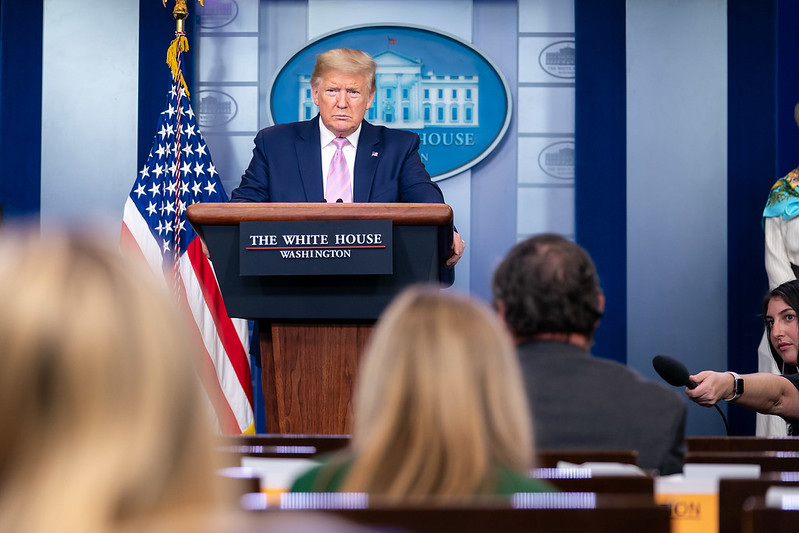
Trump at a briefing on April 4th, 2020/ The White House/ Flickr/ Public Domain

The Trump administration’s increasingly aggressive actions to drive regime change in Venezuela – at a time that the already-desperate country, weakened by its incompetent government and U.S. sanctions, faces a potentially massive COVID-19 crisis – reflect Washington’s favoring of ends over means, with little concern for corollary damage. Regardless of whether President Nicolás Maduro survives the challenge, the country’s massive humanitarian and social disaster is likely to grow worse during the weeks and months ahead. At this point, there is no plausible scenario in which Washington can achieve what it claims is its desired outcome – a stable, democratic government – without a negotiated settlement.

  • The March 26 indictment of Maduro and other senior Venezuelan officials on charges of narcotics-trafficking and support for terrorism against the United States underscored the administration’s commitment to removing a government it calls a “threat to the hemisphere.” The U.S. Department of Justice asserted that Maduro “expressly intended to flood the United States with cocaine in order to undermine the health and wellbeing of our nation.” The indictment forced an end to preliminary talks between Maduro and his opponents over a partial truce that would allow them to make a joint appeal for international aid to deal with COVID‑19.
  • On March 31, the administration announced a “Democratic Transition Framework” for Venezuela. The plan called for Maduro to step down immediately and yield to a “Council of State” to govern until new elections. National Assembly President Juan Guaidó, whom the United States and more than 50 other countries recognize as Acting President, would surrender his claim as well, but American officials made clear he had their full support in any upcoming campaign. Coming on the heels of the indictments, the framework was quickly rejected by the government.
  • The announcement on April 1 that the United States and 22 allies were launching “enhanced counternarcotics operations” in the Caribbean near Venezuela – with large-scale military assets rarely seen in such missions – was another prong of what U.S. National Security Advisor Robert O’Brien called “our maximum pressure policy to counter the Maduro regime’s malign activities.” Maduro cited these threats and indications of mysterious arms movements in Colombia – reported by a former Venezuelan general who some observers say turned collaborator with the U.S. DEA – as reasons for putting the country on military alert last weekend.

The U.S. actions appear to reflect a calculation that the Venezuelan government is so vulnerable that Maduro’s “former regime” will collapse and, somehow, a more sympathetic successor will emerge. U.S. sanctions over the past year-plus have effectively starved the economy, and the recent crash in oil prices has reduced revenues to a trickle. Observers in Caracas report that fear of COVID-19, in a country without medical supplies or even clean water in many parts, is intense.

  • The administration insists it desires a negotiated settlement, but these enhanced pressures, particularly the indictments, greatly complicate any effort to revive talks as Norway had configured them. Similar to last year’s efforts to provoke a coup against Maduro, this year’s “maximum pressure” seems premised on creating a collapse on a scale that forces the military’s hand. But the task of overthrowing Maduro would fall to an exhausted citizenry and field-grade officers not indicted or otherwise targeted by the United States government.

Whether Washington has a comprehensive strategy, is just taking ad hoc steps to force regime change, or is merely looking to wreak havoc at a time that its handling of the COVID‑19 crisis at home is falling under intense criticism, there is precious little historical evidence that its tactics will work in Venezuela. The movement of warships to the Venezuelan coast may only be a publicity stunt, with the support of some countries in the region, but it entails diplomatic and operational risks. It also is not beyond the pale to suppose that the administration, long frustrated in its regime-change efforts, will begin to believe its hyperbole about Maduro as a narco-terrorist poisoning drug-consuming U.S. youth, and be tempted to deploy measures even more drastic than those taken to date.

  • Negotiations, although difficult, are not impossible. When U.S. opposition to diplomatic efforts to resolve the wars in Central America reached a certain point, regional governments met behind Washington’s back and produced a historic plan – the “Esquipulas Accord” – that led to peace processes in each affected country. This situation is, of course, different, but Esquipulas showed that moving the U.S. to the side can work.
  • The indictments are reminiscent of U.S. tactics to overthrow General Manuel Noriega in Panama in 1988-89 – resulting in a massive invasion to arrest that one man. Venezuela is different in many ways, and all parties should heed the adage of former U.S. military commander and Secretary of State Colin Powell, who said, “You break it, you own it.”

April 7, 2020

Brazil: Politicizing Refugee Policy

By João Jarochinski Silva*

Venezuelan refugees in Boa Vista, Brazil

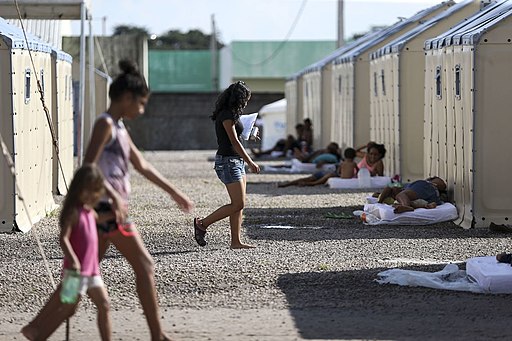
Venezuelan refugees in Boa Vista, Brazil/ Wikimedia Commons/ Creative Commons License

Brazil’s decision to welcome Venezuelan refugees is based on political calculations — part of President Jair Bolsonaro’s domestic agenda, anti-Maduro policies, and efforts to polish his international image — while asylum-seekers of other nationalities are getting a distinctly colder shoulder. The country’s National Committee for Refugees (CONARE), which includes representatives of the Executive Branch and civil society, granted refugee status to approximately 37,000 Venezuelans between December and January. As permitted by Brazilian law, CONARE granted them prima facie refugee status — by virtue of the serious and widespread human rights violations in their home country — without requiring individual interviews. It was an unprecedented number, with strong support from the government, and responded to appeals from civil society and academic experts.

  • While the number of Venezuelans in other South American countries is greater, Brazil now has the most officially designated refugees. It previously had only a little more than an estimated 5,000 refugees of all nationalities — one-eighth its current total.
  • A generous refugee policy has been a key element of Brazilian foreign policy since the 1990s, often the subject of officials’ speeches in UN contexts. The current Administration’s rhetoric, however, has been different. While visiting India in 2019, Bolsonaro criticized a Brazilian law passed in 2017 (when, he claimed, he was the only deputy to cast a dissenting vote) that liberalized the country’s policies toward migrants — constituting a law in which foreigners would not be seen as threats to Brazilian society and also impacted the reality of refugees.

The recent decision to accept tens of thousands of Venezuelans appears motivated by the Bolsonaro Administration’s opposition to Venezuelan President Maduro — as well as Brazil’s left-leaning parties — more than by the humanitarian ideal of helping people fleeing crisis.

  • The Ministry of Justice has argued that non-Venezuelan arrivals are a security threat and need greater control. It introduced a legal regulation that increased control and facilitated the expulsion and deportation of foreigners, with some provisions that specialists claimed to be contrary to Brazilian laws. The regulation was revoked but made clear that the agency will continue to emphasize the security dynamic created by the entry of foreigners.
  • Minister of Justice Sergio Moro recently sent a message on social media stating that “Brazil will no longer be a refuge for foreigners accused or convicted of common crimes” [emphasis added]. With prior approval of CONARE, he rejected an appeal by three Paraguayans, who received refuge in Brazil in 2003 but were recently facing removal, and maintained the revocation of their refugee status.
  • Critics cite Moro’s use of social media to announce a technical decision as confirmation that his intention was primarily political. They note the ideological affinity between the current Brazilian and Paraguayan governments as being more important than the asylees’ previously determined well-founded fear of persecution — a violation of international law regarding non-refoulement. Critics also point out that the three Paraguayans were politically active with left-leaning groups opposed to Bolsonaro.

The contrast between the government’s and Moro’s attitudes toward asylum-seekers from Venezuela and elsewhere is striking. When confronted with evidence of rising crime by Venezuelan arrivals along the Brazilian border, the Minister said local authorities’ evidence was inconclusive. Bolsonaro’s supporters in the border state of Roraima protested Moro’s statement, but a subsequent decision to close the border for 15 days to foreigners without a permanent residence permit — allegedly in response to the threat of coronavirus — has calmed their concerns.

The CONARE decision on Venezuelans may have been intended in part to remove a glut that had slowed the entire refugee system, but the disparity in the treatment of asylum-seekers primarily reflects Brazil’s deep political polarization. Government discourse portrays its domestic opponents as being irresponsible leftists akin to Venezuelan President Maduro, who is so bad that starving refugees show up on Brazil’s doorstep, while praising rightist governments, to which even 17-year asylees can be repatriated without concern for their treatment. The Brazilian military’s deep involvement in operations regarding Venezuela also incentivizes civilians to help keep the status of refugees from becoming a political embarrassment.

  • Politicization of refugee policies and implementation is not unprecedented in Brazil. CONARE, the Brazilian government, and, indirectly, the UNHCR will determine how long this trend will continue. Altering Brazilian action to meet current political interests weakens the rights of refugees and related protective principles embodied in the Constitution and legislation.

March 23, 2020

* João Jarochinski Silva is a CLALS fellow and professor at the Universidade Federal de Roraima (UFRR).