Cuba: U.S. Sanctions Underscore the Need for Meaningful Reform

By Ricardo Torres*

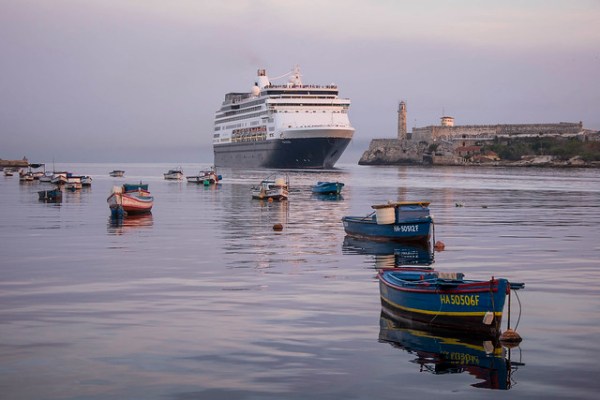
Cruise ship at Havana Harbor in April 2018/ kuhnmi/ Flickr/ Creative Commons

Washington’s new measures to tighten the embargo will hurt the Cuban people, especially the private sector, but Havana has little choice but to double-down on reform and make its economy more efficient and independent. Holding Cuba responsible for Venezuela’s resistance to U.S. regime-change policies in that country, and for alleged “acoustic” incidents harming U.S. diplomats in Havana, U.S. Secretary of State Mike Pompeo and National Security Advisor John Bolton last week announced steps that, taken together, amount to almost full reversal of the engagement that former Presidents Barack Obama and Raúl Castro announced four and a half years ago, in December 2014.

  • Among key measures is full enforcement of Title III of the Helms-Burton law of 1996 – ending waivers that three predecessor administrations had invoked – and allowing even Cuban-Americans who were not U.S. citizens at the time to sue companies involved in business dealings (“trafficking”) involving properties nationalized by the Cuban government since 1959. The U.S. officials have also pledged regulations clamping down on remittances to Cuba (which had already been regulated to ensure that senior government officials did not receive them); prohibiting dollar transactions through third-party financial institutions; and stopping “non-family” travel to the island. Details will not be known until the regulations are published, a process that usually takes several months.

The U.S. actions come at a delicate moment for the Cuban economy, will certainly worsen the country’s balance-of-payments situation by increasing the cost of international transactions, and will directly affect key sectors that depend on tourism and remittances.

  • Among the hardest hit will be Cubans engaged in private businesses, who depend on remittances for investment and foreign visitors as customers. At the end of 2018, a little more than 1.4 million formal jobs were in the non-state sector, including the self-employed (cuentapropistas), members of cooperatives, and private farmers – almost equal to the 1.6 million in state enterprises. Many others work in the informal sector to supplement their incomes.
  • The perceived increased risk posed by the U.S. measures will also cause foreign companies to postpone or cancel entirely plans to invest in Cuba.

Trump Administration efforts last year to reverse Obama-era policies, coupled with other challenges – including the weakening of the Venezuelan economy and the shift of a previously key partner like Brazil – are taking their toll on the Cuban economy. In addition, an accumulation of important internal problems has made the country vulnerable. Austerity measures announced as early as in summer 2016, including a reduction in imports and energy rationing in the public sector, have already hurt. Even in the context of a good international environment and improving ties with the United States, the Cuban economy grew slowly over the past decade. The ups and downs in policies dealing with the private sector, agriculture, and in the derailed process of reform in the dominant state sector – as well as setbacks in efforts to attract foreign investment – underscore the economy’s deep structural flaws and damage caused by deficient responses and successive delays.

In these changing times, appeals to “Resist!” are no longer enough. Aggravated by the U.S. measures, the expected worsening of the economic situation will disproportionately affect the most vulnerable of the Cuban people. The external problems could be the argument that the Cuban government needs to push aside obstacles to domestic economic reform. The country has immense internal potential but has been held hostage to the ideological purism that many profess.

  • The government of President Díaz-Canel has already announced new measures to stimulate the development of state enterprises, cooperatives, and the private sector itself. Foreign dependence has proven to be disastrous for Cuba. No foreign power is going to come to resolve the flaws of the Cuban model. Broadening and deepening reform, liberating the domestic productive powers, seems to be the only possible way forward in addition to rethinking international alliances and embracing markets more broadly.

April 23, 2019

*Ricardo Torres is a professor at the Centro de Estudios de la Economía Cubana at the University of Havana and a former CLALS Research Fellow.
Venezuela: Washington Trying to Tighten the Noose

By Eric Hershberg

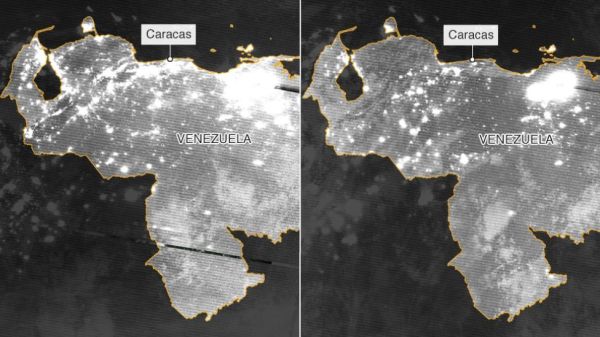
Two side by side images of Venezuela's territory comparing the electrical grid on March 7 and March 12, after six days of blackout

Satellite images of Venezuela. Left image taken on March 7, 2019; right image taken on March 12, 2019 during a blackout / Wikimedia Commons / Creative Commons

As Venezuelan President Nicolás Maduro completes 11 weeks in office since Washington and dozens of other countries recognized National Assembly President Juan Guaidó as “interim president,” the Trump Administration is ratcheting up the pressure. U.S. officials’ rhetoric and actions against both Venezuela and Cuba, which the State Department says is “propping up the former [Maduro] regime,” are escalating. A “senior official” told reporters last Friday that new sanctions would “tighten the noose of financial strangulation of Maduro and his cronies,” while U.S. Vice President Pence, speaking in Houston, reiterated that “all options are on the table.” Pence further focused U.S. regime-change policy on Cuba, citing Guaidó’s wife as the source of evidence that “the only way [Maduro] clings to power is with the help he receives from Communist Cuba.” Pence also said six U.S. businessmen arrested on corruption charges last year “are being held hostage by the Maduro regime,” suggesting another pretext for aggressive action.

  • Last Friday, the U.S. Treasury Department designated 34 vessels owned by PDVSA and two owned by non-Venezuelan companies for sanctions. Treasury Secretary Steven Mnuchin said the move was to block Venezuelan oil exports and cut off supplies to Cuba under the two countries’ “oil-for-repression schemes.”.
  • Press reports on Venezuela’s oil shipments have varied, but Thomson Reuters specialists have reported that Venezuelan oil shipments, after a 40 percent drop in February, remained basically steady in March despite the crisis and electricity disruptions at oil facilities. PDVSA was shipping almost 1 million barrels a day in March, with the bulk going to India, China, and Russia. Reuters calculated that some 65,000 barrels a day went to Cuba.

Electricity blackouts and resulting water shortages have continued for three weeks. While conceivably the result of serious neglect of infrastructural maintenance by Maduro’s Administration, the outages have all the markings of covert sabotage operations. Venezuela has suffered from short power outages many times in recent years, but the latest blackouts have been by far the most extensive, longest, and most damaging. U.S. officials have denied any U.S. role, direct or indirect, in the blackouts. On March 8, Special Representative Elliott Abrams said, “So the United States did not cause those [electricity] problems, the international community did not; the regime caused those problems.”

The U.S. sanctions and related operations are having an impact, but Washington’s initial estimations of Maduro’s strength and the timeline for his collapse were not realistic. Meanwhile, denials of involvement in the blackouts are hard to take at face value. The phrase “all options” surely includes covert action. Turning out the lights is a common disruption tactic, and extraordinary neglect in system maintenance makes the power grid a particularly tempting target in Venezuela. Sabotage and disinformation operations have long been core components of American covert operations in the hemisphere. They were essential tools in successful efforts to depose Guatemalan President Arbenz in 1954 and Chilean President Allende in 1973. The CIA has also formed armed groups, such as the Bay of Pigs force in 1961 and the Nicaraguan Contras in the 1980s (where CIA also mined Corinto harbor). These historical precedents may provide some indications of next steps in the administration’s campaign to bring about regime change in Caracas.

April 11, 2019

South America: Can it Navigate the Changes Ahead?

By Leslie Elliott Armijo*

Latin america

Latin America / Google Images / Creative Commons

Venezuela is the latest example of how Latin America, especially South America, has missed an opportunity to demonstrate the sort of hemispheric leadership it has long striven for – and instead has ceded that role to the United States and even Russia and China.  Although the United States, and the rest of the hemisphere more generally, have been slow to realize it, economic drivers are making the world more multipolar.  In a recent article by two colleagues and myself, we analyze international financial statistics covering 180 countries from 1995 to 2013 that reveal the slow relative decline of the United States as the reigning financial hegemon.  U.S. influence, although still formidable by some margin, is eroding.

  • The Trump Administration’s activities in the larger world are also undermining Washington’s influence. Policies in the WTO and other trade actions writ large – such as withdrawing from the Trans-Pacific Partnership (TPP) and threatening and implementing trade sanctions with little apparent logic – have brushed even allies back. Positions on the Paris climate accord, at the United Nations, and in the President’s relations with North Korean leader Kim Jung Un and Russian President Vladimir Putin have left many around the world increasingly reluctant to follow the U.S. lead.

In this increasingly multipolar world, Latin America, especially South America, is going to find itself not so much freed of U.S. influence – as intellectuals in the region have often stated their wishes – as exposed to new pressures.  The change will be manifest mostly in the economic arena.  New research by McKinsey Global Institute suggests that global value chains are ever more concentrated within multinational corporation networks, which tie major markets (essentially the United States, Western Europe, China, and Japan) to geographically contiguous countries.  This is arguably good for closer neighbors, such as Central America and the Caribbean in our hemisphere, but potentially harmful to those left out – including Sub-Saharan Africa, possibly the Mideast, and South America.

South America has diversified its trade – generally a good thing – among the United States, EU, and East Asia, with the latter having become the major trading partner for a number of countries. Chile and others have been pushing hard to build the Pacific Alliance, as well as to institutionalize the alliance’s relationship with Mercosur. This strategy will be put to the test if, as early trends indicate, the world regionalizes and South America comes under great pressure to refocus on its relations with the United States. To protect and advance their interests in the future, South American countries probably will try to find the right balance between embracing and rejecting the declining yet still dominant hegemon to the north and, as in the case of Venezuela, developing their own strategic vision, forging unity among themselves, and putting some muscle behind an agenda that prepares them for the future.

March 18, 2019

* Leslie Elliott Armijo is an associate professor at the School for International Studies, Simon Fraser University, Vancouver. She is the co-author, with Daniel C. Tirone (Louisiana State University) and Hyoung-kyu Chey (National Graduate Institute for Policy Studies, Tokyo), of The Monetary and Financial Powers of States: Theory, Dataset, and Observations on the Trajectory of American Dominance.

Venezuela: A Test of U.S. Hegemony in Latin America

By Eric Hershberg

Lima Group members standing at a podium

Lima Group members in Torre Tagle in Perú / Flickr / Creative Commons

The showdown in Venezuela reflects an extraordinary attempt by the United States government to resurrect hegemonic power in Latin America.  From the mid-19th century to the dawn of the 21st, it was common for Washington to directly overthrow Latin American governments or to bolster clients seeking transitions to dictatorship or democracy.  But recent years had witnessed a clear decline in U.S. hegemony.  As Latin America appeared to have escaped Washington’s imperial reach, many of us were persuaded of the finality of the Obama administration’s recognition that the era of the Monroe Doctrine had ended.  We were dismissive, perhaps excessively, of the assertion of Trump administration officials and advisors that the infamous Doctrine could somehow be revived.

Yet the dynamics of the Venezuelan confrontation result from an unprecedented, Washington-forged hemispheric coalition – of the genuinely willing – trying to force a regime transition.  Traditionally, Washington conducted such interventions on its own, opposed by most of Latin America.  Yet today not only the 12 members of the Lima Group but also Canada and several EU governments are on board with the administration’s boldly assertive intervention in Venezuela’s political crisis.  Russia’s and China’s support for incumbent President Nicolás Maduro underscores that what is at stake is the enduring relevance of the Monroe Doctrine, which almost two hundred years ago unilaterally established an American veto over extra-regional engagement with nominally sovereign countries “in its own backyard.”

For champions of the Trump administration’s policy, asserting hegemony – after the Obama administration had declared it “dead” – is an end in itself.  Rejecting the Monroe Doctrine did not provoke a crescendo of acceptance from much of the foreign policy establishment in Washington, and abandoning that stance has been a core aspiration of right-wing foreign policy networks that have taken over the Executive Branch.  Countless statements over the years by the presumed architect of the present intervention – de facto Secretary of State for Latin America Senator Marco Rubio – reflect how an enduring hatred for the Cuban Revolution, and movements inspired by it such as Chavismo and the ALBA alliance, fuels antagonism toward intra- or extra-regional engagement that call into question U.S. authority.  Russian and Chinese interest in sustaining Chavismo thus reinforce Washington’s determination to eradicate it.

  • Venezuela today is an ideal target for a US-sponsored intervention to bring about regime change and reassert American hegemony in Latin America. The dictatorship is increasingly vicious, and Maduro’s claim to legitimacy is entirely fraudulent.  Moreover, Maduro’s government has so wrecked the economy that desperate millions are fleeing the country, creating an urgent humanitarian crisis that overwhelms neighboring countries already unable to provide for the basic needs of their own populations, making them more amenable to an interventionist exit.
  • Venezuela’s opposition has been long hindered by incompetence and racked by competing personal ambitions. With its most assertive leaders imprisoned, under house arrest, or in exile, it has proven incapable on its own of bringing about Maduro’s removal, either peacefully through his rigged institutions or through uprisings in the streets.  Absent an internal path toward regime transition, conditions were ripe for Washington to coax regional partners to back a daring strategy of intervention.  To have any prospects for success, the venture required that the domestic opposition finally unify – or at least acquiesce in –the anointment as Interim President of Juan Guaidó, a young political unknown whose ties with right-wing patrons are not as well known.  That unification, presumably, was made possible by recognition that only with external support could internal resistance succeed, and only with a unified or quiescent opposition would the international partners take the aggressive stance that they did.

Just as the opening to Cuba was the signature achievement of the Obama administration with regard to Latin America, the effort to overthrow the Venezuelan government appears destined to be the signature act of the Trump administration.  The support of almost all of Latin America for it will have consequences far beyond the fate of the incompetent dictator clinging to power in Caracas.  If their gambit succeeds, Senator Rubio and National Security Advisor John Bolton could move on next to Nicaragua and then perhaps to the king’s crown in Havana. 

  • Those tempted to attribute this to abhorrence of violators of democratic norms would do well to consider the administration’s supportive stance toward increasingly authoritarian regimes in Honduras and Guatemala. Those cases, and the recognition that much of the opposition leadership wants to restore Venezuela to “what it used to be” (i.e., before Chavez tried with considerable popular support to forever end what Venezuela used to be), underscore the ideological drivers of U.S. policy today.  While Washington may have embarked on a course that can finally extricate Venezuela from Chavista misrule, the history of American influence over the region does not bode well for what a return to U.S. hegemony in Latin America could bring.  Surely that point is not lost on leaders of countries such as Mexico and Uruguay.  If the coming weeks bring a continuing stalemate between the Venezuelan regime and opposition, perhaps their good offices could catalyze a negotiated path to free elections and to a resulting regime that would not be Made in USA.


January 31, 2019

U.S. Immigration: Call for Wall Ignores Changing Migrant Profile

by Dennis Stinchcomb

Graph of southwest border apprehensions, FY 2012-2019

Southwest border apprehensions, FY 2012-2019 / Note: FY 2019 data is through November 2018. Figures may not total 100% due to rounding. / Data source: U.S. Customs and Border Protection

As a record number of Central American families and unaccompanied children flock to the U.S.-Mexico border, the Trump administration’s demand for a $5.7 billion wall ignores changing migrant demographics and leaves largely unaddressed an asylum system buckling under unprecedented strain.  While undocumented immigration at the U.S.-Mexico border remains at historic lows, over 48,000 individuals comprising family units (parents traveling with children) were apprehended at the U.S. southwest border between October and November 2018 – a 308 percent increase over the same two months in 2017.  Such a staggering rise comes on the heels of what was already a record-setting year.  Between October 2017 and September 2018, border officials tallied the highest level of family crossings on record; the over 107,000 individuals detained by border officials dwarfed the roughly 40,000 apprehensions of unaccompanied children that prompted the Obama administration to declare a “crisis” in summer 2014.

A closer look at recent immigration trends underscores changing realities at the border:

  • Central American families and children represent an ever-growing share of migrants. Because overall undocumented immigration at the border has dropped and families and children have surged, the latter now account for 40 percent of all unauthorized migrants apprehended, up from 10 percent in 2012.  (Prior to 2012, family apprehensions were not publicly reported.)
  • Guatemalans now account for over half of all Central American family and child migrants. Though Guatemala is more populous than neighboring El Salvador and Honduras, proportional disparities in migrant flows from the three Northern Triangle countries have widened in recent years.  Guatemalan families apprehended at the border doubled between 2017 and 2018, and the number of unaccompanied Guatemalan minors increased by over 50 percent.  An increasing share of these migrants are coming from indigenous communities where poverty and malnutrition are rampant, so border officials face compounding challenges including linguistic barriers and health needs – factors that may have contributed to the recent deaths of two Guatemalan children while in Border Patrol custody.
  • Family and child migration from El Salvador has plummeted to its lowest level since 2013. The abrupt decline in Salvadoran migration to the United States has led many experts to point to the chilling effects of the Trump administration’s decision to terminate Temporary Protected Status (TPS) for nearly 200,000 Salvadorans currently residing in the U.S.  The “Trump effect” following his early 2017 executive orders, however, was short-lived, and other events, such as possible controversy over elections next month, could renew migratory pressures and further exacerbate conditions at the border.
  • The dramatic increase in migrant flows from Central America has fueled an historic surge in asylum claims. At the border, credible-fear claims – the preliminary step in soliciting asylum – continue to climb precipitously, up from 9,000 in 2010 to 79,000 in 2017.

The U.S. Government’s proposed solutions to the burgeoning humanitarian crisis do not reflect the evolving profile of migrants at the U.S.-Mexico border.  President Trump’s border wall – a hallmark promise of his 2016 campaign – appears aimed at the familiar Mexican adult migrant of the early 2000s or the mythical “bad hombre” spawned by his own nativist tendencies.  His Administration’s recent attempts to deter migrants or bar their access to asylum, either by separating families or rolling back protections for victims of domestic violence, have not stemmed the flood of arrivals.  A new “caravan” of migrants is set to depart Honduras this week.  Nor will a wall extinguish migrants’ legal right to request asylum.  The President’s most recent budget request for modest funds for hiring immigration judges and providing border infrastructure to support “vulnerable populations” is being held up by the political impasse in Washington over his greatly disproportionate spending on a wall, Border Patrol agents, and detention facilities.  Compromise between the President and Congressional Democrats remains elusive three weeks into a confrontation that has shut down much of the U.S. Government.  While Democrats have expressed willingness to beef up border security in exchange for a significant immigration win, such as legalization of the Dreamers or renewal of TPS, anything short of meaningful reform to the U.S. asylum system will do little to resolve the backup at the border.

Jan 15, 2019

U.S.-Central America-Mexico: Migrant Caravan Shaking up Relations

By Fulton Armstrong

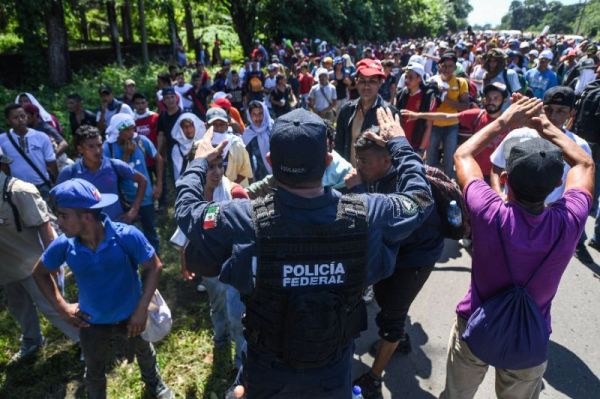
Honduran migrants meet with Mexican police in Chiapas

Honduran migrants meet with Mexican police in Chiapas. / Pedro Pardo / AFP Photo / Creative Commons

The underlying drivers of Central American migration remain the same as always – the lack of economic opportunity and strong institutions to protect citizens from violence and other threats – but the Trump administration’s accusations and threats in reaction to the caravan of migrants heading toward the United States is moving relations into uncharted territory, just two weeks after the parties congratulated themselves for progress made at a summit in Washington.

  • Honduran, Guatemalan, and now Mexican authorities have been unable to stop the peaceful caravan of 5,000-7,000 people without violating their rights and causing ugly incidents with high political costs at home. After shows of force, Guatemalan and Mexican border guards allowed them to pass, and local businesses and churches have spontaneously provided food, water, and shelter in each town.  Mexico originally said it would allow only those with current passports and identification to apply for refugee status, but, citing obligations under international agreements and national law, relented.  The migrants are now in Chiapas.

At a meeting with U.S. Vice President Pence and Secretary of State Pompeo on October 11, leaders from Central America’s three “Northern Triangle” countries – Honduran President Hernández, Guatemalan President Morales, and Salvadoran Vice President Ortiz – and Mexican Foreign Minister Videgaray trumpeted the progress that they had made in slowing the flow of migrants from the region to the United States since launching the Alianza para la Prosperidad in 2014.  CLALS research, other studies, and many press reports show, however, that the underlying drivers of migration remain essentially unchanged.

  • The Alianza may eventually foment economic growth and jobs, but multidimensional poverty and high underemployment continue to drive many to flee their homeland. An analysis by the Instituto Centroamericano de Estudios Fiscales (ICEFI) shows that about 6.2 million children, adolescents, and young adults in the Northern Triangle lack access to an educational system.  Homicide rates have declined, but the region remains one of the most violent in the world.  UN estimates show a steady increase in the number of gang members in all three countries, up to 20,000 each in El Salvador and Guatemala.  The gangs often fill voids left by government institutions that are underfunded and, often, weakened by corrupt officials’ embezzlement.  While violence has long been a driver of migration from urban areas, it is now causing new patterns of migration from rural areas as well.  Domestic violence and abuse, which UN data indicate affects up to 40 percent of girls and 16 percent of boys, is another problem some parents want children to escape.
  • President Trump has not acknowledged these drivers, and instead has portrayed the migrants in the caravan as an “onslaught” of criminals. (He also claimed that “unknown Middle Easterners” are among them but later admitted “there’s no proof of anything.”)  He apparently calculates that stirring up fear helps his allies in the U.S. Congress as midterm elections approach, as well as his campaign for a new wall on the U.S.-Mexico border.  He has threatened the Northern Triangle governments and Mexico for not stopping the migrants, tweeting Monday that he will “now begin cutting off, or substantially reducing, the massive foreign aid routinely given to [them]” because “they did nothing for us. Nothing.”  Mexican officials, relieved that the confrontation over the NAFTA renegotiation was resolved, now fear another major disruption in bilateral relations.

The migrant caravan is testing the administration’s relations with its closest allies in Central America.  Trump’s jettisoning of the nice talk from Pence’s recent summit will not in itself harm ties; the Central Americans and Mexicans are aware of his impulsive streak and may calculate that they can weather the windstorm.  His accusations and threats to suspend aid, however, reveal a fundamental misunderstanding of the underlying drivers of the migration, and he seems unaware that his partners have been unwilling to undertake the political and economic reforms needed to address those drivers except in minor ways that U.S. aid enables.  Trump apparently thinks his partners should use force – even the military if needed (as he’s threatened on the U.S. border) – to stop the flight of humans from the miserable conditions in which they live.  He also apparently judges that the more migrants are made to suffer, such as through the separation of family members who manage to cross the border, the less likely they are to try.  The caravan’s provocations and Trump’s reactions could blow up the game that has allowed both sides to pretend the problem will go away with token programs, intimidation, and a wall.

October 24, 2018

U.S. Immigration: Lacking Lawyers, Newcomers Join the Undocumented

By Dennis Stinchcomb

Immigration court backlog

Pending cases from the Northern Triangle in U.S. immigration courts. These cases now account for over 53% of the total backlog. / Note: FY 2018 data is through July 31. / Data source: TRAC, “Immigration Court Backlog Tool,” http://trac.syr.edu/phptools/immigration/court_backlog/.

As Central Americans swell the backlog of cases in U.S. immigration courts, the tens of thousands of them who do not have lawyers are joining the ranks of the country’s undocumented population.

  • The immigration court system lacks the resources to keep pace with the influx of unaccompanied children and families from the “Northern Triangle” countries of El Salvador, Guatemala, and Honduras. The backlog of cases has more than doubled since 2013 – from 350,000 to over 764,000 as of August – with cases involving people from these three countries now accounting for more than half of them.  The wait for a hearing is now several years, and pro bono or low-cost attorneys are overburdened.
  • Many thousands of other newcomers – lacking information and the ability to overcome linguistic and cultural barriers and fear – are not looking for legal assistance, and they remain unaware that representation is critical to their chances of legally staying in the United States. Migrants without an attorney are far less likely to appear in court, and many – nearly 40 percent (or 103,000) of all Central Americans whose cases were filed in 2013-17 and have been decided– are ordered deported “in absentia” just for failing to appear at a scheduled hearing.  Immigrants with an outstanding removal order who are apprehended are subject to expedited deportation without judicial review, meaning that – again, without a lawyer – they will be returned to their home countries without ever having the legal merit of their claims evaluated.

Nonprofit community-based organizations across the country are mobilizing resources – often in collaboration with local governments and pro bono partners – to address these people’s legal needs, but a report* by CLALS reveals that access to counsel varies widely.

  • Access remains inadequate even in large receiving destinations like the Washington, DC, metropolitan area, where robust legal service infrastructures have developed in response to decades of immigration. In less traditional destinations, like North and South Carolina, only around a quarter of juveniles are represented in immigration proceedings.  In addition to geographical disparities, newcomers face differing odds of securing an attorney depending on their nationality.  Less than half of Central American minors nationwide have an attorney.  Based on a review of decided cases initiated in 2013-17, Salvadoran juveniles were more than twice as likely to be represented than their Guatemalan and Honduran counterparts, probably a reflection of the extent their communities are organized.

President Trump is justified in claiming that the immigration courts are inefficient – cases take an average of almost two years – but his proposal (tweeted on June 24) is to restore “Law and Order” and to “immediately, with no Judges or Court Cases, bring [migrants] back from where they came.”  His deeper dissatisfaction appears to be with a legal process that requires the impartial application of U.S. law – which for the majority of Central Americans fortunate enough to have an attorney results in a grant of legal status.  While this outcome may be unacceptable to the president, many localities across the United States have recognized the social and economic costs of destabilizing families and communities, and of depriving immigrant community members of due process.  Trump may hope that denying due process will dissuade individuals from entering or remaining in the United States, but the crisis in the U.S. immigration adjudication system is likely to remain serious, and tens or even hundreds of thousands more newcomers are likely to join the millions of immigrants already living in the shadows.

October 16, 2018

*The full report, “Newcomer Central American Immigrants’ Access to Legal Services,” is available for download here.  No registration is necessary.  The report is the first in a series generated as part of the project by CLALS in collaboration with the University of Houston, “The Impact of Central American Child and Family Migration on U.S. Communities,” led by Eric Hershberg and Jodi Berger Cardoso.

U.S.-Latin America: Return of Monroe Doctrine

By Stefano Palestini Céspedes* and Fulton Armstrong

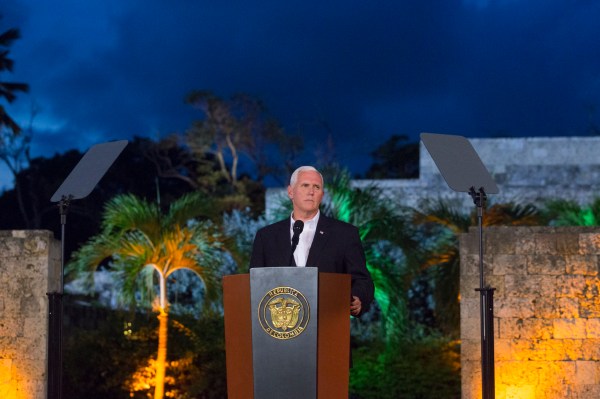
U.S. Vice President Mike Pence

U.S. Vice President Mike Pence visited Colombia during his Latin American tour last summer. / White House / Flickr / Creative Commons

The Trump administration’s revival of a vision of U.S.-Latin America relations akin to the Monroe Doctrine is advancing with little pushback from the region.  Since former U.S. Secretary of State Rex Tillerson eight months ago proclaimed that the Monroe Doctrine is “as relevant today as it was the day it was written,” Washington has continued to revive it as a guiding principle that includes limiting the influence of other powers in the hemisphere as well as reserving for itself the right to intervene when it feels its interests are threatened.

  • Tillerson complained that China “is using economic statecraft to pull the region into its orbit” and that Russia’s “growing presence in the region is alarming as well, as it continues to sell arms and military equipment to unfriendly regimes who do not share or respect democratic values.” In August, U.S. Defense Secretary James Mattis renewed the attack on China’s investment of billions in Latin America, claiming that “there is more than one way to lose sovereignty. … It can be with countries that come offering presents and loans.”  Last week, U.S. Vice President Mike Pence repeated his government’s complaint that Latin America is among the regions where China is offering large infrastructure loans that are “opaque at best, and the benefits flow overwhelmingly to Beijing.”
  • Washington has also resorted to cavalier rhetoric regarding its perceived right to intervene in the internal affairs of Latin American countries to advance its interests. At the United Nations in late September, President Trump said, “Here in the Western Hemisphere, we are committed to maintain[ing] our independence from the encroachment of expansionist foreign powers.”  President Trump argued for regime change in Venezuela and repeated that “all options are on the table, [including] the strong ones.”  In the new NAFTA agreement, Washington demanded, and achieved Mexican and Canadian concurrence on, a clause stipulating that the United States could terminate the agreement with six months’ notice if either negotiated a free trade agreement with a “non-market economy” – that is, with China.

Latin American governments’ voices have been thus far muted – perhaps because they are getting used to downplaying Trump’s rhetoric – even though the revival of the Monroe Doctrine is already shaping actual policies.  A hundred years ago, Latin American international lawyers, diplomats, and intellectuals worked hard to transform the Monroe Doctrine from a unilateral doctrine into a multilateral policy able to shape first Pan-American and later Inter-American relations.  Those efforts led to the adoption of hemispheric instruments such as the OAS Charter in 1948 and the Inter-American Democratic Charter in 2001, gradually defining a mutually acceptable approach that strikes a balance between shared hemispheric values and the principle of non-intervention.  After the Cold War, references to the Monroe Doctrine disappeared from public discourse – except to disparage it as the Obama administration did – until the Trump administration revived it.

Today, the forums and organizations that Latin America has used during the last decade to articulate concerns and political responses to U.S. policies are not working.  OAS Secretary General Luis Almagro’s recent declarations that military action to solve the crisis in Venezuela cannot be ruled out, rather than offering a riposte, echoes Trump’s stance.  The Lima Group – which gathers together a group of OAS member states committed to the defense of democracy in Venezuela – pushed back against Almagro’s statements but, importantly, not against the U.S. administration’s policy.  More formal organizations such as UNASUR are not only muted, but actually paralyzed by the inability of its members to reach consensus and solve fundamental discrepancies. 

  • To resist and speak up when confronted with rhetoric and policies with such profound implications as a revitalized Monroe Doctrine is not a matter of politics and economics, but rather a necessary condition for friendly and respectful international relations and the sort of partnership that Latin Americans of all political stripes claim to want with the United States. To articulate such a response, Latin America urgently needs its leaders to think in “regional” and not only “national” terms – to nurture a genuine Inter-American community, not just bilateral relations with Washington.  The odds for such leadership to emerge at this moment do not appear high.  The possible election of a nationalist, xenophobic, and illiberal leader in Brazil may become a further challenge for collective action in the region.

October 12, 2018

* Stefano Palestini Céspedes is an Assistant Professor at the Institute of Political Science, Catholic University of Chile.

U.S.-Guatemala: Are Donald Trump and Jimmy Morales Brothers in Arms?

By Anthony W. Fontes*

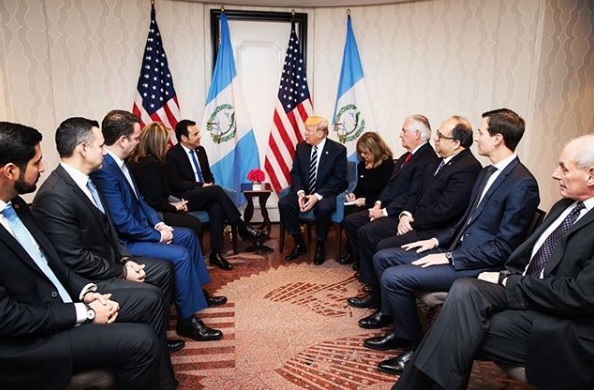
Jimmy Morales and Donald Trump

Guatemalan President Jimmy Morales meets with U.S. President Donald Trump in February 2018. / Executive Office of the President of the United States / Wikimedia

Guatemalan President Jimmy Morales’ announcement last month that he would not reauthorize the joint Guatemala-United Nations anti-corruption commission to remain in the country apparently was made with confidence that President Trump would approve, or at least turn a blind eye.  Morales’ gambit followed months of public threats against the International Commission against Impunity in Guatemala (CICIG), which has been investigating and prosecuting high-profile organized crime and corruption cases for over a decade.

  • His attempt to revoke CICIG’s authority and refusal to allow CICIG’s highly respected lead prosecutor, Iván Velásquez, to re-enter Guatemala after a trip to the United States are widely understood as intended to halt investigations into Morales’ own alleged illegal campaign financing during the 2015 presidential election. Even after Guatemala’s Constitutional Court – the nation’s highest judicial authority – ordered Morales to allow Velásquez entry, the president refused to budge.
  • Some U.S. politicians have joined in the international condemnation of Morales’ efforts – 23 members of the U.S. Senate and House wrote a letter to Secretary of State Pompeo asserting that he “must counter” the maneuver. But the Trump administration has remained largely silent; Pompeo in early September reiterated U.S. “support for Guatemalan sovereignty” – code for a hands-off policy – and, using words similar to those Morales has used in advocating dilution of CICIG’s mandate, announced his backing for a “reformed CICIG.”

Several explanations for Washington’s soft approach to Morales’ action have emerged.  Some pundits muse that the administration is repaying him for relocating the Guatemalan embassy in Israel to Jerusalem when the United States did.  Others opine that Trump fears pushing Guatemala into China’s arms amid reports that it will follow El Salvador’s recent decision to break relations with Taiwan.  Yet another, less strategic and more personal explanation might illuminate the equivocation – that Trump simply empathizes with Morales because they have a lot in common.

  • Both first emerged in the public eye as TV personalities. While Trump was building his brand on “reality TV,” Morales hosted a popular daytime talk show, where he became known for lowbrow comedic antics that included blackface.  In their campaigns, they fed on simmering discontent about the corruption of the political establishment, and trumpeted their lack of political experience as a prime reason to vote for them.  They both defeated the former first ladies of left-leaning presidents considered by large swaths of their electorates as corrupt.
  • More importantly, both presidents face far-reaching criminal investigations that have cast long shadows over their first years in office. Despite Trump’s vociferous denials to the contrary, the Special Counsel investigation into his campaign’s possible collusion with Russian efforts to influence the 2016 election has been a constant thorn in his side.  CICIG, whose investigations into former President Pérez Molina were pivotal to his arrest and impeachment, has represented an existential threat to the Morales administration since the day he took office in 2015.  CICIG’s work put his son and brother behind bars for fraud.  (Trump’s son and son-in-law are reportedly under investigation too.)  CICIG has doggedly pursued investigations against Morales and his supporters in Congress for illegal campaign financing, among numerous other charges.

The two presidents’ efforts to resist and deride the investigations into their activities expose perhaps the most striking (and disturbing) of their shared affinities.  To protect themselves, they appear willing to tarnish and undermine public institutions integral to democracy and law and order.  Trump attacks the free press and the FBI as “deep state” conspirators.  Morales has aligned with members of the Guatemalan Congress to give immunity from prosecution to politicians in office accused of a laundry list of crimes, contravening a fight against powerful criminal organizations embedded in government.  By violating decrees by Guatemala’s Constitutional Court, Morales has placed his administration on a collision course with the nation’s constitutional order.

  •  The potential long-term damage to democratic institutions suggests that the “democratic wave” that swept across the Americas in the second half of the 20th century has crested. Under the Trump administration, the United States now risks becoming a beacon for anti-democratic politicians like Morales across the hemisphere, giving political cover and guidance to those who would hasten democracy’s demise for the sake of power.  The rule of law in liberal democracies is predicated on transparency and accountability – and is threatened by executive intimidation of institutional checks and balances.

October 2, 2018

*Anthony W. Fontes is an Assistant Professor in the School of International Service at American University.

U.S. Politics: Ted Cruz’s Spanish Problem

By Chip Gerfen*

Beto O'Rourke and Ted Cruz

Beto O’Rourke, D-El Paso (left), is challenging Republican incumbent U.S. Senator Ted Cruz. / Marjorie Kamys Cotera: O’Rourke/ Bob Daemmrich: Cruz

In the race for the U.S. Senate seat in Texas, a non-Latino challenger is gaining on an incumbent widely hailed as the Senate’s first Hispanic member by mischievously challenging his bond with Latino voters.  Last Friday evening in Dallas, Democrat Beto O’Rourke and Republican Ted Cruz held the first of three planned face-to-face debates in what now appears to be a toss-up race for the Senate seat Cruz has held since 2013.  The Texas Republican Party misjudged O’Rourke’s appeal, ineptly miscalculating that his punk rock past, ability to skateboard, and occasional use of obscenities would swing sentiment away from rather than towards him.  O’Rourke is a three-term member of the U.S. House of Representatives from his hometown of El Paso.

  • Extraordinarily, the race pits a fourth-generation Irish-American, Robert Francis O’Rourke, with the Spanish nickname “Beto,” against a first-generation Cuban-American, Rafael Edward Cruz, who goes by “Ted” – and it is impossible to miss the irony in the fact that the Irish-American has challenged the Cuban-American to hold two debates in Spanish.

Cruz’s Spanish language bona-fides have come up in an electoral context before.  As I wrote during the 2016 presidential primaries, Cruz and Florida Senator Marco Rubio, also a Cuban-American, sparred openly on national television, with Cruz accusing Rubio of using Spanish to send different messages to different constituencies.  Rubio ridiculed Cruz’s lack of fluency in the language, suggesting a major positive shift in attitudes towards the value of Spanish in the public, political sphere.

  • Cruz’s traditional homogenizing view of immigrant language and identity was already clearly visible in his prior description of English as the language of the people of Texas, while Spanish was foreign and appropriate for use in the public and political discourse of places such as Cuba or Mexico. Rubio, by contrast, viewed his fluency in Spanish as a useful tool for connecting with Hispanic voters without incurring costs with non-Hispanic voters.  By openly disparaging Cruz’s Spanish in a nationally broadcast debate, Rubio sought to undermine the man’s cultural and ethnic authenticity, especially when contrasted with his own demonstrable bilingualism and cultural pluralism.

The current race in Texas is more than an incumbent defending his seat in a statewide election.  It is one with national consequences being played out on a big stage – at a time when the tsunami of Trump’s political victory and subsequent discourse and policies may seem to have changed the political calculus regarding linguistic and ethnic identity away from Rubio’s embrace of linguistic pluralism in the public square.  Nevertheless, not only are Cruz’s Spanish bona-fides being called into question again; the challenge arises from a political competitor named O’Rourke who has no ethnic connection to the Latino communities of Texas.  O’Rourke and Cruz are, in fact, polar opposites.  Cruz, son of a Cuban immigrant father, is a paradigm of traditional assimilation.  Like the children of many immigrants, he lost the language of his father, embraced English as a marker of his American identity, and chose an English nickname, Ted, over his given name, Rafael.  O’Rourke, by contrast, was raised in the bilingual border city of El Paso, grew up with a Spanish nickname, and learned to speak fluently the Spanish language of the generally economically less privileged citizens of his home.

By challenging Cruz to debate in Spanish, O’Rourke is advancing a vision of political and societal inclusion that does not demand linguistic assimilation.  Like Rubio in 2016, he is leveraging his own knowledge of Spanish to connect with a specific constituency and espouse an inclusive vision.  At the same time, by forcing Cruz to admit his inability to speak Spanish, O’Rourke, like Rubio before him, implicitly identifies Cruz as an outsider to the linguistic community to which he should, by birthright, feel some affinity.  While language itself does not define the ethnicity of either candidate, O’Rourke is adeptly challenging Cruz’s authenticity as a Latino, while at the same time signaling his own solidarity with constituents who speak Spanish or are descended from Hispanic families in ways that Cruz cannot.  Simply put, by taking the Spanish out of Cruz, O’Rourke leaves Cruz with little choice but to continue betting on the political value of the traditional, and increasingly challenged, narrative of assimilation in a demographically changing political landscape.

September 25, 2018

* Chip Gerfen is Professor of Linguistics and Spanish at American University.