U.S.-Guatemala: Are Donald Trump and Jimmy Morales Brothers in Arms?

By Anthony W. Fontes*

Jimmy Morales and Donald Trump

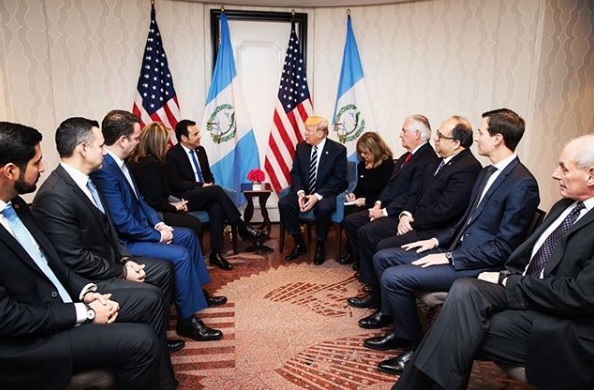
Guatemalan President Jimmy Morales meets with U.S. President Donald Trump in February 2018. / Executive Office of the President of the United States / Wikimedia

Guatemalan President Jimmy Morales’ announcement last month that he would not reauthorize the joint Guatemala-United Nations anti-corruption commission to remain in the country apparently was made with confidence that President Trump would approve, or at least turn a blind eye.  Morales’ gambit followed months of public threats against the International Commission against Impunity in Guatemala (CICIG), which has been investigating and prosecuting high-profile organized crime and corruption cases for over a decade.

  • His attempt to revoke CICIG’s authority and refusal to allow CICIG’s highly respected lead prosecutor, Iván Velásquez, to re-enter Guatemala after a trip to the United States are widely understood as intended to halt investigations into Morales’ own alleged illegal campaign financing during the 2015 presidential election. Even after Guatemala’s Constitutional Court – the nation’s highest judicial authority – ordered Morales to allow Velásquez entry, the president refused to budge.
  • Some U.S. politicians have joined in the international condemnation of Morales’ efforts – 23 members of the U.S. Senate and House wrote a letter to Secretary of State Pompeo asserting that he “must counter” the maneuver. But the Trump administration has remained largely silent; Pompeo in early September reiterated U.S. “support for Guatemalan sovereignty” – code for a hands-off policy – and, using words similar to those Morales has used in advocating dilution of CICIG’s mandate, announced his backing for a “reformed CICIG.”

Several explanations for Washington’s soft approach to Morales’ action have emerged.  Some pundits muse that the administration is repaying him for relocating the Guatemalan embassy in Israel to Jerusalem when the United States did.  Others opine that Trump fears pushing Guatemala into China’s arms amid reports that it will follow El Salvador’s recent decision to break relations with Taiwan.  Yet another, less strategic and more personal explanation might illuminate the equivocation – that Trump simply empathizes with Morales because they have a lot in common.

  • Both first emerged in the public eye as TV personalities. While Trump was building his brand on “reality TV,” Morales hosted a popular daytime talk show, where he became known for lowbrow comedic antics that included blackface.  In their campaigns, they fed on simmering discontent about the corruption of the political establishment, and trumpeted their lack of political experience as a prime reason to vote for them.  They both defeated the former first ladies of left-leaning presidents considered by large swaths of their electorates as corrupt.
  • More importantly, both presidents face far-reaching criminal investigations that have cast long shadows over their first years in office. Despite Trump’s vociferous denials to the contrary, the Special Counsel investigation into his campaign’s possible collusion with Russian efforts to influence the 2016 election has been a constant thorn in his side.  CICIG, whose investigations into former President Pérez Molina were pivotal to his arrest and impeachment, has represented an existential threat to the Morales administration since the day he took office in 2015.  CICIG’s work put his son and brother behind bars for fraud.  (Trump’s son and son-in-law are reportedly under investigation too.)  CICIG has doggedly pursued investigations against Morales and his supporters in Congress for illegal campaign financing, among numerous other charges.

The two presidents’ efforts to resist and deride the investigations into their activities expose perhaps the most striking (and disturbing) of their shared affinities.  To protect themselves, they appear willing to tarnish and undermine public institutions integral to democracy and law and order.  Trump attacks the free press and the FBI as “deep state” conspirators.  Morales has aligned with members of the Guatemalan Congress to give immunity from prosecution to politicians in office accused of a laundry list of crimes, contravening a fight against powerful criminal organizations embedded in government.  By violating decrees by Guatemala’s Constitutional Court, Morales has placed his administration on a collision course with the nation’s constitutional order.

  •  The potential long-term damage to democratic institutions suggests that the “democratic wave” that swept across the Americas in the second half of the 20th century has crested. Under the Trump administration, the United States now risks becoming a beacon for anti-democratic politicians like Morales across the hemisphere, giving political cover and guidance to those who would hasten democracy’s demise for the sake of power.  The rule of law in liberal democracies is predicated on transparency and accountability – and is threatened by executive intimidation of institutional checks and balances.

October 2, 2018

*Anthony W. Fontes is an Assistant Professor in the School of International Service at American University.

U.S. Politics: Ted Cruz’s Spanish Problem

By Chip Gerfen*

Beto O'Rourke and Ted Cruz

Beto O’Rourke, D-El Paso (left), is challenging Republican incumbent U.S. Senator Ted Cruz. / Marjorie Kamys Cotera: O’Rourke/ Bob Daemmrich: Cruz

In the race for the U.S. Senate seat in Texas, a non-Latino challenger is gaining on an incumbent widely hailed as the Senate’s first Hispanic member by mischievously challenging his bond with Latino voters.  Last Friday evening in Dallas, Democrat Beto O’Rourke and Republican Ted Cruz held the first of three planned face-to-face debates in what now appears to be a toss-up race for the Senate seat Cruz has held since 2013.  The Texas Republican Party misjudged O’Rourke’s appeal, ineptly miscalculating that his punk rock past, ability to skateboard, and occasional use of obscenities would swing sentiment away from rather than towards him.  O’Rourke is a three-term member of the U.S. House of Representatives from his hometown of El Paso.

  • Extraordinarily, the race pits a fourth-generation Irish-American, Robert Francis O’Rourke, with the Spanish nickname “Beto,” against a first-generation Cuban-American, Rafael Edward Cruz, who goes by “Ted” – and it is impossible to miss the irony in the fact that the Irish-American has challenged the Cuban-American to hold two debates in Spanish.

Cruz’s Spanish language bona-fides have come up in an electoral context before.  As I wrote during the 2016 presidential primaries, Cruz and Florida Senator Marco Rubio, also a Cuban-American, sparred openly on national television, with Cruz accusing Rubio of using Spanish to send different messages to different constituencies.  Rubio ridiculed Cruz’s lack of fluency in the language, suggesting a major positive shift in attitudes towards the value of Spanish in the public, political sphere.

  • Cruz’s traditional homogenizing view of immigrant language and identity was already clearly visible in his prior description of English as the language of the people of Texas, while Spanish was foreign and appropriate for use in the public and political discourse of places such as Cuba or Mexico. Rubio, by contrast, viewed his fluency in Spanish as a useful tool for connecting with Hispanic voters without incurring costs with non-Hispanic voters.  By openly disparaging Cruz’s Spanish in a nationally broadcast debate, Rubio sought to undermine the man’s cultural and ethnic authenticity, especially when contrasted with his own demonstrable bilingualism and cultural pluralism.

The current race in Texas is more than an incumbent defending his seat in a statewide election.  It is one with national consequences being played out on a big stage – at a time when the tsunami of Trump’s political victory and subsequent discourse and policies may seem to have changed the political calculus regarding linguistic and ethnic identity away from Rubio’s embrace of linguistic pluralism in the public square.  Nevertheless, not only are Cruz’s Spanish bona-fides being called into question again; the challenge arises from a political competitor named O’Rourke who has no ethnic connection to the Latino communities of Texas.  O’Rourke and Cruz are, in fact, polar opposites.  Cruz, son of a Cuban immigrant father, is a paradigm of traditional assimilation.  Like the children of many immigrants, he lost the language of his father, embraced English as a marker of his American identity, and chose an English nickname, Ted, over his given name, Rafael.  O’Rourke, by contrast, was raised in the bilingual border city of El Paso, grew up with a Spanish nickname, and learned to speak fluently the Spanish language of the generally economically less privileged citizens of his home.

By challenging Cruz to debate in Spanish, O’Rourke is advancing a vision of political and societal inclusion that does not demand linguistic assimilation.  Like Rubio in 2016, he is leveraging his own knowledge of Spanish to connect with a specific constituency and espouse an inclusive vision.  At the same time, by forcing Cruz to admit his inability to speak Spanish, O’Rourke, like Rubio before him, implicitly identifies Cruz as an outsider to the linguistic community to which he should, by birthright, feel some affinity.  While language itself does not define the ethnicity of either candidate, O’Rourke is adeptly challenging Cruz’s authenticity as a Latino, while at the same time signaling his own solidarity with constituents who speak Spanish or are descended from Hispanic families in ways that Cruz cannot.  Simply put, by taking the Spanish out of Cruz, O’Rourke leaves Cruz with little choice but to continue betting on the political value of the traditional, and increasingly challenged, narrative of assimilation in a demographically changing political landscape.

September 25, 2018

* Chip Gerfen is Professor of Linguistics and Spanish at American University.

Trump on NAFTA: An Offer Canada Can’t Refuse?

By Malcolm Fairbrother*

Chrystia Freeland meets with Mexican President Enrique Peña Nieto

Canadian Foreign Minister Chrystia Freeland meets with Mexican President Enrique Peña Nieto in July 2018. / Presidencia de la República Mexicana / Flickr / Creative Commons

U.S. President Donald Trump’s threat last week to abrogate free trade with Canada while signing a new bilateral agreement with Mexico alone has led many to think that NAFTA – which will be 25 years old on January 1, 2019 – has no future.  But the likeliest outcome remains just a set of fairly modest changes to the agreement.  Much of Trump’s bluster on NAFTA does not reflect the facts in U.S.-Canada-Mexico trade, though Canadian officials will still have to take his threats seriously.  Canadian Foreign Minister Chrystia Freeland, whose government sat out the United States’ renegotiation of NAFTA with Mexico this summer, rushed to Washington after the bilateral accord was announced, launching new talks with U.S. counterparts.  While Trump has said he will make no concessions, Freeland has continued seeking common ground, and looks ready to compromise on at least some issues.

  • The best econometric studies suggest that North American free trade has had disappointingly modest benefits – nowhere near advocates’ earlier projections. But the transition costs of moving to a world without free trade would still be enormously costly for Canada.  The economic and political risk of the highly unlikely, but not completely inconceivable, scenario of losing NAFTA entirely are just too great for the Canadian government to bear.

Canada, which in past negotiations stood up for Mexico on some key issues, now finds itself in the ironic position of looking to Mexico for support.  The two countries are often in a position to benefit from working together, but Trump’s wrath has tempted each to throw the other under the bus – a classic prisoner’s dilemma.

  • In the last few weeks, Mexico decided to give the U.S. what it wanted: most importantly, protectionist rules of origin for autos and textiles, and some enhanced intellectual property rights. Mexico calculated that, compared to Trump’s threats not long ago to kill NAFTA in its entirety, these concessions were a modest price to pay to keep the agreement alive.  Also importantly, Mexican leaders appear to have avoided a national humiliation of epic proportions – putting an end to Trump’s dream of getting Mexico to pay for the wall he wants to build on the border.
  • Looking for a much-needed “win,” Trump has now made an offer he thinks Canada can’t refuse. His wish list covers things Canada specifically fought hard for in the original free trade talks back in the 1980s and 90s, including protections for Canada’s cultural industries and agricultural supply management programs, and what Canada’s trade minister said in 1992 were “the vitally important dispute settlement provisions” of Chapter 19.  Now, just as Canadian opponents of free trade forewarned in the 1980s, Canada’s economy has become so enmeshed with that of its much larger neighbor that the government cannot say no to the demands of an aggressive administration in Washington.

Yet the situation does not spell disaster for U.S.-Canada trade or for Canada itself.  Trump’s claims notwithstanding, the U.S. Congress has final say over U.S. trade policy, and most of its members (with business lobbyists whispering in their ears) recognize that severing the many economic ties built up between Canada and the United States over the last quarter-century would be unnecessarily disruptive and costly.  Freeland and her negotiators will know that Trump’s threat to kill free trade is not really credible.

  •  Even caving on all of Trump’s demands would not be catastrophic for Canada. Contrary to Trump’s zero-sum perspective on trade (like on everything else) as an international battleground, most of the important conflicts with respect to trade are actually within countries.  Canada’s supply management system favors the country’s producers at the expense of consumers, for example, just as do strict rules of origin for U.S. textiles manufacturers.  So while the transition costs of dismantling free trade in North America would be substantial, the impacts of the changes Trump is proposing would be tolerable to all three countries – even if some make no sense (the sunset clause); are just giveaways to specific industries (stricter patents for pharmaceuticals); or favor some industries at the expense of others (U.S. lumber producers and U.S. home builders, respectively, as regards the possible elimination of Chapter 19).  For Canada’s government, the heaviest costs of compromise will be political: Justin Trudeau’s Liberal government will have to choose which bitter pill to swallow, as any concessions will lead to angry recriminations from one domestic constituency or another.

September 7, 2018

* Malcolm Fairbrother is Professor of Sociology at Umeå University and a researcher at the Institute for Futures Studies, both in Sweden.  He is originally from Vancouver, and has been a visiting researcher at multiple institutions in all three countries of North America. He has also participated in the Center’s North America Research Initiative.

U.S.-Latinx: Might Trump Prompt “Statistical Disobedience”?

By Stephan Lefebvre*

Eric Garcetti at a press conference

Los Angeles Mayor Eric Garcetti gives a press conference on the 2020 Census. Garcetti leads a coalition of over 160 U.S. mayors that oppose adding a question about citizenship on the census. / Office of Eric Garcetti / Flickr / Creative Commons

The Trump administration’s plans to add a citizenship question to the 2020 U.S. Census have set the stage for confrontation between Latino/a/x individuals and the U.S. government.  Community groups, civil rights organizations, a group of 18 U.S. states, and others are challenging the administration in court – oral arguments for the first of six legal challenges began last Friday.  Grassroots organizing around Latinx statistical disobedience is also under way, urging individuals to respond to the citizenship question randomly, without regard to their own status, to make the results unusable.

  • The legal challenges have yielded documents revealing the discriminatory intent of the citizenship question. Kris Kobach, the Secretary of State of Kansas known for his anti-immigrant views and inaccurate claims about voter fraud, wrote to Commerce Secretary Wilbur Ross in July 2017 advocating the citizenship question.  Kobach said – falsely – it was necessary to deal with the “problem that aliens who do not actually ‘reside’ in the United States are still counted for congressional apportionment purposes.”  Several months later, the U.S. Justice Department issued a “formal request” to the acting director of the Census Bureau to include the citizenship question to attain data “critical to the Department’s enforcement of Section 2 of the Voting Rights Act and its important protections against racial discrimination in voting.”  Claiming the measure is necessary to prevent “vote dilution” among minority groups, it is very different from the alleged problem Kobach identified.  Representation in the U.S. Congress is based on total population, not total voting population, as confirmed in 2016 unanimously by the Supreme Court in Evenwel v. Abbott.
  • It is still not clear where the idea for a citizenship question on the 2020 Census came from, but its purpose – to weaponize the census to be used against Latina/o/x and other undocumented communities – has been clear from the start. Kobach has said that his advocacy was informed by conversations with Steve Bannon, the far-right activist and former senior advisor to President Trump.  Secretary Ross initially testified to Congress that the proposal for a citizenship question was initiated by the Justice Department, but he later issued a memo contradicting this when documents came to light showing his earlier involvement.

Census Bureau testing of the 2020 Census questionnaire indicates that there is deep concern among the undocumented and Latinx communities.  Field staff conducting interviews report many red flags.  In presentations made during a meeting of the National Advisory Committee on Racial, Ethnic and Other Populations, Census Bureau documents quote one interviewer saying, “There was a cluster of mobile homes, all Hispanic. I went to one and I left the information on the door.  I could hear them inside.  I did two more interviews, and when I came back, they were moving. … It’s because they were afraid of being deported.”  In another case, a Spanish-speaking respondent said, “The possibility that the census could give my information to [U.S. government] internal security, and immigration could come and arrest me for not having documents terrifies me.”  In response, community-engaged scholars like Angelo Falcón of the National Institute for Latino Policy are calling for “statistical disobedience,” the willful misrepresentation of one’s legal status.

If the six legal challenges to the citizenship question fail, the prospects of statistical disobedience will be high.  Falsifying responses on the census is a punishable offense, but some community leaders have argued that if the Latinx statistical disobedience is widespread, enforcement will be highly unlikely.  This is not unlike other acts of historical civil disobedience.  The grassroots campaign behind statistical disobedience not only helps prevent the citizenship question from being used to target undocumented and Latinx communities; it can also drive up participation and awareness of the 2020 Census by Latinx communities who have been historically under counted.  Community leaders want to be ready.

August 21, 2018

* Stephan Lefebvre is a Ph.D. student in Economics at American University studying stratification economics.  His forthcoming article in the journal Diálogo is titled “Bold Policies for Puerto Rico: A Blueprint for Transformative, Justice-Centered Recovery.”

Nicaragua: Might Trump See Opportunity?

By Fulton Armstrong and Eric Hershberg

Donald Trump and Daniel Ortega

U.S. President Donald Trump (left) and Nicaraguan President Daniel Ortega (right). / Flickr (edited) / Creative Commons

There is no evidence that President Trump is contemplating any sort of military action in response to the political conflict in Nicaragua, but precedents set by previous U.S. administrations frustrated with challenges at home and abroad suggest he could conceivably see opportunity in throwing the United States’ diplomatic and military weight to finally boot out a government that Washington has never liked.

  • The White House last week issued its most forceful condemnation yet of the government of President Daniel Ortega for “brutalizing” the Nicaraguan people with “indiscriminate violence” that has resulted in 350 deaths. Vice President Pence recently accused Ortega of “virtually waging war on the Catholic Church.”
  • The Trump team also announced it was increasing U.S. financial support to Ortega’s opponents – adding $1.5 million to an ongoing $30 million annual program to support “democracy and governance.” Visa and financial sanctions have been put in place against three officials the administration blames for human rights violations during the four-month showdown between Ortega and opponents.  The State Department earlier had condemned the violence and issued a warning to U.S. travelers to “reconsider” travel to Nicaragua – another blow to the country’s image and its reeling tourism industry.

But there is pressure on the administration to do more.  U.S. Senator Marco Rubio – widely seen as the most influential congressional voice on U.S. policy toward Latin America – has led the way.  “As Nicaragua follows Venezuela’s dangerous path,” Rubio recently said, “the U.S. should be prepared to take further action with our regional allies to address the threat of Ortega’s regime.”

  • Rubio did not specify what “further action” he desired, and the reference to “regional allies” – all of whom would presumably oppose U.S. military action – may temper options. But President Trump’s own rhetoric, and that of senior officials, suggests the full array of options may be on the table.  In August 2017, the President publicly floated the idea of invading Venezuela to end the years-long crisis there.  According to amply-sourced press reports, National Security Advisor H.R. McMaster and Secretary of State Rex Tillerson opposed the intervention, but both moderating voices have since left the administration.  (Tillerson in February trumpeted the Monroe Doctrine, under which the United States arrogated to itself the right to intervene where it wished, as a guiding principle of U.S. policy for the western hemisphere, saying “it clearly has been a success.”)
  • Subsequent press reports based on purportedly high-level sources indicate that Trump’s invasion comment was not as spontaneous as it appeared; he’d argued with senior staff that military action against Venezuela could be a success as were, he reportedly claimed, the invasions of Grenada (1983) and Panama (1989). Those interventions gave a political bounce to two previous Republican Presidents, Ronald Reagan and George H.W. Bush, respectively, as did President George W. Bush’s wars in Afghanistan and Iraq.  Donald Trump’s polls among his political base are extremely high, and his broader approval rating has risen slightly, but nervousness about the various investigations into his campaign and presidency, and about his prospects in upcoming congressional elections, may tempt him to seek a distraction.

U.S. military action of any kind – albeit a remote possibility at this time – cannot be ruled out entirely.  The Trump administration’s policies have been highly impulsive and, in many analysts’ view, have been driven by political factors rather than considered analysis based on deep knowledge of international affairs.  Ortega has been the bane of two generations of Republicans’ efforts to forge a consistently pro-U.S. Central America, thumbing his nose at Washington repeatedly and even co-opting traditional U.S. allies in Nicaragua such as the business community.  Some analysts’ predictions that Ortega’s control over the electoral apparatus could result in his victory in early elections – a key opposition demand – also may feed Washington perceptions that bolder action is necessary.

  •  With the 72-year-old erstwhile revolutionary on the ropes and resorting to increasingly ugly tactics to remain in power, Ortega may look ripe for toppling with a little nudge from Washington. The intervention need not be a full-fledged invasion, and the pretext need not be elaborate – the Grenada invasion was supposedly a rescue mission for U.S. medical students on the island.  The administration may believe, moreover, that the Nicaraguan military, many of whose officers have appeared more comfortable with a non-partisan institutional role than with backing Ortega to the hilt, would not muster a strong reaction.  It is all hypothetical at this point, but, while Secretary of State Tillerson is gone, perhaps the Monroe Doctrine is not, and there is a long history of Washington’s treating Central America as a convenient place to “send in the Marines.”

August 7, 2018

U.S. Immigration Policy: New Obstacles to Asylum

By Jayesh Rathod*

U.S. Attorney General Jeff Sessions

U.S. Attorney General Jeff Sessions. / Glenn Fawcett / U.S. Customs and Border Patrol / Flickr / Creative Commons

The Trump administration’s decision to reverse established U.S. policy to grant asylum to certain victims of domestic violence increases the importance of – and challenges to – experts called on to demonstrate the credible threat applicants face if denied asylum and deported.  U.S. Attorney General Jeff Sessions on June 11 issued the opinion, which rescinded precedent that had paved the way for survivors of such violence to receive asylum.  More generally, the case – known as Matter of A-B- – creates additional legal roadblocks for asylum applicants who fear harm at the hands of private (non-state) actors, such as gangs and intimate partners.

  • Federal regulations permit the Attorney General to refer immigration cases to himself for decision, in order to revisit a decision of the Board of Immigration Appeals (BIA) and issue a new opinion that creates binding nationwide precedent. Sessions has made frequent use of this special procedure, certifying four cases to himself since the beginning of the year.  Each of these cases is poised to limit the rights and protections afforded to asylum seekers and others facing removal proceedings.  For example, Sessions vacated the BIA’s decision in Matter of E-F-H-L-, which had held that asylum applicants are entitled to a full merits hearing, including the opportunity to present oral testimony. The vacatur opens the door to summary denials by Immigration Judges.

In Matter of A-B-, Sessions explicitly overruled the BIA’s 2014 decision in Matter of A-R-C-G-, which provided a legal road map for asylum-seekers fleeing domestic and gang violence.  Under applicable case law, an applicant – such as a domestic violence survivor or target of gang violence – who fears persecution by a private actor may qualify for asylum, provided they can prove that their home country government is “unable or unwilling” to control the private actor.

  • Courts had previously expressed distinct views on how to interpret this standard, yet most embraced a plain-language reading of “unable or unwilling.” In Matter of A-B-, however, Sessions – in language that many legal scholars judge to be meandering and slightly inconsistent – suggests applicants must meet a higher standard and show “that the government condoned the private actions,” that those actions “can be attributed to the government,” or that the government “demonstrated a complete helplessness to protect the victims.”  Sessions opines that “[n]o country provides its citizens with complete security from private criminal activity,” implying that deficiencies in law enforcement efforts will not necessarily translate into a successful asylum claim.

The unclear language in Matter of A-B- has left some wondering about the precise legal standard that is now in place.  What is certain, however, is that Matter of A-B- presents a smorgasbord of reasons for skeptical immigration judges to deny asylum claims from the Northern Triangle of Central America.  While a CLALS-hosted workshop underscored that country conditions evidence has always been critical to these cases, adjudicators will now pay even closer attention to country experts, and will demand more evidence regarding efforts by home country governments to control private violence, and of the relationship between those governments and private actors.

  • The new requirements stack the deck against asylum-seekers. The governments in the Northern Triangle of Central America – with Washington’s strong financial and political support – have long argued they’re making efforts to curb gang violence.  Before Matter of A-B-, the “unable or unwilling” standard allowed asylum claims to succeed while permitting these governments to save face under the theory that they were trying, albeit imperfectly, to control violent private actors.  By demanding even more unfavorable evidence regarding these home country governments, Matter of A-B- sets up a likely conflict between the legal standard for asylum and the preferred messaging of those governments and the Trump administration.  Facing an array of entrenched interests, it will be difficult for country experts to show that governments commit or condone the violence against asylum-seekers or that authorities are “completely helpless” to protect victims.

July 10, 2018

* Jayesh Rathod is a professor at the Washington College of Law and founding director of the school’s Immigrant Justice Clinic.

U.S.-Latin America: “Zero Tolerance” Makes Zero Progress

By Ernesto Castañeda *

Children and adults stand in a line

Central American migrant children and their parents. / Pride Immigration Law Firm PLLC / Wikimedia

U.S. President Donald Trump’s family separation policies, despite his June 20 executive action ending them, will have long-term negative consequences and will do nothing to stem the flow of migrants into the United States.

  • Hundreds of families remain separated. Families are detained indefinitely for applying for asylum or crossing into the United States.  Political outrage in the United States may be new, but these policies are not.  Millions of families have been separated across U.S. borders for many years.  After growing up without their parents, children who did not originally accompany migrating parents often attempt to reunify with them in the United States, resulting in the increase of unaccompanied minors that we have seen since 2014 and the surge in violence in Central America.
  • The Trump Administration’s policies fail to address the underlying causes of migration – violence, impunity, corruption, and poverty in sending countries and high U.S. demand for low-cost workers – which show no sign of abating. Many Mexicans and Central Americans are fleeing kidnappings, extortions, and death threats as they explain during credible-threat interviews that give them valid claims for asylum.  U.S.-backed militarized responses to drug trafficking have produced much of the violence and corruption in Mexico and Central America, generating asylum-seekers.  Beyond the traditional economic and social reasons, many recent immigrants are escaping violence, as they did during the Mexican Revolution and the political violence in Central America in the 1980s.

Family separation and the detention of unaccompanied minors in shelters are not new practices either.  What was new in recent months was the separation of families that come to the United States seeking asylum.

  • These forced separations cause the children lifelong trauma. The American Psychiatric Association recently stated that “the evidence is clear that this level of trauma also results in serious medical and health consequences for these children and their caregivers.”  Separation inflicts trauma on adults too; parents suffer from being away from their children due to their decision to migrate.

The logic behind “zero tolerance” is to discourage migration by making conditions as miserable as possible for intending migrants – building psychological walls as well as the physical wall that Trump has pledged to build along the border with Mexico.  By ignoring the underlying causes of these movements of people, this approach is not only cruel but unlikely to be successful.  The concern is also misplaced, despite the increasing visibility of refugees and asylum-seekers in the media, as border apprehensions show a steep downward trend.

  •  The U.S. Congress has so far rejected solutions to the issue of family separation, such as creating larger guest worker programs, strengthening asylum courts, passing the DREAM Act, and demilitarizing responses to drug trafficking. Until the underlying causes of migration are addressed, Washington will be squandering its money prosecuting and causing lasting trauma for innocent children and parents.  Contrary to Trump’s claim that immigrants hurt U.S. culture, my research shows that immigrants are skillful at integrating into American life.  New pathways for legal immigration are the only way ahead to reduce undocumented migration.

 July 3, 2018

 * Ernesto Castañeda is an Assistant Professor of Sociology at American University and author of A Place to Call Home: Immigrant Exclusion and Urban Belonging in New York, Paris, and Barcelona (Stanford, 2018).

U.S.-Mexico: Trump’s Misguided Approach to NAFTA Renegotiation

By Robert A. Blecker*

Three people stand at podiums with flags behind them

Canadian Foreign Minister Chrystia Freeland, U.S. Trade Representative Robert Lighthizer, and Mexican Minister of Economy Ildefonso Guajardo (L to R) participate in the fourth round of NAFTA negotiations in Washington, DC in October 2017. / State Department / Flickr / Creative Commons

President Trump has characterized NAFTA as a “win” for Mexico and a “loss” for the United States; his administration is currently working on a renegotiated “deal” that would allegedly reduce the U.S. trade deficit and recapture lost manufacturing employment, but his nationalistic approach fails to recognize the fundamental causes of both U.S. and Mexican economic problems.  In fact, NAFTA was a huge success for President George H.W. Bush and his administration, as it achieved their fundamental goal of enabling U.S. corporations to make products in Mexico with low-cost labor – without fear of expropriation, regulation, or other loss of property rights – and export them to the United States duty-free.  The Mexican government went along because it thought NAFTA would bring in desperately needed foreign investment and provide a growth stimulus, while U.S. and Canadian workers rightly feared that they would lose jobs as a result.  While much discussion has focused on which country “won” or “lost” in NAFTA, that is the wrong way to evaluate a trade agreement.  The two key criteria for judging the accord are which sectors, groups, or interests won and lost in each country, and how it, in conjunction with other policies, has affected long-term growth, development, and inequality in each.

  • Under NAFTA, U.S.-Mexican trade in goods and services has grown exponentially, reaching $623 billion (with a U.S. deficit of $69 billion) last year. However, NAFTA (along with other causes and policies) has contributed to worsening inequality in both the United States and Mexico.  Less-skilled U.S. workers definitely lost, with wage losses up to 17 percent in local areas most exposed to NAFTA tariff reductions.  In Mexico, although consumer gains from trade liberalization were widespread, upper-income groups and the northern region benefited the most.  Real wages for Mexican manufacturing workers have stagnated since 1994.  Labor shares of national income have fallen in both countries since the late 1990s.
  • Domestic policies, exchange rates, financial crises, and the impact of China can make the impact of NAFTA difficult to identify, but effects in some sectors are clear. Mexico gained jobs in automobiles and parts, appliances, electrical and electronic equipment, and seasonal produce.  The United States gained in basic grains, soybeans, animal feed, and paper products.  Although about a half million jobs in automobiles and related industries have “moved” to Mexico, total U.S. job losses in manufacturing (5 million since 2000) have been much more affected by China and technology than by Mexico.  What Trump’s nationalistic rhetoric ignores is that U.S. companies capitalized on these dislocations to raise their profit margins and increase their bargaining leverage over workers and governments both within North America and globally.

Trump’s aggressive posture about NAFTA exploits political discontent with these sectoral effects and the overall worsening of inequality, but the U.S. Trade Representative (USTR)’s key demands in the renegotiation appear unlikely to remedy either problem.  USTR Lighthizer is focused on protection for the auto sector, by requiring higher U.S. content (or higher wages for Mexican auto workers), and on changes to dispute resolution procedures that would favor investment in the United States instead of in Mexico.  At best, these measures could bring back a small number of U.S. jobs; at worst, they could make some U.S. industries less competitive (if costs increase).

All of this debate in the United States ignores the fact that NAFTA has been a huge disappointment for Mexico.  Although export industries like automobiles have prospered, the gains to domestic sectors of the Mexican economy have been limited, resulting in sluggish growth (only 2.5 percent per year since 1994, far below the 7.6 percent achieved in East Asia) and leaving millions in poverty while millions more emigrated to the United States.  Of course, other policies and events (including Chinese competition) played into these outcomes, but NAFTA (and related liberalization policies) didn’t turn out to be the panacea for the Mexican economy that then-President Carlos Salinas promised in 1993.  Yet, in the short run the Mexican economy remains highly dependent on foreign investment and exports to the U.S. market, so Trump’s demands for a revised NAFTA and his threats to withdraw are undermining Mexico’s current economic prospects.  Instead of following Trump’s nationalistic approach, the three NAFTA members should focus on making all of North America into a more competitive region with rising living standards for workers in all three countries.  This would start with policies at home, such as public investment in infrastructure, education, and R&D, that could foster industrial growth, along with redistributive measures like higher minimum wages consistent with each country’s economic conditions.

May 11, 2018

* Robert A. Blecker is a Professor of Economics at American University.

U.S.-Latin America: Lack of Vision from Washington Didn’t Start with Trump

By Thomas Andrew O’Keefe*

A group of representatives from Latin America and China stand in a group

The Community of Latin American and Caribbean States (CELAC) hosted representatives from China in late January 2018. / Cancillería del Ecuador / Flickr / Creative Commons

U.S. leadership in the hemisphere has declined significantly over the past two decades – manifested in Washington’s inability to implement a comprehensive environmental and energy strategy for the Americas; conclude a hemispheric trade accord; revitalize the inter-American system; and stem the rising tide of Chinese influence.  In a recently published book, I argue that Washington under Presidents George W. Bush (2001-2009), Barack Obama (2009-2017), and now Donald Trump has lacked vision in Latin America and the Caribbean, and has allowed a narrow security agenda to dominate.  The most noteworthy accomplishment – the assertion of central government control in Colombia – was largely bankrolled by the Colombians themselves who also devised most of the strategy to achieve that goal.

  • President Obama’s rhetoric was the loftiest, and his opening to Cuba in 2014 changed regional perceptions of Washington. But he got off to a slow start, entering office when the United States was engulfed in the worst economic crisis since the Great Depression.  His ability to devise a bold new policy for the Western Hemisphere was further stymied by an intransigent Republican majority in both the Senate and House of Representatives after the 2010 mid-term legislative elections.

Washington’s inability or unwillingness to act is most obvious in four key areas.

  • The Energy and Climate Partnership of the Americas (ECPA) represented an opportunity for leadership on environmental issues. The United States proposed many ECPA initiatives but did not fund them, expecting the private sector or other governments to step up to the plate – which failed to happen in any significant manner.  Failure to ratify the Kyoto Protocol or enact meaningful national climate change legislation also undermined its moral authority on the issue.  Carbon offset programs would have provided an important boost to ECPA.
  • Although the United States played a predominant role in devising the parameters for a Free Trade Area of the Americas, its own positions caused it to fail. It refused to give up the options to re-impose tariffs in response to alleged dumping even if there were alternative means (such as competition policy) to redress the impact of unfair trade practices.  Washington kept discussion of the highly distortive impact of its agricultural subsidies out of the talks.  As a result, the United States was unable to offer meaningful concessions.
  • The Organization of American States (OAS) has also been a victim of U.S. neglect. Washington has pulled back from exerting leadership and, on occasion, has delayed payments of its dues.  The most effective component of the inter-American system relates to the promotion and protection of human rights, but the U.S. Senate has never ratified the American Convention on Human Rights.  The United States also rejects the binding character of decisions from the Inter-American Commission on Human Rights, opening the way for governments with deplorable human rights records to question its work.  Latin American and Caribbean governments have also shown enthusiasm for forming alternative institutions to the OAS, such as the Community of Latin American and Caribbean States (CELAC), which purposefully exclude the United States.
  • China is now the largest trading partner for many South American nations, and it could conceivably replace Washington’s influence and leadership in at least some areas, including models for economic and political reform. The boom in South American commodity exports to China allowed governments to build up their reserves, pay off debts, and liberate themselves from dependence on multilateral lending agencies centered on Washington.  Chinese banks now contribute more money, on an annual basis, to economic development projects in Latin America and the Caribbean than do traditional lenders such as the World Bank and the Inter-American Development Bank.  Moreover, this lending comes free of the conditionalities often attached to capital provided by Washington based multilateral institutions.  China’s role in building ports and telecommunication systems gives it an intelligence advantage, and arms sales have given China military influence as well.

While broad policies and political commitment behind them have been lacking, Washington has run a number of security programs in the region.  This focus, however, has often turned out to be problematic.  The Mérida Initiative, the Central American Regional Security Initiative (CARSI), and the Caribbean Basin Security Initiative (CBSI) did not resolve the myriad root causes of the drug trade and escalating violence in the beneficiary countries.  They were myopically fixated on a narrow, short-term security agenda with precarious and uncertain funding streams.  While Pathways to Prosperity and 100,000 Strong in the Americas exemplify American liberal idealism at its best, the lack of an overarching sense of purpose and political consensus behind them have led to both being woefully underfunded.  A vision for the Americas doesn’t guarantee Washington will have positive influence, but the lack of one will indeed prolong its decline.

March 16, 2018

*Thomas Andrew O’Keefe is the President of Mercosur Consulting Group, Ltd.  This article is based on his new book, Bush II, Obama, and the Decline of U.S. Hegemony in the Western Hemisphere (Routledge, 2018).

U.S.-Cuba: How to Stop the Backslide in Relations

By William M. LeoGrande*

Raúl Castro sits at a table with two men.

Cuban President Raúl Castro. / Wikimedia / Creative Commons

Relations between the United States and Cuba are on a downward spiral due to the mysterious injuries suffered by staff at the U.S. embassy in Havana last year, and there is no clear escape path from the vicious circle of recriminations that have damaged the interests of both countries.  Washington’s initial response to the reported injuries a little over a year ago was to work quietly behind the scenes with Cuban authorities, even arranging visits by the FBI to Cuba.  However, once the story went public, calling the injuries “sonic attacks,” the Trump Administration bowed to pressure from Cuban-American legislators – Florida Republican Senator Marco Rubio foremost among them – to impose sanctions on Havana.  Secretary of State Rex Tillerson in late September issued an “ordered departure,” pulling most U.S. diplomats and family out of Havana and closing the consular section.  Days later, he expelled an equal number of Cubans, including their embassy’s consular staff and entire commercial section.  Soon after, Washington issued a travel warning that “we believe U.S. citizens may also be at risk and warn them not to travel to Cuba.”

  • The most recent blow to relations came on March 2, when the State Department announced that the staffing cutbacks would be permanent. Although it has been six months since the last recorded injury, Tillerson refuses to return U.S. diplomats to Havana until the mystery is solved or Cuba provides “credible assurances” that whatever happened will not happen again, but he has not said what assurances would count as credible.  Going forward, the U.S. diplomatic presence in Cuba will be weaker than at any time since former President Jimmy Carter opened the U.S. Interests Section in 1977.  With these actions, Cuban officials have begun to see the whole acoustic episode as an excuse manufactured by the Trump Administration to reverse President Obama’s normalization policy.

The absence of diplomatic boots on the ground means fewer cultural, educational, and business exchanges; slower progress on issues of mutual interest; less help for U.S. visitors who need consular services; and new hardships for Cubans seeking to emigrate to the United States, who now have to travel abroad to get a visa.  The travel warning has already reduced the number of U.S. visitors, hurting the owners of private rental homes (casas particulares) and restaurants (paladares).  U.S. study abroad programs have been hit hardest because many universities prohibit sending students to a country under a warning.  Neither government has suspended technical talks on issues of mutual interest like counter-narcotics and safe and orderly migration, but the State Department’s refusal to meet in Havana is certain to test Cubans’ patience.

As the last incident recedes in time, the chances of solving the mystery recede with it, which does not bode well for U.S.-Cuban relations.  Next month, Raúl Castro, the principal patron of normalization on the Cuban side, will retire from the presidency, raising the question whether his successor will persist in trying to improve relations when there appears to be so little interest in Washington.  Both U.S. and Cuban diplomats seem sincere about finding a way out of this impasse, get their embassies back up to full strength, and resume the dialogues that were underway, but this is a “permanent” reduction in staff without laying out the conditions – such as a particular period of time without new incidents or enhanced security measures – for restoring personnel.  The longer the two embassies operate with skeletal staff, the more damage will be done to the broad range of issues of mutual interest the two countries share.  Without an operating consulate, moreover, the United States will likely fail to meet its commitment – rooted in a 1994 agreement maintained by Presidents from both parties – to issue 20,000 immigrant visas to Cubans each year.  The United States and Cuba made surprisingly fast diplomatic progress in the last two years of the Obama Administration, signing two dozen bilateral agreements and dramatically expanding trade and travel.  Ending the Cold War in the Caribbean was overwhelmingly popular among ordinary citizens in both countries.  The current freeze in relations puts those gains at risk, giving both governments good reason to re-double their efforts to find a way out.

March 13, 2018

* William M. LeoGrande is Professor of Government at American University.  This article is an adaptation of his analysis that appeared in Americas Quarterly on March 6.