Cuba Welcomes “Normalization,” But Only on its Own Terms

By Eric Hershberg

Photo Courtesy of Philip Brenner

Photo Courtesy of Philip Brenner

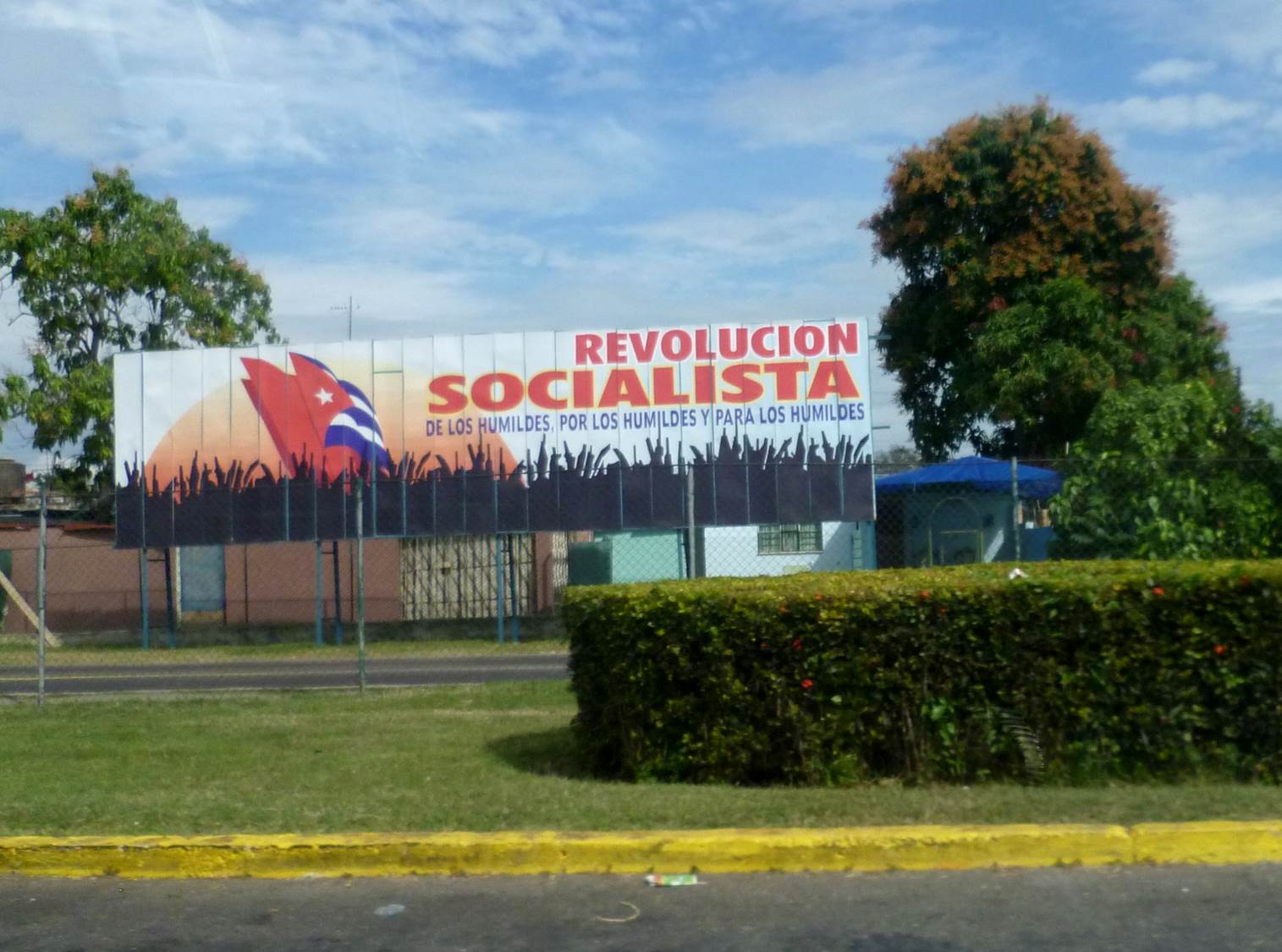
Cuban President Raúl Castro is undoubtedly as serious about normalizing diplomatic ties as President Barack Obama is, but the island’s government arguably faces more pressing challenges than working out the details of a rapprochement with Washington.  Commentators have observed that after the initial euphoria following the December 17 announcement, officials now speak of a long road ahead.  Full normalization, while welcome, is not the foremost concern of Cuban policymakers.  The paramount objective of Cuban authorities is the survival of the revolution and the one-party state that it engendered.  Top diplomats reiterated on January 23, after the first round of talks in Havana, that there will be no concessions to continued American insistence on changes in Cuba’s domestic political arrangements.

Economic revitalization is imperative.  Despite the reforms introduced by Castro, the Cuban economy remains woefully unproductive, incapable of meeting the needs of its citizenry or generating the foreign exchange that any small island developing state requires to import goods that it cannot produce domestically.  Growth rates are anemic, reaching only 1.3 percent in 2014, and independent projections call into question last month’s official announcements predicting 4 percent expansion during 2015.  Agriculture remains stagnant despite reforms aimed at putting fallow lands to productive use, so imports of food account for $2 billion in the extremely tight state budget put forth for 2015.  The severe shortage of cash, moreover, impedes public investment in Cuba’s crumbling infrastructure, which hinders autonomous producers from securing vital inputs for their businesses or distributing what they produce.  Ideally, foreign investment would supply resources where domestic sources cannot, but for the most part this is not happening either.  A 2013 foreign investment law has to date yielded little fresh capital:  European and other investors with experience on the island explain privately that the conditions for conducting business are such that they are reluctant to commit good money after bad.  The new changes in U.S. regulations may produce some increase in investment flows – primarily in the form of remittances from Cuban Americans to families and friends – and thus continue to provide some economic oxygen, but the likely scale of these flows should not be overestimated.  Washington’s new regulations seem likely to continue blocking investments that could increase the Cuban state’s ability to develop the infrastructure necessary to promote economic growth.

Because the intertwined goals of state security and economic revitalization are paramount, Havana’s engagement with the United States will be conditioned on its compatibility with those objectives.  Critics of the American opening who lambast Barack Obama for acceding to a deal with minimal Cuban concessions are right that Havana did not abandon its position that its political system is non-negotiable.  If by joining the rest of the western hemisphere in acknowledging the Cuban state Washington embarks on a path that will fuel economic activity in Cuba, the two countries will proceed, however gradually, away from confrontation.  The trajectory of U.S. relations with China and Vietnam in recent decades offers an instructive precedent for how this can be achieved and be mutually beneficial.  But if the Americans perceive greater engagement with Cuba as a tool for regime change, or strive to limit financial flows exclusively to private actors, their Cuban counterparts naturally will limit the scope of interaction.  A new round of State Department solicitations for bids to conduct democracy promotion activities in Cuba, like the U.S. negotiators’ insistence last week on getting a photo-op with dissidents before heading back to Washington, suggest that this message has yet to be absorbed by American officials.

January 26, 2015

Will Washington’s Attention to Latin America Last?

By Fulton Armstrong

Photo Credit: Prensa Presidencial Venezuela

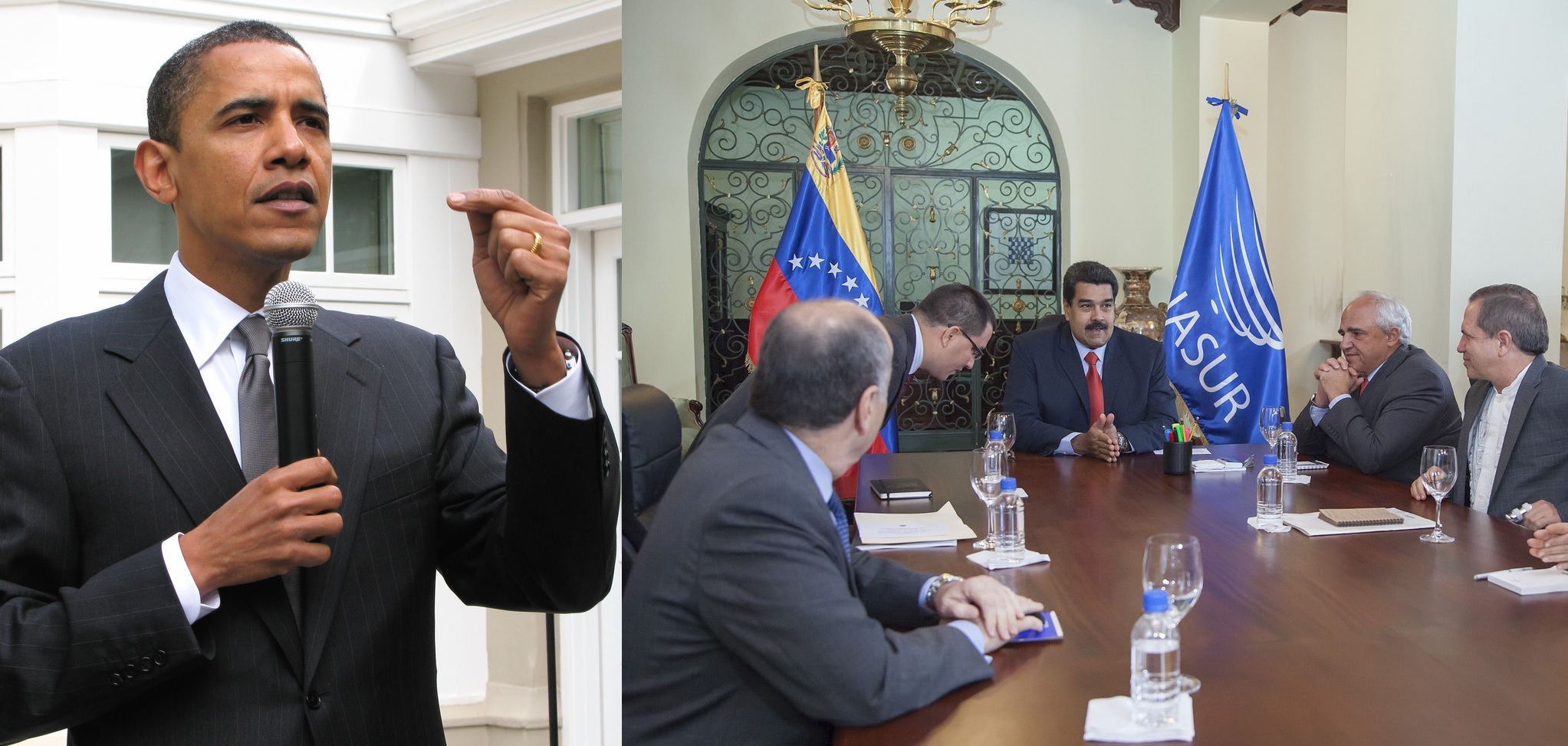
Vice President Biden meets with Venezuelan President Maduro / Photo Credit: Prensa Presidencial Venezuela

U.S. President Obama, Vice President Biden, and Secretary of State Kerry gave Latin America increased priority in 2014, including at least two efforts to open channels to countries previously off their calling lists.  Issues combining domestic politics and foreign policy– such as immigration, Cuba, and drug policy – saw noteworthy breakthroughs.

  • President Obama’s highest profile action was his announcement in December that the United States and Cuba would normalize relations. He said he would travel to Panama in April for the Summit of the Americas – the venue of his pledge to seek a “new beginning” with Cuba in 2009 and his isolation over the Cuba issue in 2012.  Last May, his trip to Mexico and Costa Rica, where he met with Central American presidents, signaled a shift on counternarcotics strategy – downplaying militarized efforts – in response to the region’s concerns about surging violence.  His November announcement of executive measures on immigration, offering temporary legal status to millions of undocumented migrants, also steeped him in Latin America policy.
  • Vice President Biden greatly expanded his Latin America portfolio, at times as stand-in for Obama but also putting a deep imprint on policy. On an extended trip in June, he met with heads of state during the World Cup and attended a summit in Central America.  In November he participated in a followup meeting with the Honduran, Salvadoran, and Guatemalan Presidents hosted by the Inter-American Development Bank, where he announced U.S. measures to prevent another crisis involving migrant children as was seen last summer.  He met with and telephoned Latin American Presidents more than a dozen times over the year and, on the margins of Brazilian President Rousseff’s reinauguration last week, even met with Venezuelan President Maduro, with whom he agreed that it was time to restore ties.
  • Secretary Kerry traveled to the region several times – to Mexico, Panama, Peru, and Colombia – and met with Latin American Presidents and foreign ministers in Washington. Some critics judged his broad policy speeches as unexciting, but he clearly has confidence in his Latin America team, and sources say his support for the President’s initiative on Cuba was strong.

We Latin America watchers in Washington tend to complain that our region doesn’t get enough attention, but it’s clear that the Administration’s level of engagement in 2014 was deeper and more sustained than in years past.  Senior advisors at the National Security Council, Vice President’s office, and State Department – Ricardo Zúñiga, Juan González, and Assistant Secretary Roberta Jacobson, respectively – got their bosses’ to act despite the many competing demands in other regions occupying the front pages of U.S. newspapers.  Several ongoing processes promise continued senior-level attention in at least the first half of the new year.  The normalization process with Cuba could entail a visit there by Secretary Kerry, and preparations for the Summit of the Americas in Panama in April afford opportunities to give momentum to U.S. engagement – in addition to rebuilding U.S. credibility in the Summit process lost at the Summit in Cartagena in 2012.  Continued political crisis in Venezuela, nose-diving oil prices, progress in the Colombian peace talks, and the ever-evolving drug threat suggest 2015 will also be a challenging year.  For now at least, Washington’s senior team is engaged.

January 7, 2015

U.S.-Cuba: Rhetoric and Reality

By Fulton Armstrong

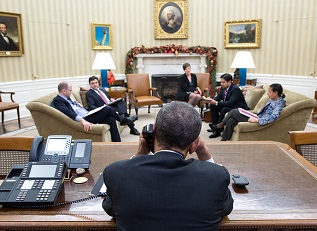
Obama speaks to Raul Castro / Official White House Photo by Pete Souza / Public Domain

Obama speaks to Raul Castro / Official White House Photo by Pete Souza / Public Domain

The decision by Presidents Obama and Castro to normalize relations is truly historic – for which they and their advisors deserve enthusiastic applause – even though both leaders’ rhetoric seems intended to suggest that they don’t know how deep the uncharted waters ahead run.  Their statements since last Wednesday sound solicitousness toward their right flanks.  President Obama launched his statement by proclaiming that the United States of America is changing its relationship with “the people of Cuba” and, while conceding that past strategies to “push Cuba toward collapse” have failed, cast his new policy as a better way of helping the Cuban people “enjoy lasting transformation.”  President Castro told the National Assembly this last weekend that he wasn’t jettisoning Cuba’s revolutionary project either.  Cuba is not going to give up, he said, “the ideas for which it has fought for more than a century and for which its people have spilled much blood and gone through the greatest risks.”

It’s true that the nature of the relationship is unlikely to change fast, and that neither President can ignore the legal strictures built up during 54 years of tensions.  Obama can’t lift the embargo and permit, for example, tourist travel without Congressional approval.  Cuba’s “Law 88 for the Protection of National Independence and the Economy of Cuba” remains on the books, and Castro’s not about to welcome the U.S. Government’s “democracy promotion” activities soon.  But normalization will significantly reduce both governments’ ability to restrain nongovernmental contacts and will unleash forces that will make the Presidents’ rhetoric look old-fashioned and unnecessary.  Both countries have to learn how to talk to each other, and time-tested people-to-people contacts show that citizens with shared interests are better than governments at learning the language of cooperation and problem-resolution – without ideological agendas.  It stands to reason that pressure will grow on Obama and Castro to pursue concrete interests, especially trade, and to manage their dreams, respectively, of “lasting transformation” and “updated communism.”

No model for this new bilateral dance is perfect.  China and Vietnam show that trade-driven economic change – even with U.S. most-favored-nation status – doesn’t necessarily drive a country to democracy.  An educated and healthy people with strategic needs, the Cubans are prepared to work hard to build their country, but they’re not going to work in factories with anti-suicide nets under the dormitory windows.  That sort of political awareness argues for change, but the Cuban revolution implanted in the Cuban psyche a certain set of values and expectations – ranging from social programs to an almost obsessive sense of dignity – that won’t always coincide with U.S. values.  The Cubans will want to go a la carte with us on political matters, and they, like every country of Asia and Latin America emerging from difficult times, will almost certainly expect us to give them the space to do change their own way.  The United States worked with Mexico under one-party rule for 70 years last century.  If Washington and Havana approach the challenge of building a healthy relationship with respect and open minds, they should able to find a middle ground and grow together a lot faster than that.

December 22, 2014

U.S. Sanctions on Venezuela: To What End?

By Michael M. McCarthy

Common Cause -Embassy of Venezuela DC / Flickr / CC BY-NC 2.0

President Obama plans to sign the “Venezuela Defense of Democracy and Civil Society Act” into law, but its lack of clear objectives seems likely to muddle Washington’s desired outcome.  The bill, approved last week by voice vote in the Senate and House, calls for punishing Venezuelan government officials involved in human rights abuses, an authority the White House already has.  It includes national security waivers that allow the President final say on which officials will have their visas revoked – denying them entry into the United States – and have any U.S. assets they own frozen.  After initially voicing skepticism about the wisdom of such measures, the Obama administration came around to supporting them.  Senators Robert Menendez and Marco Rubio and Congresswoman Ileana Ros-Lehtinen pushed the bill hard in May after episodes of violent suppression of anti-government street demonstrations painted a grim picture of the human rights situation.  The Venezuelan foreign ministry’s reaction to the legislation has been strident, and President Maduro said, “If the crazy path of sanctions is imposed, President Obama, I think you’re going to come out looking very bad.”

President Obama wasn’t alone in switching positions over the bill.  Senator Bob Corker, who’s expected to become chairman of the Senate Foreign Relations Committee in the new Congress that begins next month, had embraced the State Department’s earlier view that sanctions would undermine international talks engineered by UNASUR and the Vatican.  The Caracas government’s refusal to make concessions in the talks undermined that argument, however, and a three-way diplomatic dustup between the U.S., Aruba, and Venezuela over another issue – Aruba’s refusal to extradite Venezuela’s designated ambassador, a former Venezuelan army official, to the United States on narco-trafficking charges – further frustrated Washington players.  Corker asserted that the incident showed that Venezuela’s “complicity with criminal activity” could not go unchecked since it directly undermined U.S. interests.  Immediately after the extradition episode, the Obama administration imposed unilateral sanctions – travel and visa bans – on a dozen unnamed Venezuelan officials, laying the groundwork for Menendez and Rubio to reintroduce their legislation and drive it home before Congress adjourned for the holidays.  Corker endorsed the bill, although he highlighted that a “regional dialogue” remained the best option for finding a “negotiated, democratic way forward” to address human rights issues.

Other than punishing reported human rights offenders and making an example of them the new bill is unclear on how it could help resolve the deep political crisis that has given rise to the protests and subsequent abuses.  With Maduros popularity plummeting to new lows, strident rhetoric condemning U.S. intervention could give him a modest boost by bolstering his claim that Washington is part of an economic war against Venezuela.  It is far too early to tell whether that nationalistic narrative will work in the governments favor as the countrys dire shortages have become permanent and economic suffering is increasingly blamed on Maduros policies and declining oil prices.  If human rights really are the U.S. top concern, Washington might want to be more sensitive to the positions of PROVEA and other Venezuelan human rights groups, which have denounced the legislation despite its inclusion of funding for Venezuelan civil society groups. If punishing rights abusers is Washingtons way of pressing for sustainable change in Venezuela, then it needs to state the case that penalizing measures imposed since 2008 have made a difference.  Another option, contained in Senator Corker’s observation about a “negotiated, democratic way forward,” could be to renew support for talks sponsored by South American countries, as these are more likely to reduce tensions, improve rights, and give moderates space to promote electoral solutions.

December 18, 2014

Statements by Eric Hershberg and William LeoGrande on Release of Alan Gross – UPDATED

Havana, Cuba
December 17, 2014, 12:30 p.m.

President Obama’s statement pledging to move forward expeditiously toward full normalization of relations between the United States and Cuba constitutes a welcome and long overdue reversal of policies that have long worked to the detriment of both countries.  Initial steps carried out today, including a prisoner exchange and the release of government contractor Alan Gross, imprisoned in Cuba five years ago for clandestinely distributing high technology communications equipment in Cuba under a USAID program intended to destabilize the Cuban government, mark the beginning of a process that must move forward rapidly during the weeks and months ahead. Pledges to re-open embassies in both countries and to curtail restrictions associated with the half century-old U.S. embargo portend an accelerated process which can be facilitated by prompt Congressional action to abolish provisions of the embargo that were codified into law by the Helms-Burton Act.  In the meantime, the administration can take numerous actions unilaterally, as noted today by the White House.  It must remove Cuba from its list of state sponsors of terrorism, lift licensing restrictions on travel to Cuba by U.S. citizens, abolish constraints on U.S. investment in Cuban private enterprises and cooperatives, and cease covert USAID programs aimed at destabilizing the Cuban political system. Washington should also signal its commitment not to block Cuba’s engagement with international financial institutions, which Cuba may wish to engage to facilitate the success of the country’s ongoing economic reforms. Today’s announcements from the White House mark a fresh start for bilateral relations, which will benefit the peoples of the United States and Cuba alike, and they afford an opportunity for the United States to make good on its stated commitment to open a new era of equal partnership and mutual respect in its relations with all countries of Latin America.

Eric Hershberg

This is a historic development in US-Cuban relations, and hopefully a step toward full normalization of relations. Obama’s actions represent the most positive actions to improve relations since President Carter. This will assure that the Summit of the Americas will be a success and this move will be applauded by governments throughout Latin America and beyond.

William LeoGrande

About the American University-Center for Latin American & Latino Studies (CLALS) Cuba Initiative:

CLALS is proud of the contributions of all schools at American University and of our research fellows in promoting normalization of relations between the United States and Cuba.  Faculty at each and every one of AU’s Schools and Colleges as well as its Center for Latin American & Latino Studies have published countless books, articles, op-ed pieces, and blogposts shedding light on the relationship and demonstrating the U.S. national interest in better relations with Cuba.  AU experts have worked tirelessly to underscore the costs of Washington’s anachronistic policies toward Cuba; inform journalists and policy-makers of opportunities for normalizing relations; lead path-breaking student and faculty exchange programs linking the university with counterpart institutions in Cuba; and participated in dozens of high level dialogues connecting leading Cuban researchers and policy advisors with AU faculty and foreign policy experts from the United States.

Executive Under-Reach: Migrants on the Margins of Reform

By Eric Hershberg and Dennis Stinchcomb

UAC SPONSOR PLACEMENT updated post-report-01

Graphic courtesy of the Center for Latin American & Latino Studies (CLALS)

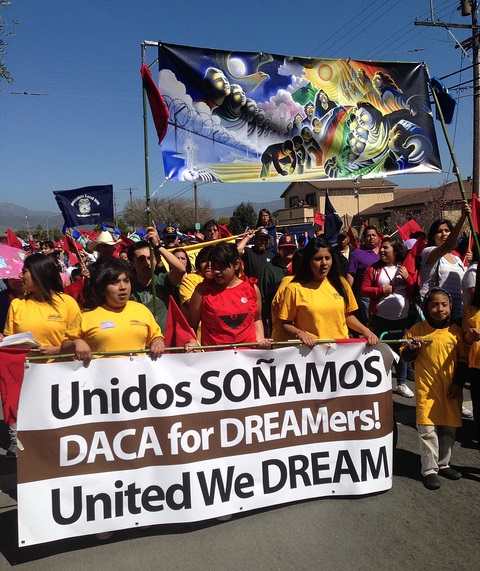
President Obama’s long-awaited executive action on immigration has finally happened – with the anticipated political fireworks – and will benefit more than one third of the country’s undocumented persons. It is premature to offer predictions regarding how the dynamic will play out between a White House wounded by electoral losses last month and an emboldened Congressional opposition.  We can, however, take stock of who the administration’s measures have and have not affected.  Between 4 and 5 million people, a majority of them originally from Mexico, will be able to apply for work permits and secure protection from deportation for three years if they have been in the U.S. for five years or longer and have children who are either U.S. citizens or authorized residents.

The executive action is no modest change in policy, but it contains little good news for large numbers of undocumented persons and no good news for those his administration has already deported.  For the 250,000 U.S. citizen children whose parents have been deported over the past six years, it provides no comfort; there is no provision for the parents to return to raise their kids here.  Nor did the President’s measures offer more permanent relief to the roughly 280,000 Central Americans who have resided in the U.S. with Temporary Protected Status (TPS) following natural disasters in the region during the late 1990s and early 2000s.  Beneficiaries of those provisions will continue to pay roughly $500 every 12-18 months to renew their status. Other populations who have been here for well over a decade as stable members of the community also remain unaffected by the reforms.  No matter how long they have been here nor how good they have been – law-abiding, tax paying, churchgoing or generally nice – they will not be eligible for relief if they do not have children.  The administration’s action was strictly cast as a family-focused initiative, and family, in this instance, means children with authorization to be in the U.S.  Spouses do not count.  An important new population of migrants was also left out of the reform: the unaccompanied children, largely from violence-torn countries of Central America’s Northern Triangle, whose surge across the border received great media attention during the summer of 2014. Indeed, the president’s speech to the nation made no mention of that humanitarian crisis and made clear that those who come across now should expect to be deported.

The 68,000 children who trudged across the border during this fiscal year remain in limbo.  According to data from the Department of Health and Human Services’ Office of Refugee Resettlement, over 55,000 have been placed with immediate or extended-family sponsors in the U.S while their removal cases are pending in immigration court.  Metropolitan areas with long-established Central American communities have witnessed the largest influx of unaccompanied children.  The Baltimore-Washington metropolitan area alone, for example, received approximately 6,500 unaccompanied minors during the past fiscal year.  Once placed in sponsor care, these kids’ prospects for remaining in the U.S. – and their well-being while awaiting a court decision – are largely dependent upon local-level policies.  While the Obama administration has taken limited steps in recent months to provide legal counsel for these minors, funding for direct legal representation and a range of other educational, health, and social services is increasingly coming from those state and local governments that traditionally support immigrant-friendly humanitarian programs. This support is crucial, as demonstrated by a Syracuse University study that found that 85 percent of unaccompanied children appearing in court without an attorney are ordered to leave the U.S.; with an attorney, however, a child’s odds of remaining in the U.S. increase from 15 to 73 percent.   In cities such as New York, local funds are also being channeled through advocacy networks to support access to services beyond the courtroom, from mental health screenings, to vaccinations, to assistance with school enrollment.  Other local communities may not follow suit, particularly in the wake of the newly announced executive action, which in the short-term will strain the already taxed resources of local governments and advocacy groups.

December 11, 2014

Executive Action, Central American Presidents and the Fate of the Unaccompanied Minors

By Eric Hershberg

Image courtesy of Center for Latin American and Latino Studies

Image courtesy of Center for Latin American and Latino Studies

Speculation abounds in Washington as to the content of the long-awaited Executive Actions that the Obama administration has promised to decree amidst the failure of Congress to enact comprehensive immigration reform.  Having resisted pressure from Latino constituents and immigrant rights advocates to act before the mid-term election, in a vain effort to protect vulnerable Democratic incumbent Senators who lost their bids for re-election anyway, the administration now seems poised to announce new measures as early as the end of this week.  Press accounts based on leaks from within the Executive Branch speculate that as many as five or six million undocumented migrants may see their vulnerability to deportation diminish as a result of the impending policy changes.  Barack Obama’s Republican antagonists are fulminating about the consequences if he makes good on his promise, with some pondering ways to shut down the government or impeach the President, and others, fearful that a particularly intemperate response could damage the Republican brand, particularly given the need to attract at least a third of the Latino vote to the candidacy of whomever is chosen as the 2016 GOP presidential candidate, allude to the likelihood of court challenges to what they deem an extreme instance of Executive overreach.

One unanticipated but welcome measure that has been announced publically is that children deemed vulnerable to the violence in the three Northern Triangle countries of Central America will be able to apply to be reunited with parents residing legally in the U.S.  This policy shift, announced during the visit to Washington last week by Presidents Otto Pérez Molina, Salvador Sánchez Ceren and Juan Orlando Hernández, is among the administration’s responses to the surge of unaccompanied minors and families across the U.S.-Mexico border over the past year or so: 68,000 unaccompanied children were detained at the border during Fiscal Year 2014.  For their part, together with Vice President Joseph Biden at the Inter-American Development Bank, on November 14 the three Central American Presidents pledged to launch an Alliance for Prosperity in the Northern Triangle, with the objective of overcoming the conditions of economic misery, social vulnerability and institutional deficiencies that propelled the wave of migration of recent years and that have the potential to motivate a renewed flow of arrivals.  Biden offered an enthusiastic endorsement, but aside from reminding those in attendance that the administration had requested $3.7 billion from the Congress in response to last summer’s “crisis,” he did not offer specific commitments of resources, which of course are unlikely to be forthcoming from the strong Republican majorities in both chambers of Congress.  Nor did the Presidents make tangible commitments to build states capable of protecting the basic rights to life chances and security that are so remarkably absent for many of their countries’ inhabitants.

Assessing the likelihood of continued surges in migration requires understanding the factors that propelled the flow of people across the border in recent years.  A newly released study* by the Center for Latin American and Latino Studies, funded by the Ford Foundation, provides essential data and analysis on the drivers of migration from El Salvador, Guatemala and Honduras and on the fate of children and families who have arrived in the U.S. from those countries over the past year.  A core message of the report is that the absence of fundamental pre-conditions for living their lives with dignity – education, jobs, and most of all protection from violence – compels people to migrate rather than seek to better their lot in their communities of origin.  In the long run, only dramatic reforms undertaken by Central American states will build the institutions needed to address the basic needs of their populations and to provide the minimal levels of security needed for them to live their lives in dignity at home.  Perhaps little that was agreed upon during the Presidents’ visit to Washington gives cause for great optimism, but it is our hope that the CLALS study points the way toward solutions to the region’s crisis and toward ensuring the protection of those who endured the perilous journey to the U.S. border and now find themselves in limbo in the U.S.

 *To download a free copy of the full report, click here.

November 19, 2014

U.S. Elections: Latino Vote Not Decisive

By Eric Hershberg and Fulton Armstrong

Rob Boudon / Flickr / CC BY-NC 2.0

Rob Boudon / Flickr / CC BY-NC 2.0

Preliminary estimates indicate that Latino voter participation and support for Democratic Party candidates on Tuesday were similar to the 2010 mid-terms – but not enough to overcome the Republicans’ gains across the broader population.  Before Tuesday, Latino observers were excited that 1.2 million Latinos had registered to vote since the last mid-term elections (2010) and, with an estimated 66,000 American Latinos turning 18 each day, they would have some new clout.  Latino Decisions, the leading polling organization focused on Latinos, found that two-thirds of Latino voters in Texas supported Democrats in House races on Tuesday, and 74 percent in Georgia supported Democrats.  Their broader impact as a bloc, moreover, is hard to assess because most of the competitive races for the U.S. Senate and House of Representatives were not in states with concentrated Hispanic populations.  Gerrymandering also blunted their impact on House races, and new voter identification laws appear to have discouraged participation as well.  The Dallas Morning News reported last weekend that Texas state officials estimated that the laws would render more than 600,000 registered black and Latino voters unable to cast ballots (without breaking out the size of each group).

Latino Decisions had warned before the elections that enthusiasm for Democratic candidates was 11 percent lower than it was during the general elections two years ago.  Many Latinos were angry that President Obama backed off his plan to use executive authority to begin immigration reform, while at the same time, ironically, they were frustrated that the Democrats saw them as a one-issue constituency and did not include them on other issues.  Indeed, Voto Latino, a voting rights organization, and others have been warning that Latinos care as much or more about the economy, health care, and women’s rights but feel ignored.  (The polls show that Latinos feel even more shut out by the Republicans.)  The great pool of young voting-age Latinos has been “hardest to reach,” according to Voto Latino, because they are busy and turned off by the stereotyping.  The Democrats also seem to have communicated priorities poorly.  Colorado Senator Mark Udall played up his support for comprehensive immigration reform, but Latino Decisions says only 46 percent of Latino voters there knew it.  On the other hand, Nevada Governor-elect Brian Sandoval – a Republican – attracted Latino voters with a platform emphasizing Medicaid expansion, English-learning education initiatives, while downplaying his party’s rhetoric on immigration.

The margin of Republican victory was wide enough that even high Latino turnout wouldn’t have flipped the outcome in places like Colorado, North Carolina, and Georgia.  Tuesday’s results notwithstanding, however, polls by Latino Decisions and other research indicate that the Latino voice at the polls will grow and, when mobilized, be potentially decisive.  Despite strains with the Democrats, it’s hard to see Latinos jumping to the Republican Party unless it significantly shifts policies on immigration, social programs, voter-ID laws, and the economy.  It would be unfair to blame President Obama alone for the lack of a Latino surge this year, but his decision to back off on immigration clearly hurt his party badly.  He wanted to take heat off vulnerable Democratic senators but helped neither the candidates nor his party’s ability to mobilize Latinos.  Latino Decision’s data on low enthusiasm and dismay about the delay of executive action mean that if the administration doesn’t take real action soon – and work to build Latinos’ enthusiasm over the course of the next two years – it will diminish prospects for the Democrats to have a big Latino edge in the presidential race in 2016.  With a Republican-controlled Senate, Obama faces the same dilemma as before – to risk the Senate’s wrath by taking executive action on immigration or continue to alienate a key constituency – but the answer should be clearer in view of Tuesday’s results. 

November 7, 2014

Post-Snowden Challenges for U.S. Information and Communication Technology Firms

By Robert Albro

infocux Technologies / Flickr / CC BY

infocux Technologies / Flickr / CC BY

A year after Edward Snowden’s dramatic disclosures about NSA surveillance in Latin America, U.S. companies hoping to make inroads into the region’s fast-growing information and communication technology market are running into increasing obstacles.  If the political costs were immediately forthcoming, especially in Brazil, the fallout for Silicon Valley’s tech giants has taken longer to assess. The biggest problem is the lingering lack of trust resulting from the revelation that the U.S. companies enabled the NSA’s eavesdropping by giving it direct access to their servers.  A 2014 NTT Communications survey found that, in response to the Snowden affair, 88 percent of information and communication technology decision-makers around the world, including Latin America, have changed their buying behavior around large-scale data storage.  In Brazil, Argentina, Mexico and Chile, “data sovereignty” has become a major issue, in the form of new data privacy and disclosure laws now shaping the direction of the region’s developing market.

According to the Information Technology & Innovation Foundation, U.S. software firms are expected to lose $35 billion in sales overseas through 2016. Forrester Research, an independent technology and market research company, puts potential losses as high as $180 billion.  Latin American investors have been questioning the wisdom of using US data storage companies, and established U.S. dominance in the cloud computing sector has already taken a hit. Cisco’s last quarterly earnings, for example, were down 7 percent – 27 percent in Brazil – even as the cloud computing market in Latin America is predicted to grow at a 26 percent clip through 2018.  The emergence of Miami as a major global tech hub and gateway to Latin America’s fast-growing information technology markets is threatened by a proposed EU-Brazil trans-Atlantic cable to circumvent the city as a key node for Latin American access to the global internet.  As investor e-news service 4-Traders has reported, Chinese tech giants like Baidu, Alibaba and Tencent are establishing and expanding beachheads in Latin America, while China’s government pursues cooperative partnerships with Latin American counterparts to accelerate the development of the region’s information infrastructure.  Meanwhile, US-based data mining and analytics firms like Choicepoint Inc., currently major players in the region’s business intelligence and online security markets, have become the subject of investigation by skeptical governments and privacy advocates in the region.

The U.S.-centric view of the internet as “free and open,” a basic feature of the business model of U.S. tech firms, is being challenged in Latin America, where the regulatory balance between free expression and privacy is increasingly tilting toward the latter.  Despite the fact that the region’s online population is the world’s fastest growing and that it boasts a dynamic tech start-up movement, U.S. internet technology firms should expect more such challenges.  Regional trends in internet governance are largely anti-American, focused on displacing U.S. commercial dominance of the internet, and promoting open-source software as alternatives to U.S. products and services.  As Latin America builds out its cloud computing market, it is doing so in ways poised to compete and not collaborate with U.S. companies.  Privacy controls and requirements to conform to local laws already create new and costly disincentives for U.S. companies, which might opt to pull up stakes.  Meanwhile, business models for Latin American start-ups are not copycatting U.S. models as frequently as in the past.  If Latin American entrepreneurs have maintained close ties with U.S. centers of innovation and investors, they are now more focused on developing their own intellectual property, instead of technology transfer, to meet specific demands of their local and regional markets.  What just yesterday seemed wildly improbable – that U.S. tech giants might lose their edge in Latin America – has become a credible scenario.

October 23, 2014

Who Will Attend the OAS Presidential Summit in Panama?

By Fulton Armstrong and Eric Hershberg

OAE-OAS & tgraham / Flickr / Creative Commons Attribution-NonCommercial-ShareAlike 2.0 Generic (CC BY-NC-SA 2.0)

OAE-OAS & tgraham / Flickr / Creative Commons Attribution-NonCommercial-ShareAlike 2.0 Generic (CC BY-NC-SA 2.0)

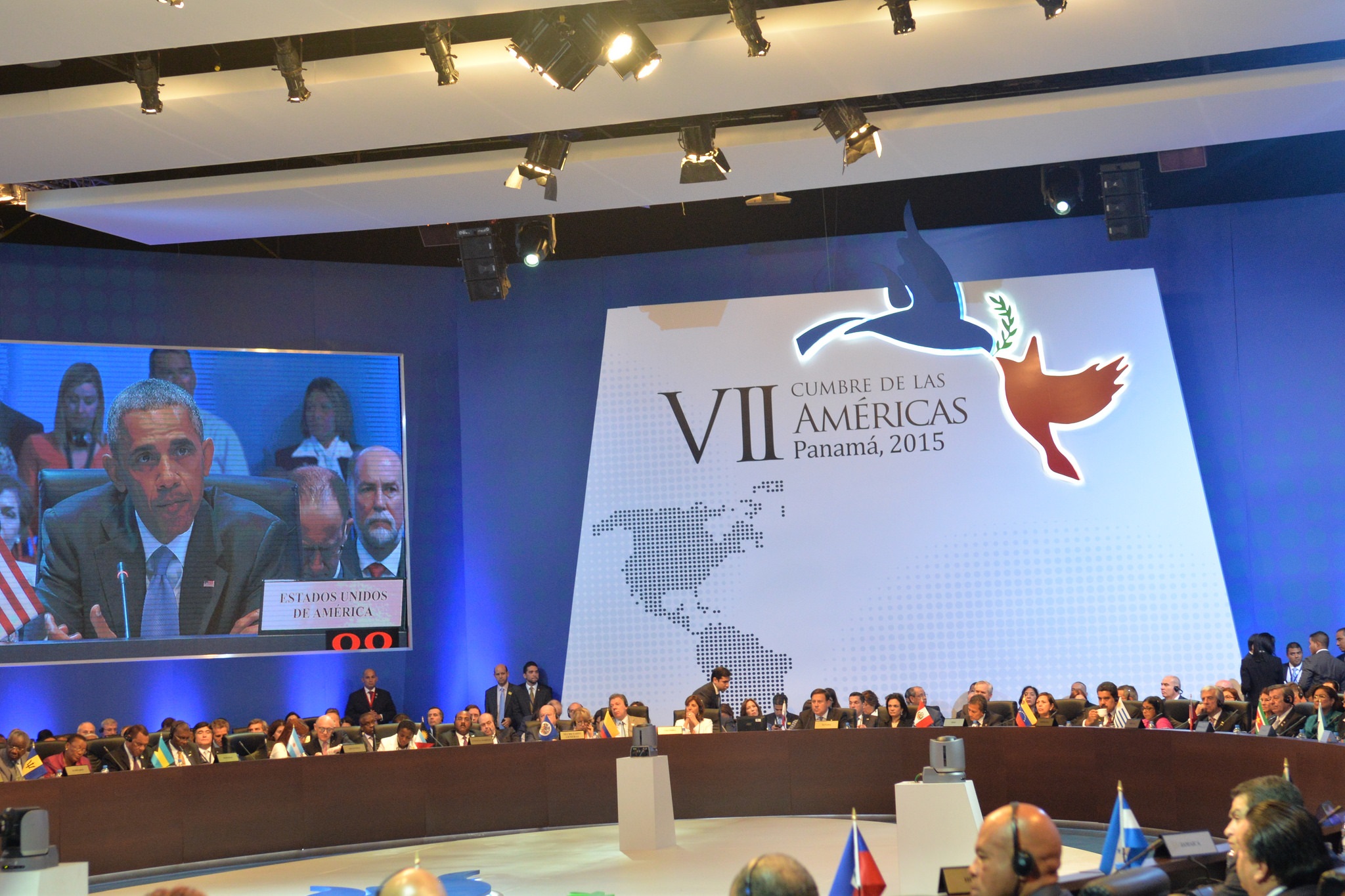
The Summit of the Americas isn’t until next April, but interest in how Panama as host handles near-unanimous pressure from Latin America to invite Cuban President Raúl Castro, and how the United States and Cuba will respond, is growing fast.  Speaking to reporters at the United Nations last week, U.S. Assistant Secretary of State Roberta Jacobson answered several questions on the U.S. position.  Key excerpts follow:

  • Asked “if the United States is still opposed to Cuba attending.”  On the Summit of the Americas, I think we’ve been pretty clear in our position on the summit, which is that obviously Panama is the host country for the summit, and as the host country they will make the decisions on invitations to that summit.  …  And the fact of the matter is we have said from the start that we look forward to a summit that can include a democratic Cuba at the table.  We also have said that the summit process, ever since Quebec in 2001, has made a commitment to democracy, and we think that’s an important part of the summit process.  But the decision about invitations is not ours to make, and obviously there’s been no invitations formally issued to the United States and other countries. And so there is no acceptance or rejection yet called for or made. …
  • Asked “is there a chance that the U.S. might refuse going.”  Again, I think you won’t be surprised to hear me say that we’re really not going to answer hypotheticals in the future yet.  Obviously, the Summit of the Americas is in April and that’s not a situation that we can answer, although I think we have made clear that we believe the summit process is committed to democratic governance and we think that the governments that are sitting at that table ought to be committed to the summit principles, which include democratic governance. And therefore that’s our position at this point.  Obviously, we have a position on Cuba which does not at this point see them as upholding those principles.

Panama’s likely invitation to Cuba – reflecting the consensus of 32 hemispheric nations at the last Summit – will draw protests from official quarters in Washington.  But it’s far from certain that the Obama Administration would risk blame for torpedoing the 20-year Summit process.  Obama survived a handshake with Raúl Castro at Nelson Mandela’s funeral last December, and being in the same room with him again as a President in the second half of his second term will have little political consequence.  A workshop in Mexico City in June, in which CLALS researchers participated, and another in Ottawa in September, sponsored by the Center and the University of Ottawa, explored likely outcomes.  Mexican international relations specialists speculated that a reasonable outcome was for the United States to show up like a polite guest, and thus avoid having the anachronism of U.S. antagonism toward Cuba overshadow its broader relations with Latin America.  Canadian experts were deeply concerned that Cuba’s inclusion might undermine the centrality to the OAS of the Inter-American Democratic Charter, but they agreed that failure to convene a Summit would constitute a serious blow to the OAS and to the regular summits that provide Canada a seat at the inter-governmental table.

The reality is that Cuba does not conform to the Democratic Charter or to the broader OAS criteria of democratic rule, but equally real is that Latin America sees Cuba as a full member of the hemisphere and has lost all patience with those in Washington who would deny that.  Either Washington — and Ottawa — set aside their objections to Cuba’s inclusion or they bid farewell to such fora and their constructive impact on regional relationships that ought to matter to them.  Moreover, if they acquiesce to Cuban participation but then try to commandeer the agenda and make the Summit a seminar on democracy and human rights, it will only reinforce the widespread sense in the region that Washington cannot move beyond its obsession with the trivial matter of Cuba and get on with a serious conversation among equal partners.  They would thus sacrifice an opportunity to discuss issues on which significant, substantive advances are possible through dialogue among leaders of countries throughout the hemisphere.  The value of the Summit rests with the capacity of all involved to act like grownups.  President Obama did so at Mandela’s funeral, and it will be telling whether he can do it again in Panama this coming April.

October 2, 2014