Can the Republicans Close Their Gap with Latinos?

By Eric Hershberg and Robert Albro

Photo credits: Iprimages, Michael Vadon, Gage Skidmore / Flickr / Creative Commons

Photo credits: Iprimages, Michael Vadon, Gage Skidmore / Flickr / Creative Commons

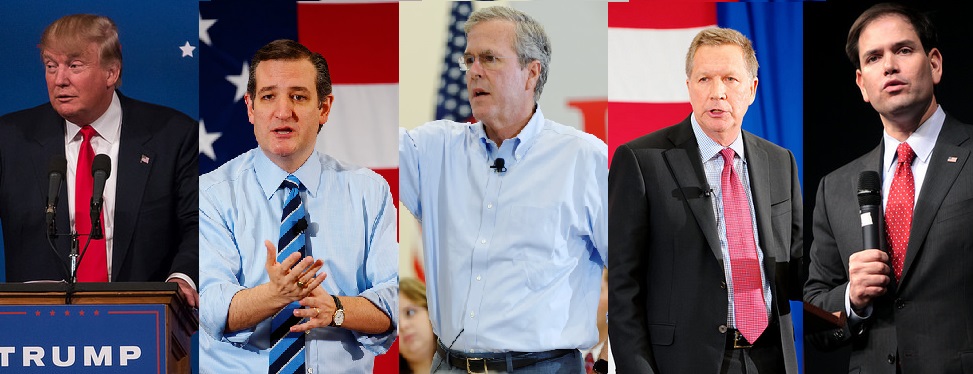
Remarks about immigration made by flamboyant New York billionaire and aspiring presidential candidate Donald Trump have embarrassed many Republicans – and angered many Latinos – but also opened the way for several of his competitors to appear more moderate on the issue.  Echoing comments he made in a televised debate on 6 August, Trump on Sunday issued a policy paper claiming, “For many years, Mexico’s leaders have been … using illegal immigration to export the crime and poverty in their own country (as well as in other Latin American countries).”  He demands that Mexico pay for an impenetrable wall along the border and that Washington deport many migrants, beef up border patrols and narrow opportunities for legal immigration.  Although Trump has often claimed he could win the Latino vote, a poll by Huffington Post/YouGov in June found that 82 percent of Latinos don’t take Trump seriously as a candidate, and subsequent surveys indicate that his rhetoric has damaged the Republicans’ image among them.  (Other polls indicate that Democrats’ immigration proposals, in contrast, have the support of some 60 percent of Latinos.)  The views of the country’s fastest-growing demographic group are significant when considering their prominence in “swing” states such as Florida (24 percent of the population and 14.6 of registered voters), Colorado (21 and 14.2), Nevada (27 and 16) and Virginia (8 and 5).

Most of the 15 other major Republican candidates have tried to ignore Trump’s remarks and the immigration issue overall.  Texas Senator Ted Cruz said he “salutes” Trump and, eschewing “Republican-on-Republican violence,” refused to criticize his views.  But two others – former Florida governor Jeb Bush and Ohio governor John Kasich – have staked out somewhat more moderate positions.

  • Bush stresses the need for more aggressive border enforcement and a crackdown on undocumented residents of “sanctuary cities,” but he also called for an immigration policy that included “documented status” – but not citizenship – for an unspecified number of them. Having a Mexican-born wife and mixed-race children also sets him apart.
  • Kasich last week noted that undocumented migrants are “people who are contributing significantly” to the United States. He said, “A lot of these people who are here are some of the hardest-working, God-fearing, family-oriented people you can ever meet,” and he said he favors a pathway to legal status for people already in the country, adding that such provisions could be part of an immigration reform package.
  • Florida Senator Marco Rubio, who was ostracized by his Republican colleagues in 2013 for proposing reforms along the same lines, has appeared reluctant to criticize Trump, Bush or Kasich – making him possibly the biggest loser on the issue for now.

The elections are still 14 months off, and electoral dynamics change.  Latinos don’t figure in the Republican primaries, and it’s too early to speculate how their voices will play until next year – at which point Donald Trump probably will be seeking celebrity through other endeavors.  Republican strategists have already said that their candidates won’t try hard to court Latinos – and risk alienating the roughly 20 percent of their base in swing states who hold hard-core anti-immigration positions.  Nonetheless, Bush and Kasich’s rhetoric, while still vague on actual policies, may give the party a chance to claim to Latinos that not all Republicans are out to get them.  No Republican on the front line today appears likely to attract majority support among Latinos, but a moderate-sounding approach to immigration could take the rough edges off the party’s image, reduce Latino opposition to it and diminish the issue as a Democratic Party advantage.

August 18, 2015

The Untold Story of Manuel Contreras and the CIA

By John Dinges*

The man who designed and executed the massive human rights crimes of Chile’s military regime died last week.  Manuel Contreras remained a general in Chile’s Army even during the last 20 years in prison, with accumulated sentences of more than 500 years imposed by Chilean courts.  In the United States, his murky relationship with the CIA and masterminding of a shocking terrorist attack in Washington, dominate perceptions of his record.  Contreras, a nondescript, somewhat pudgy man who never tired of boasting about the effectiveness of his anti-subversive campaign, created a security police apparatus, DINA, independent of Chile’s military hierarchy.  He reported only to General Augusto Pinochet, with whom he met early each morning.  DINA was responsible for about half of the 3,200 killed by the Chilean military, and virtually all of the cases of desaparecidos – people detained, tortured and killed in secret interrogation centers, whose bodies were then disposed of in secret graves or dumped into the sea.

Chile was not the most brutal military dictatorship – more than 10,000 Argentines and 200,000 Guatemalans died during that era – but Contreras and Pinochet became the international face of Latin American state terrorism of the 1970s, for various reasons, including their intimate relationship with the United States and in particular with the U.S. Central Intelligence Agency.  It is not quite true that the CIA organized the military overthrow in 1973 of socialist president Salvador Allende, but the U.S. embrace of the violent coup was enough to create the widely accepted narrative that the United States brought Pinochet to power and made him a creature of its anti-communist foreign policy, whose global architect was Henry Kissinger.  In addition to ruthlessly persecuting political opponents in Chile, DINA carried out a spectacular act of international terrorism in the heart of Washington, D.C. – the 1976 car bomb assassination of Allende’s former foreign minister Orlando Letelier, in a blast that also killed an American woman, Ronni Moffitt, and wounded her husband Michael.

Some were quick to see the hand of the CIA in that horrendous crime, a charge that is repeated even today among some writers in Latin America.  But these writers may not be aware that Contreras actually promoted the idea of CIA involvement in Chile as a way to mask DINA’s crimes.  Here, briefly, is what Contreras did to point the finger at the CIA:

  • Contreras was the first to reveal, in an interview, that the CIA had sent intelligence trainers to Chile to help in the formation of DINA, a fact belatedly confirmed by the CIA to a Congressional investigation.
  • As his chief international assassin, Contreras hired Michael Townley, a U.S. citizen who had tried to join the CIA as a clandestine agent – a fact unquestionably known to Contreras and now well established in U.S. declassified documents.
  • Contreras developed a close operational relationship with the CIA, agreeing to provide intelligence in exchange for payment.  He is known to have traveled to the United States to consult with top CIA officials at least five times, including with CIA deputy director Vernon Walters in August 1975 – after which he went on to Caracas to lay out his plans for an international assassination alliance, Operation Condor.  Whether Contreras briefed Walters on the assassination plans is buried in CIA secrecy.
  • Contreras used Operation Condor to obtain false documents for Townley and another DINA agent to use in the first phase of the Letelier assassination.  With the plot under way, in July 1976, he visited Walters again.  Whatever the nature of those conversations (the declassified record is vague), Contreras was again associating himself with the CIA in relation to the impending murder.

When charged with killing Letelier, Contreras pulled out this defense: that the CIA had infiltrated DINA to commit crimes for its own purposes, that Michael Townley was really taking his orders from the CIA, and that the CIA, not DINA, killed Letelier in Washington. That version of events is false, according to my investigations.  Nonetheless, the charge of CIA involvement in Operation Condor and Letelier’s murder has become a kind of dogma, both on the right and the left.  It can be found in the writings of some U.S. academics and is extremely common in narratives of the period in Latin America.  Although there is no direct evidence for the charge, the history of CIA intervention, complicity in human rights violations and defense of military dictatorships is enough to convince many people that it must be true.  Few of those who believe it are aware they are making common cause with General Contreras, perhaps the most emblematic human rights criminal in Latin America.

August 12, 2015

*John Dinges teaches journalism at Columbia University.  He sorts out the documented, fact-based truth about the U.S. role in “The Condor Years: How Pinochet and his Allies Brought Terrorism to Three Continents” (The New Press 2004).

U.S.-Cuba Diplomatic Ties: Beyond Symbolism

By William M. LeoGrande*

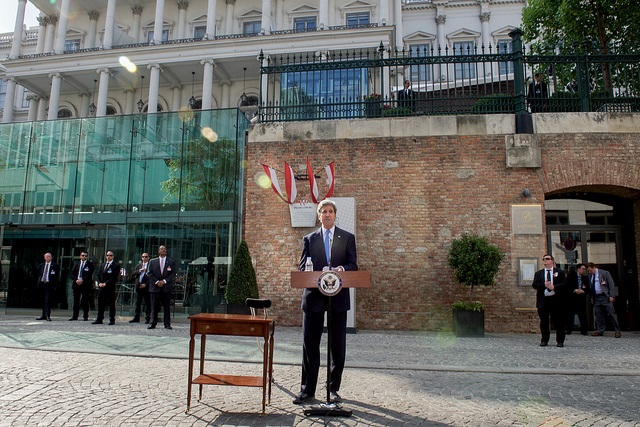
U.S. Secretary of State John Kerry delivers a statement to the international media after President Obama announced plans to re-open a U.S. Embassy in Cuba. Photo Credit: U.S. Government / Public Domain

U.S. Secretary of State John Kerry delivers a statement to the international media after President Obama announced plans to re-open a U.S. Embassy in Cuba. Photo Credit: U.S. Government / Public Domain

The reopening of embassies in Washington and Havana is symbolic of the change in U.S. policy that President Obama announced last December 17—replacing the hostility and subversion dating back to the break in diplomatic relations 54 years ago with engagement and cooperation.  As he declared on July 1, “This is what change looks like.”  Beyond symbolism, reopening the embassies has important practical benefits.

  • Cuba and the United States have had diplomatic representation in each other’s capitals since 1977, but those “Interests Sections” were restricted in their operations. Having full embassies will create better channels of communication between the two governments, facilitating negotiations on other issues that must be resolved before bilateral relations are fully normal.
  • Diplomats will have greater freedom to travel and speak with citizens of the host country.  Diplomats’ travel has been restricted to the capital regions of both countries since 2003, when the George W. Bush administration imposed controls on Cuban diplomats, and Cuba reciprocated.  Negotiations on opening the embassies were delayed by Cuban concerns that U.S. diplomats would travel around the island promoting opposition to the government—a common practice during the Bush administration.  The restoration of diplomatic relations returns to the pre-2003 status quo, when diplomats could travel freely upon simply notifying the host government.
  • For Washington, the move will have benefits beyond Cuba ties.  The policy of hostility persisted through ten U.S. presidential administrations, gradually isolating the United States from allies in Latin America and seriously endangering U.S. relations with the entire region.  It was no coincidence that President Obama noted that the new approach to Cuba would also “begin a new chapter with our neighbors in the Americas.”

Congressional opponents of the opening to Cuba can do nothing to stop the re-establishment of diplomatic relations, but they can slow down broader normalization processes.  The Constitution vests the power to recognize foreign countries with the president alone.  But whoever the president nominates as the new U.S. ambassador to Cuba will face tough sledding in the Senate Foreign Relations Committee, where Senators Marco Rubio (R-Fla.) and Robert Menendez (D-NJ) have declared unwavering opposition to normalizing relations.  In the House of Representatives, Republicans have introduced legislation to deny funds to upgrade the Interests Section to a full embassy—a move that only punishes U.S. diplomats in Havana, prospective Cuban immigrants, and visiting and U.S. citizens who need consular services.  Moreover, opponents will not allow any legislation in the next 18 months that would make Obama’s Cuba policy look like a success.  That means U.S. economic sanctions—the embargo and ban on tourist travel—will remain in place at least through the next presidential election since lifting them entirely requires changing the law.

Although full normalization—with robust trade, social, cultural, and political ties—will take a long time, there is more that can be done to expand government ties.  Washington and Havana have a half-dozen working groups on a wide range of topics, and we could soon see bilateral agreements on issues of mutual interest like law enforcement cooperation, counter-narcotics cooperation, environmental protection in the Caribbean, the restoration of postal service, and more.  President Obama also could use his licensing authority to further expand commerce with Cuba, in particular, licensing U.S. banks to clear dollar-denominated international banking transactions involving Cuba, a prohibition that is today one of the major impediments to Cuba’s international commerce with the West.  The president could restructure democracy promotion programs so that they support authentic exchanges in education, the arts, and culture, rather than promoting opposition to the Cuban government.  The issues between the United States and Cuba are complex and multi-faceted.  Resolving them will require overcoming half century of mutual distrust.  But the re-establishment of normal diplomatic relations constitutes the first necessary—symbolic and practical—step toward the future.

July 14, 2015

*William M. LeoGrande is professor of government in the School of Public Affairs at American University.  This blog is adapted from his op-ed on Fox News Latino.

U.S. Immigration Reform: Stuck Again

By Aaron T. Bell

Steve Rhodes / Flickr / Creative Commons

Steve Rhodes / Flickr / Creative Commons

Opponents of the Obama administration’s executive actions on immigration – measures the President announced last November – have successfully blocked their implementation, setting the stage for a renewed political battle over the issue during next year’s U.S. elections.  Citing frustration with congressional inaction on immigration, Obama had announced that he would use his authority to expand the age limit of the Deferred Action for Childhood Arrivals (DACA) program, which temporarily defers deportation and allows undocumented immigrants to work, and to create a similar program for the undocumented parents of U.S. citizens and permanent residents.  Twenty-six states, led by Texas, filed a lawsuit in response, claiming that Obama violated a constitutional requirement to enforce the law and that he committed a technical violation of the Administrative Procedure Act (APA).  On February 16, the day before DACA was set to expand, a federal judge in Texas issued an injunction on the executive action programs.  The administration filed for a temporary stay of the injunction, which would allow it to begin implementing the programs while the court weighed their legality, but two weeks ago a Court of Appeals panel turned it down.  A long legal process in the 5th Circuit Appeals Court (based in Louisiana) will follow.

Despite this setback, recent precedents suggest that the Administration may yet win its case.  Arizona Sheriff Joe Arpaio, an outspoken opponent of reform, filed a lawsuit against the administration shortly after Obama announced his executive action, but a federal judge threw out the case in December on the grounds that Arpaio had not suffered direct injury from these actions and was thus ineligible to file suit.  Two months ago the 5th Circuit, which has a conservative reputation, unanimously dismissed a lawsuit filed by Mississippi and several Immigration and Customs Enforcement officers that challenged the original DACA program.  As in the Arpaio suit, the court reasoned that the plaintiffs lacked legal standing to bring the case, and – rejecting an argument also embraced by the Texas lawsuit that Obama’s executive action will cost taxpayers thousands of dollars in processing fees for driver’s licenses – the court recognized the economic benefits of the DACA program.  Fourteen states and the District of Columbia filed a brief in court in favor of the government’s case arguing that Texas and its co-plaintiffs have underestimated the fiscal benefits of the executive action programs.

Although the Courts may in the end reject the arguments of Obama’s opponents, they can claim at least short-term success.  Implementation has come to a complete halt, and immigration activists worry that the longer the legal process drags out, the less willing undocumented immigrants will be to apply to the programs and increase their risk of future deportation.  A subsequent appeal to the Supreme Court may push the executive actions back to mid-2016, reinvigorating immigration reform as a campaign issue just as election season is heating up.  Pew Research announced last week that its most recent polling data show that 72 percent of Americans support a path to legal citizenship for undocumented workers in the country, including 56 percent of Republicans.  Presumptive Democratic candidate Hillary Clinton has already pledged her support for reforms that go further than what Obama has tried to accomplish.  Republican candidates have slammed the President’s executive actions as “overreach” but are divided on where to go from there.  Former Florida governor Jeb Bush and Senator Marco Rubio have expressed support for a legislative replacement for DACA, while Senators Ted Cruz and Rand Paul have said they would make reversing Obama’s executive actions on immigration one of their first acts as president.  Wisconsin Governor Scott Walker recently expressed a desire to limit legal immigration as well in order to protect American jobs. Delaying immigration reform may ultimately put the Republican Party’s candidates in a difficult position next year.  If Obama’s executive action benefits family and friends of tens of thousands of Latino immigrants in the months preceding the November elections, the weak Hispanic voter turnout for Democratic candidates in the 2014 midterms is likely to be replaced by enthusiastic and potentially decisive support for a Democratic presidency, particularly if the Republican candidate focuses on appealing to the party’s nativist faction.

June 6, 2015

Trans-Pacific Partnership: A Political Step Forward

By Fulton Armstrong

In more than 10 cities across the U.S. activists will use guerrilla light projection to illuminate monuments and building facades with slogans like “Don't Let Comcast Choke Your Freedom,” “No Slow Lanes, Open & Equal Internet For All,” and “TPP Dismantles Democracy.

In more than 10 cities across the U.S. activists used guerrilla light projection to illuminate monuments and building facades with slogans like “Don’t Let Comcast Choke Your Freedom,” “No Slow Lanes, Open & Equal Internet For All,” and “TPP Dismantles Democracy.” Photo Credit: Backbone Campaign / Flickr / Creative Commons

The chairmen of key U.S. Congressional committees agreed on legislation allowing President Obama to negotiate a Trans-Pacific Partnership (TPP) trade accord, but major political and substantive obstacles to an agreement remain. The leaders of the Senate and House tax-writing committees announced the move, with the key Democratic senator involved claiming that the Obama Administration had addressed his deep concerns about the secrecy of the talks. If passed, their bill would give the President “fast-track” trade authority – power to negotiate an accord that the Senate would eventually vote on but without the power to amend it, which would significantly increase chances of passage. Obama’s advisors have called TPP the “cornerstone” of his Asia policy, and the President said last week that it would help “make sure that we, and not countries like China, are writing the rules for the global economy.” Supporters estimate that TPP would stimulate growth by eliminating tariffs and non-tariff barriers affecting $2 trillion of goods and services (about one-third of global trade) each year among its 12 members.*

Opposition in the U.S. Congress and elsewhere remains intense, however. The Senate Democratic whip, charged with tallying support and opposition, stated that only one-quarter of Senate Democrats support the measure – and those opponents have made clear their concerns about the implications for U.S. workers and consumers. Although tariffs are on the table, most observers say the focus of the negotiations is on “harmonizing” regulations, which big multinational corporations – which have access to the talks that citizens’ groups lack – systematically seek to eliminate. Pharmaceutical companies, for example, are pushing hard for extending patents and trademarks so that cheaper generic medications cannot be sold. Critics say revisions to copyright and trademark provisions would also have implications for public information and the internet. Industry is seeking to roll back environmental protections in place since the early 1970s. The negotiations have been secret, but a leaked chapter of the draft agreement revealed that companies were gaining the right to sue governments if any regulatory action ever caused their profits to fall short of target – a massive burden on budgets.

The lack of transparency, which the leading Senate Democrat claims has been addressed, may have stoked opponents’ concerns. But the differences between U.S. backers and opponents appear significant and unlikely to fade without some serious political horse-trading, which the Obama Administration has been unwilling to do. In his statement last week, Obama admitted that “it’s no secret that past trade deals haven’t always lived up to their promise” – particularly regarding job creation – but neither he nor the Congressional chairmen have provided hard data showing that dismantling a host of regulations to accommodate corporate agendas will help consumers and un- or under-employed U.S. workers. If history is any guide, the Latin American signatories – Mexico, Chile and Peru – may see a favorable impact regarding employment in certain sectors, and others may see it as the only game in trade right now and thus worth trying to join, but Washington’s vision of TPP as primarily an Asia policy – to counter Chinese influence – suggests that they too see the advantages of participation accruing across the Pacific rather than to the north.

* Currently envisioned as members are the United States, Australia, Brunei, Canada, Chile, Japan, Malaysia, Mexico, New Zealand, Peru, Singapore and Vietnam: Korea last week expressed interest in joining the talks, but the United States told it to wait. Colombia is interested, and Panama and Costa Rica seek membership in the “Pacific Alliance,” which is related to TPP.

April 20, 2015

The Summit of the Americas: Important Progress

By Aaron Bell and Eric Hershberg

VII Summit of the Americas Photo Credit: OEA-OAS / Flickr / Creative Commons

VII Summit of the Americas Photo Credit: OEA-OAS / Flickr / Creative Commons

The U.S.-Cuba rapprochement has returned the Summit of the Americas (SOA) to the way it was before George W. Bush turned it into a forum in which the U.S. was increasingly isolated – a community of vibrant but respectful debate reflecting the varied perspectives of the hemisphere.  The event in Panama this past weekend was dominated by Cuba’s attendance at its first SOA and Presidents Raúl Castro and Barack Obama’s cordial public encounter and hour-long meeting, the first of its kind between the two nations’ leaders in over half a century.  The next step in improving relations will be for Obama to formally announce Cuba’s removal from Washington’s list of “state sponsors of terrorism,” which the State Department reportedly recommended last week.  Regrettably, the leaders did not take advantage of the Summit as an occasion to announce a target date for the formal restoration of diplomatic relations and the appointment of Ambassadors.  But that, presumably, will come soon, and regardless, in the plenary session Obama set a new tone for U.S. policy when he acknowledged that “the days in which our agenda in this hemisphere so often presumed that the United States could meddle with impunity — those days are past.”  Obama clearly articulated a desire to move beyond not only the legacy of U.S. intervention in the region but also the stale ideological debates that, he observed pointedly, pre-dated his birth.

Statements and activities surrounding the SOA also reaffirmed the broad range of perspectives in the hemisphere,  including in attitudes toward the United States.  The “People’s Summit,” held parallel with the SOA, provided a forum for left-wing critiques aimed primarily at U.S. meddling in the region, in particular its foreign military bases and its recent allegation – which it subsequently backed away from – that Venezuela poses an “extraordinary threat to U.S. national security.”  The sanctions it imposed on senior officials drew critiques from around the region, including from Argentina, Colombia, and from Brazil’s Dilma Rousseff, who summarized regional sentiment in characterizing them as “counterproductive and inefficient.”  The criticism was overshadowed, however, by widespread applause for changes in U.S.-Cuba relations.  Obama also won points from observers for meeting with Venezuelan President Nicolás Maduro, who used the Summit to denounce the 1989 U.S. invasion of Panama and present to Obama a list of 11,000 signatures opposing Washington’s sanctions.  Maduro praised the meeting as the “Summit of Truth” and even “cordial,” noting that it opened the door to further discussions on the bilateral relationship.  Obama also seemed to subscribe to a different role for civil society representatives – as opponents of sitting governments – at the summit, choosing to meet privately, for example, with Cuban dissidents opposed to the Raúl Castro and his government.

Obama’s steps to remove the festering U.S.-Cuba issue from the hemispheric agenda have been game-changing, even if some presidents criticized Washington’s continued enforcement of the economic embargo and the Administration’s bewildering inability to move faster to remove Cuba from its highly politicized terrorist list.  This summit may signal a return to the values and respectful debate that Obama, and before him Bill Clinton, espoused at past Summits, and may pave the way for cooperation over contemporary issues rather than Cold War-era ideological hang-ups.  In the final days before the Summit, senior White House advisors had intervened to ease tensions over the State Department’s national security rhetoric vis-à-vis Venezuela, emphasizing with regret that assertions regarding Venezuela’s posing a security threat were an unfortunate procedural necessity rather than a genuine assessment of the situation.  This recognition that “words matter” turned on their head the words used earlier in the week by Assistant Secretary of State Roberta Jacobson in lamenting that Latin American governments were not using language similar to Washington’s to characterize the deteriorating political situation in Venezuela.  While the correctives from the White House and the focus on the transformation of U.S.-Cuba relations were both conducive to a successful SOA, these developments did overshadow both the official theme of this year’s summit – Prosperity with Equity – and related discussions on energy, the environment, and education.  These crucial issues, all ripe for regional cooperation, are the core of what should become the focus of U.S.-Latin American relations for the remainder of this administration and beyond.

April 13, 2015

A Web Forum: Implications of Normalization of U.S.-Cuban Relations

By Eric Hershberg

Image Courtesy of the Center for Latin American and Latino Studies

Image Courtesy of the Center for Latin American and Latino Studies

Anyone concerned with Cuban affairs will remember “D‑17” – the day in 2014 that Presidents Barack Obama and Raúl Castro simultaneously announced their intention to restore diplomatic ties and endeavor to normalize relations.  Catalyzed by a year and a half of secret negotiations by senior confidants of the two presidents, bypassing normal diplomatic channels, the unexpected announcements provoked elation in most quarters.  After 55 years of estrangement and hostility, the two presidents acknowledged that an alternative path based on mutual respect was both possible and desirable.  Momentum toward restoring diplomatic relations is advancing steadily, but the path toward “normalization” is replete with obstacles, for there never has existed a “normal” state of affairs in U.S.-Cuba relations.  Despite widespread relief and optimism, a long road lies ahead.

Countless op-ed pieces have been written since D-17, and many of them have been very insightful, but the genre tends toward soundbites rather than deep analysis of the implications of change.  In this context, the Center for Latin American & Latino Studies at American University and the Cuba Program at the Social Science Research Council today launch a Web Forum that delves more deeply into the ramifications of changes in U.S.-Cuba relations, drawing on the scholarship of the contributors and on the substantial body of academic research that can inform our understanding of the present conjuncture and potential trajectories in the future.

Edited by Eric Hershberg and William M. LeoGrande, the Forum encompasses a variety of themes – from U.S.-Cuba relations, to hemispheric dynamics, to the consequences for ongoing political, societal, and economic change in Cuba.  What does it mean to contemplate “normalization” between two countries with such a fraught history of interaction?  How might experiences of “normalization” between the U.S. and other countries with which it sought to reduce longstanding hostilities provide lessons for those who seek to understand the likely course of events involving the U.S. and Cuba?  To what degree does D-17 and its aftermath alter the landscape of international relations in the Western Hemisphere?  How might Cuban cultural production and everyday life engage differently with U.S. audiences and with members of the Cuba diaspora?  Will rapprochement between the U.S. and Cuba have consequences for Cuba’s political trajectory?  What impact will changed bilateral relations and a relaxation of U.S. sanctions have on ongoing efforts to “update” and perhaps transform Cuba’s economic model?  The organizers hope that the Forum enriches debates about these and other matters, with contributions from leading experts from Europe, Latin America, and Canada as well as from the U.S. and Cuba.  We encourage readers to download the essays and to circulate them widely. View the Forum at http://www.american.edu/clals/implications-of-normalization-with-ssrc.cfm

April 2, 2015

Central American Minors: Headed Home?

By Dennis Stinchcomb and Eric Hershberg

Two young girls at the U.S. Customs and Border Protection Nogales Placement Center. Photo Credit: coolload / Flickr / Creative Commons

Last year, two young girls at the U.S. Customs and Border Protection Nogales Placement Center during the height of its operation. Photo Credit: coolload / Flickr / Creative Commons

Legislative safeguards have protected from deportation most of the 68,000 unaccompanied children (UACs), almost all of them from the Northern Triangle of Central America, who were apprehended at the southern border of the U.S. last year – but the challenges are far from over.  This temporary reprieve comes despite warnings by the Obama administration at the height of the crisis – and U.S. embassy-supported education campaigns in El Salvador, Guatemala, and Honduras since then – that youth considering flight to the U.S. will be returned home.  Provisions of the Trafficking Victims Protection Reauthorization Act (TVPRA) of 2008 have aided these Central America kids to legally remain in the U.S. by making them ineligible for expedited removal or voluntary departure until their cases are decided by an immigration court judge.  Attempts by the Department of Justice to fast track initial hearings have yet to result in expedited case closures, as judges typically issue continuances to children securing legal counsel and soliciting forms of deportation relief.  While it is still too early to predict case outcomes, several trends are evident:

  • Available data suggest that large numbers of UACs are benefiting from relief codified in U.S. immigration law, including asylum, Special Immigrant Juvenile Status (SIJS), and non-immigrant visas for victims of trafficking and other qualifying crimes. According to data from U.S. Citizenship and Immigration Services, approval rates for asylum applications submitted by minors have hovered around 80-90 percent for the past year.  (The bulk of applications of the most recent wave of arrivals have not yet been decided.)
  • More than 7,000 child migrants have been ordered deported between October 2013 and January 2015 for failing to appear in court, but their attorneys and advocacy groups have blamed an overburdened and resource-starved court system, pointing to documented instances in which clients were never notified of their hearing date or notices arrived late or were sent to the wrong address. In other cases children have been ordered to appear in court hundreds or thousands of miles away from where they have been placed in sponsor care.  With sufficient evidence, children who have received deportation orders in absentia may file motions to reopen their cases.
  • Access to legal representation continues to impact case outcomes. In fiscal years 2012-14, 73 percent of UACs with attorneys were permitted to remain in the country, compared to just 15 percent of children without representation.  According to federal data obtained by Syracuse University, as of October 31, 2014, less than one-third of UACs in pending cases had secured an attorney.

While the fate of these Central American kids hangs in the balance, so too do the legal protections that guarantee their day in court and their access to deportation relief.  An emboldened Republican-controlled Congress has resuscitated efforts to amend the TVPRA provisions protecting these children from expeditious return to their home countries.  Similar bills still under debate by the House Judiciary Committee propose tighter restrictions on the most commonly solicited forms of relief – asylum and Special Immigrant Juvenile Status.  Asylum seekers, for example, would face shorter filling deadlines and be required to wait for hearings in a “safe” third country.  A proposed revision to the hotly contested SIJS statute allowing abused, neglected, or abandoned children to reunite with a second parent in the U.S. would have serious repercussions for Central American UACs, many of whom are in the care of parent sponsors.  Meanwhile, a steady flow of new arrivals – 12,500 UACs and 11,000 family units since last October – are added to backlogged court dockets and increase the likelihood of a due process crisis.  Observers in the region and in Washington are acknowledging gingerly the possibility of a new wave of youth migration during the coming months, as conditions fueling the exodus from Central America remain acute.  The politics of such a renewed surge are complex, and may shape both the immigration policy debate in the U.S. and the prospects for Congressional approval of the administration’s request for $1 billion in development assistance for the Alliance for Prosperity in the Northern Triangle.

March 26, 2015

Venezuela: Obama into the Fray

By Michael M. McCarthy

(l) President Obama, (r) UNASUR Commission Visits Venezuela. Photo Credits: Steve Jurvetson and Cancillería de Ecuador / Flickr / Creative Commons

(l) President Obama, (r) UNASUR Commission Visits Venezuela. Photo Credits: Steve Jurvetson and Cancillería de Ecuador / Flickr / Creative Commons

The March 9 decision by the Obama Administration to sanction Venezuelan government officials – this time freezing the U.S.-based assets of seven of them – appears to be drawing Washington into a conflict it recently viewed as a problem for Latin America to solve.  Implementing the “targeted sanctions,” the U.S. government made the determination that Venezuela’s “situation” was a threat to its national security.  Such a determination is not unique – Washington continues to declare Colombian narco-trafficking a national security threat – but the language in this case is widely seen as inflammatory because the cited source of the threat is President Maduro’s government itself.

  • The action generated a predictably exaggerated reaction from Caracas.  Maduro, who faces an economic crisis with no end in sight and has approval ratings of 22 percent, took the sanctions as an opportunity to change the conversation.  He branded them as “hypocritical,” describing Washington as the “real threat” to world order and criticizing Obama as returning to Cold War-style tactics.  On March 14 the armed forces conducted hyped-up exercises to “counter” the U.S. threat and the day after Congress granted Maduro Decree Powers through an “Anti-Imperialist Ennabling Law for Peace” that lasts through the end of the year.
  • Reactions to the U.S. measure varied greatly among opposition leaders. Governor Henrique Capriles, the opposition’s candidate in the last two presidential elections, echoed the U.S. position that the sanctions are targeted against “the corrupt government elite,” rather than the country or the Venezuelan people.  Governor Henri Falcón, a former military officer who left chavismo’s ranks in 2010 criticized them as “disrespectful.”  The Mesa de Unidad coalition stressed that Venezuela is “not a threat to any country.”  Whereas more hardline opponents are behind the scenes happy about stepped-up U.S. involvement, the more moderate camps – including Capriles’s – appear puzzled about the timing because Washington’s actions effectively moved Maduro to the safer ground of defending sovereignty.
  • The sanctions ignited strong criticism from some regional players.  Nonetheless, they renewed UNASUR’s efforts to mediate, which had gotten off to an unpromising start in Caracas on March 6.  An emergency March 14 UNASUR meeting in Quito issued two declarations – one strongly rejecting the sanctions, even calling for Obama to rescind them, and another reiterating support for the UNASUR Secretary General Ernesto Samper’s pursuit of “the most open dialogue possible” in Venezuela.

The Obama Administration’s stated reasons for the sanctions – measures similar to those proposed in the “Venezuela Defense of Human Rights and Civil Society Law” last year – are not surprising.  Washington has watched with dismay as Maduro has cracked down on opponents, alleged U.S.-supported coup-plotting, and hemmed in U.S. embassy personnel and even tourists with increasingly tough limitations on their activities.  With the opening to Cuba ongoing, the Obama administration may have calculated it could try to appease conservatives in the U.S. Congress and endure a hit to its regional image for imposing sanctions.  Emboldened by UNASUR’s criticism of the sanctions and Europe’s unwillingness to follow Obama’s lead, Maduro will almost certainly continue efforts to play the anti-imperialist card for a while.  The U.S. has shifted the action back into the bilateral relationship, breathing new life into a previously closed chapter in the Venezuelan crisis.

March 16, 2015

* Michael McCarthy is a Research Fellow at the Center for Latin American and Latino Studies.

U.S.-Cuba: What Now?

Diego Cambiaso and Y. Becart / Flickr / Creative Commons

Diego Cambiaso and Y. Becart / Flickr / Creative Commons

CLALS and the Washington Office on Latin America (WOLA) convened a small group of Cuba experts to discuss the course that U.S.-Cuba relations could take now that Presidents Obama and Castro have decided to reestablish diplomatic relations.  A two-page summary of conclusions – not coordinated with workshop participants – and “wildcards” that would alter events can be found here.  Here are highlights:

  • The two presidents are committed to using their remaining time in office – Obama until January 2017 and Castro until February 2018 – to burnish their legacies as leaders who solved an historic impasse.
  • The timelines for full normalization of ties between the two countries – including political, economic and social relations – certainly will go beyond their terms in office, and the process will take time and energy beyond their offices and governments.
  • The Summit of the Americas in April can be a crowning jewel to both Presidents’ efforts if issues such as civil society representation at the event can be resolved. The timing of the Summit will hold the White House’s attention for this period.
  • Greater emphasis by the Obama administration on the tangible benefits to the U.S. made possible by steps toward normalization would serve it well, including formalization and expansion of bilateral cooperation in counternarcotics, counterterrorism, and environmental and health issues. The criteria for policy success should consist of benefits to the American people, rather than “helping” Cubans or facilitating “regime change” in Cuba, as the Castro government will (as any government would) remain firm that its political system is not negotiable.
  • The potential for trade will be strong enough to persuade U.S. business to press for the broadest possible implementation of the new measures and, if the Cubans can articulate a clear strategy to attract (and protect) investments, for embargo-loosening legislation in Congress.
  • Potential obstacles require attention, but none appears insurmountable. Provocateurs in both countries could undertake actions intended to torpedo the normalization process.  In addition, the Washington’s “democracy promotion” programs for Cuba – which are unlike any others around the world – will certainly strengthen hardliners in Havana arguing for a go-slow engagement with the U.S.  With the stroke of a pen, President Obama could suspend the Bush-era program to persuade Cuban doctors to defect to the United States, a policy that hinders bilateral medical cooperation and threatens to sour talks.
  • Hardliners in the U.S. Congress will continue to be rhetorically opposed to improved relations – because they oppose Cuba or Obama – but the Obama policy has plenty of running room before needing legislation to advance.
  • Cuba may have limited capacity to effectively manage the various processes of change in the bilateral relationship. This may slow down the process and dictate the need to proceed sequentially rather than along many fronts at once.
  • Several “wildcards” – including leadership changes – could impact the normalization process.

February 11, 2015