Detention Inc: A Private Industry of Immigrant Detention Centers

How the Private Immigration Detention Industry Functions and Thrives in the US

By Tazreena Sajjad, PhD and Jack Spehn

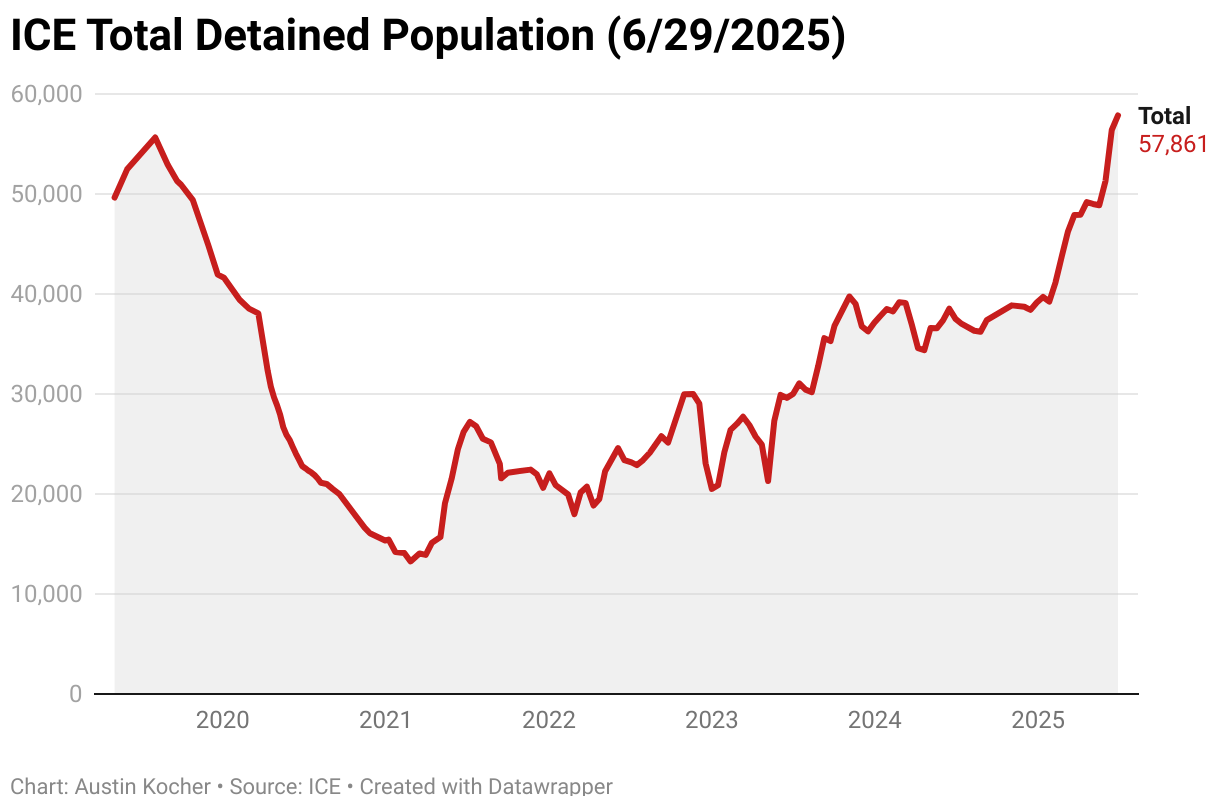
The United States is home to the oldest and largest immigration detention system in North America and arguably, in the world. As of June 24, 2025, approximately 59,000 immigrants are being detained across the country under the jurisdiction of Immigration and Customs Enforcement (ICE), the federal agency responsible for enforcing immigration law within the United States, with roughly 46,000 being detained on an average day since January 26. These numbers, significant as they are, are still notably below the Trump administration’s April claim that the government had “surpassed the entirety of Fiscal Year 2024” in immigration enforcement, with over 151,000 arrests and 135,000 deportations. As of late June, ICE’s detention level is at over 140% capacity.

Furthermore, despite the claims that these arrests —and even the most recent travel ban on 19 countries and counting— are a response to a dangerous invasion and a threat to the US, there is little empirical evidence to suggest that the vast number of detained immigrants present a “clear and present danger” to either US national security interests or to the American public. In fact, approximately 47%  of those currently detained by ICE lack a criminal record, and less than 30% have been convicted of crimes that constitute minor offenses, including traffic violations. Meanwhile, the immigration detention business is only slated to expand – the new budget (OBBBA) approved by Congressional Republicans has allocated $45 billion for the construction of new immigrant detention centers alone, including facilities for family detention.

 A growing number of immigrants are being incarcerated in the US in the private immigration detention industry, on which the US government increasingly relies for immigration enforcement. In recent years, it is estimated that as many as 90% of ICE detainees in the US have been incarcerated in facilities operated by private immigration detention companies. 

The discussion below provides an overview of the US immigration detention system’s growing reliance on the private sector, the extent to which these companies continue to derive enormous profits from immigration imprisonment, and how they navigate the US political landscape. Despite widespread allegations and documentation of abuse in these private detention centers, the industry continues to generate significant profits and thrive on support from different public and private actors.

Understanding US Immigration Detention 

In the US, immigration detention refers to the federal government’s ongoing practice of confining individuals in a range of facilities for violating immigration law. Confinement may last the duration of an individual’s immigration proceedings and, in certain situations, even after their immigration proceedings have been completed. While lacking a current immigration status is a civil violation and immigration detention under the law should be “nonpunitive and preventative,” many of its aspects are indiscernible from criminal incarceration. Detained immigrants are incarcerated in prisons and prison-like facilities; required to wear government-issued uniforms and wristbands with identifying information at all times; and have highly regimented lives under constant surveillance. Detainees are also subjected to discipline and segregation, with very limited access or contact with the world outside. Furthermore, immigrant detainees do not receive the same legal protections as criminal defendants, i.e., they do not have the right to government-appointed counsel. They also do not have the privilege against self-incrimination, the right to a speedy trial, nor are they protected from the ban on cruel and unusual punishment.

Over the past several decades, changes in the federal immigration enforcement policy paved the way for an expansive rise in detention rates. For instance, in 1973, the U.S. government detained a daily average of 2,370 migrants and increased to 5,532 by 1994. By 2009, the numbers had surged to 34,000; by 2019, the numbers had risen to a record 55,000.

Chart: Austin Kocher Source: ICE Get the data Embed Download image Created with Datawrapper

Chart: Austin Kocher Source: ICE Get the data Embed Download image Created with Datawrapper

What is clearly notable in these numbers is that since the 1990s, the US immigration policy has relied extensively on detention as a primary means of immigration enforcement. The 1988 Anti-Drug Abuse Act and the 1994 Violent Crime Control and Law Enforcement Act increased the incarceration of  U.S. citizens, particularly the Black population. In addition, the 1996 enactment of the Antiterrorism and Effective Death Penalty Act (AEDPA) and the Illegal Immigration Reform and Immigrant Responsibility Act (IIRIRA) ushered in a new era of U.S. immigration detention. Succinctly, these two latter laws not only broadened the types of criminal offenses that could trigger removal proceedings but also expanded the categories of noncitizens — including legal permanent residents — who could be detained without the possibility of release pending the completion of their removal proceedings, and even be subjected to deportation.

Following 9/11, immigration transformed into a national security concern, evidenced by the US Patriot Act, conflating terrorism with the arrival of people at US shores, while drawing on long-standing anti-immigrant sentiments and rhetoric. Under President George W. Bush, the immigration system underwent dramatic changes with Immigration Naturalization Service (INS) being replaced by the U.S. Citizenship and Immigration Service (USCIS), Immigration and Customs Enforcement (ICE), Customs and Border Protection (CBP), and the creation of the Department of Homeland Security (DHS), which housed all these agencies. DHS’ 2003 Operation Endgame used ICE to detain and deport all “removable aliens by 2012” –possibly the largest police operation in US history– was particularly instrumental in expanding immigration detention and deportation. During Obama’s presidency, the implementation of the detention bed quota (later removed in 2017) and the expansion of deportation programs such as the Secure Communities and the Criminal Alien Program resulted in thousands of immigrants being incarcerated in detention centers. Following the significant number of Central American arrivals in 2014, immigration detention —particularly family detention— expanded further.

Under the first Trump administration, the deportation dragnet became more extensive with increasing number of 278 g agreements – which allow for state and local law enforcement to work collaboratively for “protecting the homeland” – subsequent community raids, elimination of policies that prioritized detention and deportation of “criminal immigrants,” mandatory detention, and a skyrocketing detention budget that produced a growing system of mass incarceration. In FY 2019 alone, the detention system held more than 500,000 immigrants.

President Biden further funded the increase in the number of detention beds, broadened the 287(g) program, and pursued new and expanded detention facility contracts. Biden’s 2021 executive order directing the Department of Justice to phase out its contracts with private prison companies did include ICE contracts, since the agency is part of the Department of Homeland Security. Indeed, at the beginning of Biden’s presidency, there were fewer than 15,000 in ICE detention, yet the FY2024 spending bill he signed just a few years later provided funding to detain a daily average of 41,500 immigrants. While years of local organizing to end ICE contracts bore fruit along with the growth of pro-immigrant state legislation in multiple places like Irwin County, Georgia, the pipeline to detention has consequently grown, largely as a result of arrested migrants funneled through border apprehensions.

The Private Immigration Detention Industry: Growth and Expansion

The private detention industry plays a critical role in enabling immigration detention in the US. In August 2023, the American Civil Liberties Union (ACLU) reported that more than 9 out of 10 immigrant detainees were held in private prison facilities. Such corporations argue that private prisons are important in immigration management due to their cost-effectiveness, increased safety, and the humane treatment of inmates. In particular, GEO Group and CoreCivic (formerly the Corrections Corporation of America) are two companies responsible for the largest number of private immigration detention facilities in the country. Since the early 1980s, both companies have played a significant role in dominating the private prison industry to satisfy the growing demand for prisons. With the shrinking of the prison population in recent years, GEO Group and CoreCivic adapted their prison facilities to incarcerate noncriminal immigrants in the civil immigration system. In 2020, CoreCivic and GEO Group held half of all ICE detainees while bringing in billions of dollars in revenue through ICE detention contracts. As of December 31, 2024, CoreCivic operated 69 correctional, detention, and reentry facilities domestically, with a total capacity of roughly 76,000 beds. As of the same date, the GEO Group operated 99 facilities worldwide in 2024, with a total capacity of approximately 79,000 beds, the majority of which are located in the US.

The use of private immigration detention companies is by no means limited to Republican administrations; Democratic administrations have also increasingly relied on this industry for immigration enforcement. In fact, in July 2023, more than 90 percent of the average 30,000 people held daily in ICE detention were housed in private facilities.

The profit margins of the most prominent private detention centers have also been notable. From 2000 to 2020, the combined annual revenue of just the GEO Group and CoreCivic rose from well under half a billion dollars to around $4.5 billion. In 2022, GEO Group, which operates internationally as well as domestically, had $1.05 billion in revenue —43.9% of its total revenue from ICE contracts alone. This included $408 million, a significant 17%, on programs involving electronic monitoring of immigrants. In the same year, CoreCivic made $552.2 million (i.e., 30% of its total revenue) from ICE detention contracts. For FY 2023, the US Congress also appropriated $2.9 billion dollars to hold 34,000 people in ICE detention each day.

In 2024, CoreCivic reported a total revenue of $2 billion, up from $1.9 billion in 2023. A little over $1 billion came from federal contracts. Revenues from ICE  totaled $564.8 million in 2024, and $565.5 million in 2023. Meanwhile, GEO Group reported consolidated revenues of roughly $2.4 billion in 2024, 91% of which came from domestic contracts. ICE accounted for 41.5% of the company’s total 2024 revenues.

Both CoreCivic and GEO Group state plainly that their ability to grow is dependent on their ability to secure contracts to develop and manage new facilities. In turn, ICE has a heavy reliance on these private companies and their subcontractors.

Photograph of a CoreCivic Detention Center by Patrick Feller. Retrieved from Flickr.

Photograph of a CoreCivic Detention Center by Patrick Feller. Retrieved from Flickr.

The second Trump administration, with its overt commitment to an anti-immigrant agenda and increase in detention and deportations, has continued to be a boon for the private immigration detention industry. ICE plans to spend as much as $45 billion over the next two years on immigration detention. CoreCivic, in its end-of-2024 financial disclosures, stated “[we] expect demand from the federal government for our correctional and detention facilities to increase under the new presidential administration, particularly from ICE, as a result of anticipated changes in immigration policy.” Meanwhile, GEO Group said, “[we] continue to be encouraged by the current landscape of growth opportunities” and are “preparing for what we believe is an unprecedented opportunity…” Their excitement is evidently shared by their investors; both companies’ stock prices increased dramatically in the aftermath of the November 2024 election and remain well above their average pre-election value.

Questions for the Private Immigration Industry

The U.S. private immigration detention industry —like the private prison industrial complex— has long thrived based on the argument that its existence is necessary to reduce the costs of incarceration to state and federal correctional agencies and the burden on taxpayers. In fact, privatized companies have cut corners, such as reducing basic facilities for detainees and cutting back on their wages, in order to deliver on their promise of cutting government costs while maximizing profits for their shareholders.

While these measures may deliver in the short run, existing research shows they are far more likely to be more expensive in the long run. In addition to the reduction of services and reduced wages that negatively impact imprisoned immigrants, the U.S. immigration detention has long continued to be subject to intense scrutiny for human rights abuses, including verbal and physical assault, sexual harassment, insufficient food and nutrition provision, mistreatment of marginalized communities, insufficient access to medical care, negligence, lack of transparency and accountability alleged by many detainees. In May 2024, a group of U.S. Senators wrote to the Department of Homeland Security and ICE about “well-documented horrific conditions, such as ‘yellow drinking water,’ forced sleep deprivation, prolonged solitary confinement, inadequate medical care, limited access to legal counsel, and violent retaliation against those who complain.” A joint report by the ACLU, Physicians for Human Rights, and American Oversight found that 49 out of 52 deaths during detention ICE reported between January 2017 and December 2021 were “preventable or possibly preventable if appropriate medical care had been provided.” In certain cases reviewed in the report, medical staff vacancies and other health care deficiencies were found to have contributed to deaths. Groups such as Human Rights Watch have also documented multiple instances of substandard medical practices, including “unreasonable delays, poor practitioner and nursing care, and botched emergency response,” contributing to deaths in both publicly- and privately-operated facilities. Government oversight and regulatory bodies have consistently failed to anticipate, mitigate, identify, and rectify the conditions that enable such abuses. 

Private Immigration Detention Companies’ Successful Navigation of Criticisms

During President Obama’s time in office, the 2016 Inspector General report led to a directive to phase out private prisons, causing the stocks of private detention firms to tumble. However, this trend did not translate into significant economic damage for the private immigration detention industry or dampen enthusiasm for its existence. Instead, companies such as Geo Group and Core Civic, continued to develop and expand their public lobby efforts, including making donations to political campaigns. CoreCivic spent $3.7 million in lobbying throughout 2014 and 2015, with nearly $2 million in additional political donations. During Trump’s first presidential run for office, GEO Group donated US$100,000 to his 2016 campaign, and CoreCivic made large contributions to support his inaugural activities. Following President Trump’s 2016 electoral win, both firms’ stocks soared. Soon after, Trump’s Attorney General Jeff Sessions rescinded the Obama directive, citing concern that it would impair “the Bureau’s ability to meet the future needs of the federal correctional system.” In 2017, Texas State Representative John Raney told the Associated Press that a GEO Group lobbyist directly authored legislation that sought to lower childcare standards for private detention centers and extend the amount of time immigrant children could be detained.

Political contributions and lobbying funds remained high throughout the Biden administration. In 2022, GEO Group reported spending more than $4 million on political contributions and $3.1 million on lobbying expenditures, while CoreCivic cited more than $1 million in political contributions and $2.2 million in lobbying fees. Existing research suggests a possible connection between the political contributions made by these companies and their sponsorship of legislation in Congress that benefits the private detention industry. Their methods of influence can also take less overt forms. For example, the contracts these companies sign with governments often include “mandatory minimum” provisions, which guarantee payment for a set number of beds and thus create a financial incentive for governments to fill these spaces. A January 2021 review by the Government Accountability Office (GAO) found that “ICE has increasingly incorporated guaranteed minimum payments into its contracts and agreements … [but] has not taken a strategic approach to these decisions and has spent millions of dollars a month on unused detention space. Some immigrant rights groups have argued that this creates a waste of resources and a financial incentive to keep more immigrants detained within private facilities.

In 2023 alone, CoreCivic reported $983,250 in total political contributions and approximately $2 million in total direct lobbying expenditures at the federal, state, and local levels. In February 2025, GEO Group, along with its associated political action committee, reported a total of $4.02 million in political contributions alongside $3.97 million in direct lobbying expenditures. The company states that their efforts “are focused on promoting the benefits of public-private partnerships in the delivery of support services for secure facilities and processing centers…”, but that they “have not advocated for or against … criminal justice or immigration enforcement policies, such as whether to criminalize behavior, the length of criminal sentences, or the basis for or length of an individual’s incarceration or detention.” CoreCivic also reported donating half a million dollars to the Trump-Vance inaugural committee in December 2024. CoreCivic states that its lobbying efforts are “designed to educate” government officials about “the benefits of partnership corrections”, and that they avoid advocating “for or against policies or legislation that would determine the basis for or duration of an individual’s incarceration or detention.” 

Conclusion

The United States’ growing reliance on the private immigration detention industry has little to do with the country’s national security interests or protecting the American public; but it has consistently been about maximizing the profit margin through the imprisonment of some immigrants with criminal records, but many undocumented immigrants, asylum-seekers, and even lawful permanent residents. Existing research has repeatedly underscored that the private immigration detention system is costly and unsafe, and in several instances, in violation of U.S. and international human rights laws. Yet, the system persists, bolstered by both Democratic and Republican administrations. Under President Trump’s second term, the anti-immigrant agenda has ushered in a time of even more ICE raids, detention, deportation, violent family separations, and human rights violations. All of this leads to a more extensive reliance on private detention centers, which stand to benefit financially from these incarcerations, so much so that CoreCivic’s CEO Damon Hininger describes the present times as “truly one of the most exciting periods in my career.”

For more you can listen to Nancy Hiemstra and Deirdre Conlon, and Austin Kocher ICE Detention Numbers Explained

Constitutional Crisis: Donald Trump’s Immigration Policies Put Us All in Danger

By Caryalyn Jean

Photo by Anthony Sandoval

President Donald Trump’s executive orders surrounding immigration have sparked fear amongst marginalized groups and controversy amid those who hold America’s policy process dear. On January 20, 2025, Trump signed the Protecting the Meaning and Value of American Citizenship order which proposes the end to birthright citizenship. Although several judges have blocked the order and several other lawsuits have been filed, this specific executive order has caused concerns surrounding the integrity of the Constitution.

One major issue with Trump’s birthright citizenship order is his interpretation of the 14th Amendment. While he recognizes that the 14th amendment was originally intended to extend citizenship to formally enslaved African Americans during Reconstruction, his argument misinterprets the phrase “subject to the jurisdiction of the United States.” In this order, a mother’s and father’s immigration status at the time of birth determines if a federal department or agency can grant or recognized documents recognizing the United States citizenship of their child. However, there is no recent legal precedent supporting the use of a parent’s citizenship status to determine if a person born within the United States is a proper interpretation of the Amendment or any immigration law. Although Trump acknowledges the historical context in which the 14th Amendment was written, his interpretation would not be applicable to historical context Trump is supposedly intending to preserve. Ironically, Trump’s call for a stricter interpretation of the 14th Amendment calls into question how case law has broadened our understanding of how we view citizenship, even for corporations, which the law considers “artificial people” [see Santa Clara Co. v. Southern Pac. Railroad, 188 U.S. 394 (1886); Citizens United v. Federal Election Com’n, 588 U.S. 310 (2010)].

As a result of this Executive Order and many other policies which have led to the recent increase in ICE activity around the nation. President Nayib Bukele of El Salvador proposed a deal with the Trump Administration to allow for the United States to transport both deportees and imprisoned U.S. citizens to El Salvador for a fee. Despite some praise of El Salvador’s President Nayib Bukele’s “tough on crime” approach, this deal raises concerns about the conditions of these prisons. Since 2020, organizations such as Human Rights Watch and Amnesty International have reported on the lack of due process, deaths under custody, and living conditions that are below international standards. Although American immigration law would allow El Salvador to accept deportees in an instance in which a deportee returning to their country of origin is “impracticable, inadvisable, or impossible,” those factors are not the basis of President’s Bukele’s offer. Likewise, the deportation of American citizens in unconstitutional and violates the rights of incarcerated people. Nonetheless, on April 8, 2025, Press Secretary Karoline Leavitt affirmed that President Trump discussed the possibility and legality of deporting American citizens deemed “violent repeat offenders.”

The offer to accept American prisoners further cements the controversial slave status placed upon incarcerated people in the United States and El Salvador. The 13th Amendment abolishes slavery except for punishment for a crime within the United States and territories within its control. This manifests as the use of prison labor in both the public and private sector in exchange for pennies an hour. Similarly, Salvadoran prisoners make use of prison labor through their Cero Ocio program where prisoners were used to renovate schools, hospitals, and police headquarters under the guise of rehabilitation of prisons. Through this deal, El Salvador is on pace to economically benefit from accepting deportees and American prisoners in exchange for a fee as well as potentially increasing their prison labor force in a system reminiscent of slavery.

The relationship between the Trump Administration and El Salvador has already manifested into negative consequences for deportees and documented immigrants. Despite a U.S. District Judge ordering a temporary halt of the deportation of alleged Venezuelan gang members under the Alien Enemies Act, the flight continued anyway. This decision to disregard the order was a move cosigned by President Bukele on his official X account. Furthermore, Kilmar Abrego Garcia, a permanent resident living in Maryland was deported to El Salvador due to an “administrative error” and his return is being delayed due to pending litigation.

Trump’s birthright Executive Order and El Salvador’s proposal should be cause for concern for everyone regardless of immigration or citizenship status. These actions serve as a reminder of the Trump administration’s total disregard for the law and that solidarity is necessary for preserving human rights. Marking undocumented people and incarcerated citizens as undesirable leads us to overlook the harm being done and what is to come if we do not speak out against it.

Caryalyn Jean is a Research Assistant at The Immigration Lab at American University

Community Development Financial Institutions as Underappreciated Bridging Institutions for Latino Small Business Success

By Robert Albro, Associate Director, CLALS

March 26, 2025

Latina-owned business in Columbia Heights, Washington DC. Credit: Elizabeth Albro

Building upon its previous research on Latino entrepreneurship, with the generous support of the Wells Fargo Foundation, AU’s Center for Latin American and Latino Studies recently launched a project to assess the effectiveness of community development financial institutions (CDFIs) for Latino small businesses in the DC-metro region. CDFIs provide bespoke financial services and investment capital to underserved communities, and the economic crisis caused by the pandemic highlighted their crucial role as bridging institutions connecting minority small businesses with the resources they needed to stay afloat. But how have CDFIs gone about their work since the pandemic?

Together with our community partner, the Greater Washington Hispanic Chamber of Commerce, we surveyed representatives of CDFIs throughout our region to better understand how they interact with Latino business owners, but also post-pandemic challenges in doing so, as they seek to support this increasingly important community for our region’s economy. Here we report on preliminary results that show how the effectiveness of CDFIs depends upon their greater attention not just to the specific needs of Latino small business owners but also to the social and cultural circumstances, and communities, within which these small businesses operate.

CDFI’s have been a source of inspiration and innovation when it comes to engaging sometimes hard-to-reach minority small business owners. These include pioneering the use of cohort models when providing assistance, as a way to build peer relationships and support a more networked community of minority business owners. They also include the use of equity impact scorecards to help weigh disparities when evaluating eligibility for business loans. They further encompass a more strategic use of microloans and sustained efforts to rethink traditional risk evaluation systems, which have served as barriers to entrance for minority start-ups. But the role of CDFI’s as critical mediators between minority business owners and the formal financial system remains underappreciated.

Latinos are an increasingly important part of the U.S. economy, primarily through business ownership and job creation. They continue to start businesses at a faster rate than any other group, and are projected to be almost a third of business owners by 2050. But, despite comparable liquidity, credit risk and default rates, when compared with counterparts, Latino small businesses encounter more obstacles accessing capital for start-up, growth, and to survive downturns. They are, for example, 60 percent less likely than White-owned businesses to be approved for a bank loan. This disparity is a major contributor to the long-standing racial wealth gap among small business owners in the U.S.

Recent economic disruptions have also highlighted the greater vulnerability of Latino businesses. Less than half of Latino immigrants nationwide have a relationship with a bank. With less access to lending institutions, Latino business owners have relied disproportionately on personal funds, home equity, and informal social networks, leaving them more financially exposed in times of crisis. The Pew Research Center reported that Latino household wealth fell 66 percent as a result of the 2008 Great Recession, the largest decrease among any group.

During Covid-19, Latino business owners struggled to access capital to weather the pandemic. If more likely to seek funds, they were less likely to receive them from private lending sources. The Small Business Administration reported a success rate of 7 percent for Latino-owned businesses who applied to receive Paycheck Protection Program (PPP) funds provided by the federal CARES Act in 2020, compared to 83 percent for White-owned enterprises. In 2021 the Federal Reserve reported that Latino businesses were less than half as likely as White-owned businesses to receive a PPP loan. Such disparities highlight the urgency to understand the factors that continue to limit Latino asset building, and to identify successful alternatives for engaging Latino small businesses.

Overall, survey responses prioritized the bridging function of CDFIs. On the one hand, representatives of CDFIs emphasized the importance of not simply understanding the specific concerns of Latino business owners, but also the need to be actively present “in the community.” This included, as one respondent put it, “hyper local knowledge,” not just about specific industry sectors, socioeconomic status or tax rates, but about extra-financial social contexts impacting Latino business success, such as new immigration policies or incipient gentrification in a given neighborhood.

Being “in the community” encompassed the necessity of meeting business owners “where they are at.” Respondents emphasized strategies of direct personal contact, such as texting over email, the importance of “personal visits” to places of business, providing information in Spanish, access to bilingual financial professionals, use of social media platforms popular with Latinos, and outreach through Spanish-language media. This extended to attending family and other local celebrations, and was about “establishing trust” with a group, Latino small business owners, often suspicious of formal institutions. One takeaway is that CDFIs illustrate the need for lending institutions to adopt a more expansively encompassing approach to culturally informed “community engagement,” as a core competency of their work with minority small businesses.

On the other hand, respondents repeatedly emphasized that throughout the pandemic, and going forward, it has been challenging to make Latino business owners aware of their financial assistance options. For many, this boils down to a pervasive lack of “financial literacy.” Microenterprises and small businesses often do not keep adequate records and do not maintain basic financial management and accounting practices, which make it hard for them to provide the necessary documentation to qualify for grants or loans. Much of what CDFI staff spends their time doing is helping business owners “put their financial house in order.” Overcoming such informality remains a major challenge. If CDFIs are critical conduits connecting Latino small business owners to formal financial institutions, a second takeaway is the need to offer basic financial literacy assistance further upstream, prior to the business start-up phase, perhaps in coordination with immigrant-serving nonprofits and conceived as one among a set of core wraparound services.

This research project highlights the critical role played by CDFIs in connecting Latino small business owners with resources for success, but also bridging informal and formal dimensions of business practice, and often underserved minority communities with local and regional small business ecosystems. In our current environment, where federal funds supporting the work of CDFIs are under threat, it is increasingly important to bring attention to their value.

*The research for this post was made possible by a grant from the Wells Fargo Foundation. We thank Victor Burrola, who leads Wells Fargo’s philanthropy in the Greater Washington DC region, for his support throughout.

Marginalizing Multilingualism: The Impact of Trump’s Order Establishing English as the Official Language of the United States

By Sophia Robinson

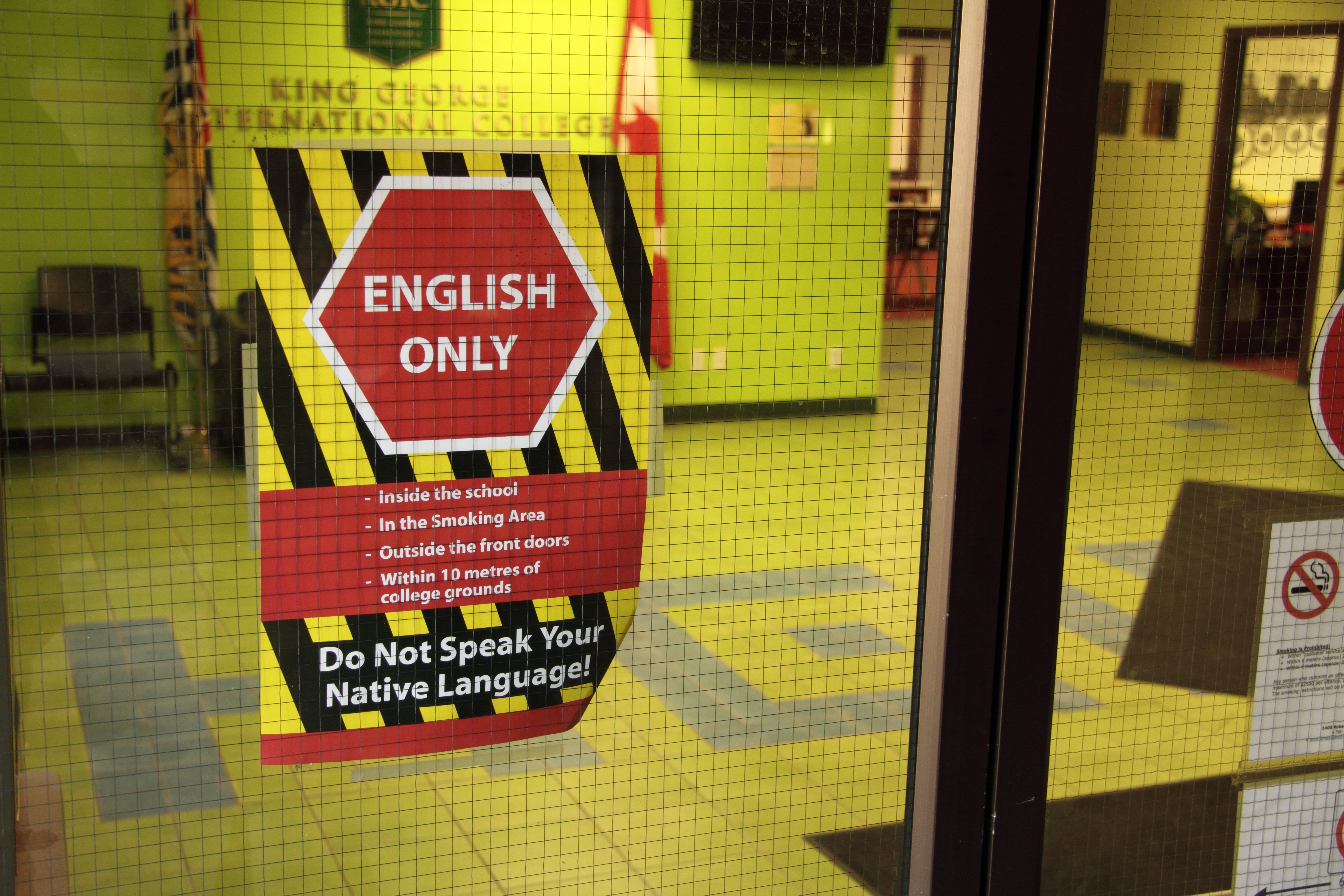
Stop sign “English Only”. Image from flicker

On March 1st, 2025, President Trump passed Executive Order 14224 making English the official language of the United States; this decision will undoubtedly have profound societal effects, further marginalizing migrant communities and diminishing multiculturalism in the U.S. By examining this order alongside a summary of “Immigrants Want to, and Do, Learn the Local Language,” Chapter Four of Immigration Realities: Challenging Common Misconceptions by Ernesto Castañeda and Carina Cione, it is possible to see how this action will affect the lives of millions across the U.S.

This Executive Order revokes President Clinton’s 2000 policy requiring language assistance for non-English speakers. Executive Order 13166 (“Improving Access to Services for Persons with Limited English Proficiency”) helped non-native speakers access essential services, including government documents, healthcare forms, and voting materials, and its absence could leave millions without access to these vital resources. The dynamics of language barriers are rooted in both historical and contemporary struggles faced by immigrants in the U.S, and Clinton’s 2000 policy was designed to ensure that non-English speakers could access government services without facing language-based discrimination. Trump’s order frames English as central to a cohesive American identity, which is inherently multifaceted and complex.

Supporters of this recent order argue that designating one language will improve the efficiency of government operations and promote national unity. However, this change can have serious consequences, especially for immigrant communities who rely on translated government materials for essential services. With over 68 million U.S. residents speaking a language other than English at home, Executive Order 14224 threatens to further marginalize a significant portion of the population both through limited required accessibility to government services and further reinforcement of misconceptions about migrants’ desire and ability to learn English.

As Castañeda and Cione’s book highlights, the challenges non-English speakers are far more complex than they appear. Many immigrants, especially those from Latin America, face significant social, economic, and legal barriers to learning English. Even with sufficient economic means, access to language education varies by region and available free time. Discrimination adds another layer of difficulty, with nearly half of Hispanic immigrants feeling judged for their English abilities. As a result of various obstacles, many are left isolated and unable to fully integrate into American society. A policy that systematically and socially upholds English as the only possible standard for success will only worsen these challenges.

Language assimilation is further complicated when considering the gendered challenges of language learning. Immigrant women, particularly in Latino communities, often face more difficulty learning English due to domestic pressures, cultural expectations, and fears of discrimination. This reinforces cycles of economic and social marginalization, as women are often left without the tools to access better opportunities. 

Language barriers can have serious consequences for mental and physical health, leading to stress, isolation, and even misdiagnosis in healthcare settings. It is vital to uphold and validate the multicultural realities of the U.S. in all spaces and having that upheld in government accessibility is a crucial part of inclusion. Lack of support for bilingualism and multicultural identity can lead second and third generation migrants to lose contact with their linguistic and cultural heritage, which has proven to be harmful to community health and well-being. The executive order’s reduction of language assistance programs will only worsen disparities and perpetuate negative perceptions of multilingualism in the U.S.

The implications of Executive Order 14224 are clear: it risks exacerbating the social and economic divides between English-speaking citizens and immigrants. While the goal of national unity is important, the needs of non-English speakers should not be overlooked. If the federal government reduces its support for language assistance, vulnerable immigrant populations will face even greater challenges in accessing essential services, deepening existing inequalities. Policymakers must consider the long-term impact of such decisions on social cohesion and the well-being of all citizens, regardless of language and background.

Sophia Robinson is a Research Assistant at the Center for Latin American & Latino Studies at American University 

Trump Halts Immigration Application for Migrants Welcomed under Biden Administration

By Valeria Chacon

March 4th 2025

USCIS Application Support Center, retrieved from wikimedia

A memorandum was issued on February 14 by  U.S. Citizen and Immigration Services (USCIS) acting Director Andrew Davidson that has effectively paused all pending immigration applications filed by migrants already living in the United States. The USCIS cited fraud and security concerns as the reasons for the halt, and the application freeze will remain in place indefinitely as government officials investigate and identify potential fraud cases

Thousands of Migrants Left in Limbo

Changes announced by the Trump administration directly impact a number of migrants, including from Latin America and the Caribbean as well as Ukraine, who have received legal entry and stay in the United States from categorical parole programs established under the Biden administration. Among them includes beneficiaries under Uniting for Ukraine, created in 2022 to provide Ukrainian citizens fleeing from Russia’s invasion legal entry to the United States. Applicants under the Cuba, Haiti, Nicaragua, Venezuela (CHNV) Parole Program are also affected. Initiated in 2023, this humanitarian parole program allowed nationals from these countries to seek stability and refuge in the U.S. In the first six months of the program, nearly 160,000 Cubans, Haitians, Nicaraguans, and Venezuelans arrived lawfully under this legal process. The latest data from USCIS shows that in December 2024, right before Trump’s inauguration, 27,340 migrants arrived in the United States with parole grants.

Applicants under the Family Reunification Parole (FRP) Program will also be affected. This program was made to reunite eligible individuals from El Salvador, Guatemala, Honduras, Colombia, and Haiti with family in the United as they wait for a family-based green card. It was created, in part, to discourage migrants from making dangerous crossings at the southern border by instead offering a legal migration pathway.

Lastly, those who have pending applications for Temporary Protective Status (TPS) from certain countries, including Haiti, Ukraine, and Venezuela, will also be impacted. The TPS program allows individuals to seek protection in the United States from ongoing armed conflict, environmental disasters, or extraordinary conditions. A TPS designation can be granted in 6, 12, or 18 months increments and recipients will need to re-register to keep their protection. However, Venezuelan and Ukrainian beneficiaries have had their protections extended until October 2025, while Haitian beneficiaries are covered through February 2026. As of March of 2024, there were 863,800 people living in the U.S. with TPS.

Legal Pathways Shut Down, Deportation Risks Rise

The programs previously mentioned provide work permits, travel authorization, protection from deportation, and legal migration channels to individuals from designated countries seeking a better life away from persecution and poverty or to reunite with family members in the U.S. However, under this policy shift, officials will no longer process any pending applications for these programs. Effectively, impeding applicants’ ability to transition to another legal status and making them vulnerable to deportation from the country.

In just his first month in office, President Trump has deported 37,660 people, and this number is expected to rise in the coming months due to the halts on the programs above that leave those already in the U.S. without legal status. It is evident that while Trump aggressively targets undocumented immigrants, he also has little regard for those who arrive under excruciating circumstances through legal migration processes.

Valeria Chacon is a research assistant with the Center for Latin American and Latino Studies at American University in Washington, DC

Edited by Katheryn Olmos, and Ernesto Castañeda

Green, Red, and Gold. I Need Only Blue to Play Uno

By Anthony Sandoval

March 3rd, 2025

The United States is where migrants come for that golden opportunity. To live a better life. To work, to be safe, to get an education. But once one leaves “La Jaula de Oro,” (“The Golden Cage”) they can’t return. All they have might be a green or red card, or maybe no card at all.

The U.S. has a visa program for temporary workers in “specialty occupations” called the H1-B visas. During Trump’s first term, he claimed the H1-B visa program was “very, very, bad for workers” and Suspended the H1-B visa program in 2020. Trump has switched his stance on H1-B visas, claiming “it’s a great program.” After Elon Musk showed his support for H-1B visas, nothing has happened to support  H-1B Visas meaning we might still see the reform that was outlined in Project 2025 to make the program ‘better.’

Other types of visa programs might be affected within the next couple of months, student visas, and visas for survivors of human trafficking and other crimes. Another program that is getting attacked is Deferred Action for Childhood Arrivals (DACA). All visas get a card and DACA gets a work permit card. Just another card to keep ahold of.

A migrant factory worker from Chicago said, “I have been waiting for my daughter to turn 21 so I can get my green card.” This working migrant applied to the Diversity Immigrant Visa Program (DV) 15 years ago and is still waiting for a Green Card. The DV program is a lottery. In 2023, the DV program had nearly 9.6 million qualified entries and only 50 thousand recipients.

The cost of green cards is already so high, that the filing cost for a family-based green card is approximately 3 thousand dollars for an applicant applying from within the United States. Other categories of green cards may have different costs depending on which one the person is aiming for, not including legal service fees. For DACA it costs $555 to renew online. The most expenses being EB-5 visas, which are for foreign investors that has made investments within the United States around one million dollars and created 10 permanent full-time jobs. For these pathways are not accessible to everyone due to the cost. While some immigrants may not have green cards, visas, or DACA, one thing that they might have are Red Cards ━which can make a difference in whether a person stays in the U.S. or gets deported. Red Cards were made back in 2007 by the Immigrant Legal Resource Center. Red cards are used to protect undocumented immigrants from U.S. Immigration and Customs Enforcement (ICE) or U.S. Customs and Border Protection (CBP). They can come in 19 different languages, including Ukrainian, Spanish, Chinese, Arabic, and Tagalog.

Trump’s “Border Czar,” Tom Homan stated, “For instance, Chicago—very well-educated, they’ve been educated on how to defy ICE, how to hide from ICE.”

On February 25th, President Trump talked about a new type of pathway to citizenship, he calls it a Gold Card. For years, many groups have been asking for an improved way for citizenship or an easier way to come into the United States. The answer was simple: a card that’s worth five million dollars. Ask your friends and family to help cover the cost. It’s that simple… but few people have that type of money. This new card is for investors. The gold card would just replace the EB-5 program.

We don’t need this. Not a 5 million dollar pathway that very few people can pay for. We need another way for citizenship, another way to come into the United States, a faster program that allows people to get green cards and not wait for years. We must remember these people are not “aliens;” they are people. One action that can help is supporting the Dream & Promise Act of 2025 that offers some DACA recipients, immigrant youth, Temporary Protected Status holders, and Deferred Enforced Departure holders a pathway to citizenship.

Anthony Sandoval is a research assistant with the Center for Latin American and Latino Studies and the Immigration Lab at American University in Washington, DC.

Edited by Katheryn Olmos, Ana Gaston, and Ernesto Castañeda,

(Not) Welcome to Florida: The Impact of Anti-Immigrant Policies

By Katheryn Olmos

Image of Welcome to Florida: The Sunshine State sign retrieved from Flikr

The atmosphere is so thick in Florida, you could cut it with a knife. Immigrants feel like they cannot catch a breath. As one immigrant told me, “every day there is something new.” Imagine having to check a map of zones to avoid every time you want to go outside, commuting further away from home to shop for groceries, having to refrain from speaking your native language in public, or avoiding going out to get coffee with a friend to lower the risk of encountering ICE raids or deportation. Living in constant fear, paranoia, and mistrust is no way to live.

State patrols will sit along highways to spot white working vans. In one case, a construction worker was pulled over in his working white van one evening at the end of January because his headlights were “too opaque.” The police officer asked him, “How long have you been in the U.S.?” to which the worker replied, “Over 20 years.” Then the officer gives him a ticket for driving without a license and tells him to go on with his day.

Shortly after the incident, Florida Governor Ron Desantis announced that he would enforce Section 287(g) of the Illegal Immigration Reform and Immigrant Responsibility Act of 1996. Therefore, the Florida Highway Safety and Motor Vehicles (FLHSMV) will join forces with the U.S. Immigration and Customs Enforcement (ICE). Through this partnership, ICE authorizes the Florida Highway Patrol to arrest and detain undocumented immigrants. State troopers will now ask individuals about their immigration status on day-to-day traffic stops. Additionally, state troopers are authorized to detain those suspected to be undocumented, regardless of their actual immigration status. This would completely dismiss the notion of “innocent until proven guilty,” leading to racial profiling of Latino drivers and causing fear among Florida residents. Florida residents have seen an increase in law enforcement. Latinos are more frequently reporting seeing people they know stopped and detained by law enforcement. It feels that this policy is only targeting the brown and immigrant community in Florida.

As Florida faces various problems, including the housing crisis, high home and auto insurance premiums, environmental crisis, and idle hurricane impacts, Desantis believes the so-called “immigration crisis” is the biggest issue at hand. On February 13, Desantis signed the “toughest immigration law in the country.” With this legislation, Desantis will allocate $298 million for detaining and deporting immigrants and increase the penalty for crimes committed by immigrants, including requiring the death penalty for undocumented immigrants who commit capital crimes. Additionally, Desantis is creating a new crime of entering the state of Florida as an undocumented person on top of the already existing federal crime of entering the U.S. through an irregular pathway.

There has been an increase in people moving in from out-of-state, including former residents of New York, California, and New Jersey. Many of them are moving to a state where their out-of-state wages for remote work or social security payments get them further, and the politics better align with their conservative beliefs. The changing demographics and anti-immigrant politics in Florida have also been creating a hostile environment for immigrant Floridians.

While Florida is experiencing an increase in residents from out of state, there is also an increase in immigrant residents moving to safer places out of state. Fleeing persecution is a recurring theme for immigrants; they often find themselves in a state of movement and fear while hoping to one day achieve the American Dream. Those who have lived in Florida for many years, even decades, face significant challenges when it comes to leaving their homes. Many immigrants who have established homes, businesses, children, and pets would prefer to remain in Florida. Immigrants who have built lives in Florida or lack the financial resources to leave are modifying their social and economic behaviors out of fear of deportation.

Florida is already witnessing the impact of migrants no longer participating in their social and economic atmosphere. Businesses that rely on Latino consumers are feeling this impact. Restaurants and other franchises that tend to be busy on weekend nights are empty. Rosy, a frequenter of Jacksonville, Florida’s Latino nightlife, says local Latino bar and club events are practically empty. She states that Latino clubs that always had long wait times to enter now have no lines.

Construction work is down due to high interest rates, weather conditions, and labor shortages. Despite Desantis’ push for mass deportations to solve the housing crisis in Florida, we need immigrants to solve the housing crisis in Florida. On February 20, 6 Mexican workers were detained at a gas station on Southside Blvd. in Jacksonville, Florida. Every day more and more innocent Latinos are detained by ICE. Instilling fear against our most vulnerable yet essential members of the community is not the solution to any of the state’s problems

Katheryn Olmos is a Research Assistant at the Center for Latin American and Latino Studies and a graduate student at the Sociology Research and Practice program at American University.

Edited by Ernesto Castañeda, Director, and Emma Wyler, Wilfredo Flores, intern at the Center for Latin American and Latino Studies and the Immigration Lab.

Mayor Adams, Don’t Sell Out New York City’s Economy

By Marshall Plane, Ernesto Castañeda

Photo credits to Flickr

Days after federal corruption charges against him were dropped, Mayor Eric Adams appears poised to open New York City to President Trump’s mass deportation agenda in what Manhattan’s federal attorney described as a “quid pro quo”. Mr. Adams’ posturing has hinted at this for some time: the mayor has framed the recent influx of asylum-seeking migrants as an economic burden that “will destroy New York City.” “The long-term consequences have yet to materialize of what this crisis will do to our cities,” he told Tucker Carlson on January 22nd.

After crunching the numbers, we agree with Mr. Adams: New York City is just beginning to reap the benefits of this influx of hardworking people. We conservatively estimate that, if their earnings and employment rates are similar to the current undocumented population, the 316,000 asylum seekers who have come here since 2022 will contribute $8.62 billion annually to the city’s economy, a figure greater than the GDP of forty countries. Much of this economic activity will flow to public coffers: the asylum seeker population is projected to pay $942 million more in taxes than they receive in benefits each year. If ICE is allowed to wreak havoc on New York City, all these benefits will be lost.

This is not particularly surprising. Previous waves of immigrants have similarly fled desperate situations, arrived with limited resources, faced nativist backlash, and still become vital contributors to the city’s economy and culture. There’s no reason to believe today’s newcomers should be any different. With New York’s US-born population declining and demand for workers growing fastest in the industries most reliant on immigrant labor, they are arriving at an opportune time.

It’s true that New York City has spent substantial amounts on services for asylum seekers: a combined $5.2 billion in fiscal years 2023 and 2024, with another $4.5 billion budgeted for FY2025. These costs doubtless been have been inflated by Adams’ “emergency” decision to suspend background checks and competitive bidding requirements for contractors providing such services. The Comptroller’s investigation found several egregious examples of overpayment. One contractor received $117/hour for security guards and $201/hour for off-site managers. Despite this waste, spending on asylum seekers made up just 4.2% of the FY2025 budget.

Most importantly, these costs are not the product of an “open border.” Immigrants have been coming to New York City via the border for decades. In fact, the city’s undocumented population was 611,000 in 2012 and fell to 412,000 by 2022. Nor is the scale of the current influx unusual in recent times–during the 1990s, the city’s foreign-born population grew at a higher annual rate than it has during the 2020s.

Instead, the recent difficulty housing asylum seekers is a unique case created by a perfect storm of policies: a political stunt that brought people to cities where they lacked connections; an artificial housing shortage; an already-struggling, poorly run shelter system unequipped to house new arrivals; a lack of legal immigration pathways; and outdated laws that prevent asylum seekers from working.

Each wave of immigration to New York City has been beneficial to both the immigrants themselves and their adopted city. The only difference today is that arcane policies have forced both sides to make major upfront investments before they begin to enjoy those mutual benefits.

Before claiming asylum, people must physically come to the US. For nearly all the asylum seekers we spoke with as part of our ongoing study, this involved taking on substantial debt to finance a deadly, months-long overland journey. This debt can be a major obstacle as people try to establish themselves in New York.

In 2023, John borrowed nearly $30,000 to bring his family of five from Ecuador to the US border. A mechanic by trade, he quickly found work repairing e-bikes at a workshop in Queens, earning $1,200 a week. Yet over half of each paycheck goes to repaying his creditors back home (who have threatened to kill his parents should he miss a payment), leaving him unable to afford rent and trapping his family in the shelter system. He says he’ll have paid off enough debt to move to an apartment in New Jersey in three months.

Lacking a sponsor in the US, crossing the border was John’s only way to come here. Leave aside, for a moment, your beliefs about whether doing so was morally correct. The fact is, he’s here and contributing to our economy. Had he been able to come directly from Quito to New York, his spending power would be going to New York businesses instead of human smugglers.

Another problem: after applying for asylum, people must wait 180 days before receiving a work permit. Unless they have connections to support them, this effectively forces people to live off the state for six months. In practice, our conversations have made clear, it’s often much longer. In 2023, New York City began limiting stays in any one shelter to 60 days, forcing people to shuffle between different facilities. Many migrants are not informed that failing to report this change of address to USCIS within 10 days is a misdemeanor and can delay or derail their ability to get documents.

The experience of Carlos, who we spoke to outside a Manhattan shelter, exemplifies the bureaucratic absurdities that hold migrants back. Bused to NYC in late 2023 as part of Operation Lone Star, he immediately applied for asylum, citing political persecution in Venezuela. While waiting for his work permit, he has bounced between different shelters and worked temporary construction and moving gigs. He says his lack of documentation allowed these employers to exploit him, frequently not paying him in full.

Carlos told us a relative in Oklahoma has found him a job in trucking, his original profession. “The moment my papers arrive, I’m going to Oklahoma,” he says. “They’re waiting on me.” He was supposed to get his work permit months ago but had to restart the process when his address changed. He was most recently told his papers should arrive in 90 days.

The absurdity is infuriating. Due to decades-old laws, people itching to work linger in shelters against their wishes and at great financial cost, while crucial jobs across the country remain unfilled. The Independent Budget Office estimates the cost of missed work authorizations for asylum seekers at up to $1 billion in 2024 alone.

Even so, with US-born workers rapidly aging, rising immigration has done much to ease post-pandemic labor shortages, helping reduce inflation while maintaining economic growth. And asylum seekers are quietly integrating into the city’s economy. Of the 225,000 migrants who have passed through the shelter system, over 170,000 (77%) have moved out, and the number remaining in city care continues to dwindle.

Many interviewees, having recently gotten their work permits and found jobs after a long ordeal, expressed excitement to begin living independently and working towards the various dreams that kept them going through sweltering jungles and deserts. As asylum seekers increasingly fill the jobs that keep New York’s service-based economy moving, the investments made by both sides finally appear to be paying off. For deportations to derail asylum seekers’ budding lives as New Yorkers would be a human tragedy and an economic catastrophe

Marshall Plane is a Research Assistant at The Immigration Lab.

Ernesto Castañeda is the Director of the Immigration Lab and the Center for Latin American and Latino Studies and a Professor at American University.

New York City’s Shift To The Right

By Caryalyn Jean

One surprising trend that emerged from the 2024 elections was New York City’s subtle shift to the right. Although the overall results of how each of the five boroughs that make up the city did not change, Trump gained 30% of the overall votes in the 2024 election as opposed to 19% in 2016. There were significant shifts in working-class neighborhoods in the Bronx and Queens. One reason for this may have been the high cost of living in New York and believing that Trump would bring prices down. Nonetheless, we must consider xenophobic messaging on both sides of the political aisle to get the full picture.

Since the initial arrival to of busses with immigrants and asylum seekers from Texas and Arizona to New York City, harmful rhetoric about them has had real-life implications. For instance, in late January 2024 reporting began surrounding an altercation which took place in Times Square between NYPD and a group of migrants. Former Police Commissioner Edward Caban responded to the incident with, “a wave of migrant crime has washed over our city.”  Mayor Eric Adams described the incident as “an attack on the foundation of our symbol of safety.” Despite body cam footage released just a few days after the initial reporting, both the media and residents alike repeated the messaging purported by Eric Adams and the NYPD Residents sharing the Eric Adams administration’s belief that migrants’ presence is correlated to an increase in crime in the city is reflected in the results of May 2024 poll. Of the 974 eligible New York City voters surveyed, “over 70 percent blamed migrants in the city for the current crime rate, with 41 percent saying immigration is having a ‘significant’ impact and 31 percent saying a ‘fair amount’ of impact.” 

New Yorker’s shift to the right is not limited to the presidential election. Another election result that may appear surprising to some is Republican Stephan Chan’s New York State Senate District 17 win, beating incumbent Iwen Chu. In 2020, New York State underwent a redistricting cycle, and Iwen Chu was the first representative of the newly formed district and served as representation for the growing Asian population in the area. Reporter Michael Lange described Chu’s loss as the solidification of “the Chinese Republican realignment in Southern Brooklyn.” On his campaign website, Stephan Chan emphasized being an immigrant from Hong Kong, a long time Bensonhurst resident, his law enforcement background, and his strong family ties. He also emphasizes his opposition of “wasteful spending of our tax dollars” juxtaposed to photo of himself at a protest opposing the building of a homeless shelter in Gravesend. Unsurprisingly, Chan’s opposition is not limited to homeless shelters. In a campaign ad, a supporter states, “he won’t hand out freebies to migrants while we pay the price.” This reflects not only Chan’s stance on spending on resources for migrants, but of some New Yorkers who often feel like New York City provides recently arrived migrants with services that long-time New Yorkers do not have access to.

On the national level, the growing anti-immigrant sentiment can be seen in how New York’s Congresspeople voted on the Lanken-Riley Act. This bill will allow the Department of Homeland security to detain undocumented immigrants who have been accused of burglary, theft, larceny or shoplifting. It also allows for states to sue the federal government for “decisions or alleged failures related to immigration enforcement.” Opponents of the bill are concerned about the erosion of due process for those accused of crimes and the lack of funding that is required to implement it. On January 23, 2025, the bill passed 263 to 156, with 6 out of 17 New York House members representing Downstate New York voting “Yea.” The bill was signed by President Trump on January 29, 2025. 

These election results amongst other things have already caused great concern around the upcoming mayoral and gubernatorial races. Ironically, despite Adam’s law and order campaign, he is in legal trouble. Likewise, since fall 2024, New Yorkers have been left many questions. During a November 6, 2024, news conference, Eric Adams was asked about his administration’s plans to cooperate with Donald Trump’s mass deportation efforts. In reply, Adams stated “We cannot add to the anxiety and fear that people are experiencing.”  The following week, Adams affirmed New York City’s sanctuary city status but stated that he believed that laws surrounding local law enforcement’s cooperation with Immigration and Customs Enforcement should be changed. Adams was also present as Trump’s inauguration and cancelled his attendance at various Martin Luther King Day celebrations to many New Yorker’s dismay. His reluctance to outright denounce Trump’s stance on immigration and recent ICE raids has caused uneasiness for immigrant advocacy groups within the city and causes further speculation that Adam’s refusal to publicly critique Trump is for his own personal gain. Democrats have long relied on New York City to keep New York State blue but shifts to the right in New York City may lead to the party losing its stronghold in the country.

Caryalyn Jean, Sociology Research and Practice MA (SORP) Student at American University

Migrante vs. inmigrante: 10 términos de la política migratoria de Estados Unidos que debes conocer

Photo cerdits to Brandon Bell/Getty Images

ORLANDO, Florida.- La política migratoria en Estados Unidos se encuentra en el foco de la atención tras las recientes órdenes ejecutivas firmadas por el presidente Donald Trump en los primeros días de su mandato. Entre las medidas, se encuentran restricciones temporales para refugiados, la limitación de solicitudes de asilo en la frontera y la polémica orden para negar certificados de nacimiento a hijos de padres sin estatus migratorio regular.

Estos movimientos han generado demandas en 18 estados, argumentando que violan el derecho de ciudadanía por nacimiento, protegido por la 14.ª Enmienda de la Constitución.

1. Migrante

Un migrante es cualquier persona que se traslada lejos de su lugar de origen, ya sea dentro de su país o al extranjero. Algunos se ven forzados a moverse por violencia o desastres naturales, mientras que otros migran por razones económicas o familiares. Este término incluye tanto a quienes cruzan fronteras de manera documentada como no documentada.

2. Inmigrante

El inmigrante es un migrante que se establece en un país diferente al de su nacimiento. En Estados Unidos, los inmigrantes pueden tener diferentes estatus legales, desde la residencia permanente (Green Card) hasta visas temporales, como las de trabajo (H-1B) o estudio (F-1). También hay visas humanitarias, como la T para víctimas de tráfico humano y la U para víctimas de crímenes graves.

3. Inmigrante indocumentado o irregular

Este término engloba a personas que ingresan o permanecen en un país sin autorización legal. Algunos llegaron con visas que vencieron, mientras que otros cruzaron sin documentos. En Estados Unidos muchos indocumentados trabajan y pagan impuestos, aunque no reciben beneficios de seguridad social.

4. Solicitante de asilo

Es alguien que pide protección al llegar a un puerto de entrada o dentro del país, alegando peligro en su nación de origen por persecución política, religiosa, étnica o de otro tipo. El proceso puede tomar años y requiere pruebas contundentes.

5. Refugiado

Un refugiado solicita protección desde el extranjero antes de ingresar a Estados Unidos, generalmente escapando de conflictos armados o persecución. Una vez en el país, pueden trabajar legalmente y, al cabo de un año, solicitar la residencia permanente.

6. Niños no acompañados

Se refiere a menores que cruzan la frontera sin un tutor legal. Según las leyes estadounidenses, pueden permanecer en el país y buscar estatus legal, generalmente bajo el cuidado de familiares ya residentes.

7. Separación familiar

Esta práctica polémica, intensificada durante el primer mandato de Trump, consiste en separar a padres migrantes de sus hijos al cruzar la frontera. Aunque la administración Biden intentó reunificar familias, cientos de niños aún están separados de sus padres.

8. Detención migratoria

Es la detención de inmigrantes en centros similares a cárceles, gestionados por el gobierno o empresas privadas, mientras esperan audiencias o deportaciones. Estas condiciones han sido criticadas por su dureza, incluyendo el uso de “hieleras” con temperaturas extremadamente bajas.

9. Coyote

Es el término utilizado para describir a los guías que, a cambio de dinero, ayudan a migrantes a cruzar fronteras de manera clandestina. Esta actividad se ha vuelto más costosa y peligrosa debido al endurecimiento de las políticas fronterizas.

10. Jugadores clave del gobierno

La política migratoria en EE. UU. involucra varias agencias: el Departamento de Seguridad Nacional (DHS), la Patrulla Fronteriza (CBP), Inmigración y Control de Aduanas (ICE) y el Departamento de Salud y Servicios Humanos (HHS), que asiste a menores no acompañados.
Entender estos términos humaniza a las personas detrás de las estadísticas. En tiempos de políticas migratorias restrictivas, la empatía y el conocimiento son herramientas esenciales para abordar este tema con sensibilidad.

Con información de AP.

Credit to Univision for translation

Original Post

https://theconversation.com/what-is-a-migrant-what-is-ice-10-terms-to-help-you-understand-the-debate-over-immigration-247317

Ernesto Castañeda is the Director of the Immigration Lab and the Center for Latin American and Latino Studies and a Professor at American University. 

Daniel Jenks is a Doctoral Student at the University of Pennsylvania,