Mexico: Peña Nieto’s Big Push

By CLALS Staff

President Enrique Peña Nieto / Photo credit: Eneas / Foter / CC BY

President Enrique Peña Nieto / Photo credit: Eneas / Foter / CC BY

President Peña Nieto’s reformist agenda wins kudos from the business and financial class, but both a recalcitrant leftist opposition and mass organizations previously aligned with his party are taking to the streets in protest – raising serious doubts about its prospects.  In his first state of the nation speech, delivered last week, Peña Nieto pledged to plow ahead with “transformational” reforms, giving flesh to the PRI’s slogan that it is Transformando a México. In education, he’s proposed a more rigorous system for hiring, evaluating, promoting and firing teachers who have resisted change despite evidence that the current system is not equipping Mexican youth for employment.  In the energy sector, he wants to open up the oil and gas industry to foreign investment, an idea that was strictly off-limits in the past even though lagging investment has caused production in Mexico’s leading export industry to decline steadily.  He is also pursuing tax reforms that, although watered down when announced on Sunday, entail political risk and, tellingly, raise marginal rates by 2 percent for higher earners and impose a levy on capital gains.  In June, he picked a fight with powerful business leaders over control of the country’s telecommunications industry, an oligopolistic structure that imposes excess costs on consumers and producers alike, diminishing Mexico’s economic competitiveness.

The teachers unions, whose symbiosis with the PRI in the past ensured cooperation, mobilized huge protests in Mexico City, forcing Peña Nieto to delay his speech by a day and then causing monstrous traffic jams during it.  The President cloaked his announcement of the energy reform in nationalistic rhetoric, and PEMEX, the oil company, followed it up with predictions of positive results – huge increases in oil investment and production that purportedly would help to create 500,000 new oil-sector jobs by 2018 and 2.5 million by 2025. But opposition to the reform has been strident, and tens of thousands filled the Zócalo on Sunday to protest it as a “covert privatization.”  Opposition leaders are already pledging demonstrations to oppose taxes, though the likelihood of this may be diminished because the long rumored reform unexpectedly left untouched the value-added tax exemption for food and medicines, which would have been a major rallying point for the Left.

Some Mexican commentators say Peña Nieto’s leadership is already losing its shine and that his Pacto por México, the loose coalition he engineered in Congress, is at risk of falling apart.  He prevailed in his congressional showdown over the long overdue education reforms, but success in transforming the underperforming education sector appears uncertain, as the teachers are threatening more protests.  The arrest of narco bosses from the Gulf Cartel and the Zetas have not given him a bounce on the security front; indeed, Mexican press reports indicate that kidnapping, extortion and other crimes that more directly affect citizens’ lives continue to rise. Further complicating Peña Nieto’s life is news last month that the economy is slowing down.  The first contraction in four years has forced the government to cut its 2013 GDP growth forecast in half, to 1.8 percent.  The administration will undoubtedly point to data showing that PEMEX production has fallen by about a quarter in the past decade because of low investment, and will emphasize that this makes modernization of the oil sector all the more imperative.  But Mexicans have heard promises before, during NAFTA debates and since, that economic reforms and greater openness to trade and investment will massively improve their lives.  Whether there is any fuel left in that rhetorical tank remains to be seen.
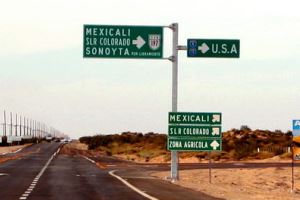
U.S.-Mexico: Border Liaison Groups—the Bread and Butter of Cooperation

By Carolyn Gallaher and David Shirk

"Little Road, Big Intersection" Photo credit: “Caveman Chuck” Coker / Foter / CC BY-ND

“Little Road, Big Intersection” Photo credit: “Caveman Chuck” Coker / Foter / CC BY-ND

Drug traffickers often find ingenious ways to get their product across the U.S.-Mexico border, but cooperation among Border Liaison Officers can often stop them.  In Mexicali, one trafficker used a pneumatic cannon attached to his truck bed to shoot packages of marijuana across the border for pickup.  After some surveillance, Border Patrol caught the truck in action.  Agents took down the license plate number and called an officer in the Mexicali police department, who looked up the number, tracked down the truck’s owner, and made an arrest.  Border Patrol agents knew who to call in Mexicali because they belong to the same border liaison group.  Although they receive little public attention, border liaison groups are a crucial part of the cooperative infrastructure between the two nations.  They allow cooperation to continue during, and in spite of, political transitions, diplomatic imbroglios, and other shifts in bilateral relations.

Border liaison groups are semi-formal organizations in which officers cooperate on policing cross-border crimes such as auto theft, low-level drug crimes, and smuggling.  They are usually organized and maintained by law enforcement officials.  The San Diego Police Department, for example, used to have a full team of officers whose full-time job was to liaison with officers in Mexico.  Membership in border liaison groups is not compulsory, however, and there are no restrictions on which agencies for which a member must work.  Groups usually include a mix of local, state, and federal officials. And meetings are typically held in informal places like restaurants, barbeques at members’ homes, or at organized events, such as boxing matches and softball games.

Border liaison groups facilitate cooperation in a number of ways.  In a structural sense, they help individuals navigate the other side’s bureaucracy – i.e. identifying which agency is in charge of a particular issue, and who in the agency you should call.  They are also fundamental for establishing trust.  In a context where corruption is an ever-present concern, border liaison groups give members a chance to get to know one another, and to discern potential partners’ trustworthiness.  A member of the Baja state’s preventive police force (known by its Spanish acronym PEP) told us, for example, that officers often use the “gut test.”  You only work with someone your gut says is “ok.”  (A California law enforcement officer told us it was similar to the “gut check” he used when meeting his teenage daughters’ suitors.)  Officers also use more tangible tests.  It is not uncommon to share a piece of information and track what happens with it.  If the information is used appropriately, the agent initiating the test may decide to share more substantial information.

One of the biggest threats facing border liaison groups is funding.  Budget cuts in California, for example, have led several law enforcement agencies to reduce liaison positions, or they have grafted liaison duties onto established jobs.  Another problem is replicating these groups in non-border areas.  The Cook County Special Investigations Unit in Chicago, for example, told us “we are the border,” noting that perpetrators and victims of crime in the city are often Mexican.  Without contacts on the other side, however, the unit can only communicate through official conduits in Washington (e.g., the FBI or Immigration and Customs Enforcement, ICE) – a cumbersome process that most officers avoid.  Indeed, the sorts of information border liaison group members share – drivers’ license numbers, last known addresses, known associates – are too time-sensitive for formal channels to be of use.  The recent arrests of high-level kingpins in the Zetas and Gulf cartel tend to get widespread media attention, but the daily work by law enforcement officers is often just as important. 

Carolyn Gallaher is a professor in the School and International Service at American University.  David Shirk is a professor in the Political Science Department at the University of San Diego.

This project was supported by Award No. 2011-IJ-CX-0001, awarded by the National Institute of Justice, Office of Justice Programs, U.S. Department of Justice. The opinions, findings, and conclusions or recommendations expressed in this publication/program/exhibition are those of the author(s) and do not necessarily reflect those of the Department of Justice.

Moving Toward Religious Unity in Response to Violence?

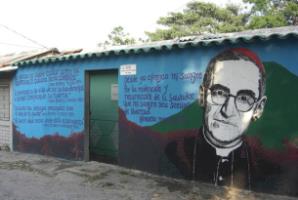
Bishop Oscar Romero mural, El Salvador / Photo credit: alison.mckellar / Foter / CC BY

Bishop Oscar Romero mural, El Salvador / Photo credit: alison.mckellar / Foter / CC BY

Many Latin American churches are struggling to address the criminal violence challenging their societies – and are finding new ways of promoting peace in ways reflecting each country’s different conditions.  As part of American University’s multi-year project (click here) on religious responses to violence in Latin America, 40 grassroots activists representing two-dozen faith-based ministries in seven countries gathered in Guatemala City in mid-July to share experiences ministering to victims of the region’s rampant violence.* Their ministries in Mexico, Central America and Colombia ranged from programs for at-risk youth, to rehabilitation centers for former gang members, to shelters for Central American migrants crossing through Mexico.  Just as they developed a range of responses to the threats posed by authoritarian governments in the past, religion-based activists today are adapting strategies to a wave of “new” violence, a battery of social ills that includes gang violence, gender-based violence, and violence against migrants, as well as the persistent violence in states that have formally democratized but failed to deliver basic security.

Conflicting interpretations of the Church’s message of peace affect how churches define victims, how they emphasize or downplay the structural causes of violence, and how they respond to human suffering.  Thus, while many of the participants characterized the current crisis in terms of structural or institutional violence, such convictions were not always reflected in churches’ proposed solutions to the crises facing their communities.  There was no consensus, for example, on how faith-based organizations can effectively engage state institutions and policies, particularly where governments are perceived as corrupt and ineffective:  some participants believe the church’s role is to condemn corruption, while others saw no alternative to holding elected and appointed authorities accountable by pressing them to deliver justice.  One of the participating ministries based in Honduras, for example, provides legal aid for victims and their families, encouraging them to press charges, provide testimony, and follow-up with police and courts until they obtain a conviction.

For many of those in attendance, the ecumenical meeting was a first – in the words of a Mexican participant, “historic” – by offering a unique opportunity for religious practitioners to learn about the realities of neighboring countries, exchange ideas about best practices responding to violence, and discuss possible means of collaboration across borders.  Despite diverse traditions and circumstances, the churches are becoming a more visible and potentially more unified force in the struggle against violence in Latin America. In a region marked by ecclesiastical competition, they are challenging traditional understandings of “accompaniment” and are recognizing their shared responsibility to respond to violence with concrete action.  Indifference, passivity, fear, and silence received the greatest condemnation from the meeting’s participants.  These churches are realizing that their diverse activities are in fact complementary, and that they have a critical role to play – both to mitigate existing suffering and to eradicate root causes of violence.  

*The seminar “The Role of the Church in the Face of Violence in Mesoamerica: Models and Experiences of Peace in Contexts of Conflict and Violence” was co-organized by AU’s Center for Latin American and Latino Studies and the Latin American Anabaptist Seminary (SEMILLA) based in Guatemala City.

Violence in Mexico: Forging a Civic Compact for Urban Resilience

By Daniel Esser

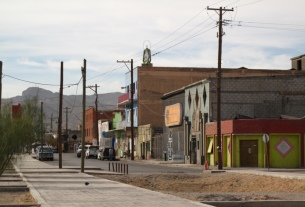
Ciudad Juarez | Photo by Daniel Esser

Ciudad Juarez | Photo by Daniel Esser

The media’s regular chronicling of human resilience in the aftermath of natural disasters and large-scale violent conflicts cover only part of story.  As inspiring as tales of individual heroism, resistance and resilience can be, they provide little guidance for public policy aiming to strengthen social ties within damaged communities, in which safety nets need to be created to work both preventatively and post-victimization.  Supported by a field research grant from the Social Science Research Council’s Drugs, Security and Democracy Program (DSD) and working jointly with a team of researchers based at the Universidad Autónoma de Ciudad Juárez, this writer recently spent four months on the U.S.-Mexico border to answer this question.  Members of 320 randomly sampled households in Ciudad Juárez were interviewed about their knowledge of non-violent collective action during the past five years.  Overall, the findings provide hope that Juárez’s social fabric has not suffered as badly as is widely claimed, but both Mexican and international policy-makers need to understand the nature of collective resilience before they can effectively support it.  Juárez no longer tops the world’s ranking of most violent cities per capita, as it did in 2010 and 2011, although organized violence continues to wreak havoc, exemplified by 30-60 murders per month.  Analysts agree that the downward trend is less the result of concerted government action and more a reflection of a reshuffling – likely temporary – of power structures within the transnational drug business.  Strikingly, most survey respondents argued that neighborly help had not decreased during the violent times.  Roughly a quarter even argued that residents’ willingness to help each other had in fact increased, mainly because people felt more united amid the terror.  Many people reported knowledge of collective street monitoring, peaceful marches, protests and public vigils, with between 5 and 8 percent saying they have actively participated in them.  For those residents, violence was not an abstract phenomenon; more than 30 percent reported personally knowing someone who had been murdered, and just under 20 percent had themselves been victims of violent crimes.  Surprisingly, almost two-thirds said they had not lost trust in local politicians and that they would vote for candidates promising to combat violence.

These findings serve as reminders of the political dimension of resilience in the context of chronic violence, implying that there are important local collective dynamics that can be leveraged through responsive and accountable political representation.  They also suggest that policymakers at all levels need to be mindful of the existence and potential of collective agency under extremely adverse conditions.  The violence in border cities created an opportunity for forging a civic compact between entities of the state on the one hand and neighborhood residents on the other, to mend frail ties between the electorate and its representatives.  This kind of deliberate state-building at the local level is precisely what Mexico needs in the aftermath of former President Calderón’s heavy-handed and, as many have claimed, detrimental strategy emphasizing federal-level and military-led programs and operations.  President Peña Nieto and his cabinet appear likely to embrace a local approach to increasing security as it complements his commitment to improving social services especially in secondary cities.  However, the most critical building block for effectively executing such a civic compact is a politically unbiased, data-driven selection of beneficiary communities and their needs.  Akin to approaches to civic reconstruction in war-torn countries such as Afghanistan and Iraq, communities should be in the driver’s seat in both project selection and monitoring.  After all, state-building is as much about procedural inclusion and justice as it is about tangible outcomes.

Dr. Esser teaches international development at American University’s School of International Service.  Click here for more information about this project.

Narcoliteratura: Another Way to Look at the Problem

By Héctor Silva

Élmer Mendoza

Élmer Mendoza

Latin America has suffered through almost three decades of the so-called war on drugs.  U.S. President George H.W. Bush formally declared the war in the late 1980s, but from the Andes to the Rio Grande it started when the Colombian cartels and their Mexican partners (then exclusively involved in distribution) created a multi-billion-dollar business to satisfy the growing U.S. market.  The druglords’ strategy of “plata o plomo” brought Mesoamerica and Mexico to their knees through violence and institutional corruption.  Hundreds of thousands have died, but the “war” has failed to tackle the economic basis of the industry: markets shift and supplies remain steady.  The cartels are smaller and more ruthless, and nation states are weakened by corruption.  Reams of reports have been written by official agencies, international organizations and think tanks – the latest a creative study by the OAS – but solutions remain elusive.

The drug trade has left an indelible mark on the very fabric of Latin American culture and society.  “Narcoliteratura,” one of whose main creators is Mexican writer Élmer Mendoza, is one of the most curious manifestations of this.  (Mendoza spoke at American University and was interviewed by this writer in February.)  His main character is Edgar “El Zurdo” Mendieta, a troubled police officer in Culiacán, Sinaloa, a city emblematic of the Mexican drug cartels.  El Zurdo’s stories capture the dual representation that Latin American culture has given to both the trade and its capos – romantic and profitable, yet evil.  Mendoza’s books give a naked and honest portrait of a society that has adapted, for its own survival, to most of the values associated with the narco business.  As Mendoza says, “El Zurdo” tries to keep a distance from the narco, but he can’t avoid him because the narco is there and is very strong and, almost without wanting to be, is always in contact.”

Compared to the many reports that fail to lead to policies that would help attack the core problems that give rise to the narco industry, Mendoza’s work provides a fresh and sincere portrait of the devastating impact the drug trade and the “drug war” have had on Latin America.  In books like El Amante de Janis Joplin and Nombre de Perro, his message is powerful, coming from a writer that has been there, in Culiacán, since it all started.  He writes with no restraints, through the voice of his characters, to tell some simple truths.  In an interview with this writer, he offered a sampling of his wisdom.  “If the US came up all of a sudden with a program to deal with its addicts, it would mean the end for the narco business,” later adding that “the war on drugs is useless and has only caused death.”  He poignantly stated:  “The war on drugs also allowed us to relax our emotions and lose the last chance for justice.”


Will Tensions Over Security Spoil the Obama-Peña Nieto Summit?

By Tom Long

Military in D.F. Photo credit: ·júbilo·haku· / Foter.com / CC BY-NC-ND

Military in D.F. Photo credit: ·júbilo·haku· / Foter.com / CC BY-NC-ND

The meeting in December between recently re-elected President Barack Obama and President-elect Enrique Peña Nieto was marked by cordiality and a desire to talk about anything but the often grisly drug-related violence in Mexico during the previous six years.  Since then, Peña Nieto has continued the changed emphasis, aided by headlines pivoting to positive stories.  Mexico has been recently hailed for its economic growth, particularly in export-oriented manufacturing, and for a series of political compromises that The Washington Post favorably compared with the U.S. Congressional stalemate.  Despite optimistic claims from the government, Mexican media reports indicate that drug-related violence continues at nearly the same pace as last year.  (Click here for a summary and analysis by our colleagues at InSight Crime.)  Moreover, pressure is growing on questions of human rights violations committed in the name of the war on drugs.  When Presidents Peña Nieto and Obama meet again in early May, holding back a renewed focus on security is likely to be a challenge.

Peña Nieto’s political incentives do not point to the same, high-profile cooperation with the United States that occurred under President Felipe Calderón, who had already begun shifting priorities last year.  Despite the major turnaround signified by the PRI’s signing NAFTA almost 20 years ago, Peña Nieto’s PRI still contains elements more skeptical of U.S. “intervention” than Calderón’s PAN.  Materially, moreover, most of the U.S. aid planned under the Mérida Initiative has been disbursed, and Congress exhibits little appetite for major new appropriations.  (Even at its height, U.S. spending was a fraction of Mexico’s contribution to the drug war.)  That reduction, coupled with growing awareness that the Calderón strategy actually fueled violence, diminishes the enthusiasm in and outside of government for continuing his policies.   Frustration from the left in both countries regarding persisting human rights violations and the slow pace of judicial reform could also grow more serious.

While these problems may be causing tensions between U.S. and Mexican police and military at the operational level, they seem to be manageable so far – and both Presidents are likely to emphasize intelligence-sharing and similar bilateral cooperation that does not require resources.  Upper echelons of the Obama administration seem to understand that Peña Nieto’s push to de-emphasize security and promise to focus on violence reduction over drug interdiction is politically necessary.  But the moral argument has not changed:  Mexicans suffer the violent consequences spawned by U.S. drug use and counterdrug policies.  Weapons sold on the U.S. side of the border continue to flow into Mexico, an issue now atop the U.S. political agenda for entirely domestic reasons.  If the two countries can manage to keep security problems at a lower decibel, they will better cooperate on issues that are just as vital but could pay larger dividends — immigration, transboundary energy, educational exchange, and infrastructure.

Mexico-Brazil: Competing Economic Models?

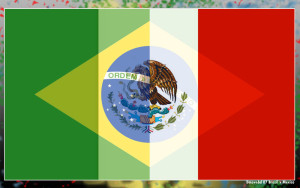
The divergent economic performances of Mexico and Brazil over the past few years have again thrust upon analysts the difficult task of estimating which factors – public policies, market trends, geographic location, financial market managers’ perceptions, or something else – are responsible for the different results.  Brazil was everyone’s favorite two years ago, but Mexico is now being hailed as the hot performer – and praise is being heaped on Mexico City for making things happen.

Former Chilean Finance Minister Andrés Velasco, writing for Project Syndicate (click here for text), explores why the Brazilian economy today is “stagnating” while Mexico, written off as a “lost cause” just two years ago, is “expanding at a steady clip.”   Among Velasco’s key points:

  • Financial markets’ behavior says more about investor perceptions than about the countries in question.  Analysts focus on short-term figures rather than on structural trends.
  • Mexico’s economy is much more open than Brazil’s because of NAFTA and other agreements with Europe and Asia, while Brazil’s is limited by the “strictures of Mercosur.”  (Velasco was a strong advocate of free-trade policies while serving on President Bachelet’s cabinet.)  Mexico’s “export basket” has expanded dramatically – to include car parts, electronics, telecommunications equipment – while Brazil’s exports are increasingly commodity-based.
  • After both implemented anti-crisis fiscal packages in 2009, Velasco praises Mexico for having reduced its stimulus sooner – enabling it to keep interest rates much lower, controlling inflation better, and thereby contributing to a more robust private-sector role.

At the same time, Velasco urges wariness “about jumping to definitive conclusions” and notes that Mexican exports have been slowing in recent months, while domestic consumption is picking up as a source of demand.  He also cautions that Brazil’s potential to sell its products around the world “should not be underestimated.”

However thoughtful, analyses like Velasco’s may neglect the impact of another long-term factor:  the steady rise in wages in Brazil and their stagnation in Mexico.  At a seminar in Washington hosted by CLALS last week, Mexican economist Luis Felipe López Calva (click here for news article) noted that the strength of the middle class continues to be a vulnerability in Latin America, and he said that the ability of the middle class to be a “lever of growth” argued for policies that emphasized economic mobility.  A thriving middle class and increased domestic consumption can be a more reliable engine for growth (and for the consolidation of democratic institutions necessary for growth) than short-term market trends.  The increasing wellbeing of the bottom two thirds of the income distribution pyramid in Brazil argues for tempering optimism that Mexico alone has found the holy grail of economic policies. 

What do you think?  Click on “leave a comment” below to contribute.

Mexico: A Hard Road for Reforms

By Tom Long

Enrique Peña Nieto by Edgar Alberto Domínguez Cataño | Flickr | Creative Commons

Enrique Peña Nieto by Edgar Alberto Domínguez Cataño | Flickr | Creative Commons

During the campaign, Mexican President Enrique Peña Nieto proclaimed in thousands of advertisements, “Me comprometo y cumplo” – I make a promise and I keep it.  Offering a list of potentially transformative reforms – regulations, security, telecommunications, energy, and more – he began with one of the most intractable:  the struggling public education system.  In December, at his instigation, the Mexican congress passed a constitutional reform to create stricter standards for teachers and move hiring authority from the teachers’ union to the government.  Enough states had ratified the amendment by the end of February to make it law.  After years of stagnation and interest-group politics, education reform suddenly became politically expedient, passing with support from the PRI, PAN, and PRD.  Last week, the government put an exclamation point on the reform by arresting the teachers’ union boss, Elba Esther Gordillo, on charges of using her post for illicit gains surpassing $100 million.  A PRI apostate whose opposing alliance was credited with helping former President Felipe Calderón win his razor-thin victory in 2006, she was not just expendable, but an obstacle.

According to OECD education data, just 45 percent of Mexican students complete their secondary education, though the rate has improved over the last decade.  Mexico spends 3.7 percent of GDP on primary and secondary learning, — less than Chile, Argentina, and Brazil but in line with the OECD average.  Experts believe that Mexico’s educational  problems are largely political, not budgetary.  A full 97 percent of spending goes to salaries, feeding a teachers’ union that has a history of patronage and graft.  The problem has deep roots in the clientelistic structure through which the old PRI governed during its 70 years in power before losing in 2000 – and with which the PAN governments coexisted for 12 years.

The storyline shares certain similarities with PRI President Carlos Salinas’ sacking of the head of oil workers’ union in the 1990s, presaging limited reforms in that sector.  Peña Nieto probably intends the removal of the most visible representative of old-style patronage politics as a clear signal that the PRI will not bring back the bad old ways – despite the possible appearance of the firing and arrest being driven by revenge – but the reform legislation is widely seen as a positive step forward.  Rhetorically at least, the major parties have agreed to a multi-pronged effort for more reforms in the “Pact of Mexico.”  However, forging consensus on further reforms will be more difficult, as entrenched PRI politicians at the local level are already resisting many of the president’s proposals.  The PAN and PRD are already criticizing Peña Nieto for being too cozy with media barons and for handling telecommunications reform behind closed doors.  Security policies and proposed energy reforms are more contentious still.  Reforming other sectors will require going after harder targets than Gordillo and will pose greater tests of Peña Nieto’s ability to win votes in the Mexican Congress.

Obama and Peña Nieto: Turning the same page?

By Tom Long
CLALS doctoral research fellow

Official White House photo by Pete Souza | public domain

Official White House photo by Pete Souza | public domain

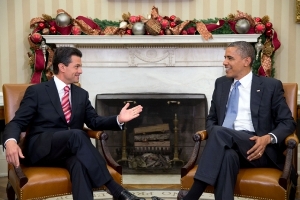
On Saturday, Mexico’s new president Enrique Peña Nieto took office and the country’s oldest party, the Partido Revolucionario Institucional, returned to power. After six years dominated by an exhausting and bloody war against drug cartels, Mexico seems ready to turn the page on outgoing President Felipe Calderón. During the last few months, Peña Nieto has tried to steer the attention of the world—and the United States—away from a disproportionate focus on drug violence. In a recent article published in The Economist, the new president downplayed drug cartels, focusing instead on plans for the economy and to “recover our leadership in Latin America.” Security was just one of thirteen proposals in his inaugural speech. In part, Calderón has given Peña Nieto a head start as he begins his term, leaving behind strong economic growth and a dip in violence. Although Calderón himself started the switch to a violence-reduction strategy, his name is likely to remain closely associated with the frontal military assault on the cartels launched at the beginning of his administration and recalibrated only in his final year; Peña Nieto is positioned to gain credit for a return to normalcy.

This desire to turn the page also marked Peña Nieto’s s pre-inaugural meeting with President Barack Obama. Both leaders seemed to be playing the same tune.  Mexico has become the front line in the war on drugs, and the U.S. has spent billions on military, police, and other projects lumped under a “Merida Initiative” label. After their meeting, Obama and Peña Nieto promised to expand the bilateral agenda to include an expansion of trade, cooperation on energy, and discussions of immigration that go beyond border fences. Obama spoke effusively of Mexico’s importance as a partner, while Peña Nieto said the two had a “shared vision” of how to create jobs in both countries. On the stage with Obama as elsewhere, Peña Nieto reiterated calls for the United States and Canada to build on NAFTA and further regional integration to improve competitiveness.

It would be a healthy change if the two presidents could restore balance between economic and security aspects of U.S.-Mexico relations. Image matters – and the deterioration of Mexico’s brand has undermined both investment and tourism. The military approach to drug trafficking has inflicted enormous costs in economic and human terms with questionable payoffs, but Mexico cannot go back to old patterns of accommodation. Domestically, the new president needs to attack the culture of impunity by building a stronger and more independent judiciary in order to reduce the frightful percentages of crimes that are never investigated or prosecuted. Accountability remains weak, especially at state and local levels; improving it would require Peña Nieto to take on powers in his own party. Placing all these objectives under a “Merida plus” framework would counterproductively squeeze broad reforms into the drug-war box. If the two presidents are sincere about rebuilding a balanced partnership, they need to take action quickly on immigration and commerce. Otherwise, the gravitational pull of the war of drugs will again consume bilateral ties.

U.S. Marijuana Vote Unlikely to Impact Mexico in Short Term

The following is excerpted from an article by InSight Crime* analyst Elyssa Pachico

Photo by: Editor B | Flickr | Creative Commons

Approval last week in Colorado and Washington state of measures allowing the recreational use of marijuana has fueled debate on whether legalization will reduce drug traffickers’ profits and the violence surrounding the illicit narcotics trade.  In both states, ballots passed with comfortable margins of 53 percent (Colorado) and 55 percent (Washington).  The measures legalize personal possession of up to one ounce of marijuana and allow the drug to be legally sold (and taxed) in licensed stores.  A similar initiative failed to pass in Oregon, gaining less than 45 percent of the vote.

A recent study by a Mexican think tank, the Mexican Institute of Competitiveness (IMCO), and Alejandro Hope (an InSight Crime contributor) found that passage of the initiatives in all three states would reduce the revenue of Mexican drug trafficking organizations by as much as 30 percent.  Hope has pointed out on Animal Político, a popular Mexican news site, that the impact will depend on the U.S. federal government’s response.  Attorney General Eric Holder strongly opposed such measures in 2010 when California residents voted on Proposition 19, but he did not issue strong statements this year.  The government’s response to last week’s votes has been muted; according to Reuters, the US Justice Department reacted to the measures by stating that its drug enforcement policy had not changed.

Mexico, a major supplier of marijuana, is unlikely to feel the impact of these measures for a while.  Parts of the Colorado measure will come into effect after 30 days, but the Washington measure will not take effect for a year.  But, over the long term, the votes indicate shifting attitudes towards marijuana prohibition in the United States – on the heels of similar shifts in Latin American countries eager to find alternatives to the current war on drugs.  The presidents of Guatemala, Mexico, and Colombia have emphasized the need for discussions, and Uruguay and Chile have considered their own marijuana legalization bills.  InSight Crime cautions, however, that the drug organizations have proved to be very adaptable in finding new sources of revenue – including methamphetamines, migrant smuggling, and even illegal mining.

Insight Crime is affiliated with American University’s Center for Latin American and Latino Studies, which produces AULABLOG.   Click here for the full text and additional links.