U.S. Marijuana Vote Unlikely to Impact Mexico in Short Term

The following is excerpted from an article by InSight Crime* analyst Elyssa Pachico

Photo by: Editor B | Flickr | Creative Commons

Approval last week in Colorado and Washington state of measures allowing the recreational use of marijuana has fueled debate on whether legalization will reduce drug traffickers’ profits and the violence surrounding the illicit narcotics trade.  In both states, ballots passed with comfortable margins of 53 percent (Colorado) and 55 percent (Washington).  The measures legalize personal possession of up to one ounce of marijuana and allow the drug to be legally sold (and taxed) in licensed stores.  A similar initiative failed to pass in Oregon, gaining less than 45 percent of the vote.

A recent study by a Mexican think tank, the Mexican Institute of Competitiveness (IMCO), and Alejandro Hope (an InSight Crime contributor) found that passage of the initiatives in all three states would reduce the revenue of Mexican drug trafficking organizations by as much as 30 percent.  Hope has pointed out on Animal Político, a popular Mexican news site, that the impact will depend on the U.S. federal government’s response.  Attorney General Eric Holder strongly opposed such measures in 2010 when California residents voted on Proposition 19, but he did not issue strong statements this year.  The government’s response to last week’s votes has been muted; according to Reuters, the US Justice Department reacted to the measures by stating that its drug enforcement policy had not changed.

Mexico, a major supplier of marijuana, is unlikely to feel the impact of these measures for a while.  Parts of the Colorado measure will come into effect after 30 days, but the Washington measure will not take effect for a year.  But, over the long term, the votes indicate shifting attitudes towards marijuana prohibition in the United States – on the heels of similar shifts in Latin American countries eager to find alternatives to the current war on drugs.  The presidents of Guatemala, Mexico, and Colombia have emphasized the need for discussions, and Uruguay and Chile have considered their own marijuana legalization bills.  InSight Crime cautions, however, that the drug organizations have proved to be very adaptable in finding new sources of revenue – including methamphetamines, migrant smuggling, and even illegal mining.

Insight Crime is affiliated with American University’s Center for Latin American and Latino Studies, which produces AULABLOG.   Click here for the full text and additional links. 

Indigenous Prospects in Mexico

American University professor Todd Eisenstadt has turned the conventional story about indigenous peoples in Mexico upside-down.  In Politics, Identity and Mexico’s Indigenous Rights Movement,* Eisenstadt presents evidence that Mexico’s indigenous peoples are at present not best characterized exclusively by the pursuit of communitarian ethnic goals and the defense of their collective rights and autonomy.  Rather, he shows that indigenous people are often preoccupied with their socio-economic conditions and struggles over land tenure and ownership, more than with ethnicity, and in ways largely comparable to non-indigenous Mexicans.

For at least a decade after the Zapatista revolt exploded onto the world stage in 1994, indigenous concerns and critiques of the state helped shape national Mexican politics and public debate.  The 1996 San Andrés Accords underscored the Zapatistas’ analysis of the limits of liberal citizenship and of the negative consequences of neoliberal state policies.  Now, in late 2012, indigenous political possibilities in Mexico appear very different.  The government has still not ratified the Accords; Mexico’s center-left has failed to capture the presidency; and the neoliberal policies of the Calderón administration promise to continue with the PRI’s return to power.  Indigenous social mobilization has been fragmented since the early 2000s.  Localized conflicts have flared up over government efforts to privatize land for outside investment and development, but these have not led to larger-scale indigenous mobilization.  The Zapatistas’ “Other Campaign” has had little impact, and they did not participate in the recent presidential elections.  As regular teacher strikes and the attention generated by the spectacle of the “#YoSoy132” anti-electoral fraud student movement have made clear, the national center of gravity of social protest no longer turns on an indigenous axis.

Eisenstadt’s book sounds a skeptical note about the possibilities for ethnically-based indigenous mobilization in Mexico.  His research underscores that Mexico’s development model does not adequately address the needs of ordinary Mexicans – including of indigenous peoples – at a moment when we should expect more of the same from the Peña Nieto (PRI) administration that takes office on 1 December.  He documents the shift away from primordialist accounts of indigenous identity to friction over control of economic resources – a shift from ethnicity to class – that is seen in some other Latin American countries. While countries such as Bolivia have actively incorporated indigenous nationalisms into state policy and law, Mexico appears headed in the other direction.  This divergence illustrates the elusiveness of the ongoing search for the best balance between collective and individual rights in Latin American countries with large indigenous populations.

* Politics, Identity, and Mexico’s Indigenous Rights Movement
by Todd A. Eisenstadt
Cambridge University Press
ISBN-10: 110700120X
ISBN-13: 978-1107001206

Mexico: Expecting More of the Same

This is the first of a series of entries examining how the U.S. presidential campaign is being viewed in different Latin American countries.

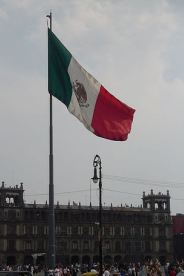
Photo: Zocalo, Mexico City | Luis Lobo Borobia (“Cromo”) | Flickr | Creative Commons

A survey of Mexican media indicates that, despite the considerable attention the U.S. presidential campaign is getting, few Mexicans expect the November election to result in significant shifts in bilateral relations.  Unlike in U.S. coverage of Mexico’s recent presidential contest, the Mexican press has not focused on bilateral drug cooperation.  Some commentators have stated general preferences.  “For the economy, demography, and proximity, a second term for Barack Obama would be good for Mexico,” wrote Enriqueta Cabrera in El Universal.  But most opinionmakers appear focused on particular issues.

There is a broad recognition in Mexico that the campaign is primarily about the U.S. economy, and the potential impact of continued stagnation has driven wide coverage.  The Mexican media are also tracking the candidates’ immigration policies.  President Obama’s executive order to halt deportation of young people who would be eligible for legal status under the long-stalled DREAM Act helped his image in the Mexican press.  The coverage of Republicans has been harsher, with El Universal saying that immigration has been “the taboo topic” for the GOP and that Governor Romney had “forgotten” about Hispanics.  The role of Latinos in the campaigns has drawn attention, mostly positively for the Democrats.

The Mexican media’s treatment of the campaign – and assumption that relations will not change much – reflects the fact that neither American candidate has brought new ideas to the table in one of the United States’ most important bilateral relationships.  On drug policy, bloody continuity seems far likelier than change, regardless of who wins in November.  Although Romney has tipped his hat – as Obama has – to the need to reduce U.S. consumption of narcotics, his main message is “to help Mexico as we did Colombia, with intelligence and surveillance.”  The greater variable is on the Mexican side, where new President Enrique Peña Nieto’s promise to refocus the drug fight on citizen security – instead of cartel interdiction – has drawn criticism from some in the United States.  Allegations that the “old PRI,” tolerant of the drug trade, is back are not far behind and could poison the relationship.

Mexico Elections: Change Ahead in Cooperation with the U.S.?

Photo by: World Economic Forum via Flickr, using a Creative Commons license.

News media are generally predicting a relatively comfortable margin of victory for PRI candidate Enrique Peña Nieto over PRD candidate Andrés Manuel López Obrador and the ruling party PAN’s candidate Josefina Vázquez Mota in Presidential elections next Sunday.  Polls give the PRI candidate (44 percent) a big lead over the PRD (28 percent) and the PAN (25 percent.)

Compared to the weight of Mexico’s problems, the campaign has been light on issues.  Both the PAN and PRI have made vague pledges of continued cooperation with the United States in efforts against the drug cartels.  While current President Calderón’s approach to drug-related violence has resulted in no discernible improvement in security – indeed, some 60,000 people have died since he launched his military-intensive strategy – both Peña Nieto and Vázquez Mota have pledged to triple the Federal police (Vázquez) and create a paramilitary gendarmerie of 40,000 (Peña).  López Obrador has focused on jobs, services, and social issues.

Whoever wins the election, Mexico-U.S. relations do not appear likely to return to the mutual suspicion and tension of years past.  Neither of the three main parties seems overly dependent on nationalism – and anti-gringoism – for political support.  But the bloom is certainly off the much-vaunted U.S.-Mexico “co-responsibility” in the struggle against the cartels, and the next Mexican president almost surely is going to press for an end to the bad deal Mexico gets in the relationship  – the U.S. provides guns and intelligence, and tens of thousands of Mexicans die as drugs flow to eager American consumers.  Calderón’s successor probably will press Washington to prosecute the “war on drugs” in the United States, where the cartels’ footprint is huge, their operations are audacious, and they freely buy thousands of weapons smuggled southbound to kill Mexicans.  Whichever candidate is elected to the U.S. Presidency in November, next year will be a watershed during which the U.S. can either demonstrate a consequential commitment to co-responsibility – by pursuing the cartels in the United States and stanching the flow of guns and bulk cash into Mexico – or Calderon’s successor will unilaterally curtail cooperation.