While Mexican Government Resists Scrutiny on Rights, Citizens Welcome It

By David Crow*

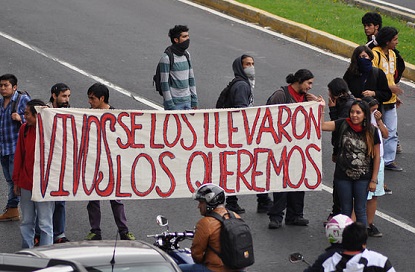
"Do you how many migrants have died this year in Mexico? The government doesn't either." Photo Credit: Grupo Cinco Amnistía Internacional México / Flickr / Creative Commons

“Do you how many migrants have died this year in Mexico? The government doesn’t either.” Photo Credit: Grupo Cinco Amnistía Internacional México / Flickr / Creative Commons

The Mexican government is rejecting recent criticism of its human rights record, but its citizens welcome it as necessary to hold the government to account on its international rights commitments.  Juan Méndez, the UN Special Rapporteur on Torture (and Professor of Human Rights Law at American University) released a scathing report on Mexico last month, revealing that torture continues to be “widespread” and occurs at every level of government and in every security agency.  Mexico’s Foreign Ministry vociferously challenged the report and indulged in ad hominem attacks against Méndez, branding him “unprofessional and unethical.”  According to Méndez, the Mexican government had pressured him to tone down the report’s findings, but he refused because it proffered no evidence that the report was wrong.  Mexico’s strategy of denying the obvious – the ubiquity of torture is well documented – has been a public relations disaster, according to human rights and international relations experts.  It is rooted in a deep-seated historical aversion to outside prying.  The cornerstone of Mexican foreign policy, the 1930 “Estrada Doctrine,” has meant abstaining from passing judgment on other governments – and Mexico expects the same in return.  Though Mexico is signatory to a number of international rights protocols (including the Convention on Torture), the Méndez kerfuffle seems to betray an atavistic revulsion to external scrutiny.

Ordinary Mexicans, however, do not toe the government line on sovereignty.  They reject the notion that rights are conduits for foreign interests, view international organizations favorably, and welcome international oversight – particularly if it’s not from the United States.   The Centro de Investigación y Docencia Económicas (CIDE) in Mexico (in The Americas and the World and the University of Minnesota  (Human Rights Perceptions Polls) teamed up last year to probe Mexicans’ views on human rights.

  • Asked “[h]ow much does promoting U.S. interests have to do with what you understand human rights to be?” Mexicans averaged just 3.0 on a 1-7 scale (anything under 4 indicates disagreement and anything over, agreement).
  • Mexicans also reject the notion that human rights “spread foreign values” (3.2).
  • In contrast, they strongly support the idea that rights “protect against torture and murder” (5.5).
  • Mexicans view international organizations favorably, awarding the United Nations and Amnesty International scores of 65 and 60 (out of 100), respectively – the two highest ratings of all organizations evaluated.
  • And 50% of the public said UN supervision would “help the human rights situation” (36% felt it wouldn’t), while 48% viewed monitoring by the Inter-American Court of Human Rights favorably (35%, unfavorably). Mexicans split over U.S. supervision: just 43% said it would help, compared to 46% who said it wouldn’t.  Nonetheless, that 43% are willing to accept U.S. oversight is perhaps a measure of just how bad things have gotten.

While a “multilateral turn” is occurring among its citizens, the Mexican government can’t seem to break free from the old isolationism, with serious implications for the country.  The horrifying rights situation dominates international perceptions of Mexico and, along with persistent high-level corruption, threatens to derail President Peña Nieto’s reform agenda, scaring off risk-averse potential foreign investors and weakening his hand domestically with Congress and the public at large.  To reverse these trends, Mexico must make strides, quickly, to improve observance of rights.  International pressure – “naming and shaming” of rights violators – is a key ingredient.  As its citizens have done, the Mexican government must embrace, not shun, international involvement.

April 27, 2015

*David Crow is an Assistant Professor in the International Studies Division of the Centro de Investigación y Docencia Económicas (CIDE, Mexico City).

Mexico: Missing Demographic Opportunity

By Yazmín A. García Trejo

Javier Armas / Flickr / CC BY-NC 2.0

Javier Armas / Flickr / CC BY-NC 2.0

Mexico appears to be squandering a historic opportunity to take advantage of the “demographic bonus” represented by its surge in working-age citizens.  The Mexican government estimates that about 32 percent of the Mexican population today is between the ages of 12 and 29 years.  During this demographic bonus, a disproportionate percentage of the population enters the workforce—compared to those who are retired or nearing retirement—and drives economic growth.  Workers passing through this demographic window of opportunity are supposed to generate wealth that will help support a soon-to-be-aging population.  These opportunities don’t come around twice: age profiles in developing countries change quickly, and societies need to make the most of those few years during which the economically active population far surpasses that of the economically dependent.  The portrayal of Mexico as a young country in the media and the adoption of labor reforms in 2012 brought an initial optimism about its ability to take advantage of this bonus, but the current state of affairs casts a shadow over the potential of its young population.  According to a new report from the Organization for Economic Cooperation and Development (OECD), Education at a Glance 2014 Report, 22 percent of people between 15 and 29 years old in Mexico are neither employed nor in education or training.  These “ni-ni’s” represent a demographic bust because of a lack of jobs.

The lack of employment also influences young Mexicans’ attitudes toward education.  According to the OECD, even high educational attainment is not a guarantee of employment in Mexico.  A 2012 report by the McKinsey Center for Government found that only half of educated young people in Mexico believe that their post-secondary education has improved their job prospects.  According to a National Survey of High School Dropouts in 2012, moreover, many young men leave high school to contribute to their households’ finances, and young women quit to take on family responsibilities related to marriage and pregnancy.  Once out of school, they have no option but to participate in low productivity niches of the informal economy—severely reducing the benefits that their entry into the labor market could bring to the national economy.

The fate of young people has profound implications for Mexico’s economic future.  Without a comprehensive plan to expand employment opportunities and access to higher education that enables youth to flourish and lead Mexico into a new stage of development, Mexico will find itself a generation from now with the demographic profile of a developed country—with an aging population producing less but needing more care—but with a middle-income level of wealth.  Budgets will be stretched, and social tensions could be great.  Many of the most capable young people will leave the country for better opportunities.  Young Mexicans appreciate what’s at stake and are using the tools at their disposal to make their voices heard. Lately, student movements have attracted international attention using social media, but it’s far from clear whether the Mexican government and political, economic, and social elites are listening and have the vision necessary to avoid a crisis.

November 4, 2014

Mexico: Is Peña Nieto Missing the Point?

By Fulton Armstrong

Rodrigo Barquera / Flickr / CC BY

Rodrigo Barquera / Flickr / CC BY

The disappearance and apparent massacre of 43 students from a city in Mexico’s Guerrero state is a rude reminder to President Peña Nieto that economic reform and increased foreign investment aren’t enough to help the country overcome the scourge of narcotics-fueled violence.  Federal and State prosecutors agree that the police in Iguala – who, along with the city’s mayor, have strong ties to the Guerreros Unidos cartel – handed the students over to the narcos after a confrontation during a student protest turned violent, already leaving six students dead.  Residents on a nearby ridge noted an increase in police and truck traffic soon after the showdown, but the dozens of bodies uncovered by searchers at mass graves in the area so far have not been the students’.  The mayor and police chief are in hiding, but Federal authorities say three dozen police and accomplices have been arrested and many have confessed.  None apparently has identified where the bodies were dumped.

As the scope of the crime, which occurred three weeks ago, has become clearer, the President’s rhetoric has been increasingly forceful, committing to investigate and bring the perpetrators to justice.  The Federal police have been directed to take control of security in the area and nearby municipalities.  The government announced last Friday, that the “supreme leader” of the Guerreros Unidos has been arrested, while another committed suicide after a standoff with police.  But critics point out the federal authorities’ own problems with corruption, and criticism of Peña Nieto’s efforts to stem the violence has been growing, especially in the wake of his administration’s many self-congratulatory statements about progress in the security area.  A new 5,000-strong national civilian gendarmerie he rolled out in August was ridiculed as too little, too late.  His continuation of his predecessor’s emphasis on arresting drug kingpins – resulting this year in the spectacular arrests of Joaquín “El Chapo” Guzmán Loera (of the Sinaloa cartel), Héctor Beltrán-Leyva (of the Beltrán-Leyva Organization), Fernando Sánchez Arellano (of the Arellano Félix cartel), and others – has failed to eliminate the underlying systems of the drug trade.

During the presidential campaign in 2012, Peña Nieto promised to reduce violence, and his decision not to obsess over the problem – as his predecessor, President Calderón, had – may have given him a respite.  But his administration apparently ignored clear signals of trouble – such as indications that in Guerrero state and elsewhere the cartels’ were expanding and consolidating their influence over government – and the problem seems to be roaring back with a vengeance.  The President’s focus on reforming the economy and attracting foreign investment makes strategic sense, but its long timeline doesn’t help him fight the fires of violence that envelop parts of the country.  There’s also merit in creating something like the gendarmerie and other institutional tools, but that approach seems to ignore that the rot of corruption has deep roots at all levels – federal, state, and local – that must be dealt with and that an elite unit tied to a federal capital hundreds of kilometers away can do little in places like Guerrero.  Calderón had shown the challenge wouldn’t be easy, but Peña Nieto has not yet shown that he – and Mexican society – are up to it either.

October 21, 2014

Mexico and NAFTA: Lessons Learned?

By Robert A. Blecker*

Photo credit: Alex Rubystone / Foter / Creative Commons Attribution-NonCommercial-ShareAlike 2.0 Generic (CC BY-NC-SA 2.0)

Photo credit: Alex Rubystone / Foter / Creative Commons Attribution-NonCommercial-ShareAlike 2.0 Generic (CC BY-NC-SA 2.0)

Twenty years after the North American Free Trade Agreement (NAFTA) went into effect, it is clear that the promises made by Mexican President Carlos Salinas and U.S. President Bill Clinton – that the accord would make Mexico “a first-world country” and halt the migration of Mexican workers to the United States – have not been fulfilled.  In Salinas’s famous words, Mexico would “export goods, not people.”  But the number of undocumented Mexican immigrants in the United States rose by a conservatively estimated 3 to 4 million during the first two decades of NAFTA, and millions more were apprehended at the border and deported.  The reasons why immigration flows accelerated post-NAFTA are not hard to discern.

  • NAFTA fostered integration of Mexican industries into global supply chains targeted at the U.S. market, accelerating Mexico’s transformation into a major exporter of manufactured goods.  Nearly one million manufacturing jobs were created there in the first seven years of NAFTA (1994-2000).  But this job growth was offset by similar job losses in agriculture, and manufacturing employment has fallen by about a half million since 2001.  The net increase in manufacturing employment from 1993 to 2013 was only about 400,000, less than half of the annual growth in the Mexican labor force.
  • Real hourly earnings in Mexican manufacturing were no higher in 2013 than in 1994, and Mexico’s per capita income has stagnated relative to that of the United States.  In 2012, typical Mexican manufacturing workers received only 16 percent as much per hour as their U.S. counterparts, down from 18 percent in 1994.  Even adjusted for the lower cost of living, workers without a college degree in Mexico still earn only about one-quarter to one-third of what they can earn by moving to the United States.

The benefits of NAFTA for Mexico have been attenuated by several factors.  First, Mexican export industries still largely follow the maquiladora model of doing assembly work using imported inputs, so their value-added is only a fraction of the gross value of their exports and they have few “backward linkages” to the domestic economy.  Second, the Mexican government has frequently allowed the peso to become overvalued, making Mexico less competitive and driving multinational firms to locate in other countries.  Third, the tremendous penetration of Chinese imports into all of North America (Canada, Mexico and U.S.), especially since China joined the World Trade Organization in 2001, has displaced significant amounts of actual or potential Mexican exports.  A revaluation of China’s currency, rising Chinese wages and increasing global transportation costs have recently led to some “reshoring” of manufacturing to Mexico, but employment in Mexican export industries has grown only modestly as a result.

The increased integration of North American industries through NAFTA has proved to be a mixed blessing for Mexico.  U.S. booms have helped Mexico grow, but only for temporary periods, and being dependent on the U.S. market has held Mexico back since the U.S. financial crisis of 2008-2009 and the ensuing “Great Recession” and sluggish recovery.  Of course, NAFTA is but one of Mexico’s constraints.  The country’s restrictive monetary and fiscal policies, frequent currency overvaluation, monopolization of key domestic markets and inadequate investments in physical and human capital have also held it back.  The Mexican economy still suffers from a profound dualism, in which only about one-fifth of all non-agricultural, private-sector workers are employed in large, highly productive firms, while the vast majority are employed in small- or medium-sized enterprises with low, stagnant or even falling productivity.  Mexico’s experience under NAFTA certainly argues against portrayals of international trade agreements, such as the proposed Trans-Pacific Partnership, as panaceas for the economic ills of Mexico or any other country.  Whatever one thinks of the “reform” agenda of President Enrique Peña Nieto – which is focused on areas such as energy, education, and telecommunications – these reforms are unlikely to help Mexico break out of its slow growth trap if the foundations of the country’s trade and macroeconomic policies remain untouched.

*Dr. Blecker is a professor of economics at American University.

Brazilian and Mexican Press Criticize Russia but Remain Focused on the Home Front

By CLALS Staff

Embed from Getty Images

Latin America’s low-key reaction to events in Ukraine and Crimea suggests that opinion makers are distracted by domestic issues and perceive such far-off developments as having little bearing on the region.  The Brazilian press has noted the “pathetic and weak” leadership of the United States and Europe and said Russia was creating a “Soviet Union light” with nationalist rather than communist undertones.  Commentators have criticized Russia’s propagandistic narrative, in which criticism of Russian expansionism and interventionism is countered with examples of the American and European bloody history.  They have said Putin’s motives are a clear and explicit demonstration of power, where Crimea is a non-negotiable territory.  They have variously called Obama’s diplomatic responses “flaccid” and his speech about Putin’s motives an “unintelligible declaration.”    Prior to Putin’s military moves, President Dilma Rousseff asserted that the protests in Venezuela are different from those in Kiev, where an “institutional rupture” is taking place, and she has been relatively quiet since.  There have been minor considerations on how a European crisis affects the Brazilian economy, since Europe absorbed 20 percent of Brazil’s exports last year.

The Mexican press has loudly criticized Putin’s actions.   Commentators have described Russia as a “monstrous creature who combines state capitalism and a corrupt oligarchy.”  They have accused Putin of threatening world peace over strategic interests.  They note that Putin holds considerable leverage over Europe (via its supply of vital energy resources) and the United States (in negotiating over Syria and Iran), and they say that he appears likely to get his way in the Crimea.  Some have denounced Putin for attempting to turn the clock back to Russia’s imperialist days, and describe this tendency alongside the United States’ inability to shape events as signs that both are declining world powers.

Both Brazil and Mexico have a full plate of domestic issues monopolizing political attention.  In Brazil, the middle class and elites remain upset about corruption surrounding the ruling PT, and many Brazilians continue to seethe over the scale of public expenditures that have constructed soccer stadiums rather than solid institutions for providing education and health.   The cost of preparations for the World Cup, set to start in three months, as well as the fortunes of the Brazilian team in that crucial tournament, have great implications for the fate of the Dilma administration.  Insofar as international issues reach the national agenda, Dilma appears most concerned with domestic political developments in Venezuela, where UNASUR has offered to play a mediating role.  In Mexico, President Peña Nieto and the media appear seized with security issues – ranging from the spectacular arrests of drug traffickers to the troubling emergence of “self-defense” groups – and the president’s ambitious economic reform agenda.  The Cold War-style East-West maneuvering over Ukraine hasn’t registered deeply in either country or elsewhere in Latin America.

Latin America Skeptical of U.S. Immigration Debate

By Aaron Bell

Photo Courtesy of Larry Engel

Photo Courtesy of Larry Engel

Latin America’s subdued response to the immigration reform debate in the United States reflects a region-wide skepticism buttressed by the recent history of unfulfilled expectations.  Mexican media and a handful of Central American counterparts across the board have identified the Republican Party as the primary impediment to progress.  Conservative editorialists in the region, many of whom denounce President Obama and the Democrats as political opportunists rather than legitimate advocates for immigration reform, have also expressed frustration with the Republicans for not coming up with a better approach.  In particular, they think the party’s digging its own political grave by failing to rein in members and supporters who smear Hispanic immigrants as a threat to the ethnic identity of the United States.  Some have fond memories of Ronald Reagan’s 1986 Immigration Reform and Control Act, which balanced security and enforcement with compassion and amnesty for undocumented migrants.

Mexico’s El Universal has been one of the most frequent contributors to the discussion of immigration reform, particularly with editorials giving greater attention to the human rights aspect of the debate.  They’ve called for reforms so that undocumented workers can “come out of the shadows,” so that families can stay together without fear of deportation, and so that harsh punishment meted out to undocumented workers caught crossing the border can come to an end.  The Mexican government has been relatively quiet on the issue of immigration reform in the previous decade, with the exception of a complaint lodged against Alabama’s HB 56, which requires police to take certain actions if they have “reasonable suspicion” that an immigrant is in the United States unlawfully.  But last summer Foreign Minister José Antonio Meade took to the pages of El Universal to complain that proposed enhanced border security measures were a detriment to regional development – and not a solution to immigration problems.

Public opinion data on Latin American views of the reform debate is limited, though circumstantial evidence suggests a connection between reforms and overall views of the United States.  Pew Research found that public opinion of the United States among Mexicans dipped sharply following the passage of Arizona SB 1070 in 2010, which laid the groundwork for HB 56.  Those numbers have since rebounded, with 66 percent of those polled holding favorable views of the United States in 2013, when many perceived that the Obama administration would achieve a positive outcome in the reform debate.  Although critical of Republican approaches, commentators who support reforms are not inherently in favor of the Democratic Party.  Only half of those Mexicans polled held a favorable view of the Obama administration, and some commentators have noted the high number of deportations on Obama’s watch.  For Latin American observers, humane and fair treatment for migrant workers and immigrants is the primary concern – and neither party appears poised to deliver.  The region’s skepticism that this round of debate over immigration reform will produce anything new appears at the moment to be warranted. 

Mexico: Policy on “Auto-defensas” Makes Things Worse

By Steven Dudley*

Photo credit: Pedro Fanega / Flickr / CC BY

Photo credit: Pedro Fanega / Flickr / CC BY

In a few short months, Michoacán’s “self-defense” groups have gone from being the Mexican government’s drunk uncle to being its strategic partner – underscoring what is wrong with the current government’s counterdrug strategy.  The vigilante groups are a multi-headed beast, born from sentiments that range from despair and frustration to opportunity.  Desperate small farmers and shopkeepers created some of the units because they’d been victimized by the “Knights Templar,” a splinter group with deep roots in the drug trade that has literally raped and pillaged their villages.  Frustrated agricultural and mining interests have funded their own “self-defense” groups.  And opportunistic rival criminal groups also seek to kill the Knights to take new, or reclaim old, territory.   Mexico’s federal and local governments are to blame for this chaos.  Drug-fueled corruption, ineptitude and lack of political will on the federal level have left the locals to fend for themselves, often leaving local politicians and security forces to align with the criminal interests, including the Knights Templar.

The federal government’s feeble and disjointed attempt to address the vigilantism is leading only to more confusion, chaos and most likely bloodshed.  In late January, it created a framework that legalized the organizations, placed then under one moniker – Rural Defense Units – and asked members to register themselves and their weapons.  But the framework makes no mention of their purview, jurisdiction, proposed length of service, nor does it clarify controls on their automatic and other sophisticated weaponry, which, under current Mexican law, requires military authorization.  Some of the groups accepted the government offer, including those that rode into the Michoacán city of Apatzingán last weekend to “take back” the city from the Knights.  More importantly, other vigilante groups have flat out refused the government.  Further fueling chaos, the federal government is applying a far harsher, more statist approach in the neighboring state of Guerrero, dispatching troops to stop the spread of “self-defense” groups that may have a longer history and more justifiable constitutional mandate than those in Michoacán.

Vigilante violence will undoubtedly continue to grow, as it becomes clearer that the federal government has no idea how to deal with it.  It is failing to address one of the root causes of the problem: illegal drugs have led to spectacular earnings that have made corrupting local and national officials easier; given criminal groups access to better training and weaponry to challenge the state and rivals; and created local, powerful criminal economies where perhaps they did not exist in the past.  In fact, no government official, vigilante group or other party in this conflict has even mentioned illegal drugs.  One vigilante told InSight Crime’s Mexico correspondent flat out: “We’re not against drug trafficking; we’re against organized crime.”  The causes of the violence are complex, but one cannot be addressed without addressing the others, and the Mexican government’s disjointed response is not pushing the country any closer to a solution.

* Steven Dudley directs InSight Crime and is a Senior Fellow at the Center for Latin American and Latino Studies.

Mexico’s Situation after Peña Nieto’s First Year at the Helm

By Manuel Suárez-Mier

President Enrique Peña Nieto / Photo credit: World Economic Forum / Foter / CC BY-NC-SA

President Enrique Peña Nieto / Photo credit: World Economic Forum / Foter / CC BY-NC-SA

After Enrique Peña Nieto’s first full year in office, the situation and prospects for his country are mixed. On the positive side, his structural reforms encompassing labor, education, taxation, finance, telecommunications, anti-monopoly and energy – the crown jewel – are unexpected and sweeping successes. Three previous administrations had failed to get such reforms through Congress in the preceding 18 years. The reforms, the success of which will depend on the implementing legislation, have attracted worldwide attention, generating a “Mexican moment,” and increasing substantially the flows of foreign direct investment.

On the dark side, however, Peña Nieto’s performance has been less than stellar regarding the pacification of the country from the violent onslaught over the last decade at the hands of bands of narcotraffickers. He changed the emphasis of the war on drugs from the stubborn fixation that it had in the Calderón administration (2006-2012), and he altered the terms of cooperation with the United States on this issue.  But he has been unable to stem the violence, which in some cases has worsened.  In the southwestern state of Michoacán, a new actor has emerged besides the narco and government forces: self-appointed groups of armed citizens that are battling the criminals while denouncing the government’s ineffectiveness.  Simply declaring victory in the war on drugs and moving on to other issues has not stemmed the violence.  Many observers believe that Peña Nieto’s security team is not up to par and that tolerating, and more recently collaborating, with the paramilitary groups is not the solution to the problem – and indeed will only worsen it down the road.  Also the terms of cooperation with the United States on the war on drug trafficking organizations are not clear yet.

It is too soon, of course, to declare victory on the reform front since the way these changes are implemented will determine their success or failure. We have had “Mexican moments” in the past, especially after NAFTA was approved in 1994, just to see them wiped out by government mismanagement and crises. But it is also too early to declare the final failure of the campaign to pacify the country since there have been some bright spots – notably in Ciudad Juárez. Coordination among security agencies has improved and the gendarmerie, a special rural federal police force that would replace the army in restoring the peace where violence rages, is being trained and will begin operations with 5,000 men in July.  But the appearance of paramilitary “self-defense” groups and the apparent alliance that they are forging with the federal government are deeply troubling considering what we have seen in other latitudes – especially Colombia – when such groups thrived. These contradictory trends explain why many people are enthusiastic about Mexico’s economic future while Peña Nieto’s approval ratings remain soft after a year of slow growth, tax increases, and unabated violence.

*  Manuel Suárez-Mier is Economist-in-Residence and Director of the Center for North American Studies in American University’s School of International Service.

Mexico: Reform Promises Boost in Energy

By Amy Ruddle

Photo credit: Wonderlane / Foter / CC BY

Photo credit: Wonderlane / Foter / CC BY

Landmark reforms passed by the Mexican Congress last month – amendments to three articles of the Constitution – allow private investment in the country’s energy industry for the first time in 75 years. They open the door for international companies to enter into joint ventures with Petróleos Mexicanos (PEMEX), with the first round of contract bidding slated for 2016 – and increased oil and gas production as soon as 2018. PEMEX will remain state-owned and all hydrocarbons in the ground will continue to belong to Mexico, but private companies will gain rights to oil at the wellhead and be permitted to participate in site exploration, gas and oil production, seismic analyses, and the transportation, marketing and refining of these resources. They will also be allowed to bid for rights to conduct offshore and shale exploration.

Although the oil industry is expected to attract billions of investment dollars – PEMEX signed a cooperation contract with Russia’s Lukoil last week for an undisclosed amount – Mexican officials say they’re not rushing into deals. Undersecretary of Hydrocarbons Enrique Ochoa Reza recently said that the government is proceeding carefully, taking cues from Brazil and Norway as examples of how energy reform can be executed successfully. “In order to do it right – and we are committed to doing this – we need to do it one step at a time,” he said. The Mexican government’s hope is to return oil production (roughly 3 million barrels per day in 2012) to its 2000 levels (3.5 million) by 2025, and possibly 4 million barrels in the distant future.  In addition to creating jobs, the government projects the reforms will increase GDP by 1 percent by 2018, and by 2 percent by 2025. Increased revenues should stabilize budgets, fund a long-term savings mechanism, and eventually support long-term projects including the universal pensions system, scholarships, and science and technology research.

The next hurdle in energy reform will be passage of secondary legislation over the next five months — and faithful implementation. The transparency mechanisms written into the constitutional reforms, including public bidding rounds, transparency clauses in energy contracts, external industry audits, and the full disclosure of all payments related to oil and gas contracts are essential to success, but overcoming the corruption and inefficiency that have plagued PEMEX will require sustained effort. In addition, President Peña Nieto still has to sell these changes to the Mexican people. Tens of thousands of citizens took to the streets to protest the changes in early December, and opinion polls show that many, if not most, Mexicans are not in favor of them. Polls conducted by Vianovo in September (still deemed to be among the most accurate) show that only 33 percent of respondents favor profit-sharing contracts between the government and private companies to explore and produce hydrocarbons, although 53 percent were at least somewhat in favor of the energy reforms overall. Unions are upset too, as the union representing PEMEX’s 140,000 employees has now been eliminated from the company’s board, and private firms benefiting from the reforms may create labor contracts without union involvement.

Mexican Judicial Reform: Example of the Need for a Closer Look

By Todd A. Eisenstadt

Foro: el Nuevo Sistema de Justicia Penal, a un Año de su Implementación en Baja California, con la ponencia: “Hacia una Justicia más Transparente” /Photo credit: Gobierno de Baja California  / Flickr / CC

Foro: el Nuevo Sistema de Justicia Penal en Baja California / Photo credit: Gobierno de Baja California / Flickr / CC

Mexico’s judicial reforms have proceeded at an uneven pace in each of the country’s 32 states since they were approved as a constitutional amendment in 2008.  The new and spacious “tower of justice” in Baja California shimmers in the desert sun, an outward sign of the $100 million-plus program that is the centerpiece of the state’s “law and order” administration.  However, halfway across Mexico, in the state of Puebla, litigators, police, and judges – untrained in the new judicial system they are implementing – watch their first important case, a manslaughter conviction, give way to a plea bargain after a series of errors.  Morelos, Oaxaca and other states do not have inter-connected computer systems for prosecutors and defenders, and Nayarit has not even passed a state-level criminal justice code to bring that state up to compliance with the 2008 reforms.  And Chihuahua, where Ciudad Juárez in 2011 held the distinction of being the most violent city in the world, a punitive “counter-reform” reducing the rights of the accused has set back that state’s reform efforts.

Progress on the reforms has been stymied by lack of a litigation tradition, a failure in interagency cooperation, a shortage of technology and resources, a lack of political will, and a lack of public support.  Mexico’s drug-related violence has put it at the center of hemispheric debate on judicial reform, but even heralded reforms of the 1990s, such as in Argentina, Bolivia, Panama, and Peru, have been unevenly implemented.  Chile’s reforms, widely seen as successful, were made possible by overcoming inertias, including judicial resistance to the creation of an adversarial relationship between defense and prosecution that moved judges into an institutionalized neutral position.  Legal scholar Mauricio Duce also argues that the retooling of Chile’s Ministerio Público – an autonomous body that functions as a fiscalía or justice ministry – was crucial because the institution became the “engine” of the reforms.

Each country brings its own history, culture and institutional strengths and weaknesses to the challenge of judicial reform. With the results of the first generation of reforms so mixed, a rigorous review of  what has worked – and not – in Latin America, Africa, or Eurasia and elsewhere can help overcome these dramatic shortcomings in the implementation of  reforms. The political commitment to reform is important, but understanding the political contexts and legal/administrative components in each case is also essential for improving the rule of law and accountability, deterring violent crimes, improving human rights recognition, economic development, and establishing security and law and order. When academics, program managers, and political leaders understand why a country like Mexico can have such vastly varying results from the same reforms, they can all take a giant step toward achieving more lasting and positive change.

Todd A. Eisenstadt is a professor of government at American University.