Trapped by Debt? China’s Role in Ecuador Oil Dilemma

Photo credit: Xinhua, https://images.app.goo.gl/rBnL1kuwMixrzmCh7

Ecuador’s struggle to move beyond oil is deeply tied to its financial obligations—especially to China. Over the past 15 years, oil revenues have not only funded public spending but also serviced billions in external debt, locking the country into a path of continued extraction. This tension was already visible when the Yasuní-ITT Initiative collapsed in 2013: efforts to protect the rainforest were ultimately sidelined as social spending and budgetary needs remained—if not deepened—the country’s dependence on oil income. A decade later, Ecuadorians voted to halt drilling in the same region, but implementation has slowed. While officials have cited fiscal pressures and legal complexities, it is also clear that a significant portion of Ecuador’s oil production remains tied up in long-term prepayment arrangements—including those linked to past oil-for-loan agreements with Chinese lenders. 

Following Ecuador’s 2008 debt default, China quickly emerged as the country’s primary financier. According to the China-Latin America Finance Database, since 2010 Chinese policy banks—primarily China Development Bank and Eximbank—provided over $18 billion in loans to Ecuador. Many of these were backed by future oil shipments. The structure followed a two-track model: financial agreements with policy banks, and parallel supply contracts with PetroChina or Unipec. In practice, this meant that while Chinese banks lent Ecuador billions in cash, PetroEcuador committed to deliver oil to Chinese traders as repayment—regardless of market prices at the time of shipment. This arrangement locked in large volumes of crude in exchange for upfront cash. By 2013, nearly 90% of Ecuador’s oil exports were committed under term contracts with Chinese buyers, giving Beijing outsized leverage over the country’s oil trade. 

These deals have had long-lasting implications. By committing barrels years in advance, they reduced Ecuador’s ability to adjust production in response to new priorities—such as conservation mandates or global price shifts. Pricing terms further undercut the country’s earnings. Although contracts referenced international benchmarks like West Texas Intermediate (WTI) or Brent, additional fees, quality discounts, and opaque delivery terms often meant Ecuador received significantly less than market value. In fact, in 2017 Petroecuador sought to renegotiate oil-for-loan contracts with Chinese firms precisely to secure better pricing and reduce the volume of barrels exported under onerous terms. A 2022 audit cited by Infobae estimated that Ecuador lost nearly $5 billion in revenue due to oil sold at below-market prices under those contracts; up to 87% of crude exports were tied to formulas that paid less than the spot market could have yielded. 

Independent investigations by journalists have also found that Chinese firms profited by reselling Ecuadorian crude at higher prices, while Petroecuador captured only a portion of the potential revenue. Contractual provisions—such as repayment accounts held abroad and sovereign immunity waivers—further limited Ecuador’s flexibility to renegotiate terms without risking legal or financial penalties. 

In this context, many of the barrels extracted today are already earmarked through older pre-sale deals. This complicates efforts to curb drilling, even when doing so in response to a clear public mandate. Contractual rigidity—not just fiscal reliance—has narrowed the government’s policy space. Reversing course isn’t just a matter of political will; it requires untangling years of embedded financial commitments. 

The 2022 debt restructuring with China offered a glimpse of what greater flexibility can unlock. By renegotiating loan maturities and rescheduling oil deliveries, Ecuador freed up dozens of cargoes that had been tied to repayment. Instead of shipping them under discounted terms, the government was able to sell them on the open market—during a favorable price window—generating millions in additional revenue. The volume of oil remained the same. What changed was when and how it could be sold. This shift in marketing autonomy directly expanded Ecuador’s fiscal space, without requiring increased production or new drilling. 

While extractive arrangements remain deeply entangled with prior commitments, recent developments suggest Ecuador is gaining modest room to pursue a different path. In mid-2025, the country secured $400 million from China’s PowerChina—part of a broader $1 billion renewable energy package that also included Spanish financing—to support solar and energy storage projects. This marks a shift in Chinese engagement away from fossil-backed infrastructure toward cleaner investments. At the same time, Ecuador has turned to debt-for-nature swaps to ease financial pressures without expanding oil production. Although these were led primarily by multilateral lenders and NGOs, they reflect a broader shift. The 2023 Galápagos blue bond refinanced $1.6 billion in debt to fund long-term marine conservation, while a second swap in 2024 unlocked $460 million for Amazon protection. Together, these efforts point to the possibility of more climate-aligned partnerships—offering early glimpses of how Ecuador, with support from external actors, including China, might gradually move beyond extractive dependence. 

Three lessons stand out. First, oil-for-loan deals may offer quick liquidity, but they impose long-term constraints that complicate democratic and environmental decision-making. Second, transparent and flexible oil sales consistently outperform opaque pre-sale contracts weighed down by discounts and delivery restrictions. And third, while China’s engagement has historically centered on extractive finance, recent shifts—such as investment in renewable infrastructure—suggest there is room for more climate-aligned and cooperative models. Deepening this kind of engagement, alongside support for flexible financing tools like debt-for-nature swaps, in line with its constitutional commitments, could help Ecuador reduce oil dependence.  

There is no easy path out of an oil-dependent economy for Ecuador. Oil still plays a major role in the country’s budget. But the choice is no longer between drilling or defaulting. The 2022 restructuring showed that smarter financing—focused on freeing future production from rigid terms—can create space to act on social and environmental goals. Greater control over the extractive model would not mean extending Ecuador’s reliance on oil, but rather using what production remains in a more strategic and limited way. This includes regaining flexibility over how and when oil is sold and ensuring that any revenues are used to actively support, rather than delay, the transition toward a more diversified and sustainable economy. The 2023 vote to halt oil drilling in the Yasuní reserve signaled a shift in public priorities. Whether Ecuador—and its partners—can align financing with that vision will determine whether Yasuní becomes a turning point or just another deferred promise. 

Edgar Aguilar is a Researcher at the Center for Latin American and Latino Studies and a graduate student in International Economics at American University 

Edited by Rob Albro, Associate Director, Research, at the Center for Latin American and Latino Studies 

*This post continues an ongoing series, as part of CLALS’s Ecuador Initiative, examining the country’s economic, governance, security, and societal challenges, made possible with generous support from Dr. Maria Donoso Clark, CAS/PhD ’91. 

Beyond the ITT Initiative: How Ecuador’s Civil Society Reclaimed the Future of Yasuní

By Edgar Aguilar

_RDL8169

Photo from flickr

The failure of Ecuador’s Yasuní-ITT Initiative in 2013—an internationally recognized proposal to leave oil in the ground in exchange for global compensation—sparked a nationwide civic response. Civil society actors mobilized not only to oppose oil drilling in Yasuní National Park but to redefine what environmental governance could look like in Ecuador’s constitutional context.

Indigenous federations condemned threats to ancestral territory and the rights of uncontacted peoples. Environmental organizations cited Yasuní’s status as one of the most biodiverse regions on Earth. Youth activists framed the issue around climate justice and generational rights. Meanwhile, oil producing communities, local governments and the state oil company defended drilling as a source of critical state revenue and social investment.

In this context, YASunidos was born. Formed in 2013 by a coalition of artists, students, lawyers, environmentalists, and Indigenous youth. YASunidos set out to trigger a national referendum to halt extraction in Block 43. By early 2014 it collected over 756,000 signatures—well above the legal threshold. Yet Ecuador’s National Electoral Council invalidated more than half on technical grounds, effectively blocking the referendum.

Over the next decade, YASunidos evolved. Faced with institutional barriers, the group pursued a multi-pronged strategy: legal challenges in domestic and international courts, cultural campaigns, public education, and transnational alliances. Their demands were anchored in Ecuador’s 2008 Constitution, which enshrines both the Rights of Nature and participatory democracy, a globally unique legal foundation that positioned extraction in Yasuní not only as an environmental threat but as a constitutional violation.

Crucially, YASunidos helped keep the issue in the national spotlight. Even when the media cycle moved on or administrations changed, they maintained public pressure. Through sustained outreach and alliances with indigenous federations, human rights defenders, and global environmental networks, the group broadened its message and constituency. Rather than frame Yasuní as a niche ecological issue, they positioned it as a symbol of the country’s democratic and development crossroads.

That civic pressure paid off. In May 2023, Ecuador’s Constitutional Court approved a binding referendum on oil drilling in Block 43. On August 20, nearly 60 percent of Ecuadorian voters opted to halt extraction, which marked the first time a national electorate democratically voted to leave oil in the ground. The result was globally unprecedented, representing a major step in participatory environmental governance.

Still, the vote revealed important nuances. In oil-producing provinces like Orellana and Sucumbíos, where jobs and infrastructure depend on extraction, a majority voted to continue drilling. These regional differences underscored a key tension: while many voters perceived few benefits from extractive activity despite its costs, others remain economically dependent on it. Civil society’s challenge was—and remains—to articulate a just transition that resonates across these divides.

Following the vote, the Ministry of Energy announced plans to decommission the Ishpingo B-56 well, beginning a phased shutdown of Block 43. The court-mandated timeline requires full dismantling within one year, though the Energy Ministry estimates the process will take five years and cost over $1.3 billion. Whether the state follows through remains uncertain, which makes the ongoing need for civil society oversight critical.

The Yasuní case shows how civil society can do more than resist. It can reshape national debates. YASunidos didn’t just oppose drilling; the coalition reframed it as a matter of constitutionality and democratic participation. By grounding its message in Ecuador’s legal framework and sustaining civic pressure over time, it turned an aborted referendum into a test of the country’s democratic and legal architecture.

The coalition’s success also underscores the value of adaptability. When formal avenues were blocked, YASunidos shifted tactics. They combined litigation, media, and grassroots organizing, without losing focus. Few civic movements sustain relevance over a decade, let alone drive constitutional interpretation and national decision-making. YASunidos did both.

Finally, the decade-long social discourse around Yasuní demonstrates that public debate matters. It was not just a legal battle, but a cultural and moral one about how Ecuador defines development and whose voices count. The 2023 referendum wasn’t the end of that conversation, but a civic milestone in a much longer struggle.

As Ecuador begins to implement the results of the referendum, civil society remains a critical force not only in holding the government accountable but in imagining and advancing alternatives that confront the complex realities on the ground. In many oil-producing regions, communities have received some benefits—such as jobs or infrastructure—but have also shouldered the heaviest environmental and health burdens. The perceived gains have often been limited, unevenly distributed, and insufficient to justify the long-term damage. YASunidos demonstrated that civic engagement can do more than just oppose extractivism. It can defend rights, reframe national debates, and build lasting democratic momentum.

Edgar Aguilar is a Researcher at the Center for Latin American and Latino Studies and a graduate student in International Economics at American University

Edited by Rob Albro, Associate Director, Research, at the Center for Latin American and Latino Studies

*This post continues an ongoing series, as part of CLALS’s Ecuador Initiative, examining the country’s economic, governance, security, and societal challenges, made possible with generous support from Dr. Maria Donoso Clark, CAS/PhD ’91.

Balancing Conservation and Extraction: Governance Challenges of Ecuador’s Yasuní-ITT Initiative

By Edgar Aguilar

Gas flaring at oil drilling site on the Napo river, Amazone, Ecuador (image: flicker)

In 2007, Ecuadorian President Rafael Correa launched the Yasuní-ITT Initiative, named after the Ishpingo, Tambococha, and Tiputini oil fields located within Ecuador’s Yasuní National Park in the Amazon. Correa novel proposal was to leave the approximately 846 million barrels of oil in these fields unexploited in exchange for $3.6 billion in international compensation—half the projected revenue from these reserves. This plan aimed to preserve one of the world’s most biodiverse regions and respect indigenous territories while addressing Ecuador’s economic needs. However, contradictions in Correa’s governance—marked by ambitious social spending funded by extractive industries—highlighted the difficulty of reconciling economic development with long-term environmental commitments.

During Correa’s tenure, Ecuador saw a significant increase in public spending, rising from 20 percent of GDP in 2004 to 43 percent in 2014. This expansion was largely financed through renegotiated oil contracts and an increased state share of oil revenues. Social investments, such as doubling government health expenditures from 2006 to 2016, led to substantial improvements in poverty reduction and infrastructure development.

However, this economic model deepened Ecuador’s reliance on oil, which highlighted the problem of directly linking social progress goals to environmentally destructive practices. While Correa promoted the Yasuní-ITT Initiative internationally, Ecuador simultaneously expanded oil exploration elsewhere, such as in the Amazonian blocks outside Yasuní. Oil concessions in the Amazon in 2007 covered 5 million hectares; 4.3 million of them conceded to foreign companies. In 2011 these numbers doubled with the incorporation of 20 more oil blocks. This inconsistency weakened the credibility of the initiative, making it difficult to secure international funding.

From the outset, the initiative faced skepticism. Donor countries were reluctant to provide funds without enforceable guarantees that future Ecuadorian administrations would uphold the agreement. Additionally, the initiative lacked a clear legal framework to ensure that the pledged conservation funds would lead to sustained economic diversification. Consequently, by 2013 the initiative had secured only $116 million in pledges, with a mere $13 million received, falling significantly short of the $3.6 billion target. The global oil market likely also played a role. In 2014 a sharp decline in oil prices significantly impacted Ecuador’s revenues, further reducing the feasibility of keeping Yasuní’s reserves untapped. With mounting fiscal deficits, Correa’s administration abandoned the initiative in 2013, citing insufficient international contributions.

As Yasuní ITT illustrates, Correa’s government struggled to maintain a coherent environmental policy, oscillating between conservation rhetoric and extractive expansion. This eroded trust among both domestic and international stakeholders. While his administration positioned itself as a defender of indigenous rights and nature, its policies often prioritized oil revenues over sustainability.

The abandonment of the initiative’s conservation goals sparked resistance from environmental and indigenous groups, leading to the formation of YASunidos, a coalition of youth activists, environmentalists, and indigenous advocates. Their activism sought to hold the government accountable, culminating in a push for a national referendum. Although the Ecuadorian government initially obstructed these efforts, the movement continued to pressure policymakers for conservation-oriented reforms.

In an August 2023 national referendum, 60 percent of voters supported the cessation of oil drilling in Yasuní National Park. In response to the vote, the government initiated plans to shut down oil operations in the Ishpingo, Tambococha, and Tiputini fields. The Energy Ministry announced the closure of the Ishpingo B-56 well, with the full decommissioning process expected to take over five years and cost more than $1.3 billion. However, concerns have been raised regarding government compliance, since the court mandated that the oil industry infrastructure be dismantled within a year.

The failure of the initiative led to the expansion of oil drilling in Yasuní National Park. Oil extraction has contributed to deforestation, biodiversity loss, and contamination of water sources, threatening endemic species and fragile ecosystems. Indigenous communities have faced territorial encroachment, social displacement, and health crises linked to pollution.

The Yasuní-ITT project illustrates the complexities of balancing economic development with environmental sustainability. Ecuador’s experience highlights the contradictions within populist environmental policies and discourse—where ambitious social programs depend on extractive revenues, ultimately undermining conservation efforts. While the 2023 referendum offers a renewed opportunity for environmental protection, long-term success will depend on sustained public pressure, policy consistency, and international cooperation.

To increase the likelihood of success 1) governments must credibly align environmental with economic policies. Contradictory approaches undermine long-term policy effectiveness. 2) Future conservation-based economic models should incorporate strong institutional safeguards, cross-administration continuity, and financial incentives for long-term compliance. 3) Reducing dependence on oil requires long-term investment in alternative sectors such as renewable energy, ecotourism, and technology.

Edgar Aguilar is a Researcher at the Center for Latin American and Latino Studies and a graduate student in International Economics at American University

Edited by Rob Albro, Associate Director, Research, at the Center for Latin American and Latino Studies

*This post continues an ongoing series, as part of CLALS’s Ecuador Initiative, examining the country’s economic, governance, security, and societal challenges, made possible with generous support from Dr. Maria Donoso Clark, CAS/PhD ’91.

The Ongoing Saga of a Chinese Infrastructure Project in Ecuador

By Julie Radomski, American University

Photo credit to Julie Radomski

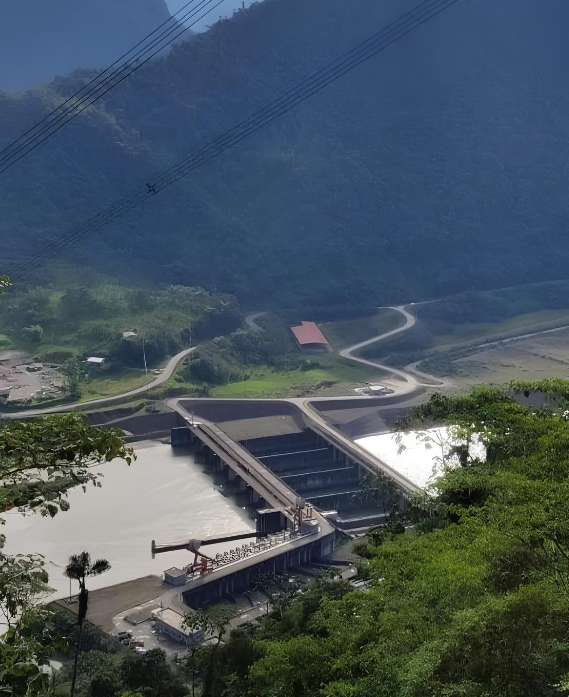
Ecuador’s Coca Codo Sinclair (CCS) hydroelectric plant has become an infamous symbol of the controversies associated with Chinese development finance in Latin America. As such, the project’s performance has outsized implications for China-Latin America relations. At the same time, CCS illustrates the inherent complexities of large infrastructure projects, where political, environmental, and technical issues can blur the lines between success and failure.

When it was inaugurated by Presidents Rafael Correa and Xi Jinping in 2016, CCS was celebrated as a triumph of South-South cooperation between Ecuador and China, and a contribution to sustainable green growth in Ecuador. Yet nearly eight years after this inauguration, the project has yet to be formally “received” by the Ecuadorian government from the contractor, Chinese state-owned enterprise Sinohydro. The reason for this prolonged state of limbo comes down primarily to fissures present in the powerhouse distributor pipes: despite repeated welding, they have yet to be fully repaired, and a durable fix may not be possible. In addition, the project’s sediment removal mechanisms have proven dysfunctional, leading to frequent pauses in the project’s operation over the past year. Separately, severe regressive erosion on the Coca River is advancing towards the dam and may trigger its collapse. The erosion advanced 1.2 kilometers upriver over the course of three days last month, and is currently located 6 kilometers from the dam.

For these reasons CCS is frequently cited by U.S. media and politicians as evidence of the threat posed by Chinese development cooperation, namely that it will saddle countries with debt, corruption, low-quality projects, and environmental damage. Meanwhile, the project’s protagonists point out that CCS produces 20-30% of Ecuador’s energy consumption on a daily basis, rendering it indispensable — hardly a white elephant. But closer examination of the details of this behemoth project makes clear that neither pro- nor anti-Chinese discourses on “China in Latin America” ring perfectly true.

Negotiations are reportedly underway between the Ecuadorian government and Sinohydro to conclude a deal in which Ecuador would sign over operation of CCS to Sinohydro in exchange for “liquidity.” Under such a deal, Sinohydro would be responsible for CCS’s repair, operations, and administration and would sell electricity back to the Ecuadorian grid. The concessioning of CCS to Sinohydro is just one of the many loose ends that could once again rewrite the story of this contentious megaproject. Beyond this hypothetical deal, the international arbitration case between the Ecuadorian state and Sinohydro has yet to reach a conclusion. The regressive erosion of the Coca River is anticipated to progress further upriver towards the diversion dam within the next five years. A corruption case initiated by the Attorney General’s office could result in the conviction of four Sinohydro representatives and a former Chinese Ambassador, as well as former Ecuadorian President Lenin Moreno. Some combination of these various developments will continue to make CCS headline news in Ecuador and abroad — and in so doing, they will rely upon prevailing narratives about China-Latin America relations.

CCS provides a vantage point for considering the longer-term effects of development cooperation between China and the region. Looking forward, while the outcomes of CCS are as of yet indeterminate, the project itself has had important implications both for Ecuadorians and for “China’s rise in Latin America” writ large. Chinese economic relations with Latin America have moved away from large state-to-state loans backed by the policy banks. This is due at least in part to the high reputational costs of scandals associated with projects like CCS. While the influence of Chinese actors on Latin American political economies has by no means waned, it now takes the form of Chinese companies’ direct investments or bidding on project contracts instead of by securing market access through granting large loans.

Nevertheless, even with the China-Latin America development relationship moving on from big infrastructure projects like CCS, the project’s politics still hold considerable weight. CCS demonstrates that infrastructure is enduring even as geopolitics can be fickle; its fate will continue to shape China-Latin America relations as a function of the still-ongoing natural and political processes enumerated above. Reductive pro- and anti-China discourses are only one part of the many factors shaping the outcomes of projects like CCS, including continuously evolving local ecologies and domestic political dynamics. In an age of great power competition and the “infrastructure state,” we must pay attention not only to the politics and capital that bring projects into being but also to how they evolve after they are ostensibly completed.

This piece can be reproduced completely or partially with proper attribution to its author.

Ecuador: The Formation of Gangs in Prison Systems

By Erica Criollo

January 17, 2024

Solidarity rally in Queens, New York by members of the Ecuadorian diaspora. Photo by Erica Criollo 

On January 7th, 2024, José Adolfo Macías Villamar, alias“Fito,” the leader of one of Ecuador’s most prominent gangs, was found missing from his luxury prison cell the day he was meant to be transferred to a maximum-security prison to be held in isolation.

While Macías began his 34-year sentence in 2011, he remained the leader of the criminal gang, Los Choneros, due to their longstanding influence over government officials and extensive illicit drug networks. Following his escape, the country descended into chaos resulting in President Daniel Noboa declaring that the country was under “armed internal conflict” to mitigate gang wars and the killings of police officers.

This presidential declaration has prompted questions as to how Ecuador could have experienced such a sudden upsurge in gang violence. Along with government corruption, the escalation can be traced to the gradual formation of gangs dominating prison systems over several years. 

 In 2003, Los Choneros, who are associated with Mexican and Colombian cartels, took control of the drug trafficking route in the province of Manabí, Ecuador, from where drug shipments were sent to Mexico, the United States, and several European countries. Transnational networks and external groups engaged in the illicit drug trade utilized Ecuador’s coasts, leveraging its access to major shipping routes and ports to transport illicit drugs across international borders. 

Furthermore, Ecuador’s adoption of the U.S. dollar, coupled with inadequate enforcement and prevalent corruption, has facilitated money laundering by drug traffickers through industries such as real estate, illegal mining, and the illicit timber trade. This impacted the way corruption played a role in the country’s efforts to combat such illicit activities. 

When Former President Rafael Correa took office in 2007, he gained public favor through his initiative to remove the United States from the Manta military base from which the U.S. has been controlling anti-drug efforts with targets against the Colombian illicit drug trade since 1999.

However, following the U.S. withdrawal from the Manta military base, the country witnessed a worsening of drug trafficking. Former President Correa failed to stop the activities of groups like Los Choneros and other Mexican cartels, allowing the unhindered transportation of drugs to and from Ecuador.

Before Macías, Los Choneros was led by Jorge Luis Zambrano, alias “Rasquiña,” who, while incarcerated, directed orders alongside arrested gang members. By 2010, the group had transitioned to operating within prison systems and communicating with members on the outside. This operational shift steered the group away from international drug trafficking, focusing instead on micro-trafficking, contract killings, extortion, and contraband activities.

Emerging factional gangs, including Los Choneros, Gorras, Lagartos, Latin Kings, and the Cubanos, have become more extensive and aggressive, leading to deadly conflicts in prisons. In 2019, a brutal fight claimed the lives of several inmate gang members at Penitenciaria del Litoral, and in 2021, a prison riot resulted in the deaths of 119 inmates in the same facility. These deviations of gangs were also a result of government initiative in dismantling gang groups through the transfer of leaders between prisons, but it only multiplied the presence of gang wars.

Following Zambrano’s death in 2020, Macías obtained leadership, triggering an uproar of chaos and gang violence across the country as gang leaders fought to dominate. Despite being in prison, Macías remained in control. For him, communication with members was not an obstacle, as several reports indicate Macías’ prison cell had plugs to charge his cell phone and an internet router. Macías was also open to sharing his lavish living space on social media, regularly throwing parties, and having access to weapons, appliances, liquor, jewelry, and ceramics.

Ecuador has experienced a long trajectory of government corruption which has led to an escalation in gang formation and violence in prison systems. With Macías’ most recent escape, the country has been submitted to crazed gang members responsible for several car bombings, kidnappings, and slayings of prison guards and innocent civilians. In response to President Daniel Noboa’s crackdown on gang members in prisons, gang leaders on the outside have resorted to hostage-taking, capturing military and prison guards. These captives are coerced into recording messages, pleading with President Noboa to halt military operations in prisons and cease the killing of gang members. The objective behind these threats is to secure the gangs’ dominance within prisons and ensure the unrestricted proliferation of gang members. 

In one such video shared on Facebook, a gang member asserts, “Just as you safeguard the right to life of Ecuadorian citizens, we too have the right to live…we are not afraid of your tactics.” In essence, Ecuador is confronted with a formidable coalition of gangs wielding enough power to subvert the law and pursue their objectives, fueled by their substantial numbers and collective readiness to act in unison to carry out attacks. 

Currently, President Noboa’s plan to overpower gang violence is to enforce stricter regulations in prisons. However, this raises concerns for Ecuadorian citizens alarmed by several online videos featuring hostages pleading with the government for compliance to spare their lives. As events unfold, President Noboa’s actions will require careful consideration to ensure that no more civilian lives are endangered and to respect the human rights of all people. 

*Erica Criollo is a Graduate Research Assistant of the Immigration Lab at American University. 

Creative Commons license. Free to republish without changing content for news and not-for-profit purposes. 

Ecuador: Weak Government Faces Growing Challenges

By Pablo Andrade Andrade*

Ecuadorians rallying during the paro nacional / Wikimedia Commons / Creative Commons License

Ecuadorian President Guillermo Lasso has tried to overcome the economic mess and political divisions he inherited from predecessors with neoliberal policies that, along with other missteps, have fueled growing opposition to him and undermined his agenda during the final two years of his term. Even if, unlike most of his predecessors in the past 30 years, he serves out his term, his record will be marred by policies that had failed when first attempted in the 1980s. According to Perfiles de Opinión, a respected poll, 66 percent of the population say that Lasso’s performance is either “bad” or “very bad,” and only 2.06 percent evaluate his government as “very good.” 

  • Lasso’s immediate predecessors – Rafael Correa and Lenín Moreno – left a country shaken by corruption, debt, a bungled strategy for dealing with COVID, and paralyzed public health and education services. He did not have a working majority in the National Assembly, and his CREO Movement failed to win control of key municipal and provincial governments. 
  • From the beginning, Lasso’s approach to the economic crisis was orthodox, borrowing heavily from the neoliberal fixes attempted in Ecuador in the 1980-90s. Although his administration managed to tap into the relative openness of the IMF and other IFIs, and successfully negotiated its massive debt with China, the Ministry of Economy and Finance adopted a tight budget, cutting state investments. Recovery from the pandemic slowed. Public employment – staple of the middle class – shrank, and inflation rose. 

Opposition to Lasso’s policies started weak but has grown steadily. The Confederación de Nacionalidades Indígenas (CONAIE), which had flexed its muscles during the Moreno government, was slow to mobilize at first, creating a situation that looked very much like the early wave of neoliberal politics in the 1980s, when a center-right government was able to bypass legislative opposition and weak civil society organizations. Last June, however, a new coalition of the three major rural organizations – CONAIE, Federación de Indígenas Evangélicos (FEINE), and Confederación Nacional de Organizaciones Indígenas y Negras (FENOCIN) – held a national strike (paro nacional) that effectively paralyzed the country for 18 days.  

  • The government backpedaled on its decisions to keep domestic fuel prices at international levels; to maintain low state expenditures for health and education; and to deny indigenous organizations a significant role in decision-making. Lasso reshuffled his cabinet, replacing a half dozen ministers. He opened negotiations with the rural organizations on a range of issues – spanning economic matters (i.e., fuel and food staples prices) and political ones (i.e., the designation of a new Secretario de Pueblos y Nacionalidades to replace the founding secretary Luis Pachala, who resigned in the wake of the national strike).  
  • Although the negotiations relieved some of the stress on the government, the core issues remain highly contentious, and so far, no agreement has emerged. Indigenous leaders say they are not happy with the process, and the few things agreed upon remain provisional. The Catholic Church tried to mediate but failed to progress beyond peripheral issues. In what looks like a desperate move, the government initiated a referendum process that most observers believe is intended to wrestle back the initiative on its own terms. 

The road ahead for the Lasso government is a difficult one – having essentially lame-duck status in the face of steadily mounting woes and opposition. His opponents are as strong and angry now as in June. Despite an improved fiscal stance, the government does not have the will or the capacity to expand public expenditures, so economic growth seems likely to continue at a snail’s pace, and employment will stay depressed in both urban and rural areas. The government’s unwillingness to adopt price controls will continue to fuel popular grievances. 

  • The leadership of CONAIE and others have already threatened a new nationwide mobilization and declared their opposition to the referendum initiative. Whatever support the executive was able to extract from the legislature has faded. Additionally, local government elections in 2023 are stimulating the parties to concentrate their efforts on their political fortunes.  
  • The Ecuadorian military, which played a major role in the abrupt departures of several Presidents over the past three decades, has so far avoided joining the partisan factionalism and appears united in the view that Lasso should stay. The President’s health may be as reliable an indicator as any of his fate. He recently traveled to Houston for treatment of melanoma, specifically a lesion in his right eyelid. In Quito’s churning rumor mill, convincing the population that he has been fully cured is nearly impossible. His efforts to assert his credibility as President will continue to be similarly challenged. 

* Pablo Andrade Andrade is the Germánico Salgado Chair on Andean Integration and Professor at the Department of Global and Social Studies, Universidad Andina Simón Bolívar, Sede Ecuador. He works on comparative political economy and Latin American politics. 

Ecuador: Is Coca Codo Sinclair a Bellwether for China in Latin America?

by Julie Radomski*

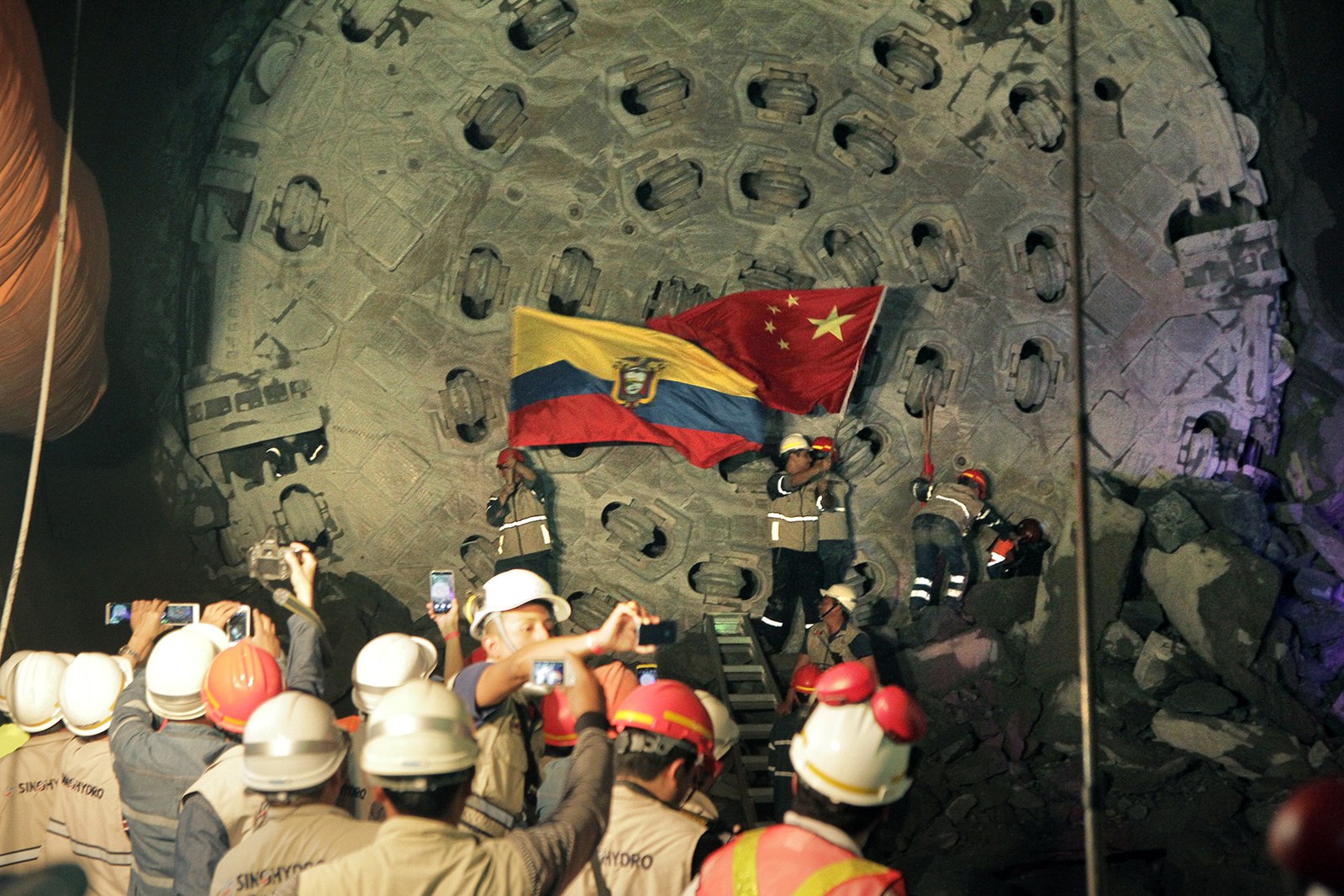
Mega project Coca Codo Sinclair inaugurates its new tunnel / Carlos Rodriguez / Agenda de Noticias ANDES / Wikimedia Commons / Creative Commons license

Ecuador’s Coca Codo Sinclair hydroelectric project – celebrated as a triumph of then-President Rafael Correa’s Revolución Ciudadana and a harbinger of the promise of South-South Cooperation when inaugurated in November 2016 – today appears to be a lightning rod for debate around China’s preferred form of international cooperation. The project was emblematic of the new relationship between Latin American countries and development finance’s new regional leaders, Chinese policy banks. Five years into its operations, Coca Codo is riddled with uncertainties and dramas at local, national, and global scales. 

  • The 1500 Mw project consists of a diversion dam; 24.8 km of tunnel to channel water under the Andean foothills; a compensation reservoir; pipes dropping the water 620 meters; and an eight-turbine powerhouse. It supplies Ecuadorians with 30 percent of their electricity, helping to edge out expensive and fossil fuel-driven thermoelectricity.

The project was a crowning jewel of efforts since the mid-2000s by Chinese policy banks – the China Development Bank and China Export-Import Bank – to provide Latin American countries with billions of dollars in loans, the majority for large infrastructure projects of the variety once financed by multilateral development lenders like the World Bank. Indeed, between 2005 and 2018, the total lending to the region by these two Chinese banks was greater than that of the World Bank and Inter-American Development Bank combined. Coca Codo was financed by a 2010 loan from the China Export-Import Bank and constructed by Chinese state company Sinohydro.

  • However, since 2015 lending has trended steeply downwards, and since 2019 Chinese policy banks have provided no new loans to Latin American countries or state-owned enterprises. While this by no means indicates a downgrading of China-Latin America relations, the nature of this political and economic relationship is no longer oriented around multibillion-dollar state-to-state infrastructure lending like that which made Coca Codo Sinclair possible. This is likely due, at least in part, to the increased hesitancy on the part of Chinese lenders following political controversies surrounding such projects.

The impacts of the projects of this period are still very much an ongoing and controversial issue for countries like Ecuador.

  • Although vital in providing Ecuadorians inexpensive and emissions-friendly electricity, to this day the project has not been fully turned over to the Ecuadorian government, primarily because its distributors (snail-shaped pipes that channel water to each of the powerhouse’s eight turbines) exhibit thousands of fissures that Sinohydro has been unable to repair despite years and millions spent trying. New fissures continue to emerge that experts say indicate “imminent danger” of equipment failure, or even collapse.
  • The diversion dam is also in danger of collapse due to a rare and catastrophic process of “headward” erosion (erosión regresiva o remontante) along the Coca River. The erosion, resulting from the collapse of the famed 150-meter San Rafael waterfall in February 2020, has so far caused two major oil spills, the loss of houses and land, and the repeated destruction of a major roadway connecting the Amazonian region to Ecuador’s capital. The Ecuadorian state power company, CELEC-EP, is investing millions in new infrastructure to attempt to contain the erosion before it reaches the dam. They are also studying the possibility of building an entirely new dam that could be reconnected to the existing powerplant.

The scientific community is debating the extent to which the dam itself may have contributed to the disastrous erosion. Lack of rigorous environmental assessments and monitoring mean that there may never be definitive evidence either exonerating the dam or proving its guilt in the current social, economic, and environmental crisis. There is, however, broad agreement that, given the instability of the Coca River basin, the dam should not have been constructed at the current location and scale due to environmental risks.

Critics of Chinese global economic expansion have seized on Coca Codo Sinclair as a symbol of the danger of China’s influence in Latin America. Other observers argue that the project’s downsides are a result of national institutional failures, irrespective of the “Chineseness” of its finance, engineering, and construction. Either way, recent patterns in Chinese lending indicate that the country’s decisionmakers no longer see this type of project as the basis of win-win development or mutual cooperation. It appears that environmentally sensitive, politically polarizing mega-infrastructure will not be the face of China-Latin America cooperation going forward. Regardless, Ecuadorians are faced with the return of expensive and unreliable electricity, an irrevocably altered Amazonian River basin, and about $3 billion at risk of being carried away by the river.

May 6, 2022

*Julie Radomski is a PhD Candidate and Fulbright-Hays Fellow at American University specializing in development studies.

Ecuador’s Return to the Past

By John Polga-Hecimovich and Francisco Sánchez*

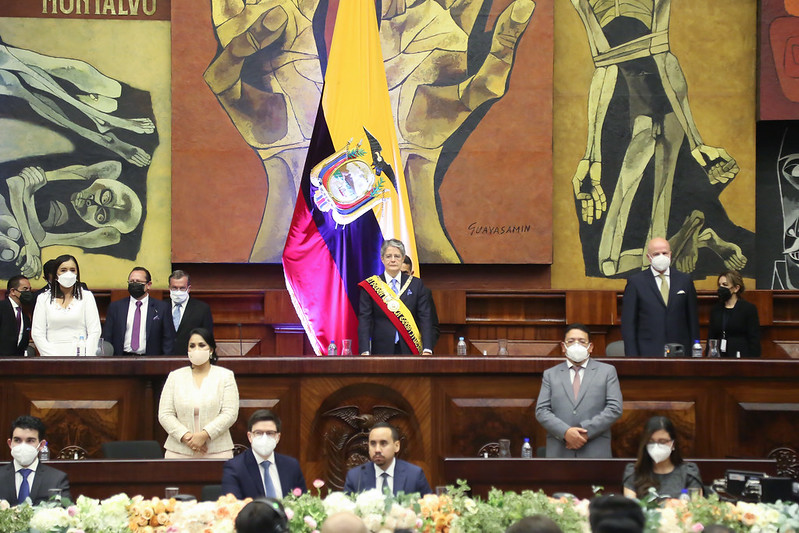
Inauguration of the President of Ecuador, Guillermo Lasso/ Asamblea Nacional del Ecuador/ Flickr/ Creative Commons License

Ecuador’s underlying political and economic pathologies bode ill for its governability and democratic stability as President Guillermo Lasso, inaugurated in May, attempts a return to the neoliberalism, fiscal austerity, and minority government that marked the contentious politics of the 1990s and 2000s.

  • This “return to the past” is the result of successive governments’ inability to resolve longstanding structural deficiencies. The Revolución Ciudadana of President Rafael Correa (2007‑17) reflected an illusory stability that depended on favorable political-economic conditions. Correa promised political, economic, and social transformation; promulgated a new Constitution to achieve it; and touted a national plan of buen vivir. He survived 10 years in office, more than double any other president in Ecuador’s history, but his change was not fundamental or durable – a consequence of the inefficiency, centralization, and personalization of decision-making under one man.
  • Under the Lenín Moreno government (2017‑21), Ecuador’s pathologies reemerged salient as ever. Correa’s acolyte in the recent presidential election, Andrés Arauz, lost in the runoff against Lasso, who campaigned on a platform of fiscal austerity that was hardly an attractive proposition for an electorate battered by the COVID‑19 pandemic and years of slow economic growth.

While breaking with one version of its past – correísmo – the electorate seems to have resigned itself to another. Ecuador’s longstanding political dysfunction, driven by multiple factors, looms large.

  • Ever-changing rules of play. Since independence from Spain in 1820, Ecuador has had 20 constitutions and myriad electoral rules. In moments of crisis, especially since Ecuador’s democratic transition (1978‑79), elites have generally sought to alter the formal rules of the game – as a kind of restart button. Although Correa proclaimed that the Constitution he pushed through would endure for 300 years, it was modified 23 times in nine years to correct errors and alter citizens’ rights.
  • Weak rule of law and persistent corruption. “Extractive elites” siphon resources from the people and often support institutions and policies inimical to sustained economic growth. Stories abound of the cultivation of party adherents and votes through clientelism, and corruption has politicized the judiciary. Correa created a breeding ground for scandal. In 2017, the court sentenced him in absentia to eight years in prison and banned him from politics for 25 years, whereby he fled to exile in Belgium.
  • Fragmented parties. Ecuador’s party system is one of the most fragmented and weakly institutionalized in the world. Since returning to civilian rule, the parties have proven unable to sustain electoral support – most last only a handful of elections before they disappear. Despite high party turnover in the legislature, voters lack clear institutional channels of representation.
  • Slow growth and surging debt. Since the mid-2010s, economic, political, and social crises have reversed many of the gains made during the greatest economic boom in the country’s history. Correa’s large investments in infrastructure, such as roads, hydroelectric plants, schools, and health facilities, reduced political pressures. But the average annual deficit jumped to 3.5 percent of GDP between 2007 and 2017, and total foreign debt jumped from $10.5 billion to $31.5 billion, and reached $40 billion by 2020, while domestic debt grew fourfold. President Moreno’s efforts to change course provoked outrage and social unrest.
  • Significant interbranch conflict. Ecuadorian executives have been politically weak despite an institutional structure that strengthens the presidency relative to the legislature. They have to build coalitions through the distribution of pork and other perks, leading to weak and corrupt governance.

These factors drastically reduce Lasso’s policy options. In legislative elections held last February, moreover, his Creando Oportunidades (CREO) party won only 12 of the 137 seats in the National Assembly. His 4.8-point margin of victory in the second presidential round gives a false sense of a popular mandate. It was a case of “outcome inversion” – when the first-round winner is defeated in the runoff – in a context of low party-system institutionalization.

  • Another challenge is that the country’s long-standing pathologies and the turmoil they cause have undermined Ecuadorians’ support for democracy, which fell from 66.7 percent in 2014 to 54.4 percent in 2019, a trend that is mirrored in several other Latin American states. Satisfaction with how democracy works in Ecuador, peaking at 68.8 percent in 2014, has once again become a minority position.

After the promises of reformist leaders, stability, and favorable economic conditions, Ecuador – like much of Latin America – seems to have returned to, or to never have actually escaped from, the volatility of its past. Its social, political, and economic weaknesses are mutually reinforcing. Economic hardship exacerbates the highly transactional and patrimonial nature of the political system and weakens the party system as lawmakers switch allegiances and votes based on whichever political broker can offer more.

  • Limited political and economic resources handicap Lasso’s efforts to address urgent problems, including the pandemic, that would sorely challenge even an experienced leader. Without a team with public-sector know-how, inexperienced politicians often end up absorbed by the pathologies of a political system that make their weaknesses more acute. From a historical perspective, there is no evidence to suggest that Lasso will succeed where previous presidents have failed.

July 27, 2021

* John Polga-Hecimovich is associate professor of political science at the U.S. Naval Academy, and Francisco Sánchez is professor of political science and administration and director of the Iberoamérica Institute at the University of Salamanca. This article is adapted from their recent essay in the July issue of Journal of Democracy.

Ecuador: Beyond the Presidential Contenders

By Christopher Kambhu*

Andrés Arauz Galarza / Wikimedia Commons / Creative Commons License (Modified) | Profile photo of Guillermo Lasso / Mabel Velástegui / Wikimedia Commons / Creative Commons License (Modified)

When Ecuadoreans head to the polls this Sunday to vote in the presidential election runoff, the two candidates on the ballot represent the country’s dominant political movements, but February’s first-round and legislative votes demonstrate a changing political context that will constrain the next president.

  • Andrés Arauz, a little-known economist until he launched his campaign, won the first round with 33 percent and is favored by analysts to win the runoff. His support lies in his ties to former President Rafael Correa, who anointed him to lead his leftist political movement. Correa intended to be Arauz’s running mate but was barred from seeking office due to corruption convictions from his time as president. Arauz’s policies are largely a continuation of Correa’s in substance and style; he has pledged to provide cash payments to a million families during his first week in office and vowed to scrap an austerity plan put in place by outgoing President Lenín Moreno as part of a loan package with the International Monetary Fund.
  • Guillermo Lasso, a major shareholder in one of Ecuador’s biggest banks and former economy minister, has reached the runoff for the third time in as many attempts, with just under 20 percent of the vote. He has the support of the business community, especially in Quito and the coastal commercial hub of Guayaquil. His name recognition and significant finances put him in a strong position heading into the second round, but his role as minister during the country’s 1999 financial crisis and long career in the banking sector remain liabilities. His campaign is working to unite rivals who lost the first round.

This is the third consecutive election in which a rightwing challenger is taking on the leftist politics of Correa, but an environmental lawyer and the third-place finisher in the first round, Yaku Pérez, is poised to play a decisive role in the outcome. Positioning himself as a leftist alternative to the establishment politics that Arauz and Lasso represent, Pérez calls for stronger environmental protections and support for renewable energy – positions that have been adopted, at least rhetorically, by both runoff campaigns.

  • While analysts predict Arauz and Correismo will triumph, the polls are close. Further uncertainty stems from how Pérez’s supporters will vote; for them, deciding between a Correista and a banker is to choose the lesser of two evils. So far, Pérez is not endorsing either candidate and has told his supporters to spoil their ballots. (Voting is mandatory.) Voters are apparently listening; polls show up to 20 percent of respondents will not vote for either candidate.

Whoever wins, they will face several immediate challenges. Cases of COVID-19 are nearing the record levels set a year ago, when scenes of bodies lying in the streets of Guayaquil made international headlines. The outgoing Moreno administration has struggled to obtain vaccines and changed health minsters three times due to poor results and various scandals. Engineering economic recovery from the pandemic will also be a huge test. Both candidates support expansion of extractive industries, which were key drivers of Ecuador’s economic growth during Latin America’s commodities boom in the 2000s. However, this tactic will face resistance from the growing environmental movement energized by Pérez’s campaign.

  • The runoff victor must also contend with the National Assembly, which saw a significant electoral shakeup in February. The Pachakutik Plurinational Unity Movement, the indigenous party which Pérez represented in the presidential campaign, had the best results in its history and will be the second largest party in the legislature after Arauz’s Unión por la Esperanza. Pachakutik generally played a minor role on the national stage until it and other indigenous groups lead nationwide 2019 protests against the Moreno administration’s attempt to end fossil fuel subsidies as part the IMF loan deal. Pachakutik parlayed its new national profile into electoral success and is in a strong position to influence most legislation, regardless of who wins the presidency.

April 8, 2021

*Christopher Kambhu is a Program Coordinator at CLALS.

Ecuador: Growing Political and Economic Repercussions of COVID-19

By John Polga-Hecimovich*

Lenín Moreno speaking at an event

Lenín Moreno, presidente de Ecuador/Flickr/Creative Commons

Despite early aggressive measures against COVID‑19, Ecuador has suffered one of the world’s most devastating outbreaks that, combined with the drop in international oil prices, may be catastrophic for the country’s economy and for President Lenín Moreno. Since March 16, the President declared a national state of emergency and curfew throughout the country; imposed strict social isolation (until May 4) that suspended all face-to-face activities; and established a special security zone in the province of Guayas, epicenter of the pandemic. Even so, Ecuador currently has the second-highest number of documented cases in South America, after Brazil, and the death toll from COVID‑19 may have reached between 7,600 and 11,000 during April.

  • Ecuador’s first case of COVID-19 was detected on February 27 in the port city of Guayaquil. As the virus spread in March and early April, the city experienced an unprecedented humanitarian crisis due to the much-publicized accumulation of hundreds of corpses in homes and on the streets. The local government’s response was erratic, with mayor Cynthia Viteri at one point ordering officials to block the runway at the airport to prevent a flight from Spain from landing, and later comparing the devastation to “the Hiroshima bomb.” Viteri has since estimated that perhaps as many as one-third of guayaquileños have COVID‑19.

Despite the lockdown measures, the national government has also shown a lack of capacity in addressing the public health crisis. Moreno created a task force to deal with the situation in Guayaquil, but even then, the government possessed a limited ability to determine who had the virus, to say nothing of addressing shortages of suits, masks, gloves, and ventilators for hospital personnel. In a national address in early April, the President acknowledged that official coronavirus figures had significantly understated the extent of the country’s health emergency. There have also been worrying accusations of corruption against officials in the Ecuadorian Institute of Social Security (IESS) in outfitting hospitals, and the Attorney General’s office charged the now ex-National Secretary of Risk Management Alexandra Ocles with influence-peddling.

  • The combined impact of the pandemic and oil crisis on the country’s economy may be catastrophic. Petroleum is Ecuador’s largest export commodity and accounts for about a third of its public-sector revenue. The 2020 national budget was planned with an oil price of $51.30 per barrel (currently hovering around $30.00), which will increase the country’s deficit. Ecuador also has little savings to implement a countercyclical fiscal policy and is on the brink of defaulting on its $50 billion debt. Adding to the troubles, due to dollarization, it cannot devalue its currency to reduce its deficit. The collapse of export revenues and massive foreign debt payments have greatly compounded the economic cost of the pandemic, and the country’s GDP may shrink by as much as 7-8 percentage points.
  • The government is just barely muddling through. Private bondholders have accepted the government’s request to defer interest payments on the country’s debt until August 15, freeing up $811 million and buying Moreno some breathing room. However, this could merely postpone a default: a fragmented and intransigent legislature and social sectors have balked at emergency austerity measures. Responding to the country’s social needs and economic well-being is a difficult line to walk. The government has issued a $60 stimulus (bono) that will benefit some 400,000 people, while at the same time it submitted a bill to the National Assembly that proposes an extraordinary tax on both companies and individuals to bring unbudgeted resources into the national treasury.

While the government confronts its public health and economic problems, general elections are nine months away and the National Electoral Council is already debating ways to carry them out. There is too much uncertainty at the moment to determine any potential frontrunner. Moreno is not running for re-election; ex-Guayaquil Mayor Jaime Nebot has suffered due to his city’s lack of preparedness at confronting the pandemic; and the fate of Interior Minister María Paula Romo may rest on the Moreno government’s (so far unconvincing) response. Like leaders around the globe, Moreno is faced with the unpleasant challenge of keeping the country’s economy shuttered longer or risking a resurgence of the virus. The success or failure of his strategy will undoubtedly shape the country’s political and economic future.

May 15, 2020

* John Polga-Hecimovich is an Assistant Professor of Political Science at the U.S. Naval Academy. The views expressed in this article are solely those of the author and do not represent the views of or endorsement by the Naval Academy, the Department of the Navy, the Department of Defense, or the U.S. government.