Brazil: Will Officers’ Role in Government Taint the Military Institution?

By Christoph Harig*

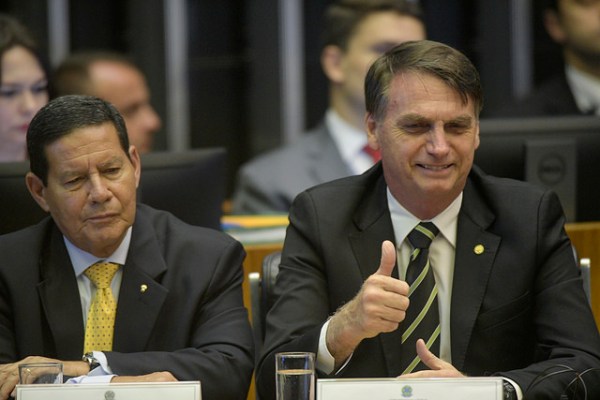
President and Vice President of Brazil

Vice-President General Hamilton Mourão and President Jair Bolsonaro / Pedro França / Agência Senado / Flickr / Creative Commons

More military officers have joined Brazilian President Jair Bolsonaro’s government than during most periods of the country’s last military regime (1964-1985), which raises the question how much the military – as an institution – will avoid compromising its supposed non-partisan nature.  The President, Vice-President, as well as eight government ministers, are retired or reserve military officers.  Bolsonaro furthermore nominated an active-duty army general as the government spokesperson.  In total, more than 100 reserve and active-duty military personnel serve in various ministries and subordinate government agencies.  Some officers have joined out of true allegiance, others, out of a sense of duty or because they want to prevent worse things from happening.  The government is drawing heavily on individual (mostly reserve) military officers, but the military as an institution is not running the government.  This is not a return to the military’s previous political interventionism: instead, a democratically elected government is (re)militarizing politics.

  • The military’s official discourse is keen on maintaining its image as a non-partisan state institution. However, officers are aware that this will be a challenge.  The presence of dozens of reserve officers in government agencies irrevocably connects the armed forces to the administration.  Although many officers do have reservations about Bolsonaro, others have proudly displayed their satisfaction with the victory of the former paratrooper.  Many citizens and international observers will thus perceive the government’s actions as being at least implicitly backed by the military.
  • For the armed forces, this involvement comes with opportunities as well as risks. On the one hand, there is a considerable increase in the military’s veto power.  They can expect privileged treatment and an effective representation of their interests.  The military might for instance be able to draw some red lines when it comes to being included in the government’s planned pension reform.  On the other hand, the prominent role in Bolsonaro’s administration attracts unwanted public scrutiny.  Discontent with an eventual preferential treatment of the armed forces in the pensions reform might grow louder than if the military had stayed below the radar.

So far, military officers’ involvement in government appears to have boosted the military’s standing.  The generals are widely being seen as a moderating force.  They have blocked some controversial foreign policy proposals of Bolsonaro and the radical wing of the government, such as the move of the Brazilian embassy in Israel to Jerusalem or the establishment of a U.S. military base on Brazilian soil.  Some observers even suggest that the generals have established a tutelary role in foreign policy after the Minister of Foreign Affairs ended military cooperation with Venezuela without consulting the armed forces.

  • Particularly Vice-President General Mourão – once known for threatening military intervention in politics and even considered a liability during the election campaign due to several ill-considered statements – excels in his newly found role as “adult in the room.” As President Bolsonaro is stuck in polarizing campaign mode (for instance, he keeps on attacking Brazil’s press and recently lauded late Paraguayan dictator Alfredo Stroessner as great statesman), it is fairly easy for Mourão to present himself as pragmatic and reliable statesman.  In this role, he led Brazil’s delegation to the Lima Group meeting in Bogotá, where he clarified that Brazil would not support a military intervention in Venezuela.

In the long run, the impact of officers’ enhanced policymaking role on the military’s prestige will depend on whether they stay clear of blunders, failures, and scandals.  While the military officers in government might succeed in playing a moderating role for the time being, this development entails considerable risks.  Within and outside of the barracks, there already is a widespread perception of the military as savior that is supposed to rescue Brazil in times of extreme crisis.  This historically grown paternalistic role of high levels of political interventionism – in which allegedly competent armed forces save the nation from incompetent civilian politicians – will only become further entrenched.

March 6, 2019

*Christoph Harig is a Postdoctoral Research Fellow in Political Science at the Helmut Schmidt University/University of the Federal Armed Forces in Hamburg, Germany.


Brazil: Far-Right Foreign Policy Ahead?

By Gilberto M. A. Rodrigues*

John Bolton and Jair Bolsonaro

U.S. National Security Advisor John Bolton (left) and Brazilian President-elect Jair Bolsonaro (right). / Prensa Latina / Creative Commons

Brazilian President-elect Jair Bolsonaro appears to be moving ahead with promises to steer the country’s foreign policy in the direction of his own far-right ideology.  He has accused the Workers’ Party (PT) of former President Lula da Silva (2003-10) and Dilma Rousseff (2011-16) of pursuing a foreign policy with a partisan left-wing ideology, and now he wants to “liberate” Itamaraty, the Ministry of Foreign Affairs, from what he considers an inappropriate ideological bias.

  • Bolsonaro says that President Trump is his inspiration, his “model” of leadership, and he has made policy coordination with Washington a priority. After a congratulations call to Bolsonaro, Trump tweeted that he and the president-elect “agreed that Brazil and the United States will work closely together on Trade, Military and everything else!  Excellent call, wished him congrats!”  Bolsonaro met last week with Trump’s National Security Adviser, John Bolton, to discuss joint efforts to achieve regime change in Cuba and Venezuela, among other topics.
  • Even before that, Bolsonaro had ramped up his already strong rhetoric against Venezuelan President Nicolás Maduro and reversed a long-standing policy of cooperation with Cuba, taking aim first at the 8,300 Cuban doctors in Brazil’s Mais Medicos. “We can’t allow Cuban slaves in Brazil,” he said, “And we can’t keep feeding the Cuban dictatorship.”  Havana began withdrawing the doctors before Bolsonaro could expel them.
  • Bolsonaro has barely mentioned UNASUR and is downplaying relations with Argentina, Brazil’s main strategic partner in the region, while emphasizing relations with what he calls “developed nations.” In addition to the United States, he is focused on Italy, Hungary – due to leaders’ far-right political affinities – and Israel.  The evangelical political forces who backed his election are pressing him to move the Brazilian embassy from Tel Aviv to Jerusalem, respecting “a sovereign decision of Israel.”  The Trump administration will warmly welcome the move, but Bolsonaro will face a potentially significant loss of trade among Middle Eastern and Asian partners.  The president-elect has yet to show his hand on China – Brazil’s main trading partner – and the other BRICS countries.  The Trump administration’s increasingly tough criticism of China’s activities in Latin America may temper the new government’s enthusiasm for closer ties with Beijing.

Bolsonaro has taken positions that set him at odds with the rest of the hemisphere.  He has denied the excesses of Brazil’s past dictatorship, advocated the use of torture against criminals whom he classifies as “terrorists,” used aggressive rhetoric against minorities (LGBTI, women, indigenous peoples, Afro-Brazilian Quilombolas, and migrants), and promised to reduce certain social rights.  Brazil’s diplomatic capital as a leader on environment and climate change is also at risk due to his domestic priority to promote agricultural business and the need to preserve “total” sovereignty over the Amazon Basin at the expense of protecting the rainforest.  He has cancelled Brazil’s commitment to host crucial UN climate change talks (COP25) in 2019, a deal negotiated by the government of President Temer just months ago.

Bolsonaro’s choice of his new foreign minister may be emblematic of his approach to international relations.  He met his commitment to choose a career diplomat, but his choice was Ernesto Araújo, an unknown who was recently promoted without ambassadorial experience who is a self-declared anti-globalist, anti-communist, and Trump’s enthusiastic “intellectual disciple.”  This appointment violates the tradition, observed even during the military governments, of selecting senior, skillful, and experienced ambassadors not directly linked to any ideological trend.  Further questions are raised by the military’s influence in the cabinet.  Two retired generals, Vice President Hamilton Mourão and the future head of Institutional Security Cabinet, Augusto Heleno, are expected to be the president’s right-hand men.  They and an empowered Ministry of Defense certainly will exercise huge influence in promoting a military vision of foreign policy in addressing issues such as borders policy and the Venezuela crisis, and could become a “second track” on Brazil’s foreign policy.

December 4, 2018

* Gilberto M.A. Rodrigues is Professor of International Relations at the Federal University of ABC (UFABC) in Brazil, and was a CLALS Research Fellow in 2017.

Brazil: The WhatsApp President

By Barbara dos Santos*

Bolsonaro social medis

Graphics from Brazilian presidential candidate Jair Bolsonaro’s social media detailing his followers on Facebook (left) and Twitter (right). / Twitter: @jairbolsonaro / Creative Commons

If polls predicting a landslide victory for Jair Bolsonaro in Sunday’s runoff election are correct, Brazil on January 1 will inaugurate its first president to win by virtue of his superior social media prowess rather than the strong party bases that propelled his predecessors.  He gained strong support from different sectors of Brazilian society by delivering – legally and potentially illegally – the message his supporters wanted to hear directly to their personal electronic devices, without the validation and transparency of traditional media.  The receptivity of his young supporter base compensated for the low amount of TV time allotted to him under Brazilian law.

  • WhatsApp has around 120 million users in Brazil, around 60 percent of the population, for a wide array of personal and commercial communication needs. The polling firm Datafolha found that two-thirds of Brazilian voters use WhatsApp, and that of them a majority (61 percent) are Bolsonaro supporters likely to follow political news on the service – compared to 38 percent of the backers of his opponent, Fernando Haddad.
  • The platform is perfect for manipulation of information. Messages are encrypted and are therefore beyond the domain of electoral authorities, independent fact-checkers, or even WhatsApp managers.  Real and fake news spread like wildfire.  Agência Lupa, a fact-checker service, has found that only 50 of the most shared pictures in 347 WhatsApp groups were factually correct.  During the weekend of October 6-7, the company found that 12 of the fake news items it evaluated were shared 1.2 million times.  The Federal Electoral Court (TSE), which created a consultative council earlier this year to tackle online misinformation, has been slow to respond to the threat – perhaps out of fear it would be accused of limiting free speech.

Bolsonaro’s campaign also used Facebook effectively even after it twice shut down pages carrying content of his deemed to be fake – 197 pages and 87 accounts in July, and 68 pages and 43 accounts two weeks ago.  Many of the pages portrayed Haddad as a Communist whose Workers Party would turn Brazil into another Cuba and convert children to homosexuality.  One attack – alleging that Haddad would distribute “gay kits” to expose schoolchildren to homosexuality – was so blatant that the TSE ordered Bolsonaro’s campaign to stop it.

  • Haddad’s presence on Facebook (1.5 million followers) is minuscule compared to Bolsonaro’s (7.8 million). Some of Haddad’s followers used social media to spread rumors that Bolsonaro staged his near-fatal stabbing at a rally last month; social media have not shut down any of Haddad’s pages or accounts.

Bolsonaro’s social media campaign has also allegedly been tainted by illegal funding.  Folha de São Paulo, one of Brazil’s biggest newspapers, last week reported that wealthy businesspersons spent US$3.2 million on a WhatsApp fake news operation.  If true, they broke electoral laws barring undeclared corporate campaign donations and the purchase of contact lists from a third party.  Speaking on Facebook Live, Bolsonaro said Folha had no evidence, adding in an interview later that he has no control over the businesspersons anyway.

Fake news in elections – in the traditional or social media – is not a new phenomenon, but its wildfire impact has caught many in Brazil by surprise.  The mere speed that disinformation travels makes it nearly impossible for Brazilian authorities to curb its spread, and self-policing by social media platforms also seems an implausible solution given their benefit from the high traffic fake news drives.  Bolsonaro and his campaign team realized this earlier and embraced it more aggressively than Haddad, who did not enter the race until September 11, ever did.  Haddad was busy trying to simultaneously convince Lula’s supporters to vote for him and others that he was not Lula’s puppet, while Bolsonaro’s message was reaching tens of millions of Brazilians with smartphones.  The likely president’s expertise in using social media (legally or not) has clearly boosted his campaign, but governing by WhatsApp, Facebook, or Twitter remains an untested proposition.  It seems that Bolsonaro may also follow U.S. President Donald Trump’s playbook into government.  Crushing his opposition under a barrage of half-truths and lies does not bode well for democratic governance.

October 26, 2018

*Barbara dos Santos is a Ph.D. Candidate in Political Science at the School of Public Affairs at American University.

Southern Cone: Rapid Transition to Non-Conventional Renewable Energy

By Thomas Andrew O’Keefe*

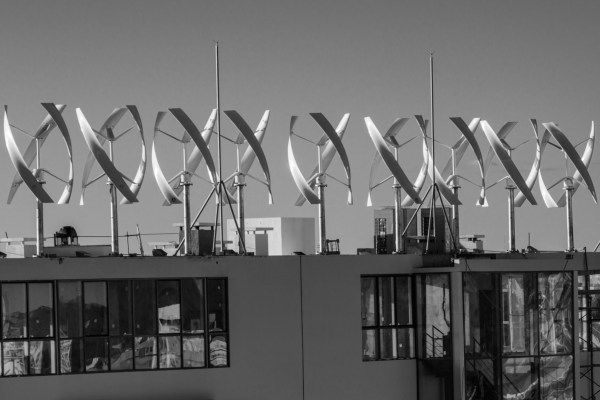
Edificio Alexander

Edificio Alexander, a building in Punta del Este, Uruguay, that produces wind energy on its roof. / Jimmy Baikovicius / Flickr / Creative Commons

South America’s Southern Cone is undertaking a transition to non-conventional, renewable energy resources – that is, production not dependent on fossil fuels or large-scale hydropower – that creates the opportunity for a historic regional consensus on energy policy.  Uruguay and Chile are at the forefront.  Both lack significant fossil fuel reserves and have experienced crises when droughts detrimentally impacted hydro-supplied electricity.  For them, the rapid shift to other forms of domestically sourced renewables is as much a means to guarantee energy security as to combat climate change.  Approximately a third of Uruguay’s electricity is currently generated from wind power (up from only one percent as recently as 2013).  Similarly, about a third of Chile’s electric power – depending on the time of day – is sourced from the sun and the wind.

  • Brazil has also made significant strides in incorporating wind, and to a lesser degree, solar power into its energy matrix. The primary motivation is the need to offset carbon emissions from the burning of rain forests and the country’s greater use of natural gas.  Brazil has long enjoyed the cleanest energy of any large economy in the world because of its heavy reliance on hydropower, which still covers some two-thirds of the country’s electric needs.  Brazil was also a pioneer in the development of more environmentally friendly sugar-based ethanol (as opposed to corn favored in U.S. ethanol production); most passenger vehicles today have flex-fuel engines.  Paraguay gets almost all its electricity from hydropower (and exports the bulk of what it produces).
  • Argentina, while increasing exploitation of its large shale gas and oil reserves, in 2017 expanded renewable energy projects nearly 800 percent over the previous year, according to reports. President Mauricio Macri has created a more inviting investment climate for the private sector, rapidly increasing natural gas output, especially from the Vaca Muerta shale reserves in Patagonia.  He is also encouraging the expansion of renewable energy beyond large hydro by, among other things, allowing long-term power purchase agreements in U.S. dollars as a hedge against currency devaluations.  Furthermore, large industrial consumers face penalties if they do not meet increasing thresholds set for renewable energy use.  Current laws require that at least 20 percent of the nation’s electricity come from non-conventional renewables by the end of 2025, and they include tax exemptions, import duty waivers, and a special trust fund called FODER, created in 2016, to provide subsidized loans and other assistance.

The rapid expansion of the renewable energy sector in the Southern Cone will enable countries to export excess production to their neighbors, facilitated by a robust regulatory framework to facilitate the cross-border trade in energy resources.  In addition, by creating a fully integrated regional market in renewable energy products, a crucial backup is established for resources such as wind and solar power that are inevitably prone to interruptions during the day.  It would also mitigate the impact of droughts on hydro-generated electricity, which are likely to worsen with global climate change.  Accordingly, there are strong incentives to revive efforts begun by MERCOSUR in the late 1990s to integrate energy markets that collapsed with the Argentine energy crisis at the start of the 21st century.  The fact that all the Southern Cone governments are now ideologically aligned in favor of market-oriented economic and investment policies facilitates achieving a regional consensus on energy for the first time.  Governments in the region now need to move beyond the discussion phase to turn all this into a concrete reality.

October 19, 2018

*Thomas Andrew O’Keefe is the President of Mercosur Consulting Group, Ltd. and currently teaches at Stanford University in Palo Alto and Santiago, Chile.

Brazil: A Moment of Truth

By Barbara dos Santos*

Brazil elections 2018

A group of demonstrators gathered in São Paulo last week to protest Brazilian presidential candidate Jair Bolsonaro and show their support for other candidates like Ciro Gomes. / Mark Hillary / Flickr / Creative Commons

Campaigning for Sunday’s election has brought out deep divisions in Brazilian society and set the stage for an even more divisive runoff later this month.  This week’s polls underscore that, although most voters arguably occupy the center, the right and the left have the strongest candidates.  Populist conservative Jair Bolsonaro (31 percent) has a 10-point lead over Workers Party (PT) latecomer Fernando Haddad (21 percent), who started campaigning only after party standard-bearer “Lula” da Silva definitively pulled out of the race three weeks ago.  But both candidates have high negatives, and the polls suggest that they would be tied in a second round (42 percent each).  Ciro Gomes, of the Democratic Labor Party (PDT), is still hovering around 11 percent, but polls also show that he would beat Bolsonaro (39 to 45 percent) if they face off on October 28.  Everyone else is polling in the single digits.

  • Hate politics has spiked during this campaign, powered by polarization, culture wars, and fake news on social media. Uncivil discourse and even physical violence have increased.  Although Federal Police have concluded that the man who stabbed Bolsonaro last month acted alone, the candidate and allied social media are hyping the incident as a political attack.  Other rumors circulating online are that Haddad’s running mate, Manuela d’Ávila of the Partido Comunista do Brasil, ordered the stabbing (which prompted threats against her.)  A review by the national daily O Estado de São Paulo found that several of Bolsonaro’s campaign themes – defending the death penalty and vigilantism, the use of torture, and past racial cleansing – have fueled aggressive attacks by both opponents and supporters.  One of the leaders of the Facebook group Mulheres Unidas Contra Bolsonaro was assaulted by three men outside her home on September 24; their political views are clear, although their affiliation remains unconfirmed.
  • The emergence of Bolsonaro – who has publicly called women unequal, stupid, and even “too ugly to rape” – shows the stridency of the culture wars now occurring in Brazil. His campaign has also revealed greater tolerance among some sectors for misogyny going far beyond traditional machismo.  It reflects a rejection of the younger generation’s progressive and liberal values of equality and inclusion.  Bolsonaro’s proud refusal to apologize for his remarks suggests confidence that his base sympathizes with his views.

In terms of political institutions, the election is crucial to the future of the PT and the left in Brazil and beyond.  Over its 14 years in power, the party led the country on a path of decreasing inequality, a booming economy, and international prestige as a “global player.”  It all came tumbling down for external and internal reasons:  commodity prices crashed, economic recession set in, and massive corruption scandals led to deep, sustained political crises.  The PT’s opponents have cast the party as the embodiment of all that is wrong with Brazilian society and institutions, and Bolsonaro and others on the right are hoping to deal it a deathblow.  Haddad is running hard, but local observers believe he needs to distance himself more from his party’s past – such as by trying harder to avoid criticizing the judicial processes that landed Lula in jail, advocating a responsible government budget, and more aggressively criticizing Presidents Maduro in Venezuela and Ortega in Nicaragua.

This round of elections is the most important since the re-democratization of Brazil in 1988.  While some democracies around the world are known for tumult and strident campaigning – and may even be able to weather periods of authoritarianism – those that are of more recent vintage and less institutionalized, including Brazil, can break.  A Bolsonaro victory would not necessarily lead the country to military dictatorship, but the acceptance of his authoritarian vision, including his praise for military rule in the past, poses a potentially serious threat to the continuing strengthening of Brazilian democratic institutions.  In an interview last week, he even implied that if he were not elected, he would reject the vote count and claim that PT committed fraud.  Similarly, Haddad would also pose a threat to democratic institutionalization if he does not allow the justice system to handle Lula according to the law.

 October 4, 2018

*Barbara dos Santos is a Ph.D. Candidate in Political Science at the School of Public Affairs at American University.

Brazil: Diving into Uncertainty

By Marcus Rocha*

Brazilian presidential candidates 2018

Brazilian presidential candidates, from left to right: Lula da Silva, Jair Bolsonaro, Geraldo Alckmin, Marina Silva, and Ciro Gomes. / Wikimedia, edited

With voting just a little under four weeks off, Brazil faces the most confusing, unpredictable, and consequential election since democratization in the 1980s.  The two leading contenders – former President “Lula” da Silva and firebrand conservative Jair Bolsonaro – are in jail and the hospital recovering from a stabbing, respectively, but the former is being left behind, and the latter is likely to try to use his victimhood to overcome other weaknesses.  At a point that Brazil needs stability and leadership, it is lurching toward an election that appears unlikely to produce either.

  • Lula’s Workers Party (PT) hierarchy continues to push his candidacy, but yet another rejection last week of his appeal of his conviction on corruption charges is increasingly opening the way for Fernando Haddad, former mayor of São Paulo, to assume the party mantle. Haddad has polled poorly, only 6 percent as recently last week, but a serious PT mobilization will be a big asset.  (Announcement of his candidacy is expected today.)
  • Prior to Bolsonaro’s stabbing, his weaknesses seemed likely to hold him back despite a good 22 percent in recent polls. His popularity may rise as he seeks sympathy for his injury, but his strong negatives – 44 percent of people polled say they will never vote for him – will be hard to erase.  His Social Liberal Party (PSL) has a very narrow base in Congress, and the former Army captain and lawmaker’s main tactic – divisive rhetoric attacking human rights advocates and praising the military dictatorship of 1964-85 – does not conceal his lack of a serious political agenda, according to many observers.

The proliferation of other parties is also deepening confusion.  Brazil has 35 parties, and for the first time faces the possibility that neither of the two Brazilian parties with a virtual monopoly on presidential succession – the PT and Brazilian Social Democracy Party (PSDB) – will make it into the runoff in Brazil’s two-round system.  The PSDB’s Geraldo Alckmin has a strong Congressional base (which under the law determines his access to media time) but continues to poll poorly (9 percent).  Marina Silva, of the Rede Sustentabilidade, and Ciro Gomes, of the Democratic Labor Party (PDT) – both of whom currently have 12 percent – have a shot at a place in the second round.  Another eight candidates show much less promise.

The political chaos has not brought protesters out into the streets or threatened a broader social crisis in the closing weeks of the campaign, but it has thrust Brazil into uncharted territory.  Bolsonaro’s stabbing and his certain efforts to play the victim will almost certainly continue push his rhetoric beyond that traditionally acceptable in Brazil.  The political parties, however flawed, were sources of predictability and stability, but no longer are.  Investigations into corruption, also previously thought to strengthen the political system, have contributed to uncertainty.  The courts are accused of political bias.  As the PT and PSDB slip, none of the smaller parties appears poised to gain broad enough confidence to lead the country through its numerous challenges.  In the first- and second-round votes on October 7 and 28, Brazilians will choose between trying to revive the old – clinging to PT or PSDB – or continuing the search for something that is not yet visible on the horizon.

September 11, 2018

*Marcus Rocha is a Ph.D. candidate in Public Policy at the Federal University of Rio Grande do Sul in Porto Alegre, and a former CLALS Research Fellow.

Brazil: Is Democracy Under Threat?

By Marcio Cunha Filho*

A large group of Brazilians wave the Brazilian flag

A rally supporting former president Luiz Inácio Lula da Silva in October 2017. / Eduardo Figueiredo / Midia NINJA / Flickr / Creative Commons

Brazil’s ongoing political turmoil hit a new peak last weekend – resulting in former President Luiz Inácio Lula da Silva’s decision to turn himself in to be imprisoned – and strongly suggests that the country’s democracy is in deeper trouble than previously thought.  Lula said he was a victim of political persecution by both prosecutors and the courts, including the six Supreme Court justices who ruled that he not be allowed the courtesy of remaining free during his appeals to Brazil’s higher courts on his conviction on corruption charges.

  • Lula’s Worker’s Party (PT) claims that the decision is part of a campaign against leftwing forces that has intensified since Dilma Rousseff’s impeachment in August 2016. Supporters say that Lula’s imprisonment at a time that he is leading in presidential polls is the culmination of a strategy aimed at making sure that the PT – the only party to have won the presidency in elections since 2002 – remains out of power.  Most mainstream media and some rightwing lawyers have argued that Lula’s arrest obeyed all legal procedures, but PT supporters are not alone in their allegation of impropriety.  José Afonso da Silva, one of the most prominent non-partisan constitutional law professors in Brazil, has written a legal opinion against Lula’s imprisonment.  Other experts claim that Lula’s imprisonment order was strangely rushed (jurist Celso Antônio Bandeira de Mello), while others have expressly criticized the Supreme Court for denying Lula Habeas Corpus (Prof. José Geraldo da Silva Júnior).
  • While proof remains elusive, strong circumstantial evidence of conspiracy persists. The lawsuit against Lula was tried much more rapidly by Judge Sérgio Moro than most cases, and the guilty verdict was reaffirmed by the regional court just in time to keep Lula out of the presidential election scheduled for October 7.  Moreover, the accusations against Lula are fragile:  Moro argues that the former president received a $1 million remodeled beach apartment as a bribe from a construction company in exchange for political favors, but there is no evidence that the apartment was Lula’s or that he used it in any way.  Neither is there evidence that the construction firm received any favors.

Other indications that Brazil is experiencing an “open season” against the left are emerging.  Civil society leaders have reported repressive practices against them, including violent protests at their public events.

  • The assassination of a Rio de Janeiro municipal legislator is widely thought to have been carried out by rightwing elements. At a recent political rally, unidentified gunmen shot at Lula’s vehicle.  A wealthy São Paulo night club owner is offering a reward for anyone willing to murder Lula in prison.  Radical and angry political movements such as Movimento Brasil Livre are gaining strength by angrily advocating and celebrating through social media the imprisonment of political opponents.  Congressman Jair Bolsonaro, a former military officer who praises the military dictatorship, has become the new frontrunner in the presidential race.
  • Another troubling sign was a tweet from the Armed Forces – issued the day before the Supreme Court’s judgment against Lula – that it will not tolerate impunity. It has been widely interpreted as the most direct threat to the Court since the end of military dictatorship.
  • Freedom of expression and academic freedom are under pressure as well, according to many observers. Local, state, and federal legislators are trying to ban the teaching of gender issues in public schools, claiming gender issues are a leftwing ideology should not be taught to young children.  At the university level, in Rio Grande do Sul a local congressman filed a complaint to the Public Prosecutor’s Office asking that a course entitled “The 2016 Coup d’état” – referring to the removal of Dilma Rousseff and inauguration of President Michel Temer – be disallowed.

Democracies rarely die as a result of the acts by one or even a small group of political leaders, but rather as the outcome of repressive actors’ manipulation of popular confusion and anxiety about the country’s direction.  Lula may not have been perfect – he was not – but he deserved fair treatment by the government and fair enforcement of the law.  Democracies cannot endure when one group or another uses government institutions, even with significant popular support, to impose its views on others, often violently.  We should not forget that, in its early stages, the military coup in Brazil was supported by the media (at least by the biggest TV network in the country, Rede Globo), by civil society institutions (such as the Ordem dos Advogados do Brasil), as well as by much of the political leadership.  Radicalization, inability to dialogue, and unwillingness to make political compromises are the factors that made Brazil descend in 1964 into two decades of repression.  We might now be slipping down this same path, and witnessing the rebirth of institutionalized and popularly-supported repression and intolerance.

April 10, 2018

* Marcio Cunha Filho is a Ph.D. candidate at the University of Brasília; federal auditor in Brazil’s Office of the Comptroller General; and former CLALS Research Fellow.

Brazil: Will Marielle’s Murder Help Build Consensus on How to Reduce Violence?

By Marcus Rocha*

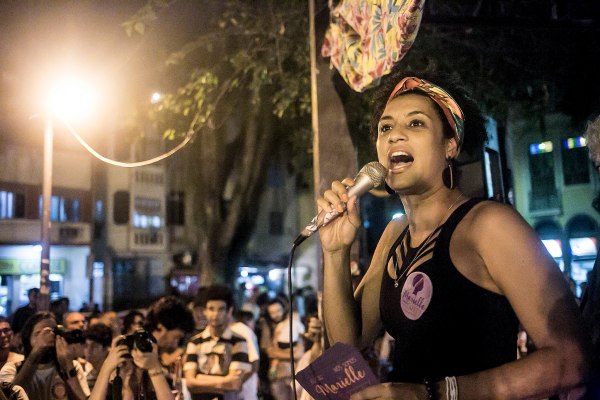
A woman with a microphone stands in front of a crowd

Marielle Franco campaigning in 2016. / Mídia NINJA / Wikimedia

The murder in March of Marielle Franco – a popular 38-year-old black, gay city councilor in Rio de Janeiro – has stirred outrage across Brazil, but debate over how to increase security has been stifled by political agendas and fake news.  Marielle and her driver were shot dead on March 14 in what press reports characterized as a professional hit job.  Some commentators have speculated it may have been retaliation for her outspoken criticism of the police and military deployments in the cities and favelas.  One of her final posts on Twitter called attention to police violence, citing the case of a young man gunned down by authorities while leaving church.

  • Tens of thousands of mourners took to the streets in Rio and other cities to protest. MC Carol, a black funk singer from favelas near Rio, reflects the popular anger with her immediate hit song entitled “Marielle Franco,” in which she sings:  “You [the system] want to kill us, control us / But you won’t silence us / even bleeding we gonna make it / marching and screaming / I’m Marielle, Claudia, I’m Marisa.”  (Original Portuguese below.)  Claudia and Marisa were women killed during police operations in favelas.

There is no consensus, however, over the meaning of Marielle’s death within a broader agenda of solutions to curb violence in Rio de Janeiro amid an escalation in federal intervention in the state, now entering its second month.  Proponents of President Michel Temer’s push to mobilize the military and other federal assets claim the Councilor’s murder justified the policy.  Opponents argue that Marielle’s assassination and other high-profile murders underscore that the mobilization has not worked, and, indeed, the deaths have fueled widespread skepticism.

  • A poll conducted by Folha de São Paulo newspaper shows these mixed feelings. Seventy-nine percent of interviewees say they support the federal intervention, but 71 percent believe that nothing has changed since it started.  Moreover, 22 percent of people living in affected communities fear the police more than they do drug dealers (16 percent).  Some 15 percent have more fear of milícias– the gangs, which often include former and current police that control much of people’s lives in these communities – and 13 percent of general criminals.  Of those polled, 28 percent say fear all of them equally.  Criminal activities like car theft and robbery have shown no sign of decline.
  • Complicating discussion of Marielle’s murder has been the torrent of fake news about her. Through Facebook pages and Whatsapp messages, far-right groups have spread unsubstantiated allegations that she had links to organized crime.  One Facebook page shows a woman and a man, supposedly Marielle and Marcinho VP, a famous drug dealer, as a couple.  Marco Feliciano, a rightwing preacher turned lawmaker, said during a radio program that Marielle’s death was “just another number” and offered a crude joke.  “They shot a leftist in the head in Rio de Janeiro,” he said.  “It took a week to die because the bullet didn’t find the brain.”  Brazilian justice directed Facebook and YouTube to remove some of the offensive profiles and videos, but fake news is still being shared through social networks.

President Temer’s official announcement that he intends to run for reelection in October deepens the political dimension of his militarized solution to the violence problem.  The federal intervention in Rio de Janeiro has become a key issue on his agenda, but the lack of results is undermining his efforts to shore up his historically low, single-digit approval ratings.  Investigations into Marielle’s murder haven’t identified any suspects yet, and there’s no discussion about changes to security laws or any other measure other than putting more army troops in the streets.  Despite the general outrage, the window for change opened after Marielle’s murder is closing fast.  The Brazilian political system is looking straight to general elections in October, and the speed and depth of the politicization of the assassination, aggravated by fake news, suggest prospects for serious discussion are nil.

[Excerpt from MC Carol’s “Marielle Franco”]

Vocês querem nos matar, nos controlar
Vocês não vão nos calar
Mesmo sangrando a gente vai tá lá
Pra marchar e gritar
Eu sou Marielle, Cláudia, eu sou Marisa

April 5, 2018

*Marcus Rocha is a CLALS Research Fellow.

“New Transnationalisms” in Latin American Cinemas

By Dolores Tierney*

Guillermo del Toro speaks on a panel

Mexican director Guillermo del Toro, who won the Oscar for Best Director last month. / Gage Skidmore / Flickr / Creative Commons

When Mexican film director Guillermo del Toro won the Oscar for Best Director for The Shape of Water last month, it was another example of the “new transnationalism” of contemporary Latin American cinemas.  Working across cultures while preserving his Mexican creative identity, del Toro follows in the footsteps of his compatriots, Alejandro González Iñárritu (Best Director for Birdman in 2014 and The Revenant in 2015) and Alfonso Cuarón (Best Director for Gravity, 2013).  An examination in my recent book of these and three other Latin American directors – Brazilians Walter Salles and Fernando Meirelles, and Argentine Juan José Campanella – finds that their work is part of a broader shift toward transnational filmmaking: films made in one country produced with capital, creative input, or paradigms borrowed from another, and actors and directors making films in nations other than their own.

  • To a certain extent, Latin American filmmaking has always involved the use of personnel, equipment, and cinematographic styles from Europe and the United States. This comingling has become more radical, however, since the early 1990s, when neoliberal policies in the three major filmmaking nations – Mexico, Brazil, and Argentina – in particular led to a withdrawal of government financial support for the industry.  State-owned film infrastructures, including film institutes, distribution companies, and theater chains, were dismantled.  Production numbers fell from close to 100 annually in each country to less than ten, and Hollywood films increasingly dominated box offices.  In Mexico, government patronage still contributed to Cuarón and del Toro’s first features, respectively Sólo con tu pareja (1991) and Cronos (1993), but large numbers of directors, cinematographers, and actors left to look for work in the United States film industry.

At the turn of the century, however, production shifted toward a new model of transnational production.  Mexican cinema experienced a box office and critical renaissance because deregulation of movie ticket prices encouraged investment in new U.S.-style multiplex theatres situated in upscale shopping malls and neighborhoods.  Among the hits were Amores perros; Y tu mamá también; El crimen del padre Amaro; and Sexo, pudor y lágrimas.  The new multiplex-goers welcomed a range of Hollywood-derived genre films (romantic comedies, teen films), narratives, and practices (tie-in soundtracks) that reflected Mexicans’ own evolving tastes – finding common ground between Mexican and U.S. culture even if, quantitatively, “Hollywood” films still dominated.  In the same general time period, moreover, Mexican state support shifted toward a new model of privately and transnationally financed filmmaking that includes funds from European countries, other Latin American countries, and the United States.  Iñárritu, Cuarón and del Toro straddled two markets and two cultures, and excelled in both.

  • A similar evolution took place in Argentina and Brazil, with state withdrawal in the early 1990s and then a push to filmmaking in a reformed model of co-production in more recent years. Brazil and Argentina’s most successful domestic films are made with a combination of funds from the state (or state-owned businesses such as Petrobras) and private companies working with foreign partners, such as the Spanish Telefe and U.S.-based Disney affiliate Miravista (in Argentina), and a consortium of foreign firms partnered with Globo in Brazil.

Latin American film critics often lament that the region’s transnationalized cinemas borrow too much from the aesthetic models of the north – the genre templates of the crime film, melodrama, and romantic comedy among others.  But closer analysis shows that, while such artistic appropriation and the international co-producers’ distribution muscle are important, the films’ success also depends on their strong elements of “local exceptionality.”  Transnationally funded artists whose films circulate successfully in Europe and North America have leverage to tackle important sociopolitical aspects of their respective national histories.  Argentine director Lucrecia Martel (La ciénaga, La niña santa, La mujer sin cabeza, Zama) and Peruvian Claudia Llosa (Madeinusa, La teta asustada) are able to get around funding bodies’ prescriptive demands to make films that challenge stereotypes of developing nations.  In his recent Oscar-winning film, The Shape of Water, del Toro has made an English-language adult fairy tale with nods to science fiction, spy thrillers, and the musical, but it is much more than a product of U.S. industry.  It is a transnational film that reflects what del Toro refers to as the contradictions of his Mexican identity – a mixing of the “dark” and the “good” – and explores how Latin American and Latinness function in the U.S. political and racial imaginary.  His transnational film doesn’t diminish his Mexican voice; it enhances it.

 April 2, 2018

* Dolores Tierney is Senior Lecturer in Film Studies at the University of Sussex and former CLALS Fellow.  Her book, New Transnationalisms in Contemporary Latin American Cinemas, was published by Edinburgh University Press last month.

Brazil in 1999: The Impact of Rigid Labor Regulations

By Jennifer P. Poole and Rita Almeida*

The outside of a building in Brasilia, Brazil

Brazil’s Ministry of Labor and Employment in Brasília. / Grupo Vestcon / Creative Commons

During Brazil’s currency crisis and devaluation in 1999, stringent implementation of labor regulations hindered, rather than enhanced, manufacturing plants’ recovery and workers’ wellbeing – an important lesson to keep in mind in current debates in many countries.  In an article published in the May 2017 Journal of Development Economics (JDE), we examine the implications of global economic integration through international trade on local labor markets during that critical period in 1999.

  • Many economic policymakers agree that reforms in the latter half of the 20th century, such as liberalizing trade relations and encouraging foreign investment, have been powerful drivers of efficiency gains, income growth, and consumer choice around the globe. At the same time, however, there is agreement that – as firms adapt to a more competitive global environment – the gains are often accompanied by short-term costs for workers in terms of unemployment and income risk.  Policymakers have to weigh the broad economic benefits from globalization and technological change, on the one hand, against workers’ opportunities and security on the other.

A micro-econometric estimation analysis of detailed, confidential, and proprietary micro-data sets – collected in part while visiting the Brazilian Labor Ministry – reveals a causal impact of trade reform on employment.  Brazil’s policy environment of strict labor market regulations (e.g., hiring and firing costs), coupled with its dramatic trade liberalization and currency devaluation, make it a particularly appropriate setting to study the implications of globalization on employment opportunities in a middle-income country.  As in many countries, much of the de jure labor market framework was established on a national basis in Brazil (in the Brazilian Federal Constitution of 1988), but de facto labor regulations – the varying levels of implementation through labor inspections, fines, and other processes in different locales – are heterogeneous.

  • Administrative data on the enforcement of labor regulations during the 1999 currency crisis, a shock to trade openness, show that the way trade affects employment largely depends on the stringency of de facto labor regulations that companies face. The impact of the currency devaluation – widely predicted to expand employment by facilitating access to foreign markets and weakening import competition – was less significant in plants facing strong labor enforcement than in those facing more lax enforcement.  The findings suggest that stringent labor regulations limit job creation and lower productivity gains.
  • Not only was the efficient reallocation of labor in response to shocks inhibited by strict de facto labor market regulations; rigid enforcement also restricted the within-plant potential for productivity gains. The data reveal that regulations, for example, may limit plants’ ability to introduce new goods or investment in more complex production technologies that might have higher value-added.  The burden of having to retain unproductive workers, making plants less able to compete, is another possible explanation for weak productivity gains.

Previous research – arguing that weak enforcement leaves regulations ineffective – ruled out the possibility of labor regulations as an explanation for slow labor adjustment to trade reform.  But our research shows that flexible regulations maximize the gains of reforms such as trade liberalization.  As middle-income countries continue to face a globalizing and technologically advancing world economy, their strict labor market policies, limiting adjustment and reallocation, may have potentially distortive, unintended consequences.  The trade-off between job security, on the one hand, and productivity and growth is already one of the most prominent public policy debates worldwide.  Regulations designed to protect workers may actually further reduce employment as costs increase.  Countries must show flexibility, while enhancing education and training programs, to benefit fully from changes driven by the global economy.  As populist, protectionist policies gain influence in the world, policymakers should know that increasing the flexibility of de jure regulations will allow for increased job creation and thus offer broader access to productivity gains.

March 7, 2018

*Jennifer Poole is Assistant Professor of Economics, School of International Service, and Research Fellow at the IZA Institute of Labor Economics and the CESifo Research Network.  Rita Almeida is a Research Fellow at the World Bank and the IZA Institute of Labor Economics.  Their article is titled “Trade and Labor Reallocation with Heterogeneous Enforcement of Labor Regulations.”