Elections in Uruguay: A Bellwether for the Latin American Left?

By Aaron T. Bell

Photo credit: Frente Amplio (FA) / Foter / CC BY-NC-SA

Photo credit: Frente Amplio (FA) / Foter / CC BY-NC-SA

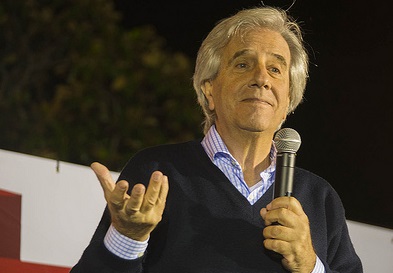
Uruguay’s elections on October 26 – once seen as a sure bet for the ruling Frente Amplio’s presidential candidate, former president Tabaré Vázquez (2005-2010) – have become a tight race, perhaps signaling challenges for other left-leaning Latin American governments as well.  The FA’s slight slip in the polls since the beginning of 2014 has been matched by sustained growth by the Partido Nacional, led by Luis Lacalle Pou, the son of a former president.  While Vázquez still holds a ten-point lead, he’s well below the absolute majority needed to avoid a run-off election, whose numbers look even bleaker for the ruling party.  In February, Lacalle Pou was running twenty-five points behind Vázquez in a head-to-head matchup, but the latest polls now show him only two points back.  Lacalle Pou will need the support of his party’s long-time rival, the Colorado Party, to win a second round against the FA, but Colorado candidate Pedro Bordaberry has thus far refused to concede the first round to the PN despite trailing them by 17 points.  Nonetheless, Vázquez was defeated by just such a second-round alliance in 1999.  Complicating things for him, polling strongly suggests that FA could lose control of both houses of the national legislature this fall.

The Lacalle Pou campaign has focused on public security and education.  Uruguay’s homicide rate remains one of the lowest in the region, but a modest increase in crime in recent years has spurred both urban and rural Uruguayans to rank security as the principal problem facing the nation – well ahead of the second leading concern, education.  The October elections will coincide with a referendum on lowering the age of criminal responsibility from 18 to 16 for serious offensives, with polls showing Uruguayans closely divided but leaning toward approval.  On the education front, the FA’s Plan Ceiba has helped provide laptops to every student, but 2012 assessment data from the Organization for Economic Cooperation and Development still place Uruguay’s students well below the international average in math, science, and reading.

The FA’s political situation is paradoxical: it has presided over major socioeconomic improvements in the last decade and won international acclaim, but earned a more tepid response at home.  Uruguay’s decision to legalize marijuana was widely celebrated abroad as a step toward a more progressive drug policy in the region, but polls continue to show that a majority of Uruguayans oppose legalization, and it has not won the FA much support even among proponents of cannabis, who have resisted the creation of a registry of buyers.  (Vázquez recently suggested the registry would be used to develop rehabilitation programs.)  The FA seems to have not yet figured out how to respond effectively to the perception of insecurity, nor has it overseen a decided improvement in education, which is central to long-term development prospects.  With Brazil’s Partido dos Trabalhadores facing an uncertain future, and political crises in Argentina and Venezuela simmering, the FA may be the first case of a larger regional rollback of the first wave of 21st century leftwing movements.

September 30, 2014

Historic August for LGBT Rights in Colombia

By Juliana Martínez

Colombia Diversa / Flickr / Creative Commons Attribution-NonCommercial-ShareAlike 2.0 Generic (CC BY-NC-SA 2.0)

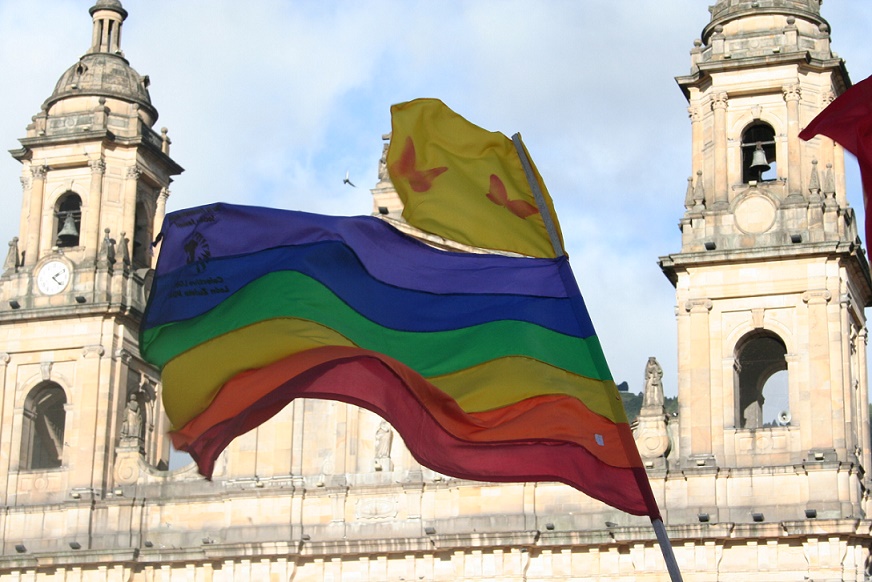
Colombia has again shown itself to be a country of contrasts – a society ostensibly ruled by Catholic and conservative morals with one of the hemisphere’s most progressive Constitutional Courts – with two important legal decisions on LGBT rights.  The Court has defended the democratic, pluralistic, and inclusive spirit of the Colombian Constitution against powerful authoritarian and conservative forces for years.  In 2007 and 2008, it granted pension, social security, and property rights to registered same-sex couples, and it ruled that same-sex couples “constitute a family” in 2011.  In spite of some recent rulings tarnishing its liberal record, last month the Court made two decisions that, though limited, have historic implications.

  • It ruled in favor of step-child adoptions by gay couples.  After much political, legal, and even religious debate, the Court broke a four-year silence on the highly contested issue, ruling 6 to 3 that Verónica Botero could legally adopt the biological children of her wife, Anna Leiderman.  The ruling does not explicitly allow joint adoption by gay couples, but the decision cites ample scientific evidence and declares that parental homosexuality cannot be considered a risk factor for children, thus leaving the door open for further LGBT-friendly jurisprudence in the matter.
  • The court recognized the gender identity of trans women by declaring that they do not have to comply with the compulsory military service required of all Colombian males.  The case centered on Gracy Kelly Bermúdez, a transgender woman who filed a lawsuit against the mayor’s office in Bogotá when she was denied a job for failing to provide proof of her military service.  Bermudez had not entered the military because she identifies as a woman, and therefore did not have the Military Service Registration Certificate (libreta militar) required when applying for jobs, studying at the university level or accessing health care services.  She would have been exempted if she had undergone an official sex change – the right to change one’s sex has been protected in Colombia since 1993 – but this can only be legally done after undergoing sex realignment surgery, a procedure that most trans women do not have access to, cannot afford, or do not want.  Therefore, despite their gender identity and expression, the legal sex of the majority of trans women continues to be “male.”  The Court decided in favor of Bermúdez and ordered the mayor’s office to hire her immediately.

These decisions are far-reaching.  In the Bermúdez case, the Court was essentially prioritizing gender identity over assigned sex at birth.  It declared that asking trans women for the Military Service Registration Certificate when hiring them is unconstitutional because it violates their right to define their own gender.  Furthermore, the Court told Congress to draft a bill that regulates the rights of transgender people in Colombia, paving the way for a much-needed Gender Identity Law.  The ruling also has deep regional implications.  Since Argentina passed a groundbreaking Gender Identity Law in 2012, many countries have been struggling to achieve similar results – and the Colombian legal precedent can become a viable alternative for impact litigation.  Currently, at least ten countries in Latin America have compulsory military service with different levels of enforcement attached to non-compliance.  But as the Bermúdez case illustrates, military conscription mandates can turn into strange, yet effective platforms to denounce how the state routinely imposes gender identity on its citizens, often against their own will, and to catalyze legal reform that advances LGBT rights in the Americas.

* Dr. Juliana Martínez teaches gender and sexuality and Latin American Literature in the Department of World Languages and Cultures at American University.

September 25, 2014

Argentine Debt and the U.S. Dollar

By Leslie Elliott Armijo

Images Money / Flickr / Creative Commons Attribution-NonCommercial-ShareAlike 2.0 Generic (CC BY-NC-SA 2.0)

Multiple economic and political challenges have called into question the future status of the U.S. dollar as the world’s dominant reserve currency, but backlash from Argentina’s recent spat with the United States over defaulted bonds appears to be fueling interest in reforms that may have beneficial implications.  According to the IMF, some 61 percent of the world’s known foreign exchange reserves held by central banks around the world remain in low-yielding dollar-denominated assets, mainly U.S. Treasury bonds.  The United Nations Conference on Trade and Development (UNCTAD), China, and heavyweights in the Global South, including Brazil, are calling for international trade agreements that would give emerging economies “policy space” – allowing national governments to impose capital controls, fund exports, subsidize local industry, and keep financial services national.  Private U.S. banks, however, claim that continued U.S. dominance of world capital markets – a crucial pillar of continued reserve currency status – requires ever more open trade in financial services.  The BRICS complain about the U.S. government’s “exorbitant privilege” as the reserve currency country, with some of the sharpest complaints coming from joint statements by Brazil, Russia, India, China and South Africa. Chinese officials, though, worried about their own large dollar investments and ambivalent about the implications of renminbi internationalization, more than once have pulled the group toward a softer tone.

Argentina’s ongoing sovereign debt negotiations provide a different window onto the dollar’s reserve currency status.  Like most countries, Argentina has held a large chunk of its government’s savings in the U.S. and hired private U.S. financial institutions as its international bankers.  Today it is trying to extricate itself from U.S. markets and do its saving and financial intermediation elsewhere. Iran and Russia are doing the same, but Argentina has no foreign policy quarrel with the Obama Administration – and is not subject to U.S. financial sanctions over nuclear or military adventurism.  Buenos Aires is among those who chafe at U.S. power through the dollar, but it is primarily motivated by the U.S. Supreme Court’s decision in July to let stand a lower court judgment in favor of investors holding bonds from Argentina’s $82 billion sovereign debt default in December 2001.  Although 92 percent of the original bondholders accepted the Argentine government’s restructured (lower value) bonds in 2005 and 2010, New York Federal District Court Judge Thomas P. Griesa ruled that Argentina’s failure to settle with the holdouts means that any U.S. financial institutions, or their international affiliates, that intermediate funds enabling Argentina to stay current on payments to the majority will themselves be in contempt of court.  This has sent Argentina into “technical default.” Argentina is suing the U.S. in the International Court of Justice (whose jurisdiction the U.S. refuses to recognize) and in the court of global public opinion – pushing, for example, a recent proposal for global financial reform before the U.N. General Assembly. It has also welcomed an $11 billion currency swap agreement with China, and Chinese state banks have since pledged $6.8 billion in new infrastructure loans.  Some observers speculate that the very first loan of the New Development Bank, newly organized by the BRICS countries, could go to Argentina.

The Argentine bond case harms the perceived fairness and credibility of U.S. financial markets and, by extension, the strength of the U.S. dollar because the recent legal judgments seem capricious to many.  Senior figures at the IMF have long supported the routine inclusion in all international sovereign bond issues of a so-called “collective action clause,” which would make any restructuring accepted by two-thirds of bondholders binding on all.  The European Union already has ruled that sovereign bonds issued within the EU, including many for troubled Eastern or Southern European governments, must contain such clauses.  Moreover, the International Capital Markets Association, representing more than 400 of the world’s largest private investment institutions, has just issued a position paper endorsing obligatory collective action clauses, placing it on the same side of this issue as non-governmental organizations advocating financial architecture reform such as the New Rules for Global Finance and the Jubilee Debt Campaign.  This would give taxpayers in emerging economies – the ultimate backstop of the creditworthiness of their governments – the same bankruptcy rights as firms and households.  It is not in the interest of Latin American and other emerging economies for U.S. currency and financial dominance to end anytime soon – a tripolar reserve currency system based on the dollar, euro, and reniminbi does not yet appear able to sustain the worldwide growth and prosperity of recent decades and may in fact entail significant risks – but fairer rules for sovereign financing would benefit everyone.

* Leslie Elliott Armijo is a Visiting Scholar at Portland State University and a Research Fellow at CLALS.  She has just published The Financial Statecraft of Emerging Powers: Shield and Sword in Asia and Latin America (London: Palgrave, 2014).

September 23, 2014

Brazil: Is Marina Silva the PT’s Nemesis?

By Luciano Melo

MarinaSilva

Photo courtesy of the Marina Silva campaign website

No politician in recent years has been able to shake and polarize Brazilian politics as Marina Silva has since becoming the Brazilian Socialist Party (PSB) presidential candidate after its original nominee, Eduardo Campos, died in a plane crash last month. She has an alluring biography: born into an extremely poor family and illiterate until she was 16, she worked as a rubber tapper and rose to become one of the most prominent ecologists and defenders of the Amazon region alongside Chico Mendes, a true Brazilian hero. After earning a degree in history, Silva entered politics in the mid-1980s. Several years later she received the most votes as a state representative for Acre, served twice as a senator, and later became the Minister of Environment in Lula’s administration (a position from which she resigned due to fundamental divergences with the Workers Party and Dilma Rousseff). In 2007 she won the UN’s Champions of the World award, and three years later she ran for President under the Green Party banner, amassing 20 million votes on a platform emphasizing environmental issues and education.

Recent polls find roughly a third of Brazilian voters favoring Silva in the first round of balloting scheduled for October 5, and running even with or slightly ahead of President Rousseff in an anticipated run-off election three weeks later. The Brazilian media suggest that a large part of Silva’s appeal comes from a personal aura of transparency and rectitude – a refreshing change from others competing for Brazil’s top job. She has also demonstrated an old-fashioned ability to compromise in order to form alliances. A committed environmentalist, Silva teamed up with Eduardo Campos, a titan of agribusiness, and now, heading up the PSB ticket, her running mate is Beto Albuquerque, a moderate farmer who can bring a certain level of balance in the economic-environmental equation. On the separation of church and state, however, Marina may face a difficult balancing act. She is an evangelical Christian, winning a large chunk of religious voters in 2010, and she has defended the teaching of creationism in schools, saying that God created even Darwin. She rolled out an agenda for advancing LGBT rights recently, but criticism by Pastor Silas Malafaia, one of Brazil’s main evangelical leaders, forced her to reverse course and abandon her position 24 hours after having presented it.

Although Brazil is a religious country, laïcité – a French version of secularism – is a serious matter for the upper and middle classes, and Silva’s religiosity may cost her votes. She has exposed her core weak spot, which the other candidates will exploit in the upcoming debates and electoral campaigns. But popular concerns about corruption run much deeper in the eyes of the Brazilian people. The fact that presidents Dilma and Lula and the PT have become synonymous with misconduct in general, and mismanagement regarding Petrobrás in particular – a scandal involving 40 PT members in a multi-million real scheme – weakens their ability to counterattack amidst Silva’s continuous rise. What we will see in the elections in October is therefore a battle between the PT’s Bolsa Família – one of the most successful social programs in the history of Brazil – and a candidate who theoretically embodies honesty and honor. Whatever the outcome, it seems that PT has met its biggest challenge in 12 years.

El Salvador: The Maras, Community Action, and Social Exclusion

By Mario Zetino Duarte, Larissa Brioso, and Margarita Montoya

Photo Courtesy of FLACSO-El Salvador

Photo Courtesy of FLACSO-El Salvador

Maras and gangs in El Salvador have become social actors with great power in communities suffering from a high level of social exclusion. They have been linked to violence and organized crime, and they have been blamed for the highest number of homicides, organized criminal actions, and the generalized insecurity in which the country lives. They have brought a sense of isolation to the communities in which they live, as well as a reputation that increases the communities’ exclusion. According to a study being conducted in crime-ridden communities of Santa Tecla (near San Salvador) and Sonsonate (64 km. west of the capital), the maras’ power derives from their ability to cause fear and terror among inhabitants as a result of their effective and organized criminal actions. Their influence has a strong psychological impact and broad influence over people’s lives. The criminal activities of the gangs in the community are generally rejected by inhabitants because they put families at risk, make neighborhoods the target of police operations, and taint both the community and its residents socially – making it hard for people to get or keep jobs.

Nonetheless, many citizens in these communities have a positive assessment of the maras when it comes to providing important neighborhood security, due to a lack of national or local authority. In Santa Tecla and Sonsonate, the Salvadoran government, the municipality, international organizations, and other institutions have invested heavily in programs to stem the tide of mara violence, with mixed results. These communities suffer from low levels of employment, education, and social security, particularly among women. Afraid of retribution, citizens in these communities do not turn to state institutions to report crimes or to request protection, and they instead approach the maras to take actions regarding conflicts with neighbors and situations related to domestic violence. The void in institutional services, which has been permanent in some communities, is being filled by the maras and their members, making them the primary support for the local Asociaciones de Desarrollo and implementers of development plans.

Changes in the community philosophy of the National Civilian Police (PNC) in one of the communities of the study offers a useful example of how new approaches can help improve citizens’ lives. The PNC’s new approach to the community and its underlying social and security problems has also led to the evolution of the maras’ role as community actors and their legitimacy in the people’s eyes, primarily based on the fear they instill. This has benefited some communities.  Likewise, international cooperation – which has played an essential role – and the recent implementation of community policing practices as a model within the national security strategy to reduce gang criminality have driven debate on how communities can confront violence and crime in a sustained manner. The problems are far from resolved, but the gangs, the police, and the state each appear to be redefining strategies and roles. It remains to be seen whether these actions are sustainable and applicable in other territories – and whether the maras’ involvement in development programs can help create conditions for citizens to cope with the violence and social exclusion that plague their communities.

* Mario Zetino Duarte, Larissa Brioso, and Margarita Montoya are researchers at FLACSO-El Salvador.  Their study is funded by the International Development Research Centre.

Latin America United Against Violence in Gaza

By Aaron T. Bell

Sergio / Flickr / Creative Commons Attribution-NonCommercial-ShareAlike 2.0 Generic (CC BY-NC-SA 2.0)

Sergio / Flickr / Creative Commons Attribution-NonCommercial-ShareAlike 2.0 Generic (CC BY-NC-SA 2.0)

Israel’s assault on Gaza this summer provoked sharp criticism from Latin American governments.  Condemnation came not only from Cuba, a long-time critic of Israel, and from Bolivia, Venezuela, and Nicaragua, which have been without diplomatic ties to Israel since cutting them after previous conflicts in Gaza in 2009 and 2010.  This summer’s UN-estimated 1,500 civilian deaths also provoked outrage from center-left governments, as Brazil, Chile, Ecuador, El Salvador, and Peru all withdrew their ambassadors.  At the Mercosur summit at the end of July, Brazil, Venezuela, Uruguay, and Argentina issued a joint statement in which they criticized Israel’s “disproportionate use of force…which has almost exclusively affected civilians.”  And one of the largest popular demonstrations worldwide against the Israeli action took place in Chile, home to hundreds of thousands of Palestinian descendants.

Latin American interest in Israeli-Palestinian affairs is deeply rooted in the past.  Waves of immigration beginning a century ago have made the region home to the largest Palestinian diaspora outside the Arab world.  Latin American governments provided crucial support for the 1947 UN Partition Plan for Palestine that led to the creation of the state of Israel, but they roundly condemned the occupation of the Gaza Strip 20 years later.  In the Cold War era, Israel provided military hardware to rightwing military regimes in the region while the Palestine Liberation Organization, more leftist than Islamic in its revolutionary views, lent political and economic support to the Sandinista government in Nicaragua.  Contemporary Latin American governments have taken a balanced approach in their relations with Israel and the Palestinians.  All but Colombia, Mexico, and Panama have recognized a Palestinian state based on national borders prior to the 1967 Arab-Israeli war, and trade with Israel has flourished.  Brazil is the top destination for Israeli exports, totaling over $1 billion per year.  In addition, Israel signed free trade agreements with Mercosur in 2007 and 2010; became an official observer to the Pacific Alliance (Chile, Colombia, Mexico, and Peru) in 2013; and in May 2014 approved a four-year, $14 million plan to boost trade with the PA nations and Costa Rica.  Israel’s recent efforts to further trade in Latin America ironically developed out of a desire to shrug off some of its dependency on Europe, where criticism of Israeli policy has become widespread and boycotts of Israeli goods are being organized by advocates of the Palestinian cause.

This summer’s fighting in Gaza chilled diplomatic relations between Latin American governments and Israel.  The Israeli Foreign Ministry described the withdrawal of Latin America ambassadors as a “hasty” decision that would only encourage Hamas radicalism, and it struck a nerve in Brazil when dismissing its “moral relativism” as an example of “why Brazil, an economic and cultural giant, remains a diplomatic dwarf.”  But both Israel and Latin America stand to gain from stronger economic ties, and with the exception of Chile’s suspension of trade talks, there are no pending signs that economic relations will suffer further now that this round of fighting in Gaza has come to an end.  The significance of this summer’s events lies instead in the autonomous decision by Latin American governments of all political stripes to act in favor of peaceful conflict resolution and the protection of civilians enveloped by the violence of war.  The Assad regime’s massacre of its own citizens in Syria in recent years provoked a more reticent condemnation from Latin America’s center-left governments and regional blocs, which backed a negotiated solution to the conflict while strongly opposing the possibility of foreign military intervention.  Without the specter of a wider conflict looming over this summer’s Gaza crisis, Latin American governments seized the opportunity to stake out a firmer position.  The region’s reaction to future atrocities – which may come sooner rather than later as the US prepares to battle the “Islamic State” in Syria and Iraq – will show how durable this new approach will be.

Preparing the West Indies for the Demise of PetroCaribe

By Thomas Andrew O’Keefe*

ariwriter / Flickr / Creative Commons Attribution-NonCommercial-ShareAlike 2.0 Generic (CC BY-NC-SA 2.0)

ariwriter / Flickr / Creative Commons Attribution-NonCommercial-ShareAlike 2.0 Generic (CC BY-NC-SA 2.0)

The English-speaking Caribbean nations – whose heavy dependence on imported diesel and fuel oil to generate electricity has placed them among the most heavily indebted countries in the world (on a per capita basis) – will face massive headaches if PetroCaribe collapses.  They eagerly signed up for the Venezuelan initiative, which sells them petroleum with one- or two-year grace periods and long repayment schedules ranging from 15 to 25 years at 1 or 2 percent interest.  Participating countries can even pay with products or services in lieu of hard currency.  In the case of Guyana, Haiti, Jamaica, and the Eastern Caribbean mini-states, PetroCaribe’s financing scheme represents an estimated 4 to 7 percent of their annual GDP.  The worsening economic turmoil in Venezuela, however, raises serious concerns about PetroCaribe’s future.  According to recent media reports, PdVSA, the Venezuelan national petroleum company, is shortening repayment periods and increasing interest rates.

No doubt this is one reason why the Obama administration launched the Caribbean Energy Security Initiative (CESI) in June.  CESI seeks to diversify the Caribbean’s energy matrix away from its current heavy reliance on fossil fuels by using Overseas Private Investment Corporation (OPIC) loans and credit guarantees to encourage private sector investment in renewable energy.  It is premised upon the Caribbean’s huge potential to generate energy from the sun, wind, geothermal sources, and maritime currents.  In the past, the principal bottlenecks to harnessing these abundant resources have been hefty startup costs and small populations that make it difficult, if not impossible, for the private sector to recover profits within a reasonable period of time.  Although the initial capital investment for solar- and wind-based technology has dropped considerably in the last few years, it is unrealistic to expect Caribbean nations to make a full switch to renewable energy resources anytime soon.  A more realistic, short- to medium-term alternative is to make greater use of natural gas.  Although still a fossil fuel, gas is more efficient – and therefore the generated electricity is less costly – than fuel oil and diesel.  Moreover, electricity generated from natural gas emits 70 percent as much carbon dioxide as oil, per unit of energy output.

The shale gas boom in the United States generated by innovations in hydraulic fracturing has led to calls to lift restrictions on U.S. natural gas exports to those countries with which it does not have a free trade agreement.  The Caribbean is potentially a major target market of this natural gas in liquefied form (LNG), but this would be a big mistake.  Lifting restrictions on exports will inevitably raise natural gas prices in the U.S., thereby hurting consumers and putting the nascent revival of domestic manufacturing at risk.  It would also require building expensive LNG offloading and regassification facilities in the West Indies, which would run up against the same economies of scale limitations (except in Jamaica and Hispañola) that have undermined a mass transition to renewable energy.  A more realistic alternative is to revive plans to build a natural gas pipeline from Trinidad and Tobago to Barbados, and then up through the Eastern Caribbean.  Proposed back in the early 2000s, it was scuttled with the appearance of PetroCaribe in 2005.  Trinidad and Tobago has ample reserves of natural gas; at one point before the shale gas revolution it was the largest source of imported LNG in the United States.  The pipeline would link islands with populations of under 100,000, where LNG is economically unviable, with the more densely populated French dominions of Guadalupe and Martinique.  It would also help revive the floundering Caribbean Common Market and Community (CARICOM).

* Thomas Andrew O’Keefe is President of San Francisco-based Mercosur Consulting Group, Ltd.

Children and Migrant Teens: Trapped with No Way Out

By Ursula Roldán Andrade*

Alaks / Flickr / Creative Commons Attribution-NonCommercial-ShareAlike 2.0 Generic (CC BY-NC-SA 2.0)

Alaks / Flickr / Creative Commons Attribution-NonCommercial-ShareAlike 2.0 Generic (CC BY-NC-SA 2.0)

The 56,000 Central American children involved in the humanitarian crisis along the Mexico-United States border are trying to reach the United States not only to reunite with their families.  They are also driven by poverty, social exclusion and violence in their home countries of northern Central America.  The response of U.S. and Central American authorities, however, seems to be only to strengthen the barriers to migration – not only along the Mexico-United States border but also between Mexico, Guatemala, El Salvador, and Honduras.  The United States has emphasized immediate deportation, and its request for funding includes an increase in the number of courts to expedite deportations and in enhanced border security with military and police forces.  The Obama Administration also seeks resources to address the consequences of emigration in Central America, where the governments have done little more than begin criminal prosecutions against the “coyote” network.  In Guatemala there are rumors that parents responsible for migrating children could face criminal charges.  Caring for would-be migrants is a much lower priority; there are only two shelters, of a capacity of less than 80 children, in charge of the Social Work Program of the Office of the First Lady of Guatemala (SOSEP), which has also proposed the improvement of child reception conditions.

A mass media campaign in Guatemala promotes the idea of children staying to fulfill the “Guatemalan Dream” rather than risk their lives attempting to live the “American Dream.”  Yet, the “Guatemalan Dream” that authorities are referring to is lacking.  The Human Rights Office of the Archbishop of the Catholic Church of Guatemala (ODHAG), which has tracked human rights for children in the nation for the past 15 years, reported in 2011 that simply being alive in Guatemala means surviving health risks, food insecurity, and violence.  The report’s most revealing data show that over 48 percent of Guatemalan children suffer from chronic malnutrition.  According to ODHAG, 51 percent of the deaths of minors in 2011 were teenagers between the ages of 13 and 17.  The report called on the state to take preemptive measures to protect children and adolescents from malnutrition, hunger, violence, abuse, and human trafficking networks, but the government still spends only 3.1 percent of GDP on this population, whereas other Central American countries invest 6 percent.

Central American children are caught in the crossfire of political discourse in the United States – a migrant population that either gains protection or is cast aside, sometimes with xenophobic or even racist overtones.  Partisan politics, interest in cheap labor, and other factors short-circuit debate, creating conditions for exploitation of migrants without recognition of their citizenship, families, or rights.  The Guatemalan government neglects its vulnerable population, is rife with political corruption, and is cursed with the narrow-mindedness of its economic elite, which does not, in the least, attempt to change the structural conditions that exclude and eventually expel their countrymen.  Solutions to the resulting humanitarian crisis will remain elusive as long as Central American governments do not guarantee fundamental rights and undertake policies aimed at the defending the higher interests of children and adolescents. 

* Dr. Roldán Andrade specializes on migration issues at the Center for Research and Policy Management (INGEP) at the Universidad Rafael Landívar in Guatemala.

Prison Reform in Latin America: Lessons from Costa Rica

By Geoff Thale and Adriana Beltran*

Steven and Darusha / Flickr / Creative Commons Attribution-NonCommercial-ShareAlike 2.0 Generic (CC BY-NC-SA 2.0)

Steven and Darusha / Flickr / Creative Commons Attribution-NonCommercial-ShareAlike 2.0 Generic (CC BY-NC-SA 2.0)

Prison overcrowding is a widespread problem in Latin America, primarily because of harsh drug-sentencing laws and inadequate budgets, but Costa Rica may be setting a useful example for dealing with it.  In most countries, guards control the perimeter, but groups of prisoners or criminal gangs organize and control life inside the prison compound.  Rehabilitation and re-integration programs are limited.  Not surprisingly, there is little political leadership for prison reform; the issue wins few points with the general public.  Even dramatic events – like prison riots in Venezuela or prison fires in which hundreds of young men die as in Honduras – don’t generate interest in prison reform.  A key component of the criminal justice system – as a deterrent, a punishment, and as a provider of rehabilitation and reintegration services that will reduce recidivism – the prisons are often neglected.

While Costa Rica faces growing drug-related problems, a multi-country analysis by the Washington Office on Latin America of persistent criminal justice and prison problems in Latin America – aimed at identifying strategic solutions – indicates that the country stands out as having undertaken at least modest reforms of its prisons to prevent them from becoming the breeding grounds for increasingly hardened criminals and gangs.  Prison conditions in Costa Rica have not been among the worst in Latin America, although the U.S. State Department said in its Human Rights Report for 2013 report that they were “harsh” and that “overcrowding, inadequate sanitation, difficulties obtaining medical care, and violence among prisoners remained serious problems.”  Until very recently, when new drug sentencing laws and tough anti-crime measures pushed the prison population up, the system generally did not exceed capacity.  Even today, the system is at 140 percent of capacity – far less than the 200-300 percent seen in other countries.  Prison conditions also seem less abusive than those seen in other countries.  An external oversight body was created to protect the rights of prisoners.  Moreover, the government, with support from the Inter-American Development Bank (IDB), is reaching out to local businesses to support vocational training programs for inmates.

This process has been driven by reformers inside the government and prison system, in contrast to most reforms elsewhere in the hemisphere driven by international donors.  This is a rare example of how reformers inside and outside the system worked to achieve institutional changes that increase citizen security while respecting human rights.  In this case, long-standing mid-level and senior staff of the penitentiary system, with the support of successive Ministers of Justice appointed by President Laura Chinchilla, played a key role in resisting pressures from legislators who want to toughen sentencing, which would increase prison populations.  They have advocated measures to ease overcrowding and ensure proportionality in sentencing.  At the same time, they have also used the IDB loan to both defend and expand the rehabilitation and re-insertion programs in the prison system.  Every country’s situation is unique, and Costa Rica has advantages — a relatively low crime rate, a relatively strong state structure, a relatively well-established respect for the rule of law – that others lack, but San José has shown that reform in this difficult, politically sensitive area is possible.

*Geoff Thale and Adriana Beltran, of the Washington Office on Latin America (WOLA), recently led a small delegation to visit Costa Rican prisons.

Resources and the New Developmentalism

By Paul A. Haslam*

María del Carmen Ortiz / Flickr / Creative Commons Attribution-NonCommercial-ShareAlike 2.0 Generic (CC BY-NC-SA 2.0)

María del Carmen Ortiz / Flickr / Creative Commons Attribution-NonCommercial-ShareAlike 2.0 Generic (CC BY-NC-SA 2.0)

Resource nationalism is driving the most significant shift in Latin American development policies of the past decade.  It is rarely talked about yet is constituting a new developmental model that is being adopted by governments of diverse ideological inclinations.  It has involved reforming taxation regimes dating from the 1990s to extract more “rent” from natural-resource intensive industries; strengthening and extending state capacity; using rents to support social spending by the state, including anti-poverty programs; and – most importantly – linking resource abundance with industrial policy.  It is the basic framework of the post-neoliberal development model, and examples are many.  The splashier headlines in the past decade focus on various instances of nationalization, including the expropriation of YPF in Argentina (2012); Venezuela’s erratic nationalization program; and Bolivia’s dramatic military occupation of foreign-owned gas facilities in 2006 – all intended to achieve these goals.  Early this month, the provincial government of San Luis, Argentina, presented a project-law to create a new provincially owned mining company, San Luis Minera (SAPEM) – joining many fellow provinces that have created or breathed new life into state-owned enterprises (SOEs), particularly in the mining sector.

By and large, these enterprises exist to associate with multinationals, following the trail blazed by Argentina’s YMAD (in Catamarca) and Fomicruz (in Santa Cruz) during the dawn of Argentina’s mining boom in the late 1990s.  The SOEs typically offer the rights to prime potential lands claimed by the state, handle the administrative and regulatory requirements of the province, and in some cases, negotiate the social licence with nearby communities.  In exchange, they get a small net profits interest (typically around 8-10 percent), which results in rent for the province.  The multinational does everything else: raises the money; plans, builds and operates the mine, and sells the mineral.

These are not the rent-seeking policies typical of low-capacity governments.  The enduring principles of the liberal regime (such as low royalty rates) have pushed revenue-hungry governments to explore creative options such as these to capture rent from their mining sectors.  The new SOEs are also an institutional innovation that aims at leveraging natural resource wealth for economic development, as governments also expand resource-funded social spending.  One of the objectives of Morales’s “nationalization” of Bolivia’s oil and gas resources, for example, was to “revitalize” the state-owned YPFB (Yacimientos Petrolíferos Fiscales Bolivianos) as an engine of development.  Nor is this “resource nationalism” exclusively a project of the left: Chile increased royalty rates in a “Special Tax” on the mining sector in 2005, and Colombia and Peru have hiked taxation on mining as well.  Brazil has continued to use of SOEs like PETROBRAS.  It’s still an open question, however, how successfully the rents generated by this new model can be combined with industrialization or development strategies that deliver enduring benefits. 

*Dr. Haslam teaches at the School of International Development and Global Studies, University of Ottawa, Canada.