By Felipe Rezende, Research Fellow and Visiting Scholar in Residence at American University’s Center for Latin American and Latino Studies (AU-CLALS), from the University of Brasília (UnB), Brazil.
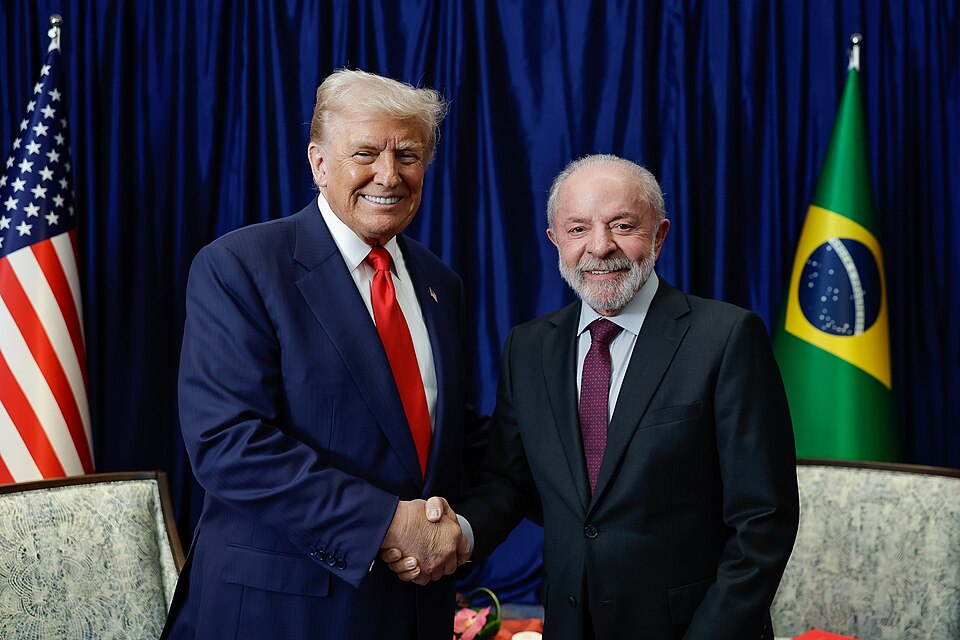
Notwithstanding the “excellent chemistry” cited by Donald Trump in reference to a brief September 2025 meeting with Lula da Silva on the sidelines of the 80th United Nations General Assembly, in recent times the bilateral Brazil–U.S. relationship has yet to produce the quantity and quality of results one might have expected. Whether a result of different national and international commitments, or differing approaches to foreign policy, at least for the short term the interplay of a variety of factors has cooled the potential for advances in the relationship between the two countries. Reviewing recent developments in the bilateral relationship between Brazil and the U.S., here I consider how the current pattern of this relationship, together with upcoming electoral considerations, are likely to determine its limits and possibilities for the near future.
Sources of Direct and Indirect Friction between the White House and the Palácio do Planalto
Trump’s preferred trade policy in his second term, based on the unilateral imposition of tariffs upon numerous countries, with the declared objective of establishing an alleged fair balance (“Leveling the Playing Field”) in U.S. trade relations with the world, has lately been a primary factor of direct friction in the bilateral relationship with Brazil.
The historical U.S. surplus in trade with Brazil did not prevent the application in June 2025 of a 50 percent tariff on imports of Brazilian products. This imposition greatly hindered the flow of Brazilian agricultural production to North America, generating an oversupply in the South American country and inflation in the U.S. for such consumer products as beef, coffee, soybeans, orange juice, and other fruits.
In November 2025, pressured by domestic demand in the U.S., and interested in advancing strategic talks with Brasília, Washington withdrew the tariff weeks before the U.S. Supreme Court declared such practices illegal. At that time, the Palácio do Planalto appeared to have avoided the domestic political consequences of the tariff standoff by successful mobilization a narrative appealing to Brazil’s sovereignty and to the impropriety of such practices.
Since the inauguration of Trump’s second term, the influence campaign by groups linked to former Brazilian President Jair Bolsonaro – sentenced to 27 years in Brazil for an attempted coup d’état and violent abolition of the Democratic Rule of Law – has also been decisive in dampening official bilateral activity between Brazil and the U.S.
This included months of lobbying with the MAGA movement and gatekeepers of the Trump administration by his son Eduardo Bolsonaro, who endorsed the decision to impose additional tariffs, and suggested that justices of Brazil’s Federal Supreme Court (STF) be sanctioned, which was understood as an attempt to constrain the Court’s role in judging the case concerning the attempted coup d’état on January 8th, 2023.
In response the U.S. revoked valid visas for entry into the U.S. for almost all ministers of the Court, including Justice Alexandre de Moraes, who was rapporteur in the trial of the January 2023 rioters. The U.S. also applied financial sanctions under the Magnitsky Act, effective between July and December 2025, when they were withdrawn.
Under Lula Brazil’s foreign policy, and Ministry of Foreign Affairs, has continued to follow certain traditional patterns of Brazilian diplomacy, grounded in multilateralism, pacifism, and the reform – rather than rejection – of already existing institutions, organizations, and regimes of global governance, beginning with the United Nations — something that does not necessarily converge with U.S. foreign policy practices under Trump.
This was reflected, for example, in the Lula administration’s reluctance to accept an invitation to join the so-called “Board of Peace” in January 2026, created by Trump as a better alternative – in his view – to managing international conflicts. Lula publicly commented that Trump’s initiative appears to overlap with the competences ascribed to the UN, an important institution for the pursuit of Brazil’s interests as a middle power.
Lula’s skepticism toward Trump’s Board of Peace, with Trump as its self-appointed permanent Chairman and its likely promotion of U.S. foreign-policy interests, was compounded by the White House’s proposed Gaza peace plan even while the U.S. actively initiated global conflicts, especially its most recent incursion into Iran — a fact that delayed the meeting between Lula and Trump.
The May 7th Meeting and What Comes Next: Between Appearances and Substance
The approximately three hour meeting between Lula and Trump revolved around three principal issues. First was the question of bilateral trade, where disagreement remained as to the use of tariffs and U.S. allegations of unfair trade, refuted by the Brazilian side. Brazil, instead, sought unsuccessfully to convince the Trump administration of a U.S. trade surplus of USD 400 billion over the last 15 years.
With the possibility looming of the reapplication of a 30 percent tariff on Brazilian products, considered within the scope of ongoing investigations undertaken by the U.S. Trade Representative, Brazil achieved at least temporary relief, with the institution of a 30-day delay for the counterparts to reach a common understanding regarding the terms-of-trade scenario.
Second was a potential partnership for the exploitation of critical rare earth minerals in the South American country, which holds the world’s second-largest reserve. The condition set by Brazil is U.S. investment in local processing of the minerals and integration into the production chain. The legal framework to regulate this is on the verge of approval in the Brazilian Congress, thus enabling the U.S. and other countries to invest in this sector in Brazil.
What seems not to have been mentioned at this meeting is Brazil’s government-backed payment method, called PIX, often criticized by U.S. Vice President JD Vance. The White House is bothered that this payment method, in force since 2020, departs from the traditional payment models embraced by U.S. credit-card networks. Above all, the U.S. is concerned about the possibility of extending this model, currently being studied by the New Development Bank, to other BRICS countries.
Third, the meeting addressed questions of public security and cooperation against organized crime. Brasília emphasized that at present there is no significant volume of narcotics produced in the country entering the U.S., while the number of synthetic drugs and American weapons—especially originating from the state of Delaware—entering Brazilian territory is increasing. Brazil’s interest lies in deepening cooperation around preventive measures to stem these illicit flows.
On this topic, the principal unspoken point concerns the U.S. intention of characterizing Brazilian criminal factions, such as the Primeiro Comando da Capital (PCC) and Comando Vermelho (CV), as terrorist cells, which could provide a pretext for U.S. interference in domestic issues related to the repression of crime in Brazilian territory. The view of the Palácio do Planalto is that cooperation in public security and in combating organized crime should involve other approaches than mere classification of these groups as terrorists.
The May 7th meeting between Trump and Lula at the White House highlighted the sensitivity of these and other topics, which have been sources of frictions in the official relationship between the countries. It became clear that during the meeting an effort was made by both parties to minimize potential disagreement or embarrassment.
This does not mean, contrary to what the niceties of diplomacy might suggest, that the meeting was in fact productive. Despite appearances and exchanges of compliments between the two leaders – both of whom are facing declining popularity with decisive elections on the horizon – in objective terms this meeting does not seem to have gone much beyond a meeting to schedule other meetings, marking the triumph of aesthetics over politics.
Final Considerations
Despite a certain optimism generated by the May 7th meeting, the recent past demonstrates that a show of courtesies in the Brazil–U.S. relationship does not necessarily mean an absence of conflicts or, still less, indicate the likelihood of productive results in the short term. It is to be expected that evident foreign policy disagreements between Lula and Trump will not overturn a pattern of high-level pragmatism governing the relationship between the two great American powers, with more than two centuries of strong ties.
However, when each pursues their own objectives, including those conflicting with the specific interests of maintaining the bilateral relationship, these meetings become little more than an empty performance. Meanwhile, international far right networks continue to show that they are capable of interfering in the official relationship between Brazil and the U.S., undermining or complicating opportunities to deepen mutual gains while threatening democratic process in both countries.
The prevalence of ties among far-right movements continues to threaten the productivity of the official Brazil–U.S. relationship. Flávio Bolsonaro, another son of Brazil’s former president and a pre-candidate for the Brazilian presidency in the 2026 elections, visited the White House in late May to restore his reputation among voters, with his candidacy facing a setback after his name surfaced in the Banco Master scandal, the worst bank fraud in Brazil’s history. The next day, Marco Rubio declared both the PCC and CV terrorist groups.
Amid distinct tones of populism, it is regrettable that the Brazil–U.S. relationship remains hostage to personalistic interests that often end in transactional bargaining without producing durable results. Overall, it seems unlikely that the Lula-Trump relationship will deliver anything substantive beyond cordial meetings used primarily to restore the domestic reputations of each, particularly given a polarized electoral landscape in Brazil that continues to treat the Bolsonaro-Trump relationship as a relevant factor.


