By Esteban Caballero
Political Scientist, Independent Investigator for FLACSO-Paraguay, and Columnist for Ultima Hora
Xi Jinping’s warning that “the Taiwan issue is the most important matter in relations between China and the United States” will go down in history. However, for the government of Paraguay, Donald Trump’s subsequent statements on the subject could prove even more unsettling. Speaking in a measured tone, the U.S. President acknowledged that Xi “holds a very firm opinion and does not want to see an independence movement,” adding that he, too, “does not intend for anyone to declare independence.” Furthermore, he left it unclear whether or not he would authorize a new arms sale to Taiwan.
Even if these amounted to only a few of the many assertions made by the heads of state of China and the United States at their recent summit, Santiago Peña and his Foreign Minister, Rubén Ramírez Lezcano, likely paused for a moment to reconsider Paraguay’s stance regarding Taiwan. Should they, perhaps, review their close relationship with Taipei in light of a potential shift in global geopolitics? Paraguay belongs to the small group of 12 countries that still recognize Taiwan; alongside Guatemala, it is one of only two Spanish-speaking nations to do so.
The doubts to which we allude do not concern the progress of cooperative agreements and trade relations with Taiwan. Both are advancing favorably. These are matters involving technical cooperation, market access, and infrastructure financing. During Santiago Peña’s administration, this kind of cooperation with Taiwan has been significantly bolstered—a progression that culminated during the President’s recent visit to the island in May 2026. Returning from that visit, he announced an agreement for a massive AI data center project, although its feasibility remains to be assessed.
What may well have generated uncertainty within the Paraguayan government is Trump’s apparent complacency in the face of warnings from Xi Jinping. Such an attitude on the part of the U.S. President would signal a departure from the tougher stance of American foreign policy hawks and would compel the Paraguayan Foreign Ministry to rethink its strategy—particularly the approach of presenting ties with Taiwan as proof of its firm rejection of Chinese influence in Latin America in order to ingratiate itself with the Trump administration. Nothing is set in stone, but this possibility is increasingly making its way into their deliberations.
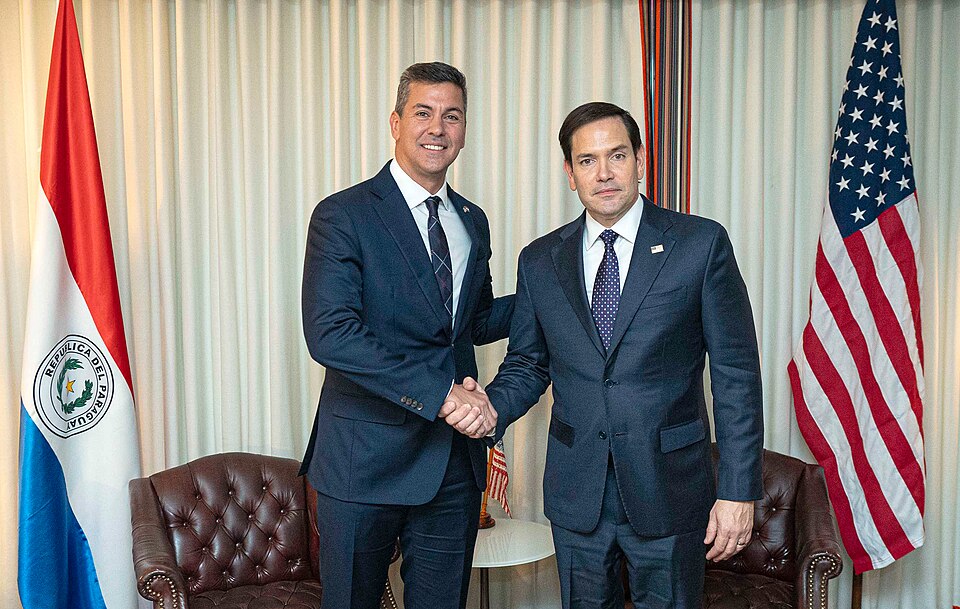
Management of relations with Taiwan forms part of the Santiago Peña administration’s—in our view, excessive—effort to draw closer to the Trump administration and align itself with the State Department, headed by Marco Rubio. In this vein, Paraguay has backed U.S. military intervention in Venezuela and Iran, declared itself an unwavering ally of Israel, and supported the Trump Corollary to the Monroe Doctrine. Furthermore, alongside Argentina, it is the only other Latin American country to serve on Trump’s Board of Peace. Added to this is its enthusiastic participation in the Shield of the Americas summit, held in Miami in March of this year.
Demonstrations of alignment have also been made through measures of cooperation and collaboration regarding migration, security, and the fight against drug trafficking. The Peña administration has cooperated with the United States in the realm of migration, including a willingness to function as a “third country”[1] to process asylum applications for the U.S. It also endorsed a memorandum to facilitate the return of migrants denied admission to U.S. territory back to their countries of origin “with the assistance”[2] of Paraguay.
In the realm of security, Peña announced the designation of the Cartel de los Soles, the Comando Vermelho, and the Primeiro Comando da Capital as terrorist organizations, in line with the U.S. narrative regarding transnational organized crime and its links to state networks in the region. Concurrently, Paraguay signed a Status of Forces Agreement with the U.S.—a legal instrument that governs the status of foreign troops, including their entry, criminal jurisdiction, taxation, immunities, and operational protocols. In practice, such agreements typically facilitate troop deployments, military exercises, and defense cooperation; however, they can also spark domestic debate concerning the scope of immunity of foreign personnel, the extent of the host state’s oversight, and the tensions they may trigger with neighboring nations, such as Brazil.
This alignment has led to Paraguay being regarded as a reliable ally of the United States, and the measures adopted are presented as a reaffirmation of the historic alliance between the two countries. Today, that relationship is expressed within a new framework of cooperation, in which “security” and “counterterrorism” occupy a central place.
Nevertheless, the concrete benefits for Paraguay have not been particularly visible. It appears that Paraguay is conceding far more than the United States is yielding. Consequently, the prevailing opinion in various circles is that this has been too high a price to pay for the lifting of sanctions—imposed by the Treasury Department during the Biden administration—against the companies owned by Horacio Cartes, the former president and current chairman of the ruling party.
This is also the reason why concerns are arising regarding the scope of current foreign policy. If one observes the steps that have been taken, a pattern seems to emerge: a short-term outlook and the absence of a cohesive state policy. Santiago Peña has committed himself to a U.S. administration that may not endure in its current form following the November 2026 midterm elections. President Trump’s popularity is on the decline; the Democrats are gaining ground. The decision to align with the U.S., even in violation of international law, overlooks the fact that small states must uphold the protections afforded by such law regarding the defense of their sovereignty. Forging such a close alliance with Israel, and the most radical elements of the Netanyahu government, has isolated Paraguay from the international community. Finally, coupling all of this with an adoption of far-right rhetoric may yield short-term gains; however, once that political cycle concludes—as was the case in Hungary—the ensuing disappointment could be profound.
[1] See Signing of a Safe Third Country Agreement with Paraguay – United States Department of State
[2] See: https://www.mre.gov.py/paraguay-y-ee-uu-amplian-cooperacion-migratoria/


