China in Latin America: Is the Dragon Here to Stay?

By Ivanova Reyes & Amy Ruddle

Source: Based on Gallagher et al. (2012).

Source: Based on Gallagher et al. (2012).

As China has become a major importer of Latin American & Caribbean commodities, it has significantly increased its financing and investment in the region.  Data on Chinese investment is not complete, but we estimate that it reached 38 percent of the combined financing from the IDB and World Bank to the region during 2005-11, with Venezuela getting the most.  In 2010 China became the third largest outside investor in the region (behind the United States and the Netherlands), and it provided an estimated $22 billion in 2011 – approximately 13 percent of total investment flows to Latin America and the Caribbean.

This investment is likely to continue to grow.  The Chinese government provides tax breaks, lines of credit and other incentives for companies to invest in key industries overseas, and a great deal of its lending corresponds to “finance for assured supply,” such as a  $10 billion loan from the Chinese Development Bank to Brazil’s Petrobras in 2009 in exchange for 200,000 barrels of oil per day.  Currently, according to Gallagher et al. (2012), 72 percent of the Chinese lending to the region is in the oil and mining industries and in related infrastructure projects.  The remaining funds lent in recent years have gone towards other infrastructural developments (21 percent), and towards trade, finance, and communications (7 percent).  Latin American countries have implemented policies aimed to attract Chinese investment.  They generally impose fewer conditions than those demanded by international financial institutions and require less compliance with environmental standards.

Recent surveys indicate that citizens overall view the growing influence of China in the region as a positive thing.  Indeed, Vanderbilt University’s AmericasBarometer found in 2012 that 20 percent of respondents viewed China as already the most influential country in the region, and an average of 63 percent said it had a positive influence.  However, respondents see China as less trustworthy than the United States.  Across those nations polled, roughly 38 percent viewed China as “very trustworthy” or “somewhat trustworthy,” whereas 45 percent had similarly positive views of the United States.

Although the growing Chinese investment and trade may give Latin America and the Caribbean a great opportunity to generate growth, there are several challenges.  If Chinese participation in the mining and oil industries results in environmental degradation, indigenous rights advocates and community organizations already skeptical of commodity driven growth will increasingly confront Latin American states as well as foreign enterprises. In addition, Chinese concentration in the commodities industries has generated strong structural changes in Latin American economies, further relegating manufacturing to a secondary role and raising the possibility of Dutch disease, in which high commodity prices harm other exports by reducing the country’s competitiveness.  It has become commonplace to observe that South America is building a 21st century economy on a 19th century logic of primary product exports. A third concern is that, since Latin America as a region is the smallest recipient of Chinese investment in the world, China will turn elsewhere if governments start putting conditions on Chinese projects.  Ultimately, these concerns make a strong case for Latin American countries to cultivate stronger ties with the Chinese economy while remembering that China’s strategic interest in extractive industries may collide with each country’s own development strategies.


References

ECLAC. 2010. “Chapter III: Direct investment by China in Latin America and the Caribbean.” In ForeignDirect Investment in Latin America and the Caribbean. Retrieved November 2013, from http://www.eclac.cl/publicaciones/xml/0/43290/Chapter_III._Direct_investment_by_China_in_Latin_America_and_the_Caribbean.pdf.

Faughnan, Brian M. and Elizabeth J. Zechmeister. 2013. “What do Citizens of the Americas Think of China?” AmericasBarometer: Topical Brief, June 13.

Gallagher, Kevin P., Amos Irwin, and Katherine Koleski. 2012. “The New Banks in Town: Chinese Finance in Latin America.” In 30 Years of Inter-American Dialogue Report: Shaping Policy Debate for Action.

Zechmeister, Elizabeth J., Mitchell A. Seligson, Dinorah Azpuru, and Kang Liu. 2013. “China in Latin America: Public Impressions and Policy Implications.” Presentation of the LAPOP.

ALBA’s Future: Continuity or Break Down?

By Marcela Torres

ALBA Emblem | public domain

ALBA Emblem | public domain

The death of Hugo Chávez last March and the increasingly severe economic dislocations inside Venezuela have raised serious questions about the sustainability of the Bolivarian Alliance for the Peoples of the Americas (or ALBA).  Born out of an agreement between the Venezuelan and Cuban governments in 2004, the alliance was intended as a response to the U.S. goal of a Free Trade Area of the Americas (FTAA), as well as a vehicle for Chávez to project his Bolivarian vision for Latin American solidarity around a socialist project.  The regional bloc won its first symbolic battle at the Fourth Summit of the Americas in 2005, where Argentina, Brazil, Uruguay, and Paraguay definitively halted negotiations led by U.S. allies to create a single hemispheric free trade area (excluding Cuba, of course).  Over time, ALBA and its oil-based extension, Petrocaribe, have had a significant impact on economies in the region, providing crucial underpinning for presidents who signed on to Chávez’s vision for ideological or pragmatic reasons.  Among the greatest beneficiaries have been the Castro government in Cuba and the Ortega government in Nicaragua, which have received petroleum in exchange for food, in the case of Nicaragua, and doctors and teachers, in the case of Cuba. Ecuador and Bolivia, along with several states in the greater Caribbean, have also become key players in the ALBA network.

Venezuela’s leadership of ALBA, frequently described as “petro diplomacy,” has repeatedly come under fire from the country’s political opposition and from government critics in other ALBA-friendly nations.  The critiques in Venezuela rarely acknowledge the degree to which petro diplomacy has been a recurring feature of that country’s foreign policy, most notably during the governments of Carlos Andrés Pérez in the 1970s and 1980s.  Critics inside Venezuela and beyond frequently accused Chávez of building dependent clientelistic networks with countries desperate for energy resources. However, ALBA activities have transcended ideological divides, a fact demonstrated by Misión Milagro in Colombia, where Cuban doctors indirectly supported by Venezuela provide medical services in conflict zones.  If Chavez’s oil and charisma initially defined ALBA’s possibilities, the alliance has also fostered economic ties and investments among member countries, independent from Venezuela.

Though the election of Nicolás Maduro as Chávez’s successor might appear to guarantee political continuity, lacking Chávez’s charisma, Maduro might not be able to continue Chávez’s level of oil-fueled investment in ALBA.  Public spending in Venezuela continues to increase dramatically, with the fiscal deficit at 9-12 percent, inflation exceeding 40 percent, and the scarcity of dollars contributing to shortages of basic consumer goods.  To sustain its financial backing for ALBA, Maduro will have to stabilize the economy at home lest he lose the  popular legitimacy — no simple challenge.  Following the Twelfth Presidential Summit of ALBA in July, the presidents of Ecuador, Bolivia and Nicaragua joined Maduro in reaffirming their shared commitment to a socialist project in the region and a desire to maintain the international exchanges initiated by Chávez, suggesting that the alliance will not disappear at least in rhetoric in the medium term.  It is possible, however, that Maduro’s leadership will be challenged.  After the airplane in which Bolivian President Evo Morales was traveling was not allowed to land in France and Portugal this summer,  he proposed creating an ALBA army and convening another anti-imperialist summit.  Recently re-elected Rafael Correa of Ecuador has also hinted he might want to lead ALBA.  Without Venezuelan oil and sweeteners like Petrocaribe, it’s hard to see how ALBA will amount to more than a platform for personalistic agendas.


The 50 States and U.S.-Latin America Relations

By Aaron Bell

48outlineObservers seeking to fully understand U.S. relations with Latin America often focus on the federal level, but much is occurring in the majority of U.S. states as well.  Over 40 state governments have engaged with issues related to Latin America, most commonly confronting the legal aspects of immigration (particularly rights for undocumented workers who are overwhelmingly Latin American in origin), and organizing trade missions for local businesses.  Arizona, frustrated with federal policies to counter illegal immigration, enacted its own package of restrictive measures under SB 1070 in 2010, which was followed by similar legislative efforts in Alabama, Georgia, Mississippi, and South Carolina.  On the trade front, after abandoning pursuit of a hemisphere-wide free trade area and then focusing on bilateral trade deals, the federal government has shifted focus toward development of a Pacific Alliance. States meanwhile have pursued commercial opportunities themselves, sending at least 17 trade delegations to Latin America over the past three years, primarily to Brazil, Mexico, and Chile.  Trade initiatives have infrequently clashed with federal policy, but a 2012 law in Florida — blocking the state government from contracting with companies with direct or subsidiary business ties to Cuba and Syria – was a rebuke of what some Floridians perceive as a weak approach by Washington. The Brazilian company Odebrecht, which has projects in Cuba that do not violate the U.S. Embargo, successfully sued the state for overstepping federal jurisdiction.  The bill’s sponsors say they intend to pursue new legal means and rally local political opposition to discourage state contracts with “sponsors of terrorism.”

Coordination initiatives by Arizona and Colorado stand out as unique models for other U.S. states.  The Arizona-Mexico Commission and its counterpart, La Comisión Sonora-Arizona, were founded in 1959 by the governors of Arizona and Sonora to coordinate local support for improvements to infrastructure, education, and security in order to benefit economic development in both states. In Colorado, the Biennial of the Americas was first organized in 2010 to highlight Denver’s role as a site of Pan-American cultural exchange.  The second Biennial, held this summer, hosted art exhibitions and roundtable discussions of social issues facing the region.

The trade and immigration focus of most of the state-level initiatives usually does not clash with Washington’s priorities and indeed are complementary of them.  When the states’ initiatives do challenge the federal government, however, the courts usually come down on the side of the latter.  Yet when states have ultimately lost out to federal power, their actions have at times brought U.S.-Latin American relations to the forefront of national debate, such as when Arizona passed tough immigration laws in 2010.  Bold initiatives from the states are rare, but there are alternatives to the standard trade-and-immigration fare.  The binational approaches of Arizona and Colorado aren’t perfect – critics of the Biennial of the Americas note that corporations use it as a platform for their own interests —but the connections they build are valuable and promote progress by connecting actors with shared interests and developing economic and cultural organizations around those ties.


Aaron Bell is a PhD candidate in the Department of History at American University.


Emerging Engines for Latin American Economies? The Potential of Cultural and Creative Industries

By Robert Albro
Associate Research Professor, CLALS

Filming in Chile / Photo credit: Patt V / Foter / CC BY-NC-SA

Filming in Chile / Photo credit: Patt V / Foter / CC BY-NC-SA

In global terms Latin America’s economy is expected to grow at a relatively brisk 4% in 2013. In the medium-term, however, the picture is not as rosy, since this growth is largely sustained by the export of natural resources and raw materials, the demand for which is expected to slow. If Latin America hopes to continue to enjoy economic growth and stability, other sectors will need to emerge. One strong candidate is cultural and creative industries, a sector that includes all copyrightable entertainment, education, information, and other cultural goods and services, like film, T.V., music, or video games, but also tourism and local heritage products. One of the world’s fastest growing sectors, it has quadrupled its share of world trade since 1995. In 2012 it represented an estimated $2.2 trillion, or 11% of the global total. Cultural and creative industries are also seen as largely immune to the ups and downs of the business cycle. At the height of the recession in 2008, global trade declined by 12%, while trade in creative goods increased by 14%.

Signs that the creative industries are taking off in Latin America are widespread. As the 2010 Creative Economy Report noted, regional governments are now actively promoting policies for this sector, including to incentivize tourism, create new cultural infrastructure, and increase intellectual property protection. South America’s MERCOSUR Cultural, a regional network of over 400 institutions, is centralizing country-based cultural data. Latin America’s film industry is resurgent, with more than 600 million gate receipts last year, and in 2011 Mexico’s television content distribution business alone topped an estimated $251 billion. As a burgeoning tech start-up hotspot, Chile has also become an important video game incubator. Buenos Aires’s design industry is a global player with double digit growth that accounts for 3% of Argentina’s total economy. Designated a UNESCO “creative city” in 2012, Bogotá is now the focus of major government investment as a center of music innovation. Meanwhile, in Brazil the new Creative Rio Program has been launched to enhance that city’s creative economy.

If there is cause for optimism, significant barriers remain. Cities rather than countries are the critical units of scale, as cultural platforms and global nodes in an emerging information economy. But the persistent lack of citizen security across Latin America’s cities is likely to undermine the sustainable development of this sector. The creative industries are also highly unevenly distributed throughout Latin America. Audiovisual production, for example, is limited to Argentina, Mexico, Brazil, Colombia, and Venezuela. Cultural goods and services, too, can become vehicles for regional concerns about the threats posed by globalization, leading to trade frictions. Most importantly, a thorough assessment of the organization and diversity of the region’s cultural and creative industries has yet to be done, debilitating future strategic decision-making. Assessment of this sector is undermined by inadequate or incomplete metrics. But even with metrics in hand, how to make best sense of these in ways that account for the exceptional status of cultural goods as key sources of collective identity, community well-being and quality of life remains a real challenge, one which CLALS is currently partnering with the Inter-American Development Bank to address.

Mexico-Brazil: Competing Economic Models?

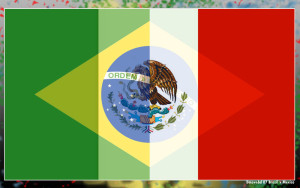
The divergent economic performances of Mexico and Brazil over the past few years have again thrust upon analysts the difficult task of estimating which factors – public policies, market trends, geographic location, financial market managers’ perceptions, or something else – are responsible for the different results.  Brazil was everyone’s favorite two years ago, but Mexico is now being hailed as the hot performer – and praise is being heaped on Mexico City for making things happen.

Former Chilean Finance Minister Andrés Velasco, writing for Project Syndicate (click here for text), explores why the Brazilian economy today is “stagnating” while Mexico, written off as a “lost cause” just two years ago, is “expanding at a steady clip.”   Among Velasco’s key points:

  • Financial markets’ behavior says more about investor perceptions than about the countries in question.  Analysts focus on short-term figures rather than on structural trends.
  • Mexico’s economy is much more open than Brazil’s because of NAFTA and other agreements with Europe and Asia, while Brazil’s is limited by the “strictures of Mercosur.”  (Velasco was a strong advocate of free-trade policies while serving on President Bachelet’s cabinet.)  Mexico’s “export basket” has expanded dramatically – to include car parts, electronics, telecommunications equipment – while Brazil’s exports are increasingly commodity-based.
  • After both implemented anti-crisis fiscal packages in 2009, Velasco praises Mexico for having reduced its stimulus sooner – enabling it to keep interest rates much lower, controlling inflation better, and thereby contributing to a more robust private-sector role.

At the same time, Velasco urges wariness “about jumping to definitive conclusions” and notes that Mexican exports have been slowing in recent months, while domestic consumption is picking up as a source of demand.  He also cautions that Brazil’s potential to sell its products around the world “should not be underestimated.”

However thoughtful, analyses like Velasco’s may neglect the impact of another long-term factor:  the steady rise in wages in Brazil and their stagnation in Mexico.  At a seminar in Washington hosted by CLALS last week, Mexican economist Luis Felipe López Calva (click here for news article) noted that the strength of the middle class continues to be a vulnerability in Latin America, and he said that the ability of the middle class to be a “lever of growth” argued for policies that emphasized economic mobility.  A thriving middle class and increased domestic consumption can be a more reliable engine for growth (and for the consolidation of democratic institutions necessary for growth) than short-term market trends.  The increasing wellbeing of the bottom two thirds of the income distribution pyramid in Brazil argues for tempering optimism that Mexico alone has found the holy grail of economic policies. 

What do you think?  Click on “leave a comment” below to contribute.

Cumbritis and Prospects for Latin American Regionalism

By Carlos Portales
Washington College of Law and Center for Latin American and Latino Studies

UNASUR Cumbre by  Globovisión | Flickr | Creative Commons

UNASUR Cumbre by Globovisión | Flickr | Creative Commons

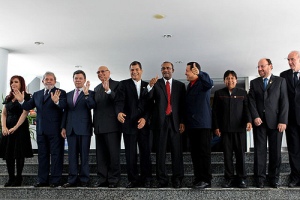
Latin America has experienced a veritable proliferation of presidential summits (cumbres) in recent years, an indication of how the hemisphere’s complex web of regional ties is shuffling the landscape of multilateral organizations. This trend was manifested in the Nov. 16-17 Iberoamerican Summit in Cadiz, Spain, followed in quick succession by summits for UNASUR on Nov. 30 and MERCOSUR on Dec. 7. The New Year will witness two summits in Santiago, Chile, the first between the European Union and Latin American and Caribbean States, the second among Latin American and Caribbean States (CELAC).  While sometimes useful in isolation, the cumulative impact of these meetings may be less than the sum of its parts. Indeed, the region may be suffering a bout of cumbritis that is as distortive as it is productive.

The Cadiz summit reflected Spanish determination to sustain an Ibero-American bloc amidst its own profound crisis. Spain’s investments in Ibero-America, particularly in banking and telecommunications, are keeping alive important sectors of the Spanish economy. When the VI UNASUR Summit met in Lima two weeks later, the Presidents of Argentina, Brazil, Venezuela and suspended Paraguay were all absent. Still, the meeting reaffirmed UNASUR’s role in political and military matters: UNASUR was active in the crisis in Paraguay, sent its first-ever electoral mission to Venezuela, the South American Defense Council provides coordination in defense industries and natural disaster responses, and aspires to support protection of human rights.

The following week in Brasilia, MERCOSUR formally incorporated Venezuela and signed an adhesion protocol with Bolivia. However, as Tom Long wrote in “Mercosur’s future: Whither economics?” on Dec. 18, MERCOSUR’s expanding breadth masks a lack of depth. The trade bloc has not agreed on a common external tariff, and integration has stalled as Argentina and Brazil adopted unilateral protectionist measures both during and after the global financial crisis. Though its market is growing, MERCOSUR’s ability to negotiate with third parties is limited. The countries most interested in boosting trade have split off on their own under the loose Pacific Alliance (PA), whose Presidents met on the sidelines during the Cadiz summit. Chile, Colombia, Mexico and Peru have set high targets for the reduction of customs duties and plan on reducing visa requirements for their citizens while already having FTAs with the US and Europe.  Chile and Peru have reached similar accords with China and other main Asian countries. However, the Alliance is primarily an informal gathering of free-trade-minded presidents, and so far institutionalization is minimal.

Brazil is leading South America-centered institutions (UNASUR and MERCOSUR) when it perceives that these suit its interests; The Venezuela-led ALBA has lost steam due in part to President Chavez’s illness; the PA process remains low-key and trade centered. Meanwhile, the Organization of American States risks irrelevance. Its robust human rights system has come under attack from ALBA countries and others, while four ranking members of the U.S. Senate Foreign Relations Committee have lambasted its leadership publically. The OAS may not be unsalvageable, and it remains potentially useful, though that potential will only be realized if the United States endeavors to support rather than undermine its efforts.

And Summits alone will not ensure the success of any of these multilateral forums: increasingly ubiquitous conversations among presidents can be effective for defusing immediate crises and for establishing guidelines for cooperation, but their long-term impact on policy coordination will be limited if they are not matched by analogous cross-national dialogue among key government ministries. The symptoms of chronic cumbritis lie in the failure of many presidential declarations to result in concrete advances in cooperation.

Mercosur’s Future: Whither Economics?

By Tom Long

Mercosur’s December 6 meeting in Brasilia might seem to be a watershed. The organization formally integrated Venezuela and signed adhesion agreements with Bolivia. Ecuadorean President Rafael Correa was in attendance, too, along with officials from other South American countries. The bloc was established starting in 1991, with goals of removing internal tariffs, setting a common external tariff, coordinating commercial policies, and harmonizing regulations. An unwritten objective was to spur industrialization and decrease dependence on foreign manufactures. Yet more than twenty years on, Mercosur appears to be further than ever from establishing a common market. The Inter-American Development Bank notes that Brazil and Argentina have traded protectionist measures, and that “Buy Brazil” provisions in government procurement have been a bilateral irritant.

Mercosur

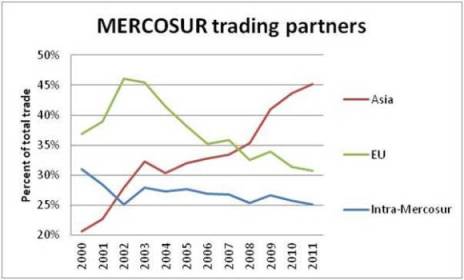
Expanding breadth masks decreasing depth. While both Mercosur’s total trade and trade among its members have grown greatly over the past decade, the former has outpaced the later.  WTO data show that intra-regional trade as a percentage of total trade has declined from 31 percent in 2000 to 25 percent in 2011. Instead of being driven by integration, MERCOSUR’s trade patterns are propelled by skyrocketing trade with Asia, led by Argentine and Brazilian commodity exports. In this light, the failure of late October meetings between Mercosur and the European Union suggest that China has taken the place of Europe.

Evaluated from a strictly economic perspective, Mercosur’s recent expansion represents a step backwards. The inclusion of Bolivia will not add much economic heft to the pact, and with the addition of each new member, reaching consensus will become even more difficult. The full membership of Venezuela increases the bloc’s size, but also its dependence on natural-resource exports. Neither newcomer—nor the two original heavyweights—appear committed to the original common market mission. Is the bloc’s raison d’etre shifting from the economic to the political? If so, what will be Mercosur’s relation to ALBA and UNASUR? Whereas Brazil was never fully comfortable with the Bolivarian Alliance—in part because of the anti-U.S. tone—it has now brought ALBA’s two most committed members to its own table. Inside Mercosur, Brazil has a greater voice than it does in UNASUR, but the hijacking of a potentially important trade alliance masks a lack of economic leadership for South America.

Obama and Peña Nieto: Turning the same page?

By Tom Long
CLALS doctoral research fellow

Official White House photo by Pete Souza | public domain

Official White House photo by Pete Souza | public domain

On Saturday, Mexico’s new president Enrique Peña Nieto took office and the country’s oldest party, the Partido Revolucionario Institucional, returned to power. After six years dominated by an exhausting and bloody war against drug cartels, Mexico seems ready to turn the page on outgoing President Felipe Calderón. During the last few months, Peña Nieto has tried to steer the attention of the world—and the United States—away from a disproportionate focus on drug violence. In a recent article published in The Economist, the new president downplayed drug cartels, focusing instead on plans for the economy and to “recover our leadership in Latin America.” Security was just one of thirteen proposals in his inaugural speech. In part, Calderón has given Peña Nieto a head start as he begins his term, leaving behind strong economic growth and a dip in violence. Although Calderón himself started the switch to a violence-reduction strategy, his name is likely to remain closely associated with the frontal military assault on the cartels launched at the beginning of his administration and recalibrated only in his final year; Peña Nieto is positioned to gain credit for a return to normalcy.

This desire to turn the page also marked Peña Nieto’s s pre-inaugural meeting with President Barack Obama. Both leaders seemed to be playing the same tune.  Mexico has become the front line in the war on drugs, and the U.S. has spent billions on military, police, and other projects lumped under a “Merida Initiative” label. After their meeting, Obama and Peña Nieto promised to expand the bilateral agenda to include an expansion of trade, cooperation on energy, and discussions of immigration that go beyond border fences. Obama spoke effusively of Mexico’s importance as a partner, while Peña Nieto said the two had a “shared vision” of how to create jobs in both countries. On the stage with Obama as elsewhere, Peña Nieto reiterated calls for the United States and Canada to build on NAFTA and further regional integration to improve competitiveness.

It would be a healthy change if the two presidents could restore balance between economic and security aspects of U.S.-Mexico relations. Image matters – and the deterioration of Mexico’s brand has undermined both investment and tourism. The military approach to drug trafficking has inflicted enormous costs in economic and human terms with questionable payoffs, but Mexico cannot go back to old patterns of accommodation. Domestically, the new president needs to attack the culture of impunity by building a stronger and more independent judiciary in order to reduce the frightful percentages of crimes that are never investigated or prosecuted. Accountability remains weak, especially at state and local levels; improving it would require Peña Nieto to take on powers in his own party. Placing all these objectives under a “Merida plus” framework would counterproductively squeeze broad reforms into the drug-war box. If the two presidents are sincere about rebuilding a balanced partnership, they need to take action quickly on immigration and commerce. Otherwise, the gravitational pull of the war of drugs will again consume bilateral ties.

FTA Dreaming: Promises to Expand Free Trade in the Hemisphere

Photo by: Starley Shelton | Flickr | Creative Commons

Although Latin America has not been an issue in the U.S. presidential campaign, Republican presidential contender Mitt Romney has stated multiple times that he would promote hemispheric trade agreements.  In the second debate, he said, “I’m also going to dramatically expand trade in Latin America. … I want to add more free trade agreements so we’ll have more trade.”  Romney did not specify, however, with which partners he would conclude trade agreements.  (A request to the Romney campaign for more information has not been answered.)  President Barack Obama did not comment on Romney’s promise, suggesting the president’s lack of focus on the region or calculus that voters simply don’t care.  Under Obama, the United States ratified pacts with Colombia and Panama, negotiated during the Bush administration.  The U.S. already had FTAs with Central America and the Dominican Republic, Chile, Mexico, and Peru.

While that would seem to leave a number of large economies, nearly all of them are unlikely partners. The most important remaining economies – Brazil, Argentina, Venezuela, Uruguay, and Paraguay – are part of the Mercosur trading bloc.  Washington has refused to negotiate with them as a group, and the group prohibits members from signing bilateral accords.  Meanwhile, Venezuela, Bolivia, Nicaragua, Ecuador, Cuba, and several Caribbean nations have joined together specifically to counter U.S. proposals for free trade in the hemisphere.  The few remaining countries have tiny trading relations with the United States.

The idea of adding FTAs in Latin America looks quixotic.  Nevertheless, that is hardly an excuse for failing to improve trade relations short of comprehensive agreements.  There are important opportunities to deepen the United States’ most important trade relations with Canada and Mexico, as AU Professor Robert A. Pastor has argued.  Moreover, if the United States is willing to use the Andean Trade Preferences Act as a tool for development instead of a cudgel against Latin Americans it considers wayward, it could expand trade in ways that benefit all parties.  Likewise, trade problems have become outsized irritants in U.S. relations with Brazil and Argentina – to say nothing of the broader implications of U.S. “trade policy” with Cuba.  These problems have largely festered under Obama, and Romney’s promises of free trade agreements do not seem a serious proposal to correct them.

Brazil’s Protest: If You Get QE3, We Get Tariffs

Photo by “SqueakyMarmot” | Flickr | Creative Commons

For two years Brazilian voices have complained that U.S. policies of near-zero interest rates and “quantitative easing” have been damaging its economy.  Lax monetary policies in the U.S. and Japan are blamed for the high valuation of the Brazilian real, which further suppresses Brazil’s  languishing manufacturing sector.  Tensions escalated following the September 2012 announcement of the U.S. Federal Reserve’s third round of quantitative easing.  Now the debate has spilled over into discussions about Brazilian restrictions on trade.  As Finance Minister Guido Mantega warns of a “currency exchange war,” Brazil is increasing tariffs on U.S. goods and foresees the imposition of taxes on inflows of foreign capital, which further inflate the Real.  Writing in Folha de São Paulo, Luiz Carlos Bresser-Pereira argues that Brazil is acting in self-defense.  The tariffs Brazil is contemplating are by his account not protectionist but simply an effort to compensate for the unfair advantage that the U.S. seeks to achieve through its monetary policy.

The tension is spreading beyond Brazil, as currency appreciation is portrayed as a drag on manufacturing in much of South America.   In an interview with CNN, Chilean President Sebastián Piñera criticized “QE3,” asserting that “printing money” would not solve U.S. economic woes.  So far, Andean countries are responding by purchasing dollars and cautiously reducing interest rates, but the Brazilians, in particular, present protectionist measures as counter-cyclical tools of their own, necessitated by American attempts to “drive down” the dollar.

The Brazilian and South American claims may be overdrawn somewhat; many experts believe that overvaluation is primarily a consequence of Chinese demand for South American commodities and the decision by most Latin American countries to maintain high interest rates in order to forestall inflation.  But U.S. policies meant to boost job growth are indeed having unintended consequences in the hemisphere.  There has been little thought in the United States of the external implications of Fed policy—beyond a belief that a reinvigorated U.S. economy would be good news for everyone.  Brazil has been the first, and most vocal, challenger of a stance that always frowns on tariffs while presenting monetary policy as a purely domestic matter.  It is a bit much for Brazilians to expect that U.S. monetary policy should be crafted with an eye to its impact on the region, particularly when conventional fiscal policy measures are thwarted by Congressional dysfunction, but Washington should not be surprised when efforts to tamp down its currency – not unlike Chinese policies that Washington condemns  – are seen abroad as aggressive threats to competition.