Brazilian Leadership and the Global Internet

By Sybil D. Rhodes and Leslie Elliott Armijo*
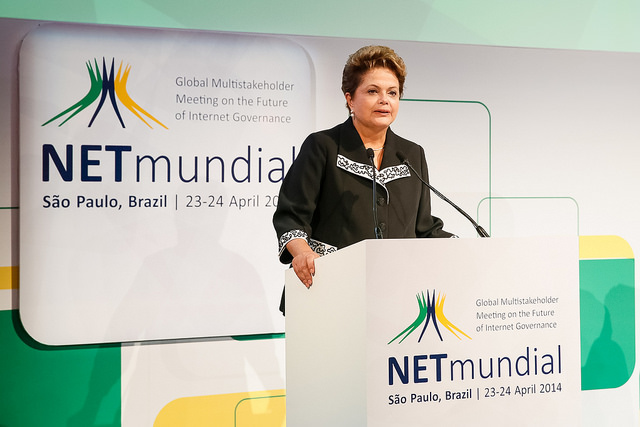
Photo credit: Blog do Planalto / Flickr / CC

Photo credit: Blog do Planalto / Flickr / CC

Brazil’s efforts as defender of internet privacy and rights may be effective even if it sparks criticism from all sides of the issue.  Along with German Chancellor Angela Merkel, President Dilma Rousseff has been among the most vocal protestors against spying by the U.S. National Security Agency (NSA).  She used her opening remarks at the United Nations General Assembly (UNGA) in September to criticize the spying.  Three months later, the UNGA passed a resolution initiated by Brazil and Germany in favor of the right to privacy in the digital age.  The Brazilian Chamber of Deputies and Senate have passed legislation, known as the Marco Civil da Internet, which web leaders and scholars consider a pioneering framework for internet governance.  Last week, Brazil hosted the international meeting NETMundial, focused on standards for name registration, domains, and IP addresses.  Rousseff and her Science, Technology, and Innovation minister, Cleio Campolina, emphasized that, as the first such event since U.S. intelligence contractor Edward Snowden leaked information about abuses, privacy concerns should be paramount at the meeting.

Brazil has considered itself an emerging leader in internet governance for at least the last fifteen years, although until 2013 “digital sovereignty” and the allocation of commercial benefits appeared to be more important goals than protecting civil liberties.  Brazil also has counted itself as an important member of a coalition — including India, China, Russia, Arab countries, and the United Nations Working Group on Internet Governance – that has called for less U.S. dominance of internet governance.  The group has proposed that the UN’s International Telecommunications Union (ITU) assume responsibility for the Internet Cooperation for Assigned Names and Numbers (ICANN), the non-profit organization in charge of distributing domain names since 1998.  An American creation, with headquarters in Los Angeles and a Board of Directors supervised by the US Department of Commerce, ICANN is seen by many as embodying U.S.-centric internet regulation.  Critics in Brazil and elsewhere claim that the private-sector and civil-society input into ICANN decisions is disproportionately pro-American.  The U.S. and its supporters, including Google, Microsoft, and civil associations like the Mozilla Foundation and the Electronic Frontier Foundation, argue that the existing regime promotes a “free and decentralized internet” – and that any changes must preserve these principles.

Since Snowden, President Dilma has also renewed emphasis on “digital sovereignty” measures.  For example, provisions in legislation passed in the lower house (but removed from the Senate version) required that Google, Facebook and other companies doing business with Brazilians store their data about Brazilians on local servers.  The government has also promoted building fiber optic cables connections that do not go directly through the United States as a way of preventing NSA espionage.  The economic and technical feasibility of some of these projects is not clear, and some of them have encountered important political opposition within Brazil – because, according to an informal survey of experts, many Brazilians are suspicious of their own government’s regulation of the internet as well.  Language in the new bill simply obligates business to obey national legislation regarding privacy.

Snowden’s revelations have given a boost to efforts to reduce U.S. dominance of internet governance, which previously was viewed as a technical issue for which the existing regulatory regime worked well.  Announcing that the U.S. Department of Commerce will not renew its contract with ICANN when it expires in September 2014, the Obama administration appears to recognize that U.S. credibility as the guarantor of a free and open internet has been undermined.  The exact technical and legal procedures through which privacy and national sovereignty might be better protected on the internet remain open questions in national and global debates.  But Brazil appears poised to play a leading role in setting a moderate middle-range course, one that allows for multipolar or global governance of the internet while protecting the liberal principles the U.S. has long claimed are core values.  Dilma could come in for criticism from both sides – U.S. conservatives who believe that only the United States can guarantee a free internet as well as “anti-imperialist” advocates who will accuse her of selling out to corporate interests.  Moderate heroes are sometimes the most unsung but also the most necessary.

*Sybil D. Rhodes is Director of the MA in International Studies at the Universidad del Cema in Buenos Aires.  Leslie Elliott Armijo is a Visiting Scholar at Portland State University and a Research Fellow at CLALS.  They are currently writing a book about international cooperation in the Western Hemisphere.
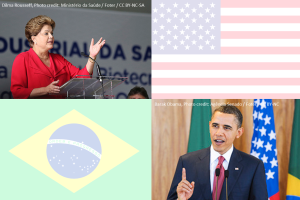
Brazil-U.S.: Implications of Postponed State Visit

By Luciano Melo

Picture2The postponement of Brazilian President Dilma Rousseff’s state visit to Washington was officially cast as the consequence of the lack of a good explanation for the National Security Agency’s cyber-espionage targeting her, the cabinet, Petrobras (the national oil company), and others.  Although the Brazilian Foreign Ministry issued a letter stating that both countries agreed to the postponement, Dilma’s remarks at the UN General Assembly on September 25 about NSA’s activities were so harsh that it was clear that frustration with the Americans’ widespread spying on Brazilians remains extremely high in Brasilia.

Experts agree that economically the postponement and bilateral tensions hurt the United States more than Brazil.  Contracts worth billions of dollars between Boeing and the Brazilian air force (FAB) are at stake, as are agreements that would favor cooperation in oil exploration and development of biofuels and others that would facilitate the transfer of “sensitive technologies.”  For Brazil, on the other hand, the postponement jeopardizes progress in talks to allow Brazilian citizens to enter the United States without visas – a project long-desired by Brazilians that was on the agenda for the state visit. Some observers in Brazil also speculate that, with the overall Brazilian economic slowdown, Dilma may actually prefer to have Brazilians spending their reais at home, not in the United States.

In a tactical sense, Dilma may have feared that Edward Snowden will leak more damaging information during her visit to the U.S., causing her even greater embarrassment at home and abroad.  In this way, fear and self-protection certainly played a role in her decision. On the other hand, the Brazilian president almost certainly saw domestic political advantages in a good old fight between the Brazilian David and the American Goliath.  She is desperately in need of boosting her popularity after the demonstrations against corruption in the country.  In fact, opinion polls show that public approval of her leadership increased from 45 to 54 percent just since the NSA dustup.

In strategic terms, the postponement fits Brazil’s strategy for claiming its position as a global player – and expressing unhappiness when it feels frustrated.  Dilma already had told President Obama in 2011 that Brazilians would seek a “more balanced relationship” with the United States. The postponement, like the speech at the UN, clearly reflects Brazilians’ desire to be treated better by the United States.  Obama’s speech at the General Assembly the same day, on the other hand, was interpreted by many Brazilians as emphasizing the United States’ traditional role as world policeman – not as the respectful neighbor in a new, multi-polar world order.  In this battle of self-images, Brazil sees itself as one of the global leaders, while the United States sees itself as the mighty one, considering only the European powers as full equals.  The broad base of Brazilians that Dilma is reaching out to is not “anti-American” in sentiment, and indeed wants a robust and respectful U.S.-Brazil relationship.  That is in the interest of both countries, but for this shared objective to be achieved, Washington will need to recalibrate its responses to Brazilian concerns.

Luciano Melo is a PhD candidate in the Department of Government at American University.

Snowden’s Revelations Rile Latin America

"Snowden Day in Brasilia, Brazil" Photo credit: midianinja / Foter / CC BY-NC-SA

“Snowden Day in Brasilia, Brazil” Photo credit: midianinja / Foter / CC BY-NC-SA

Allegations by former U.S. intelligence officer Edward Snowden about U.S. operations in Latin America have stirred further recriminations toward Washington.  According to press reports, Snowden revealed that U.S. agencies monitored internet traffic, especially in Colombia (with a special focus on the FARC guerrillas), Venezuela, Brazil and Mexico.  The National Security Agency (NSA) allegedly spied on military procurement and the oil industry in Venezuela, as well as the energy sector and political affairs in Mexico.  The Huffington Post reported that almost every Latin American country was targeted to one degree or other.

Regional reaction has been strong:

  • O Globo (Brazil) columnists, claiming that Brazil was the most spied upon country in Latin America, called the surveillance a genuine invasion of privacy that undermines both Brazilian authorities and citizens.  Former President Cardoso said, “If such activities existed, if they were done, as with all espionage, it was outside the law.”  The Senate has already “invited” Cabinet ministers to testify – and they have pledged to investigate.  (It also invited U.S. Ambassador Tom Shannon, but he is under no obligation to appear before the Brazilian Congress.)
  • El Espectador (Colombia) said the U.S. spying was an attack on Colombian sovereignty.  It quoted various senators as saying that “one does not spy on one’s friends and even less when they’ve been political allies in big decisions between states” and demanding that the government limit such activities.  Foreign Minister Holguín sent a delegation to Washington to seek explanations.
  • Mexican President Peña Nieto called the U.S. spying “totally unacceptable,” and the opposition PRD has accused the government of being “too soft” in its response to the alleged espionage.
  • The ALBA countries have been strident.  Venezuelan President Maduro has demanded “answers and explanations, [and] more than explanations, apologies.”  Ecuadoran President Correa said “we will put up with no more abuses, arbitrariness, disrespect for human rights.”

The extent of U.S. intelligence operations will not be known for decades.  It took experts 30 years, for example, to pry loose information about the CIA’s role in the coup that brought Chilean strongman Pinochet to power.  But the tensions such allegations create do not fade rapidly.  Even accounting for hyperbole in political rhetoric, these protestations cannot be helpful to U.S. short-term efforts to win Latin American help in capturing Snowden, nor in long-term efforts to revive the Obama Administration’s stated goal of building “partnership” in the region.  Continued threats – thinly veiled – from unnamed senior U.S. officials also run counter to that goal of building partnership and the related objective of minimizing fallout from accusations of spying.

The Snowden Case: Provocations and Intimidation

By Fulton T. Armstrong

Edward Snowden / Photo credit: zennie62 / Foter / CC BY-ND

Edward Snowden / Photo credit: zennie62 / Foter / CC BY-ND

The rhetoric and diplomatic jostling surrounding the flight of American whistleblower (or, depending on perspective, criminal leaker) Edward Snowden have once again thrust to the fore Latin America and U.S. policy toward the region.  Some Latin American presidents have seemed to go out of their way to prick U.S. sensitivities, and Washington seems to have gone out of its way to stomp on Latin American sensitivities.  Both sides have been happy to live up to the caricatures of themselves held by the other, but both sides’ interests have been harmed in the process.

The drama started, of course, while Snowden was in hiding in Hong Kong, and it has dragged on as he’s resided in a transit lounge of the Moscow airport.  U.S. media, which in the past have published stories casting Cuba, Venezuela, Ecuador, and others as eager to poke the U.S. in the eye, ran pieces – shifting attention to Latin America – and away from China and Russia’s even bigger slap in Washington’s face in refusing to hand the leaker over.  Reporters believed their own rumors and piled into an Aeroflot plane bound for Cuba.  Washington rolled out the big guns, including Vice President Biden, to discourage the Latin Americans from offering Snowden any help – and seemed to have success.  Ecuador, which has protected Wikileaks boss Julian Assange from British, Swedish and U.S. pursuit, initially welcomed Snowden but, after a phone call from Washington, pointed out that an asylum petition could not be considered until he arrived in country.  The crisis between the U.S. and Latin America deepened, however, when several European countries – presumably responding to U.S. pressure and bad U.S. intelligence – closed their airspace to Bolivian President Morales, who someone, somewhere, suspected of flying Snowden out of Moscow on the president’s return home.  Latin American condemnation exploded.

Venezuelan President Maduro, stating that that he wanted “to protect this young man from the persecution unleashed by the world’s most powerful empire,” publicly offered Snowden asylum on Friday.  That move ended the slight progress Caracas and Washington had made toward rapprochement– evident since the OAS General Assembly in June – and bilateral relations will surely worsen.  But the Obama Administration’s relations with Latin America writ large don’t appear likely to fare much better.  Some leaders’ rhetoric may be over the top, but Washington’s language has been threatening, and its actions speak louder than its words.  An unidentified senior U.S. official told the New York Times that “there is not a country in the hemisphere whose government does not understand our position at this point,” adding that any aid for Mr. Snowden “would put relations in a very bad place for a long time to come.” Such statements leave one wondering whether we are approaching the point where this administration will cease proclaiming its commitment to a new era of US-Latin America relations characterized by partnership and respect among equals.  Transcripts of Mr. Biden’s calls will not be released, but rarely do countries reverse their positions publicly in the absence of either serious threats or generous inducements – and few clear-thinking Ecuadorans, tracking the Administration’s attitudes toward President Correa, see the latter as in the cards.  In pressuring its European allies to establish a no-fly zone to keep a head of state from returning home, Washington took an action that many Latin Americans – not without a grain of truth – believe it would never take against a region that it respected.  Repairing the damage of el asunto Snowden will be hard for both sides, but Washington has the bigger task ahead.


U.S. Credibility Takes Another Hit

By Fulton T. Armstrong

Photo credit: Chairman of the Joint Chiefs of Staff / Foter.com / CC BY

Photo credit: Chairman of the Joint Chiefs of Staff / Foter.com / CC BY

The domestic spying programs under the Bush and Obama Administrations further erode U.S. moral leadership in the hemisphere and probably beyond.  At crucial junctures since President Jimmy Carter made human rights a pillar of policy in Latin America, U.S. moral authority has been decisive in persuading regimes on the right and the left to open the way for pluralism and democracy.  Lecturing governments and militaries on the need to eschew torture, domestic spying, and other abuses, U.S. diplomats and politicians could have been charged with arrogance, but on these specific aspects of the U.S. government’s treatment of its own people, not serious hypocrisy. The U. S. had its racial and economic injustices, but trends were positive, and the country stood for the rule of law, skepticism of State Security officials’ penchant to use information for power, and a pretty solid respect for due process. Even before Carter, the Watergate scandal – and resulting resignation of the President and overhaul of the intelligence agencies – was a clarion signal that agencies created to monitor foreign affairs must keep their focus far off U.S. shores.

Latin American media have carried primarily factual stories revealing the “PRISM” program, which collects data from hundreds of millions of e-mails and other electronic communications each day and stores it for exploitation by targeters (now called “analysts”) on the lookout for alleged potential terrorists, based on secret profiling.  Some papers have reported that Director for National Intelligence Clapper lied to the U.S. Congress without batting an eyelash when asked directly if such activities were ongoing.  Coming after reports in recent years of the use of torture (and the impunity granted to the perpetrators), the so-called “extraordinary renditions” (and the cases in which kidnap victims were innocent), the use of “black prisons” (in which security services in new democracies were encouraged to circumvent their elected officials),drone attacks (even against U.S. citizens), and the continued detention of prisoners without trial at Guantanamo (giving human rights violations in Cuba a new meaning) have all been noted throughout Latin America.  PRISM may no longer be considered newsworthy.

The fact that British and American newspapers eventually brought the domestic spying programs to light may hearten some in Latin America, as evidence that an essential element of democracy – a probing press –shows signs of life despite reports of Justice Department harassment of the Associated Press and other media.  But sentient Latin Americans know the implications of PRISM – and what enterprising State Security “analysts” can do with years of data about even the most mundane aspects of potential targets’ lives.  The Obama Administration’s defense of PRISM as necessary to defend against supposed terrorists doesn’t sell well in a region that knows how information never sits unused.  The Bush Administration gave the Medal of Freedom to Colombian President Uribe, who deployed his secret intelligence agency to harass opponents and allowed his military to disappear thousands of youths.  The Obama Administration’s lectures to Venezuela, Nicaragua, Bolivia and Ecuador on the need to give more space to opponents – however warranted – ring sort of hollow when, in Latin Americans’ minds, it has nurtured its own Frankenstein state-security apparatus that lacks credible checks and balances.  Washington can argue that U.S. moral authority doesn’t matter, and that the “terrorist threat” it faces calls for extraordinary measures, but it will be a long time before an American statesman can wag his finger at a Latin American counterpart for doing the same thing.

The TecnoLatinas: A Start-Up Revolution

Foro de Ahorro de Energía Eléctrica, México | Photo credit: Alejandro Castro | Foter.com | CC BY-NC-SA

Foro de Ahorro de Energía Eléctrica, México | Photo credit: Alejandro Castro | Foter.com | CC BY-NC-SA

Latin America is experiencing a full-fledged start-up movement amid rapid growth of an innovation and information economy.  Over the last several years the region’s online population has grown faster than in any other part of the world – with approximately 255 million internet users as of last year.  Half of the top 10 markets worldwide, ranked by time spent on Facebook and other social media, are in Latin America.  Clusters of innovation start-ups, such as those around Monterrey, Mexico, are springing up with astonishing speed.  In 2012 Mexico was among the largest exporters of information technology services in the world.  Google is currently building a data center in Chile, while Amazon Web Services opened a data center in Sao Paolo last December.  But these are not information-era maquiladoras. Instead, Latin American entrepreneurs are combining the availability of open-source innovation tools and the emergence of cloud computing with effective bridge building in Silicon Valley to bring collaboration, expertise, and capital to their home markets.

  • Latin America offers multiple advantages for tech start-ups: a low cost of development, an educated and growing talent pool with the necessary technical and entrepreneurial skills, and increasingly available and affordable broadband and internet access.
  • In particular, Mexico, Chile, Brazil, Argentina, and Colombia, along with metropolitan areas across the region, are incentivizing the development of a competitive start-up ecosystem – an advantage attracting a growing number of “angel investors.”
  • Start-Up Chile, a national program begun in 2010 with 22 start-ups from 14 countries, offers seed capital, grants, tax protection, space, mentoring, and networking to “accelerate” promising ventures.  Its most recent competition drew 1421 applicants from 60 countries, including from Singapore, London, and San Francisco.

The lack of tech innovation and incentives for start-ups has been an Achilles’ heel of Latin American economies for decades.  If the start-up trend continues, the region could make significant, lasting progress toward narrowing the sizable gap between itself and the most dynamic developing countries, mostly in Asia.  Latin America’s start-up movement is both top-down and bottom-up, with a tech-savvy generation of entrepreneurs not afraid to take risks and to leverage government support, as part of a collaborative business model built on multiple ties to Silicon Valley.  A core challenge will be whether these initiatives are scalable, and whether governments can move away from stale policy debates rooted in antiquated paradigms to move their economies toward the frontiers of innovation of the information age.  Old elites with a lock on traditional industries are poorly positioned to obstruct the phenomenon, but if these emerging innovation hubs are to succeed, at some point they are likely to confront  the entrenched and oligopolistic business practices still prevalent in the region’s energy, telecom, and other sectors.