Preparing the West Indies for the Demise of PetroCaribe

By Thomas Andrew O’Keefe*

ariwriter / Flickr / Creative Commons Attribution-NonCommercial-ShareAlike 2.0 Generic (CC BY-NC-SA 2.0)

ariwriter / Flickr / Creative Commons Attribution-NonCommercial-ShareAlike 2.0 Generic (CC BY-NC-SA 2.0)

The English-speaking Caribbean nations – whose heavy dependence on imported diesel and fuel oil to generate electricity has placed them among the most heavily indebted countries in the world (on a per capita basis) – will face massive headaches if PetroCaribe collapses.  They eagerly signed up for the Venezuelan initiative, which sells them petroleum with one- or two-year grace periods and long repayment schedules ranging from 15 to 25 years at 1 or 2 percent interest.  Participating countries can even pay with products or services in lieu of hard currency.  In the case of Guyana, Haiti, Jamaica, and the Eastern Caribbean mini-states, PetroCaribe’s financing scheme represents an estimated 4 to 7 percent of their annual GDP.  The worsening economic turmoil in Venezuela, however, raises serious concerns about PetroCaribe’s future.  According to recent media reports, PdVSA, the Venezuelan national petroleum company, is shortening repayment periods and increasing interest rates.

No doubt this is one reason why the Obama administration launched the Caribbean Energy Security Initiative (CESI) in June.  CESI seeks to diversify the Caribbean’s energy matrix away from its current heavy reliance on fossil fuels by using Overseas Private Investment Corporation (OPIC) loans and credit guarantees to encourage private sector investment in renewable energy.  It is premised upon the Caribbean’s huge potential to generate energy from the sun, wind, geothermal sources, and maritime currents.  In the past, the principal bottlenecks to harnessing these abundant resources have been hefty startup costs and small populations that make it difficult, if not impossible, for the private sector to recover profits within a reasonable period of time.  Although the initial capital investment for solar- and wind-based technology has dropped considerably in the last few years, it is unrealistic to expect Caribbean nations to make a full switch to renewable energy resources anytime soon.  A more realistic, short- to medium-term alternative is to make greater use of natural gas.  Although still a fossil fuel, gas is more efficient – and therefore the generated electricity is less costly – than fuel oil and diesel.  Moreover, electricity generated from natural gas emits 70 percent as much carbon dioxide as oil, per unit of energy output.

The shale gas boom in the United States generated by innovations in hydraulic fracturing has led to calls to lift restrictions on U.S. natural gas exports to those countries with which it does not have a free trade agreement.  The Caribbean is potentially a major target market of this natural gas in liquefied form (LNG), but this would be a big mistake.  Lifting restrictions on exports will inevitably raise natural gas prices in the U.S., thereby hurting consumers and putting the nascent revival of domestic manufacturing at risk.  It would also require building expensive LNG offloading and regassification facilities in the West Indies, which would run up against the same economies of scale limitations (except in Jamaica and Hispañola) that have undermined a mass transition to renewable energy.  A more realistic alternative is to revive plans to build a natural gas pipeline from Trinidad and Tobago to Barbados, and then up through the Eastern Caribbean.  Proposed back in the early 2000s, it was scuttled with the appearance of PetroCaribe in 2005.  Trinidad and Tobago has ample reserves of natural gas; at one point before the shale gas revolution it was the largest source of imported LNG in the United States.  The pipeline would link islands with populations of under 100,000, where LNG is economically unviable, with the more densely populated French dominions of Guadalupe and Martinique.  It would also help revive the floundering Caribbean Common Market and Community (CARICOM).

* Thomas Andrew O’Keefe is President of San Francisco-based Mercosur Consulting Group, Ltd.

Climate Change: Creating Spaces for Action

Pacchanta women with Ausangate Glacier in the background.  Photo credit: Oxfam International / Foter / Creative Commons Attribution-NonCommercial-NoDerivs 2.0 Generic (CC BY-NC-ND 2.0)

Pacchanta women with Ausangate Glacier in the background. Photo credit: Oxfam International / Foter / Creative Commons Attribution-NonCommercial-NoDerivs 2.0 Generic (CC BY-NC-ND 2.0)


The Organization of American States (OAS) has resolved to strengthen its role in addressing climate change, but it has yet to demonstrate that it can convene Latin American countries around this urgent issue.  Participants at a recent OAS roundtable agreed that Latin American leaders have moved beyond debating the existence of climate change and are now focused on mitigating its immediate and future effects.  Of primary concern are the potentially devastating economic consequences of climate change for the region, which the Inter-American Development Bank estimates will reach $100 billion per year by 2050 – severely jeopardizing national economies that are currently growing at a healthy rate.  Based on recent climate change reports and initiatives, the potential of a looming transnational cataclysm is driving a sense of urgency for action within an effective regional framework.

Within the consensus for action, there will be competing priorities.  Climate change presents different challenges to different parts of Latin America and the Caribbean.  In Peru, for example, a major concern is glacier melt in the Andes, which affects fresh water resources, agricultural irrigation, and sustainable urban development.  This has created a need not only for new dams and reservoirs to redirect water, but also for managing internal social conflicts generated by an increasing scarcity of basic resources.  In the Caribbean, where tourism revenue represents the greatest proportion of the regional economy (14 percent of GDP), the top priority is managing the triple threat of rising sea levels, the loss of coastal livelihoods, and intensifying weather conditions.  And in Brazil, as Evan Berry highlighted here recently, deforestation, carbon markets and land use, among other concerns, need to be addressed.

The OAS would appear to be the logical forum to address these issues and provide a negotiating framework regarding climate change.  On recent non-environmental issues, however, the OAS has struggled to coordinate actions and lost prestige among many in Latin America.  The OAS response toward Honduras following the 2009 presidential coup was divisive and ultimately was end-run when the United States cut a deal with the coup regime.  The 2012 OAS assembly in Bolivia was plagued by persistent absenteeism of member states.  Washington has repeatedly pressed the OAS toward a more political agenda, especially pressing for condemnation of Venezuelan Presidents Chávez and Maduro, and has even threatened to suspend its contributions to the organization’s budget.  Insofar as the OAS is perceived as a U.S. proxy, its effectiveness on difficult issues with a north-south spin, like climate change, is undermined.  At the same time, the OAS is competing with other regional bodies, such as UNASUR and CELAC, and the region has raised its profile in international venues such as the 2010 alternative climate summit held in Bolivia after UN negotiations in Copenhagen failed.  With the UN’s 20th Conference of Parties (COP20) taking place in Lima in December 2014, Latin America will again be center stage during conversations on ways to strengthen and replace the 1997 Kyoto Protocol.  Should the OAS overcome its problems of effectiveness and image, and participate successfully in the current dialogue around climate change, this issue could redefine its existing agenda and give it relevance for years to come.

Prospects for Energy Integration in Latin America

By Thomas Andrew O’Keefe*
  Embed from Getty Images

South America’s presidents began discussing energy integration years before UNASUR made it one of its central initiatives, but these efforts have been hobbled by differences on what role the private and public sectors should play.  One tangible project that has emerged from UNASUR seeks to interconnect the electricity grids of Bolivia, Chile, Colombia, Ecuador, and Peru.  While the Colombian, Ecuadorian, and Peruvian grids (as well as that of Venezuela) are already linked, cross-border transmission of electric power is relatively insignificant.

Since the Sixth Summit of the Americas in Cartagena in April 2012, the UNASUR project has become part of a wider hemispheric agenda called “Connecting the Americas 2022,” which includes Panama and potentially – once the long-delayed Electrical Interconnection System for the Central American Countries (SIEPAC) becomes fully operational – all of North America.  The idea was promoted by the Colombians as hosts of the last Summit and emerged as one of the key mandates.  It seeks universal access to electricity through enhanced electrical interconnections, power sector investment, renewable energy development, and cooperation.  By focusing on electrical interconnections, the hope is to allow countries with excess power to export electricity to those facing deficits as well as permit greater integration of renewable energy resources and exchanges among countries with varying climate and seasonal needs.  Interconnection also expands the size of markets, creating economies of scale that can attract private sector investment, lower capital costs, and reduce electricity costs for consumers.  A separate initiative focuses on Brazil and the River Plate countries as well as the Caribbean.

A number of unanswered questions about “Connecting the Americas 2022” raise doubts about its viability.  For one thing, including Chile and Bolivia means that huge swaths of relatively empty territory will have to be traversed, which inevitably leads to losses of electrical power transmitted over long distances.  (The Chilean grid itself is not integrated, but divided into three separate systems.)  Furthermore, electricity generation in the Andean countries relies heavily on hydropower sourced from high mountain glaciers that are gradually disappearing as a result of climate change.  If “Connecting the Americas 2022” is to succeed, the regulatory frameworks of each participating nation must also be harmonized to facilitate long-term cooperation and network development.  Nationalistic concerns that have plagued the integrated Central American electricity network since it first came on line in the late 1990s must also be overcome.  The actual amount of electricity traded among the Central American countries has, to date, been minimal and is actually declining, as national governments have been reluctant to permit long-term contracts for the international sale of electricity that might put access to domestic electricity supplies at risk.  Such obstacles must be overcome to fulfill any vision for Latin American energy integration.

*Thomas Andrew O’Keefe is President of San Francisco-based Mercosur Consulting Group, Ltd. and teaches at Stanford University.
Venezuela: Vicious Cycle Continues

By CLALS Staff

Photo Credit: Cancillería Ecuador / Flickr / Creative Commons Attribution 2.0 Generic (CC BY 2.0)

Photo Credit: Cancillería Ecuador / Flickr / Creative Commons Attribution 2.0 Generic (CC BY 2.0)

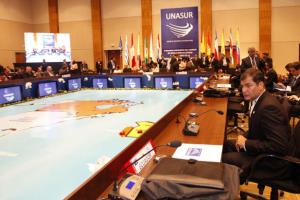
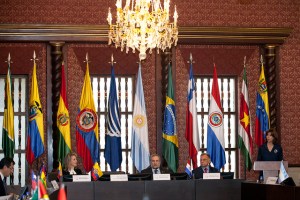
UNASUR has shown energy and flexibility as a facilitator during the Venezuela crisis, but neither the government, nor its opponents, nor the opposition’s allies in Washington have matched it – prolonging the vicious cycle that’s been plaguing the country for years.  Speaking as UNASUR, the foreign ministers of Colombia, Brazil and Ecuador reflected the continent’s frustration when they threw up their hands this week and left Caracas after another failed attempt to get a national dialogue on track.  Their statements represented a balance between the UNASUR members that are generally perceived as tolerant of the Venezuelan government’s “Bolivarian” revolution and those perceived as opposing it.  They reiterated calls, issued officially in Suriname on 16 May, for both sides to “achieve a broad dialogue that permits Venezuelans, without interference, to reach an accord that guarantees peaceful coexistence and stability in the country.”

The government, opposition and Washington have not heeded the appeal by UNASUR and the Vatican’s nuncio to be constructive and patient.  The government’s attack on opposition and student camps in early May and subsequent arrest of more than 200 protestors highlighted the authoritarian tendencies that have given momentum to the demonstrations.  The Mesa de Unidad Democrática (MUD), representing important sectors of the opposition, gave the foreign ministers yet another list of demands – including a Truth Commission investigating rights violations (and not headed by the pro-government president of the National Assembly, Diosdado Cabello) and the selection of an entirely new National Elections Council.  The MUD’s executive secretary declared that he has no interest in participating in a peña or chit-chat session, and said, “The ball is in the government’s court.”  Although U.S. Assistant Secretary Roberta Jacobson said during a hearing that sanctions were premature (a statement that she attributed to “confusion”), the foreign affairs committees in both house of the U.S. Congress – without objection from the Obama Administration – have passed bills authorizing an array of punitive measures against Venezuelan officials.  The legislation also authorizes an additional $15 million dollars in aid to the government’s opponents.

The less overtly political agenda that first sparked the protests in February – soaring crime rates, rocketing inflation, and shortages of basic goods and services – has been overshadowed by the shouts of opposition leaders eager to force President Maduro from office and by Maduro’s defenses from the plotting against him.  Demands that Maduro negotiate with a foreign-funded opposition that has as its clear goal his removal as constitutionally legitimate president – something no head of state in the hemisphere would accept – naturally keep his bases on edge.  Political leaders on both sides manipulate popular opinion and claim el pueblo as supporting them.  Another of each side’s real strengths is its ability to portray itself as a victim of the unfairness of the other – because their victimhood rationalizes whatever actions they wish to take.  In that regard, the U.S. sanctions against the government and subsidies to the opposition play into Maduro’s hand.  Washington’s extra $15 million is a drop in the bucket for the well-funded opposition, but the U.S. support is as clear a signal as any of its desired outcome.  With both the United States and important segments of the opposition appearing to aim for nothing short of regime change, UNASUR is wise to step aside and see if anyone decides to get serious about ending the crisis.  Should the situation on the ground deteriorate further, however, UNASUR will probably ramp up its engagement and press both sides to make concessions in exchange for regional support.

Trans-Pacific Partnership: A Framework for U.S.-Latin America Relations?

By Eric Hershberg
Embed from Getty Images
President Obama’s desire to move forward with the Trans-Pacific Partnership (TPP) appears likely to founder amidst Congressional resistance to granting him “fast-track” authority, but it does signal a noteworthy initiative by an administration eager to grow trade relations with some Latin American countries.  Originally formed by Chile, New Zealand, Brunei and Singapore in 2006, TPP is currently negotiating the accession of five new members, including the United States and Peru.  Mexico, Colombia, Costa Rica, Panama, Canada, and Japan are also considering joining.  U.S. Undersecretary for International Trade Francisco Sanchez said last year that agreement on a framework for the United States to join TPP represents “a landmark accomplishment because it contains all of the elements of a modern trade accord.”  It eliminates all tariff and non-tariff trade barriers; takes a regional approach to promote development of production and supply chains; and eases regulatory red tape.  The White House’s senior official responsible for Latin America has also emphasized the importance of the Partnership.

The Administration for the most part has tried to sell the pact as a domestic economic issue – the argument being that more trade and harmonized regulations translate into more jobs – or as integral to a strategic focus on strengthening economic ties to the dynamic economies of Asia, rather than as a policy that has the potential to redefine economic relations with Latin America.  But lobbying on Capitol Hill has so far been ineffective, and Obama’s own Democratic Party has denied him the “fast-track authority” needed for an effective negotiation.  The Administration’s diplomatic strategy has not progressed smoothly either.  During Obama’s recent four-nation swing through Asia, he and Japanese Prime Minister Abe failed to sign an agreement widely seen as crucial for moving ahead with TPP.  Negotiators from all 12 TPP countries met in Vietnam last week, and – despite claims of progress – press reports generally suggest a gloomy prognosis for progress soon.

President Obama has made much of his “pivot” to Asia, and the push for TPP situates Latin America relations in Washington’s wider foreign policy agenda.  The emphasis on the TPP signals that liberalizing trade remains the core principle guiding U.S. thinking about economic relations in the hemisphere, in effect continuing a paradigm that has reigned for decades and that is embodied by proposals such as the now-abandoned Free Trade Area of the Americas.  Unable to secure broad South American buy-in for that U.S.-minted vision for economic cooperation, the administration seems to have settled on trying to work with a “coalition of the willing” comprised of Chile, Colombia, Mexico and Peru.  For governments elsewhere in the region, however, the not-so-particularly-new approach has elicited scant enthusiasm.  One could imagine ambitious proposals from Washington for hemispheric cooperation around energy, climate, infrastructure, technological innovation or even, eventually, labor market integration. But that would require visionary leadership, a commodity that is in strikingly short supply nowadays in the U.S. capital.  Rather than leading the articulation of a novel, shared agenda for a 21st century economic transformation of the Americas, Washington has chosen for now to repackage the last century’s prioritization of trade.

Caribbean Integration: Necessary but Elusive

By Victor Bulmer-Thomas*

Embed from Getty Images

The dream of Caribbean solidarity has never been in greater peril.  Norman Girvan, who died on April 9, was committed to the cause of Caribbean integration all his adult life, including during his time as Secretary-General of the Association of Caribbean States.  Born and raised in Jamaica, he saw no contradiction between Jamaican nationalism and Caribbean solidarity.  After steady progress from CARIFTA (a free trade area formed in the 1960s by a number of former British colonies) to CARICOM (a customs union formed in 1973 by all British ex-colonies and many colonies) to a commitment starting in 2006 to build a Caribbean Single Market and Economy (CSME), regional integration has gone backwards.  The CSME was never completed; a ‘pause’ in its implementation has been introduced by the Heads of Government and the famous Regional Negotiating Machinery (RNM) – itself formed to promote Caribbean unity in international agreements but then largely dismantled.  Suriname (in 1995) and Haiti (in 2002) have joined CARICOM, but the Dominican Republic is still outside after 25 years of discussions.  Cuban membership is still a distant dream, and the only non-independent state that participates today is the British colony of Montserrat, with a population of 5,000.  CARICOM may in theory represent much of the Caribbean population, but Haiti – its largest member by far – is not in the CSME.

Countries outside the Caribbean have reacted in very different ways to the region since the end of the Cold War.  The European Union (EU), three of whose member states – France, Holland and the United Kingdom – still have territorial ties to the Caribbean, has negotiated an Economic Partnership Agreement (EPA) with CARIFORUM (CARICOM plus the DR) that will in due course give the EU unrestricted access for almost all goods and services.  The agreement has generated very little enthusiasm in the CARIFORUM states despite the improved access for some of their goods and services in the European market.  Venezuela has persuaded most oil-importing countries to join Petrocaribe, but only a handful (Antigua & Barbuda, Cuba, Dominica, St. Lucia and St. Vincent & the Grenadines) have been attracted by the more ambitious ALBA.  The United States, a colonial power itself in the region thanks to Puerto Rico and the Virgin Islands, still offers asymmetrical trade privileges through the Caribbean Basin Initiative (CBI) and its related acts, but some of these provisions will end in 2020, and it is far from clear what will replace them.  Canada, which established CARIBCAN (similar to the CBI) in 1986, is negotiating its own version of the EPA with a broadly similar set of countries, but the negotiations have stalled recently.  Only China appears to have made huge advances in the region through increased exports and major foreign investments despite several of the countries that still recognize Taiwan.

All integration schemes, as Norman Girvan would have been the first to recognize, involve a balance between widening and deepening.  Through its premature commitment to a CSME, the member states of CARICOM took deepening too far.  At the same time, widening – necessary to negotiate with outside powers – has not gone nearly far enough.  It is a scandal that the Dominican Republic remains outside and that so little has been done to embrace Cuba despite the good political relations all states have with the island.  And the non-independent territories, as numerous as the independent states, should not be overlooked.  France and the UK have dropped their objections to closer ties between their territories and CARICOM, and the Dutch territories are largely autonomous already.  Even the U.S. territories would welcome closer links.  And when relations between Cuba and the United States are normalized, as could happen quite soon, it would be in the Caribbean’s interests to have fully embraced Cuba first.  That is an outcome that Norman Girvan would have strongly welcomed.

*Dr. Bulmer-Thomas is a professor at the University College London Institute of the Americas, fellow (and former director) at Chatham House, and author of numerous books, including The Economic History of the Caribbean Since the Napoleonic Wars (2012).

What does the New Year hold for Latin America?

We’ve invited AULABLOG’s contributors to share with us a prediction or two for the new year in their areas of expertise.  Here are their predictions.

Photo credit: titoalfredo / Foter.com / CC BY-NC-SA

Photo credit: titoalfredo / Foter.com / CC BY-NC-SA

U.S.-Latin America relations will deteriorate further as there will be little movement in Washington on immigration reform, the pace of deportations, narcotics policy, weapons flows, or relations with Cuba.  Steady progress toward consolidating the Trans-Pacific Partnership (TPP), however, will catalyze a shared economic agenda with market-oriented governments in Chile, Mexico, Peru and possibly Colombia, depending on how election-year politics affects that country’s trade stance.

– Eric Hershberg

The energy sector will be at the core of the economic and political crises many countries in the Americas will confront in 2014.  Argentina kicked off the New Year with massive blackouts and riots.  Bolivia, the PetroCaribe nations, and potentially even poster child Chile are next.

– Thomas Andrew O’Keefe

Unprecedented success of Mexico’s Peña Nieto passing structural reforms requiring constitutional amendments that eluded three previous administrations spanning 18 years, are encouraging for the country’s prospects of faster growth.  Key for 2014: quality and expediency of secondary implementing legislation and effectiveness in execution of the reforms.

– Manuel Suarez-Mier

Mexico may be leading the way, at least in the short term, with exciting energy sector reforms, which if fully executed, could help bring Mexico’s oil industry into the 21st Century, even if this means discarding, at least partly, some of the rhetorical nationalism which made Mexico’s inefficient and romanticized parastatal oil company – Petróleos Mexicanos (PEMEX) – a symbol of Mexican national pride.  Let’s see if some of the proceeds from the reforms and resulting production boosts can fortify ideals of the Mexican Revolution by generating more social programs to diminish inequality, and getting rid of the bloat and corruption at PEMEX.

– Todd Eisenstadt

Brazil is without a doubt “the country of soccer,” as Brazilians like to say.  If Brazil wins the world cup in June, Dilma will also have an easy win in the presidential elections.  But if it loses, Dilma will have to deal with new protests and accusations of big spending to build soccer fields rather than improving education and health.

– Luciano Melo

Brazilian foreign policy is unlikely to undergo deep changes, although emphasis could shift in some areas.  Brazil will insist on multilateral solutions – accepting, for example, the invitation to participate at a “five-plus-one” meeting on Syria.  The WTO Doha Round will remain a priority.  Foreign policy does not appear likely to be a core issue in the October general elections.  If economic difficulties do not grow, Brazil will continue to upgrade its international role.

– Tullo Vigevani

In U.S.-Cuba relations, expect agreements on Coast Guard search and rescue, direct postal service, oil spill prevention, and – maybe – counternarcotics.  Warming relations could set the stage for releasing Alan Gross (and others?) in exchange for the remaining Cuban Five (soon to be three).  But normalizing relations is not in the cards until Washington exchanges its regime change policy for one of real coexistence.  A handshake does not make for a détente.

– William M. LeoGrande

A decline in the flow of Venezuelan resources to Cuba will impact the island’s economy, but the blow will be cushioned by continued expansion of Brazilian investment and trade and deepened economic ties with countries outside the Americas.

– Eric Hershberg

In a non-election year in Venezuela, President Maduro will begin to incrementally increase the cost of gasoline at the pump, currently the world’s lowest, and devalue the currency – but neither will solve deep economic troubles.  Dialogue with the opposition, a new trend, will endure but experience fits and starts.  The country will not experience a social explosion, and new faces will join Capriles to round out a more diverse opposition leadership.  Barring a crisis requiring cooperation, tensions with the United States will remain high but commerce will be unaffected.

– Michael McCarthy

Colombia’s negotiations with the FARC won’t be resolved by the May 2014 elections, which President Santos will win easily – most likely in the first round.  There will be more interesting things going on in the legislative races.  Former President Uribe will win a seat in the Senate.  Other candidates in his party will win as well – probably not as many as he would like but enough for him to continue being a big headache for the Santos administration.  Colombia’s economy will continue to improve, and the national football team will put up a good fight in the World Cup.

– Elyssa Pachico

Awareness of violence against women will keep increasing.  Unfortunately, the criminalization of abortion or, in other words, forcing pregnancy on women, will still be treated by many policy makers and judges as an issue unrelated to gender violence.

– Macarena Saez

In the North American partnership, NAFTA’s anniversary offers a chance to reflect on the trilateral relationship – leaving behind the campaign rhetoric and looking forward. The leaders will hold a long-delayed summit and offer some small, but positive, measures on education and infrastructure. North America will be at the center of global trade negotiations.

– Tom Long

The debate over immigration reform in Washington will take on the component parts of the Senate’s comprehensive bill. Both parties could pat themselves on the back heading into the mid-term elections by working out a deal, most likely trading enhanced security measures for a more reasonable but still-imposing pathway to citizenship.

– Aaron Bell

The new government in Honduras will try to deepen neoliberal policies, but new political parties, such as LIBRE and PAC, will make the new Congress more deliberative. Low economic growth and deterioration in social conditions will present challenges to governability.

– Hugo Noé Pino

In the northern tier of Central America, despite new incoming presidents in El Salvador and Honduras, impunity and corruption will remain unaddressed.  Guatemala’s timid reform will be the tiny window of hope in the region.  The United States will still appear clueless about the region’s growing governance crisis.

– Héctor Silva

Increased tension will continue in the Dominican Republic in the aftermath of the Constitutional Tribunal’s decision to retroactively strip Dominicans of Haitian descent of citizenship.  The implementation of the ruling in 2014 through repatriation will be met with international pressure for the Dominican government to reverse the ruling.

— Maribel Vásquez

In counternarcotics policy, eyes will turn to Uruguay to see how the experiment with marijuana plays out. Unfortunately, it is too small an experiment to tell us anything. Instead, the focus will become the growing problem of drug consumption in the region.

– Steven Dudley

Eyeing a late-year general election and possible third term, Bolivian President Evo Morales will be in campaign mode throughout 2014.  With no real challengers, Morales will win, but not in a landslide, as he fights with dissenting indigenous groups and trade unionists, a more divisive congress, the U.S., and Brazil.

– Robert Albro

In Ecuador, with stable economic numbers throughout 2014, President Rafael Correa will be on the offensive with his “citizen revolution,” looking to solidify his political movement in local elections, continuing his war on the press, while promoting big new investments in hydroelectric power.

– Robert Albro

Determined to expand Peru’s investment in extractive industries and maintain strong economic growth, President Ollanta Humalla will apply new pressure on opponents of proposed concessions, leading to fits and starts of violent conflict throughout 2014, with the president mostly getting his way.

– Robert Albro

UNASUR Looking for Leadership and Direction

By Andrés Serbin

unasur meetingThe seventh UNASUR head of state summit, held in Suriname in August, failed to give the organization the shot in the arm that it needed to continue developing as an effective voice for South America. Despite grandiloquent declarations that it was a “historic event” for the region, the summit was in danger of being overshadowed by several incidents. The son of Suriname´s President and summit host, Desi Bouterse, (who himself has a checkered past) was detained in Panama the day before the summit and extradited to the United States, where he faced drug- and arms-trafficking charges.  (The son was subsequently charged with “attempting to support a terrorist organization” as well.)  Moreover, four of the 12 UNASUR heads of state didn´t attend the Summit, and bilateral tensions between some of the participants got the meeting off to a rough start:  Bolivia was irritated that Brazil gave asylum to a senator accused of corruption; Uruguay’s decision to expand a paper plant on the Paraná River peeved Argentina; Chile and Argentina were in a row regarding the Chilean airline LAN’s use of facilities in Buenos Aires; Chile and Peru continue a battle in the Hague about a territorial dispute; and Paraguay was still in limbo after being suspended from UNASUR (and MERCOSUR) after President Lugo’s removal last year by the Congress.

Even as the dust settled, however, UNASUR was unable to take on the most important task of the summit – appointing a new Secretary General for the organization.  Despite their contrasting styles – sometimes complementary and sometimes in open competition – Presidents Chávez and Lula de Silva had driven the creation and consolidation of UNASUR after the end of the FTAA project during the Mar del Plata Summit of the Americas in 2005, but that strong leadership is not there anymore.  Their absence laid bare the weak political will of most other South American leaders to consolidate the organization and to build a strong institutional basis for its development.  No one, except perhaps former (and controversial) Paraguayan President Lugo has expressed interest in the job of Secretary General.  It was no surprise, moreover, that the Summit was not able to advance other crucial decisions, such as the creation of the long expected Banco del Sur. A resolution condemning U.S. initiatives regarding Syria was one of the few relevant and consensual results of the Summit.

UNASUR started out as a political endeavor based on regional, instead of national, interests, and much of its earlier momentum was driven by rejection of earlier “neoliberal” attempts at regional integration and of the role of the United States in the region. Members’ new focus is clearly state-centric and political, as regional market and trade issues have been superseded by a new agenda focusing on infrastructure and communications development, energy and security agreements, global financial impact and environmental concerns. The absence of new leadership to move forward a regional agenda poses a series of challenges to this process.   In the meantime, other processes continue.  Paradoxically, some of the member countries are deeply involved in the creation of a new initiative – the Pacific Alliance (Alianza del Pacífico), clearly oriented towards free trade.

Revitalization of the OAS: More Than an Act of Congress

By Carlos Portales*

OAS logoU.S. Congressional passage in late September of the “Organization of American States Revitalization and Reform Act of 2013” could either help revitalize the troubled body or contribute to its irrelevance. By directing the U.S. Secretary of State to develop and drive OAS reform options, the bill seeks to give much higher priority in the OAS and Summit of the Americas to promoting and consolidating democracy in the hemisphere – “with due respect for the principle of nonintervention” – while recognizing that “key OAS strengths” are also in strengthening peace and security, assisting and monitoring elections, and fostering economic growth. Reducing “mandates” – ongoing programs that tend to get institutionalized – is another priority. The new law also requires Secretary Kerry to devise a strategy for a new fee structure in which no member state would pay more than 50 percent of OAS’s assessed yearly fees. (The U.S. Library of Congress reports that the United States, the organization’s largest donor, contributed an estimated $67.5 million in fiscal year 2012 – nearly 43 percent of the total 2012 budget.)

The reforms parallel ideas presented by OAS Secretary General Insulza in his “Strategic Vision of the OAS” on December 2011 (updated in March 2013) striving for concentration on four main pillars: democracy and conflict resolution; human rights; development (in association with the Inter-American Development Bank); and security (mainly against drugs and organized crime). He also advocated limiting a single state contribution to 49 percent without reducing the OAS’s total budget. The Secretary General embraced similar reforms when the legislation was first introduced by then-Senator Kerry in the previous Congress.

Agreement that the OAS needs reform is nearly universal, but any strategic transformation will have to take into account important developments among the Latin American international organizations. The OAS handily accommodated the creation of subregional organizations such as SICA and CARICOM in the past.  But new bodies – such as UNASUR, CELAC and ALBA – have posed new challenges to the organization’s relevance and effectiveness. Differences among the organizations have emerged over trade, democracy (different value attributed to the independence of powers and to press freedom, as well as of handling of crises in Venezuela, Honduras, and Paraguay), security (withdrawal of five countries from the Inter-American Treaty of Reciprocal Assistance), the strategy against drugs, and relations with the United States.  The organizations have also created new arenas for leaders to meet, at times taxing governments’ ability to keep up. From 1990 to 2012 there have been 272 Latin American regional and subregional summits, including eight Summits of the Americas.  When Secretary Kerry delivers his plan, it will be difficult for him to strike a balance between bringing the OAS more in line with Washington priorities, as laid out in the legislation, and seeking a bigger tent that addresses some of the concerns that gave rise to the plethora of competing organizations.

*Carlos Portales is the Director of the Program on International Organizations, Law and Diplomacy at WCL, American University. He was Ambassador of Chile to the OAS between 1997 to 2000.”

ALBA’s Future: Continuity or Break Down?

By Marcela Torres

ALBA Emblem | public domain

ALBA Emblem | public domain

The death of Hugo Chávez last March and the increasingly severe economic dislocations inside Venezuela have raised serious questions about the sustainability of the Bolivarian Alliance for the Peoples of the Americas (or ALBA).  Born out of an agreement between the Venezuelan and Cuban governments in 2004, the alliance was intended as a response to the U.S. goal of a Free Trade Area of the Americas (FTAA), as well as a vehicle for Chávez to project his Bolivarian vision for Latin American solidarity around a socialist project.  The regional bloc won its first symbolic battle at the Fourth Summit of the Americas in 2005, where Argentina, Brazil, Uruguay, and Paraguay definitively halted negotiations led by U.S. allies to create a single hemispheric free trade area (excluding Cuba, of course).  Over time, ALBA and its oil-based extension, Petrocaribe, have had a significant impact on economies in the region, providing crucial underpinning for presidents who signed on to Chávez’s vision for ideological or pragmatic reasons.  Among the greatest beneficiaries have been the Castro government in Cuba and the Ortega government in Nicaragua, which have received petroleum in exchange for food, in the case of Nicaragua, and doctors and teachers, in the case of Cuba. Ecuador and Bolivia, along with several states in the greater Caribbean, have also become key players in the ALBA network.

Venezuela’s leadership of ALBA, frequently described as “petro diplomacy,” has repeatedly come under fire from the country’s political opposition and from government critics in other ALBA-friendly nations.  The critiques in Venezuela rarely acknowledge the degree to which petro diplomacy has been a recurring feature of that country’s foreign policy, most notably during the governments of Carlos Andrés Pérez in the 1970s and 1980s.  Critics inside Venezuela and beyond frequently accused Chávez of building dependent clientelistic networks with countries desperate for energy resources. However, ALBA activities have transcended ideological divides, a fact demonstrated by Misión Milagro in Colombia, where Cuban doctors indirectly supported by Venezuela provide medical services in conflict zones.  If Chavez’s oil and charisma initially defined ALBA’s possibilities, the alliance has also fostered economic ties and investments among member countries, independent from Venezuela.

Though the election of Nicolás Maduro as Chávez’s successor might appear to guarantee political continuity, lacking Chávez’s charisma, Maduro might not be able to continue Chávez’s level of oil-fueled investment in ALBA.  Public spending in Venezuela continues to increase dramatically, with the fiscal deficit at 9-12 percent, inflation exceeding 40 percent, and the scarcity of dollars contributing to shortages of basic consumer goods.  To sustain its financial backing for ALBA, Maduro will have to stabilize the economy at home lest he lose the  popular legitimacy — no simple challenge.  Following the Twelfth Presidential Summit of ALBA in July, the presidents of Ecuador, Bolivia and Nicaragua joined Maduro in reaffirming their shared commitment to a socialist project in the region and a desire to maintain the international exchanges initiated by Chávez, suggesting that the alliance will not disappear at least in rhetoric in the medium term.  It is possible, however, that Maduro’s leadership will be challenged.  After the airplane in which Bolivian President Evo Morales was traveling was not allowed to land in France and Portugal this summer,  he proposed creating an ALBA army and convening another anti-imperialist summit.  Recently re-elected Rafael Correa of Ecuador has also hinted he might want to lead ALBA.  Without Venezuelan oil and sweeteners like Petrocaribe, it’s hard to see how ALBA will amount to more than a platform for personalistic agendas.