From Lima to Paris … and Beyond

By Evan Berry*

16451794648_f54e94c55a_b

Photo Credit: Ron Mader / Flickr / Creative Commons

The “COP 21” Climate Conference beginning in Paris this week appears likely to produce meaningful results yet fall short of policymakers and civil society leaders’ high hopes for an international accord.  Strong action on climate change is of particular significance in Latin America – because of its environmental vulnerability and the key role it plays in helping establish a post-carbon global economy.  The coastal communities of the greater Caribbean Basin, the intensely biodiverse forests of the Amazonian region, and the glaciated peaks of the Andes are acutely threatened by climate change.  Concern about climate change is higher in Latin America than in any other region of the world, according to the Pew Research Center.  Several nations from the region have played key roles in putting the international community on a path toward a substantive agreement at COP 21, especially Peru, host of last year’s UN climate talks.

The negotiations in Paris are designed to develop an architecture for international cooperation on carbon mitigation and climate adaption that, while essentially voluntary, will catalyze bolder action in the future.  In anticipation that COP 21 will conclude an agreement signed by all the negotiating parties, the international community finds itself again trying to strike the right balance between critical pressure for stronger action and acceptance of an imperfect, but necessary, policy apparatus.  Although observers expect that more mitigation will be necessary, Paris will provide several powerful tools for states afflicted by climate change.  Most especially, through the vehicle of the Green Climate Fund (GCF), financing for large-scale adaptation projects is now starting to flow.  Because the mandates of the GCF prioritize low-carbon agriculture, climate-compatible cities, resilience in Small Island Developing States (SIDS), and financing for forests, the fund will have a special impact in Latin America, one of the world’s most urbanized and forested regions and home to more than 20 SIDS.  Indeed, the first round of CGF projects, announced this month, includes two in Latin America – an energy efficiency bond in eastern Mexico and an indigenous people’s forest management project in Peru.

While there is room to be optimistic that these talks will make important progress, many probably will be dissatisfied with the outcome.  According to independent evaluations, several Latin American countries have put forward robust plans to limit carbon emissions, including Costa Rica, Mexico, and Brazil.  But many stakeholders, particularly environmental NGOs and leftist governments like Bolivia and Ecuador, are likely to be skeptical about the outcome of the negotiations.  They will be right to point out that the sum total of emissions reductions being discussed at COP 21 is insufficient to keep warming below the consensus 2°C limit, and that the anticipated deal is almost certain not to be legally binding and may also have weak measures for verification.  The “Road to Paris” may not take interested countries as far as they’d like to go, but in Latin America as elsewhere, critics might be well advised temper their skepticism, embrace the incremental progress, and begin preparing for the next round of climate change politics. 

November 30, 2015

* Evan Berry is Associate Professor of Philosophy and Religion and Co-Director of the Ethics, Peace, and Global Affairs master’s program at American University.
OAS: Almagro’s Challenges

By Fulton Armstrong and Eric Hershberg

Photo Credit: OEA – OAS / Flickr / Creative Commons

Photo Credit: OEA – OAS / Flickr / Creative Commons

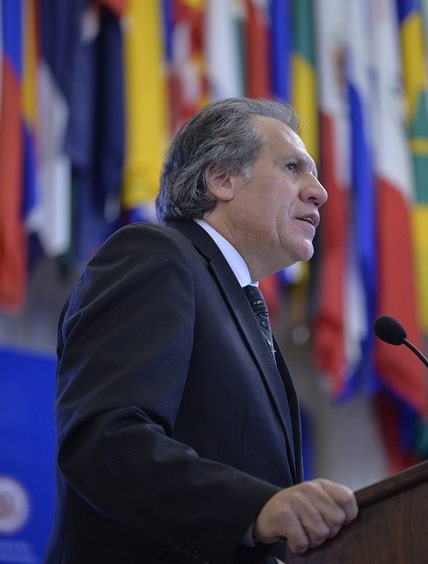
The OAS’s new Secretary General, Luis Almagro Lemes, appears to be steering his organization toward a coordinating role that, he hopes, places it above the fray of hemispheric tensions.  He has not chafed at Washington’s version of democracy promotion, and indeed has embraced elements of it.  He has readily admitted the “inexorable conclusion” that the OAS needs to be “revamped and modernized”; that it needs to “reinforce its legitimacy”; and that its structure and resources need to be better realigned with the four pillars of its mission—democracy, human rights, security, and integral development.  His promises of internal reform so far have not been radically different from those put forth by his beleaguered predecessor, José Miguel Insulza, or even diverged from proposals embodied in U.S. legislation passed in 2013.  They have been articulated, however, in the sort of Washington consultancy language that might help his cause in the U.S. capital, such as references to evolving “from the OAS’s traditional command and control toward an organization that operates like a matrix geared to results in which the hemispheric and national dimensions feed into and enrich each other.”  Elected in March and inaugurated in May, in June Almagro received a mandate from the OAS General Assembly to restructure the General Secretariat, reorganize old offices into new ones, and implement other aspects of his plan.

Regional reactions to Almagro’s election and reform plan have been positive if sometimes not overly enthusiastic.  At the General Assembly meeting, U.S. Deputy Secretary of State Blinken spoke of a “new chapter … in the history of the OAS” and said, “We have a new secretary general, a new strategic vision statement, and renewed attention to genuine reform.”  South America’s preeminent power has been generally aloof toward the OAS, but the Brazilian Senate in mid-July approved a new OAS permanent representative, and last week Brasilia paid $3 million of its $18 million in late dues—modest relief from the slow strangulation caused by dire cash-flow issues because of non-payment by several key countries.  Almagro has also won support in Latin America through his repeated signals of a desire to work more closely with other hemispheric bodies—even CELAC, which was created in 2011 as a direct challenge to the OAS and supposed U.S. influence over it.  He pledged to “seek out areas where we can complement the work of other bodies,” citing by name CELAC, UNASUR, SICA, CARICOM, and MERCOSUR.  According to press reports, his close cooperation with UNASUR as Foreign Minister of Uruguay in 2010‑15 lends credibility to that promise.  Almagro also has won regional praise for pledging to continue efforts for bring Cuba back into the OAS as a full member—building on the success of the Summit of the Americas in April driven by the Washington-Havana rapprochement.

Outgoing Secretary General Insulza was a relatively easy act to follow because, often unfairly, his image was tattered after 10 years in the crossfire between Washington and the countries pushing to undermine U.S. influence in Latin America.  Almagro appears eager to push the re-set button, and the success of the Summit of the Americas and his pledges on democracy, reform, and hemispheric cooperation have given him a good start.  But leading the OAS is going to take more than artful rhetoric, internal restructuring, and a few reforms.  President Obama’s move on Cuba removes one major irritant from hemispheric relations, but an effective Secretary General is going to have to navigate the shoals of longstanding North-South tensions.  The “spirit of genuine and equal partnership” that Deputy Secretary Blinken spoke of wanting with the OAS will be difficult to achieve, and the supporters of CELAC, UNASUR, and other alternatives to the OAS will find it equally tough to accept the OAS as a valid venue for debate and compromise.  Almagro will also have to show that he can run the organization in a professional and modern way to overcome the perception left by his predecessor of weak management of the institution.  He has declared himself a man of practical solutions, not ideology, but pleasing everyone—trying to be a coordinator who threatens no one’s interests—may not be a workable strategy for long.  If the OAS is to fulfill its mission, moreover, the United States and others will have to give Almagro the space to do his job.

July 27, 2015

Brazil on the Global Stage: Power, Ideas, and the International Order

By Matthew Taylor and Oliver Stuenkel*

Now available via Palgrave Macmillan.

Now available via Palgrave Macmillan.

Brazil has risen to become the seventh largest economy and fourth largest democracy in the world – yet its rise challenges the conventional wisdom that capitalist democracies will necessarily converge to become faithful adherents of a U.S.-led global liberal order.  Indeed, Brazil demonstrates that middle powers, even those of a deeply democratic bent, may offer important challenges to prevailing conceptions of the world order, differing in their views of what democracy means on the global stage and how international relations should be conducted among sovereign nations.  For Brazil, successful diplomacy involves an increased voice for the developing world, greater accountability in multilateral institutions, and a desire to reduce emphasis on coercive instruments.

  • Because the role of middle powers such as Brazil is often less easily understood in the realist terms that dominate U.S. foreign policy circles, its foreign policy stances are often portrayed by frustrated Washington officials as quixotic and naïve, or ridiculed as puerile and petulant third-worldist jabs at a stereotypical Tío Sam, intended only to win popular approval from a nationalistic and anti-American electorate. In fact, Brazilian foreign policy positions usually have deeper and more enduring origins, embedded within a deeply held set of beliefs that together shape Brazil’s rational strategic perspective on the structure of power in the world today.
  • Brazil’s new role on the world stage has much to do with the country’s success in addressing its own domestic challenges under a succession of democratically elected presidents. Over the past three decades, Brazil has left behind its history of economic disarray, established a robust democracy, and begun to address its record-setting inequality.  It has found paths past the hyperinflation and financial crises of the 1980s and 1990s, undertaken substantial institutional reforms to overhaul the gargantuan and inefficient public sector, and implemented highly regarded social policies.  Even its recent stumbles can be seen in the positive light of democratic progress: the demonstrations that took hold in many Brazilian cities in 2013 and 2014 can largely be attributed to a growing middle class impatient with the pace of change and increasingly conscious of its political rights, a direct consequence of the important successes of the past generation.  Although the country continues to face a number of domestic challenges, the gains of the past generation appear to have fostered an enduring intent to play a role on the world stage.

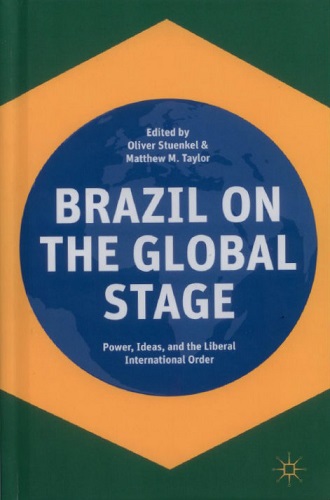
These conclusions and others are presented in a book entitled Brazil on the Global Stage: Power, Ideas, and the Liberal International Order (Palgrave Macmillan, 2015), co-edited by Professors Matthew Taylor and Oliver Stuenkel.  The book is based on a conference sponsored jointly by American University’s Center for Latin American & Latino Studies and School of International Service, and includes contributions by eight faculty members from AU and Fundação Getulio Vargas (FGV), as well as experts from the Washington community.  It offers a general evaluation of Brazil’s stance toward global order, while also addressing its postures on specific aspects of governance, including trade, foreign and environmental policy, humanitarian intervention, nuclear proliferation, and South-South relations, among other topics.

May 21, 2015

*Professors Matthew Taylor and Oliver Stuenkel teach at American University’s School of International Service and the Fundação Getulio Vargas in Brazil, respectively.

The Summit of the Americas: Important Progress

By Aaron Bell and Eric Hershberg

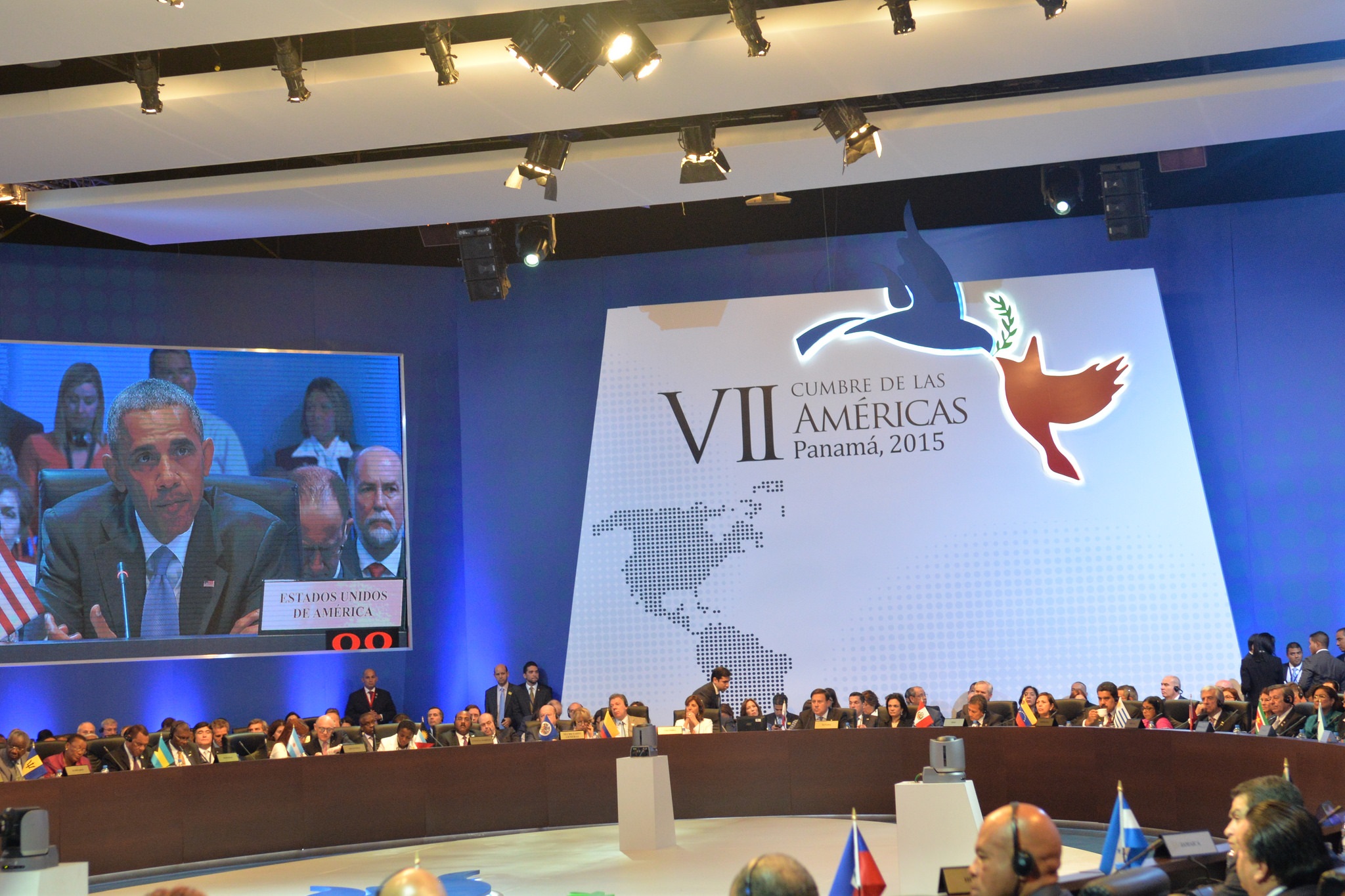
VII Summit of the Americas Photo Credit: OEA-OAS / Flickr / Creative Commons

VII Summit of the Americas Photo Credit: OEA-OAS / Flickr / Creative Commons

The U.S.-Cuba rapprochement has returned the Summit of the Americas (SOA) to the way it was before George W. Bush turned it into a forum in which the U.S. was increasingly isolated – a community of vibrant but respectful debate reflecting the varied perspectives of the hemisphere.  The event in Panama this past weekend was dominated by Cuba’s attendance at its first SOA and Presidents Raúl Castro and Barack Obama’s cordial public encounter and hour-long meeting, the first of its kind between the two nations’ leaders in over half a century.  The next step in improving relations will be for Obama to formally announce Cuba’s removal from Washington’s list of “state sponsors of terrorism,” which the State Department reportedly recommended last week.  Regrettably, the leaders did not take advantage of the Summit as an occasion to announce a target date for the formal restoration of diplomatic relations and the appointment of Ambassadors.  But that, presumably, will come soon, and regardless, in the plenary session Obama set a new tone for U.S. policy when he acknowledged that “the days in which our agenda in this hemisphere so often presumed that the United States could meddle with impunity — those days are past.”  Obama clearly articulated a desire to move beyond not only the legacy of U.S. intervention in the region but also the stale ideological debates that, he observed pointedly, pre-dated his birth.

Statements and activities surrounding the SOA also reaffirmed the broad range of perspectives in the hemisphere,  including in attitudes toward the United States.  The “People’s Summit,” held parallel with the SOA, provided a forum for left-wing critiques aimed primarily at U.S. meddling in the region, in particular its foreign military bases and its recent allegation – which it subsequently backed away from – that Venezuela poses an “extraordinary threat to U.S. national security.”  The sanctions it imposed on senior officials drew critiques from around the region, including from Argentina, Colombia, and from Brazil’s Dilma Rousseff, who summarized regional sentiment in characterizing them as “counterproductive and inefficient.”  The criticism was overshadowed, however, by widespread applause for changes in U.S.-Cuba relations.  Obama also won points from observers for meeting with Venezuelan President Nicolás Maduro, who used the Summit to denounce the 1989 U.S. invasion of Panama and present to Obama a list of 11,000 signatures opposing Washington’s sanctions.  Maduro praised the meeting as the “Summit of Truth” and even “cordial,” noting that it opened the door to further discussions on the bilateral relationship.  Obama also seemed to subscribe to a different role for civil society representatives – as opponents of sitting governments – at the summit, choosing to meet privately, for example, with Cuban dissidents opposed to the Raúl Castro and his government.

Obama’s steps to remove the festering U.S.-Cuba issue from the hemispheric agenda have been game-changing, even if some presidents criticized Washington’s continued enforcement of the economic embargo and the Administration’s bewildering inability to move faster to remove Cuba from its highly politicized terrorist list.  This summit may signal a return to the values and respectful debate that Obama, and before him Bill Clinton, espoused at past Summits, and may pave the way for cooperation over contemporary issues rather than Cold War-era ideological hang-ups.  In the final days before the Summit, senior White House advisors had intervened to ease tensions over the State Department’s national security rhetoric vis-à-vis Venezuela, emphasizing with regret that assertions regarding Venezuela’s posing a security threat were an unfortunate procedural necessity rather than a genuine assessment of the situation.  This recognition that “words matter” turned on their head the words used earlier in the week by Assistant Secretary of State Roberta Jacobson in lamenting that Latin American governments were not using language similar to Washington’s to characterize the deteriorating political situation in Venezuela.  While the correctives from the White House and the focus on the transformation of U.S.-Cuba relations were both conducive to a successful SOA, these developments did overshadow both the official theme of this year’s summit – Prosperity with Equity – and related discussions on energy, the environment, and education.  These crucial issues, all ripe for regional cooperation, are the core of what should become the focus of U.S.-Latin American relations for the remainder of this administration and beyond.

April 13, 2015

OAS: New Leadership, Old Challenges

By Aaron Bell and Fulton Armstrong

José Miguel Insulza and Luis Almagro Lemes Photo Credit: OEA - OAS / Flickr / Creative Commons

José Miguel Insulza and Luis Almagro Lemes Photo Credit: OEA – OAS / Flickr / Creative Commons

Uruguayan diplomat Luis Almagro, elected secretary general of the Organization of American States (OAS) last week, says he wants to revitalize the hemispheric organization – a herculean, if not impossible, task.  Almagro was the only candidate remaining after Guatemalan Eduardo Stein and Peruvian Diego García-Sayán withdrew from the race – the former for health concerns, and the latter due to a perceived lack of support from his government.  Almagro previously served as Foreign Minister under former president José Mujica and is a member of his Movimiento de Participación Popular, whose left-leaning sympathies led observers to wonder whether Almagro could draw sufficient backing even running unopposed.  But Almagro received formal support from several prominent nations ahead of time, including Brazil, Argentina, Mexico, and the United States, and he got 33 of 34 votes (Guyana abstained) to secure his election.  Following the election, U.S. Deputy Secretary of State Antony Blinken called for the new Secretary General to “lead the OAS through this genuine reform process by helping to refocus the OAS on its core pillars – democracy, human rights, sustainable development, and citizen security,” all while resolving its fiscal challenges.  “We look to [him] for his leadership, but we want him to know that he does not stand alone.”  His five-year term begins in May.

In his acceptance speech, Almagro stated that he intends to rise above the role of crisis manager and facilitate “the emergence of a revitalized OAS,” but major challenges await him:

  • The political crisis in Venezuela has long challenged the OAS, and an escalation in sanctions and rhetoric from the United States has made its balancing act harder. Current Secretary General José Miguel Insulza criticized the Obama administration’s national security warnings while also calling out the Maduro government for the arrest of opposition leader Antonio Ledezma and its resistance to dialogue with the opposition.  Almagro has been critical of U.S. sanctions as well, and quietly worked behind the scenes to encourage negotiations between political opponents in Venezuela, but his public silence on abuses by the Maduro government worries his critics.
  • The Cuba issue will also put Almagro in a tight spot. Havana’s participation in the Summit of the Americas is likely to build pressures for its readmission to the OAS, and Almagro’s record shows he’ll be sympathetic.  But the process could be fraught with risks for the new Secretary General.  Outgoing Secretary General Insulza bears scars attesting to U.S. Senators’ penchant for personalizing attacks when the OAS doesn’t go their way.
  • Any reform agenda is going to get battered from both sides. The OAS mandates are broad and expensive, and members don’t agree on priorities.  As Deputy Secretary Blinken’s comments suggest, Washington wants the organization to focus on its agenda, but much of South America, particularly the ALBA countries, wants the OAS to pull away from U.S. influence.  Nor do differences lie strictly along North-South lines, as made clear by protests during last year’s general assembly against Brazil’s resolution condemning discrimination based on sexual orientation and gender identity.

Almagro seems to have the experience and temperament to be an excellent choice for the job, and his coming from Uruguay, whose good offices have credibility virtually everywhere, may serve the OAS well.  But the challenges will be daunting.  He faces several ongoing crises, particularly in Venezuela, and ongoing splits within the region over the OAS’s role.  One tempting option would be for Almagro to try to distance himself and the organization from Washington – a difficult task at best.  Not only is his headquarters several hundred meters from the White House and the State Department, but the United States government (and to a lesser extent Canada) provides substantially more funding for the OAS’s general fund and through special donations than any other member state.  Almagro’s actions will also be watched closely by U.S. conservatives who, stung by President Obama’s move toward diplomatic relations with Cuba, are looking for a fight over Venezuela, Ecuador, Argentina, and even on some issues with Brazil.  Whatever Almagro does, it will be with the black cloud of the OAS’s financial difficulties over him, and the possibility that failing to successfully balance all of these issues may weaken the OAS and benefit regional organizations like CELAC and UNASUR, which are smaller and less well established, but independent of North American influence.

March 23, 2015

Venezuela: Crossing the Line

By Eric Hershberg and Fulton Armstrong

Marcos Oliveira / Agência Senado / Flickr / Creative Commons

Marcos Oliveira / Agência Senado / Flickr / Creative Commons

Venezuelan President Maduro’s arrest of Caracas Mayor Antonio Ledezma reflects a new level of vindictiveness and almost desperation at home – and threatens to leave his government more isolated than ever in Latin America.  In a three-hour televised speech, Maduro alleged that the mayor, whom he called a vampire and fascist, was plotting with military officers to remove him from office.  Ledezma has been a strident opponent – playing a prominent role in last year’s salida movement – and the Associated Press cites unnamed sources as acknowledging the existence of identified coupists.  But Maduro’s evidence against Ledezma was negligible, mostly a document on a national transition accord.  Other Maduro opponents are also reportedly to be arrested soon.  At the same time, the President said that the U.S. Embassy was trying to turn the military against him by, he alleged, calling generals’ wives to say their U.S. visas were being revoked.

The increasingly repressive nature of the Maduro regime is drawing scorn from throughout Latin America, including countries that previously tolerated the excesses of deceased President Hugo Chávez.  UNASUR has announced it will hold an extraordinary meeting soon on the deepening crisis caused by Ledezma’s arrest, and the Foreign Ministers of Brazil, Colombia and Ecuador will make an urgent visit to Caracas this week.  Chilean President Bachelet and Senate President (and daughter of the assassinated President) Isabel Allende expressed their “concern” over the arrest.  Colombian President Santos, heretofore restrained in his criticism, told the press he was “worried.”  Amnesty International also condemned the action.  Washington’s vehement denials of Maduro’s allegations that it was involved have not been challenged.

Maduro’s Latin American neighbors are likely to continue hewing to traditional non-interventionism, but even the left appears to regret that recent events confirm the monumental squandering of the Chávez revolution’s opportunity to carry out a radical project of redistribution and propose an alternative model for the region.  Chavismo had a social base, but Chávez and, to a much greater extent, Maduro have failed to develop a democratic or economically coherent approach to their revolutionary project.  Venezuela is now paying the price and, as many predicted, the situation is getting worse before getting better.  It is impossible to say how and when the impasse will break, and hard to identify who’s capable of ending the misery – be it the military or a faction within Maduro’s own party.  It’s clear, though, that this crisis is not sustainable and regional patience with it is growing thin.

February 23, 2015

Inter-American Educational Exchange: A Drop in the Bucket

By Aaron T. Bell

Photo Credit: Public Domain

Photo Credit: Public Domain

The Obama administration’s program for strengthening inter-American ties through cooperative education – “100,000 Strong in the Americas” – is now several years old and making incremental progress toward its stated goal of a multilateral exchange of 100,000 students between the United States and Latin America.

  • The latest Open Doors report from the Institute of International Education shows that the number of Latin American students studying in the United States during the 2013-14 academic year (AY) rose 8.2 percent from the previous AY to 72,318 – the largest number to date and the largest annual percentage increase in at least 15 years. Mexico and Brazil now rank ninth and tenth respectively as places of origin for foreign students in the United States.
  • The most recent data on U.S. students studying in Latin America is less promising. In the 2012-13 AY, 45,473 U.S. students studied in Latin America, the highest number to date but a smaller annual percentage increase (1.8 percent) compared to the late 2000s.

Countries’ investments in such exchanges vary widely.  Under “100,000 Strong,” figures for U.S. spending are elusive.  In early 2014 the State Department announced the creation of the Innovation Fund, partnership grants that will be awarded over the next several years to strengthen collaboration between higher education institutions – including 38 grants totaling over one million dollars last year.   Mexican President Peña Nieto has introduced Proyecta 100 Mil, which in addition to sending 100,000 students to the United States by 2018, hopes to entice 50,000 U.S. students to study at its own universities.  (U.S. students in Mexico dropped from 10,000 in 2005-06 to less than 4,000 in 2012-13 because of security concerns.)  Both countries’ financial commitment to international education pales next to that of Brazil.  President Rousseff announced last summer the renewal of its Science Without Borders program, the first phase of which cost US$1.36 billion.

These programs, universally seen as laudable, have thus far let certain countries fall through the cracks.  Vice President Joe Biden recognized in his recent New York Times editorial that “inadequate education” is one of the barriers holding back Guatemala, Honduras, and El Salvador, from which thousands of children have fled in recent years.  The development assistance portion of President Obama’s proposed $1 billion budget for Central American assistance is in part slated for strengthening literacy and vocational education.  Bringing Central America into the Innovation Fund program is a logical addition to the President’s efforts, yet Central American partners were notably absent in 2014.  Only one of the five grant rounds was open to Central American countries – where it arguably could have a greater national-level impact – and of the 109 recipient institutions of Innovation Fund grants, only two were from the region – and none from the Northern Triangle (Honduras, Guatemala, and El Salvador).  That disparity suggests that, in spite of the rhetoric, education exchange is considered a supplementary tool rather than a leading means of bolstering development in Latin America.  While the 100,000 Strong in the Americas program deserves applause as a cooperative, multilateral program, it remains an underutilized tool of U.S. engagement in much of the hemisphere.

February 16, 2015

CELAC: Losing Relevance?

By Michael M. McCarthy

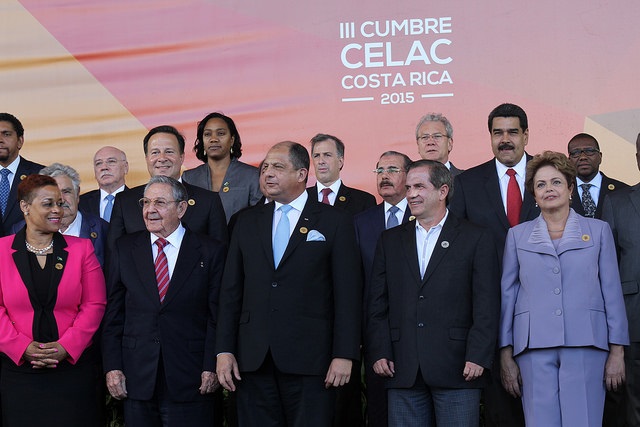
Presidencia de la República del Ecuador / Flickr / Creative Commons

Presidencia de la República del Ecuador / Flickr / Creative Commons

The announcement by Presidents Obama and Castro of their intention to normalize diplomatic relations could leave a big hole in the agenda of the Community of Latin American and Caribbean States (CELAC), which met January 28-29 for its third heads of state Summit in San José, Costa Rica.  Raúl Castro kicked off last year’s summit, in Havana, with a speech decrying the United States NSA spying scandal.  In San José, he moderated his tone, noting that “our America has entered a new era” since CELAC was founded (2010) while also calling on the U.S. to end the trade embargo – a point other member states echoed – and to return the naval station at Guantanamo Bay.  In concrete terms, the results of last week’s CELAC summit were modest.  The technocratic goals of quantifying progress on poverty and technology development announced by Ecuador, the group’s 2015-2016 President Pro-Tempore, suggest no major changes are imminent.

Since President Chávez’s death March 5, 2013, the former leader’s Bolivarian vision of Latin American and Caribbean integration and unity has shown signs of weakening.  CELAC now faces even tougher challenges defining and defending its identity and mission beyond the creation of a common political space for regional decision making insulated from the U.S. and Canada.  With Chávez’s successor, President Nicolás Maduro, losing support amid economic crisis, the Alianza Bolivariana para los Pueblos de Nuestra América (ALBA) can no longer throw its weight around on the international scene.  Cuba’s inclusion in the Summit of the Americas – increasing the likelihood of its participation in the OAS – is a major achievement but represents the loss of a major rallying point. 

Going forward, three issues will determine the groups trajectory.  The Cuba issue wont go away suddenly, but rapid change in U.S.-Cuba ties could reset hemispheric relations and leave CELACs mission muddled and potentially irrelevant.  Disagreement among CELAC members over issues such as Puerto Ricos status may create tensions, as they did when Nicaraguan President Daniel Ortega gave the island a high profile during the presidential plenary underlining the risks inherent in the unity within diversity principle embraced by CELAC.  (Ecuadoran President Correa, another ALBA supporter, chided Ortega.)  But perhaps the biggest determinant of the groups future relevance lies in its emerging relationship with ChinaA CELAC-China foreign ministers forum met in Beijing last month, formalizing the Asian nations relationship with CELAC.  The forum announced the 2015-2019 China-CELAC cooperation plan calling for the doubling of two-way trade and the increasing of Chinese investment in the region to $250 billion.  Exclusion of the U.S. and Canada may remain a tenet of CELACs platform, but the groups leaders may judge that its long-term relevance can be rescued by reaching out to China instead.

February 2, 2015

*Michael McCarthy is a Research Fellow with the Center for Latin American and Latino Studies.

Will Washington’s Attention to Latin America Last?

By Fulton Armstrong

Photo Credit: Prensa Presidencial Venezuela

Vice President Biden meets with Venezuelan President Maduro / Photo Credit: Prensa Presidencial Venezuela

U.S. President Obama, Vice President Biden, and Secretary of State Kerry gave Latin America increased priority in 2014, including at least two efforts to open channels to countries previously off their calling lists.  Issues combining domestic politics and foreign policy– such as immigration, Cuba, and drug policy – saw noteworthy breakthroughs.

  • President Obama’s highest profile action was his announcement in December that the United States and Cuba would normalize relations. He said he would travel to Panama in April for the Summit of the Americas – the venue of his pledge to seek a “new beginning” with Cuba in 2009 and his isolation over the Cuba issue in 2012.  Last May, his trip to Mexico and Costa Rica, where he met with Central American presidents, signaled a shift on counternarcotics strategy – downplaying militarized efforts – in response to the region’s concerns about surging violence.  His November announcement of executive measures on immigration, offering temporary legal status to millions of undocumented migrants, also steeped him in Latin America policy.
  • Vice President Biden greatly expanded his Latin America portfolio, at times as stand-in for Obama but also putting a deep imprint on policy. On an extended trip in June, he met with heads of state during the World Cup and attended a summit in Central America.  In November he participated in a followup meeting with the Honduran, Salvadoran, and Guatemalan Presidents hosted by the Inter-American Development Bank, where he announced U.S. measures to prevent another crisis involving migrant children as was seen last summer.  He met with and telephoned Latin American Presidents more than a dozen times over the year and, on the margins of Brazilian President Rousseff’s reinauguration last week, even met with Venezuelan President Maduro, with whom he agreed that it was time to restore ties.
  • Secretary Kerry traveled to the region several times – to Mexico, Panama, Peru, and Colombia – and met with Latin American Presidents and foreign ministers in Washington. Some critics judged his broad policy speeches as unexciting, but he clearly has confidence in his Latin America team, and sources say his support for the President’s initiative on Cuba was strong.

We Latin America watchers in Washington tend to complain that our region doesn’t get enough attention, but it’s clear that the Administration’s level of engagement in 2014 was deeper and more sustained than in years past.  Senior advisors at the National Security Council, Vice President’s office, and State Department – Ricardo Zúñiga, Juan González, and Assistant Secretary Roberta Jacobson, respectively – got their bosses’ to act despite the many competing demands in other regions occupying the front pages of U.S. newspapers.  Several ongoing processes promise continued senior-level attention in at least the first half of the new year.  The normalization process with Cuba could entail a visit there by Secretary Kerry, and preparations for the Summit of the Americas in Panama in April afford opportunities to give momentum to U.S. engagement – in addition to rebuilding U.S. credibility in the Summit process lost at the Summit in Cartagena in 2012.  Continued political crisis in Venezuela, nose-diving oil prices, progress in the Colombian peace talks, and the ever-evolving drug threat suggest 2015 will also be a challenging year.  For now at least, Washington’s senior team is engaged.

January 7, 2015

Who Will Attend the OAS Presidential Summit in Panama?

By Fulton Armstrong and Eric Hershberg

OAE-OAS & tgraham / Flickr / Creative Commons Attribution-NonCommercial-ShareAlike 2.0 Generic (CC BY-NC-SA 2.0)

OAE-OAS & tgraham / Flickr / Creative Commons Attribution-NonCommercial-ShareAlike 2.0 Generic (CC BY-NC-SA 2.0)

The Summit of the Americas isn’t until next April, but interest in how Panama as host handles near-unanimous pressure from Latin America to invite Cuban President Raúl Castro, and how the United States and Cuba will respond, is growing fast.  Speaking to reporters at the United Nations last week, U.S. Assistant Secretary of State Roberta Jacobson answered several questions on the U.S. position.  Key excerpts follow:

  • Asked “if the United States is still opposed to Cuba attending.”  On the Summit of the Americas, I think we’ve been pretty clear in our position on the summit, which is that obviously Panama is the host country for the summit, and as the host country they will make the decisions on invitations to that summit.  …  And the fact of the matter is we have said from the start that we look forward to a summit that can include a democratic Cuba at the table.  We also have said that the summit process, ever since Quebec in 2001, has made a commitment to democracy, and we think that’s an important part of the summit process.  But the decision about invitations is not ours to make, and obviously there’s been no invitations formally issued to the United States and other countries. And so there is no acceptance or rejection yet called for or made. …
  • Asked “is there a chance that the U.S. might refuse going.”  Again, I think you won’t be surprised to hear me say that we’re really not going to answer hypotheticals in the future yet.  Obviously, the Summit of the Americas is in April and that’s not a situation that we can answer, although I think we have made clear that we believe the summit process is committed to democratic governance and we think that the governments that are sitting at that table ought to be committed to the summit principles, which include democratic governance. And therefore that’s our position at this point.  Obviously, we have a position on Cuba which does not at this point see them as upholding those principles.

Panama’s likely invitation to Cuba – reflecting the consensus of 32 hemispheric nations at the last Summit – will draw protests from official quarters in Washington.  But it’s far from certain that the Obama Administration would risk blame for torpedoing the 20-year Summit process.  Obama survived a handshake with Raúl Castro at Nelson Mandela’s funeral last December, and being in the same room with him again as a President in the second half of his second term will have little political consequence.  A workshop in Mexico City in June, in which CLALS researchers participated, and another in Ottawa in September, sponsored by the Center and the University of Ottawa, explored likely outcomes.  Mexican international relations specialists speculated that a reasonable outcome was for the United States to show up like a polite guest, and thus avoid having the anachronism of U.S. antagonism toward Cuba overshadow its broader relations with Latin America.  Canadian experts were deeply concerned that Cuba’s inclusion might undermine the centrality to the OAS of the Inter-American Democratic Charter, but they agreed that failure to convene a Summit would constitute a serious blow to the OAS and to the regular summits that provide Canada a seat at the inter-governmental table.

The reality is that Cuba does not conform to the Democratic Charter or to the broader OAS criteria of democratic rule, but equally real is that Latin America sees Cuba as a full member of the hemisphere and has lost all patience with those in Washington who would deny that.  Either Washington — and Ottawa — set aside their objections to Cuba’s inclusion or they bid farewell to such fora and their constructive impact on regional relationships that ought to matter to them.  Moreover, if they acquiesce to Cuban participation but then try to commandeer the agenda and make the Summit a seminar on democracy and human rights, it will only reinforce the widespread sense in the region that Washington cannot move beyond its obsession with the trivial matter of Cuba and get on with a serious conversation among equal partners.  They would thus sacrifice an opportunity to discuss issues on which significant, substantive advances are possible through dialogue among leaders of countries throughout the hemisphere.  The value of the Summit rests with the capacity of all involved to act like grownups.  President Obama did so at Mandela’s funeral, and it will be telling whether he can do it again in Panama this coming April.

October 2, 2014