Secretary-designate Kerry Hews to Old Line on Latin America

Photo by: cliff1066™ | Flickr | Creative Commons

Photo by: cliff1066™ | Flickr | Creative Commons

Senator John Kerry’s confirmation hearing to be Secretary of State focused overwhelmingly on Syria, Iran, and Libya, but there were glimpses of the nominee’s approach – at least for now – to Latin America.  His almost-certain successor as Chairman of the Senate Foreign Relations Committee (SFRC), Democrat Bob Menendez of New Jersey, sees Latin America through a distinctly Cuban-American optic and asked Kerry predictably leading questions about the region.  Menendez asked Kerry how he would respond to change in the Western Hemisphere, highlighting “changing political tides,” potential transition in Venezuela, public security in Mexico and Colombia’s talks with the FARC.

Kerry’s responses did not challenge the premises of Menendez’s questions and stuck closely to recent U.S. policies.  He offered neither details nor hints of change.  Reflecting the State Department’s emphasis on a programmatic approach to the region, he highlighted security cooperation with Mexico and Central America, unspecified energy and climate initiatives with Brazil, and development assistance to Honduras and Guatemala.  Kerry praised former president Álvaro Uribe, under whose aegis most of the $8 billion in Plan Colombia funds were spent, for helping make Colombia “one of the great stories in Latin America.”  He termed Venezuela and its allies as “outlier states” and said U.S. policy should “induce people to make a better set of choices.”  When Arizona Republican Jeff Flake expressed support for a broader opening on Cuba travel, arguing that unleashing hordes of American students on spring break would pose a greater challenge to the Castro brothers than continued restrictions, Kerry smiled but remained quiet. Later, Menendez lashed back and turned the focus to Cuba’s human rights record.

As expected, Kerry did not advocate any major shifts or offer new ideas on U.S. policy toward Latin America – obviously preferring to avoid confrontation with Menendez and Republican Cuban-American Marco Rubio.  Kerry’s strategy was to ruffle no feathers.  His remarks about President Uribe, for example, appeared intended to assuage right-wingers unhappy with his focus as Chairman on the Colombian President’s dismal human rights record and lack of accountability for a host of abuses of power.  Likewise, agreeing with Menendez that President Chávez was a problem was thin gruel; eagerly awaiting the Venezuelan’s demise does little to address the shortcomings of U.S. leadership in the hemisphere.  

Latin America-watchers know well that Kerry and President Obama will be more focused on other regions, leaving space for the SFRC conservatives to weigh more heavily on Latin American policy than they already do.  Despite the Cuban-American community’s obvious shifts away from most elements of the right wing’s Cuba policy, Menendez and Rubio have already declared they will block any efforts toward better relations with Cuba even on a people-to-people level.  By extension, they will oppose any outreach to Venezuela before they believe regime change has occurred.  Nor did Kerry offer any departures from the U.S. war on drugs.  Stagnation on these two policies puts the United States on a collision course with even close friends in the region, who have said they will not participate in hemispheric conferences that continue to exclude Cuba and that advocate a more candid conversation about the failure of the “war on drugs.”  This approach risks continuing to undermine U.S. relevance and influence in the region.
Cumbritis and Prospects for Latin American Regionalism

By Carlos Portales
Washington College of Law and Center for Latin American and Latino Studies

UNASUR Cumbre by  Globovisión | Flickr | Creative Commons

UNASUR Cumbre by Globovisión | Flickr | Creative Commons

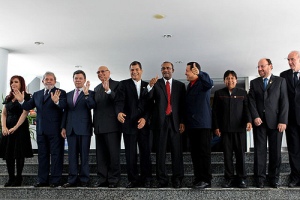
Latin America has experienced a veritable proliferation of presidential summits (cumbres) in recent years, an indication of how the hemisphere’s complex web of regional ties is shuffling the landscape of multilateral organizations. This trend was manifested in the Nov. 16-17 Iberoamerican Summit in Cadiz, Spain, followed in quick succession by summits for UNASUR on Nov. 30 and MERCOSUR on Dec. 7. The New Year will witness two summits in Santiago, Chile, the first between the European Union and Latin American and Caribbean States, the second among Latin American and Caribbean States (CELAC).  While sometimes useful in isolation, the cumulative impact of these meetings may be less than the sum of its parts. Indeed, the region may be suffering a bout of cumbritis that is as distortive as it is productive.

The Cadiz summit reflected Spanish determination to sustain an Ibero-American bloc amidst its own profound crisis. Spain’s investments in Ibero-America, particularly in banking and telecommunications, are keeping alive important sectors of the Spanish economy. When the VI UNASUR Summit met in Lima two weeks later, the Presidents of Argentina, Brazil, Venezuela and suspended Paraguay were all absent. Still, the meeting reaffirmed UNASUR’s role in political and military matters: UNASUR was active in the crisis in Paraguay, sent its first-ever electoral mission to Venezuela, the South American Defense Council provides coordination in defense industries and natural disaster responses, and aspires to support protection of human rights.

The following week in Brasilia, MERCOSUR formally incorporated Venezuela and signed an adhesion protocol with Bolivia. However, as Tom Long wrote in “Mercosur’s future: Whither economics?” on Dec. 18, MERCOSUR’s expanding breadth masks a lack of depth. The trade bloc has not agreed on a common external tariff, and integration has stalled as Argentina and Brazil adopted unilateral protectionist measures both during and after the global financial crisis. Though its market is growing, MERCOSUR’s ability to negotiate with third parties is limited. The countries most interested in boosting trade have split off on their own under the loose Pacific Alliance (PA), whose Presidents met on the sidelines during the Cadiz summit. Chile, Colombia, Mexico and Peru have set high targets for the reduction of customs duties and plan on reducing visa requirements for their citizens while already having FTAs with the US and Europe.  Chile and Peru have reached similar accords with China and other main Asian countries. However, the Alliance is primarily an informal gathering of free-trade-minded presidents, and so far institutionalization is minimal.

Brazil is leading South America-centered institutions (UNASUR and MERCOSUR) when it perceives that these suit its interests; The Venezuela-led ALBA has lost steam due in part to President Chavez’s illness; the PA process remains low-key and trade centered. Meanwhile, the Organization of American States risks irrelevance. Its robust human rights system has come under attack from ALBA countries and others, while four ranking members of the U.S. Senate Foreign Relations Committee have lambasted its leadership publically. The OAS may not be unsalvageable, and it remains potentially useful, though that potential will only be realized if the United States endeavors to support rather than undermine its efforts.

And Summits alone will not ensure the success of any of these multilateral forums: increasingly ubiquitous conversations among presidents can be effective for defusing immediate crises and for establishing guidelines for cooperation, but their long-term impact on policy coordination will be limited if they are not matched by analogous cross-national dialogue among key government ministries. The symptoms of chronic cumbritis lie in the failure of many presidential declarations to result in concrete advances in cooperation.

Mercosur’s Future: Whither Economics?

By Tom Long

Mercosur’s December 6 meeting in Brasilia might seem to be a watershed. The organization formally integrated Venezuela and signed adhesion agreements with Bolivia. Ecuadorean President Rafael Correa was in attendance, too, along with officials from other South American countries. The bloc was established starting in 1991, with goals of removing internal tariffs, setting a common external tariff, coordinating commercial policies, and harmonizing regulations. An unwritten objective was to spur industrialization and decrease dependence on foreign manufactures. Yet more than twenty years on, Mercosur appears to be further than ever from establishing a common market. The Inter-American Development Bank notes that Brazil and Argentina have traded protectionist measures, and that “Buy Brazil” provisions in government procurement have been a bilateral irritant.

Mercosur

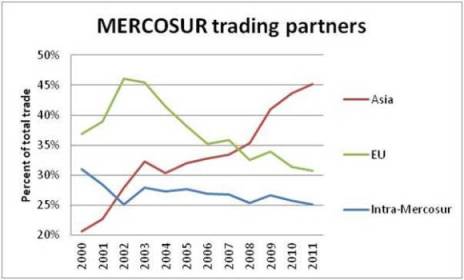
Expanding breadth masks decreasing depth. While both Mercosur’s total trade and trade among its members have grown greatly over the past decade, the former has outpaced the later.  WTO data show that intra-regional trade as a percentage of total trade has declined from 31 percent in 2000 to 25 percent in 2011. Instead of being driven by integration, MERCOSUR’s trade patterns are propelled by skyrocketing trade with Asia, led by Argentine and Brazilian commodity exports. In this light, the failure of late October meetings between Mercosur and the European Union suggest that China has taken the place of Europe.

Evaluated from a strictly economic perspective, Mercosur’s recent expansion represents a step backwards. The inclusion of Bolivia will not add much economic heft to the pact, and with the addition of each new member, reaching consensus will become even more difficult. The full membership of Venezuela increases the bloc’s size, but also its dependence on natural-resource exports. Neither newcomer—nor the two original heavyweights—appear committed to the original common market mission. Is the bloc’s raison d’etre shifting from the economic to the political? If so, what will be Mercosur’s relation to ALBA and UNASUR? Whereas Brazil was never fully comfortable with the Bolivarian Alliance—in part because of the anti-U.S. tone—it has now brought ALBA’s two most committed members to its own table. Inside Mercosur, Brazil has a greater voice than it does in UNASUR, but the hijacking of a potentially important trade alliance masks a lack of economic leadership for South America.

ICJ Decision on Colombia-Nicaragua Dispute Settles Little

Photo: Patricia Iriarte Diaz Granados "orianauta" | Flickr | Creative Commons

Photo: Patricia Iriarte Diaz Granados “orianauta” | Flickr | Creative Commons

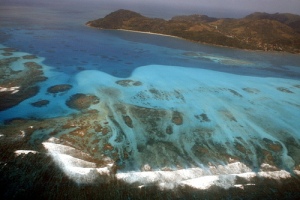
The decision announced last month by the International Court of Justice on a three-decade maritime dispute between Nicaragua and Colombia has pleased Managua and angered Colombia.  The court confirmed Colombia’s sovereignty over seven islets known as San Andrés and Providencia, but it extended Nicaragua’s sovereignty over 200 nautical miles.  The ruling means that, although Colombian jurisdiction includes a 12-mile radius around the islands, Nicaragua will control a much bigger area of the Caribbean – and greater access to fishing grounds and potential underwater oil deposits.

Colombia has rejected the ICJ verdict; refused to withdraw its navy from the contested waters; and withdrawn from the Pact of Bogotá, which recognizes ICJ jurisdiction.  Foreign Minister Holguín said Colombia wants to protect itself from future challenges to Colombian territory.  This position has implications for its neighbors.  Colombia’s withdrawal leaves a pending case brought against it by Ecuador regarding harm caused by herbicides from aerial fumigation near its border.  It also shifts back into bilateral renegotiations Colombia’s dispute with Venezuela over the Gulf of Venezuela, which Colombia had often proposed taking to the ICJ.  According to press reports, Panama, Costa Rica, and Honduras did not see themselves affected by the ICJ decision.

While ICJ decisions are final and cannot be appealed, the Court lacks the means to enforce them.  Colombia’s rejection of the ruling suggests it will take advantage of that, setting itself and Nicaragua on a collision course that will undoubtedly raise tensions in the region.  (Non-enforcement is an old problem.  The United States got the UN Security Council to support it in rejecting an ICJ decision in the 1980s that Nicaragua was entitled to reparations for U.S. support of the Contras.)  Even if the countries don’t come to blows, the dispute puts regional cooperation in crucial areas, such as counternarcotics, at risk.  It also raises questions about the willingness of countries to work with multilateral institutions.  The ALBA countries support ICJ jurisdiction now, but Colombia’s position probably will embolden them to reject it if inconvenient in the future.  Maritime disputes appear to be increasing worldwide, and Central America promises to be no different.

The U.S. Election: A Sigh of Relief, A Moment of Hope?

Photo by: Hanoian | Flickr | Creative Commons

Latin American media see a glimmer of hope in President Obama’s reelection that was largely absent during the campaign.  The breadth and composition of the coalition that carried Obama to victory appears to have impressed commentators, and some believe that Obama might be freer of political constraints in a second term.  In Mexico, undergoing its own presidential transition, there is expectation that continuity in Washington will facilitate a smoother transition there.  The prospect that Obama will be willing, and perhaps more able, to press for additional stimulus measures to jumpstart the U.S. economy – with obvious benefit for interdependent Mexico – may also be a factor.  El Tiempo in Colombia noted that “with Obama, there won’t be surprises,” and that stability is welcome during the difficult peace talks.  The ALBA countries generally welcomed Obama’s reelection, and – probably reflecting a wider view – Cuban media proclaimed: “U.S. elections: the worst one did not win.”  Some media, such as Brazil’s O Globo, reminded readers that the U.S. House of Representatives remains under Republican control, and that the GOP “had been kidnapped” by the Tea Party.

A quick review of regional commentary reveals interest in the fact that Latino voters, more than 70 percent of whom opted for the President, were an important part of his coalition in Virginia, Colorado, and New Mexico.  Despite the Obama administration’s record number of deportations and its failure to introduce comprehensive immigration reform during its first term, there is little doubt that the President’s June 2012 decision to implement provisions of the Dream Act increased enthusiasm.  Challenger Mitt Romney’s tough talk on Cuba and Venezuela did not win over South Florida, suggesting that demographic change is undermining support there for hardline policies.  Bolivian President Evo Morales said, “Obama needs to recognize and pay that debt to the Latinos.”

No one so far has dared to expect a major shift in emphasis toward Latin America during Obama’s second term, but reelection gives the President another opportunity to make good on his vision for “partnership” in our hemispheric “neighborhood.”  Early analysis of the voting, particularly in Florida and in Latino communities, suggests that he will have the political space to live up to the expectations created by his soaring rhetoric during his first Summit of the Americas in 2009.  Not only can he explore reasonable approaches to longstanding issues such as Cuba, which will improve the U.S. image throughout the region; he can reengineer Washington’s relations with Central and South America in ways that reflect the region’s own evolution and ambitions – enhancing and facilitating them, rather than fearing or even resisting change.  If Latin America is ready to move into the future with a new, constructive interaction with the United States, now is the time to give it a try.

How Real is Anti-Americanism in Latin America?

Photo: WideAngleWandering | Flickr | Creative Commons

American University professor Max Friedman’s new book* offers a refreshingly original account of the sources of “anti-Americanism” in international affairs, with direct implications for U.S.-Latin America policy.  For Friedman, anti-Americanism is defined as a tendency – often ideological – to hate or resent the United States, driven primarily by cultural conflict or a rejection of democracy.  While not denying the existence of anti-Americanism, Friedman’s well-researched argument demonstrates that anti-Americanism is also a self-serving “myth” that U.S. policy makers repeat to each other, and to the U.S. public, in their unilateral pursuit of policy goals.  As the alter ego of American exceptionalism, it is too often a story we tell ourselves about the rest of the world, increasingly to our own detriment.

For Latin America, Friedman emphasizes the U.S. tendency during the Cold War to interpret regional governments as either “pro” or “anti-American,” maintaining a counterproductive “North-South perceptual divide.”  For example, Washington badly mischaracterized Guatemalan governments in 1954 and again in 1963 as communist puppets, despite significant support for the United States, which facilitated two U.S.-backed coups.  The installation of a dictatorship and subversion of democracy led to worldwide condemnation, the alienation of Latin American countries otherwise favorable toward the United States, and accusations of U.S. hypocrisy.  Even today, when the Obama Administration’s Latin America policy appears on auto-pilot, alarmists write about “the axis of anti-Americanism” in the region.  This theme is fueled by Washington’s isolation over its Cuba embargo and counternarcotics approach, its failure to deal effectively with the coup in Honduras in 2009, and its continued emphasis on free-trade zones with decidedly lukewarm governments pursuing other opportunities.

The United States has been slow to realize that its role in the region is diminishing, and Washington policy makers have not appreciated the varying economic, political, and security interests of the different countries in the region and the interplay among them.  These intraregional interests reflect motives or objectives not simply attributable to the U.S.-Latin American relationship.  But too often, as Friedman makes clear, the U.S. has dismissed Latin American concerns as latter day anti-Americanism, a manifestation of pathological hatred, irrationality, jealousy, resentment, illegitimate slander, pride, fear, inferiority, political immaturity, ideological intransigence, or an anti-modern hostility to free society.  And, as Friedman says, this “myth of anti-Americanism” promotes analytic failures and mistaken interpretations about regional conditions; it limits access to useful information from regional counterparts; equates criticism with hostility, and highlights an unwillingness to treat Latin American governments as independent actors; while it justifies faith in the superiority of U.S. thinking. As the U.S. seeks new footing in the region, none of this ultimately serves the national interest.

* Rethinking Anti-Americanism: The History of an Exceptional Concept in American Foreign Relations
by Max Paul Friedman
Cambridge University Press
ISBN-10: 0521683424
ISBN-13: 978-0521683425

Central America on U.S. Elections: A Shy Shadow

Photo by Norman B. Leventhal Map Center at the BPL’s | Flickr | Creative Commons

The U.S. election doesn’t seem to matter much for Central America.  Salvadoran President Mauricio Funes – speaking at an event with U.S. Ambassador Mari Carmen Aponte – publicly wished the “best of luck” to President Barack Obama, reflecting his close relationship with the American President.  At the Summit of the Americas in Cartagena last spring, Funes – along with Honduran President Porfirio Pepe Lobo – appeared to be Washington’s closest ally in the “war on drugs.”  This came after newly elected Guatemalan President Otto Pérez had raised the idea of legalizing marijuana, which Obama´s State Department has opposed fiercely.  Costa Rican President Laura Chinchilla slammed “the international community” – code for the United States – for pushing a policy in which only Central Americans died.  Nicaraguan President Daniel Ortega, while perhaps Washington’s most effective partner in counternarcotics, has resorted to old-school anti-U.S. rhetoric.  Panama is missing in action as a Central American voice.

The U.S. has two main interests in the subregion.  One is combating the drug trade, and the other, according to informed observers, is blocking the influence of Venezuelan President Hugo Chávez.  The U.S. Southern Command estimates that roughly 500 tons of cocaine enters the U.S. market through Central America, accounting for some 60 percent of U.S. consumption.  But there are very few clues in the American electoral narrative about either Obama´s or Republican contender Mitt Romney´s views on Latin America, not to mention Central America.  Romney´s Latin America advisors are perceived as the same hawks, with the same close ties to the Miami lobby, who dominated during the Bush administration.  Robert Zoellick, the fixer for the Central American Free Trade Agreement (CAFTA) in Washington some eight years ago, is also close to the GOP campaign and has been mentioned as a potential cabinet member, perhaps suggesting a push for some sort of second chapter of neoliberal reform.  To date there are no signs of fresh faces in the Obama camp, casting doubt as to whether a second-term State Department will be more open to out-of-the-box thinking.

This apparent estrangement comes at a time that the northern triangle of Central America – Guatemala, Honduras and El Salvador – is on a very dangerous path towards uncontrolled violence and even more weakened states. Neighboring countries are hardly in a position to help.  President Laura Chinchilla´s tenure in Costa Rica is fading rapidly toward lame-duck status, and Panamanian President Ricardo Martinelli is surrounded by corruption allegations.  For a second-term or incoming U.S. President, Nicaragua´s slippage on good-governance, despite the country’s economic tranquility, provides little political space for cooperation.  The next U.S. President will have no easy options in the most violent region of the world, which now faces, as Colombia did 20 years ago, a clear and present danger.  The absence of visible alternatives is probably a consequence of the fact that, since the Salvadoran Peace Accord ended the Cold War in Central America, Washington has not perceived much urgency to grapple with the fundamental political and economic challenges confronting the region.  Only by doing so will a new administration identify opportunities to move forward with a jointly articulated agenda.

ALBA’s Low Expectations for U.S. Election

Discussion of the U.S. election in  the countries roughly aligned under the banner of the “Bolivarian Alliance” (ALBA) – Venezuela, Bolivia, Ecuador and Argentina – generally reflects their own polarized domestic politics.  In Venezuela, comparisons between the two countries electoral campaigns were common.  Washington-based commentator Moisés Naím suggested that Romney could learn from Venezuelan Presidential candidate Capriles’s empathy and inclusiveness in order to unseat Obama.  Andrés Correa ripped President Obama, saying he needs to take Chávez more seriously and needs “an atlas and a compass so he can figure out where he is and come to understand that the United States has more connections with Latin America than with any other part of the world.”  In a column that appeared in several countries, Argentine Ricardo Trotti praised the civic spirit of the first U.S. Presidential debate, and took Chávez, Bolivia’s Evo Morales, Nicaragua’s Daniel Ortega, Ecuador’s Rafael Correa, and Argentina’s Cristina Fernández to task for not engaging in debates.  “The fear of debating implies a fear of democracy,” he wrote.  In Nicaragua, former education minister Humberto Belli Pereira made a similar point in La Prensa, as did a commentator in Bolivia’s El Deber.

Mitt Romney’s criticism of Obama as being naïve about the pernicious influence of the “failed ideology” of Venezuelan President Hugo Chávez and Cuba’s Castro brothers attracted wide coverage throughout the region – with predictable reactions from each side.  In ALBA countries, opposition media evinced skepticism of Obama and appreciation for Romney’s promises to take a hard line against Chávez, and pro-government outlets portrayed the Republican as a loose cannon who trumpets Manifest Destiny and military options.  Chávez’s reference to Romney as “crazy” during the primaries set the tone for some media.  On Aporrea, a popular pro-Chávez online forum, one commentator said he preferred Clinton Eastwood’s empty chair to either Romney or Obama.  In Argentina, Martin Kanenguiser wrote in La Nación that his country could only “tie or lose” in the U.S. election, particularly in regard to the Argentine relationship with international financial institutions.  The 2011 elections in Argentina, followed by the U.S. 2012 contest, have contributed to a sour atmosphere for bilateral relations, noted Leandro Morgenfeld in Marcha.

That the U.S. election has become polarizing illustrates the challenges the new U.S. administration will face in 2013.  If Romney wins and follows through on his rhetoric, he might please hardliners in the U.S. and opposition groups in ALBA-aligned countries, but relations will become even more bitter.  If Obama is re-elected, those opposition groups will continue seeking support for their own agendas and pressure from Washington on ALBA governments. However, the dearth of high level attention would likely continue in a second Obama administration, leaving bilateral relationships to stagnate.  More likely, the real choice in U.S.-ALBA relations will be between empty rhetoric and deafening silence – while further exposing the limits of U.S. influence in the region.

South America: Low Expectations for U.S. Election

Photo is in the public domain

Media in Colombia, Chile, and Peru are paying close attention to the U.S. presidential election, but only in Colombia do commentators seem to sense that November’s vote could have a direct impact on their country.  Colombian opinion-makers have not articulated specific concerns; their attention appears premised merely on the immensity of the relationship.  In Peru, commentators have noted concern about the positions advocated in the Republican primaries on a host of issues, such as immigration and the Cold War optic the GOP candidates espoused.  Chileans are following the horse race with curiosity but little mention of its potential implications.  In these countries, which are generally open to working with Washington, there is dissatisfaction with Obama but greater trepidation about a return to the foreign policies that characterized the Bush-Cheney era.  “Obama losing would not matter much,” wrote Antonio Caballero in Colombia’s Semana.  “But what would matter, a lot, is his Republican rival Mitt Romney winning.”  The columnist said it would be like re-electing Hoover after four years of Roosevelt.

Commentators fret that Romney’s swing right during the primaries proves he is unable to stand up to what they describe as conservative, white Tea Partiers on issues including gun control and taxes, but especially on immigration.  In Diario Correo, Peruvian Isaac Bigio wrote that Romney and Ryan would “launch an offensive against immigrants.”  On foreign policy, commentators see Obama’s record as mediocre.  In Colombia, the president gains points for passing the free trade agreement, but loses them for an overall lack of focus on the hemisphere.  But Romney’s rhetoric, punctuated by swipes at Russia and what he labeled a Chávez-Castro axis in the hemisphere, has created uneasy feelings.  “Romney advocates an aggressive discourse and hard hand in international relations,”writes Sergio Muñoz Bata of Bogota’s El Tiempo.  “If this sounds like a repetition of Bush’s policies, that is because those who dictate the foreign policy of the Republican candidate today are the same people who dictated Bush’s policies yesterday.”  Peruvian Santiago Pérez writes in Los Andes that Romney might “harden the U.S. position against ALBA…and try to intimidate (probably unsuccessfully) his unthreatening Bolivarian enemies.”  A return of the GOP could pose problems for the ongoing talks with the FARC and ELN, moderate Colombians fear.  Writing in Portafolio, Ricardo Ávila Pinto noted that Bogotá should be wary of “the U.S. reaction to any eventual success in the peace process with the FARC.”  Likewise, Chile’s Ernesto Ottone writes that Romney’s “uncultured simple-mindedness in foreign affairs responds to identity-based fanaticism with a warlike tone.”

A consistent theme is that the 2012 election lacks the hope of four years prior – hope for more effective U.S. partnership with the region, which Obama promised at the Summit of the Americas soon after his inauguration but has failed to deliver.  Many outlets reported former President Jimmy Carter’s comment that neither candidate was likely to pay much attention to the region.   While Colombian and Peruvian media reflect public concerns about immigration, the most prevalent fear is that a return to strident rhetoric would only heighten tensions between the U.S. and ALBA-aligned countries.  Colombia, Peru, and Chile don’t want to be stuck in the middle. There are no great expectations for improvement, but there is considerable worry about further decline.

Mercosur, Unasur Holding Firm on Democracy in Paraguay

Photo by Christian Van Der Henst S. via Flickr , http://www.flickr.com/photos/cvander/5215442086/

As Paraguay marked the one-month anniversary of the summary removal of President Lugo from office, the distance between South America and the rest of the hemisphere on how to deal with the “constitutional coup” remains great and is perhaps growing.  OAS Secretary General Insulza announced last week that the regional organization’s Permanent Council decided to take no further action, except to send a “support mission” to Asunción.  The Obama Administration’s inaction further indicates that the United States is prepared to allow things to stand unchallenged and even unexamined.

Mercosur, Unasur, Spain and, more predictably, ALBA have all been tougher.  Mercosur last week announced that the new Paraguayan government, led by President Federico Franco, is still barred from participating in the organization’s activities, although the government to be elected in April 2013 will be welcome.  Unasur made clear that Paraguay’s participation will be suspended “until democratic order is reestablished.”  ALBA countries have minced no words in condemning Lugo’s ouster.  Spanish Foreign Minister García-Margallo suggested publicly last week that Paraguay’s participation in the Ibero-American Summit in November may not be appropriate.

This division among hemispheric players is reminiscent of the tensions following the coup that removed democratically elected President Mel Zelaya in Honduras three years ago.  Whereas the United States quickly softened its stance on the value of isolating the golpista government of Roberto Micheletti in 2009 and later became Tegucigalpa’s most ardent advocate for speedy readmission to the OAS – while Brazil and most South Americans remained committed to seeking a more democratic outcome – Washington is now showing patience with the right-wing factions that ousted Lugo.  Mercosur’s formula for welcoming the government to be elected next year helps avoid the sort of crisis for the incoming leadership that hindered Honduran President Lobo’s efforts to push back against his country’s golpistas, who to this day are undermining his administration.