Will Tensions Over Security Spoil the Obama-Peña Nieto Summit?

By Tom Long

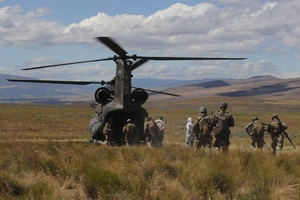
Military in D.F. Photo credit: ·júbilo·haku· / Foter.com / CC BY-NC-ND

Military in D.F. Photo credit: ·júbilo·haku· / Foter.com / CC BY-NC-ND

The meeting in December between recently re-elected President Barack Obama and President-elect Enrique Peña Nieto was marked by cordiality and a desire to talk about anything but the often grisly drug-related violence in Mexico during the previous six years.  Since then, Peña Nieto has continued the changed emphasis, aided by headlines pivoting to positive stories.  Mexico has been recently hailed for its economic growth, particularly in export-oriented manufacturing, and for a series of political compromises that The Washington Post favorably compared with the U.S. Congressional stalemate.  Despite optimistic claims from the government, Mexican media reports indicate that drug-related violence continues at nearly the same pace as last year.  (Click here for a summary and analysis by our colleagues at InSight Crime.)  Moreover, pressure is growing on questions of human rights violations committed in the name of the war on drugs.  When Presidents Peña Nieto and Obama meet again in early May, holding back a renewed focus on security is likely to be a challenge.

Peña Nieto’s political incentives do not point to the same, high-profile cooperation with the United States that occurred under President Felipe Calderón, who had already begun shifting priorities last year.  Despite the major turnaround signified by the PRI’s signing NAFTA almost 20 years ago, Peña Nieto’s PRI still contains elements more skeptical of U.S. “intervention” than Calderón’s PAN.  Materially, moreover, most of the U.S. aid planned under the Mérida Initiative has been disbursed, and Congress exhibits little appetite for major new appropriations.  (Even at its height, U.S. spending was a fraction of Mexico’s contribution to the drug war.)  That reduction, coupled with growing awareness that the Calderón strategy actually fueled violence, diminishes the enthusiasm in and outside of government for continuing his policies.   Frustration from the left in both countries regarding persisting human rights violations and the slow pace of judicial reform could also grow more serious.

While these problems may be causing tensions between U.S. and Mexican police and military at the operational level, they seem to be manageable so far – and both Presidents are likely to emphasize intelligence-sharing and similar bilateral cooperation that does not require resources.  Upper echelons of the Obama administration seem to understand that Peña Nieto’s push to de-emphasize security and promise to focus on violence reduction over drug interdiction is politically necessary.  But the moral argument has not changed:  Mexicans suffer the violent consequences spawned by U.S. drug use and counterdrug policies.  Weapons sold on the U.S. side of the border continue to flow into Mexico, an issue now atop the U.S. political agenda for entirely domestic reasons.  If the two countries can manage to keep security problems at a lower decibel, they will better cooperate on issues that are just as vital but could pay larger dividends — immigration, transboundary energy, educational exchange, and infrastructure.

Brazil’s Counternarcotics Policy Challenges

By Tom Long

Minister Alexandre Padilha meeting to discuss policies against crack | Photo by: Ministério da Saúde | Flickr | Creative Commons

Long a significant market for cocaine – the second or third largest in the world according to estimates – Brazil is suffering a major increase in crack cocaine use.  Visible in the centers of major cities, drug abuse has become a more serious national concern as Brazil prepares to mount the world stage as host of the 2014 World Cup and the 2016 Rio Olympics.  Brazil was slow to recognize the problem as it grew to epidemic levels, surpassing the United States as the largest consumer of crack cocaine, according to a recent report from the Federal University of São Paulo.  While national and local authorities have emphasized their recent approach to drugs as focused on public health – in contrast with the U.S.-led, supply-oriented policies – Brazil also has increased control and interdiction efforts.  According to the UN, cocaine seizures by Brazilian security tripled between 2004 and 2010.

The effort to control the flow of cocaine into and through Brazil will test both the country’s diplomacy and state capacity.  Its long, undefended and sparsely populated borders touch every major narcotics-producing and ­transiting country in South America, and cooperation in addressing the problem varies widely for political reasons and disparities in capabilities.  For example, the government of President Evo Morales in Bolivia has declined Brazilian requests for crossborder eradication, InSight Crime reported.  Other countries’ counternarcotics focus is almost completely internal, such as in Colombia and Peru.  As a result, Brazil is increasing action on its own.  President Dilma Rousseff supports plans to spend some $400 million on an expanded fleet of unmanned aerial vehicles, or drones, to provide surveillance of its borders.  Military patrols have increased, albeit in necessarily limited areas.

Experts have long warned that the “balloon effect” of counter-narcotics policies – when successful drug operations push the trade into less-defended countries and regions – was going to worsen the flow and use of narcotics in Brazil, and Brazil has long sought ways, within its resources, to collaborate.  When U.S.-Bolivia cooperation deteriorated in 2009-2010, for example, Brasilia tried to fill some of the void.  Brazilian diplomats have usually tried to lead quietly, build consensus, and avoid obvious pressure on neighbors.  However, as concerns grow, domestic politics could push Brazilian leaders to be more assertive, with the potential benefits and risks that would entail.  The challenge will be for them to find ways to collaborate on a common drug strategy with often skeptical neighbors while making gains to reduce internal demand.  Four decades of U.S. experience provide a cautionary tale.

A Nicaraguan Model for the Drug War?

Daniel Ortega | Photo by: Presidencia de la República del Ecuador | Flickr | Creative Commons

Bilateral tensions going back to the Cold War have obscured the value of counternarcotics cooperation between the United States and one of its least-favorite governments in Latin America – that of former Sandinista guerrilla and three-term Nicaraguan President Daniel Ortega.  The man who battled U.S.-funded proxies, the Contras, in the 1980s is now the most effective soldier against the drug trade in Central America, although Washington appears loathe to admit it and to imbue the cooperation with political good will.  However, while closer U.S. allies such as Honduras and El Salvador have seen levels of violence climb, Nicaragua remains relatively safe.  According to U.S. government estimates, Honduras (with vastly greater assistance) interdicted more cocaine than did Nicaragua in 2011 (22 v. 9 metric tons), seized one-tenth as much heroin (8 v. 86 kilograms) and arrested only half as many drug-related criminals (84 v. 168) – but had a homicide rate six times greater than Nicaragua.

Managua has achieved its relative success with an approach quite different from its neighbors’ –less costly in both dollars and bloodshed.  Compared to the flow of allegations about human rights violations committed by the Mexican security forces, Nicaragua’s record appears clean and citizens feel relatively confident providing information to the police.  Its armed forces have been involved in drug interdiction, focusing on coastal seizures, often in cooperation with the U.S. Navy.  But the backbone of Nicaragua’s strategy has been a series of local initiatives such as community policing.  These programs focus on “juvenile delinquency, education, and reintegration into society by gang members and other young offenders,” scholars noted in a recent special issue of the journal Policing and Society.  Nicaragua’s geography may be a factor as well.  The cartels’ main routes to Mexico are through the northern tier of the isthmus, and Nicaragua does not have the same sort of migration patterns that shaped Salvadoran gangs, as Insight Crime noted last year.

Scaling up Nicaragua’s local solutions to fit Mexico would be an immense challenge because of the disparity between the countries’ size and history.  But elements of Managua’s approach could be tried and adapted in neighboring countries, particularly its emphasis on community policing and anticorruption efforts that help gain citizens’ confidence.  Within Nicaragua itself, some observers argue that the government should do more to integrate its Afro-descendant Creole population into these supportive measures.  Currently, these Creole coastal communities bear much of the effect of military-oriented U.S.-Nicaraguan counternarcotics cooperation, without the social assistance to deal with the underlying problems in the region.  As the costs – and limits on effectiveness – of the full-frontal assault on cartels become ever clearer, Nicaragua’s relative success stands as an important reminder that other paths are possible.

U.S. Marijuana Vote Unlikely to Impact Mexico in Short Term

The following is excerpted from an article by InSight Crime* analyst Elyssa Pachico

Photo by: Editor B | Flickr | Creative Commons

Approval last week in Colorado and Washington state of measures allowing the recreational use of marijuana has fueled debate on whether legalization will reduce drug traffickers’ profits and the violence surrounding the illicit narcotics trade.  In both states, ballots passed with comfortable margins of 53 percent (Colorado) and 55 percent (Washington).  The measures legalize personal possession of up to one ounce of marijuana and allow the drug to be legally sold (and taxed) in licensed stores.  A similar initiative failed to pass in Oregon, gaining less than 45 percent of the vote.

A recent study by a Mexican think tank, the Mexican Institute of Competitiveness (IMCO), and Alejandro Hope (an InSight Crime contributor) found that passage of the initiatives in all three states would reduce the revenue of Mexican drug trafficking organizations by as much as 30 percent.  Hope has pointed out on Animal Político, a popular Mexican news site, that the impact will depend on the U.S. federal government’s response.  Attorney General Eric Holder strongly opposed such measures in 2010 when California residents voted on Proposition 19, but he did not issue strong statements this year.  The government’s response to last week’s votes has been muted; according to Reuters, the US Justice Department reacted to the measures by stating that its drug enforcement policy had not changed.

Mexico, a major supplier of marijuana, is unlikely to feel the impact of these measures for a while.  Parts of the Colorado measure will come into effect after 30 days, but the Washington measure will not take effect for a year.  But, over the long term, the votes indicate shifting attitudes towards marijuana prohibition in the United States – on the heels of similar shifts in Latin American countries eager to find alternatives to the current war on drugs.  The presidents of Guatemala, Mexico, and Colombia have emphasized the need for discussions, and Uruguay and Chile have considered their own marijuana legalization bills.  InSight Crime cautions, however, that the drug organizations have proved to be very adaptable in finding new sources of revenue – including methamphetamines, migrant smuggling, and even illegal mining.

Insight Crime is affiliated with American University’s Center for Latin American and Latino Studies, which produces AULABLOG.   Click here for the full text and additional links. 

Central America on U.S. Elections: A Shy Shadow

Photo by Norman B. Leventhal Map Center at the BPL’s | Flickr | Creative Commons

The U.S. election doesn’t seem to matter much for Central America.  Salvadoran President Mauricio Funes – speaking at an event with U.S. Ambassador Mari Carmen Aponte – publicly wished the “best of luck” to President Barack Obama, reflecting his close relationship with the American President.  At the Summit of the Americas in Cartagena last spring, Funes – along with Honduran President Porfirio Pepe Lobo – appeared to be Washington’s closest ally in the “war on drugs.”  This came after newly elected Guatemalan President Otto Pérez had raised the idea of legalizing marijuana, which Obama´s State Department has opposed fiercely.  Costa Rican President Laura Chinchilla slammed “the international community” – code for the United States – for pushing a policy in which only Central Americans died.  Nicaraguan President Daniel Ortega, while perhaps Washington’s most effective partner in counternarcotics, has resorted to old-school anti-U.S. rhetoric.  Panama is missing in action as a Central American voice.

The U.S. has two main interests in the subregion.  One is combating the drug trade, and the other, according to informed observers, is blocking the influence of Venezuelan President Hugo Chávez.  The U.S. Southern Command estimates that roughly 500 tons of cocaine enters the U.S. market through Central America, accounting for some 60 percent of U.S. consumption.  But there are very few clues in the American electoral narrative about either Obama´s or Republican contender Mitt Romney´s views on Latin America, not to mention Central America.  Romney´s Latin America advisors are perceived as the same hawks, with the same close ties to the Miami lobby, who dominated during the Bush administration.  Robert Zoellick, the fixer for the Central American Free Trade Agreement (CAFTA) in Washington some eight years ago, is also close to the GOP campaign and has been mentioned as a potential cabinet member, perhaps suggesting a push for some sort of second chapter of neoliberal reform.  To date there are no signs of fresh faces in the Obama camp, casting doubt as to whether a second-term State Department will be more open to out-of-the-box thinking.

This apparent estrangement comes at a time that the northern triangle of Central America – Guatemala, Honduras and El Salvador – is on a very dangerous path towards uncontrolled violence and even more weakened states. Neighboring countries are hardly in a position to help.  President Laura Chinchilla´s tenure in Costa Rica is fading rapidly toward lame-duck status, and Panamanian President Ricardo Martinelli is surrounded by corruption allegations.  For a second-term or incoming U.S. President, Nicaragua´s slippage on good-governance, despite the country’s economic tranquility, provides little political space for cooperation.  The next U.S. President will have no easy options in the most violent region of the world, which now faces, as Colombia did 20 years ago, a clear and present danger.  The absence of visible alternatives is probably a consequence of the fact that, since the Salvadoran Peace Accord ended the Cold War in Central America, Washington has not perceived much urgency to grapple with the fundamental political and economic challenges confronting the region.  Only by doing so will a new administration identify opportunities to move forward with a jointly articulated agenda.

U.S.-Honduras Counternarcotics Cooperation Stumbles

DEA Helicopter | by Andrew W. Sieber (Drewski2112) | Flickr | Creative Commons

Four months after the launch of Operación Anvil, a joint U.S.-Honduran counternarcotics effort, cooperation has stumbled.  Early in September, the United States suspended the sharing of intelligence – publicly characterized as mostly based on radar tracks – after the Honduran Air Force in July shot down two civilian aircraft suspected of trafficking drugs.  Citing the incident as a breach of a bilateral agreement that prohibits firing on civilian aircraft, State Department officials said they are reviewing procedures regarding cooperation.

The shootdowns were not the first controversial incident to raise doubts about the cooperation.  In May, a U.S.-Honduras counternarcotics operation in northeastern Honduras, during which at least one small boat was strafed, left four people dead and at least five injured.  While the raid targeted suspected drug traffickers in the vicinity, various reports have suggested that the victims were innocent locals or, at most, were spotters for traffickers.  Rather than undertake its own investigation, the U.S. Embassy in Honduras reportedly has deferred to a preliminary investigation by the Honduran authorities that showed no wrongdoing in the incident.  American and Honduran officials insist no American fired a weapon during the raid, but details of how the Honduran forces they were advising carried out the operation remain elusive.

The U.S. approach to counternarcotics in Honduras – like that in Colombia and Mexico – emphasizes military-style operations driven by U.S. intelligence tips.  In addition to sharing intelligence, the U.S. Drug Enforcement Administration and other U.S. entities provide training, equipment and on-site operational guidance to Honduran security units.  While the jury is out on whether this strategy has been worth the cost in human lives (60,000 in Mexico) and dollars (more than $7 billion in U.S. aid alone in Colombia), the case has not been made that it will work in a country plagued by weak institutions and corruption like Honduras.  Holding Honduran officials accountable and creating the vetted units upon which these military-style operations depend will be difficult in a small, desperately poor country in which the narco-dollar buys much more than U.S. aid channeled through officials in whom few have any confidence.  Efforts to create vetted units capable of operating securely (and without abuses of authority) have failed in the past because of unseen and unsolved links between the state officials and the narcos.  The Honduran people – still suffering from political violence born of the coup of June 2009 – have legitimate fear of a massive surge in drug violence.   The U.S. government, ever optimistic about the renewal of cooperation, has asked that Honduras put in place remedial measures to prevent future incidents.  President Lobo of Honduras has since replaced his Air Force commander, but the question remains whether Tegucigalpa can – and should – become a cornerstone of U.S. antidrug strategies.

Honduras Adopting Failed Counternarcotics Model?

The rapid escalation of operations by U.S. and Honduran military and counterdrug teams against suspected drug-traffickers transiting Honduras suggests that Washington has persuaded Tegucigalpa to follow Mexico’s footsteps with a predominantly military strategy against the cartels.  The New York Times has published reports on the deployment of binational teams – patterned after U.S. operations in Iraq and Afghanistan – in remote areas of Honduras to disrupt clandestine aircraft dropping off Colombian cocaine for shipment by river to the north coast and then northward to the United States.  The aircraft, weapons, advisors, trainers, and intelligence used by the “Tactical Response Teams” are all provided by Washington.  U.S. Ambassador Lisa Kubiske said the Honduran units are “eager and capable partners in this joint effort.”

The units claim to have intercepted tons of cocaine, but the operations have also stirred up controversy.  In one operation near the northeastern town of Ahuas in May, a response team killed four citizens, including two pregnant women.  Although the circumstances of the victims’ presence in the area are not entirely clear, the mayor has protested the U.S.-inspired tactics, and local indigenous groups issued a statement that “declared these Americans to be persona non grata in our territory.”  One June 23, a DEA agent shot and killed a man during a raid in northern Honduras when the suspect reportedly pulled a gun on him.

This military-intensive strategy has yielded some 60,000 dead in Mexico – with negligible impact on cartel operations – and in Honduras, where institutions are much weaker, the violence probably will be proportionally even higher.  The U.S. Ambassador’s confidence in Honduran units notwithstanding, the military’s human rights record – never stellar – has steadily worsened since the coup that removed President Manuel Zelaya in June 2009.  Vetting units and keeping them clean when institutions are so weak and vulnerable to corruption and protecting operatives’ identities in Honduras’s “small-town” society all argue for an approach different from that which has failed in Mexico.

Mexico Elections: Change Ahead in Cooperation with the U.S.?

Photo by: World Economic Forum via Flickr, using a Creative Commons license.

News media are generally predicting a relatively comfortable margin of victory for PRI candidate Enrique Peña Nieto over PRD candidate Andrés Manuel López Obrador and the ruling party PAN’s candidate Josefina Vázquez Mota in Presidential elections next Sunday.  Polls give the PRI candidate (44 percent) a big lead over the PRD (28 percent) and the PAN (25 percent.)

Compared to the weight of Mexico’s problems, the campaign has been light on issues.  Both the PAN and PRI have made vague pledges of continued cooperation with the United States in efforts against the drug cartels.  While current President Calderón’s approach to drug-related violence has resulted in no discernible improvement in security – indeed, some 60,000 people have died since he launched his military-intensive strategy – both Peña Nieto and Vázquez Mota have pledged to triple the Federal police (Vázquez) and create a paramilitary gendarmerie of 40,000 (Peña).  López Obrador has focused on jobs, services, and social issues.

Whoever wins the election, Mexico-U.S. relations do not appear likely to return to the mutual suspicion and tension of years past.  Neither of the three main parties seems overly dependent on nationalism – and anti-gringoism – for political support.  But the bloom is certainly off the much-vaunted U.S.-Mexico “co-responsibility” in the struggle against the cartels, and the next Mexican president almost surely is going to press for an end to the bad deal Mexico gets in the relationship  – the U.S. provides guns and intelligence, and tens of thousands of Mexicans die as drugs flow to eager American consumers.  Calderón’s successor probably will press Washington to prosecute the “war on drugs” in the United States, where the cartels’ footprint is huge, their operations are audacious, and they freely buy thousands of weapons smuggled southbound to kill Mexicans.  Whichever candidate is elected to the U.S. Presidency in November, next year will be a watershed during which the U.S. can either demonstrate a consequential commitment to co-responsibility – by pursuing the cartels in the United States and stanching the flow of guns and bulk cash into Mexico – or Calderon’s successor will unilaterally curtail cooperation.