Guatemala: One Step Forward, Two Steps Backward?

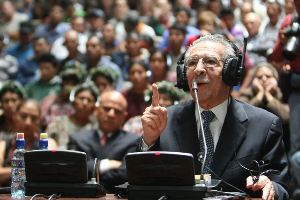
Efrain Rios Montt testifying at his genocide trial | Photo by the Guatemalan government | public domain

Efraín Ríos Montt testifying at his genocide trial | Photo by the Guatemalan government | public domain

The decision of Guatemala’s highest court to overturn the guilty verdict in the trial of former dictator Efraín Ríos Montt – found guilty of genocide and crimes against humanity – has raised serious questions about whether, as many had hoped, the country’s elites will ever allow justice, national reconciliation, and democracy to move forward.  What was a clear victory for many in and outside of Guatemala has evolved into a massive setback, at least for now.  For the victims and survivors of the atrocities, the trial was the first time that their tragic stories got an open and respectful hearing.  For the noble prosecutors and judges who pursued the case despite personal risk and beat back repeated maneuvers by Ríos Montt’s defense team to derail proceedings, it was a solid validation of their commitment to build rule of law.  For Guatemalan society, it meant unprecedented public discussion of the past – and the symbolism of the condemned dictator being taken away by bailiffs promoted closure.  For the international community, it proved that persistence could help a country with chronically weak and politicized institutions become the first in the world to put a former head of state on trial for genocide.  But now the outcome is cloudy.

From the beginning, the long-term impact of the trial would depend on the followup.  Immediately after the verdict was issued, President Pérez Molina, a former military commander, set aside his vehement denials that genocide occurred and said he respected the court’s verdict.  But he conditioned issuance of an official government apology, as ordered by the court, on the exhaustion of all defense appeals – which could take years – and was noncommittal in responding to the court’s call for more investigations of people involved in the atrocities.  While he personally has immunity from prosecution, allegations of his own activities during the Ríos Montt period would obviously be problematic for him.  The powerful business organization CACIF, long aligned with the military, rejected the verdict and began mobilizing resistance to further investigations.  Even moderate politicians, such as former Vice President Eduardo Stein, criticized the genocide ruling and calls for more investigations, apparently fearing that more ethnic groups will stake claims.  Like other dictators facing justice, Ríos Montt has already suffered a supposed health problem requiring that he be moved out of prison and into a military hospital – leaving observers wondering how much of his 80-year sentence he would serve.

The U.S. Government supported the trial process and proclaimed it a victory for Guatemalan judicial institutions.  But it appeared cautious on next steps even before the upper court overturned the verdict (on which U.S. comment is lacking).  Ambassador at Large for War Crimes Issues Stephen J. Rapp who visited Guatemala last month and gave the trial a push, and U.S. Ambassador to Guatemala, Arnold Chacon, attended some proceedings.  The U.S. Embassy pledged its continued support to “credible, independent, transparent, and impartial judicial processes,” but its statement also suggested a lack of enthusiasm for more.  “In these moments it is significant to remember that Guatemala, as a country, was not on trial, but rather two individuals, one of whom was absolved and the other convicted,” it said.  It added that “now is the opportunity to advance to real reconciliation” – a prospect that appeared premature even before the upper court action.  Neither the prosecution nor defense spoke much during the trial of Washington’s direct or indirect role in the 1980s violence – a situation that U.S. policymakers may prefer to continue.  If so, it’s a far cry from the position taken by President Bill Clinton, who during a visit to Guatemala in 1999 apologized for American support for security forces that committed “violent and widespread repression.
Is the Truth Finally Arriving in El Salvador?

By Héctor Silva Ávalos

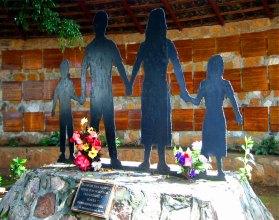
Memorial of massacre site at El Mozote, Morazan, El Salvador | By Efrojas | Wikimedia Commons | public domain

Memorial of massacre site at El Mozote, Morazan, El Salvador | By Efrojas | Wikimedia Commons | public domain

A U.S. court is on the verge of making a major contribution to El Salvador’s struggle to end impunity.  A former Salvadoran military commander six weeks ago admitted in a Miami immigration court that his troops had engaged in human rights violations and extrajudicial killings in the 1980s.  More significantly, he confirmed that the U.S.-trained and -funded Atlacatl Battalion was responsible for the horrendous massacre at El Mozote, a hamlet in which the elite Marine-style battalion killed an estimated one thousand peasants, mostly women and children, over three days in December 1981.  Until recently, current and former military commanders claimed that reports of the bloodbath were communist propaganda.  In his defense, General José Guillermo García, who was defense minister, said he was unaware of the soldiers’ actions at the time.  The judge responded skeptically, saying García “didn’t do what a military officer respectful of the law should have done in order to fully serve his country and his people.”

The General’s confession is no small matter.  An Amnesty Law passed in 1993, pushed by allies of the war-era government, put the lid on many investigations.  Its passage kept two mid-ranking officers convicted of involvement in the 1989 Jesuit massacre from serving their prison sentences, and it paved the way for other military and civilian leaders to cover up that atrocity. The air of impunity has endured for 20 years.  General García’s testimony provides the first real open window for Salvadorans to start learning about what happened despite strong efforts to keep the truth under wraps.  The political and economic elites’ defense of the Amnesty Law has focused on the argument that El Salvador should not be confronting its past if it really wants reconciliation and peace.  But two decades after the peace accord brought the end of the war, that kind of thinking is beginning to fade, and will continue to wane as Salvadoran society is confronted with the naked truth, the naked horrors.

The Obama Administration deserves some credit for advancing the legal case against García and a former colonel facing similar immigration charges in Boston, Inocente Orlando Montano.  Both processes have been encouraged by a U.S. policy of locating and ousting foreigners on U.S. soil who have been credibly accused of human rights violations abroad.  However ironic it is that some of the violations were committed by units receiving U.S. assistance, Washington is promoting an important lesson:  generals who once held in their hands power over citizens’ lives and deaths become common defendants – criminals – when the truth is known.  The impunity enjoyed by the colonels and generals – and their civilian sponsors – has grown roots in Salvadoran institutions and still feeds today a culture of obscurity, injustice and inequity that prevents the country’s progress towards development and modernity.  This vicious cycle will not will not end until they are held accountable.

Read the full text of this essay.

Religious Responses to Violence in Latin America

By Alexander Wilde, CLALS Research Fellow

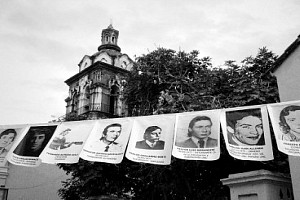
Commemoration of those killed in the 1980's at a church in Cordoba, Argentina | By: Pablo Flores "pablodf" | Flickr | Creative Commons

Commemoration of those killed in the 1980’s at a church in Cordoba, Argentina | By: Pablo Flores “pablodf” | Flickr | Creative Commons

Latin America today is one of the world’s most violent regions. It has been so for 50 years, although the character and agents of violence have changed considerably over time. The “old violence” of the 20th century was largely political, associated with revolutionary insurgencies and repressive regimes that systematically violated fundamental human rights. The “new violence” is largely criminal – illegal drug traffickers and urban gangs are among the leading perpetrators – but its consequences in many societies have been comparably lethal. Countries such as Honduras, El Salvador, Guatemala, Venezuela and Colombia have among the highest murder rates in the world.  “Citizen security” is a leading issue in politics throughout the region.

Religion played a significant part in confronting the old violence.  Human rights became a new cause for the Catholic Church, which in some cases helped legitimate peace settlements and democratic transitions. In the generation since then, Latin American Christianity has been transformed.  Evangelical and Pentecostal churches have achieved unprecedented growth. Catholicism has been reined in by Rome to curb the influence of Liberation Theology. More pietistic and spiritually-oriented theologies have flourished within both traditions. The result has been a tendency to turn away from the “political” ministries of the past – defending human rights and promoting social justice. The Christian churches, it is widely believed, have failed to address the widespread violence of today.

Fresh research, however, is revealing ways in which – although less visible at the national level – they remain a vital force in violence-plagued societies. A two-year project at American University has produced studies of religiously based shelters for Central American migrants in Mexico, a 15-year Jesuit program of peace building and development in Colombia, and an Evangelical prison ministry in Rio de Janeiro, among a dozen pieces of new research. They identify particularly the significance of an active church presence among poor and marginalized populations, who suffer disproportionately from violence. This “accompaniment” appears to be motivated by Biblically-based beliefs about Christian love, the redemptive power of God and the direct experience of living with these populations in perilous, threatening conditions. Another emerging theme in project research is the potential significance of supportive national and international allies – who clearly contributed to the defense of human rights in the past and remain important in our changed, globalized world.

Violence in Latin America today reflects the wrenching changes these societies have undergone in the last half-century, and religion has been a dynamic dimension of those changes. In the region’s civil societies and the lives of its citizens, Catholic and Evangelical Christianity remains a potent and creative presence. Where it is willing to work and live in situations of conflict and violence, it could find a new role in bringing about more stable, peaceful and just societies.

Gay Rights Amidst Uneven Cultural Change

The lower chamber of Uruguay’s legislature passed a bill legalizing gay marriage on December 12 that is expected to sail through the Senate. The law, which polls show is supported by a majority of Uruguayans, comes just two months after the country legalized abortion.  Even for Uruguay, long seen as among Latin America’s most progressive and democratic countries, these measures represent a major shift in social attitudes.

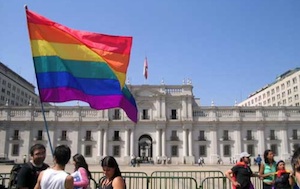
MUMS Movimiento de la Diversidad Sexual | Flickr | Creative Commons

MUMS Movimiento de la Diversidad Sexual | Flickr | Creative Commons

Writing in the Journal of Democracy, Bard College political scientist Omar Encarnación argues that the 2005 legalization of gay marriage by Spain’s socialist government was a model for activists and legislators across Latin America. Transnational networks with ties in these cities have led the charge, using human rights language and gaining support from human rights organizations. Evidence in support of his argument is growing:  the city of Buenos Aires and later all of Argentina legalized gay marriage in 2002 and 2010 respectively, as did Mexico City, in 2012.  Where legislatures have not acted because of opposition from religious or other groups, activists have appealed to courts, earning recognition of important civil rights for gay couples in Brazil and Colombia. Progress in the ALBA countries, Chile, and Central America has been more limited still.  Honduras banned gay marriage in 2005. Discrimination, both legal and de facto, remains an issue.

The changes in Uruguay and elsewhere indicate the need for an updated map of Latin America that reflects widely differing approaches to social issues.  Secularism is an emergent force in global metropolises such as Mexico City, Buenos Aires, and São Paulo, and the Catholic Church’s dominant role in the region’s social policy and politics has diminished considerably.  But the decline in the Catholic Church’s power to block gay rights does not mean a continued shift in social norms is inevitable.  Evangelical faiths have exploded in parts of the continent, many of them even more conservative than the Catholic Church in opposing gay rights. Moreover, in countries that lack the strong transnational human rights networks of Argentina and Colombia, activists have fewer tools at their disposal.

Ecuador’s Difficult Choice on Assange

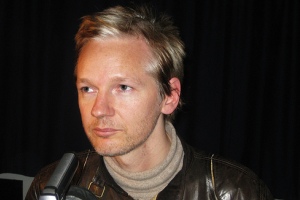
Photo: Julian Assange by Ben Bryan (bbwbryant) | Flickr | Creative Commons

Many observers have portrayed President Rafael Correa’s decision to grant asylum to Wikileaks founder Julian Assange as an act of defiance – a gratuitous slap at the United States – and, because of Correa’s mixed record of respect for a free press, as a sign of hypocrisy.  How can a President who has prosecuted newspapers for revealing damaging information about his government, according to Correa’s accusers, now stand up as the defender of Assange’s right to publish hundreds of thousands of sensitive U.S. Government documents?

The lack of clarity on British and Swedish intentions made the decision difficult.  American officials have minced no words about their hopes to prosecute Assange, although none has stated what the charges would be.  Even U.S. Vice President Joe Biden has referred to him as a “high-tech terrorist.”  Former Republican presidential nominees Sarah Palin and Mike Huckabee have called for his execution.  (A former senior Canadian official said, “I think Assange should be assassinated.”)  The Swedish government, which seeks only to question Assange about allegations of sexual abuses (important offenses in Swedish law), has refused to conduct the interrogations in London or by video, or  to provide reassurances that he will not be extradited to the United States.  British officials at one point even threatened to enter the Ecuadoran Embassy in London, a flagrant violation of well-established principles of international law.

Correa’s ancillary agendas notwithstanding, the asylum decision would have been difficult for almost any country.  There is no evidence that Assange would not get a fair trial in the United States or that he would face the sort of abuse and torture that Bradley Manning – the alleged American source of the Wikileaks documents – has faced.  But the American silence on the charges Assange might face, the rhetoric tarring him as a terrorist and the lack of U.S. accountability for past abuses – the Obama Administration last week announced yet another decision to forego prosecution of U.S. officials involved in alleged torture – makes the absence of a pledge regarding extradition to the United States politically sensitive.  Ironically, the U.S., British and Swedish position risks thrusting them into the same ironic contradiction as Correa finds himself:  claiming to protect human rights, they may open the door to prosecution of a man who published leaked information – and who by any reasonable standard is an indiscriminate whistle blower but hardly an agent of espionage.  If their pursuit of Assange were to result in his exposure to U.S. prosecution related to the Wikileaks matter, these democracies would potentially risk being parties to a serious violation of fundamental principles of free expression.

Honduras Adopting Failed Counternarcotics Model?

The rapid escalation of operations by U.S. and Honduran military and counterdrug teams against suspected drug-traffickers transiting Honduras suggests that Washington has persuaded Tegucigalpa to follow Mexico’s footsteps with a predominantly military strategy against the cartels.  The New York Times has published reports on the deployment of binational teams – patterned after U.S. operations in Iraq and Afghanistan – in remote areas of Honduras to disrupt clandestine aircraft dropping off Colombian cocaine for shipment by river to the north coast and then northward to the United States.  The aircraft, weapons, advisors, trainers, and intelligence used by the “Tactical Response Teams” are all provided by Washington.  U.S. Ambassador Lisa Kubiske said the Honduran units are “eager and capable partners in this joint effort.”

The units claim to have intercepted tons of cocaine, but the operations have also stirred up controversy.  In one operation near the northeastern town of Ahuas in May, a response team killed four citizens, including two pregnant women.  Although the circumstances of the victims’ presence in the area are not entirely clear, the mayor has protested the U.S.-inspired tactics, and local indigenous groups issued a statement that “declared these Americans to be persona non grata in our territory.”  One June 23, a DEA agent shot and killed a man during a raid in northern Honduras when the suspect reportedly pulled a gun on him.

This military-intensive strategy has yielded some 60,000 dead in Mexico – with negligible impact on cartel operations – and in Honduras, where institutions are much weaker, the violence probably will be proportionally even higher.  The U.S. Ambassador’s confidence in Honduran units notwithstanding, the military’s human rights record – never stellar – has steadily worsened since the coup that removed President Manuel Zelaya in June 2009.  Vetting units and keeping them clean when institutions are so weak and vulnerable to corruption and protecting operatives’ identities in Honduras’s “small-town” society all argue for an approach different from that which has failed in Mexico.