Latin America: Evangelical Churches Gaining Influence

By Carlos Malamud*

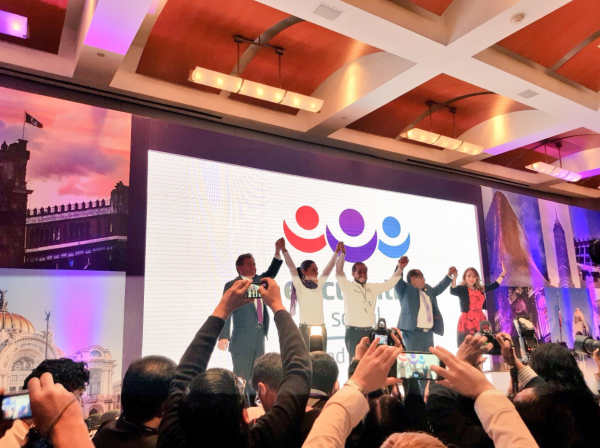
Five people stand up in front of a screen with their arms raised

The evangelical political party Partido Encuentro Social (PES) held a rally earlier this month in Mexico City. / Twitter: @PESoficialPPN / Creative Commons

The line between religion and politics is getting increasingly blurred in Latin America as evangelical churches grow in strength and candidates try to curry the support of – or at least avoid confrontation with – the faithful.  Tensions over mixing religion and politics have historic roots in Europe and Latin America and persisted throughout the 20th century, but we are witnessing a new phenomenon in Latin America now.  In much of the region, evangelical churches are showing an increased political presence and institutional representation in partisan politics.

  • In Mexico, the secular Movimiento de Regeneración Nacional (MORENA) and the Partido del Trabajo (PT) have struck an alliance with the evangelical Partido Encuentro Social (PES) to back presidential candidate Andrés Manuel López Obrador. Guatemalan President Jimmy Morales is an evangelical, and Costa Rica – if current polls prove correct – could soon have Fabricio Alvarado, an evangelical pastor, as President.  In Brazil, presidential aspirant Jair Bolsonaro has been building popular support by, among other things, appealing to the an evangelical base, even though most Brazilian evangelical churches aren’t reaching for executive power but rather support parties concentrated on building local, provincial, and congressional influence.
  • The evangelical churches’ membership has grown steadily but unevenly in recent decades. About 20 percent of all Latin Americans are evangelicals.  In Mexico, they account for more than 10 percent of the population.  In Peru, Ecuador, Colombia, Venezuela, Argentina, and Panama, observers estimate more than 15 percent.  In Brazil and Costa Rica, the number reaches 20 percent, while in Guatemala, Honduras, and Nicaragua it surpasses 40 percent.

The evangelical churches’ political agenda is centered on defense of family values – basically opposition to abortion, same-sex marriage, divorce, euthanasia, and what they erroneously call “gender ideology.”  On these topics on certain occasions, there’s a striking convergence with the Catholic hierarchy, Social-Christians, and conservative parties.  The evangelicals do not usually take positions, however, on other issues in which the government has a strong role, such as the economy or international relations.

The evangelical phenomenon reflects a double dynamic:  the unstoppable surge in non-Catholic faithful poses an enormous challenge for the region’s deeply rooted bishops conferences, and the growing distrust for political leaders and parties has facilitated the emergence of new options, including evangelicals, with barely articulated platforms.  The faithful who profess the tenets of evangelicalism are disciplined, and pastors’ positions have a lot of influence over them.  Even if not linked directly to candidates through the parties, voters’ evangelical affiliation and their churches’ recommendations have a strong influence over them.  The evangelical vote, moreover, is highly desired by all candidates and at least indirectly influences campaigns.  Candidates in Colombia, Brazil, or Mexico, as in other Latin American countries, are making that increasingly obvious as elections approach.

March 20, 2018

*Carlos Malamud is Senior Analyst for Latin America at the Elcano Royal Institute, and Professor of Latin American History at the Universidad Nacional de Educación a Distancia (UNED), Madrid.  A version of this article was originally published in El Heraldo de México.

Brazil: Growing Federal Role in Security

By Marcus Rocha*

A man in a military uniform and a man in civilian dress shake hands

Brazilian President Temer (right) and General Villas Bôas (left) shake hands. / Romério Cunha / Flickr / Creative Commons

Brazilian President Temer is increasing the armed forces’ role in security matters, especially in Rio de Janeiro, in what appears to be a populist measure to increase his odds in the October election should he decide to run.  Although General Villas Bôas, commanding general of Brazilian Army, has cautioned about the limitations on the military’s ability to carry out civilian security operations, the Army has generally accepted the mission and used it as pretext for more funding and more legal protection from prosecution.  Governments have increased the use of the Armed Forces for security in Rio on a number of occasions in the last 26 years, including during international conferences, a Papal visit, and surges in drug violence in the favelas.  Preparing for the 2014 World Cup and 2016 Olympics, then-President Dilma Rousseff also favored using the military over state police for many security functions.  Military units have usually operated under Decretos de Garantia de Lei e Ordem to circumvent Constitutional prohibitions on their role in civilian policing.

  • This approach has been criticized for both its fiscal and human costs. During a 15-month period beginning in 2014, when the Armed Forces occupied Favela da Maré (a group of 16 communities in Rio), the operation used 85 percent of both the military personnel and of the $200 million budget used during Brazil’s 11 years of involvement in Haiti peacekeeping under MINUSTAH.  Violations against slum residents were reported, and polls showed that most of the inhabitants of Maré did not feel safer with the Army in the streets.
  • Congress last year approved a law initially proposed in 2003 allowing cases of civilians killed by the military in such operations to be tried in special military courts – fueling popular concern that the extra protections for troops would give them a “license to kill.” Army commander Villas Bôas had lobbied for the law.  The internal security mission gives the military leverage for resources, but generals acknowledge that soldiers aren’t trained to deal with security in urban areas.  Villas Bôas has said publicly that his forces “don’t like this kind of deployment”; are concerned it hurts their image; and lament that affected areas return to status quo after they depart.  Villas Bôas has spoken also of “fears of the contamination” of troops by organized crime.

Temer’s moves go beyond his predecessors’ in that federal authority, rather than supplementing local officials, is subordinating them for the first time under the 1988 Constitution.  The interventor assumes the governor’s authority for the entire state’s security, with power to command both civilian and military units.

  • Temer has also announced the creation of a new Ministry of Public Security focused only on security – an issue normally under the states’ exclusive purview. While the ministry would provide more federal funds and coordination to anticrime initiatives, specialists note that the move also would give the President increased influence over the anti-corruption investigations that have rattled his Administration (among many others).  The Brazilian Federal Police, now under the Ministry of Justice and widely speculated to move to the newly created Ministry, is a key player in the years-long Lava Jato  Temer’s announcement has prompted fear – including among Lava Jato investigators, according to press – that changes in the chain of command could undermine efforts against corruption under the guise of focusing the resources in public security.

Temer’s actions suggest greater concern about polls than improved security.  With national elections just seven months away, he has single-digit approval ratings and has been unable to push through signature initiatives, such as pension reform.  Of the three top concerns in the polls – health care, corruption, and security – he has chosen the latter as the centerpiece of his agenda for the election, even though he has said he will not run.  Temer may find confirmation of his strategy in a drop in the crime rate during Carnival this month, but the use of the Armed Forces against drug-trafficking, organized crime, gangs, and other security challenges has proved dubious at best in Colombia, Mexico, and elsewhere.  In Rio de Janeiro, mafias made up of former Army, civilian police, and firemen dominate the drug trade and even services like gas, light and cable TV.  The increased use of the military also has potentially profound consequences for human rights, military professionalization, the development of civilian institutions, and the broader embrace of rule of law.  Increased federal intervention in Rio and elsewhere responds to short-term political interests with long-term outcomes that will only make things worse.

February 26, 2018

*Marcus Rocha is a CLALS Research Fellow.

Brazil: Lula’s Conviction and Electoral Reforms Stirring Up Presidential Race

By Paulo Castro*

Large room in with many people at desks

Brazil’s Chamber of Deputies. Presidential candidates’ TV and radio time in the upcoming 2018 election will be proportionally determined by the number of seats they hold in the Chamber. / Edilson Rodrigues / Agência Senado / Flickr / Creative Commons

Already overshadowed by the Lava Jato corruption investigations, Brazil’s preparations for general elections in October are likely to take place amid rising tensions – and perhaps even some violent protests.  Early campaign maneuvering intensified last month when a regional federal court raised obstacles to former President Luiz Inácio “Lula” da Silva’s candidacy, and electoral reforms passed in 2015 promise to fuel further disruption as election day approaches.

  • Lula’s appeal to overturn his conviction on corruption and money laundering charges was rejected by the Regional Federal Court in Porto Alegre (TRF-4). The ruling does not automatically knock him out of the race, but it drastically decreases his chances of running in October.  His best hope at this point lies with the Federal Supreme Court (STF), which has the power to overturn the regional court’s ruling.  This is very unlikely, however, because (i) a recent change in the Supreme Court’s interpretation of the law allows a defendant to be arrested if the original conviction is confirmed ; (ii) STF Chief-Justice Carmen Lúcia, who unilaterally has the power to set the Court’s agenda, has stated clearly that “overturning the Federal Court’s ruling against Lula would undermine the Supreme Court”; and (iii) the Clean Record Act (Lei da Ficha Limpa) prevents candidates from running for public office for eight years if they have been convicted by a second instance court such as the TRF-4.
  • The campaign climate is also affected by changes brought about by the electoral reforms of 2015, which reduced the campaign period from 90 to 45 days (with TV/radio time reduced from 45 to 35 days) and barred corporate donations to campaigns. These changes are likely to shift the balance in favor of traditional political leaders who already have national name recognition and have more influence inside their parties to get the few resources available.

Lula’s likely disqualification and the reforms have thrown the parties, especially his Workers Party (PT), into uncharted territory.  After 30 years of internal deal-making with his “mystical” name at the center, the PT will have to produce new political leaders and policy platforms.  For all parties, reduced financial resources and less TV time will increase the role of “politics as usual.”

  • TV and radio time is allocated in proportion to the parties’ representation in the Lower House of Congress, so candidates will need a strong party’s support to build a competitive candidacy. This suggests that the rise in the polls of Jair Bolsonaro – an Army reservist and congressman with a penchant for populist, authoritarian rhetoric – doesn’t necessarily make him a strong candidate; the small party under whose banner he’s running controls only 3 of 513 seats in the Chamber of Deputies. The center and center-right parties, such as PMDB and PSDB, will also have an advantage because in 2016 they elected the highest number of mayors, who can bring additional resources to bear.

 The final outcome of the Lula case and implementation of the reforms could ignite further political instability.  Lula’s arrest could very well spark a new wave of demonstrations, with possible violence.  Lacking resources, Bolsonaro – who has already advocated military intervention in civilian political affairs – will try to rally right-wing groups behind his candidacy.  Combined, these opposing movements create a dangerous political landscape that brings both sides of the spectrum to doubt the capacity of democratic institutions.  A recent survey by Latinobarometro already shows that only 13 percent of Brazilians are pleased with the current state of their democracy.  Perceptions that the Judiciary has been excessive in the Lula case and that election laws have only empowered traditional (and corrupt) forces are likely to feed into the sort of authoritarian rhetoric Bolsonaro espouses and cause turmoil that harms the overall confidence on Brazil’s democracy.

February 9, 2018

* Paulo Castro is Ph.D. Candidate in Political Science at the University of Brasilia, where he is focusing on the political actions of the Brazilian Supremo Tribunal Federal.  He has worked as an advisor and analyst in the Ministry of Justice and private sector organizations.  He is also a CLALS Research Fellow.

Ecuador: Referendum Marks Critical Juncture for Moreno and Correa

By John Polga-Hecimovich*

Two men sit at a table with a yellow background

Current President of Ecuador Lenín Moreno (left) and ex-President Rafael Correa (right) during the presidential transition last spring. / Micaela Ayala V / ANDES / Flickr / Creative Commons

A national referendum in Ecuador this Sunday appears likely to give a boost to President Lenín Moreno in his political struggle against his predecessor, Rafael Correa (2007-2017).  The central item on the seven-question ballot will be whether or not presidential term limits should be reinstated into the Constitution – an initiative that Correa, who would like to run for a fourth term in 2021, is campaigning against.  The country appears poised to move on from the thrice-elected yet polarizing Correa to the more conciliatory Moreno; at the time of writing, citizens resoundingly endorse all seven referendum questions, with no question polling lower than 66 percent approval.  A “yes” vote on term limits would end Correa’s future presidential aspirations and position Moreno – Correa’s hand-picked successor – as the standard bearer of the political left in Ecuador.

  • The feud between Moreno and Correa – and within their ruling Alianza PAIS (AP) party – has been building for nearly a year and a half. Last November, one of Moreno’s closest advisors, Eduardo Mangas, alleged in a leaked recording that Correa hoped Moreno would lose the election.  Correa purportedly provided no logistical or financial support for his chosen successor while saddling him with the deeply unpopular Jorge Glas as running mate.  According to Mangas, Correa preferred that AP lose the presidential election and instead govern through its control of the vast state bureaucracy and National Assembly – with Correa returning to the presidency in 2021.  Eking out a narrow victory (51.6 percent against Guillermo Lasso’s 48.8 percent), Moreno upended this plan.
  • The morenista and correista factions have divided the AP since Moreno took office in May 2017. Vice President Glas, a Correa ally accused of taking $13.5 million in bribes from the Brazilian construction firm Odebrecht, was sentenced to six years in prison and impeached as part of Moreno’s campaign against corruption.  The AP Secretary, a correista assemblywoman, tried to remove Moreno as party head after he alleged the party put a hidden camera in his office.  Correa and 28 legislative deputies have left the party and formed what they are calling the “Citizen’s Revolution Party.”

Moreno took office facing a polarized political environment and daunting fiscal deficit and weak GDP, but his sound policies and astute political strategy have given him the highest approval ratings in Latin America.  His focus on the popular valence issues of corruption and re-election – about which citizens will usually share a common preference regardless of ideology – has also helped distract voters from the tepid economy.  The referendum is a particularly smart gambit.  It proposes seven different changes that would reverse actions taken during Correa’s rule – and that happen to enjoy broad popular support.  Instead of trying to push them through established institutional channels staffed with correistas, like the National Assembly or the courts, the President is turning directly to the public to give the measures legality.

Absent any bombshell announcements or drastic changes in public opinion, Moreno looks set to coast to victory in the referendum, quite remarkably establishing him as the country’s most powerful politician.  However, he faces a number of challenges to governance over the remainder of his four-year term.  The defection of Correa and his faction from Alianza PAIS left him with only 46 seats in the 137-member National Assembly.  This means Moreno’s bloc will continue to depend on ephemeral voting alliances with the center-right to govern – exactly like much of the 1979-2006 period when no popularly elected president finished his term.  Moreover, after 2.7 percent GDP growth in 2017, the IMF predicts that Ecuador’s economy – vulnerable because of its dependence on oil exports – will grow by only 2.2 percent in 2018 and 1.7 percent in 2019.  Moreno should enjoy his victory on Sunday, but he will soon face challenges greater than Rafael Correa: long-term governance in a country that has long proven averse it.  Whether he is up to the challenge remains to be seen, although he has so far proven resourceful.

February 2, 2018

*John Polga-Hecimovich is an Assistant Professor of Political Science at the US Naval Academy.  The views expressed in this article are solely those of the author and do not represent the views of or endorsement by the Naval Academy, the Department of the Navy, the Department of Defense, or the US government.

Costa Rica: Anything is Possible in Upcoming Elections

By Carlos Malamud*

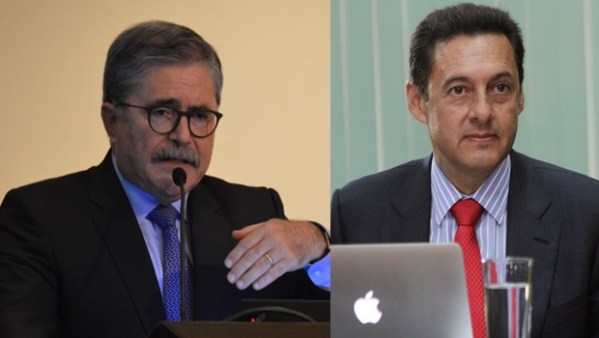
Two boring men look out into space

The apparent front-runners in the Costa Rican presidential election, Juan Diego Castro (left) and Antonio Álvarez (right). / Wikimedia, edited / Luis Madrigal Mena (left) / MadriCR (right) / Creative Commons

In the run-up to Costa Rica’s presidential and legislative elections on February 4, the words “uncertain” and “uncertainty,” “volatility,” and “surprise” are crowding out all others.  Since current President Luis Guillermo Solís’s unexpected victory in 2014 marked the end of two-party domination – in which power was shared by Liberación Nacional (PLN) and the Partido Unidad Social Cristiana (PUSC) – fragmentation has deepened.  Today there are 13 candidates for President and a heightened number of undecided voters.  Alongside the many who don’t know who they want to vote for, there are others, including many liberacionistas, who do not want to reveal their support for other candidates.  The country is in a scenario in which anything can happen.

  • According to most polls, former Minister of Justice and Security Juan Diego Castro (of the minority Partido Integración Nacional, PIN) and Antonio Álvarez (of the PLN) are practically at a technical tie. Castro’s campaign has focused on combating corruption, an issue of steadily growing concern to Costa Ricans, and the threat posed by gangs.  Close behind are Rodolfo Piza (PUSC) and evangelical candidate Fabricio Alvarado (Restauración Nacional).  The latter’s support surged last week when he denounced a decision by the Inter-American Human Rights Court accepting same-sex marriage.  It’s unclear whether any of the candidates’ issues have lasting support or only an ephemeral presence on the electoral agenda.

Since these four top candidates each have about 15 percent of the vote so far, it will be difficult for any to reach the 40 percent necessary to avoid a runoff.  The two strongest – Álvarez and Castro –also have strong negatives.  If, as seems most likely, the undecided and the “hidden vote” do not give one candidate or other a clear victory, there will be a second round between the top two vote-getters on April 1 (Easter Sunday).  Polls also show that many voters see Piza as the best “second option.”  For that reason, the results of a second round of voting are also difficult to predict.

Insofar as Costa Rica was the exception in Central American or even Latin American politics in the past, things have changed very rapidly.  Its distinction in the 1960s and 1970s as one of only four countries without military dictatorships (along with Colombia, Mexico, and Venezuela) has faded into different clichés.  The lauded former President Óscar Arias once made the specious argument that the constitutional prohibition on presidents running for consecutive terms was a violation of politicians’ human rights.  In addition, the conviction of two ex-presidents on corruption charges has laid bare the links between part of the political class and misgovernment.

  • Solís’s election in 2014 ended Costa Rican bipartisanship. It’s possible that the new President will be from the PLN or PUSC, but the two traditional parties’ hegemony is over.  That Costa Rica could become like its neighbors is no consolation.  To avoid that fate, it should strengthen its principal institutions, beginning with the Judiciary and the National Assembly, without forgetting the important role of the political parties, which are key to democratic regeneration.

January 25, 2018

*Carlos Malamud is Senior Analyst for Latin America at the Elcano Royal Institute, and Professor of Latin American History at the Universidad Nacional de Educación a Distancia (UNED), Madrid.  A version of this article was originally published in El Heraldo de México.

The OAS and the Honduran Election Crisis

By Stefano Palestini Céspedes*

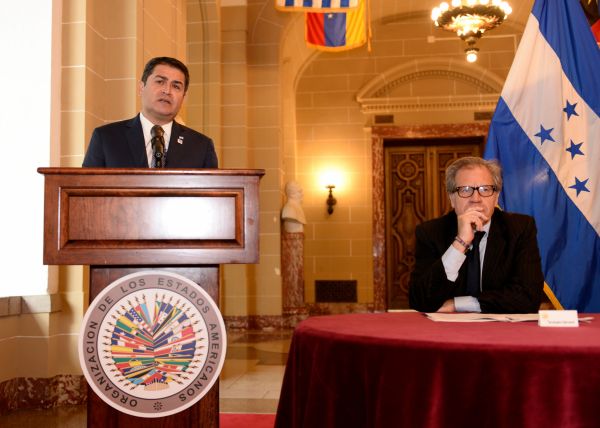
One man stands at a podium while another sits at a table

Honduran President Juan Orlando Hernández (left) and OAS Secretary General Luis Almagro (right) at an OAS meeting last year. / Juan Manuel Herrera / OAS / Flickr / Creative Commons

OAS Secretary General Luis Almagro – consistent with his mandate and commitment to protect democracy throughout the hemisphere – has challenged the legitimacy of the Honduran presidential election, but member countries’ failure to embrace his call for new elections could undermine his leadership and the credibility of OAS democracy protection instruments.  Almagro so far stands out as the only international actor exerting pressure on the Honduran government to guarantee free and fair elections after the serious irregularities observed on November 26.

  • On December 4, the OAS Electoral Observation Mission’s preliminary report established that the electoral process was characterized by irregularities and deficiencies, with low technical quality, and lacking integrity. Two days later, Almagro issued a statement concluding no winner could be determined and calling for the lifting of Honduran government measures that suspended the civil and political rights of Hondurans.
  • On December 17 – the same day the Honduran Electoral Tribunal proclaimed President Juan Orlando Hernández the winner in the election – the Observation Mission issued a second report documenting concerns about the electoral process The Secretary General then called for new elections, and appointed special representatives to set out the new electoral process and the process of national reconciliation in Honduras.

The Honduran government’s rejection of the OAS actions has hardened, apparently emboldened by the fact that no other international actor has backed Almagro’s call for new elections.  In an official communique, Tegucigalpa rejected Almagro’s initiative to send a special representative; claimed the Secretary General had exceeded his authority; and accused him of jeopardizing the autonomy of the Electoral Mission and inciting the polarization of the Honduran population.  In this way, Hernández, initially a strong supporter of OAS democracy protection efforts in Venezuela, now fends off the organization with arguments that recall those employed by Maduro’s government.

  • President Hernández seems to expect that he will overcome all challenges. He apparently believes the internal discontent, which has included peaceful demonstrations involving thousands of protesters, will cool down, and the opposition and angry citizens will come to terms with his reelection.  He must be pleased, moreover, that Washington has endorsed his supposed victory, and that no other international actor has backed Almagro’s call for new elections.  The European Union electoral mission dropped its initial complaints about the election.  Colombia, Mexico, Guatemala, and others have congratulated Hernández on his reelection.

The burden now falls on the OAS Permanent Council and the OAS member states whether to support their Secretary General’s efforts to reestablish democratic order in Honduras.  After the failed attempts to come up with a collective response in Venezuela, the electoral crisis in Honduras represents a new test for the credibility of American states’ commitment to multilateral democracy protection.  If a majority of OAS member states do not support the call for new elections and accept the results of November 26, the signal would be that they trust neither the OAS electoral mission nor the Secretary General.  This would be a new erosion in OAS legitimacy as an international organization and could even prompt the Secretary General to resign.  As Latin America enters a “super electoral cycle” this year – with elections in Costa Rica, Paraguay, Colombia, Mexico, Brazil, and possibly Venezuela – the management of the crisis in Honduras will have crucial, demonstrative effects on how tolerant the hemispheric community will be with breaches to the quintessential democratic institution: fair and free elections.

January 16, 2018

* Stefano Palestini Céspedes is a former CLALS Research Fellow and Postdoctoral Fellow at the Department of Political and Social Sciences at the Freie Universität Berlin, where he specializes in international organizations and regional governance.

Honduras: Hernández Stealing the Election Too?

By Eric Hershberg and Fulton Armstrong

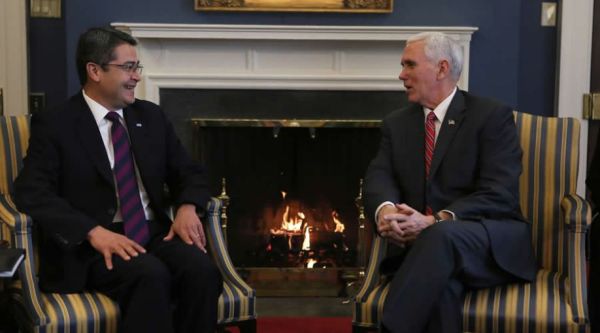
Two men sitting in chairs looking at each other.

Honduran President Juan Orlando Hernández and U.S. Vice President Mike Pence. / Embassy of Honduras / Creative Commons

Honduran President Juan Orlando Hernández and the military have declared a “state of emergency” – tantamount to martial law – to ensure that the President wins a second term, but irregularities in the vote-counting and the harsh suppression of the opposition probably will poison political discourse and hinder democratic progress for years to come.  The government declared the emergency, which will run for 10 days, on Friday night after days of growing tensions over mysterious actions by the Supreme Electoral Tribunal (TSE) – heavily stacked in favor of Hernández – that erased opposition candidate Salvador Nasralla’s five-point lead earlier in the week and moved toward formalizing the incumbent’s victory by 1.5 percentage points.  Senior government officials themselves have characterized the action as a “suspension of constitutional guarantees.”  Hondurans are now living under a dusk-to-dawn curfew; radio and TV stations have been warned against publicizing opposition claims of fraud; and street confrontations are growing.  Media confirm several deaths, but opposition leaders say that more than a dozen demonstrators have been killed.  Opposition videos showing military and police violence, including chasing individual protestors and shooting them, have been removed from Facebook and other venues, although still photos of the victims can be found.

  •  The TSE has agreed to hand-count about a thousand ballot boxes with “irregularities” in three of 18 departments, representing about 6 percent of the votes, but the opposition claims that several thousand more boxes have been compromised and need to be reviewed.

International reaction has been mixed and generally muted.  The EU’s observers have held firm on demanding a full vote count and expressing, diplomatically, skepticism about TSE’s handling of it.  Observers for the “Grupo de Lima,” which has been active on the Venezuela issue, issued a “position” paper on election day (November 26) urging calm and patience with the vote count, but it has released no apparent updates since then.  OAS observers have taken a similar low-key position.

  • Although the Trump Administration may conceivably be working behind the scenes, neither the White House nor State Department has done publicly more than urge calm. Vice President Pence, who previously praised Hernández “for his leadership in addressing security and governance challenges,” has remained silent.  The U.S. chargé d’affaires has said Honduras is in “a new, unprecedented phase in the electoral process” but limited herself to calling for calm and a full vote count.

The audacity of this apparent election fraud and crackdown on Hernández’s opponents dwarfs the many other charges of corruption brought against the Hernández government, including some validated by the OAS Mission to Support the Fight against Corruption and Impunity in Honduras (MACCIH).  Although different in form from the coup in 2009, these events also threaten to undermine the nation’s political stability, economic wellbeing, and institutions necessary to building democracy.  The U.S. reaction suggests that Washington will acquiesce in the ongoing abuses and Hernández’s second term despite the obvious irregularities and rights violations.  The United States – convinced as in the past that political leaders who are “our SOBs” can make good partners – has often countenanced dubious elections.  Moreover, both the Obama and Trump Administrations were persuaded that Hernández has been their faithful, effective ally in combating the drug trade, despite evidence of official involvement in it, and the temptation to turn a blind eye to less-than-democratic political outcomes must be strong.

  •  The OAS, the “Lima Group,” and other intraregional groupings do not appear poised to weigh in despite their good intentions. Neither do Mexico, Guatemala, and El Salvador appear likely to condemn a neighbor for engaging in practices that are ongoing or fresh in their own near pasts.  The Inter-American Democratic Charter, a historic document laying out hemispheric values, is of little value in the absence of the political will and ability to enforce it.  Now is a crunch time both for the OAS and for those governments that advocate some teeth to the charter.  At this point, they appear likely to cave – to the detriment of democracy in Latin America.

 December 4, 2017

Argentina: Excessive Optimism?

By Nicolás Comini*

Man delivers a speech on an airfield.

Argentine President Mauricio Macri. / Cancillería del Ecuador / Flickr / Creative Commons

Argentine President Macri’s Cambiemos coalition won an overwhelming victory in last month’s legislative elections – a step toward fulfilling his 2015 promise of a “revolution of joy” – but it’s not clear yet whether the administration’s optimism translates into national hope.  The coalition won in 15 of the 24 provinces of the country, including the five largest jurisdictions – the City of Buenos Aires, Buenos Aires, Córdoba, Mendoza, and Santa Fe.  Government officials and Macri’s supporters have expressed optimism that the economy will turn around and political confrontation will be overcome.  Macri won the presidency in 2015 with an alliance that made optimism – and the appearance of optimism – a central theme for overcoming what he called the polarization generated by his predecessor, former President Cristina Fernández.  His discourse was rooted in the ideas of change, happiness, efficiency, and meritocracy.

  • Even critics acknowledge that the government has generated innovation in terms of political discourse and representation, rooted in a greater horizontality of leadership and greater citizen access to public officials. News of some officials’ questionable business practices as revealed in the “Panama Papers” and “Paradise Papers” has caused little or no backlash.  Second, the idea of “normalization” of the country, supported by the media, has had a positive impact on part of society.  GDP growth at almost 3 percent this year and the lifting of exchange controls and imports have also buttressed this theme.  The unfavorable trade balance, with a deficit of US$765 million in 2017, has not been a factor.  Third, the government is still able to blame the country’s problems – including high levels of inflation and indebtedness – on the “received inheritance” from his predecessors, whose rule implied corruption, social polarization, and isolation from the world.
  • Rejection of the legacy of Cristina Fernández and her husband/predecessor, Néstor Kirchner, also seems to be one of the Macri government’s greatest assets. Even though Cristina is the most popular candidate in the opposition, her rejection among the broader population is greater; many of the votes that the government’s allies garnered were “anti-Kirchner” votes.  Cristina won a seat in the Senate, but in national politics, there’s a growing sentiment of “anyone but Cristina,” while a civil war simmers within the ranks of her Peronista base.  The political rise of Macri ally María Eugenia Vidal as governor of the Province of Buenos Aires – historic bastion of Peronismo and the country’s main electoral district – attests to these troubles.

Macri’s gains indicate a significant strengthening of the government, which is key to the reform package that the administration launched almost immediately after the election.  Proposals include aggressive changes in tax and labor matters.  While the tax reform has triggered battles with some large corporations, such as Coca-Cola, that will pay higher taxes, the labor reform has broad support from employers.  The latter faces strong resistance from a large part of society and, above all, of the union and opposition sectors, who fear that it, similar to one already carried out in Brazil, will contribute to job insecurity.  Macri’s increasingly forceful discourse on reducing public employment has also raised concerns despite his assurances that reducing state structures will help create private-sector jobs.

British theorist Terry Eagleton has said that an optimist is someone who thinks that things will improve even if there are no reasons for it.  The optimism of the government and its supporters is as easy to understand – there are some clear reasons for it – as it is palpable.  Macri has a strong government in a Latin America plagued by weak governments.  He not only has power in parliament; the country’s large corporations, mass media, security forces and, of course, an important part of the people are also behind him.  But Argentina is accustomed to living in cycles.  Expecting that in Argentina one or two or even three electoral victories will produce a durable revolution and fundamentally change those cycles, as the current government’s rhetoric suggests, may not be warranted by the facts.  Each administration usually assumes that the previous one did things absolutely wrong, and they will do better this time.  But this kind of impulse has an expiration date.  Joy and good vibes can have a positive impact on a society’s feelings about itself, but a real lasting solution will require addressing the underlying causes of the country’s polarization, poverty, and exclusion.  This implies, above all, state policies and continuity through different administrations.

November 15, 2017

* Nicolás Comini is Director of the Bachelor and Master Programs in International Relations at the Universidad del Salvador (Buenos Aires) and Professor at the New York University-Buenos Aires. He was Research Fellow at CLALS.

Chile: Election Likely to Show Big Political Shifts

By Kenneth Roberts and Eduardo Silva*

A presidential candidate stands in front of a crowd and a large Chilean flag

Ex-president Sebastián Piñera addresses his supporters at a campaign rally last month. / Twitter: @sebastianpinera

Chilean politics in the run-up to national presidential and legislative elections on November 19 have revealed that – within major lines of continuity – significant changes in the political alignments that have structured the country’s democracy since the end of the Pinochet dictatorship in 1990 are taking place.

  • Continuity is most pronounced on the conservative side of the political spectrum, where the two main conservative parties, Renovación Nacional (RN) and Unión Demócrata Independiente (UDI), have joined forces with smaller parties to sponsor the presidential candidacy of billionaire business mogul and former President Sebastián Piñera. In public opinion surveys of voter intentions, Piñera has maintained a healthy lead over a collection of centrist and leftist candidates.  He appears likely to come out on top in the first round of voting – and significant abstention (if fewer than 5.5 million registered voters vote) could push him over the top.  If he is forced into a run-off, the final outcome will rest heavily on the ability of his opponents in the divided center-left bloc to coalesce forces.
  • The center-left space is where most change is concentrated. The core parties in the Nueva Mayoría coalition that backed incumbent Socialist President Michelle Bachelet have won five of Chile’s six presidential elections since the transition to democracy in 1990.  For the first time, however, the main centrist party, the Partido Demócrata Cristiano (PDC), has opted out of the alliance to run its own candidate, Senator Carolina Goic.  With Goic languishing in the polls, however, the primary challengers to Piñera are located further to the left, including the Nueva Mayoría’s favorite, Senator Alejandro Guillier.  Although early speculation pegged him as an outsider, he is now firmly identified with the moderate reformist left and represents continuity with the current government.

A new left-leaning group, the Frente Amplio, has nominated Beatriz Sánchez, an independent journalist.  She arguably represents a larger challenge to the status quo, as her candidacy gives political expression to social actors who are sharply critical of Chile’s political establishment and the neoliberal economic model.  Even though the Broad Front’s electoral strength is untested, it brings together a number of small parties alienated from Nueva Mayoría and inspired by Chile’s massive student protest movement and other activist networks that have mobilized around labor, environmental, and pension reform issues in recent years.  Sánchez favors more redistributive taxation and greater state intervention in strategic enterprises and utilities, as well as in water property rights and forestry where social conflict has been high.  She is also for replacing the private pensions system with a mixed public-private one and getting private banking out of the student loan business.

This election will likely show that the broad center-left coalition that dominated Chilean politics since the 1990 transition has effectively splintered, with the Christian Democrats seeking to carve out an independent space in the political center and a movement-based alternative emerging on the mainstream parties’ left flank.  Uniting such disparate forces to compete against Piñera in a run-off election, should one be required, will clearly be a formidable task.  Nueva Mayoría candidate Alejandro Guillier, considered the strongest run-off candidate to take on Piñera, is already in conversation with Christian Democrats and Sánchez’s Frente Amplio.  In a run-off, he is thought likely to get around 60 percent of the Christian Democratic vote, with more conservative Christian Democrats voting for Piñera.  His appeal to Frente Amplio voters could suffer because of their unhappiness with Nueva Mayoría.

  •  The specter of high abstention looms large for second-round voting, too. President Bachelet’s low approval ratings for most of her second term in office, although recently reversed, signaled low enthusiasm despite her successful pushing through a series of major reforms, including a reform of the electoral law to enhance proportional representation, a tax reform to increase revenues for social programs, the initiation of free university education for low-income students, and a much-debated law to legalize abortions in limited circumstances.  Last, but not least, mainstream parties across the board have been weakened by a series of corruption and campaign finance scandals, leaving many citizens alienated from parties.

November 2, 2017

*Eduardo Silva is Professor of Political Science at Tulane University, and Kenneth Roberts is Professor of Government at Cornell University.

Brazil: Surge in Divisive Politics

By Marcus Vinicius Rossi da Rocha*

Two politicians debate

Brazilian right-wing politician Jair Bolsonaro disparages fellow politician Maria do Rosário during a debate on violence against women. / Marcelo Camargo / Agência Brasil / Wikimedia / Creative Commons

Political tumult, constant corruption scandals, and widespread popular loss of confidence in political institutions have given rise to divisive right-wing movements that, although not poised to win office in the 2018 elections, are laying the groundwork to have an impact on Brazilian politics in coming years.  Brazil will elect a president and both houses of Congress in October 2018, after five years of economic crisis (3.6 percent contraction in 2016); corruption scandals (President Michel Temer is still under investigation in the Lava Jato probe); low confidence in government (Temer has 3 percent approval); and political instability.  Many observers believe Brazilian democracy could be in peril.

Two factors in particular – the economic decline and the odor of taint surrounding Temer and the political class – are fueling a surge in right-wing and populist politics.  Conservative and market-oriented agendas are, unsurprisingly, gaining momentum, but also are challenges to the country’s three decades of democracy, including the defense of torture and military dictatorship.  The surge is seen in three main areas:

  • The Free Brazil Movement (Movimento Brasil Livre, MBL) is a youth libertarian movement born in early 2014 following the mass street protests of 2013, which its leaders helped organize. While promoting free speech, less government, individual liberty, and market-oriented reforms, its agenda emphasizes moral issues as an electoral strategy.  It mobilizes protesters against left-leaning politicians and gay art exhibits and succeeded in shutting one event down on spurious grounds.
  • Jair Bolsonaro, a former army captain turned lawmaker, is famous for his defense of torture and the death penalty, his opposition to human rights protections, and his praise for the military dictatorship that ruled Brazil in 1964-85. Proud of his lack of political correctness, he compares himself to U.S. President Donald Trump, and he casts himself as engaged in a moral struggle to save the nation.  He promises to withdraw Brazil from international human rights agreements; opposes gay marriage; and wants to adopt the death penalty and loosen gun laws.  In a speech on the House floor one time, he told a female legislator and human rights defender, “I do not rape you because you are not worth it.” He was reprimanded by the courts for this and other statements, but a leading public opinion institute Datafolha shows him with almost 20 percent of popular support.
  • A handful of senior active-duty and reservist military officers also seem to be crossing the line with greater frequency, openly speaking about “constitutional military intervention.” These officers espouse a highly disputed interpretation of Article 142 of the Constitution – which states that the “Armed Forces aims … to defend the homeland, to assure the constitutional powers, and, by initiative of any of these powers, to assure law and order” – to argue that the Constitution gives the Armed Forces authorization to intervene in politics.  At an event a few weeks ago, General Antonio Hamilton Mourão said that if the judiciary does not fix the government’s corruption problem, the Armed Forces could.  The high command remained silent.

Few analysts believe that the 2018 elections will be obstructed in any way, but the years of crisis, compounded by the polarizing rhetoric and activities of frustrated conservatives, will put checks and balances to test.  A military coup is highly unlikely – the Army is not eager to run the state again – but the apparent politicization of institutions sworn to defend the rule of law could cause others to flout the Constitution.  Congressman Bolsonaro does not appear likely to score big in 2018.  His party is small, but his popularity could very well give a boost to similarly minded groups poised to gain ground in Congress. This could lead to more than a continued shift toward the interests of construction firms, financial system, and agriculture sector that support them; it could portend a dismantling of decades of work to build democratic institutions; end torture and police brutality; and protect citizens’ rights to choice, freedom from discrimination based on sex or sexual orientation; pro-choice laws, gay rights, and indigenous rights.  Three decades of democracy won’t be reversed easily, but the next several years call for healing, not a new politics of division.

 October 5, 2017

* Marcus Rocha is a Ph.D. Candidate in Public Policy at the Federal University of Rio Grande do Sul (Brazil) and a CLALS Research Fellow specializing in the Brazilian executive branch and corruption in municipalities.