“Se me ha hecho misión imposible”

“Se me ha hecho misión imposible”: How U.S. Immigration Policy Dehumanizes Migrants of Color

By Iran Pacheco Martinez

Image of a stethoscope and paperwork. Retrieved from Cutler Integrative Medicine.

“(a) In General.–Subject to subsection (b), an individual may be entitled to, or enrolled for, benefits under this title only if the individual is–

“(1) a citizen or national of the United States;

“(2) an alien who is lawfully admitted for permanent residence under the Immigration and Nationality Act;


This segment, part of Sec. 112103 of the Trump administration’s Big Beautiful Bill, restricts Medicaid benefits for U.S. citizens and lawful permanent residents. Policies like these, that value legal status over human need, convey the message that undocumented individuals are less deserving of safety, dignity, and support—reducing complex human lives to a legal category that erases their struggles and humanity.

Divisive immigration policies are often written in rooms that exclude individuals with experience or knowledge about immigration. As a result, these laws further criminalize immigrants and enable the mistreatment of immigrants, including in detention facilities, where conditions are often life-threatening, marked by freezing temperatures, inadequate nutrition, and a profound lack of regard for immigrants’ humanity.

Twenty-six interviews with migrants from Venezuela and El Salvador provided valuable insights into their journeys to the United States and their experiences with integration. The findings indicate that many migrate to the United States in pursuit of safety and stability due to limited academic and employment opportunities, gang violence, government corruption, poverty, and hyperinflation in their home countries.

Throughout the interviews, participants shared their experiences accessing medical care, seeking employment, and navigating the U.S. systems—experiences that revealed a broader unwillingness to accommodate their unique circumstances.

Neglecting migrants’ basic needs often begins early in their journey, particularly as they’re taken to and held at detention facilities in the United States. Venezuelan and Salvadoran migrants recall conditions in detention facilities so extreme that the detention experience alone might have dissuaded their journey to the U.S. One migrant shares their experience in detention:

“…si yo hubiera sabido de que cuando me entregaran me iban a poner a pasar tanto frío y esas cosas créeme que no fuera viajado para acá, ¿me entiendes? Porque allí se sobrepasan, como te he dicho, se sobrepasan con el frío, me entiende, con alimentación, cómo te van a dar galletas y papitas, y jugo, comida de mala calidad, sabe, que por lo menos te den comida que te tengan fuerte…


“…if I knew that when they handed me over, they were going to make me go through all that cold and those things, believe me, that I wouldn’t have traveled here, you know? Because there they go overboard, like I told you, they go overboard with the cold, you know, with food, how are they going to give you cookies and chips, and juice, poor quality food, you know, at least they should give you food that keeps you strong…”

—Ruben, Venezuelan Man, 26 years old

One participant expressed concern for the impact that extreme facility conditions may have on young children:

…lo único, como digamos, incómodo, eh, en el caso de que uno tiene niños es que, eh, la migración de aquí, bueno le dicen la hielera, ellos le dicen haci, entonces es como un sitio bastante como extremo para los niños no, que son tan chiquitos, y hace frío allí.”


“…the only thing, let’s say, uncomfortable, eh, in the case that someone has children is that, eh, immigration [officers] from here, well they call it the icebox, they call it that, so it’s like- like a pretty extreme place for children, they’re so little, and it’s cold there.”

—Andrea, Venezuelan Woman, 26 years old

Reducing people to negligible subjects–held in freezing, inhumane detention facilities– simply for pursuing better living conditions.

The challenges faced by migrants do not end upon their entry into the United States. Limited access to resources for migrants is a looming and prevailing barrier to their financial stability and success.

Many migrants reported that language barriers make obtaining employment in the United States especially difficult. In instances where employment opportunities are available, workers encounter exploitative conditions or discriminatory treatment. As one Venezuelan migrant recalled:

…aquí trabajé, fue construcción… Entonces tampoco me gustó porque esa me pagan demasiado poquito, trabajaba en el sol y por lo que yo estaba haciendo sentía que no me pagaban bien…


…I worked here, it was construction… So I didn’t like it either because they paid me too little. I worked in the sun, and because of what I was doing, I felt like they weren’t paying me well…”

—Mauricio, Venezuelan Man, 23 years old

Another Venezuelan migrant recalls an encounter in which an English-speaking desk worker yelled at him as he delivered a mobile app order:

“…te voy a decir algo; me sentí humillado, a veces cuando voy, conserje o gente de seguridad a un edificio que no sé, si algún número en inglés y me maltratan, y siento que… porque me gritan, y yo por respeto me quedo callado…


“ …I’m going to tell you something, I felt humiliated, sometimes when I go, a janitor or security personnel to a building that I don’t know, if a number in English, and they mistreat me, and I feel that… because they yell at me, and out of respect I stay quiet…”

—Ruben, Venezuelan Man, 26 years old

While many claim that, as “guests” in this country, migrants have a responsibility to learn English, the resources to do so are not always widely available or even accessible.

These interviews reveal the many forms of dehumanization that many migrants endure. They are met with detention in harsh conditions, are denied access to language resources essential for employment, and are subjected to mistreatment in the workplace. Rather than being welcomed with dignity, they are met with indifference, exploitation, and disrespect.

Additionally, access to medical care poses another urgent challenge, especially for recently arrived migrants. This has become increasingly concerning, particularly in light of the recent passage of the “Big Beautiful Bill.” One mother from El Salvador explains that she has struggled greatly to obtain medical attention because she lacks a Social Security Number:

…no he podido obtener un seguro de salud porque no tengo el social… se me ha hecho misión imposible, he buscado en unos lugares, eh, me mandaron a un lugar después no hay cita, después me mandaron a otro lugar ‘tiene social, no? No hay cita,’ después otro lugar ‘¿tiene social, no? No hay cita,’ entonces así he estado durante como dos meses aproximadamente, y entonces se me ha hecho imposible, sí.


“…I have not been able to get health insurance because I don’t have a social [security number]… It’s become an impossible mission. I’ve looked in some places, they sent me to one place, then there was no appointment, then they sent me to another place, ‘Do you have a social [security number]? No? There’s no appointment,’ then another place, ‘Do you have a social [security number]? No? There’s no appointment,’ so I’ve been like that for about two months, and so it’s become impossible for me, yes.”

—Andrea, Venezuelan Woman, 26 years old

Using legal status as a measure for determining access to essential support reinforces harmful hierarchies. This perpetuates narratives of “illegal” or “criminal,” which dehumanize immigrants and may limit efforts to create viable pathways to citizenship.

Many people in influential positions are themselves descendants of immigrants who once sought a better life or fled catastrophic conditions in search of safety. Yet some of these same individuals now work to deny others that very opportunity, advancing policies to exclude others. They may have “forgotten” the immigrant experience—the fear and uncertainty, the exclusion, and the forced assimilation. Instead, they write immigration laws driven by biases and the desire to preserve power.

Some lawmakers want a white, English-speaking, and wealthy America, even if achieving it comes at the expense of others. Meanwhile, these same lawmakers refuse to create attainable pathways to citizenship for migrant workers who pay billions in taxes every year. Instead, they dismantle existing authorization processes and shift their focus toward excluding people of color, casting them as dangerous, undeserving, and less than human.

Migration to the United States in pursuit of safety and stability should not be criminalized, nor should it be used to strip people of their dignity and humanity. Can we not imagine their desires and actions as our own if we were in a similar situation? Would we not also relocate to safety if our livelihoods were threatened? And, would we not want others to approach us with respect and empathy?


Iran Pacheco Martinez is a Research Assistant at The Immigration Lab and a Government and Legal Studies double major with Latin American, Caribbean, and Latinx Studies at Bowdoin College.

Edited by Ernesto Castañeda, Director, Katheryn Olmos, Lab Coordinator, and Nadia Issah, Research Intern at the Center for Latin American and Latino Studies and the Immigration Lab.

“I was extorted, not a gang member”

How the United States Classification of MS-13 as a Terrorist Organization Complicates Immigration for Salvadorans

By Edwin Santos

El Salvador has long struggled with the legacy of organized violence, most notoriously through gangs like Mara Salvatrucha (MS-13) and Barrio 18. Until recently, these gangs wielded near-total control over neighborhoods, operating extortion rackets that shaped the daily lives of ordinary Salvadorans. While recent efforts by President Nayib Bukele’s administration have dramatically curtailed gang activity, the effects of past criminal governance continue to haunt Salvadorans, especially those navigating the United States immigration system. The 2025 executive order issued under the Trump administration, classifying MS-13 as a terrorist organization, may have aimed to combat transnational crime, but it also intensified the exclusion of Salvadorans in and from the United States. This designation renders many Salvadorans inadmissible to the United States and ineligible to receive immigration benefits—not because they pose a threat, but because they were once forced to “pay rent” to survive.

Photograph of Federal Court by Carol M. Highsmith. Retrieved from Raw Pixel.

Before El Salvador’s recent crackdown, gang extortion was a widespread and normalized form of criminal taxation. For years, MS-13 and Barrio 18 demanded weekly or monthly payments from residents, street vendors, and business owners. Refusal to pay often led to harassment, violent retaliation, or even death. This practice was not a matter of choice—it was a matter of survival. Victims lived in a state of constant psychological distress, stripped of agency and decreasing trust in institutions.

Extensive journalistic investigations documented this grim reality. The 2020 VICE documentary Pay Up or Die: The Gangs Extorting a Nation featured firsthand accounts from Salvadorans who, to stay alive, had to close businesses, relocate, or pay gangs what they could. Similarly, Killers on a Shoestring: Inside the Gangs of El Salvador, a 2016 report by The New York Times, illustrated the staggering scale of gang influence, which, according to this article, once spanned 94 percent of El Salvador’s municipalities. These criminal groups extracted payments from nearly 70 percent of small businesses at their peak. For many Salvadorans, paying rent to a gang was not collaboration—it was a survival mechanism.

In January 2025, the Trump administration issued an executive order that allowed criminal organizations to be designated as Foreign Terrorist Organizations (FTOs) or Specially Designated Global Terrorists (SDGTs). A month later, the U.S. Department of State officially designated MS-13 as such. While this classification may have served political objectives and enhanced the United States government’s ability to prosecute gang leaders, it also marginalizes Salvadoran nationals who were once coerced into coming into contact with the gang. This classification now has serious repercussions for Salvadorans navigating the United States immigration system.

Creative Commons Licenses.

Under Section 1182 of the Immigration and Nationality Act (INA), individuals who have provided “material support” to terrorist organizations are considered inadmissible to the United States. This includes anyone who has paid money, offered food, or given shelter to a designated group. Crucially, the Board of Immigration Appeals (BIA) case, Matter of M-H-Z, 26 I&N Dec. 757, established that even when providing material support to a terrorist organization is done under duress, it still constitutes a bar to admissibility under the INA. Thus, Salvadorans who previously paid extortion fees to MS-13 to protect themselves and their families could still be barred from entering the United States. As such, a Salvadoran street vendor who once paid $10 a week to avoid being killed by MS-13 may be barred from entering the United States to visit a loved one on a tourist visa or to come to our border and seek asylum the “legal way”—even if they are fleeing the very violence the United States condemns.

This legal rigidity is not only unjust—it is blind to the realities that Salvadorans have endured and the lives they now wish to lead. The landscape in El Salvador changed significantly in the last few years due to mass incarcerations under the Bukele government’s state of exception. Today, many Salvadorans are not fleeing imminent violence, but wish to reunite with their loved ones who once fled the Civil War or gang violence that once terrorized the country. Many may seek to travel to the United States to participate in their loved ones’ most important moments: meeting a newborn grandchild, attending a sibling’s wedding, or celebrating a child’s graduation.

For Salvadorans in the United States with deep transnational ties to El Salvador—especially in cities like Los Angeles, Washington, D.C., and Houston—these visits are acts of love and family unity, not security risks. Yet the application of terrorism-related inadmissibility rules still casts a wide and indiscriminate net, making it nearly impossible for some to obtain even a tourist visa if they had any past contact with MS-13, regardless of context. Not to mention those who have legitimate persecution claims and are fleeing from violence. This legal structure contradicts both humanitarian principles and the reality of criminal governance in El Salvador. The majority of those who interacted with MS-13 did so under threat, not allegiance.

There is no doubt that MS-13 committed acts of brutality. Their transnational reach and harm are undeniable. However, the blanket classification of the organization as a terrorist entity, combined with a rigid application of immigration law, fails to account for the nuance of civilian life under criminal regimes. Salvadorans who were extorted by gangs are not terrorist sympathizers or supporters; they are victims. Continuing to penalize them under blanket statutes undermines the humanitarian values the United States claims to uphold.  This United States policy punishes those who suffer, treating survivors of violence as security threats rather than individuals in need of protection.

United States policymakers must revise the implementation of immigration statutes, such as Section 1182, to recognize the lived experiences of those under criminal control. Anything less is a failure to distinguish oppressors from the oppressed. This includes incorporating mandatory exemptions for individuals who acted under duress and updating the waiver process to be transparent, accessible, and timely. Additionally, it means recognizing that people migrate not only to flee but to connect—to love, to celebrate, to live. Salvadorans deserve the chance to do so without being condemned for surviving a past they never chose.

The U.S. Helped Destroy El Salvador—Now It’s Supporting Its Authoritarianism

By Valeria Chacon

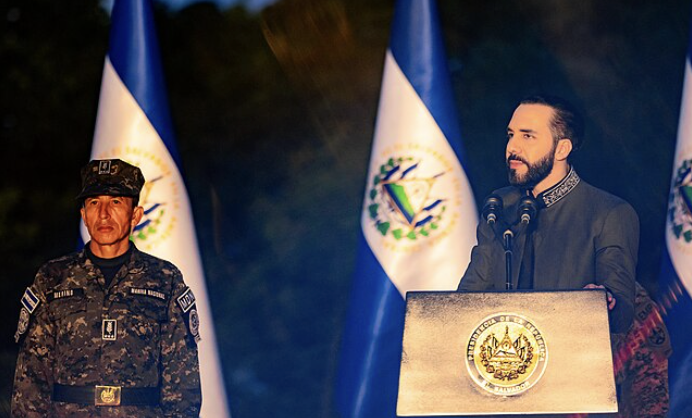
El Salvador’s President Nayib Bukele speaks during a press conference before casting his vote in a parliamentary election in San Salvador, on February 28, 2021 (REUTERS / Jose Cabezas)

El Salvador’s President Nayib Bukele speaks during a press conference before casting his vote in a parliamentary election in San Salvador, on February 28, 2021 (REUTERS / Jose Cabezas)

When President Ronald Regan distributed billions of dollars in economic and military aid to El Salvador during its civil war in the 1980s, it fueled the displacement of roughly one million Salvadorans and the slaughter of thousands. Years later, many Americans forgot this chapter in U.S. history, as American politicians smeared the image of this small Central American country.  Senator Marco Rubio once described El Salvador’s suffering as “the result of bad leaders, rampant crime and natural disasters.” However, many Salvadorans—myself included—have not forgotten.

President Nayib Bukele was reelected in February of last year and has been credited with transforming El Salvador from one of the most dangerous countries in the world into the safest—despite growing concerns regarding human rights violations. Now, the U.S. government and President Trump bear responsibility for the current crisis of criminalized migration, as evidenced by the agreement between the U.S. and El Salvador to imprison migrants from multiple countries in the mega-prison CECOT. This development echoes the violence the U.S. once supported during El Salvador’s civil war, as the country now becomes the face of U.S. immigration hell.

U.S. Involvement in the Civil War

Between 1980 and 1990, during the brutal 12-year Salvadoran civil war, the United States provided over $1 billion in military assistance to El Salvador—including approximately $996 million for military education and training. That training was later used to terrorize and kill Salvadoran civilians.

One female participant interviewed by The Immigration Lab, from El Gavilàn, El Salvador, describes the horrors she witnessed during the war:

“Sometimes the guerrilla would pass by and force us to give them food, and the armed forces would realize what had happened. The problem was that if they [the guerrillas] passed by and forced us to give them food, we had to. My two uncles were killed that way—because they came to us asking to give them food, and when the armed forces realized that, they kidnapped and murdered them.”

It was U.S.-trained Salvadoran military, such as the Atlacatl Battalion, that were responsible for the El Mozote Massacre—one of the worst massacres in Latin American history. On December 11, 1981, residents of El Mozote were rounded up to be killed, dismembered, and raped. Nearly half of the victims were under 10 years old.

But why would the US government support such horrific acts of mass murder? During the Cold War, the left-wing militia Farabundo Martí National Liberation Front (FMLN), was at war with the Atlacatl Battalion. The guerrillas, influenced by left-wing politics and Catholicism, were one of the country’s most prominent political forces. President Ronald Reagan’s fear that El Salvador’s authoritarian government might fall to communism led the U.S. to excuse and cover up atrocities in the service of anticommunism and defeating the guerrillas.

A mother from Ayutuxepeque told us her reason for migrating to the U.S. was her fear that the Salvadoran armed forces would target civilians for their political beliefs.

“The fear was overwhelming, just because you had an affinity towards a certain group. The armed forces would come and murder you. That’s why people mainly fled.”

Misinformation about the massacre and its aftermath spread, as the U.S.-trained Salvadoran military denied responsibility for the deaths of hundreds of civilians, claiming that the massacre was “totally false.” However, the Truth Commission for El Salvador issued a report documenting human rights violations from 1980 to 1991. It found that 85% of the cases reported to the Truth Commission involved state agents or death squads allied with Salvadoran armed forces.

Another female participant from La Union, El Salvador, described her immense fear of the Salvadoran armed forces:

“One had so much fear. There was no sense of security at all. Dead people would appear in alleyways. I couldn’t even sleep because I was scared they [armed forces] would knock on my door. I suffered a lot.”


Aftermath

Due to the civil war, more than a million Salvadorans were displaced, and half a million fled to the United States during the 1980s. However, just 2% of asylum applications filed by Salvadorans were approved, making it incredibly hard to legally stay and work in the U.S. This stemmed from U.S. aid to the Salvadoran government—extending protection would have contradicted its own foreign policy. However, in 1990, Congress created a program and legal immigration status called Temporary Protected Status (TPS), providing temporary permission to reside in the U.S., a work permit, and protection from deportation for foreign nationals of designated countries that are facing an ongoing armed conflict, environmental disaster, or extraordinary and temporary conditions.

The growing Salvadoran Population in Los Angeles during the early 1980s led to the formation of Mara Salvatrucha (MS-13), a Salvadoran street gang formed to navigate life in impoverished neighborhoods and defend its community members from other gangs. However, mass deportations of young Salvadorans involved with MS-13 led to the further destabilization of El Salvador, contributing to the gang’s expansion.

By 2005, Salvadoran authorities estimated the gang population at 40,000, with MS-13 having significant control of the country, and Salvadorans were living in fear, once again. The gang recruited older children and teenagers, many of whom were vulnerable targets as they lacked the means to survive in a country suffering from economic turmoil and educational limitations.

By 2015, El Salvador had become the most dangerous country in the world, with 103 murders per 100,000 residents—many linked to MS-13 or its rival, the 18th Street gang. The brutality of MS-13 is often characterized by not just killing but also by torturing, maiming, and dismembering victims. This gang funded itself through extortion, and in 2019, MS-13’s estimated revenue was $31.2 million.

Salvadorans saw a glimmer of hope in February 2019 when Nayib Bukele won the presidency, as he pledged to combat the gangs in El Salvador. He began addressing the country’s high crime rate by increasing police and military presence in gang-dominated areas to diminish their control, declared a state of emergency in prisons, and placed them on lockdown to prohibit visitors in order to block out communication with the outside world. By 2022, El Salvador’s homicide rate dropped to 7.8 per 100,000 residents—due in part to the imprisonment of more than 50,000 gang members.

It’s no surprise that President Nayib Bukele’s actions have caused him to be highly popular. You can even walk through parts of the Washington metropolitan area with Salvadoran populations, such as Columbia Heights or Hyattsville, and see merchandise with Bukele’s face. But with many discrepancies in detainees dying and rampant due process violations, it is clear that the improvement on El Salvador’s gang problem came at the expense of massive human rights violations.

El Salvador now surpasses the U.S. as having the world’s highest incarceration rate. In 2022, as many as 3,000 children have been arrested without any connection to criminal activity—many imprisoned solely based on their appearance or anonymous tips. These detainees are being sent to CECOT, which held Kilmar Armando Abrego Garcia, and holds many Venezuelan and Salvadorian immigrants sent by the United States government. But beyond its most notorious facility, El Salvador has 25 prisons across the country, where people have been vanished to and have not been heard of again.

Inmates dying under suspicious and unexplained circumstances being buried in mass graves, mirrors the events from the Civil War. Ramón Abraham Vargas Ávila died in Santa Ana on April 14 and Lorena Abigail Escobar Mejía died in Apanteos prison on April 18. The lack of coverage surrounding their deaths speaks volumes about the unimaginable things occurring inside Salvadoran prisons. Many of the detainees come from impoverished communities, highlighting policies rooted in eugenic ideologies aimed at eliminating the country’s poor through mass incarceration, gentrification, and the expedited naturalization of white tourists. President Bukele offers free visas under the guise of boosting the country’s economy, yet fails to address the needs of Salvadorans living in impoverished neighborhoods with limited access to employment or educational opportunities.

It is nauseating to see other Americans visit and revel in the beauty of the land I’ll never fully know because of the atrocities of the 1980s and the need for my family to flee. It pains me to hear elder Salvadorans fall victim to the propaganda and misinformation about what El Salvador has become. History has conditioned Salvadorans to favor strong, authoritarian leaders, and the country has never truly been given a chance to heal from the Civil war.

The U.S. has made a $15 million deal with El Salvador to imprison deportees. Some 278 men deported by the Trump administration to El Salvador have been accused of being members of the Venezuelan gang Tren de Agua or Salvadorans allegedly affiliated with MS-13—often on baseless connections such as simply having tattoos. The current U.S. administration sees El Salvador as nothing more than a remote place to detain people in what is essentially a concentration camp, where people sit without being found guilty or provided due process. What Bukele is doing to these kidnapped men is what he has been doing to Salvadorans for years—and only now is the Salvadoran diaspora beginning to wake up.

Valeria Chacon is a former research assistant and recent graduate of American University.

Why MS-13, M-18, and Tren de Aragua Are Not Terrorist Groups

by Melissa Vasquez, Ernesto Castañeda, and Anthony Fontes

Image of President Trump of the United States and President Bukele of El Salvador meeting, White House, Sep 25 2019, Fliker

Are MS-13, M-18, and Tren de Aragua terrorist organizations? The short answer is no, they are not. They are transnational criminal organizations. El Salvador’s President Bukele and Donald Trump have officially labeled these groups as terrorist organizations, citing their extreme violence and control over some territories. However, these classifications have sparked debate, as their activities are more aligned with organized crime than political terrorism. Making this distinction is crucial given that mislabeling them can lead to misguided policies that fail at curbing their violence.

The 1980s civil wars in Central America forced nearly a million people to flee the U.S. Some immigrants are still forced to leave their countries because of organized crime and gang recruitment. Today most often, some displaced people are victims of gangs, not members or representatives abroad. However, upon originally arriving in Los Angeles, many Central American migrants faced marginalization and sought protection from the gangs present in the areas where they lived and worked. These challenges ultimately contributed to the formation of the present-day MS-13 and M-18 gangs. Many of the members of these new local gangs were incarcerated in Los Angeles prisons alongside members of other gangs, which allowed them to regroup and learn from their rivals. Shortly after the wars, mass deportations from prisons and streets sent MS-13 and M-18 members back to a weakened Central America, where they expanded their networks and influence. 

Similarly, El Tren de Aragua (TdR), which originated in the early 2000s in Venezuelan prisons—particularly the Tocorón prison—has expanded across South America. Originally, a prison gang, Tren de Aragua, expanded beyond prison walls to exploit weak governance, connecting criminal networks across South and North America. Furthermore, like MS-13 and M-18, Tren de Aragua is driven by criminal enterprising rather than political ideology. That is, neither group aims to take over state power or remake society in their own image. Rather, they are hyper-focused on generating maximum profits through illicit means while avoiding state interference. They are criminal syndicates with some capacity—though quite limited—to carry out their rackets across borders. They are certainly NOT terrorist entities. 

What separates a terrorist organization from a criminal syndicate? While both engage in illicit activities and use violence as a means to an end, it is crucial to distinguish their goals and methods to dismantle them effectively. The primary difference lies in their objectives: terrorist organizations seek political, religious, or ideological change by influencing government policies or societal structures, whereas transnational criminal organizations (TCOs) operate across borders solely for financial gain, without political or ideological motives beyond sowing conditions to maximize profit. 

For example, the U.S. government has classified groups like Revolutionary Armed Forces of Colombia (FARC) and ISIS as terrorist organizations due to their political objectives. FARCS’s history dates back to 1964 when it emerged as a communist insurgency that employed terrorist tactics. Initially formed as a guerilla movement from campesino self-defense groups, whose primary objective was to overthrow the Colombian government. Over the next five decades, FARC waged guerilla warfare by carrying out illicit activities—such as bombing, kidnappings, and assassinations–all in an effort to challenge state authority. Colombia, the U.S., and the European Union designated FARC as a terrorist organization due to their use of political violence.

However, the 2016 peace accords between FARC and the Colombian government led to the successful disarmament. This agreement allowed the group to transition into a political party known as Comunes. Even though some dissident factions still operate, FARC’s official transformation has been a key factor in maintaining long-term stability in Colombia. Recognizing this shift has been crucial in fostering peace and ensuring that former combatants can engage in democratic processes rather than armed conflict.

The contrast between ISIS and FARC highlights the importance of proper classification. FARC has abandoned the characteristics that once classified it as a terrorist organization and instead has evolved into a political entity. ISIS, on the other hand, remains committed to its extremist and political ideology, seeking to overthrow governments through guerrilla warfare and establish a global Islamic caliphate through territorial control and sectarian violence. Addressing the causes behind these organizations is equally crucial. FARC’s transition has allowed Colombia to tackle the drivers that led to its rise in the first place, providing the foundation for long-term stability. When governments misdiagnose the factors driving their emergence, violence continues.

Despite claims that Tren de Aragua serves the Maduro regime, evidence suggests otherwise. The group arose from Venezuela’s weak governance and not from direct state sponsorship. According to Insight Crime, in September 2023, Venezuelan law enforcement raided the Tocorón prison in Aragua state, aiming to “dismantle and put an end to organized crime gangs and other criminal networks operating from the Tocorón Penitentiary.” This operation demonstrates that Tren de Aragua is not a state-sponsored group, nor is it a tool being used by the Venezuelan state to destabilize the region. Its rise—like that of MS-13 and M-18—can be traced back to systemic failures, including poverty, corruption, and forced population displacement. These factors have allowed transnational criminal organizations to flourish across Latin America. 

MS-13 and M-18 expanded by exploiting political corruption and institutional weakness in their home countries. Similarly, Tren de Aragua has taken advantage of Venezuela’s economic crises and large emigration to expand into new territories, such as the Darién Gap. Unlike terrorist organizations, these gangs did not emerge to push a political ideology; rather, they have thrived by leveraging corruption and weak law enforcement. In many ways, they are products of the environments that fostered them, growing out of instability rather than ideological ambition.  These transnational criminal groups do not engage in violent attacks abroad, targeting governments or aiming to take political power in the United States. That is beyond their purview and capabilities. 

Why does the distinction between organized crime and terrorist organizations matter? Although all of these organizations engage in violence and illicit activities, their end goals set them apart: MS-13, M-18, and Tren de Aragua operate for profit, whereas ISIS and others seek to reshape the political landscape of their regions. Properly distinguishing between terrorist organizations and transnational criminal organizations like MS-13, M-18, and Tren de Aragua is crucial for drafting effective policies and responses to their violence. Mislabeling these groups can lead to inappropriate responses. Applying counterterrorism measures to profit-driven gangs fails to address the root causes for their expansion in the first place. Failing to properly distinguish organized crime from political terrorists leads to failed policies. The misclassification of these groups could destabilize the region by shifting U.S. foreign policy and resources away from where it is truly needed—addressing the drivers of gang-related violence, corruption, and weak governance—toward counterterrorism efforts. 

While transnational criminal organizations are heavily involved in drug trafficking, and their violence may create fear among civilians and impact governance, this does not qualify them as terrorist organizations. Their primary objective is financial gain, not advancing an ideological or political agenda. This distinction matters because government responses shape outcomes. If the goal is to curb migration, drug trafficking, or violence, then we need to stop treating criminal organizations like terrorist groups and start addressing the real issues driving their expansion. If the U.S. truly wants to curb migration and secure the southern border, then it must ensure that its classification of these organizations is accurate and aligned with its actual objectives.

Melissa Vasquez is a Graduate Student in the International Affairs and Policy Analysis program at American University and an Intern at the Immigrant Lab.

Ernesto Castañeda is the Director of the Immigration Lab and the Center for Latin American and Latino Studies and a Professor at American University

Anthony Fontes is an Associate Professor and ethnographer at American University’s School of International Service.

This piece can be reproduced completely or partially with proper attribution to its author.

New Wave of Salvadoran Immigrants in the DMV

By Hanseul Cho, Washington College of Law ’23

Based on data from the Immigration Lab’s Immigration to the DMV (DC, Maryland, and Virginia) project, there is a new wave of immigration from El Salvador, even though people from this country have sought refuge in the U.S. for decades. Despite being better educated, many Salvadoran immigrants work in lower-income, service-oriented jobs due to credential recognition issues and language barriers. Addressing integration challenges through inclusive policies for immigrants is crucial for harnessing their full potential and strengthening society.

El Salvador is similar in size to New Jersey and has a population like Tennessee. Although a relatively small country, Salvadorans are the biggest immigrant group in Washington, DC. Seventeen percent of the population in DC is immigrants, 11% of which are from El Salvador. 

Individuals from El Salvador ranked fourth in the number of refugeeslocated in the United States, and a significant number concentrated in the DMV. Although Los Angeles has the biggest Salvadoran migrant population, DC has the second largest group. Although when combined with Maryland and Virginia, the DMV has the largest Salvadoran population in the U.S.

Salvadorans rank fifth among the largest immigrant populations in the United States, behind China, India, Mexico, and the Philippines. 

Why did they choose to migrate? El Salvador experienced right-wing military regimes seizing power through rigged elections in the 1950s. The failure of land reform and political turmoil led to a civil war from 1979 to 1992, causing a 21.5% drop in GDP.

The United States justified its intervention in the Salvadorean civil war as preventing a left-wing party from taking power within the context of the Cold War. The conflict led to many refugees moving to the United States. A few of them formed gangs in Los Angeles, who were incarcerated and later deported, leading to the emergence of gangs in El Salvador, including MS-13. These gangs focused on territorial control and their violence caused some targeted people to look for safety in the United States.

Among the immigrants interviewed in the Immigration to the DMV project, 95% answered that El Salvador’s violence, climate, and economic difficulties influenced their decision to immigrate to the U.S. Our interviewees cite a bad economic situation, a serious lack of security, and corruption as the reasons they left.

Female immigrants make up a significant portion of the sample in this interview. The data indicates an increasing trend of more female migrants, which aligns with previous research. Some of the factors contributing to this include the demand for care and domestic work in the U.S. and an increased probability for women to pursue higher in the United States. A young woman who came to Washington, D.C. in 2022 mentioned that she migrated for a better chance at self-development, to study college, and to become a nurse. 

Even though the female participants in this study faced danger, including receiving contraceptive injections to avoid pregnancies during the arduous journey and threats of sexual violence, they desperately wanted to find long-term security and a chance to study.

New Generation of Salvadoran Immigrants

We interviewed Salvadoran immigrants who arrived in the U.S. fleeing the aftermath of the civil war, which they saw as a truly traumatic event. Political violence contributed to political corruption, economic failure, and widespread violence. Interviewers coming later also came looking for safety and economic opportunity.

People who arrived after 2019 are relatively proficient in English and more educated. Interviewees are from a country where only 33% of the population graduated from middle school, but 80% of the interviewees from this generation graduated middle school, and 60% graduated high school or with their GED. All of them had a better education than their parents. They had much better education and skills than their parents, but still, even though they are minors and part-timers, most still tend to work in lower-income jobs in the service sector. What causes this tendency? 

Two main challenges face this group: language barriers and lack of recognition of relevant training and job experience. These factors hinder their integration into the U.S. job market and society.

One of the main challenges that Salvadoran immigrants face is credential recognition. The skills and experiences they obtain in their home country may need to be properly evaluated or acknowledged in the United States. This includes the requirement for a GED, a U.S. high school diploma, or a U.S.-specific certificate. This can prevent immigrants from utilizing their previous experience and instead require them to start from scratch.

A 24-year-old Salvadoran man who lives in DC has been certified in forklift management in El Salvador. Another former electric technician also mentioned a similar experience. Still, those certifications needed to be recognized in the U.S., and ultimately, their professional experience was dismissed. So, in this case, the electrician became a cook even though electricians and forklift drivers are in high demand and are well-paying jobs.

This experience can lead to immigrants’ struggle with “imposter syndrome,” which negatively affects their self-image and makes it harder to derive self-esteem from their work. Furthermore, it can be argued that language barriers are a significant obstacle for immigrants to fully participate in the labor market.

The pandemic’s profound economic repercussions severely impacted El Salvador, exacerbating the country’s preexisting high crime rates. Interestingly, statistical data indicates that language barriers among Salvadoran immigrants do not immediately result in income disparities. Their incomes are quite similar when comparing Spanish-speaking immigrants who arrived recently with English-speaking immigrants who arrived in 2010 (Median is $30,000 for English speakers versus $35,000 for Spanish speakers, and the average is $36,430 versus $37,000). Most interviewees noted that their ability to speak only Spanish did not pose a significant challenge in assimilating into society. Spanish speakers might even have an advantage when seeking certain jobs.

However, English-speaking individuals tend to have a wider range of job opportunities, which can influence their assimilation and long-term settlement. While Spanish-speaking immigrants typically work in service-oriented roles, English speakers often have access to a broader spectrum of employment options, including management positions and roles in non-governmental organizations. Language proficiency plays a crucial role in the employment opportunities available to immigrants, affecting their ability to assimilate and succeed long-term.

Although immigrants from El Salvador could get jobs with the help of friends and relatives, there is a risk that the occupation will be limited to the service industry only. A Salvadoran woman in her 20s who wants to be a Spanish teacher faced challenges getting information about how to become one due to language barriers. 

In the DMV area, organizations like Northern Virginia Family Service, Maryland Multicultural Youth Centers, and DC Central Kitchen’s Culinary Job Training Program are available in multiple languages for immigrants. However, these services are decentralized and challenging for immigrants to access due to lack of time and transportation, creating barriers to utilization. In the data analyzed, almost none of the participants reported being part of a community organization, but most of them stated they were interested in learning opportunities and cultural activities.

It would be helpful to create a centralized portal that provides professional skills enhancement and digital-based social networking, integrating Salvadoran cultural influences.

It is important to acknowledge that immigrants, specifically Salvadorans, contribute to diverse cultural environments and enrich communities economically and socially. Addressing their integration challenges through inclusive policies and accessible support systems is crucial for developing a united and strong society.