Bolivia’s Remarkable Political Stability

By Miguel Centellas*

31077401152_b9af7fb247_b

Political slogans in support of Bolivian President Evo Morales and his MAS party (Movement for Socialism), calling for “500 more years” of their rule. / Francoise Gaujour / Flickr / Creative Commons

In the 11 years since he was first elected president of Bolivia, Evo Morales has delivered remarkable stability and progress even though his drive for power still concerns many opponents.  Along with Venezuela’s Hugo Chávez and Ecuador’s Rafael Correa, he was labelled by some observers as part of the “irresponsible” or “populist” left – in contrast to more “social democratic” leftists like Brazil’s Lula da Silva or Chile’s Michelle Bachelet.  The “populists” were also widely criticized for weakening and playing loose with democratic institutions and for authoritarian practices associated with the region’s caudillo legacy.  But Morales’ course has neither followed Venezuela’s, whose populist regime lies in ruins with no clear exit strategy; nor Ecuador’s, which looks set to accept a peaceful transition of power to the opposition later this year.  Bolivia appears to have reached a sort of political equilibrium.

  • Despite charged economic rhetoric and his championing of leftist socioeconomic policies, Morales has pursued prudent, conservative macroeconomic policies. Bolivia has carefully increased its reserves from a little over $3 billion in 2006 to more than $15 billion by 2014.  As of 2015 reserves amounted to 40 percent of GDP.  At the same time, the GDP has grown from just over $8 billion in 2000 to nearly $33 billion by 2015, with GDP per capita (PPP) nearly doubling from $3,497 to $6,954 in the same time span.
  • Morales’s signature socioeconomic reforms borrow from the “responsible” leftist models, rather than the vertical chavista model. He has created cash transfer programs similar to those used successfully in Mexico and Brazil.  These bonos, including some created by Gonzalo Sánchez de Lozada, provide unconditional cash for pensions, pre- and post-natal care, and education.  While this spending pales in comparison to “megaprojects” such as highways and soccer stadiums, it goes directly to Bolivian households – with obvious political benefit for the Morales government and clear, direct benefits to average Bolivians.
  • The new constitution adopted in 2009 – a product of compromise between Morales and the regionalist opposition – radically decentralized state structure, satisfying opponents’ desire for significant space at the local level. The eastern lowland regionalist opposition can regularly count on winning governorships in Santa Cruz, Beni, and Tarija, while middle-class, liberal opponents win in the major cities of La Paz, Cochabamba, Potosí, and now even El Alto.  This diffuses political conflicts and prevents the consolidation of unified opposition.  Conflict between the central state and regionalists continues, but it has become routinized and therefore has stabilized.
  • The electoral court, elevated to be a “branch” of government in the 2009 constitution, has remained largely impartial, maintained its political independence, and significantly improved its capabilities – increasing Bolivians’ trust in the legitimacy of elections. A referendum last year, rejecting a constitutional reform that would allow Morales to run for another term in 2019, was managed competently and (for the most part) fairly.

Not all is well, however.  Despite losing the referendum, Morales and his MAS party made clear that he intends to find a way to run for reelection yet again in 2019.  The opposition’s concerns about his authoritarian tendencies are not wholly exaggerated.  Indeed, the government frequently lashes out at its perceived enemies in ways that go well beyond the niceties of democratic adversarial politics.  Likewise, there are clear signs that corruption remains deeply rooted within the government.  But none of this contradicts what seems obvious: The MAS government has brought relative prosperity and stability – even fueling optimism that if (or when) it steps down, its transition may be more like the one that Ecuador appears likely to experience later this year than the meltdown that is tearing apart Venezuela.

March 23, 2017

* Miguel Centellas teaches political sociology at the University of Mississippi’s Croft Institute for International Studies and has written extensively on Bolivian electoral and subnational politics.  He also co-directs an interdisciplinary summer field school based in La Paz.

Argentina: The (Un)Fulfilled Promises of an Election Year

By Ernesto Calvo*

ArgentineCongressCC

Palace of the Argentine National Congress / Andresumida / Wikimedia / Creative Commons

As the 2017 mid-term election approaches, both Argentine voters and party elites see a gloomy present and a bright future. With only seven months until the October 22 election, the economy still shows few signs of recovery. Patience is running thin in Congress, among governors, and with organized labor – but it seems to be never-ending among voters.

  • For over a year, surveys have shown that a majority of voters perceive their personal economic situation as dire. In survey parlance, each month voters perceive that they are worse off than in the previous month. Yet, to the surprise of specialists, a majority of voters also expect the economy to improve in the next month. Indeed, voters seem as willing to credit the current administration of President Mauricio Macri for its policy choices as they are unhappy with the economy.
  • The opposition is betting its future success on the dismal economic outlook: high inflation, stagnating wages, and lack of growth. The government expects voters’ optimism, the raw expectation of future growth, to carry the day. The increasing gap between current perceptions and future expectations has baffled specialists. The only possible result, many confide, is either a rude awakening for the administration or a real change in the pace of economic growth.

Both parties suffer from divisions. Former President Cristina Fernández’s Front for Victory still carries most support among Peronists, although many fear that a Senate victory by their leader in the Province of Buenos Aires will ensure a divided party in the election of 2019. Peronist dissident Sergio Massa is still running outside the party, and few anticipate any grand-coalition before 2019. The other traditional party, the UCR, remains on life support after a decade of mishaps, and is only a minor partner of President Macri’s party, Republican Proposal (PRO), in the government coalition. Meanwhile, the incumbent PRO has yet to decide their strategy to form Provincial alliances and nominate its candidates.

As the election nears, it is unclear whether voters will hold the government responsible for their current economic malaise or will still believe in PRO’s capacity to deliver a better economy. Voters have one leg in a bad economy and another leg in the promise of a better tomorrow. They are, in the words of the Herald Editor J.G. Bennet, “Like a stork by a frog pond, they are as yet undecided which to rest upon.” Eventually, one of the two legs will have to go up, for either the government or the opposition – but not both – to celebrate on Election Day. Regardless, the mid-term election may provide little information as to who the real winner is. With no presidential candidates on the ballot, no important gubernatorial races to publicize, and only one important Senator on the line (that of the Province of Buenos Aires), the signal will be unclear. If the government does extremely well, it may gather a third of the House vote, all provinces considered together. If the government performs badly, it may get a quarter of the House seats. As the election approaches, it would seem that the only measure of success or failure would be whether the government coalition, Cambiemos, wins first, second, or third place in races for the National Senators of the Province of Buenos Aires. More troubling yet, it is unlikely that the result of the election, whichever it may be, will clarify the choices faced by voters, the future of the Peronists, or the likelihood of a steady government coalition after 2017.

March 9, 2017

*Ernesto Calvo is a Professor and Associate Chair of the Department of Government and Politics at the University of Maryland.

U.S.-Mexico Trade: The Numbers and the Real Issues

By Robert A. Blecker*

30986371735_f660fc42e9_k

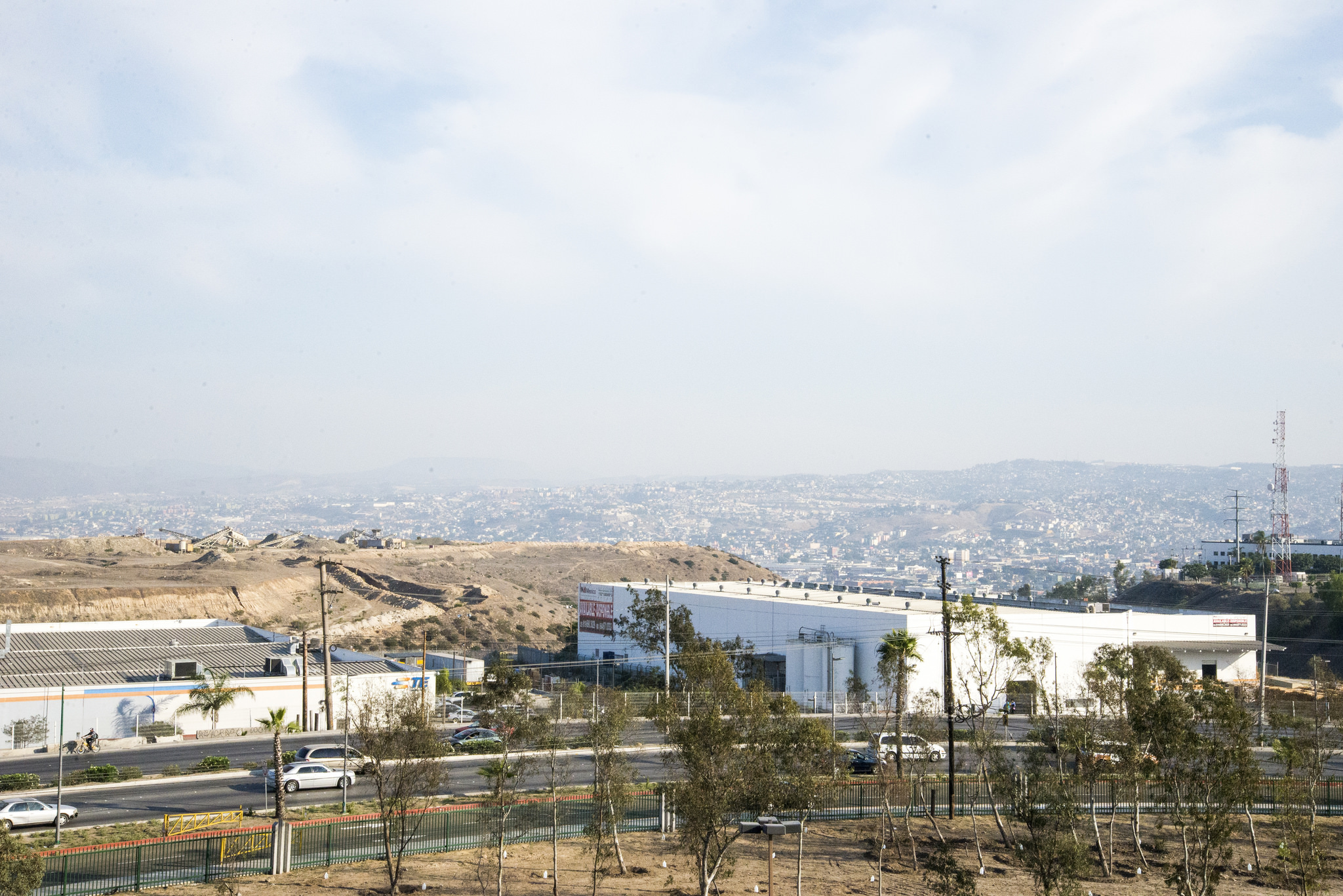
Two maquiladoras in Tijuana, Mexico. The low percentage of Mexican value-added in Mexico’s exports is a key reason why the country has not gotten nearly as much employment growth as it hoped for when it joined NAFTA. / Anthony Albright / Flickr / Creative Commons

Officials in the Trump administration are proposing a new way of measuring the U.S.-Mexican trade deficit that, by making the deficit look larger than it currently appears, will likely be spun to support efforts to impose high tariffs or dismantle NAFTA.  According to press reports, the President’s senior advisors, including the head of his new trade council, Peter Navarro, are proposing to include only “domestic exports” (exports of U.S.-produced goods) in calculating bilateral trade balances with Mexico and other countries.  This would exclude “re-exports” – goods that are imported into the United States from other countries (such as Canada or China) and transshipped into Mexico – which are currently counted in total U.S. exports.

  • In spite of its political motivation, the proposed new accounting would render a more accurate measure of U.S. exports. In fact, it would make the U.S. deficit with Mexico look closer to what Mexico reports as its surplus with the U.S.  For 2016, the U.S. reports a deficit of $63.2 billion with Mexico, while Mexico reports almost twice as big a surplus of $123.1 billion with the U.S.  If the U.S. excluded re-exports, its trade deficit with Mexico for 2016 would be $115.4 billion, which is much closer to the Mexican number.

Nonetheless, this recalculation fails to correct for another bias, which makes the U.S. deficit with Mexico look artificially large.  Imports are measured by the total value of the goods when they enter the country, from the immediate country of origin.  But in today’s global supply chains only part of the value-added in imported goods comes from any one country.  A television, for example, can be assembled in Mexico with components imported from Korea and other East Asian nations.  As a result, the reported U.S. imports from Mexico (especially of manufactured goods) greatly exaggerate the Mexican content of those goods.  Although data limitations do not permit an exact calculation of the Mexican content of U.S. imports from Mexico, it is likely relatively low.  (My own estimates suggest it is on the order of about 30-40 percent for manufactured goods).  Indeed, the low percentage of Mexican value-added in Mexico’s exports is a key reason why the country has not gotten nearly as much employment growth as it hoped for when it joined NAFTA.

The Trump Administration’s aggressive rhetoric and action on other issues related to Mexico, including immigration and the wall, suggest a political motivation for the proposal to adopt a new measure of exports, regardless of its merits.  But the real problem is not the “correct” number for the U.S.-Mexican trade deficit; it is why NAFTA has not lived up to its promise of supporting high-value added exports and high-wage job creation in both countries.  This promise was based on the idea that the United States would export capital and intermediate goods to Mexico for assembly into consumer goods, which would then be exported back to the United States.  But especially since China joined the WTO in 2001, Mexico has increasingly become a platform for assembling mostly Asian inputs into goods for export to the United States (and secondarily Canada).  Even if “re-exports” are excluded, Mexico remains the second largest export market for the United States (after Canada) – and U.S. exports to Mexico are 65 percent greater than U.S. exports to China.  Focusing too much on measuring the U.S.-Mexico trade imbalance only distracts attention from the need to reform NAFTA so as to encourage more of the “links” in global supply chains to be produced in North America generally.  If the Trump administration is serious about making the U.S. more competitive vis-à-vis China, it should think about viewing Mexico as a partner instead of as an enemy.  In the larger context of Trump’s many objectionable policies on migration and in other areas, a long-overdue correction of U.S. export statistics is not worth getting upset over.  The real issue is whether Trump’s trade policies – with Mexico and beyond – will bring the promised gains to U.S. workers, or will further enrich corporate billionaires and Wall Street tycoons.

February 23, 2017

* Robert A. Blecker is a Professor of Economics at American University.

What Will Trump Do About NAFTA?

By Malcolm Fairbrother*

trump-nafta

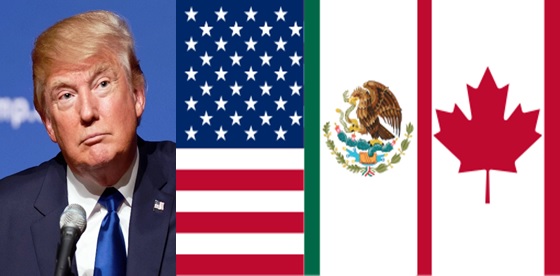
U.S. President-elect Donald Trump and the flag of the North American Free Trade Agreement (NAFTA). / Flickr and Wikimedia / Creative Commons / Modified

Despite his campaign rhetoric repeatedly attacking the North American Free Trade Agreement, U.S. President-elect Donald Trump probably won’t touch it, except in superficial ways.  He has called NAFTA the “worst trade deal ever,” and promised to pull the U.S. out unless Mexico and Canada agree to renegotiate it.  Last week, he suggested renegotiation of NAFTA will include provisions for Mexico to repay the U.S. government for the wall he wants to build along the border.

Dismantling or even significantly rewriting the accord is unlikely for a couple reasons:

  • First, the billionaires, chief executives, and friends he is choosing for his cabinet are hardly people inclined to dismantle an agreement whose contents largely reflect what American business wanted from the U.S.-Mexico relationship when NAFTA was being negotiated in the early 1990s. Corporate preferences weighed heavily against any big deviation from the status quo after the last political transition in Washington, in 2008.  Barack Obama too said that “NAFTA was a mistake,” though his criticisms were a little different.  He railed against lobbyists’ disproportionate influence over trade policy, and promised big changes to international trade agreements, including better protections for workers and the environment.  Even so, he didn’t touch NAFTA, and the Transatlantic Trade and Investment Partnership (TTIP) and the Trans-Pacific Partnership (TPP) he negotiated included – like NAFTA – shady provisions for investor-state dispute settlement.
  • It would be near-impossible, or least massively expensive, to get what Trump seems to want most: a big drop in imports from Mexico. In his eyes this would make NAFTA a better deal for America, though of course serious economists disagree.  Realistically, reopening the agreement would be very messy, and if he tried to throw up massive new trade barriers business leaders would strongly object.  NAFTA could include some additional measures to make it easier for goods and/or people to get around among the NAFTA countries, but that’s not what Trump has promised.

His economic nationalism makes the Republican Party establishment squirm, but it’s clear it also helped Trump win several Midwestern states, tipping the electoral college in his favor.  Insofar as agreements like NAFTA entrench rules friendly to business, and generate market efficiencies and economies whose benefits accumulate in the hands of the few, voter hostility is no mystery.  But economics is only part of the reason.  The bigger issue is what the backlash against globalization – embodied also by Brexit and the rise of neo-nationalist parties in Europe – means more broadly.  The average Democratic voter has a lower income than the average Republican voter, but Democrats are more supportive of trade agreements because they are more internationalist, more open to other cultures, younger, more educated, and more urban.  Throughout his presidency, Trump will therefore be squeezed between his working class rhetoric – appealing to the distrustful – and his business class milieu.  He is an extreme case of the politicians’ mercantilist thinking on trade, wherein exports are good and imports are bad, and “trade deals” like NAFTA are somehow like deals in the business world, where it’s possible to out-negotiate someone.  The reality is that this thinking – which flies in the face of basic economics – doesn’t point to any clear course of action.  This is why Trump won’t actually do much about NAFTA.

January 10, 2017

* Malcolm Fairbrother is social science researcher and teacher/mentor in the School of Geographical Sciences at the University of Bristol (UK).  This article is adapted from a recent blog post for the American Sociological Association.

2017: Happy New Year in Latin America?

By Eric Hershberg and Fulton Armstrong

posse_de_michel_temer_3

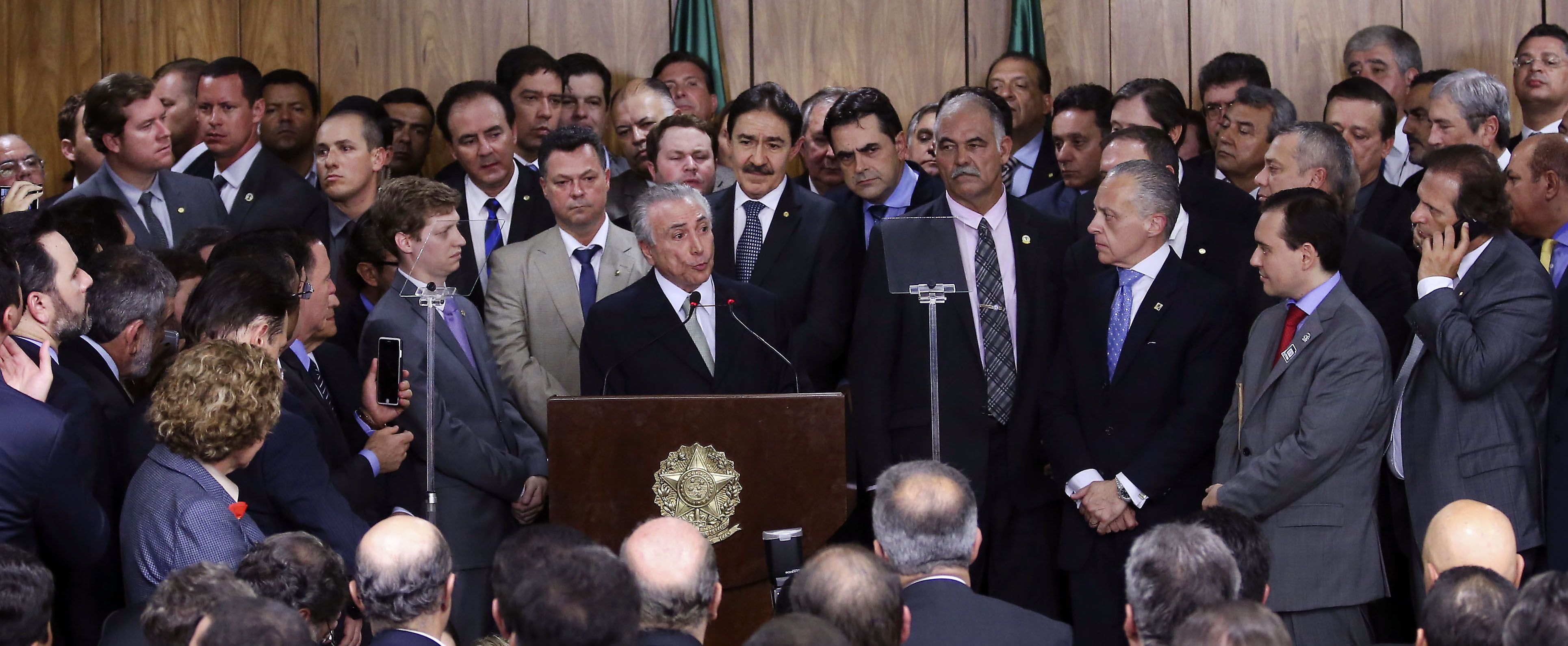
Brazilian President Michel Temer surrounded by members of his party in mid-2016. His government will continue to face questions of legitimacy in 2017. / Valter Campanato / Agência Brasil / Wikimedia / Creative Commons

The year 2016 laid down a series of challenges for Latin America in the new year – not the least of which will be adapting to a radically different administration in Washington.  Last year saw some important achievements, including an elusive peace agreement in Colombia ending the region’s oldest insurgency.  Several countries shifted politically, eroding the “pink tide” that affected much of the region over the past decade or so, but the durability and legitimacy of the ensuing administrations will hinge on their capacity to achieve policy successes that improve the well-being of the citizenry.  The legitimacy of Brazil’s change of government remains highly contested.  Except in Venezuela, where President Maduro clung to power by an ever-fraying thread, the left-leaning ALBA countries remained largely stable, but the hollowing out of democratic institutions in those settings is a cause for legitimate concern.  Across Latin America and the Caribbean, internal challenges, uncertainties in the world economy, and potentially large shifts in U.S. policy make straight-line predictions for 2017 risky.

  • Latin America’s two largest countries are in a tailspin. The full impact of Brazil’s political and economic crises has yet to be fully felt in and outside the country.  President Dilma’s impeachment and continuing revelations of corruption among the new ruling party and its allies have left the continent’s biggest country badly damaged, with profound implications that extend well beyond its borders.  Mexican President Peña Nieto saw his authority steadily diminish throughout the course of the past year, unable to deal with (and by some accounts complicit in) the most fundamental issues of violence, such as the disappearance of 43 students in 2014.  The reform agenda he promised has fizzled, and looking ahead he faces a long period as a lame duck – elections are not scheduled until mid-2018.
  • The “Northern Triangle” of Central America lurches from crisis to crisis. As violence and crime tears his country apart, Honduran President Hernández has devoted his energies to legalizing his efforts to gain a second term as president.  Guatemala’s successful experiment channeling international expertise into strengthening its judicial system’s ability to investigate and prosecute corrupt officials is threatened by a weakening of political resolve to make it work, as elites push back while civil society has lost the momentum that enabled it to bring down the government of President Pérez Molina in 2015.  El Salvador, which has witnessed modest strides forward in dealing with its profound corruption problems, remains wracked with violence, plagued by economic stagnation, and bereft of decisive leadership.
  • Venezuela stands alone in the depth of its regime-threatening crisis, from which the path back to stability and prosperity is neither apparent nor likely. The election of right-leaning governments in Argentina (in late 2015) and Peru (in mid-2016) – with Presidents Macri and Kuczynski – has given rise to expectations of reforms and prosperity, but it’s unclear whether their policies will deliver the sort of change people sought.  Bolivian President Morales, Ecuadoran President Correa, and Nicaraguan President Ortega have satisfied some important popular needs, but they have arrayed the levers of power to thwart opposition challenges and weakened democratic institutional mechanisms.
  • As Cuban President Raúl Castro begins his final year in office next month, the credibility of his government and his successors – who still remain largely in the shadows – will depend in part on whether the party’s hesitant, partial economic reforms manage to overcome persistent stagnation and dissuade the country’s most promising professionals from leaving the island. Haiti’s President-elect Jovenel Moise will take office on February 7 after winning a convincing 55 percent of the vote, but there’s no indication he will be any different from his ineffective predecessors.

However voluble the region’s internal challenges – and how uncertain external demand for Latin American commodities and the interest rates applied to Latin American debt – the policies of incoming U.S. President Donald Trump introduce the greatest unknown variables into any scenarios for 2017.  In the last couple years, President Obama began fulfilling his promise at the 2009 Summit of the Americas in Trinidad and Tobago to “be there as a friend and partner” and seek “engagement … that is based on mutual respect and equality.”  His opening to Cuba was an eloquent expression of the U.S. disposition to update its policies toward the whole region, even while it was not always reflected in its approach to political dynamics in specific Latin American countries.

 Trump’s rhetoric, in contrast, has already undermined efforts to rebuild the image of the United States and convince Latin Americans of the sincerity of Washington’s desire for partnership.  His rejection of the Trans-Pacific Partnership – more categorical than losing candidate Hillary Clinton’s cautious words of skepticism about the accord – has already closed one possible path toward deepened ties with some of the region’s leading, market-oriented economies.  His threat to deport millions of undocumented migrants back to Mexico and Central America, where there is undoubtedly no capacity to handle a large number of returnees, has struck fear in the hearts of vulnerable communities and governments.  The region has survived previous periods of U.S. neglect and aggression in the past, and its strengthened ties with Asia and Europe will help cushion any impacts of shifts in U.S. engagement.  But the now-threatened vision of cooperation has arguably helped drive change of benefit to all.  Insofar as Washington changes gears and Latin Americans throw up their hands in dismay, the region will be thrust into the dilemma of trying to adjust yet again or to set off on its own course as ALBA and others have long espoused.

 January 4, 2017

Cuba: Preparing for President Trump

By Fulton Armstrong

15859186069_103bf8055c_b

Photo credit: Day Donaldson / Flickr / Creative Commons

Cubans are already calibrating their expectations for relations with the United States under President Trump – hoping the normalization process does not unravel but preparing for a return to a sanctions-based policy from Washington.  Conversations in Havana reveal deep concern that the President-elect’s tweets and statements about Cuba, Mexico, and Latinos in the United States will translate into efforts to slow, stop, or reverse normalization.  The past two years of dialogue have focused on mutual interests, without ignoring remaining differences between capitals but not allowing them to blot out hopes of mutually beneficial cooperation.  Cuba will interpret a return to bombastic rhetoric, exaggerated conditions to reach a “deal,” and the pressure tactics of the pre-Obama era as a sign of U.S. willingness to put bullying a small neighbor eager for improved ties ahead of its own national interests.

Cubans present the stiff upper lip in conversations and, not surprisingly, defiantly note that they’ve already survived decades of U.S. pressure, but their disappointment is palpable.

  • Most concerned are entrepreneurs in Cuba’s small but growing private sector, who depend on investment from U.S.-based relatives and friends. More than 100 Cuban private businessmen wrote a letter to Trump last week urging restraint.
  • Nationalism has precluded Cubans from saying that normalization would be a major driver of their long-promised economic reforms, but few deny that improving ties with the United States would eventually present Havana important opportunities. U.S. retrenchment will remove important incentives for the government to move ahead with its reform strategy.
  • Rumors about tensions between Cuban proponents of normalization and conservative opponents may have some merit, but Cubans across the spectrum will close ranks if Trump gets aggressive.

Cuba’s reactions to Trump’s election, including President Raúl Castro’s congratulatory message to him, so far suggest that it will hold its tongue and resist being provoked.  A U.S. return to full-bore Cold War tactics would not pose an existential threat to Cuba, even considering the country’s difficulties dealing with unrelated problems such as the crisis in Venezuela.  Popular reactions to the passing of Fidel Castro last month are being construed as evidence of residual political legitimacy for the government and support for it to deliver on promised improvements.  Moreover, Cuba’s progress in normalization; its effective contribution to the Colombia peace accord; its new political dialogue and cooperation agreement with the European Union; and the recent Havana visit of Japanese Prime Minister Abe have boosted the country’s international image – and blame for collapse of normalization will surely fall solely upon the United States.  However difficult it will be for the proud people of Cuba to resist rising to whatever bait the Trump Administration throws its way, showing forbearance in the bilateral relationship and moving “without hurry but without pause,” as Raúl Castro said, with its national reform plan would protect the investment that Cuba has already made in normalization.

December 19, 2016

Does Trade Incentivize Educational Achievement?

By Raymundo Miguel Campos Vázquez, Luis-Felipe López-Calva, and Nora Lustig*

Female student walking by building

A student walks around Preparatoria Vasconcelos Tecate. / Gabriel Flores Romero / Flickr / Creative Commons

Mexico’s experience with free trade has challenged one of the tenets of faith economists know well from reading early in their careers David Ricardo’s Principles of Political Economy and Taxation: that “the pursuit of individual advantage is admirably connected with the universal good of the whole” and that “[trade] distributes labor most effectively and most economically.”  Under this principle, “wine shall be made in France and Portugal; corn shall be grown in America and Poland; and hardware and other goods shall be manufactured in England.”  Mexico reminds us that while these benefits exist in the abstract, there are trade-offs to be faced—that there are, potentially, social and individual costs induced by trade liberalization.

In a recently published paper entitled “Endogenous Skill Acquisition and Export Manufacturing in Mexico,” MIT economics professor David Atkin shows the ways in which individual people experience trade and how it affects their decision-making – sometimes in ways that may not necessarily be socially desirable.  It analyzes a time period (1986-2000) during which Mexico underwent major economic transformations, including a rapid process of trade liberalization after 1989 and the introduction of the North American Free Trade Agreement (NAFTA) in 1994.  Analyzing data for more than 2,300 municipalities in the country, the paper tells us that young Mexicans at the time faced a very basic decision: to stay in school and continue studying or to drop out and look for a job (among the many being created in the export-oriented manufacturing sector), most of which did not require more than a high school education.  Atkin found that, on average, for every 25 new jobs created in the manufacturing sector, one student would drop out after 9th grade.  (The World Development Report 2008 on Agriculture for Development had raised the question about “missing” individuals in this age group, but in relation to migration.)

  • While trade brought positive effects including a higher demand for low skilled workers and an eventual increase in their wages – consistent with David Ricardo’s basic notion – Atkin concluded that in Mexico it had the socially undesirable effect of preventing, or slowing down, the accumulation of human capital. The reduction in human capital investment is a trade-off which can have negative effects on the economy as a whole.
  • Factors other than free trade might explain this effect. First, young students may drop out if the returns to schooling are not high enough to compensate for the additional investment.  Second, a lack of access to credit and insurance for relatively poorer households might make it impossible for aspiring students to finance their investment and obtain higher returns by continuing to tertiary education or to cope with shocks and avoid abandoning school.  Finally, the result could be driven by a lack of availability of information about actual returns to investment in education, which could lead to myopic decision-making.

The movement of capital toward locations with lower labor costs is an expected, and intended, result of an agreement such as NAFTA, pursuing higher export competitiveness at the regional level.  David Ricardo would have said that TVs and automobiles shall be made in Mexico, while software shall be made in Silicon Valley.  What completes the story, however, is that because of distortions like the ones mentioned above – low educational quality, under-developed credit markets, or weak information that skews decision-making – free trade might lead to socially undesirable consequences.  And it did in the case of Mexico, as Atkin convincingly shows in his paper.  It seems that when Ricardo gets to the tropics, the world gets more complex.

November 7, 2016

* Raymundo Miguel Campos Vázquez teaches at the Centro de Estudios Económicos at el Colegio de México, and is currently conducting research at the University of California, Berkeley.  Luis-Felipe López-Calva is Lead Economist and Co-Director of the World Development Report 2017 on Governance and the Law.  Nora Lustig is Professor of Latin American Economics at Tulane University.

Challenging Assumptions about Supercycles in Peru and Latin America

By Claudia Viale and Carlos Monge*

spcc_gp22eco_ilo_-_toquepala

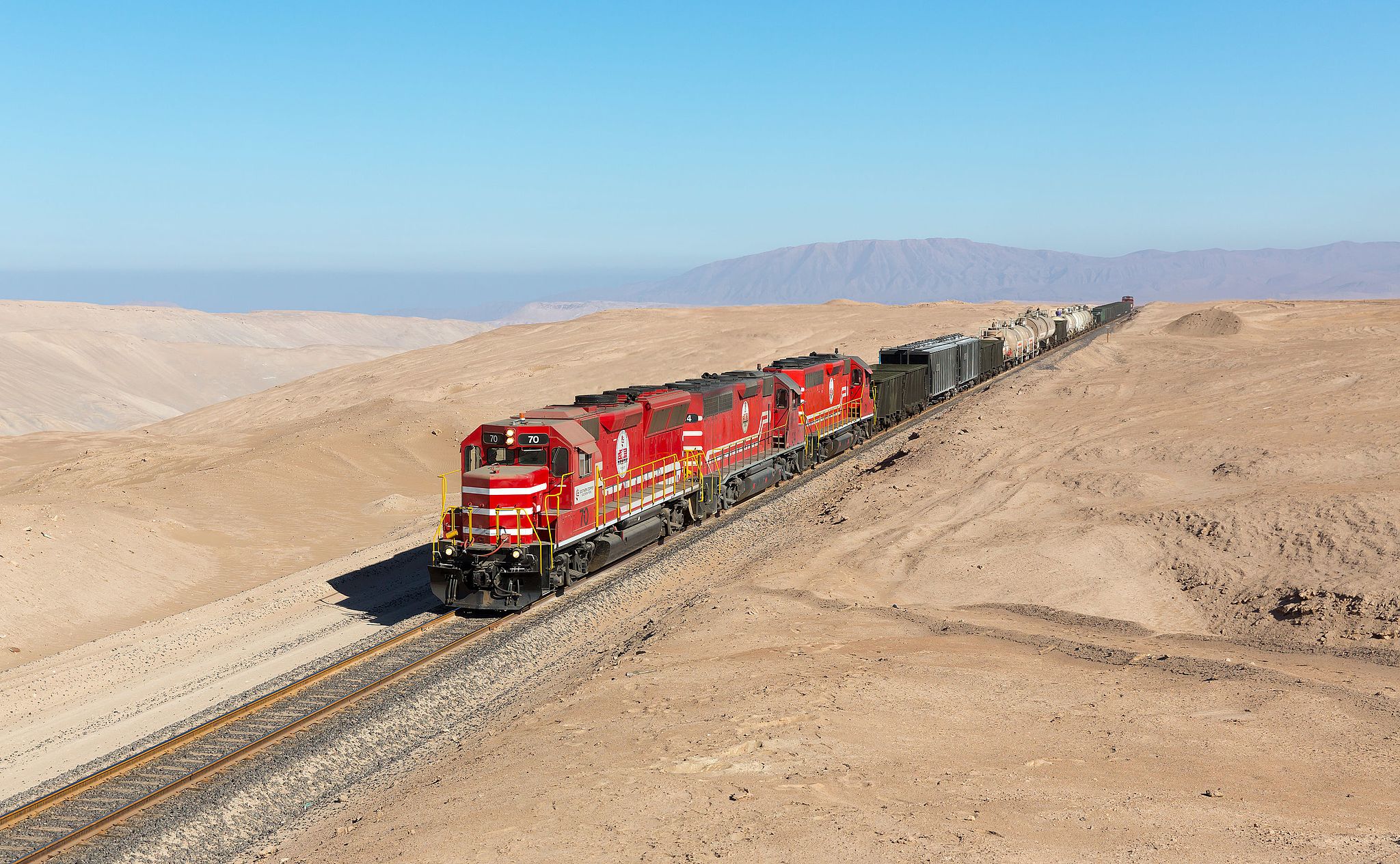
A Southern Copper Corporation train heading towards the Peruvian mines of Toquepala and Cuajone. / David Gubler / Wikimedia Commons / Creative Commons

The commodity-fueled “supercycle” that has propelled Latin American economies for the past decade and a half is ending, but careful analysis of other ongoing cycles will help countries cushion the blow.  ECLAC economist Jean Acquatella has identified four significant global cycles in which Latin America has actively participated as a raw materials exporter through the 20th and 21st centuries: U.S. industrialization; post-war European reconstruction and Japan’s industrialization; the post-1973 OPEC-driven oil boom; and, most recently, urbanization and industrialization in Asia, especially China.  During this fourth cycle – considered a supercycle because of sustained record levels of commodity prices and demand – resource-rich countries in Latin America experienced high growth rates, fiscal abundance, and a decrease in poverty rates as well as an increase in social conflict over the extraction of natural resources.  Slower Chinese growth has since reduced global demand and prices for the region’s minerals and energy, but the impact has been less severe than at the end of previous cycles.

  • José de Echave, of CooperAcción, has emphasized the need to differentiate the recent supercycle from what he terms the “extractive boom,” which started in the early 1990s as a result of the privatization of state mining and hydrocarbons assets and pro-market legislative reforms. His analysis indicates that the extractive boom will outlast the supercycle as long as large-scale projects mature and pro-investment policies continue in place.

The concessions, investments, production and fiscal rent during the past decade and a half in Peru and other countries indeed point to other cycles, some of which have enduring momentum.  Peru has experienced a “concessions cycle” for exploration activities; “investment cycles” as a result of privatization of state assets in the ‘90s and as a result of successful explorations and increased demand and prices starting in 2002; “productive and export cycles” as a result of investments; and a “fiscal cycle” of abundant public revenue.  Several cycles will obviously decline, but the country’s pro-investment policies remain in effect.  The new government of President Pedro Pablo Kuczynski is deepening policies started under former President Humala: reducing corporate income taxes, making environment compliance less onerous, and curtailing the oversight capacities of the Ministry of the Environment.  Investments made in the last five to ten years are, in many cases, only now beginning production.  Thus, as contradictory as it might sound, Peru is poised to double its copper production in the next five years.

The complex differences between “extractive booms” and “supercycles” have deep political implications.  The end of a supercycle could mean a substantial reduction in social conflict between local populations and extractive enterprises and government, but the current “race to the bottom” driven by pro-investment policies could fuel new tensions.  The Las Bambas project in the South Andean region of Apurimac, Peru, illustrates the point.  New legal procedures adopted in 2014 easing approval of environmental impact assessments (EIA) have allowed the Ministry of Energy and Mines to approve substantial changes in the project’s design and EIA without informing the local population and authorities, generating a violent local social reaction.  Available data shows analogous phenomena underway in Bolivia, Colombia, and Ecuador.  The implications will vary for each country, of course, but careful analysis is needed if state policies and civil society activism are to be on solid ground.

October 11, 2016

Claudia Viale and Carlos Monge are Program Associate and Latin America Director at the Natural Resource Governance Institute in Lima.


Cuba: Time to Move Ahead with Reforms

By Ricardo Torres*

cuba-economy

Oil drums and a tobacco curing hut near Viñales, Cuba / Adams Jones / Flickr / Creative Commons

The economic challenges that Cuba currently faces probably do not signal the beginning of a new Período Especial – the profound crisis Cuba experienced in the 1990s – but they are a painful reminder of the country’s chronic structural problem: the inability to generate enough hard currency to develop the economy and the failure of efforts to overcome that obstacle so far.  The immediate predicament was caused by a combination of internal and external factors, including the Venezuelan crisis and the low prices for certain Cuban exports.  (Ironically, oil byproducts from a refinery in Cienfuegos, which Cuba jointly owns with Venezuela’s PDVSA, have become a leading export.)  Venezuela is affecting income from services that Cuba sells there (in particular that of medical doctors) as well as a drop in the supply of oil products, which has covered about a half of Cuba’s needs.  This has placed extreme stress on Cuba’s external finances and forced a significant economic adjustment.  The government has imposed restrictions on energy consumption and a reduction in imports and investments – with important recessionary effects on an economy that desperately needs growth.  The energy rationing has fueled fears that the country could repeat the deep shortages of the early 1990s and again experience one of the most powerful symbols of that period: blackouts.

The situation is serious, but a crisis on the scale of the Special Period does not appear to be on the horizon.  Cuba today has a more diversified economy and produces a significant portion of its own energy, and the majority of the population has other sources of income to cushion themselves during bad times.  Most creditors and suppliers have shown confidence in their ability to move ahead.  In July, important contracts were announced for French companies to expand and operate Havana’s airport, which has been overwhelmed by the increase of international visitors (one of the few bright spots in the economy this year) in tandem with the improvement in relations with the United States.  Early this month, Cuban officials made presentations to firms from around the world on the government’s timely interest in renewable energy.  They emphasized the great opportunities that exist, not just current problems.

Once again, a close partner’s difficulties have put Cuba in a bind – too many times in too short a period.  Moreover, these problems arise at a politically sensitive moment.  Cubans are discussing the new model and development strategy through 2030, and – while Cubans are expecting results after six years of reform – President Raúl Castro has little time remaining in office.  The current complications can further delay essential monetary and exchange reforms.  Cuba needs to fix its foreign trade to supply oxygen for dynamic activities, such as its booming private sector.  Its development potential can’t rely just on its mystique as la Perla del Caribe.  Today’s challenges are an opportunity to remove the obstacles to changes that already have been announced, such as by accelerating the heretofore slow and ineffective implementation of agreed policies on foreign investment.  Some multilateral financial institutions can help, but Havana’s recent agreement with the Corporación Andina de Fomento (CAF), while a positive signal, is not enough.  The short-term answer is clear:  Only a combination of structural measures can guarantee that this latest economic crunch will be the last.

September 12, 2016

*Ricardo Torres is a professor at the Centro de Estudios de la Economía Cubana at the University of Havana and a former CLALS Research Fellow.

Colombia: Peace by Pieces

By Angelika Rettberg*

colombiapaz

Photo Credit: Government of Venezuela / Public Domain.

Despite challenges ahead, the Colombian state’s confrontation with one of the longest active revolutionary groups in the Western Hemisphere appears likely to reach closure by December.  As Colombian writer Héctor Abad has said, the peace agreement preliminary signed on August 24 is long, imprecise, often ambiguous, and tedious – certainly not a piece of entertaining literature – but it is the most eagerly awaited, downloaded, shared, and controversial official document in recent Colombian history.  The signatures of Colombian President Santos and FARC leader “Timochenko” are still pending, as is the result of a national plebiscite, to be held on October 2.

  • Humberto de la Calle, the government’s chief negotiator, defined the agreement as the “best possible” – a lukewarm description that fits well a process that has been rather anti-climactic. President Santos, who started the peace process and staked his reelection (which he barely won) on it two years ago, was more emotional and said, “Today, August 24th, we can say that hope has become reality.”
  • The agreement has already made permanent a cease-fire between the two sides. FARC fighters have begun to gather in the areas in which they will hand in their weapons and await the initiation of transitional justice proceedings.

Even if “yes” wins in the upcoming plebiscite – as surveys now predict – this peace by pieces presents challenges.  The accord has accomplished more than any Colombian process before and, by many normative international and academic standards, has been better designed and more professionally negotiated than any other Colombian accord.  It does not seem, however, to awaken most Colombians’ enthusiasm.  A generalized apathy or, in many cases, open disapproval of the negotiations can be linked to the absence of a sense of conflict-related crisis, especially in urban areas, where there has been a steady decline in battle-related casualties for years.  In addition, as the World Bank and international media have reported, Colombia’s economic performance has been steadily improving.  No longer the Andean problem case, Colombia is now a preferred destination for international investment in Latin America.  The “paradox of plenty, Colombian style” – success in promoting security and investment amid conflict resulting – has ended up eroding support of peace negotiations.

International support for several peace-building tasks will not translate into enormous amounts of desperately needed resources.  FARC demobilization, victims’ reparations, and addressing the needs of the most conflict-affected regions of the country will carry a big price tag for years to come.  Most economic and political resources for implementing the agreements will need to be raised domestically, and local authorities and communities will be increasingly reluctant to prioritize the needs of conflict-related social groups.  In addition, much needed fiscal reform will further affect political support for the government.  A core group of economic elites have backed negotiations unconditionally and have been well represented at the table.  However, the costs and vagaries of the implementation process will strain the support of peace´s crucial allies.  In this context, it will be difficult for any leading candidate to fully endorse the agreements in the upcoming presidential election of 2018.  Considering these limitations, not only the peace agreement, but also the resulting change, may only be “the best possible.”

September 7, 2016

* Angelika Rettberg is Associate Professor in the Political Science Department, Universidad de los Andes, in Bogotá.