Can Peru’s Democracy Recover?

By Cynthia McClintock*

Photographs from the early hours of the Generation Z protest in Peru, 2025
(Source: Wikimedia Commons)

Since 2021, democratic backsliding has been severe in Peru, and Peruvians are furious. Peru’s Congress is loathed. In 2025, the approval rating for Peru’s President, Dina Boluarte, fell below 3 percent and she became the most unpopular president on the planet. Finally, in October, Boluarte was impeached on the grounds of “permanent moral incapacity”; it was the fifth time since 2018 that a president had been impeached or had resigned upon imminent impeachment.  Per Peru’s constitution, Boluarte was succeeded by the Congress Speaker, José Jerí. Presidential and Congressional elections are scheduled for early 2026.

Why are Peruvians so angry? What does their anger mean for the 2026 elections (with the Congressional elections and the first round of the presidential elections scheduled for April 12 and a likely runoff on June 7)? Is it possible that the elections can lead to a democratic recovery?

Why are Peruvians So Angry?

The key reason is not “the economy stupid,” but an escalation of organized crime and the perception that Peru’s political leaders are part of the problem rather than part of the solution.

Between 2019 and 2024 the number of homicides doubled and the number of reported extortions jumped sixfold. Extortion is hurting huge swathes of lower-middle class Peruvians. Transport workers have been particularly vulnerable; so far in 2025, approximately 50 bus drivers have been killed for refusing to make extortion payments.

The reasons behind the crime escalation are various. Demand for cocaine remains high and, over the last decade, Peru’s coca cultivation has increased. As the price for gold jumped, so did illegal gold mining. Peru’s gangs are fragmented—and therefore hard to track—and they have developed nefarious new strategies such as using WhatsApp for extortion.

But, Peruvians believe, the reasons also include the government’s complicity. In part because illicit operators have provided campaign finance, in 2024 approximately half of Peru’s legislators were under criminal investigation; these same legislators have passed laws to impede investigations and prosecutions. Boluarte herself is under investigation for various crimes, including illicit enrichment. She sported a Rolex watch priced at $19,000, despite no evident financial means for such extravagance.

Further, from the start large percentages of Peruvians did not deem Boluarte a legitimate president. In 2021-2022, Boluarte was Vice President under President Pedro Castillo. Leading a far-left party in fraught elections during COVID, Castillo was an accidental, unprepared president. He was virulently opposed by the dominant right-wing forces in Congress, in particular Fuerza Popular, the party of Keiko Fujimori, the daughter of former authoritarian President Alberto Fujimori. As Vice President, Boluarte had said that, if Castillo were impeached, she too would resign, triggering new elections. However, in the event of Castillo’s December 2022 impeachment, Boluarte stayed on, despite massive protests and ubiquitous calls for new elections.

As President, Boluarte appeared indifferent to Peruvians’ concerns. Between December 2022 and February 2023, 49 civilian protesters were killed by the security forces. Boluarte’s response was support for an amnesty law. And, amid an October 2025 transport workers’ strike, Boluarte’s advice to Peruvians worried about crime was that they should not open text messages from unfamiliar people—placing blame for crimes on the victims.

What Does Peruvians’ Anger Mean for the 2026 Elections?

Peruvians’ anger spells difficulties for its incumbent parties and advantages for parties that can claim an “outsider” mantle. Fujimori’s Fuerza Popular is widely considered the dominant party in the Congress, and it will struggle against this perception. Its presidential candidate, Fujimori, is running for the fourth time and is likely to have worn out her welcome.

Not surprisingly, demands for an “iron fist” against crime are strong. The current presidential frontrunner is Renovación Popular’s Rafael López Aliaga (aka “Porky”), a Trump-like far-rightist who placed third in the 2021 election and was subsequently elected Lima’s mayor. López Aliaga promises a hardline strategy against organized crime, including implementing similar imprisonment policies to those of El Salvador’s Nayib Bukele. But Renovación Popular holds the fourth largest number of seats in Congress and it will be difficult for López Aliaga to claim an “outsider” mantle.

A candidate likely to claim an “outsider” mantle is Mario Vizcarra, running as a proxy for his brother, former President Martín Vizcarra. As President in 2018-2020, Vizcarra confronted the dominant parties in Peru’s Congress, building his popularity but ultimately catalyzing his impeachment. After a strong showing in Peru’s 2021 legislative elections, he was disqualified from holding elected office for ten years. Yet, Vizcarra’s government was far from without fault. There are other candidates, including the popular former clown, Carlos Álvarez, who could seize the “outsider” mantle.

Can Peru’s 2026 Elections Lead to Democratic Recovery?

The challenges to Peru’s elections are serious. In recent years Fuerza Popular and other illiberal parties in Peru’s Congress have allied to skew the electoral playing field in their favor.  Interim President Jerí is, of course, new to his position and his possible impact on the elections is unclear. (His first-month record was better than was first expected.)

As elsewhere in Latin America, Peru’s illiberal parties have strategized to achieve the disqualification of viable candidates. As indicated, this strategy is currently being used against Vizcarra; it could also be used against a rising new candidate.

Peru’s illiberal parties have calculated that a plethora of candidates is in their interest. Currently, 39 party lists are registered. Such a head-spinning number is problematic for journalists trying to cover the campaign and problematic for voters trying to identify their preferred candidate, especially because pre-election polls are more likely to be inaccurate. Yet, Peru’s Congress cancelled a provision for a preliminary round of voting, in which parties would have been required to secure 1.5 percent of the vote in order to qualify for the “first round.”

Still, there are grounds for optimism. The massive protests of recent years have shown that Peruvians want their political views heard. Peruvians recognize the importance of honest, capable leadership and want to find it.

*Cynthia McClintock is Professor of Political Science and International Affairs at George Washington University.

Bolivia Decisively Enters New If Unknown Political Territory

By Robert Albro, Associate Director, CLALS

Rodrigo Paz is sworn in as president of Bolivia, 2025
(Source: Wikimedia Commons)

Centrist Rodrigo Paz’s victory in October’s runoff election signals a dramatic change of direction for Bolivian politics. The era of dominance of the Movement Toward Socialism (MAS) party, led by ex-president Evo Morales, is definitively over. For only the second time since 2006 the MAS will not control the presidency. As a result of the recent election, it now has a mere two representatives in the legislature’s lower house, and no one in the upper house. Though it does not hold an outright majority, Paz’s Christian Democratic Party is now the single largest presence in both legislative chambers. How did Bolivia get here?

Twenty years ago, the leftist-populist MAS swept into power, as a new and energetic grassroots alternative to the elite-run traditional parties that had traded off governing Bolivia since the end of dictatorship in 1982, or one could even argue, since the 1952 Revolution. The MAS’s popularity sprung largely from the dynamism of Morales, himself, then a coca grower union leader adept at organizing and leading large-scale protests in opposition to prevailing Washington Consensus policies and government efforts to sell off Bolivia’s non-renewable resources to transnational corporate interests. The MAS styled itself a bottom-up social movement and not a party. Its participatory “lead by following” approach to governance appealed to a great majority of indigenous voters and working-class people of indigenous descent.

Morales and the MAS proved historically consequential in undertaking a contentious but innovative rewrite of the country’s Constitution, which went into force in 2009. It fully embraced Bolivia’s “plurinational” identity and incorporated an unprecedented variety of collective indigenous rights of consultation, to their traditional territories, and perhaps most controversially, of judicial autonomy. The Morales administration also used a large surplus from the country’s extractive boom to finance a wide range of new social safety net provisions that halved the number of people living in poverty, including cash transfers to families, a pension program, minimum wage increase, as well as public investments in schools, hospitals, and other infrastructure. Perhaps most importantly, his presidency raised the public visibility of Bolivia’s indigenous majority, no longer as second class citizens but as political protagonists of their own present and future.

Morales and the MAS were immensely popular. But then cracks began to appear. In 2011 a plan to build a controversial highway through a protected indigenous reserve brought the MAS government into direct conflict with the reserve’s residents, damaging its support among some indigenous groups. When the extractive boom ended around 2014, Bolivia’s economy slowed considerably, and the MAS fiscal policies that had lifted so many out of poverty became increasingly unsustainable. Part of the problem was Morales, who served two presidential terms and aspired to another, without any thought to a succession plan. Constitutionally limited to two terms, in 2016 he soundly lost a national referendum in a bid for a third and then ignored the result, further alienating many former supporters.

The upheaval around the contested 2019 election, which eventuated in Morales going into exile in Mexico and the persecution of MAS loyalists by a rightwing caretaker government, set the stage for the party’s eventual fall from grace. The 2020 election restored the MAS to power. But soon Morales and the new president, his ex-finance minister Luis Arce, were in a pitched battle for control over the party, a bitter and increasingly personal rivalry that fatally fragmented the MAS into opposed camps. Their protracted feud, which paralyzed congress, strayed into surreal territory, with accusations of a staged coup and mutual assassination attempts. The credibility of the MAS was so fundamentally damaged that the incumbent Arce, with his poll numbers plummeting, suspended his campaign. Morales, meanwhile, remains holed up in his coca grower redoubt to avoid criminal charges.

The MAS-led government’s political fragmentation, and its ineffectual response to Bolivia’s increasingly disastrous economy, have left the party deeply unpopular. The country is currently floundering amid its worst economic crisis in 40 years. Its natural gas production is half of what it was in 2014, with nothing to replace it. Bolivia has failed to develop its large reserves of lithium. Depleted currency reserves and a scarcity of US dollars have driven up inflation, creating severe shortages of fuel and basic goods. Over the past year, ordinary Bolivians have angrily expressed their discontent with the country’s economic collapse through repeated strikes and protest actions.

Emerging from this bleak political and economic state-of-affairs is the surprise election winner, Rodrigo Paz. Son of onetime leftist president Jaime Paz Zamora, former mayor of Tarija, and recently a senator, Paz’s campaign focused on restoring Bolivia’s economy, but gradually rather than by instituting sweeping fiscal austerity measures as his rival in the run-off proposed. Non-indigenous, pro-business, and ideology averse, Paz successfully positioned himself as a pragmatic reformer. He has delivered a strong anti-corruption message, pledged to restore relations with the US and bring back foreign investment. His populist call for a “capitalism for all” hopes to thread the needle by mixing decentralization, lower taxes, support for small businesses, and greater fiscal discipline, with continued spending on popular MAS-era social programs.

Paz’s critics argue that what he proposes is an impossible fiscal balancing act. Desperate and impatient Bolivians will expect immediate results. But it remains far from clear whether Paz will be able to overcome likely regional opposition to at least some of his policies. And if he does not stabilize the country’s dysfunctional economy quickly, Paz’s political honeymoon might be brief.

The Rise, Decline, and Crisis of Ecuador’s Indigenous Movement

By Dr. Pablo Andrade Andrade

October 17 Demonstrations (Manifestaciones del 17 de Octubre)
(Source: Wikimedia Commons)

Just six years ago, in 2019, the three major organizations of the Ecuadorian indigenous movement were on the rise. CONAIE (the Confederación de Nacionalidades Indígenas del Ecuador) led the charge against Lenin Moreno’s government. For eleven days their widespread demonstrations posed a serious threat to the government’s stability. The “Paro Nacional” (Nationwide Strike) not only facilitated CONAIE’s alliances with the other two indigenous organizations (FENOCIN, the Federación Nacional de Organizaciones Campesinas, Indígenas y Negras, and FEINE, the Federación Ecuatoriana de Indígenas Evangélicos) but also broadened its coalition with a diverse range of civil society organizations, marking a significant shift in Ecuadorian politics. The impact of the indigenous movement on Ecuadorian politics was profound, as Moreno´s government was seriously weakened. Two years later, in 2021, CONAIE’s political party, Pachakutik, won substantial representation in the National Assembly and placed third in the Presidential elections.

In 2022 CONAIE’s president, Leonidas Iza, led a successful national strike against Guillermo Lasso’s right-wing government. His leadership, bolstered by unity among indigenous communities and their allies, made it the most powerful leftist organization. Newfound solidarity among indigenous communities and stronger ties with student, feminist, and environmental movements, enhanced Iza’s national and international reputation. Less than a year later, President Lasso had to end his term and called for early general elections. However, at that moment Iza´s radical wing of CONAIE also attempted to impose its agenda over Pachakutik and the Amazonian federation CONFENIAE, which proved to be a high-cost strategy. The internal conflicts that followed led, in 2025, to the most serious electoral defeats that both organizations had suffered in decades.

The 2023 general elections were marred by prison massacres and political assassinations, including that of presidential candidate Fernando Villavicencio and the mayor of Manta, among numerous other government officials. Amid this unprecedented turmoil, a young center-right candidate, Daniel Noboa, emerged victorious as interim president. His win signaled yet another shift in Ecuador’s political landscape, with the country’s fragile democracy once again at the mercy of a personalist, plebiscitarian president.

The first warning sign of the current political turn to populist rule came with the 2025 regular election. The President’s party (Alianza Democrática Nacional, ADN) and the opposition party (Revolución Ciudadana, RC) totalled over 80 percent of National Assembly representatives. Noboa won his first five-year mandate. Pachakutik saw its representation shrink to five members, who the government rapidly coopted. Free from legislative checks, Noboa advanced his economic adjustment program. In addition, amid the ongoing public security crisis, Noboa expanded the military’s role in maintaining domestic order. Although assassinations have risen since 2023, militarization has strengthened Noboa’s control over organized violence, boosting political support for his government.

As part of its economic program, in September 2025, the Noboa administration raised diesel prices, a decision that in 2021 and 2022 sparked the wrath of CONAIE. But the leaders misjudged the lasting strength gained in 2021 and 2022, failing to account for damage from the 2023 and 2025 leadership races. As a result, they  rushed to emulate the apparent successes of the past. This time, however, CONAIE was at its lowest point. Unable to coordinate a nationwide strike, organizations in the northern province of Imbabura were left to their fate. The indigenous peoples of Cotacachi, Ilumán, Peguche, and Otavalo sustained demonstrations for a month. Still, they paid a high price in lost lives, injured people, and detainees due to systematic and brutal repression at the hands of the Armed Forces and the Police. This time, the government did not back down; the solidarity of  allied urban groups was, in this case, mostly symbolic and ineffective.

If CONAIE’s crisis should not be seen as the end of the indigenous movement, its significance cannot be overlooked. While grassroots mobilization once seemed effective, Noboa’s strong appeal and military support present new challenges. The aftermath of the national strike has called into question CONAIE’s representativeness and capacity to organize. An emboldened Noboa is now proposing a national plebiscite, in which he will likely be victorious, while Ecuador’s civil society appears weaker than ever. The challenges ahead are complex. The failed challenge to Noboa´s government could herald a new era of competitive authoritarianism, a scenario made even more likely by renewed international tolerance of hybrid forms of democracy. The lost battle left the indigenous organizations of Imbabura with wounds that could be challenging to heal, and racism lurks underneath the surface of Ecuador’s still young experiment with intercultural co-governance.

Pablo Andrade Andrade is Professor and Chair of the Germánico Salgado Lectures, Universidad Andina Simón Bolívar

*This post continues an ongoing series, as part of CLALS’s Ecuador Initiative, examining the country’s economic, governance, security, and societal challenges, made possible with generous support from Dr. Maria Donoso Clark, CAS/PhD ’91.

On the U.S. – Argentina Currency Swap

By Dr. Susana Nudelsman

Central Bank of Argentina (Banco Central de la República Argentina)
(Source: Wikimedia Commons)

In October of this year, the United States Treasury Secretary Scott Bessent ratified the signing of a US$20 billion currency swap with the Central Bank of Argentina as part of an “economic stabilization agreement” (Buenos Aires Herald, 2025). Moreover, the U.S. Treasury announced it is working on a complementary US$20 billion credit line that would be provided by private-sector banks and sovereign wealth funds (La Nación, 2025).

According to the Argentine banking institution, this agreement seeks to contribute to the country’s macroeconomic stability, emphasizing the need to preserve price stability and promote sustainable economic growth. The swap operations will enable the Central Bank of Argentina “to expand its set of monetary and exchange rate policy instruments, including the liquidity of its international reserves”, in line with the regulatory functions outlined in its statutes. The agreement is an important factor of a far-reaching approach that aims to strengthen the country’s monetary policy and improve the Bank’s ability to cope with events of volatility in the foreign exchange and capital market (Central Bank of Argentina, 2025).

Why is Argentina interested in this agreement?

Peterson Institute Professor Maurice Obstfeld (2025) highlights Milei’s remarkable success in lowering inflation, achieving a federal budget surplus, and relaxing regulations. Prior to the present crisis, the IMF predicted that Argentina’s GDP would expand by 5.5 percent in 2025, after shrinking 1.3 percent in 2024. At the same time, the IMF’s initial assessment of April 2025 concluded that, with one exception, important objectives were met. Indeed, the country’s net foreign exchange reserves, which are primarily in US dollars, fell well short of their target level.

Harvard Professor Ricardo Hausmann (2025) explains that Argentina is trapped in a multiple equilibrium, that is, a situation in which given the same set of conditions, an economy can achieve two or more distinct and stable equilibrium outcomes. If investors are willing to lend money when they feel optimistic, this lowers interest rates helping the economy grow and keeping debt service low, thus confirming the initial expectations. Conversely, if investors become pessimistic, they demand high risk premiums, which causes interest rates to skyrocket, harming investment and making public debt more expensive, thus justifying their fear of a crisis.

For his part, the former Secretary of Finance of Argentina Daniel Marx (2025) underscores that the pre-election portfolio adjustment has been less complicated than in the past, which shows more credibility with banks and institutions. In this regard, financial support from the U.S. Treasury can be useful in creating a sequence that enables its orderly implementation. Hence, the funds obtained to cope with the ongoing problems could be used to address important unresolved issues rather than being used for other instances in which funds are being depleted in the short-term.

Why is the U.S. interested in this agreement?

As Brad Setser (2025), Senior Fellow at the Council on Foreign Relations, argues, Washington has an interest in Milei’s success, not only because of his emphasis on stabilizing the Argentine economy, but also because his commitment to the free-market approach could serve as an important example for the rest of the continent.

However, U.S. interest in the swap agreement should also be understood in terms of the momentous change that the architecture of international financial relations has been experiencing in recent times. Indeed, following various decades of growing global economic integration, the planet is now confronting the threat of policy-driven geo-economic fragmentation.

In this context, Argentina matters for the strategic interest of the United States. Scott Bessent (2025) has emphatically stressed that the country is “a systemically important U.S. ally and that the U.S. Treasury stands ready to do what is needed within its mandate to support Argentina.” In other words, the Trump administration’s bailout resembles Mario Draghi’s support for European stability in 2012 with his “whatever it takes” approach, applied to the Argentine case in 2025.

Vera Bergengruen (2025), a journalist for The Wall Street Journal, believes that Washington’s security policy is a sort of revival of the Monroe doctrine. While the prior doctrine sought to keep European powers out of the region, the current one is primarily focused throughout the Americas with an aim to reward loyalty and to root out enemies. In this respect, Argentinian political analyst Juan Landaburu (2025) points out that in the context of a North American withdrawal from other regions, the so-called “backyard” of the United States is gaining greater importance, but this time not because of European ambitions but because of China’s advances.

  • With the results of Argentina’s midterm elections, the government has gained public support for its pro-market approach, while also gaining ground in the international financial community.
  • For its part, the United States government welcomes this result, which reaffirms its political preferences and allows it to make projections about its strategic interests in Latin America.
  • That said, the swap agreement between the U.S. and Argentina, while not without risks, constitutes an opportunity to renew ties of cooperation in the context of the current complex architecture of international relations. The coin is in the air.

REFERENCES

Bergengruen Vera, 2025, Trump’s ‘Donroe Doctrine’ Aims to Dominate the Americas, The Wall Street Journal, October 22, available at https://archive.is/20251023231723/https://www.wsj.com/world/americas/trumps-donroe-doctrine-aims-to-dominate-the-americas-b31208dd

Bessent Scott, 2025, Argentina is a systemically important U.S. ally in Latin America, and the @US Treasury stands ready to do what is needed within its mandate to support Argentina, available at https://x.com/SecScottBessent/status/1970107351912075454

Buenos Aires Herald, 2025, Scott Bessent confirms Argentina-US currency swap has been signed, available at https://buenosairesherald.com/economics/scott-bessent-confirms-argentina-us-currency-swap-has-been-signed

Central Bank of Argentina (Banco Central de la República Argentina), 2025, The BCRA and the U.S. Department of the Treasury sign a USD 20 billion agreement for exchange rate stabilization, available at https://www.bcra.gob.ar/Pdfs/Noticias/acuerdo-bcra-tesoro-estados-unidos-EN.pdf

Hausmann Ricardo, 2025, Trump Alone Can`t Save Argentina, New York Times, October 15, available at https://www.nytimes.com/2025/10/15/opinion/argentina-milei-trump-bailout.html

La Nación, 2025, Estados Unidos prepara otra ayuda para la Argentina con el sector privado por US 20000 millones, October 16, available at https://www.lanacion.com.ar/estados-unidos/eeuu-prepara-otra-ayuda-para-la-argentina-con-sector-privado-por-us20000-millones-nid16102025/

Landaburu Juan, 2025, Por qué Trump mira a América Latina más que nunca? La Nación, October 25, available at https://www.lanacion.com.ar/el-mundo/por-que-trump-mira-a-america-latina-mas-que-nunca-y-cuales-son-los-riesgos-detras-de-su-estrategia-nid25102025/

Marx Daniel, 2025, De pesos a dólares: esta vez es algo diferente, El Cronista Comercial, October 21, available at https://www.cronista.com/suscripciones/?limit=false&continue=https%3A%2F%2Fwww.cronista.com%2Fcolumnistas%2Fde-pesos-a-dolares-esta-vez-es-algo-diferente%2F&kicker=Opini%C3%B3nExclusivo%20Members&title=De%20pesos%20a%20d%C3%B3lares%3A%20esta%20vez%20es%20algo%20diferente&summary=&image=https%3A%2F%2Fwww.cronista.com%2Ffiles%2Fimage%2F1272%2F1272625%2F68f969cdb980d_600_315!.jpg%3Fs%3D0eec9030d86ead2043d767eb59f61bac%26d%3D1761176231

Obstfeld Maurice, 2025, Argentina’s Credibility Trap, Brookings Institution, available at https://www.piie.com/blogs/realtime-economics/2025/argentinas-credibility-trap

Setser Brad, 2025, Will Trump’s $20 Billion Backing Help Milei Change Argentina’s Fortunes, available at https://www.cfr.org/article/will-trumps-20-billion-backing-help-milei-change-argentinas-fortunes


Susana Nudelsman is a Doctor in Economics focused on international political economy. Counselor at the Argentine Council for International Relations and visiting fellow at CLALS.

Vicissitudes of Global Inequality

By Dr. Susana Nudelsman

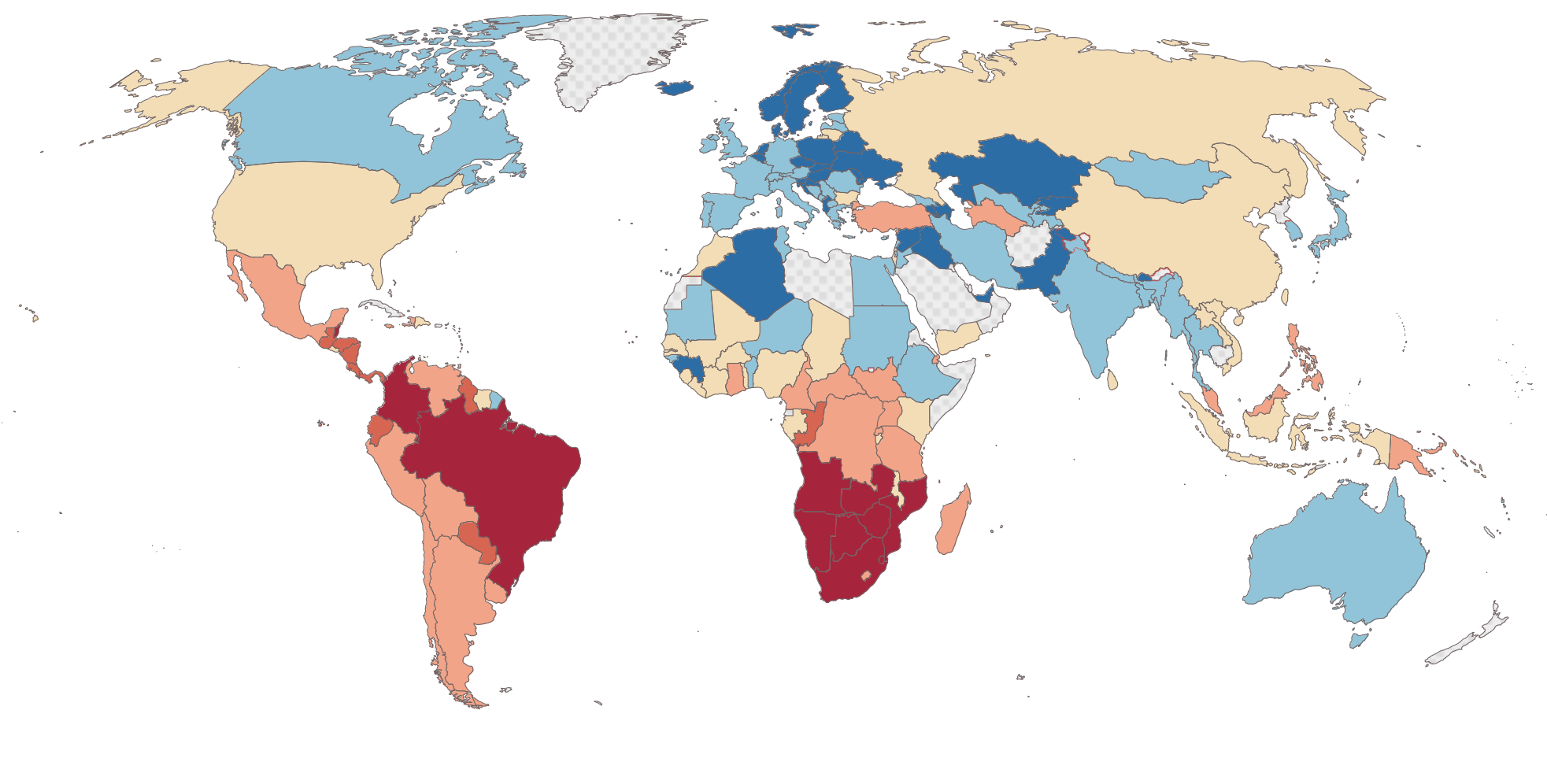
Global map of high inequality countries, 2022 (Source: Wikimedia Commons)

Global inequality is composed of two components: between-country inequality and within-country inequality. The between-country component assesses disparities in per capita gross domestic product between countries, either as an unweighted measure where each country counts equally, or as a weighted measure in which each country is weighted by its population, the latter being the methodology applied by most empirical studies. The within-country component adds up to the calculation of the disparities within countries (Neckerman and Torche, 2007).

Today, global inequality is greater than it was 200 years ago, but at the same time, it has stopped increasing for the first time since the Industrial Revolution. This downward trend has been driven by a reduction in inequality between countries—the main driving force of global income disparities—and should not be surprising, as growth rates in low-income Asian countries, especially China, significantly outpaced the global average. However, within countries, inequality has tended to increase. The pandemic led to a rise in global inequality, while for the following years, the data show a return to the downward trend, albeit at a slow pace and with differences across countries (Milanovic, 2019; World Inequality Report, 2022).

In particular, global inequality in the final quarter of the 20th century shows substantial changes. A rising global middle class in Asian countries — mainly China—, the establishment of a real plutocratic elite, and the steady income levels of the lower middle classes in wealthier countries are changing global economic, social, and political dynamics. In relative terms, the emerging global middle class has emerged as the primary “winner” of globalization; however, in absolute terms, the wealthiest and ultra-wealthy individuals have reaped the biggest rewards, while the poorest groups have received only a minimal share of the global wealth.

Regarding within-country inequality, three primary factors have influenced its development: technology, globalization, and politics. As a result, inequality in the most advanced Western economies, particularly the United States, includes the growing share of capital in the national pie, the high concentration of capital ownership, the higher return on assets of the richest, the rising correlation of high capital and labor incomes in the same people,  the rising mating among people of similar incomes, the greater intergenerational transmission of disparities and the strong control of the political process by those at the top who wield increasing power in a move towards plutocracy (Milanovic, 2019).

In this framework, the traditional political economy inquiry regarding the division between capital and labor in global income reveals a decline for the latter (Piketty, 2014), which has also been influenced by the race between technology and education (Goldin and Katz, 2008).

In China, the share of private capital earnings has increased in the context of a growing privatization process led by capitalist-business sectors and the professionals of the new middle class, who also, through their savings, significantly enhanced their status. The political structure in terms of bureaucratic effectiveness, absence of the rule of law, and state autonomy has, in contrast with Western experience, overshadowed the influence of the emerging capitalist class pandemic (Milanovic, 2019).

Regarding between-country inequality, the population-weighted measure indicates a decline since the late 1970s. Given that this measure represents the bulk of global inequality, changes in between-country inequality allow us to capture changes in the total quite accurately. Nevertheless, income gaps between countries persist today (World Inequality Lab, 2024).

China’s growth performance, and to a lesser degree India’s, has been a crucial equalizing element in driving this decline. Curiously, the swift economic expansion of this country is related to its idiosyncratic policymaking that clearly reveals a rejection of the principles of neoliberalism in its domestic policies, combined with its acceptance in its international economic interactions. And that sets China apart from numerous other developed and developing countries that adopted both the domestic and international aspects of globalization with great seriousness (Maddison, 2006; Hung and Kucinskas, 2011).

While the pandemic caused the most significant rise in global income inequality in over thirty years, the trajectory of global inequality largely depends on the growth of incomes in different regions worldwide. If the trends of the past thirty years persist, inequality could rise as the growth in those countries that helped reduce inequality now leads to greater inequality, as they occupy the higher tiers of the global income distribution. However, if less affluent countries today expand more rapidly than their wealthier counterparts, worldwide inequality might keep declining (García Rojas et al., 2025).

  • Summing up, global inequality is higher than at the dawn of capitalism, but it stopped increasing and even started a downward trend in recent decades.
  • Since 1800, within-country inequality has decreased its share in global inequality, thus narrowing class divisions in societies, but has recently shown an upward trend.
  • Since 1800, between-country inequality has increased its share in the total, and while it has registered a downward trend since the late 1970s, it still accounts for the majority of global inequality, so the location where we are born undoubtedly influences our future. Furthermore, existing disparities between countries still reflect inequality of income and opportunity.

References

Garcia Rojas Diana C., Nishant Yonzan and Christoph Lakner, 2025, Global Inequality and Economic Growth The Three Decades before Covid-19 and Three Decades After, Policy Research Working Paper 11093, World Bank Group.  

Goldin Claudia and Lawrence F. Katz, 2008, The Race between Education and Technology. The Belknap Press of Harvard University Press.

Hung, Ho-F. and Jaime Kucinskas, 2011, Globalization and Global Inequality: Assessing the Impact of the Rise of China and India, 1980-2005, American Journal of Sociology, 116 (5).

Milanovic Branko 2019, Capitalism Alone, The Belknap Press of Harvard University.

Neckerman, Kathryn M. and Florencia Torche, 2007, Inequality: Causes and Consequences, Annual Review of Sociology, 33.

Piketty Thomas, 2014, Capital in the Twenty First Century, The Belknap Press of Harvard University Press.

World Inequality Lab Activity Report, 2024, World Inequality Lab, available at https://wid.world/www-site/uploads/2025/03/WIL-Activity-Report-2024.pdf


Susana Nudelsman is a Doctor in Economics focused on international political economy. Counselor at the Argentine Council for International Relations and visiting fellow at CLALS.

Immigration as the Current Main Driver of Economic Growth in the U.S.

By Ernesto Castañeda, Edgar Aguilar, and Natalie Turkington

A new report from CLALS and the Immigration Lab finds that recent immigrants are a key driver of economic growth in the United States.

The report presents an original calculation that finds that only in 2022:

  • Immigrants who sent money home contributed over $2.2 trillion dollars to the U.S. economy.
  • This contribution by migrant labor constitutes about 8% of the U.S. GDP.
  • Remittances represent just 4% of the total output generated by immigrants, even if they add up to $81.6 billion annually, disputing the narrative that immigrants drain the U.S. economy.


Immigrants who remit contribute around $2.2 trillion annually to the U.S. economy. Despite concerns that remittances drain U.S. dollars, they only represent 4% of immigrants’ total contributions. This estimate is based on credible sources indicating that 17.5% of immigrants’ income is sent as remittances and considering a combined yearly salary of approximately $466.5 billion.  Using data from the World Bank, the Association for Central Banks of Latin America, the U.S. Census Bureau, and the Bureau of Labor Statistics, however, this is just a good approximation to quantify some of the benefits of migration. Immigrants’ contributions to the economy are greater as not all send remittances through formal channels. Additionally, it overlooks the economic growth immigrants stimulate by spending their wages in the U.S., creating demand, and generating jobs. Not to say anything about the human, cultural, culinary, and creative contributions. Below are more details about this novel estimation and projections of future contributions by immigrants to the U.S. economy.

The Congressional Budget Office’s Demographic Outlook 2024-2054, which has gotten some deserved media attention, estimates that in 2034 the U.S. economic output will be $7 trillion larger due to new immigration. Tax revenues would also be higher and the deficit lower because of immigration all else equal.

The quote from the CBO Director’s press release is, “in our projections, the deficit is also smaller than it was last year because economic output is greater, partly as a result of more people working. The labor force in 2033 is larger by 5.2 million people, mostly because of higher net immigration. As a result of those changes in the labor force, we estimate that, from 2023 to 2034, GDP will be greater by about $7 trillion and revenues will be greater by about $1 trillion than they would have been otherwise.”

We estimate immigrants’ contribution to the U.S. economy between 2023 and 2034 will be greater. Using the same immigration estimates as the Congressional Budget Office’s (see graph below), we calculate new immigrants have the potential to elevate the U.S. economic output by a staggering $17 trillion just in 2034.

Net population growth is through immigration.

Source: Congressional Budget Office interactive graph here.

However, if the number of new immigrants and asylum seekers continues at the same pace as in estimated for 2024, 3.3 million per year (10,000 per day as happened in December of 2023), we calculate that the U.S. would enjoy an increased economic output of over $37 trillion just in 2034.

As the Economic Policy Institute writes, “The unemployment rate for U.S.-born workers averaged 3.6% in 2023, the lowest rate on record. Obviously, immigration is not causing high unemployment among U.S.-born workers.” They further write, “immigrants that make up 18.6% of the U.S. labor force are playing key roles in numerous industries and are employed in a mix of lower, middle, and higher-wage jobs. And as the Congressional Budget Office recently reported, immigration is contributing to strong economic growth—with future immigration forecasted to boost real gross domestic product by 2% over the next 10 years—as well as increasing government revenue. Immigrants are also complementing U.S.-born workers by contributing to overall population and workforce growth. The U.S. Census Bureau projects that if the U.S. were to have lower-than-expected immigration levels, the population would begin to decline in 20 years, and if there were suddenly zero immigration, the population would begin to decline next year, deeply harming economic growth.”

A Washington Post article states that around 50% of the growth in the labor market in 2023 was due to foreign-born workers. The same was the case in the 1990s.

In 2021, 45 million immigrants lived in the United States, accounting for 14% of the country’s population. Immigrants are integrated into American social, economic, cultural, and political life. The Immigrant Research Initiative calculates that “Immigrants account for 17 percent of the U.S. economic output (GDP), even higher than their share of the population. The United States has a $19.6 trillion economy according to the Bureau of Economic Analysis 2021 statistics, which means immigrants are conservatively responsible for $3.3 trillion of economic output.” This supports our calculation of around 2.2 trillion only from immigrants who send money abroad because many do not send remittances.

Estimates and projections vary, but what is clear is that there would be no economic growth without recent immigrant arrivals. If immigration (of all types) decreases in the following years, economic growth will most likely plummet, and inflation will rise. Furthermore, this does not only apply to the United States but to other countries as well.

You can find coverage of the report in Spanish here:

“Immigracion y Economia en EE.UU.” RTVE 24h.

“Los hispanos y el mercado laboral en EE. UU.” Y Esto No es Todo podcast on YouTube.

“Ernesto Castañeda y el mercado laboral en EE.UU.” RTVE audio.

Ernesto Castañeda is the Director of the Center for Latin American and Latino Studies and the Immigration Lab.

Edgar Aguilar and Natalie Turkington are research assistants at the Center for Latin American and Latino Studies.

Full report here.

From Coup Attempt to Inauguration: Guatemala’s Tumultuous Elections

by Edgar Aguilar*

February 21, 2024

“Dia nacional de la bandera de Guatemala.” Gobierno de Guatemala. Gobierno de Guatemala. CC. / Creative Commons License

Edie Cux, director of Acción Ciudadana, local chapter of Transparency International, spoke with CLALS’ researcher Edgar Aguilar about Guatemala’s recent presidential elections. Read a synthesis of the interview below.  

What were the defining issues in Guatemala’s recent elections? 

The main problem in the social imaginary here in Guatemala was the issue of the fight against corruption. This was key after years of exposed corruption in the government by Alejandro Giammattei. The other issue was security. 

How do presidential elections work in Guatemala? 

In Guatemala, there are two electoral rounds. The first round is in June and the second is in August. In the first round, there were 24 candidates. Many of the candidates had previously run for election. In the second round, there were 2 candidates, Sandra Torres and Bernardo Arévalo. 

Why was Mr. Arévalo making it to the final round a surprise?  

Sandra Torres, a perennial politician, was expected to make it to the second round. The surprise was Bernardo Arévalo. During the first round, Arévalo was initially in ninth place but then emerged as a surprise contender.  

How much support did Mr. Arévalo receive in the second round? 

In the second round, Bernardo Arévalo received 58% of the vote while Torres received 42%. That shows that people were really hoping for a change in the country. Arévalo was a new face and a left-wing or progressive candidate. Alternatively, Torres was a former first lady and had previously run for president twice.  

How did the uncertainty surrounding the inauguration of Mr. Arévalo begin? 

It started immediately after the first round when it was known that both Bernardo Arévalo and Sandra Torres were the favorites. From there, the attacks began against Arévalo’s Semilla party and the electoral authorities. Even the Prosecutor’s Office went after the people who participated in the polling stations and municipal, electoral, and departmental boards. This began a strategy of questioning the electoral results: going through a second review of the counts.  

Who started the questioning of the results?  

The Attorney General’s office initiated legal challenges that cast doubt on the election results. Judges joined in, further amplifying the uncertainty. Other groups used social media accounts, like X and TikTok, to spread narratives questioning the outcome. These unsuccessful efforts were part of a broader attempt by identified “coup plotters,” including influential groups such as congressmen. The goal here was to prevent Bernardo Arévalo from assuming power.  

The instrumentalization of both legal and social media channels was key to their strategy. They questioned Arévalo 

 but especially focused on the election results: the transmission of data and the electoral authority. At this point, the authorities of the Supreme Electoral Tribunal were practically in exile. They were stripped of the immunity that the law gives them.  

Were there actual irregularities in the process? 

These were the most observed elections in Guatemala, maybe ever. Actors like the European Union (EU) (with over 100 observers) and civil society organizations had mechanisms (like Mirador Electoral) to watch every step of the elections. After the elections, an Organization of American States (OAS) report confirmed clean results, corroborated by other countries and civil society.  

No international or national observer questioned the elections, except the Attorney General’s office. They illegally dug into things, opened bogus cases, demanded information from the electoral tribunal, and even took ballot boxes! Basically, they stole them, which I believe is illegal. This narrative only came from them. The OAS, with 29 votes, all countries, basically said the Attorney General was trying to mess with the results and backed the results.  

Why was there uncertainty until the day of the inauguration?  

Groups within Congress continued their efforts to obstruct Arévalo’s election until the inauguration day, delaying the swearing-in process by nine hours. 

Can you tell me what the day of the inauguration was like? 

Bernardo’s inauguration victory belongs to the people, especially the indigenous communities. Their 20-day strike, continued resistance, and unwavering presence on inauguration day, with mothers and children even sleeping in the Plaza de la Constitución, were crucial. Their sacrifice overflowed the central park, keeping spirits high even amidst delays. International observers, delegations from the OAS, Spain, the U.S., and key figures like Petro solidified the legitimacy of the process, forcing the “coup groups” to stand down. The transfer of power, thanks to the people’s energy, marked a dramatic shift in Guatemala’s political climate. 

What do Guatemalans expect now that President Arévalo has been inaugurated? 

At this moment, the panorama is changing a lot; there is already an expectation of how the new government is going to develop. There is a lot of hope, and everyone is waiting. Different civil society and especially indigenous peoples, we are all waiting to see what the new government is going to be like.  

What are the key takeaways from this turbulent process? 

Guatemala’s democratic institutions have been under attack since their beginning. The institutions have never been trusted. Indigenous people maintain alternative governance, economy, and justice structures. The state of Guatemala has not enjoyed the legitimacy that has been achieved in other states. Neither has it created the representativeness of a plurinational population. What happened in Guatemala is an example, globally, of what indigenous people have done to protect a democracy that does not even represent them.  

Currently, there are several democratic crises globally. Additionally, there are many examples of the instrumentalization of public institutions, especially the justice system, to attack democracy. Guatemala has brought to light how indigenous peoples propose sustainability not only environmentally but also for democracy and politics.  

Edition: Ernesto Castañeda 

Interview and writing: Edgar Aguilar 

Transcription and translation: Aleli Nava 

Copyright Creative Commons. Reproduction with full attribution is possible by news media and for not-for-profit and educational purposes. Minor modifications, such as not including the “About the Study” section, are permitted. 

Edgar Aguilar is an International Economics Master’s student at American University and a research assistant at the Center for Latin America and Latino Studies (CLALS). With four years of experience as a researcher and analyst, he specializes in migration, human security, energy, finance, and environmental policy. He is passionate about sustainable energy solutions that unlock prosperity in the Western Hemisphere.

X- @EdgarAAguilar

Where Is Cuba’s Economic Policy Going?

by Ricardo Torres*

A photo of Havana, Cuba taken in December 2023 / Ernesto Castañeda / Creative Commons License

In the concluding sessions of the National Assembly in December, the Cuban Prime Minister alluded to new economic policy initiatives aimed at “correcting distortions and boosting the economy.” Subsequently, he emphasized that these reforms should not be perceived as mere continuation of previous policies. His discourse encompassed several areas, including pricing and subsidies, the role of the private sector and small and medium-sized enterprises (SMEs), international trade and tariff regulations, investment, and the foreign exchange market, among others. In the first weeks of January, various representatives from the government elaborated on the price increases of essential goods, which has become a focal point of discussions due to the immediate impacts on people’s daily lives. This new wave of measures is being introduced against a unique context:

  • The Cuban economy’s inability to embark on a path to sustainable recovery after the economic downturn triggered by the COVID-19 pandemic is noteworthy. The year 2023 witnessed a contraction in the Gross Domestic Product (GDP), marking this period as the most severe crisis encountered by Cuba since the revolution in 1959, given its widespread economic, social, and political implications.
  • The ineffectiveness of previously implemented economic policies, including the so-called “Monetary Ordering,” is evident. The Cuban authorities persistently attribute these economic adversities to external factors, notably the sanctions imposed by the United States. There is little mention of the government’s obvious mistakes.  
  • The Biden administration’s limited opening towards Cuba has narrowed the window to implement substantial measures to mitigate the island’s economic challenges. 
  • The Cuban government has continued to search for support elsewhere. For example, Russia and China have provided some economic support, and Mexico has provided cheap oil, oxygen after the pandemic, and some food. But not one country can provide all the support that Cuba needs.

The measures announced thus far appear to have limited potential in contributing to the economic recovery. The fiscal strategy focuses more on revenue collection rather than containing expenditures, as indicated by the incomplete budget data for 2024 when the deficit is set to increase. 

  • Notably, the emphasis remains on preserving the extensive public sector, including state-owned enterprises, without introducing substantial structural reforms.
  • The marginalization, or at most, a cursory mention of other structural reforms aimed at stimulating domestic supply, is significant. The criticism of the private sector and the lack of initiatives to address external debt are particularly conspicuous. 
  • The potential impact of the price increase and these newly announced measures on the fiscal deficit remains ambiguous, especially given the scant details regarding their implications for the 2024 budget. Besides, these measures will likely exacerbate inflationary pressures in the short term.

In a rather dramatic turn, Cuban authorities announced the suspension of the price increases on January 31st, citing a cyberattack, and failed to commit to a new date. Furthermore, the government reshuffled the cabinet, including the sacking of the Economy Minister. 

The challenges of runaway inflation and elevated fiscal deficits should be viewed as symptoms rather than the root cause of the economic malaise. Historical evidence from the 1970s and 1980s has demonstrated that attempts to manipulate aggregate demand to counter stagflation are futile. Cuba’s economic stagnation, however, presents a unique case, having persisted for decades and intensified due to a series of adverse external shocks commencing around 2016 with the decline of Venezuela’s economy. Superficial adjustments to economic policies are unlikely to yield significant medium-term benefits. Instead, a concerted effort towards systemic change by both the government and international stakeholders is imperative. The existence of the political will and strategic insight, both within Cuba and internationally, to enact such comprehensive reforms to the ultimate benefit of the embattled Cuban people remains an open question.

Copyright Creative Commons. Reproduction with full attribution is possible by news media and for not-for profit and educational purposes. Minor modifications, such as not including the “About the Study” section, are permitted. 

Ricardo Torres is a Professor and Faculty Fellow in the Department of Economics, Research Fellow at American University’s Center for Latin American & Latino Studies, and Coordinator of the Red de Investigadores Cubanos (RedIC).