Venezuela- OAS: New Chapter in a Long Story

By Stefano Palestini Céspedes*

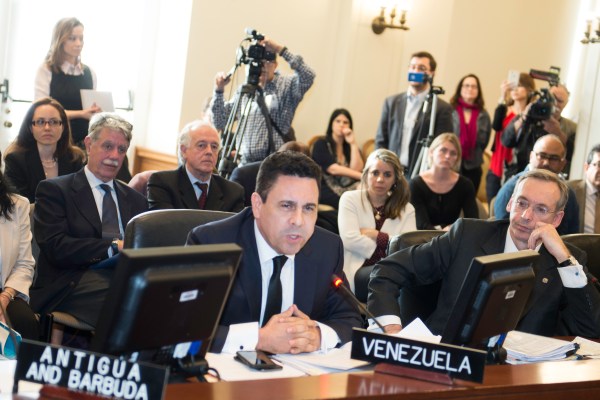
Special Meeting of the Permanent Council, April 3, 2017

On April 3, a special meeting of the OAS Permanent Council voted to condemn Venezuela’s action that allows the Tribunal Supremo de Justicia (TSJ) to take over the functions of the National Assembly. / Juan Manuel Herrera/ OAS / Flickr / Creative Commons

Venezuelan President Nicolás Maduro seems determined to validate critics’ claims that the separation of powers in Venezuela has been breached, thereby strengthening diplomatic efforts to force him to reverse course.  After the OAS Permanent Council met for two days to discuss Secretary General Almagro’s call for Caracas’ suspension, Venezuelan courts on March 29 authorized the Tribunal Supremo de Justicia (TSJ) to take over the functions of the National Assembly, and to limit the immunity of the members of the parliament.  The action reinvigorated an exhausted domestic opposition and further infuriated international observers.  Two days later, the TSJ overturned the two rulings after Maduro, casting himself as a mediator between competing constitutional powers, requested it.  These erratic actions signaled the worsening erosion of the rule of law as well as the divisions in the government and the Bolivarian movement.

  • The reversal did not take the edge off OAS General Secretary Almagro’s and others’ condemnation of the power grab as an autogolpe or “self-coup.” The Inter-American Democratic Charter was designed in 2001 precisely to provide the OAS with instruments to deter self-coups in the aftermath of those carried out by Alberto Fujimori (Peru) and Jorge Serrano (Guatemala) in the 1990s.

The TSJ decisions and Venezuela’s defiance didn’t put Almagro’s suspension efforts over the top, but the Permanent Council is now much more actively involved in the crisis.  Venezuela has isolated itself within the Permanent Council.  Speaking at the Council, its delegation severely criticized individual member states the day before the TSJ decisions.  Chile and Peru recalled their ambassadors for consultation after it.  Ecuador, an ally since the time of Hugo Chávez, distanced itself from Maduro.  On April 1, MERCOSUR invoked the Protocol of Ushuaia – the group’s democracy clause – against Venezuela, and it joined Colombia and Chile in a forceful public statement on behalf of UNASUR.  Mexico, historically a jealous guardian of the principle of non-intervention, has assumed the leadership in holding Venezuela accountable for its undemocratic practices.  As a result, the Permanent Council on April 3 approved a resolution condemning the TSJ decisions and committing to “undertake as necessary further diplomatic initiatives to foster the restoration of the democratic institutional system,” including convening a ministerial meeting.

Building a consensus for tougher action in the Permanent Council will be difficult, however.  Last week’s resolution was approved by 19 member states, but four abstained and 10 were absent.  Any proposal to suspend Venezuela will require two-thirds of the members’ affirmative votes.  Although there is still a long way to go to make the OAS part of the solution of the Venezuelan crisis, the General Secretary’s activism has set an important precedent in rallying a majority of states in the Americas to come together to discuss a member’s erosion of democratic principles and institutions – and to condemn the non-democratic actions of a democratically-elected government.  This is a first for the organization, and it is a big step toward fulfilling the original purpose of the drafters of the Inter-American Democratic Charter.

April 10, 2017

* Stefano Palestini Céspedes is a CLALS Fellow and Postdoctoral Fellow at the Department of Political and Social Sciences at the Freie Universität Berlin, where he specializes in international organizations and regional governance.

Latin America: The Spirit of Constitutionalism under Attack

By Maxwell Cameron*

Venezuela constitition

A participant in a march in Venezuela holds up the country’s constitution. / TeleSURtv / Flickr / Creative Commons

Recent events in Paraguay and Venezuela raise yet again the issue of whether political leaders are capable of deliberating and acting in ways that show an appreciation for constitutional essentials, or whether they choose instead to perform their roles and offices in ways that continuously test constitutional principles and, over time, contribute to their erosion.  The principles of re-election and term limits are important in every presidential democracy, the product of historical circumstance.  In the case of Paraguay, a dictatorship under strongman Alfredo Stroessner from 1954 to 1989, sensitivity to the idea of a president serving for too long is strong.  Venezuela’s elimination of term limits a few years ago set a dangerous precedent.  Other constitutions limit incumbents to one term (Mexico, Paraguay) or two terms (United States, Colombia); in some constitutions, presidents cannot be re-elected immediately but can run later after a term has elapsed (Peru, Uruguay).

  • More important than the constitutionality of term limits is that the re-election issue be settled in a way that commands the assent of all parties – within a certain spirit of constitutionalism. Paraguayan President Horacio Cartes’s error was to think that he could change the constitution by means that violated this spirit, even if the public would arguably support a modification of the re-election rule if pursued in the right way.  (Since the fall of Stroessner, the Partido Colorado, the pillar of his rule, has won every election except in 2008, when Catholic priest Fernando Lugo was elected.  Lugo was deposed in 2012.)  The President of the Senate, Roberto Acevedo, opposed the change and was outraged by the way it was adopted: the Senate voted in a special session held behind closed doors.  In that session, 25 Senators approved the measure, bypassing the opposition Partido Liberal Radical Auténtico.

The showdown in Venezuela over President Maduro’s effort to shut down the congress was another undemocratic blunder.  A decision by the Tribunal Supremo de Justicia (TSJ), Venezuela’s supreme court, to arrogate legislative functions to itself or delegate them to other branches or agencies was unconstitutional.  (The TSJ has the power only to declare a law invalid or that another branch of government is operating outside the law.)  When the Fiscal General de la República, Venezuela’s equivalent of attorney general, Luisa Ortega Díaz argued that the TSJ’s decision was unconstitutional, she gave herself political cover by expressing loyalty to the Constitution of 1999 – the legitimacy of which has long been undermined by the fact that it is a document made to measure for chavismo.  As a result of this and significant domestic and international pressure, the government backed down – a rare event.  The attorney general’s insistence that the constitution not be violated indicates that a spirit of constitutionalism among chavistas is not completely dead, but it also shows that it remains a mechanism for coordinating the actions of agents within the government.  Her position also raises the possibility of a split between constitutionalists and hardline militarists within the regime.

Democracy is not just a system of rules.  It requires politicians to acknowledge and respect the essential constitutional agreements that have to underpin the struggle for power in a self-governing community.  The crises in Paraguay and Venezuela both forewarn of the dangers of excessive partisanship and the risks of playing fast and loose with constitutional rules.  Something similar seems to be playing out in Ecuador, where allegations of fraud have been made by the opposition.  If spurious, they are condemnable; if supported by evidence, they are deeply disturbing.  Either way, they reflect mistrust in institutions after a decade of rule by Rafael Correa (Likewise, U.S. Senate Republicans’ threats to use of the “nuclear option” to confirm Judge Gorsuch threatens to deepen the politicization of the U.S. Supreme Court.)  The cost of the failure of politicians and citizens to cultivate a spirit of constitutionalism is very heavy.  In Paraguay, it has resulted in deadly protests and resignations by top officials; in Venezuela it has taken the country to the brink of civil war; in Ecuador, there is a real prospect of debilitating governance problems as Lenín Moreno of Alianza PAIS takes office; and in the United States we are starting to see the kinds of governance problems that have long been associated with the “politicized states” (to use Douglas Chalmers’s phrase) of Latin America.

April 5, 2017

* Maxwell A. Cameron is Director of the Centre for the Study of Democratic Institutions at the University of British Columbia.

OAS-Venezuela: Almagro Ups the Ante

By Stefano Palestini Céspedes*

32009916073_0a79dea9a2_k

Luis Almagro, OAS Secretary General, met with Freddy Guevara, First Vice President of the National Assembly of Venezuela, in Washington, DC in early February 2017. / Juan Manuel Herrera, OAS / Flickr / Creative Commons

OAS Secretary General Luis Almagro’s second report on Venezuela, issued on March 14, reflects his personal commitment to enforce the principles enshrined in the Inter-American Democratic Charter, but risks getting ahead of the organization’s member states and could ultimately hurt the credibility of the charter and OAS.  The 73-page document states that the government of Venezuelan President Nicolás Maduro has become a “dictatorial regime” that violates “every article” of the Charter; concludes that all attempts at dialogue have failed; and essentially calls for the OAS to suspend Venezuela’s membership in accordance with the charter’s democracy clause.  Almagro said the UNASUR negotiation (supported by the Vatican) has failed to achieve any of its proposed objectives and has become “a tool for reinforcing the regime’s worst authoritarian features domestically and, externally, for not engaging in international condemnation and pressure.”

  • The report concludes with an ultimatum: If the government does not call for general elections, release all political prisoners, restore all laws it has annulled, and select a new electoral authority and a supreme tribunal in the next 30 days, Venezuela should be suspended from the OAS. Few observers believe Maduro could meet these conditions even if he wanted.

Almagro’s actions, including his forceful call for application of Article 21 of the Charter – the “democracy clause” – moves his office and the OAS into uncharted territory as it would be the first time it is applied against an elected government.  Article 21 was applied against the government in Honduras that came to power in a coup in June 2009, but the sanctions were initiated at the request of ousted President Zelaya and strongly supported by Latin American governments – including Hugo Chávez – and Washington.  To enforce Article 21 against an incumbent government, a strong consensus needs to be built.

The Secretary General’s showdown with President Maduro presents a test for the Charter and, ultimately, for the OAS, as it pushes the organization beyond its traditional institutional limits.  Any decision on suspension must be approved by a two-thirds majority of member states, whose delegates represent executive branches that traditionally have shied from intervening in each other’s affairs.  Some insiders also grumble that the Secretary General has fallen short in his consultation with the member states; instead he seems to take a partisan position such as by inviting Maduro’s opposition to OAS headquarters this week for a press conference.  If the members back Almagro’s call for suspension, he will have demonstrated that principled arguments can break even strong institutional barriers – moving OAS into a new phase.  In that case, the Secretary General together with the member states will need to come up with a post-suspension plan; only then will OAS become part of the solution to Venezuela’s crisis.  If member states do not support the Secretary General’s call, Almagro will be respected as a leader moved by convictions, but the OAS will probably move one step down towards irrelevance.

March 21, 2017

Stefano Palestini Céspedes is CLALS Fellow and Postdoctoral Fellow at the Department of Political and Social Sciences at the Freie Universität Berlin, where he specializes in international organizations and regional governance.

2017: Happy New Year in Latin America?

By Eric Hershberg and Fulton Armstrong

posse_de_michel_temer_3

Brazilian President Michel Temer surrounded by members of his party in mid-2016. His government will continue to face questions of legitimacy in 2017. / Valter Campanato / Agência Brasil / Wikimedia / Creative Commons

The year 2016 laid down a series of challenges for Latin America in the new year – not the least of which will be adapting to a radically different administration in Washington.  Last year saw some important achievements, including an elusive peace agreement in Colombia ending the region’s oldest insurgency.  Several countries shifted politically, eroding the “pink tide” that affected much of the region over the past decade or so, but the durability and legitimacy of the ensuing administrations will hinge on their capacity to achieve policy successes that improve the well-being of the citizenry.  The legitimacy of Brazil’s change of government remains highly contested.  Except in Venezuela, where President Maduro clung to power by an ever-fraying thread, the left-leaning ALBA countries remained largely stable, but the hollowing out of democratic institutions in those settings is a cause for legitimate concern.  Across Latin America and the Caribbean, internal challenges, uncertainties in the world economy, and potentially large shifts in U.S. policy make straight-line predictions for 2017 risky.

  • Latin America’s two largest countries are in a tailspin. The full impact of Brazil’s political and economic crises has yet to be fully felt in and outside the country.  President Dilma’s impeachment and continuing revelations of corruption among the new ruling party and its allies have left the continent’s biggest country badly damaged, with profound implications that extend well beyond its borders.  Mexican President Peña Nieto saw his authority steadily diminish throughout the course of the past year, unable to deal with (and by some accounts complicit in) the most fundamental issues of violence, such as the disappearance of 43 students in 2014.  The reform agenda he promised has fizzled, and looking ahead he faces a long period as a lame duck – elections are not scheduled until mid-2018.
  • The “Northern Triangle” of Central America lurches from crisis to crisis. As violence and crime tears his country apart, Honduran President Hernández has devoted his energies to legalizing his efforts to gain a second term as president.  Guatemala’s successful experiment channeling international expertise into strengthening its judicial system’s ability to investigate and prosecute corrupt officials is threatened by a weakening of political resolve to make it work, as elites push back while civil society has lost the momentum that enabled it to bring down the government of President Pérez Molina in 2015.  El Salvador, which has witnessed modest strides forward in dealing with its profound corruption problems, remains wracked with violence, plagued by economic stagnation, and bereft of decisive leadership.
  • Venezuela stands alone in the depth of its regime-threatening crisis, from which the path back to stability and prosperity is neither apparent nor likely. The election of right-leaning governments in Argentina (in late 2015) and Peru (in mid-2016) – with Presidents Macri and Kuczynski – has given rise to expectations of reforms and prosperity, but it’s unclear whether their policies will deliver the sort of change people sought.  Bolivian President Morales, Ecuadoran President Correa, and Nicaraguan President Ortega have satisfied some important popular needs, but they have arrayed the levers of power to thwart opposition challenges and weakened democratic institutional mechanisms.
  • As Cuban President Raúl Castro begins his final year in office next month, the credibility of his government and his successors – who still remain largely in the shadows – will depend in part on whether the party’s hesitant, partial economic reforms manage to overcome persistent stagnation and dissuade the country’s most promising professionals from leaving the island. Haiti’s President-elect Jovenel Moise will take office on February 7 after winning a convincing 55 percent of the vote, but there’s no indication he will be any different from his ineffective predecessors.

However voluble the region’s internal challenges – and how uncertain external demand for Latin American commodities and the interest rates applied to Latin American debt – the policies of incoming U.S. President Donald Trump introduce the greatest unknown variables into any scenarios for 2017.  In the last couple years, President Obama began fulfilling his promise at the 2009 Summit of the Americas in Trinidad and Tobago to “be there as a friend and partner” and seek “engagement … that is based on mutual respect and equality.”  His opening to Cuba was an eloquent expression of the U.S. disposition to update its policies toward the whole region, even while it was not always reflected in its approach to political dynamics in specific Latin American countries.

 Trump’s rhetoric, in contrast, has already undermined efforts to rebuild the image of the United States and convince Latin Americans of the sincerity of Washington’s desire for partnership.  His rejection of the Trans-Pacific Partnership – more categorical than losing candidate Hillary Clinton’s cautious words of skepticism about the accord – has already closed one possible path toward deepened ties with some of the region’s leading, market-oriented economies.  His threat to deport millions of undocumented migrants back to Mexico and Central America, where there is undoubtedly no capacity to handle a large number of returnees, has struck fear in the hearts of vulnerable communities and governments.  The region has survived previous periods of U.S. neglect and aggression in the past, and its strengthened ties with Asia and Europe will help cushion any impacts of shifts in U.S. engagement.  But the now-threatened vision of cooperation has arguably helped drive change of benefit to all.  Insofar as Washington changes gears and Latin Americans throw up their hands in dismay, the region will be thrust into the dilemma of trying to adjust yet again or to set off on its own course as ALBA and others have long espoused.

 January 4, 2017

Local Ownership in Peacebuilding, Colombian style

By Angelika Rettberg*

30182229095_5b894a1d05_k

“Colombian peace is our American peace.” / urban_lenny / Flickr / Creative Commons

Amid the increased political juggling in Colombia as the government’s peace deal with the Fuerzas Armadas Revolucionarias de Colombia (FARC) has advanced, one key lesson is that the nature of “local ownership” will have an impact on its success or failure. After the razor-thin victory of the agreement’s opponents in the referendum on October 2 propelled the country into uncertainty, its proponents – buttressed by the informal deadline created by the Nobel Peace Prize being awarded to President Juan Manuel Santos on December 10 – tried a different track. Instead of calling for a new referendum, as many expected, the government appears to have learned its lesson about the perils of direct democracy and sent the new agreement to Congress, where it was approved by an undisputed majority in both houses. A Constitutional Court ruling on December 13 gave Congress fast-track authority to approve required changes in the law, paving the way for implementation. Meanwhile, FARC fighters have begun moving toward the more than 20 camps in which complete disarmament is expected to conclude by June 2017.

The country’s shifting approach to the accord has been caused by uneven local ownership. As scholars and practitioners alike underscore, broad participation in transitional countries must be involved in order to achieve sustainable peace. To avoid difficulties such as those experienced by Guatemala, where many felt the agreement was imposed by international actors, societies need to feel that agreements and the resulting commitments have been developed bottom-up, or at least with domestic actors. The Colombian process was touted as one “by Colombians for Colombians.” International participation was intentionally kept to a low profile and key players in the negotiations were all Colombians. But when the results of the October referendum temporarily pushed the country back to square one – “Nada está acordado” – it became clear that local ownership in this case had a broader meaning: Paradoxically, submitting the agreement to the popular will did not cause collective responsibility behind it to surge but rather gave a boost to people’s sense that they had the democratic right to reject the deal altogether. Similarly, despite the actions of Congress and the Constitutional Court, debate on how the agreement will be translated into action is taking place within and among the domestic institutions, including the Presidency, Congress, the courts, and several control organisms.

Colombia’s peace deal has powerfully posed the question not of whether to include popular opinion in peace deals, but how to do so in the most constructive way. The result will be very much a reflection of the Colombian people’s and their institutions’ capabilities to negotiate and establish priorities and to design policy accordingly. After all, peace is a public policy. The Colombian case thus holds many lessons for peacebuilding in general, and for the potential tensions and dilemmas needed to balance peace, majoritarian democracy, public opinion, and justice. The agreement itself may turn into a moving target as different sectors on all sides of the debate seek to steer implementation toward their interests. Regardless of what happens, the quality of “local ownership” will be central to determining the shapes and contents – and the durability – of Colombian peace.

December 22, 2016

* Angelika Rettberg is a Professor of Political Science at La Universidad de los Andes in Bogotá.

Success of the Implementation of the Peace Accord Depends on Real Participation

By Christian Wlaschütz*

30457706561_c969365b8c_k

A march for peace in Colombia after the failure of the October 2016 plebiscite. / Leon Hernandez / Flickr / Creative Commons

The same thing that caused the Colombian government to fail to win the plebiscite on its peace agreement with the FARC in October – a deficient understanding of participation – could complicate implementation of the version of the agreement approved by the Congress last week.  Congressional approval on November 30 is occasion for joy and expectation, but it is also a moment for reflection.  That failure was caused not only by disagreements about political participation and justice issues, but also by the government’s consistently deficient understanding of the meaning of participation in its broader sense, beyond politics, and an over-reliance on the desirability of “peace” in the absence of tangible benefits.  Since negotiations began in 2012, several partial accords on issues such as land reform, political participation, and victims were achieved and publicized.  Unlike the negotiations between the government of former President Uribe and the paramilitary groups a decade ago, there was clarity about the process, the results of the specific negotiations, and the way forward.  President Santos’s decision to submit the final accord to a plebiscite, however, changed the public dynamic significantly and revealed several shortcomings in the government’s strategy regarding communication and participation.

  • Participation has been inadequately understood as a space for the public to be informed and to listen – rather than for the government to listen. Massive public events gave the political elite the opportunity to speak about the process, with only a few moments for the listeners to ask questions.  While many written proposals were submitted to the negotiation process, no comment or feedback was ever given.  This one-way communication did not help the public balance the benefits and costs of the peace process, and there was an enormous gap between the informed, mostly urban circles of academics, organized civil society, and other political and economic actors and the people in the urban and rural peripheries of the country.
  • The distance between elites who negotiated “peace” and the very poor living conditions of many people on the ground transformed peace into an abstract term void of tangible significance. Talk of peace dividends lacked a real connection to people’s everyday experience of corruption, deficient state services, and increasing insecurity.  The high abstention rate in the plebiscite – 63 percent –is clear evidence of the disconnect.
  • Indeed, “peace” has remained a distant objective claimed by many generations of Colombians. Since almost nobody has real experience with what peace is like, how it feels and changes life, the motivation to make deals on things such as justice in exchange was limited.  In contrast, terms such as impunity or privileges for criminals have an authentic meaning based on experience, helping the NO campaign discredit the peace accord.

Despite the Congressional approval, enthusiasm for the peace process has waned in comparison to two months ago, when the first version was solemnly signed in Cartagena.  Even though no plebiscite was legally required on either version, the lack of a second plebiscite has left a bitter taste behind – as if the accord were pushed through despite popular rejection.  Also troubling is a wave of assassinations and threats against civil society leaders.  According to the Jesuit Research Center CINEP, 31 leaders have been killed in the last three months; the UN High Commissioner for Human Rights counts 57 assassinations in the course of this year.

The legitimacy and success of implementation of the accord will depend on more authentic participatory methods to plan and implement the politically controversial issues of reintegration, land reform, justice, and the creation of a political party by the FARC.  Real participation – with space for exchange, debate, and the certainty of having a stake in the process – would foster shared responsibility for the successful implementation of the accords.  It would also help the people to grasp the benefits of peace and, therefore, the need to make compromises.  The contents of the accord are sufficiently comprehensive to end the armed conflict; whether or not it also helps to transform a structurally unequal society will depend to a great extent on the way participation is defined.  Only with broad participation will the communities protect and support the peace process.

December 6, 2016

Christian Wlaschütz is an independent mediator and international consultant who has lived and worked in Colombia, in particular in conflict zones in the fields of disarmament; demobilization and reintegration; and reconciliation and communitarian peace-building.

Colombia: University Professors Appeal for Post-Referendum Solution

By Eric Hershberg and Fulton Armstrong

27352274634_50095d1bc9_o

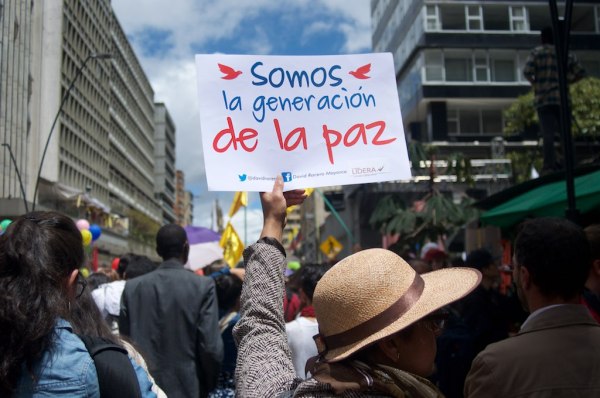
At a march for peace in Bogotá, Colombia, a woman holds a sign that states, “We are the generation of peace.” / Agencia Prensa Rural / Flickr / Creative Commons

A group of Colombian university professors have organized an appeal to their colleagues in and outside the country to sign a petition “requesting an effective solution without delay” to overcome the impasse created by rejection of the peace accord on October 2.  The text of the petition, which currently has more than 1,700 cosigners, is as follows:

[We] university professors, from different disciplines, universities, and regions, join our voices with those underscoring the urgent need to reach, as soon as possible, a final Accord to end the conflict with the FARC.  Delay poses enormous risks.  It is essential to set, with all urgency, an agenda for talks limited to points requiring discussion, with concrete and viable proposals for modifying the existing text.  Reflecting the extremely close results in the October 2 plebiscite, the agenda should address the concerns of the No voters, who won the vote, while respecting the voice of the equally numerous Yes voters, who supported a text that cannot be wholly reevaluated, as well as those who did not speak at the polls.

The result of the plebiscite on Sunday [2 October] provides the unique opportunity to adjust the existing Accord in a way that draws a majority of society.  Capitalizing on that opportunity is the responsibility of all sides:  the FARC, the representatives of No, and those of Yes.  The plebiscite leaves no doubt – and the mobilizations in the streets and social media confirm – that society demands that all be flexible in their positions.  That’s what the youth demand as they convoke marches and other actions to push a quick Agreement, and which we support without hesitation.

The professors are an important voice of society and, as the statement explicitly states, of young people throughout the country who aspire to have a peaceful future.  The statement dodges specifics on what needs to be changed in the accord, but its assumption that sufficient pressure can be brought on all parties, including those who opposed the accord, to find common ground is credible.  Appeals such as this – unprecedented in the sheer number as well as in the wide range of institutions, disciplines, and regions that are represented – will be a good test of the capacity of Colombian civil society, such as the Academy, to push compromise, and for others, such as the economic elites, to achieve compromise.  Agreement may emerge, for example, to move discussion of certain social issues, such as those that riled some religious groups, into another venue so they aren’t an obstacle to agreement on war-and-peace issues.  The professors have their finger on the pulse of the nation and grasp the underlying political, economic, and social drivers of peace – and their optimism that neither side will come to a new negotiating table with dealbreakers is probably more warranted than anyone else’s.

Click here to see the original Spanish version of the petition.

October 14, 2016

Nicaragua: A New Family Dynasty Taking Root

By Aaron T. Bell*

nicaragua-0919l

Left: Photo of Daniel Ortega celebrating his latest presidential triumph (July 20, 2012) / Fundación ONG de Nicaragua / Wikimedia / Creative Commons; Right: Anastasio Somoza DeBayle / DemonSabre / Wikimedia / Creative Commons

Events in Nicaragua this summer have demonstrated that President Ortega and his family have a vision for the future that erodes a key element of political democracy – the replacement of the executive through free and fair elections – and risks establishing a dynasty of corruption and authoritarian rule.  In May 2016, President Daniel Ortega of the Frente Sandinista de Liberación Nacional (FSLN) announced his candidacy for a fourth presidential term – his third consecutive.  Since then the government has taken several steps to ensure that Ortega and his family remain in power in November’s elections for President and National Assembly, and beyond:

  • Voting irregularities, a lack of transparency, and accusations of fraud have marred several successive elections since Ortega’s return to power in 2007. In June of this year, Ortega announced that he would not permit international election observers to monitor this fall’s elections.
  • Weeks later, the Supreme Court stripped opposition leader Eduardo Montealgre of his position as head of the Partido Liberal Independiente (PLI) and replaced him with Pedro Reyes, considered by observers to be an Ortega ally. In July, Nicaragua’s electoral council removed 16 sitting members of the National Assembly and 12 alternates after they refused to recognize Reyes.
  • In August, Ortega announced that Rosario Murillo, his long-time partner and wife since 2005, would serve as his vice presidential candidate in the November election. Murillo has been a prominent figure in the Ortega government while serving as both first lady and chief spokeswoman.  Her political ascension is complemented by the rise to prominence in recent years of her and Ortega’s children as operators of business and media interests, including the couple’s eldest son and presidential adviser on investments, Laureano Facundo, who helped sell the stalled interoceanic canal project to Chinese businessman Wang Jing.

Nicaragua’s opposition parties have thus far been unable to mount an effective response and have shown the lack of cohesion and focus that have plagued them for decades. Montealgre announced that the coalition led by the PLI would boycott the election and called on others to do the same.  But rather than present a united front, opposition leaders are fighting amongst themselves to seize the mantle of leadership and challenge Ortega through several competing parties and coalitions.  This will be no easy task: polling conducted by M&R Consultores this summer shows that over 60 percent of voters are likely to vote for Ortega, with the leading opposition parties drawing low single digits.  Over a quarter of potential voters said they were unsure whom they would vote for.  With the opposition beset by division and lacking much legitimacy – tainted as they are by a history of corruption, self-interest, and financial support from the United States – it is unsurprising that protests and civil unrest have been largely absent.  The ouster of the PLI delegates has also stirred the FSLN’s old opponents outside the government, who have been largely quiescent in recent years but condemned the decision: the Bishops of the Episcopal Council, the Nicaraguan-American Chamber of Commerce, and the Consejo Superior de la Empresa Privada (COSEP), the largest business chamber that has enjoyed a working relationship with the Ortega government.

The FSLN’s authoritarian turn, Ortega’s long reign, and the rise to prominence of both Murillo and the couple’s children invite comparisons between Ortega and Somoza family dynasties.  It may be from COSEP and the business sector, rather than among the weak and divided political opposition, that a serious challenge to Ortega could eventually emerge. It was after all the defection of non-Somoza family interests in the private sector, combined with a popular insurrection led by a guerrilla insurgency, that did away with Nicaragua’s previous family dynasty.  But that combination only emerged following the shock of the 1972 earthquake and resulting massive corruption, the assassination of a national figure like Pedro Chamorro in 1978, and the particularly bloodthirsty turn that the Somoza regime had taken. With similarly game-changing circumstances absent at this juncture, the sort of cross-sector revolutionary movement that ultimately toppled the Somozas appears unlikely.  For the moment at least, an Ortega family will be well on its way to firmly preserving its dynastic power come November.

 September 19, 2016

* Aaron Bell is an Adjunct Professorial Lecturer in History and American Studies at American University.

Political Upheaval in South America

By Eric Hershberg

MarchaVenezuela

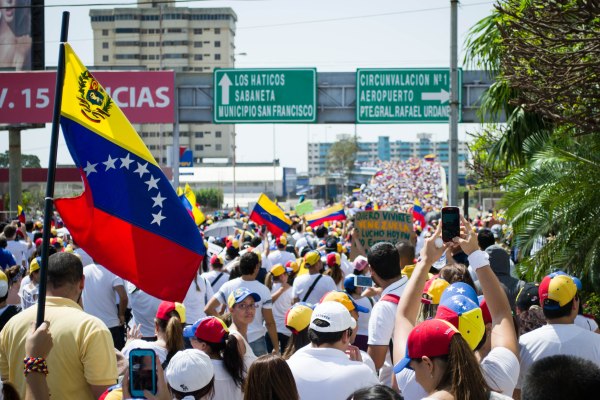
Thousands of protesters in Maracaibo, Venezuela. Photo Credit: Google Images / Creative Commons

2016 is proving to be this century’s most complicated year to date for South American political systems, and the coming months will be critical to assessing how well the region’s democracies can govern amid declining economic conditions and spiraling corruption scandals.  Brazil and Venezuela – two very different systems with very different problems – are suffering the most visible crises.

  • In Venezuela, where the Bolivarian project has descended into an incompetent Putinism in the tropics, is collapsing under the weight of monumental mismanagement of the economy. Many of the ills of the Venezuelan petrostate predate Chavismo, but during a collapse in oil prices President Maduro has doubled-down on profligate economic policies introduced by Hugo Chávez, bringing the country to catastrophe made worse by increasingly draconian repression of loyal and disloyal opposition alike.
  • President Dilma Rousseff’s mismanagement of coalitions in a presidential system predicated on coalition-building has opened the way to political and economic implosion in Brazil.  Contrary to the fervent assertions of important segments of the Workers Party (PT), her impeachment does not precisely constitute a coup, but it may indeed amount to an ill-advised bending of institutional mechanisms by cynical legislators and aggressive judges, egged on by rightist sectors whose commitment to democracy is in fact dubious.  Dilma didn’t invent the corruption and footloose budgetary practices that have been her undoing, but her fall does respond to overwhelming popular rejection of her performance.  Interim President Temer’s appointment of an entirely white male cabinet that includes representatives of some of the country’s most retrograde interests suggests abandonment of many of the most laudable achievements of more than a decade under PT rule – and more backlash as well.

Other institutional crises may be on the horizon.  Ecuadoran President Rafael Correa pursued a high-risk strategy of debt-driven expansion of the state, which is not sustainable amid economic contraction.  Argentine President Mauricio Macri’s honeymoon may prove short-lived.  Much-needed economic reforms are likely to provoke even greater inflation and have already stoked resistance from the Peronist opposition.  Macri enjoys some unprecedented assets – for the first time non-Peronists also control the city and province of Buenos Aires– but Argentine public opinion overwhelmingly favors statist economic policies that he aims to dismantle, and no non-Peronist elected president has completed his term in office since the rise of Peronism as a political force.  Chilean President Michelle Bachelet, wounded by a drop in mineral export revenues and comparatively minor corruption allegations involving her daughter-in-law, reshuffled her cabinet earlier this month but continues to tank in the polls.  Latinobarómetro reports that 70 percent of Chileans believe their political system doesn’t work.

It’s not hard to envision other relatively stable South American democracies facing hard times ahead.  The June 5 presidential runoff in Peru could leave the country deeply polarized, especially if Keiko Fujimori, heiress to the country’s darkest episode in recent history, wins.  It is not a foregone conclusion that Colombian President Juan Manuel Santos, who has staked his second term on a long-awaited and much-needed peace accord, will secure its ratification, risking lameduck status for the remainder of his administration.  If the presidents elsewhere appear to be weathering the storm, democratic governance nonetheless faces important challenges.  It would be rash to predict that democracy will fail the test – and that such failure will give rise to a new era of authoritarian rule – but it’s clear that the region will witness widespread instability during the coming years.

May 26, 2016

Haiti: Crisis Upon Crisis

By Fulton Armstrong

Haiti OAS

OAS Secretary General Almagro visits Haiti. Photo Credit: OAS / Flickr / Creative Commons

Haiti is stumbling, again, from one crisis into another, but the timing of this ongoing mess puts the United States and other international partners in a particularly bad position.  The country’s political institutions are dysfunctional, without an elected executive nor fully legitimate legislature, and efforts to rebuild them continue to be haphazard.  Under Interim President Jocelerme Privert (formerly leader of the Senate), the government has missed another deadline for resolving disputes over the first round of presidential elections held last October and re-running them or scheduling the second round.  Instead, Privert, who assumed the Presidency in February, on 28 April formed a five-member “verification panel” to take yet another look at allegations of first-round fraud and determine which candidates should participate in the runoff, with a 30-day deadline.  The deadline for Privert to step down passed on 14 May.

  • The move coincides with growing perceptions that Privert is enjoying the perquisites of the job and may be dragging things out on purpose. Both sides to the contested elections – supporters of Jovenel Moïse, former President Martelly’s hand-picked successor, and the opposition party’s Jude Célestin – are mobilizing crowds, some numbering thousands, for almost-daily protests.  Calls for Privert to resign are growing intense as suspicions of his own ambitions and imputed bias for or against one of the candidates surge.  Several dozen gunmen, allegedly directed by an enemy of Privert, shot up a police station in the southern city of Les Cayes earlier this week, resulting in six dead.
  • International reactions to Privert’s delays have been mixed but predictably of frustration.  The former leader of an official OAS mission to Haiti in early April supported the verification process, and OAS Secretary General Almagro said recently that elections “shouldn’t be rushed.”  But U.S. Secretary of State John Kerry last month condemned “this process of delay” and urged Haiti’s “so-called leaders” to act.  His Special Coordinator for Haiti Affairs, veteran diplomat Kenneth Merten, called the new verification process a “black box” and said it was “opaque and non-democratic.”

The political mess coincides with other serious challenges.

  • The World Food Program (WFP) is increasingly concerned about hunger caused by a three-year drought, aggravated by El Niño, and the country’s economic situation. Some 3.6 million Haitians (one third of the population) face “food insecurity,” including 1.5 million who are “severely food insecure.”  A U.S. program to send Haiti surplus peanuts, which is one of Haitian farmers’ most successful crops, has deflated prices and further hurt local food production.
  • Shortages of medical supplies, worsened by corruption, have prompted doctors to conduct strikes. High-profile cases, including the death of a bleeding pregnant woman at the entrance of the Port-au-Prince General Hospital, have led to dramatic demonstrations, on at least one occasion parading around a victim’s corpse.
  • Fear of spread of the Zika virus is rampant. The University of Florida recently confirmed that Zika was present in Haiti before the outbreak in Brazil last year.  (Carried by the same mosquito, Aedes aegypti, it was mistakenly identified as chikungunya, which has almost identical symptoms except microencephaly.)  Haiti’s cholera epidemic, which has killed 9,200 people since 2010, continues to claim about 50 lives a month, according to some estimates.

The usual threats by the United States and Haiti’s other international partners to suspend aid if the government doesn’t resolve the political impasse have been muted presumably because they’re unlikely to be credible while such major threats to Haitian citizens’ wellbeing loom large.  Haiti’s political and economic elites assume that the outsiders will care for the Haitian people and continue bailing the country out while they pursue their internecine struggles.  Former President Martelly, who is not free from blame for the elections impasse, has been in Miami these days to promote his autobiography ($50 a copy) and reestablish himself as a naughty boy Kompa musician.  The international community is, once again, in a lose-lose situation.  A previous caretaker government, headed by Gérard Latortue, lasted two years (2004-2006).  The United States and others can ill afford a deeper humanitarian disaster, so while Haitian elites fiddle, outsiders will try to put out the fires.

May 19, 2016