Brazil: Will Officers’ Role in Government Taint the Military Institution?

By Christoph Harig*

President and Vice President of Brazil

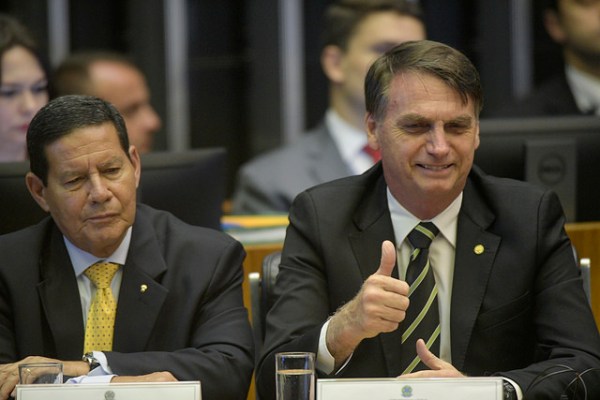
Vice-President General Hamilton Mourão and President Jair Bolsonaro / Pedro França / Agência Senado / Flickr / Creative Commons

More military officers have joined Brazilian President Jair Bolsonaro’s government than during most periods of the country’s last military regime (1964-1985), which raises the question how much the military – as an institution – will avoid compromising its supposed non-partisan nature.  The President, Vice-President, as well as eight government ministers, are retired or reserve military officers.  Bolsonaro furthermore nominated an active-duty army general as the government spokesperson.  In total, more than 100 reserve and active-duty military personnel serve in various ministries and subordinate government agencies.  Some officers have joined out of true allegiance, others, out of a sense of duty or because they want to prevent worse things from happening.  The government is drawing heavily on individual (mostly reserve) military officers, but the military as an institution is not running the government.  This is not a return to the military’s previous political interventionism: instead, a democratically elected government is (re)militarizing politics.

  • The military’s official discourse is keen on maintaining its image as a non-partisan state institution. However, officers are aware that this will be a challenge.  The presence of dozens of reserve officers in government agencies irrevocably connects the armed forces to the administration.  Although many officers do have reservations about Bolsonaro, others have proudly displayed their satisfaction with the victory of the former paratrooper.  Many citizens and international observers will thus perceive the government’s actions as being at least implicitly backed by the military.
  • For the armed forces, this involvement comes with opportunities as well as risks. On the one hand, there is a considerable increase in the military’s veto power.  They can expect privileged treatment and an effective representation of their interests.  The military might for instance be able to draw some red lines when it comes to being included in the government’s planned pension reform.  On the other hand, the prominent role in Bolsonaro’s administration attracts unwanted public scrutiny.  Discontent with an eventual preferential treatment of the armed forces in the pensions reform might grow louder than if the military had stayed below the radar.

So far, military officers’ involvement in government appears to have boosted the military’s standing.  The generals are widely being seen as a moderating force.  They have blocked some controversial foreign policy proposals of Bolsonaro and the radical wing of the government, such as the move of the Brazilian embassy in Israel to Jerusalem or the establishment of a U.S. military base on Brazilian soil.  Some observers even suggest that the generals have established a tutelary role in foreign policy after the Minister of Foreign Affairs ended military cooperation with Venezuela without consulting the armed forces.

  • Particularly Vice-President General Mourão – once known for threatening military intervention in politics and even considered a liability during the election campaign due to several ill-considered statements – excels in his newly found role as “adult in the room.” As President Bolsonaro is stuck in polarizing campaign mode (for instance, he keeps on attacking Brazil’s press and recently lauded late Paraguayan dictator Alfredo Stroessner as great statesman), it is fairly easy for Mourão to present himself as pragmatic and reliable statesman.  In this role, he led Brazil’s delegation to the Lima Group meeting in Bogotá, where he clarified that Brazil would not support a military intervention in Venezuela.

In the long run, the impact of officers’ enhanced policymaking role on the military’s prestige will depend on whether they stay clear of blunders, failures, and scandals.  While the military officers in government might succeed in playing a moderating role for the time being, this development entails considerable risks.  Within and outside of the barracks, there already is a widespread perception of the military as savior that is supposed to rescue Brazil in times of extreme crisis.  This historically grown paternalistic role of high levels of political interventionism – in which allegedly competent armed forces save the nation from incompetent civilian politicians – will only become further entrenched.

March 6, 2019

*Christoph Harig is a Postdoctoral Research Fellow in Political Science at the Helmut Schmidt University/University of the Federal Armed Forces in Hamburg, Germany.

Venezuela: When Will the Military Flip?

By Fulton Armstrong

venezuelan military marching

A military exercise in Caracas, Venezuela. / Cancilleria del Ecuador / Flickr / Creative Commons

Venezuelan leader Juan Guaidó and his backers, including the Trump administration, are increasingly focused on swaying the country’s security forces to switch allegiance from Nicolás Maduro to the National Assembly President.  Guaidó has appealed to the military to support his efforts to “restore constitutional order” and is pushing through the legislature a law giving amnesty to cooperating officers for certain crimes committed since President Chávez took office in early 1999.  U.S. officials, apparently to shake up the armed forces, continue to say that “all options are on the table”; National Security Advisor John Bolton held a notepad at a press briefing referring to “5,000 troops to Colombia.”  Maduro, for his part, continues to orchestrate loyalty pledges from senior officers and preside over military exercises.

  • Several small units of the military have flipped, and Maduro’s military attaché in Washington – serving there for a number of years to get medical treatment – has declared loyalty to Guaidó. The vast majority of the officer corps, however, still maintain an appearance of commitment to Maduro.

The most common explanation for the military’s apparent loyalty cited by Maduro’s opponents is that the high command has been bought off by opportunities to engage in corruption.  Other factors, however, may better explain why the institution has stuck with him this long.

  • Ideological reasons? Most available information suggests that Madurismo – with its gross, incompetent mismanagement of the economy, corruption, and thuggery – is not attractive to the officer corps.  But they appear to know that Chavismo has deep roots; that the elites, including the more hardline opposition, don’t understand the significance of change since 1999; and that efforts to return to the pre-Chávez era would be destabilizing and bloody.
  • Financial reasons? Although historically and perennially corrupt, senior officers arguably have been able to do more corruption under Maduro than under another regime.  That said, in their heart of hearts, they probably know a lot of their activities will continue under any government.
  • Distrust of the opposition? The military traditionally has communicated better with opposition moderates, such as Henrique Capriles, and in recent years has shown no trust in the faction that Guaidó comes from and its leader, Leopoldo López.  Information is very limited, of course, but many officers may believe that this group’s obsession with overthrowing Maduro and its no-negotiation stance has contributed to the crisis.  Senior officers’ confidence in Maduro’s ability to hold the country together seems to have evaporated, but the opposition have not presented a viable, comprehensive alternative.
  • Concern about the López-Guaidó faction’s ties with Colombia and the U.S.? Good information is elusive, but senior officers’ posture suggests that they see Bogotá’s strategic objective to keep Venezuela weak and Washington’s objective to purge the country of Chavismo and themselves.
  • Concern that the “international community” will not give them a fair deal? Distrust of Washington seems obvious, but – within their logic – senior officers almost certainly are suspicious of OAS Secretary General Luis Almagro, the Lima Group, Brazilian President Jair Bolsonaro, and others as intolerant and biased.
  • Belief that, in the face of total chaos and widespread bloodshed, they can force a last-minute peaceful solution onto Maduro? Senior officers presumably have good enough intelligence to know when and how to intervene – and persuade Maduro to accept a peaceful solution and fly into exile.  The bigger problem at this point is that they do not see a viable alternative to sticking it out.
  • Fear that Maduro’s people have deeply penetrated officer ranks, and their lives will be at stake if they move against him? As the scope of the crisis grows and the credibility of Maduro’s power begins to slip, this would appear now to be less important.  Officers talk among themselves more than outsiders think.

The Venezuelan military’s threshold for intervening against civilian governments of any stripe has always been high, amplified by the embarrassment of the reversed coup against Chávez in 2002.  None of the factors that, on balance, still appear to favor sticking with Maduro is unmovable.  Distrust of the United States, OAS, and the Lima Group – the outside forces that legitimized Guaidó’s claim to power – leave the military with no reliable allies; Cuban, Russian, and Chinese friends can provide no solace.  A credible negotiation proposal from someone like Mexican and Uruguayan Presidents López Obrador and Vázquez, especially if backed by Pope Francis, could conceivably give them a credible direction in which to push Maduro.  But at this moment – subject to rapid change – the balance still argues in favor of the military fearing a new course.

Honduras: Will Political Reforms Go Anywhere?

Honduras Highway Sign

Honduras by Nick Youngson CC BY-SA 3.0 Alpha Stock Images / Picserver.org / Creative Commons

By Eugenio Sosa*

Honduras’s long-running political crisis and the realignment of its political parties have given rise to broad discussion of political and electoral reforms, but resistance from the political parties – including the relatively new Libertad y Refundación (LIBRE) Party – appears likely to stymie significant change.  Honduran civil society groups increasingly believe that only through political and electoral reforms will the country move toward democracy.  Holding elections is an important starting point, reform advocates say, but deepening democracy requires reducing the monopoly of the political parties.  The configuration of the parties has changed significantly since the coup d’état in June 2009; the century-old “bipartisanship” of the National and Liberal Parties has been shaken up and become more volatile.  LIBRE has moved to the front line, and smaller players, like the Partido Anticorrupción (PAC), have faded.  Reformers argue that this realignment affords the country an opportunity to undertake reforms that cut across the country’s institutions and processes.

  • Depoliticizing the Supreme Electoral Tribunal (TSE) and making it a truly independent and autonomous body to supervise elections. The current TSE has fallen far short of its legal requirements to ensure, without prejudice, to enfranchise all citizens. 
  • Professionalizing and depoliticizing the National Registry of Persons – removing the partisan activists who dominate it today and directing it to issue identification cards without political influence. Observers agree that 30 percent of voters on the current lists have deceased or left the country.  Other citizens’ names have been mysteriously dropped from voter rolls or been lost while changing domicile.  Similarly, the country needs a complete, honest census.
  • Allowing regular citizens to staff election tables in polling places. They should be chosen based on clear criteria, such as their contributions to society.  In 2013 and 2017, credentials were being bought and sold with party funds, totally undermining observers’ credibility.
  • Establishing second round balloting when no candidate wins an absolute majority. The country’s shift away from a two-party system has significantly increased the chance that a president would be elected with a percentage of votes below the abstention rate.  A runoff between the top two candidates will give the victor greater legitimacy.

Other important reforms are receiving less attention.  Laws on transparency and accountability in campaign finances, such as the Law on Clean Politics implemented in 2017, have not had significant results so far, but discussion of ways to give them teeth has been limited.  Neither is there much talk about how the incumbent candidate benefits from access to public resources, including access to the national networks, or about the biases of privately owned media, which slant coverage and charge different rates for advertising depending on their preferences.  Guarantees of political participation by sectors traditionally excluded from representation and government, such as women, the indigenous, and youth, are also largely off the table.

The urgency for reform, obvious since the coup in June 2009, has surged since the contested elections in November 2017, during which the Constitutional Court decided in favor of the reelection of President Juan Orlando Hernández in the face of evidence of electoral fraud.  Honduras is now living the paradox of a President serving a second term that is still prohibited by the Constitution.  Some issues, such as re-election, demand serious national debate and may have to be resolved by plebiscite or through a National Constituent Assembly.

  • Despite the broad base of the organizations proposing reforms, the success of any initiatives will depend on the views, limitations, and vetoes imposed by the three main parties. Even LIBRE, the newcomer that previously challenged the status quo, sometimes appears to be buying into existing systems and could go soft on reform.  As a result, one possible outcome could be that certain reforms are implemented in form – such as modernization of the National Registry of Persons – but the parties retain their influence over the office’s magistrates and personnel.  In addition, neither of the three main political forces appears interested in allowing authentic citizen control over voting tables on election day. 
  • While the need for reform is arguably deeper than at any time since the current Constitution was approved in 1982, and while the proposals for moving forward are constructive and mature, the prospects for change appear limited. The configuration of the country’s political parties has changed, but their priorities and behavior have not. 

January 22, 2019

*Eugenio Sosa is a sociologist and senior analyst at the Centro de Estudio para la Democracia (CESPAD), in Tegucigalpa.  This article is adapted from his essay on the CESPAD website.

Mexico: Will AMLO Bring a “Fourth Transformation” or Return to Authoritarian Past?

By Daniela Stevens*

President-Elect Andrés Manuel López Obrador / Eneas / 500px / Creative Commons

A week before his inauguration, Mexican President-elect Andrés Manuel López Obrador (AMLO) continues to stress his commitment to be a “good president” and leader of the country’s “Fourth Transformation,” but some of his early actions suggest that he will challenge political pluralism and destabilize the investment environment.  His sexenio could have a rocky start both politically and economically.

  • AMLO’s handling of a “national consultation” over the ongoing construction of Mexico City’s new international airport – a project that he criticized as corruption-laden – raised red flags about his intended governing style. Most observers say the consultation was unconstitutional and, with only one percent of registered voters participating, inconsistent with the President-elect’s pledge to respect the “people’s will.”  AMLO’s reaction to the criticism – asking “¿quién manda?” (who governs?) – was widely interpreted as a sign that the airport maneuver was not about careful financial planning but rather political power.  He held another referendum last weekend, a “consultation” with citizens on 10 projects on which he seemed to have made up his mind beforehand.  These referendums seem intended to legitimize his intentions and enhance his power.
  • He and his party, Movimiento de Regeneración Nacional (Morena), appear to be moving ahead with plans to increase control over public spending, eroding institutional checks on presidential power. The Morena majority in the Tabasco state congress, for example, last month approved a provision empowering the next governor, also from Morena, to assign public works and acquisitions directly, without public bidding.  If the Supreme Court does not deem the reform unconstitutional, the administration will build a refinery in Tabasco without any review of the integrity of the process.
  • To reduce imports of gasoline and natural gas, AMLO plans to halt oil exports and reserve production for national consumption only, as well as to build a new refinery and modernize six existing ones. Critics say such policies reflect an outdated vision of national sovereignty closely tied to oil, and that they would directly diminish Mexico’s creditworthiness, endanger the finances of state-owned Petróleos Mexicanos (Pemex), and, according to Moody’s, result in a two percent decrease in GDP.  Additionally, oil experts say, the emphasis on refining would detract from important efforts to expand exploration and production.  The country cannot immediately meet domestic demand for crude.  Similarly, the transition team seems to disregard the potential of renewable energies and the need to electrify transportation.

Morena proposals to reduce the autonomy of regulatory agencies are scaring investors as well.  A Morena Congressman, for example, is pushing to incorporate the energy sector’s regulatory agencies into the Secretariat of Energy, subordinating them to greater political control.  Although AMLO did not publicly support the initiative, his appointee as Secretary of Energy, Rocío Nahle, has already asked the director of the National Commission of Hydrocarbons, one of the regulatory agencies, to step down three years ahead of schedule.  Given its debt and deficits, Pemex can ill afford to strain its partnerships with private capital.

It’s too early to assess how many of these actions reflect AMLO’s and Morena’s inexperience or a considered approach to governing, but the incoming leadership so far seems unaware or unconcerned that such measures undercut their stated vision of ushering in a “Fourth Transformation” on a par with the country’s three previous ones – independence (1810–1821), the Reforma wars (1857–1861), and revolution (1910).  The hints of authoritarianism, alongside decisions to appoint single-representatives in the states and to maintain a pervasive military presence in the streets, suggest AMLO’s tenure may indeed transcend history – as a government not different from the priista centralized governments of the 20th century, and the militarized calderonista administration (2006 2012) he vehemently criticizes.  After 1997, when the hegemonic Partido Revolucionario Institucional (PRI) – from which AMLO had already defected to lead the leftwing Partido de la Revolución Democrática (PRD) – lost the majority of the Chamber of Deputies for the first time, political analysts and academics pointed out the disadvantages of divided governments in presidential systems, such as political gridlock.  A unified government under AMLO, however, may not be the answer for Mexico either, unless progressives in Morena committed to democracy and its institutions find a way to restrain his impulses and keep his government on a democratic path. 

November 27, 2018

* Daniela Stevens is a Ph.D. candidate in Political Science in the School of Public Affairs at American University.

Mexico: Is Centralization the Way to Battle Corruption?

By Daniela Stevens*

A large group of people stand on a stage.

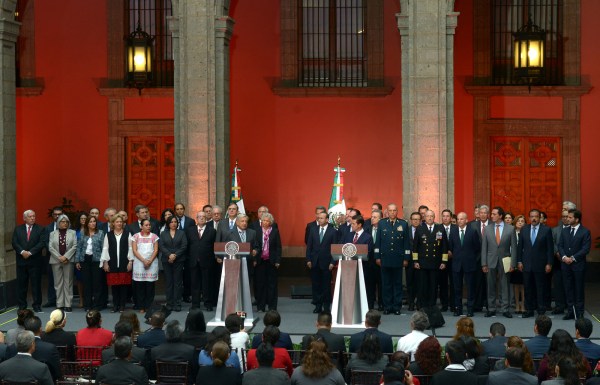
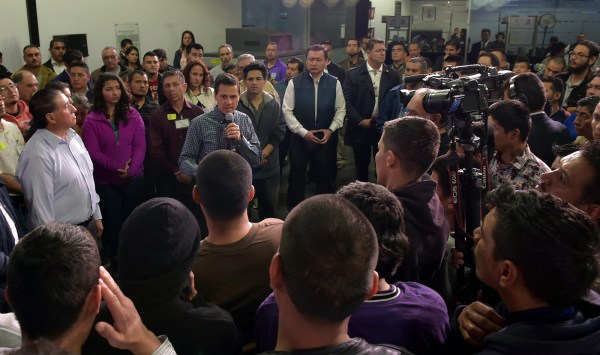
Mexican President-elect Andrés Manuel López Obrador (center left) meets with current President Enrique Peña Nieto and members of his cabinet during the transitional government period. / Presidencia de la República Mexicana / Flickr / Creative Commons

Half way through Mexico’s five-month transition period, an effort by President-elect Andrés Manuel López Obrador (AMLO) to increase central government oversight over states’ affairs suggests an agenda that may go beyond the “republican austerity” he frequently calls for.  His plans to lower the numbers and salaries of high-ranking bureaucrats have been well received, but he raised hackles when he announced plans to appoint a single federal representative – a delegado – to liaise with each of the 32 states, eliminating the 20 to 30 central government representatives that until now have been dispersed throughout each jurisdiction.  He claims the measure is to save on the bureaucracy payroll, but many observers are concerned it will concentrate more power in his own hands.

  • Criticism has already forced AMLO to repackage his plan somewhat. He uses mixed language to refer to the responsibilities of the delegados.  While he has strongly defended his legal ability to appoint a single delegado, he more recently reassured aggravated governors that his representatives would maintain “institutional relations” and respect local elected officials’ autonomy and authority.  Olga Sánchez Cordero, AMLO’s appointee as Secretary of the Interior, further clarified that the delegates would only be in charge of social development programs, constituting a “layer of proximity to citizens” currently or potentially enrolled in social programs.  Under AMLO’s proposal, delegados would take over all kinds of programs, including youth scholarships, conservation efforts, health care, and social security programs for special populations – a herculean portfolio for a single representative.
  • Critics argue that the appointment of single delegados reporting directly to AMLO will undermine federalism. Electoral and administrative decentralization were integral to Mexico’s long democratization process.  For decades, the president was not only the predominant force over the legislative and judicial powers; he also appointed governors from the hegemonic party to the states.  The delegados would potentially create a power structure that parallels and rivals that of the state governors.  Some governors argue that the constitution does not recognize intermediate authorities, and wonder whether persons with partisan agendas will get too deeply involved in local budgets and policies.  In addition, the position would be coveted for its discretionary power and direct link to the president – giving politicians from AMLO’s party, Morena, a leg up as potential candidates for governor.

If done right, however, the measure could alleviate the plague of corruption that permeates the states, and the governorships in particular, and which AMLO has repeatedly condemned.  Governors routinely abuse their powers and engage in serious acts of corruption and financial crime.  As Agustina Giraudy has documented, undemocratic governors have used their offices to perpetuate “subnational undemocratic regimes” in the wake of Mexico’s 2000 transition to electoral democracy at the national level.  Former Governor Javier Duarte, of Veracruz, stole hundreds of millions of dollars from the public budget, and others, like Humberto Moreira in Coahuila, left their state with large debts.  Oversight from an anti-corruption executive in Mexico City might not necessarily be a bad thing.

Ideally, state legislatures – rather than the president or his delegado – would constitute the brake on governors’ decisions, providing a real counterweight anchored in local political dynamics.  AMLO’s efforts to turn Mexico into an “authentic democracy” will miss the mark – and amount to a crass political move – if the transformation does not include an institutionalization of leadership.  His party, Morena, is extraordinarily dependent on his personal leadership; it is an amalgam of politicians who abandoned other parties or joined it because of personal ties to him.  AMLO, who plans to preach integrity by example, cannot alone be the foundation of the “fourth transformation” he purports to lead (the first being independence, the second the “Reforma,” wars, and the third the 1910 Revolution).  With institutionalization, AMLO and Morena could put appointees and delegados through a transparent, legal vetting process – based on merit – and give them clear, legal operational responsibilities.  Failing that, their reforms may prove to be a primarily partisan project.

September 14, 2018

* Daniela Stevens is a Ph.D. candidate in Political Science in the School of Public Affairs at American University.

Honduras: Would a Constituent Assembly Help?

By Hugo Noé Pino*

Several people raise their hands in the Honduran National Congress

A recent session in Honduras’ National Congress. / Congreso Nacional de Honduras / Creative Commons

The need for Honduras to convene a National Constituent Assembly appears increasingly compelling even though the country’s political elites continue to oppose one.  Proponents of an “ANC” argue that it would not only help the country overcome the fraud perpetrated in last November’s elections; it would give oxygen to the country’s failing democracy.  They note that the current constitution, promulgated in 1982, has been violated and modified so many times – such as when President Juan Orlando Hernández was allowed to run for reelection – that the document’s original meaning has been obscured if not lost.  ANC proponents cite other facts pointing to the need for an assembly:

  • The constitution calls for a “planned economic policy,” in which the state and law “shall regulate the system and process of planning with the participation of the Powers of State, and political, economic and social organizations shall be duly represented.” But that planning model, which has never been implemented in Honduras, has been overtaken by the neoliberal model, based on market freedoms, adopted in the 1990s.  Amendments passed in 2012 were intended to create special employment and development zones, but not a single one has emerged.
  • Since the 2009 coup, Honduran society has been polarized by violations of the law, the concentration of power, abuses, corruption, and other problems – all aggravated by the widely contested election of last November. Business, workers, farmers, trade unions, academia, non-governmental organizations, and other sectors have been unable to find agreement on how to deal with the nation’s pressing problems.  ANC supporters say that true national reconciliation is going to require a new social pact that a new constitution can create.
  • Backers also argue that the ANC would breathe new life into the political parties – deeply discredited by the corruption and chaos engulfing them – and allow them to become a mechanism for intermediation between society and the state. An assembly, they say, would bring political leaders and the people together in pursuit of better alternatives to the current system.  A system of checks and balances, including a new judicial system, would help guarantee the separation of powers and enhance citizen participation in public policy.

Prospects for an ANC do not look good at this moment despite important endorsements, such as that of the Honduran Catholic Bishops Conference in a public letter last December.  Most of the political elite, responsible for setting the country on its destructive course, stridently oppose the idea, but proponents feel the elites will eventually have to accept one.  The “national dialogue” launched after the November elections has made no progress or, worse, has aggravated tensions.  The black cloud over those elections and the surge in corruption cases under investigation – an important achievement of the Misión de Apoyo contra la Corrupción y la Impunidad en Honduras (MACCIH) and its partners working under the Attorney General – have driven politicians to dig in their heels.  Their efforts to hold onto power, prevent transparency, and block accountability puts them directly against the sort of reforms an ANC would represent. 

  • Even when the political class eventually allows the ANC proposal to take off, many obstacles lay ahead. One of the first – and extremely difficult – steps would be selection of a truly independent Supreme Electoral Tribunal to oversee a referendum on the ANC and the election of assembly delegates.  The questions on the ballot would be simple, focused on support for the ANC and support for presidential reelection, but the task of making Honduras an inclusive society, with transparency, accountability, and respect for the rule of law would take the sort of vision and discipline that only a new constitution would provide.  While critics claim an ANC would be playing with fire, it’s certainly better than the current situation in which we are all threatened with being burned.

August 14, 2018

* Hugo Noé Pino is currently a professor and coordinator of a Ph.D. program at the Universidad Tecnológica Centroamericana (Unitec) in Tegucigalpa, Honduras.

Brazil: Is Democracy Under Threat?

By Marcio Cunha Filho*

A large group of Brazilians wave the Brazilian flag

A rally supporting former president Luiz Inácio Lula da Silva in October 2017. / Eduardo Figueiredo / Midia NINJA / Flickr / Creative Commons

Brazil’s ongoing political turmoil hit a new peak last weekend – resulting in former President Luiz Inácio Lula da Silva’s decision to turn himself in to be imprisoned – and strongly suggests that the country’s democracy is in deeper trouble than previously thought.  Lula said he was a victim of political persecution by both prosecutors and the courts, including the six Supreme Court justices who ruled that he not be allowed the courtesy of remaining free during his appeals to Brazil’s higher courts on his conviction on corruption charges.

  • Lula’s Worker’s Party (PT) claims that the decision is part of a campaign against leftwing forces that has intensified since Dilma Rousseff’s impeachment in August 2016. Supporters say that Lula’s imprisonment at a time that he is leading in presidential polls is the culmination of a strategy aimed at making sure that the PT – the only party to have won the presidency in elections since 2002 – remains out of power.  Most mainstream media and some rightwing lawyers have argued that Lula’s arrest obeyed all legal procedures, but PT supporters are not alone in their allegation of impropriety.  José Afonso da Silva, one of the most prominent non-partisan constitutional law professors in Brazil, has written a legal opinion against Lula’s imprisonment.  Other experts claim that Lula’s imprisonment order was strangely rushed (jurist Celso Antônio Bandeira de Mello), while others have expressly criticized the Supreme Court for denying Lula Habeas Corpus (Prof. José Geraldo da Silva Júnior).
  • While proof remains elusive, strong circumstantial evidence of conspiracy persists. The lawsuit against Lula was tried much more rapidly by Judge Sérgio Moro than most cases, and the guilty verdict was reaffirmed by the regional court just in time to keep Lula out of the presidential election scheduled for October 7.  Moreover, the accusations against Lula are fragile:  Moro argues that the former president received a $1 million remodeled beach apartment as a bribe from a construction company in exchange for political favors, but there is no evidence that the apartment was Lula’s or that he used it in any way.  Neither is there evidence that the construction firm received any favors.

Other indications that Brazil is experiencing an “open season” against the left are emerging.  Civil society leaders have reported repressive practices against them, including violent protests at their public events.

  • The assassination of a Rio de Janeiro municipal legislator is widely thought to have been carried out by rightwing elements. At a recent political rally, unidentified gunmen shot at Lula’s vehicle.  A wealthy São Paulo night club owner is offering a reward for anyone willing to murder Lula in prison.  Radical and angry political movements such as Movimento Brasil Livre are gaining strength by angrily advocating and celebrating through social media the imprisonment of political opponents.  Congressman Jair Bolsonaro, a former military officer who praises the military dictatorship, has become the new frontrunner in the presidential race.
  • Another troubling sign was a tweet from the Armed Forces – issued the day before the Supreme Court’s judgment against Lula – that it will not tolerate impunity. It has been widely interpreted as the most direct threat to the Court since the end of military dictatorship.
  • Freedom of expression and academic freedom are under pressure as well, according to many observers. Local, state, and federal legislators are trying to ban the teaching of gender issues in public schools, claiming gender issues are a leftwing ideology should not be taught to young children.  At the university level, in Rio Grande do Sul a local congressman filed a complaint to the Public Prosecutor’s Office asking that a course entitled “The 2016 Coup d’état” – referring to the removal of Dilma Rousseff and inauguration of President Michel Temer – be disallowed.

Democracies rarely die as a result of the acts by one or even a small group of political leaders, but rather as the outcome of repressive actors’ manipulation of popular confusion and anxiety about the country’s direction.  Lula may not have been perfect – he was not – but he deserved fair treatment by the government and fair enforcement of the law.  Democracies cannot endure when one group or another uses government institutions, even with significant popular support, to impose its views on others, often violently.  We should not forget that, in its early stages, the military coup in Brazil was supported by the media (at least by the biggest TV network in the country, Rede Globo), by civil society institutions (such as the Ordem dos Advogados do Brasil), as well as by much of the political leadership.  Radicalization, inability to dialogue, and unwillingness to make political compromises are the factors that made Brazil descend in 1964 into two decades of repression.  We might now be slipping down this same path, and witnessing the rebirth of institutionalized and popularly-supported repression and intolerance.

April 10, 2018

* Marcio Cunha Filho is a Ph.D. candidate at the University of Brasília; federal auditor in Brazil’s Office of the Comptroller General; and former CLALS Research Fellow.

Ecuador: Referendum Marks Critical Juncture for Moreno and Correa

By John Polga-Hecimovich*

Two men sit at a table with a yellow background

Current President of Ecuador Lenín Moreno (left) and ex-President Rafael Correa (right) during the presidential transition last spring. / Micaela Ayala V / ANDES / Flickr / Creative Commons

A national referendum in Ecuador this Sunday appears likely to give a boost to President Lenín Moreno in his political struggle against his predecessor, Rafael Correa (2007-2017).  The central item on the seven-question ballot will be whether or not presidential term limits should be reinstated into the Constitution – an initiative that Correa, who would like to run for a fourth term in 2021, is campaigning against.  The country appears poised to move on from the thrice-elected yet polarizing Correa to the more conciliatory Moreno; at the time of writing, citizens resoundingly endorse all seven referendum questions, with no question polling lower than 66 percent approval.  A “yes” vote on term limits would end Correa’s future presidential aspirations and position Moreno – Correa’s hand-picked successor – as the standard bearer of the political left in Ecuador.

  • The feud between Moreno and Correa – and within their ruling Alianza PAIS (AP) party – has been building for nearly a year and a half. Last November, one of Moreno’s closest advisors, Eduardo Mangas, alleged in a leaked recording that Correa hoped Moreno would lose the election.  Correa purportedly provided no logistical or financial support for his chosen successor while saddling him with the deeply unpopular Jorge Glas as running mate.  According to Mangas, Correa preferred that AP lose the presidential election and instead govern through its control of the vast state bureaucracy and National Assembly – with Correa returning to the presidency in 2021.  Eking out a narrow victory (51.6 percent against Guillermo Lasso’s 48.8 percent), Moreno upended this plan.
  • The morenista and correista factions have divided the AP since Moreno took office in May 2017. Vice President Glas, a Correa ally accused of taking $13.5 million in bribes from the Brazilian construction firm Odebrecht, was sentenced to six years in prison and impeached as part of Moreno’s campaign against corruption.  The AP Secretary, a correista assemblywoman, tried to remove Moreno as party head after he alleged the party put a hidden camera in his office.  Correa and 28 legislative deputies have left the party and formed what they are calling the “Citizen’s Revolution Party.”

Moreno took office facing a polarized political environment and daunting fiscal deficit and weak GDP, but his sound policies and astute political strategy have given him the highest approval ratings in Latin America.  His focus on the popular valence issues of corruption and re-election – about which citizens will usually share a common preference regardless of ideology – has also helped distract voters from the tepid economy.  The referendum is a particularly smart gambit.  It proposes seven different changes that would reverse actions taken during Correa’s rule – and that happen to enjoy broad popular support.  Instead of trying to push them through established institutional channels staffed with correistas, like the National Assembly or the courts, the President is turning directly to the public to give the measures legality.

Absent any bombshell announcements or drastic changes in public opinion, Moreno looks set to coast to victory in the referendum, quite remarkably establishing him as the country’s most powerful politician.  However, he faces a number of challenges to governance over the remainder of his four-year term.  The defection of Correa and his faction from Alianza PAIS left him with only 46 seats in the 137-member National Assembly.  This means Moreno’s bloc will continue to depend on ephemeral voting alliances with the center-right to govern – exactly like much of the 1979-2006 period when no popularly elected president finished his term.  Moreover, after 2.7 percent GDP growth in 2017, the IMF predicts that Ecuador’s economy – vulnerable because of its dependence on oil exports – will grow by only 2.2 percent in 2018 and 1.7 percent in 2019.  Moreno should enjoy his victory on Sunday, but he will soon face challenges greater than Rafael Correa: long-term governance in a country that has long proven averse it.  Whether he is up to the challenge remains to be seen, although he has so far proven resourceful.

February 2, 2018

*John Polga-Hecimovich is an Assistant Professor of Political Science at the US Naval Academy.  The views expressed in this article are solely those of the author and do not represent the views of or endorsement by the Naval Academy, the Department of the Navy, the Department of Defense, or the US government.

Mexico: Migrants Getting Political but Not Driving Reform

By Michael S. Danielson*

A large group of people gathers in an airport.

Returning Mexican migrants are greeted upon their arrival in Mexico by Mexican President Enrique Peña Nieto. / Presidencia de la República Mexicana / Flickr / Creative Commons

Mexican migrants who currently live in the United States or have returned home after spending many years abroad have become an important social and political constituency in the Mexican polity, but they do not uniformly enhance local democracy.  A growing body of research indicates that migrants affect the politics of their home towns and home countries through both direct and indirect channels.  Their departure releases pressure on prevailing authorities to reform, and the prospect of future migration causes citizens to disengage from the political process.  Friendships, alliances, and other contacts allow migrants to become intimately involved in their home communities from abroad as they communicate their attitudes and ideologies among themselves and friends and relatives back home.  Returning home with accumulated social, political, and economic capital also enables them to become influential leaders there.

  • Analysis of the municipalities to which U.S.-based migrants provide financial support, for example, shows that migrants are more likely to contribute where migrant civil society has become more deeply institutionalized at the state level and in municipalities and states with longer histories of migration.
  • A survey of more than 400 mayors in Oaxaca shows that migrants returning to their home communities who become mayors are more likely to be members of the popular classes than their non-migrant counterparts, suggesting that migration might be a pathway to power for non-elite individuals. But the same data also show that migrant mayors are just as likely to align with dominant political groups as with opponents of the status quo, suggesting the limits of their transformative and democratizing potential.

Field research shows different outcomes in different states.  In Oaxaca – where the exclusion of migrants from influence has alienated them from the governing party (an attitude further fueled by their experiences of exploitation and resistance as migrants in Mexico and California) – returnees tend to enter the political fray in opposition to dominant powers.  In contrast, the returning migrants who have been most influential in the states of Guanajuato and Zacatecas have tended to be mobilized by and act in support of the dominant parties in their states.  The institutionalization of the state-migrant relationship in these states facilitates migrant social and political engagement with governing parties.

  • Ethnographic data in 12 high-migration municipalities in Oaxaca, Guanajuato, and Zacatecas indicate, moreover, that the political engagement of returning migrants resulted in increased political competition that, in all but one case, caused factionalism and a divided opposition at best and deep, violent social conflict at worst. In the remaining six municipalities, dominant political actors either incorporated migrants into the prevailing system by establishing neocorporatist equilibria or successfully blocked the influence of migrant actors all together, despite high levels of migration.

Returning migrants’ political influence will only increase.  The historic flow – some 16 million Mexicans entered the United States in the 50 years since 1965 – has been reversed, as more migrants are returning to Mexico than entering the United States.  The economic, social, cultural, and political ties forged between communities on both sides of the border are growing, and the futures of the two countries are more intertwined than ever.  The economic and social importance of migration in some municipalities helps migrant political actors gain influence back home, and it can open up a pathway to local power for historically excluded social groups, even if – as in the cases that I have examinedthis influence has only rarely translated into fundamental changes in the way that politics are done.  The engagement of millions of Mexican migrants in their home towns has not resulted in thousands of political earthquakes, but rather the Mexican political system is incorporating these new actors without instituting fundamental changes to the way that politics are done.

 January 4, 2018

*Michael S. Danielson is CLALS Research Fellow and Visiting Professor at the University of California Washington DC Program.  His new book, Emigrants Get Political: Mexican Migrants Engage Their Home Towns, was published by Oxford University Press.  He has also participated in CLALS’ North America Research Initiative as a Pastor Scholar.

Migrants Make Family Back Home Critical of Government

By Clarisa Pérez-Armendáriz and David Crow*

9017797074_eccf684eb1_b

A mural depicting the transnational migrant experience. / Max Herman / Flickr / Creative Commons

Latin American citizens who discuss politics and belong to a transnational household – a household in which at least one member lives abroad – are more critical of their democracy than those who discuss politics but have no household members abroad.  In our recently published report, we use data from 2006-08 Americas Barometer surveys in 20 Latin American countries to demonstrate that among transnational household members (THMs) with an emigrant living in the United States, assessments of how democratic their country is, satisfaction with their country’s currently existing democracy, and pride in their democratic system all decline as discussions about politics become more frequent.

THMs talk about politics with their emigrant household members across international borders.  When they hear about the political and social system in the U.S., they become more aware that they have reason to be critical of their system’s performance, and judge their own democracy more harshly.  Skeptics counter that migrants and their children – particularly ethnoracial minorities – are marginalized, second-class members of receiving societies, which would logically alter the impact of their communications with THMs.  Public opinion polls show, however, that immigrants embrace and adopt their host country’s political beliefs and behaviors within as little as two years and that their social, political, and religious organizations give them a feeling of civic engagement they did not have back home.  Furthermore, even when conditions abroad are difficult, civil liberty protections in the U.S. enable immigrants to mobilize politically and to demonstrate a greater sense of personal efficacy – two traits that THMs respect.

  • Even absent cross-border political discussions, having a household member abroad shifts THMs’ sense of political community to include co-nationals living both at home and abroad. In turn, THMs expect their government to deliver the goods of democracy to its citizens wherever they live.  Data from the Mexico, the Americas, and the World survey in 2014 provide initial support for this claim.  Among Mexican THMs, 65 percent described “protecting nationals abroad” as a very important foreign policy objective, compared to 52.8 percent of non-THMs.  Furthermore, this policy emphasis indirectly influenced negatively their feelings toward President Enrique Peña Nieto, giving him a slightly lower “thermometer score.”
  • To the extent that THMs’ everyday talk (with other THMs or non-THMs living in Latin America) about politics revolves around this transnational sense of community (in contrast to the narrower national identity of non-THMs) THMs become aware that they have even more reasons to be critical of their government’s performance than do fellow citizens without migrant connections. Our analysis of this rests entirely on the case of Mexico, but we believe it holds elsewhere in Latin America since, of all the countries in the region, Mexico provides the most extensive range of services to its citizens abroad.

The 2006-08 Americas Barometer data that we used predates major shifts in U.S. immigration policy during President Obama’s term and, in particular, the hard shift in rhetoric, roundups of undocumented migrants, and deportations during these first months of the Trump Administration.  The sense of political efficacy that democratic rights to mobilize and protest produces among immigrants may decline in impact if, as reported, migrants are keeping a low profile out of fear of capture or harassment.

July 5, 2017

 *Clarisa Pérez-Armendáriz is an Assistant Professor at Santa Clara University. Her research, which focuses on how immigrants influence politics in their origin countries, has appeared in Comparative Political Studies and Studies in Comparative International Development.  She is also a participant in the Robert A. Pastor North America Research Initiative.

*David Crow is an Associate Professor of International Studies at CIDE (Mexico City). He is co-PI (and past director) of the Americas and the World survey on international relations and the Human Rights Perceptions Polls, and formerly Associate Director of the Survey Research Center at UC Riverside.  His research has appeared in Comparative Politics, Comparative Political Studies, Political Psychology, Human Rights Quarterly, and elsewhere.