Venezuela: Racing to the Bottom

By CLALS Staff

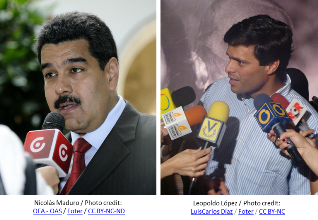
VenezuelaThe casualty figures from last Wednesday’s confrontation between government and opposition groups in the streets of Caracas – three dead, several dozen injured and many thousands angry – are clearer than the solutions to Venezuela’s current crisis.  The airwaves immediately flooded with the usual accusations of who provoked whom.  The protest leaders – who have shoved aside the opposition’s more moderate standard-bearer, Henrique Capriles – blamed toughs within the pro-government “colectivos.”  President Maduro blamed “small fascist groups” for the violence.  He has accused protest leader Leopoldo López of trying to orchestrate a coup, and a court is charging him with murder and “terrorism.”  López denies the coup-plotting, but he does state forcefully that, under the campaign slogan of “La Salida,” he wants to put millions in the streets to force Maduro to step down.  Failing that, he’s building a base from which to launch a referendum to remove Maduro when the Constitution allows in 2016.

As always, both sides in the dispute claim to have the support of “el pueblo” and to seek only to promote the people’s interests.  The people did speak, albeit by a small margin, in favor of Maduro in last April’s presidential election, but the opposition – especially the boisterous faction that’s orchestrating the current protests – has never officially acknowledged his legitimacy as president.  Maduro’s ad hoc reactions to Venezuela’s increasingly dire economic situation, including policies that he boasts are going to make the “bourgeoisie squeal,” appear desperate and counterproductive.  Confusing audacity for leadership, Maduro has signaled that if López and his followers want to take to the streets, he’s ready to accept the challenge.

Venezuelan politics has long been characterized by a vicious cycle in which each side strives to provoke the other into making mistakes that injure itself – and each side can’t resist rising to the provocation, fueling a downward spiral.  Maduro and the opposition hotheads have found soul mates in one another – feeding on each other’s extremism – and it’s happening just as Capriles and other opposition moderates were making progress in a decade-long effort to redefine political dynamics in the country.  Maduro’s tough talk and López’s battle calls for massive protests, for salida, and for recall referendums are reminiscent of 2002‑04, when Chávez grew steadily stronger as he survived a coup, a national strike, mysterious bombings and other clandestine operations by foes, a recall referendum and more.  For a young (42 years old) Harvard-educated man from the wealthy end of town to think that he can best Maduro in the streets shows the sort of questionable judgment that gives a little credibility to government allegations that his provocations are part of a bigger, externally directed plan.  The U.S. State Department spokesman insisted on Thursday that it “is absolutely not true” that Washington is interested in “influencing the domestic political situation in Venezuela.”  Whatever the merit of the allegations and denials,  Venezuelan elites on both sides of the deep divide seem ill-prepared to find a better way of doing politics.

Mexico: Policy on “Auto-defensas” Makes Things Worse

By Steven Dudley*

Photo credit: Pedro Fanega / Flickr / CC BY

Photo credit: Pedro Fanega / Flickr / CC BY

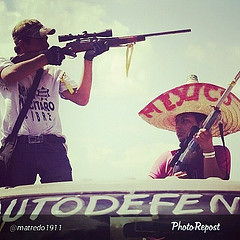
In a few short months, Michoacán’s “self-defense” groups have gone from being the Mexican government’s drunk uncle to being its strategic partner – underscoring what is wrong with the current government’s counterdrug strategy.  The vigilante groups are a multi-headed beast, born from sentiments that range from despair and frustration to opportunity.  Desperate small farmers and shopkeepers created some of the units because they’d been victimized by the “Knights Templar,” a splinter group with deep roots in the drug trade that has literally raped and pillaged their villages.  Frustrated agricultural and mining interests have funded their own “self-defense” groups.  And opportunistic rival criminal groups also seek to kill the Knights to take new, or reclaim old, territory.   Mexico’s federal and local governments are to blame for this chaos.  Drug-fueled corruption, ineptitude and lack of political will on the federal level have left the locals to fend for themselves, often leaving local politicians and security forces to align with the criminal interests, including the Knights Templar.

The federal government’s feeble and disjointed attempt to address the vigilantism is leading only to more confusion, chaos and most likely bloodshed.  In late January, it created a framework that legalized the organizations, placed then under one moniker – Rural Defense Units – and asked members to register themselves and their weapons.  But the framework makes no mention of their purview, jurisdiction, proposed length of service, nor does it clarify controls on their automatic and other sophisticated weaponry, which, under current Mexican law, requires military authorization.  Some of the groups accepted the government offer, including those that rode into the Michoacán city of Apatzingán last weekend to “take back” the city from the Knights.  More importantly, other vigilante groups have flat out refused the government.  Further fueling chaos, the federal government is applying a far harsher, more statist approach in the neighboring state of Guerrero, dispatching troops to stop the spread of “self-defense” groups that may have a longer history and more justifiable constitutional mandate than those in Michoacán.

Vigilante violence will undoubtedly continue to grow, as it becomes clearer that the federal government has no idea how to deal with it.  It is failing to address one of the root causes of the problem: illegal drugs have led to spectacular earnings that have made corrupting local and national officials easier; given criminal groups access to better training and weaponry to challenge the state and rivals; and created local, powerful criminal economies where perhaps they did not exist in the past.  In fact, no government official, vigilante group or other party in this conflict has even mentioned illegal drugs.  One vigilante told InSight Crime’s Mexico correspondent flat out: “We’re not against drug trafficking; we’re against organized crime.”  The causes of the violence are complex, but one cannot be addressed without addressing the others, and the Mexican government’s disjointed response is not pushing the country any closer to a solution.

* Steven Dudley directs InSight Crime and is a Senior Fellow at the Center for Latin American and Latino Studies.

Mexico’s Situation after Peña Nieto’s First Year at the Helm

By Manuel Suárez-Mier

President Enrique Peña Nieto / Photo credit: World Economic Forum / Foter / CC BY-NC-SA

President Enrique Peña Nieto / Photo credit: World Economic Forum / Foter / CC BY-NC-SA

After Enrique Peña Nieto’s first full year in office, the situation and prospects for his country are mixed. On the positive side, his structural reforms encompassing labor, education, taxation, finance, telecommunications, anti-monopoly and energy – the crown jewel – are unexpected and sweeping successes. Three previous administrations had failed to get such reforms through Congress in the preceding 18 years. The reforms, the success of which will depend on the implementing legislation, have attracted worldwide attention, generating a “Mexican moment,” and increasing substantially the flows of foreign direct investment.

On the dark side, however, Peña Nieto’s performance has been less than stellar regarding the pacification of the country from the violent onslaught over the last decade at the hands of bands of narcotraffickers. He changed the emphasis of the war on drugs from the stubborn fixation that it had in the Calderón administration (2006-2012), and he altered the terms of cooperation with the United States on this issue.  But he has been unable to stem the violence, which in some cases has worsened.  In the southwestern state of Michoacán, a new actor has emerged besides the narco and government forces: self-appointed groups of armed citizens that are battling the criminals while denouncing the government’s ineffectiveness.  Simply declaring victory in the war on drugs and moving on to other issues has not stemmed the violence.  Many observers believe that Peña Nieto’s security team is not up to par and that tolerating, and more recently collaborating, with the paramilitary groups is not the solution to the problem – and indeed will only worsen it down the road.  Also the terms of cooperation with the United States on the war on drug trafficking organizations are not clear yet.

It is too soon, of course, to declare victory on the reform front since the way these changes are implemented will determine their success or failure. We have had “Mexican moments” in the past, especially after NAFTA was approved in 1994, just to see them wiped out by government mismanagement and crises. But it is also too early to declare the final failure of the campaign to pacify the country since there have been some bright spots – notably in Ciudad Juárez. Coordination among security agencies has improved and the gendarmerie, a special rural federal police force that would replace the army in restoring the peace where violence rages, is being trained and will begin operations with 5,000 men in July.  But the appearance of paramilitary “self-defense” groups and the apparent alliance that they are forging with the federal government are deeply troubling considering what we have seen in other latitudes – especially Colombia – when such groups thrived. These contradictory trends explain why many people are enthusiastic about Mexico’s economic future while Peña Nieto’s approval ratings remain soft after a year of slow growth, tax increases, and unabated violence.

*  Manuel Suárez-Mier is Economist-in-Residence and Director of the Center for North American Studies in American University’s School of International Service.

Violence in Central American Urban Communities: Challenging Common Perceptions

By Juan Pablo Pérez Sáinz*
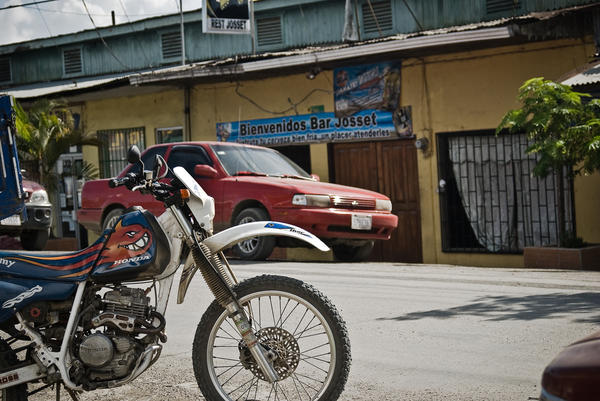
Urban storefront within a community of Sonsonate, El Salvador / Photo credit: Lon&Queta / Foter.com / CC BY-NC-SA

Urban storefront in a community of Sonsonate, El Salvador / Photo credit: Lon&Queta / Foter.com / CC BY-NC-SA

A recent survey on urban violence revealed that several kinds of violence are more serious in Costa Rica than in El Salvador.  Common wisdom, buttressed by homicide rates and other traditional “hard” indicators, is that El Salvador suffers from violence similar to Guatemala and Honduras, while Costa Rica does not. Historical factors stand out as possible explanations. Conflict among Salvadoran elites in the 1930s left the country deeply polarized and politically closed, laying the groundwork for war in the latter half of the century – with violence continuing, albeit in new forms, after the war ended. Costa Rica, on the other hand, emerged democratic, and the Second Republic created a welfare state committed to development. The structural economic adjustments of the 1980s challenged that order, and the growing inequality resulting from “neo-liberalism” has been accompanied by a rise in violence, but violence in Costa Rica did not reach the levels of its Central American neighbors.

A survey conducted by FLACSO specialists in El Salvador and Costa Rica challenges those theses. Polls of families in nine urban communities cast new light on the problem of violence, revealing important differences in the occurrence of three main categories of violence.

  • Members of 15.1 and 18.4 percent of the families in two Costa Rican communities reported suffering from criminal violence against persons, while the highest figure registered in El Salvador – in a community in Sonsonate – was only 11.5 percent.
  • The three Costa Rican communities also reported a higher incidence of violence against personal property (household wealth), with 26 percent of families in Cariari (in Limón Province, on the Caribbean coast) reporting such violations, and only 12.8 percent reporting this kind of violence in El Salvador’s hardest-hit community.
  • Only in the case of domestic violence did Salvadoran respondents report a higher incidence than did their Costa Rican counterparts.

Several hypotheses may explain these findings. Costa Rica’s higher level of socioeconomic development may be a factor in its higher rate of crimes against property even in less-affluent communities. Another possible explanation is that violence is a relatively recent phenomenon there and has not yet induced attitudes of resignation and acceptance of crime as something natural, leading to more accurate reporting.  In the case of Cariari, where the highest levels of violence in Costa Rica are reported, the existence of a local awareness program may be prompting residents to be more forthcoming in expressing concerns about violence. In El Salvador, on the other hand, the existence of youth gangs – maras – and the government’s abandonment of these communities have given rise to an institutionalization of their role in violence. The maras don’t permit the presence of other actors, and some of their actions may be perceived by communities as legitimate (for example, extortion could be interpreted as an act of protection). In addition, it’s noteworthy that the poll was conducted during the truce among the gangs, which at least until recently appears to have reduced violence. FLACSO will explore these explanations more deeply in the next phase of our research, which is being supported by the International Development Research Centre of Canada (IDRC).

*  Juan Pablo Pérez Sáinz is a senior researcher for the Latin American Social Science Faculty in San José (FLACSO-Costa Rica) and lead researcher in this project supported by the IDRC. For a description of the project please click here.
Little Promise of Progress on LA Issues in the U.S. Congress

U.S. Capitol Building / Photo credit: Architect of the Capitol / public domain

U.S. Capitol Building / Photo credit: Architect of the Capitol / public domain

Members of the U.S. House of Representatives and Senate appear likely to continue having diverse positions on elements of Latin America policy, but the parties are divided and the proposals – as has been said of the Obama Administration’s – appear piecemeal.  Neither the Democratic nor Republican Party is monolithic; both have diverse voices on the region – with strident internal differences registered on Cuba, Venezuela, the alleged role of Iran, and other contentious issues.  Congressional interest in Latin America tends to swirl around three interwoven areas:

  • On human rights, both parties have expressed concerns, but in very different contexts.  Conservatives continue to press the Administration to be tougher on Cuba, Venezuela, Ecuador and others.  Centrist and liberal-leaning members have urged reassessment of Washington’s position on human rights-related developments in Honduras and Mexico.
  • On security issues, there appears to be vague agreement to give priority to stemming transnational crime and promoting “citizen security” – and to programs that are spinoffs of Plan Colombia and the Iniciativa Mérida – but the Administration’s penchant for militaristic approaches and the concomitant need to cooperate with existing (and often corrupt) forces also draw considerable criticism.  Some members of Congress continue to insist that Iran is laying the groundwork for radical Islam and terrorism in Latin America, but the Administration, while remaining vigilant, has been reluctant to make that concern central to its programs.  Predictably, Congressmen close to former Colombian President Uribe oppose President Santos’s peace talks with the FARC.
  • The trade agenda is also contentious.  Both parties have advocates obsessed with securing trade accords as well as others who are skeptical or even hostile toward them.  With the “Free Trade Area of the Americas” vision of Presidents Bush (father) and Clinton long gone, some members continue to push for bilateral deals, but a three-region approach – linking Latin America, Asia, and the United States – seems to be gaining momentum.  Special deals under the Generalized System of Preferences (GSP) and the Andean Trade Promotion and Drug Enforcement Act (ATPDEA) – already battered by ups and downs in U.S. bilateral relationships – have faded.

Issues like relations with Cuba and Venezuela perennially threaten the broader agenda on Latin America, and the intensity of rightwingers on those issues – including Cuban-American Senators Menendez (D‑NJ) and Rubio (R‑FL) and Representatives Ros-Lehtinen (R‑FL) and Albio Sires (D‑NJ) – tends to intimidate other members of the House and Senate.  Sen. Jeff Flake (R‑AZ) and Reps. Farr (D‑CA) and McGovern (D‑MA) have denounced the embargo, but the Committee chairs in both houses of Congress can block their legislation.  But other aspects of Latin America policy, especially on trade, may advance if the Administration pushes hard – or will wither if it does not.  The result will be a continued reliance on diverse security programs without a broader vision for Washington’s supposed partnership with the region.


Guatemalan President’s Mid-term Exam: A Failing Grade?

By Ricardo Barrientos*

Guatemala Otto Pérez Molina President / Photo credit: World Economic Forum / Foter.com / CC BY-NC-SA

Guatemalan President Otto Pérez Molina / Photo credit: World Economic Forum / Foter.com / CC BY-NC-SA

President Pérez Molina’s second annual report to the nation last week at Guatemala’s National Theater featured statistics on the government’s progress, but it may be better remembered for an incident in which a protester threw white powder in the face of Vice President Roxana Baldetti.  A number of opposition deputies boycotted the session, and protestors outside drew headlines.  The President touted specific accomplishments, but his overarching plans –structured in three “pacts” welcomed even by the opposition – have fallen short of expectations.

  • The President in his speech said malnutrition has declined, but critics say that the Zero Hunger Pact is mostly unimplemented and chronic malnutrition persists. National surveys and several studies report that half of all Guatemalan children face a life with deficits in their abilities to learn and be competitive.
  • The Security, Justice and Peace Pact – expected to be a strong point for a former Guatemalan army general with a reputation as an “iron fist guy” – has fallen short.  Pérez Molina said the national homicide rate has dropped from 39 to 34 per hundred thousand inhabitants, but the National Institute of Forensic Sciences has reported a slight increase in murders in the capital and surrounding area.  Crime and insecurity remain a daily reality for Guatemalans, fueling popular frustration that Pérez Molina is not meeting one of his top campaign promises.
  • The Fiscal Pact for Change is also not delivering desired results.  According to Icefi, public finances are in crisis, not because of an external economic shock (2009-2010) or because tax reforms failed to increase revenues (corporate taxes rose 35 percent in 2013).  Rather, corruption is fueling fiscal shortfalls. According to President Pérez Molina and in Vice-President Baldetti’s own words, the influence of organized crime over the Customs System, whose duties and VAT on imports account for one third of Guatemalan tax revenues, is hampering collection.

For a student, a bad grade on a mid-term exam is an alert that things are not going well – but that a serious effort in the second half can save the course and achieve success.  For Pérez Molina, serious effort from now on is going to require more than a speech and applause at the National Theater.  The final exam for him and his government looms large on the horizon: elections will take place in September 2015, and campaigning will be well advanced in 2014. Voters are influenced by their daily reality, not an official report of success and accomplishments more reminiscent of Alice in Wonderland than real life Guatemala.  The President knows the clock is ticking.

Ricardo Barrientos is a senior economist at the Central American Institute for Fiscal Studies (Icefi).

Mexican Judicial Reform: Example of the Need for a Closer Look

By Todd A. Eisenstadt

Foro: el Nuevo Sistema de Justicia Penal, a un Año de su Implementación en Baja California, con la ponencia: “Hacia una Justicia más Transparente” /Photo credit: Gobierno de Baja California  / Flickr / CC

Foro: el Nuevo Sistema de Justicia Penal en Baja California / Photo credit: Gobierno de Baja California / Flickr / CC

Mexico’s judicial reforms have proceeded at an uneven pace in each of the country’s 32 states since they were approved as a constitutional amendment in 2008.  The new and spacious “tower of justice” in Baja California shimmers in the desert sun, an outward sign of the $100 million-plus program that is the centerpiece of the state’s “law and order” administration.  However, halfway across Mexico, in the state of Puebla, litigators, police, and judges – untrained in the new judicial system they are implementing – watch their first important case, a manslaughter conviction, give way to a plea bargain after a series of errors.  Morelos, Oaxaca and other states do not have inter-connected computer systems for prosecutors and defenders, and Nayarit has not even passed a state-level criminal justice code to bring that state up to compliance with the 2008 reforms.  And Chihuahua, where Ciudad Juárez in 2011 held the distinction of being the most violent city in the world, a punitive “counter-reform” reducing the rights of the accused has set back that state’s reform efforts.

Progress on the reforms has been stymied by lack of a litigation tradition, a failure in interagency cooperation, a shortage of technology and resources, a lack of political will, and a lack of public support.  Mexico’s drug-related violence has put it at the center of hemispheric debate on judicial reform, but even heralded reforms of the 1990s, such as in Argentina, Bolivia, Panama, and Peru, have been unevenly implemented.  Chile’s reforms, widely seen as successful, were made possible by overcoming inertias, including judicial resistance to the creation of an adversarial relationship between defense and prosecution that moved judges into an institutionalized neutral position.  Legal scholar Mauricio Duce also argues that the retooling of Chile’s Ministerio Público – an autonomous body that functions as a fiscalía or justice ministry – was crucial because the institution became the “engine” of the reforms.

Each country brings its own history, culture and institutional strengths and weaknesses to the challenge of judicial reform. With the results of the first generation of reforms so mixed, a rigorous review of  what has worked – and not – in Latin America, Africa, or Eurasia and elsewhere can help overcome these dramatic shortcomings in the implementation of  reforms. The political commitment to reform is important, but understanding the political contexts and legal/administrative components in each case is also essential for improving the rule of law and accountability, deterring violent crimes, improving human rights recognition, economic development, and establishing security and law and order. When academics, program managers, and political leaders understand why a country like Mexico can have such vastly varying results from the same reforms, they can all take a giant step toward achieving more lasting and positive change.

Todd A. Eisenstadt is a professor of government at American University.

U.S.-Mexico: Border Liaison Groups—the Bread and Butter of Cooperation

By Carolyn Gallaher and David Shirk

"Little Road, Big Intersection" Photo credit: “Caveman Chuck” Coker / Foter / CC BY-ND

“Little Road, Big Intersection” Photo credit: “Caveman Chuck” Coker / Foter / CC BY-ND

Drug traffickers often find ingenious ways to get their product across the U.S.-Mexico border, but cooperation among Border Liaison Officers can often stop them.  In Mexicali, one trafficker used a pneumatic cannon attached to his truck bed to shoot packages of marijuana across the border for pickup.  After some surveillance, Border Patrol caught the truck in action.  Agents took down the license plate number and called an officer in the Mexicali police department, who looked up the number, tracked down the truck’s owner, and made an arrest.  Border Patrol agents knew who to call in Mexicali because they belong to the same border liaison group.  Although they receive little public attention, border liaison groups are a crucial part of the cooperative infrastructure between the two nations.  They allow cooperation to continue during, and in spite of, political transitions, diplomatic imbroglios, and other shifts in bilateral relations.

Border liaison groups are semi-formal organizations in which officers cooperate on policing cross-border crimes such as auto theft, low-level drug crimes, and smuggling.  They are usually organized and maintained by law enforcement officials.  The San Diego Police Department, for example, used to have a full team of officers whose full-time job was to liaison with officers in Mexico.  Membership in border liaison groups is not compulsory, however, and there are no restrictions on which agencies for which a member must work.  Groups usually include a mix of local, state, and federal officials. And meetings are typically held in informal places like restaurants, barbeques at members’ homes, or at organized events, such as boxing matches and softball games.

Border liaison groups facilitate cooperation in a number of ways.  In a structural sense, they help individuals navigate the other side’s bureaucracy – i.e. identifying which agency is in charge of a particular issue, and who in the agency you should call.  They are also fundamental for establishing trust.  In a context where corruption is an ever-present concern, border liaison groups give members a chance to get to know one another, and to discern potential partners’ trustworthiness.  A member of the Baja state’s preventive police force (known by its Spanish acronym PEP) told us, for example, that officers often use the “gut test.”  You only work with someone your gut says is “ok.”  (A California law enforcement officer told us it was similar to the “gut check” he used when meeting his teenage daughters’ suitors.)  Officers also use more tangible tests.  It is not uncommon to share a piece of information and track what happens with it.  If the information is used appropriately, the agent initiating the test may decide to share more substantial information.

One of the biggest threats facing border liaison groups is funding.  Budget cuts in California, for example, have led several law enforcement agencies to reduce liaison positions, or they have grafted liaison duties onto established jobs.  Another problem is replicating these groups in non-border areas.  The Cook County Special Investigations Unit in Chicago, for example, told us “we are the border,” noting that perpetrators and victims of crime in the city are often Mexican.  Without contacts on the other side, however, the unit can only communicate through official conduits in Washington (e.g., the FBI or Immigration and Customs Enforcement, ICE) – a cumbersome process that most officers avoid.  Indeed, the sorts of information border liaison group members share – drivers’ license numbers, last known addresses, known associates – are too time-sensitive for formal channels to be of use.  The recent arrests of high-level kingpins in the Zetas and Gulf cartel tend to get widespread media attention, but the daily work by law enforcement officers is often just as important. 

Carolyn Gallaher is a professor in the School and International Service at American University.  David Shirk is a professor in the Political Science Department at the University of San Diego.

This project was supported by Award No. 2011-IJ-CX-0001, awarded by the National Institute of Justice, Office of Justice Programs, U.S. Department of Justice. The opinions, findings, and conclusions or recommendations expressed in this publication/program/exhibition are those of the author(s) and do not necessarily reflect those of the Department of Justice.

Moving Toward Religious Unity in Response to Violence?

Bishop Oscar Romero mural, El Salvador / Photo credit: alison.mckellar / Foter / CC BY

Bishop Oscar Romero mural, El Salvador / Photo credit: alison.mckellar / Foter / CC BY

Many Latin American churches are struggling to address the criminal violence challenging their societies – and are finding new ways of promoting peace in ways reflecting each country’s different conditions.  As part of American University’s multi-year project (click here) on religious responses to violence in Latin America, 40 grassroots activists representing two-dozen faith-based ministries in seven countries gathered in Guatemala City in mid-July to share experiences ministering to victims of the region’s rampant violence.* Their ministries in Mexico, Central America and Colombia ranged from programs for at-risk youth, to rehabilitation centers for former gang members, to shelters for Central American migrants crossing through Mexico.  Just as they developed a range of responses to the threats posed by authoritarian governments in the past, religion-based activists today are adapting strategies to a wave of “new” violence, a battery of social ills that includes gang violence, gender-based violence, and violence against migrants, as well as the persistent violence in states that have formally democratized but failed to deliver basic security.

Conflicting interpretations of the Church’s message of peace affect how churches define victims, how they emphasize or downplay the structural causes of violence, and how they respond to human suffering.  Thus, while many of the participants characterized the current crisis in terms of structural or institutional violence, such convictions were not always reflected in churches’ proposed solutions to the crises facing their communities.  There was no consensus, for example, on how faith-based organizations can effectively engage state institutions and policies, particularly where governments are perceived as corrupt and ineffective:  some participants believe the church’s role is to condemn corruption, while others saw no alternative to holding elected and appointed authorities accountable by pressing them to deliver justice.  One of the participating ministries based in Honduras, for example, provides legal aid for victims and their families, encouraging them to press charges, provide testimony, and follow-up with police and courts until they obtain a conviction.

For many of those in attendance, the ecumenical meeting was a first – in the words of a Mexican participant, “historic” – by offering a unique opportunity for religious practitioners to learn about the realities of neighboring countries, exchange ideas about best practices responding to violence, and discuss possible means of collaboration across borders.  Despite diverse traditions and circumstances, the churches are becoming a more visible and potentially more unified force in the struggle against violence in Latin America. In a region marked by ecclesiastical competition, they are challenging traditional understandings of “accompaniment” and are recognizing their shared responsibility to respond to violence with concrete action.  Indifference, passivity, fear, and silence received the greatest condemnation from the meeting’s participants.  These churches are realizing that their diverse activities are in fact complementary, and that they have a critical role to play – both to mitigate existing suffering and to eradicate root causes of violence.  

*The seminar “The Role of the Church in the Face of Violence in Mesoamerica: Models and Experiences of Peace in Contexts of Conflict and Violence” was co-organized by AU’s Center for Latin American and Latino Studies and the Latin American Anabaptist Seminary (SEMILLA) based in Guatemala City.

Nicaragua: Model for Citizen Security?

Police in Managua, Nicaragua / Photo credit: jorgemejia / Foter.com / CC BY

Police in Managua, Nicaragua / Photo credit: jorgemejia / Foter.com / CC BY

Nicaragua – often accused of keeping bad company on political and economic matters – finds itself in a special group of countries that are doing quite well combatting crime.  Along with Chile, Costa Rica, and Uruguay, it has one of the lowest crime and violence rates in Latin America.  At a discussion* at the Wilson Center in Washington this week (click here for video), experts identified factors explaining why these countries stand out, including the democratic traditions, relatively strong institutional frameworks, and economic stability in Chile, Costa Rica, and Uruguay.  Nicaragua, on the other hand, has witnessed dictatorships, coups, chronically weak institutions, and the sort of grinding poverty that fuels chronic security challenges.  Gross generalizations are risky, but analysts probed why Nicaraguans generally trust their police force and commit fewer violent crimes.

Among the key factors is that Nicaragua, like the other three top performers, separated the police from the armed forces and increased civilian control over it.  Unlike in the rest of Central America, where revolutionary movements did not triumph, the Sandinistas abolished the hated National Guard in 1979 and created a force under the Interior Ministry.  Over the course of the Esquipulas peace accords, the elections in 1990, and the passage of a Ley Orgánica de la Policía Nacional in 1996, civilian oversight was institutionalized and respect for human rights and judicial process grew.  The Sandinistas’ promotion of mechanisms for community vigilance – a negative when used to root out suspected “counterrevolutionaries” in the 1980s – later helped communities develop cohesive approaches to citizen security and contributed to respect of institutions.  Another factor is that, like the other three countries under discussion, Nicaragua has a relatively low gun ownership rate.

Chile, Uruguay, Costa Rica and Nicaragua have another thing in common:  none has resorted to the sort of militarized strategies toward transnational or homegrown crime that Colombia, Mexico and the United States have espoused.  The Nicaraguan National Police have generally maintained closer ties with their Scandinavian counterparts, who emphasize addressing the root causes of crime and violence – a philosophy that Nicaraguans of most political stripes embrace more readily than the emphasis on military-style operations.  The steadily worsening situation in Honduras, where Washington has pursued collaboration with the military, has convinced many in Central America that the militarized approach doesn’t work.  The mix of limited training and operational cooperation that the United States provides Costa Rica would probably work well in Nicaragua, but Washington – prodded by legislators who still see Nicaragua through a 1980s optic and condition cooperation on electoral performance – appears cool to fashioning a flexible package of joint initiatives.  Rather than applying the Colombian-Mexican security model to Central America, perhaps the successful elements of the Nicaraguan model can be expanded in the troubled region.

*CLALS Research Fellow and InSight Crime Senior Fellow Javier Meléndez delivered the lead presentation on Nicaragua.