El Salvador Security Challenges: Shaky Response So Far

By Héctor Silva Ávalos

Globovisión / Flickr / CC BY-NC 2.0

Globovisión / Flickr / CC BY-NC 2.0

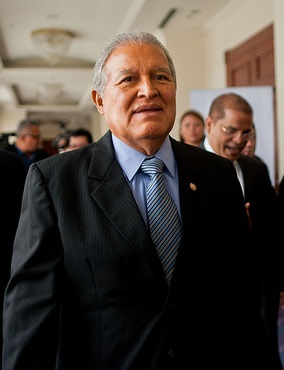
After five and a half months in office, Salvadoran President Sánchez Cerén is still groping for ways to address the country’s pressing security concerns.  According to official figures, the homicide rate has rebounded to 11 per day – compared to five or six per day for four months last year during a gang truce sponsored by President Funes and his Security Minister, General  Munguía.  Highly unpopular among Salvadorans and despised by the United States – the key partner in security issues – the truce turned out to be the most effective homicide reduction policy since the end of the Civil War.  For Sánchez Cerén, however, the failure to renew the truce has proven to be politically toxic as violence has once again surged.  Inside sources say that the new government has engaged in a quiet dialogue with gang leaders but refuses to publicly embrace it as a mainstay of its approach to security.  Instead, Public Security Minister Benito Lara is pushing a model of community policing that has yet to prove effective and will be difficult to implement nationally.  Low morale within police ranks, the unwillingness of citizens to cooperate with police in gang-plagued territories and, as always, the lack of meaningful resources to address social investment in poor and violent communities are undermining the policy.

Two main elements of a successful approach – funding and political courage – are lacking.  Truce implementation was supposed to be followed by a comprehensive social investment program called Comunidades libres de violencia (Communities Free of Violence), but it never got funded.  Sánchez Cerén, moreover, has shown reluctance to take on the security issue.  The United States, for its part, has provided millions of dollars in assistance under its Central American Regional Security Initiative (CARSI) for vetted units of special investigators, transnational law enforcement initiatives to combat gangs, police equipment and training, and prison management, but institutional weaknesses remain acute and violence has continued to climb.  Moreover, many critics say the programs are flawed by a failure to condition aid on concrete government steps to end security forces’ impunity, corruption, and secret cooperation with organized crime.

The days in which iron-fist approaches and fanfare-hyping law enforcement activity represented a credible security strategy have passed.  Salvadoran politicians can no longer talk their way out of the security chaos by selling mano dura fantasies.  The truce under President Funes helped gang leaders consolidate their influence and hone their political skills to the point that a solution to reduce homicides without gang leaders’ imprimatur is plainly not possible.  As President, Sánchez Cerén has the opportunity to provide strong leadership, while addressing the public’s concerns, to pursue talks under clear conditions and with credible consequences for gang violations.  In return for a gang promise to reduce homicides, stop recruitment in vulnerable areas, and end gang rapes, the President could credibly offer to allow them greater sway in prisons and to support social programs in affected communities.  He can also commit to find the necessary resources.  The elites will resist paying, but a mini-summit of the three Presidents of Central America’s northern tier and U.S. Vice President Biden hosted by the Inter-American Development Bank this week affords Sánchez Cerén a chance to make a bilateral pitch for help to Biden and a multilateral pitch to the IDB.  He will have to steel himself for the political hits that will ensue, but without strong leadership, security in El Salvador will only continue to deteriorate.   The former guerrilla leader must know that there is no easy solution at hand, but as President – validated by a democratic election – he has the responsibility and holds the power to act.

November 11, 2014

Mexico: Is Peña Nieto Missing the Point?

By Fulton Armstrong

Rodrigo Barquera / Flickr / CC BY

Rodrigo Barquera / Flickr / CC BY

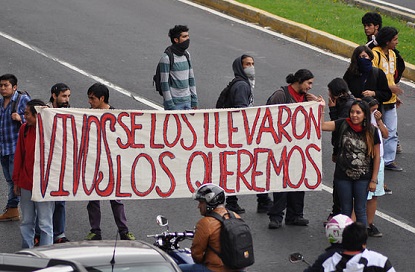
The disappearance and apparent massacre of 43 students from a city in Mexico’s Guerrero state is a rude reminder to President Peña Nieto that economic reform and increased foreign investment aren’t enough to help the country overcome the scourge of narcotics-fueled violence.  Federal and State prosecutors agree that the police in Iguala – who, along with the city’s mayor, have strong ties to the Guerreros Unidos cartel – handed the students over to the narcos after a confrontation during a student protest turned violent, already leaving six students dead.  Residents on a nearby ridge noted an increase in police and truck traffic soon after the showdown, but the dozens of bodies uncovered by searchers at mass graves in the area so far have not been the students’.  The mayor and police chief are in hiding, but Federal authorities say three dozen police and accomplices have been arrested and many have confessed.  None apparently has identified where the bodies were dumped.

As the scope of the crime, which occurred three weeks ago, has become clearer, the President’s rhetoric has been increasingly forceful, committing to investigate and bring the perpetrators to justice.  The Federal police have been directed to take control of security in the area and nearby municipalities.  The government announced last Friday, that the “supreme leader” of the Guerreros Unidos has been arrested, while another committed suicide after a standoff with police.  But critics point out the federal authorities’ own problems with corruption, and criticism of Peña Nieto’s efforts to stem the violence has been growing, especially in the wake of his administration’s many self-congratulatory statements about progress in the security area.  A new 5,000-strong national civilian gendarmerie he rolled out in August was ridiculed as too little, too late.  His continuation of his predecessor’s emphasis on arresting drug kingpins – resulting this year in the spectacular arrests of Joaquín “El Chapo” Guzmán Loera (of the Sinaloa cartel), Héctor Beltrán-Leyva (of the Beltrán-Leyva Organization), Fernando Sánchez Arellano (of the Arellano Félix cartel), and others – has failed to eliminate the underlying systems of the drug trade.

During the presidential campaign in 2012, Peña Nieto promised to reduce violence, and his decision not to obsess over the problem – as his predecessor, President Calderón, had – may have given him a respite.  But his administration apparently ignored clear signals of trouble – such as indications that in Guerrero state and elsewhere the cartels’ were expanding and consolidating their influence over government – and the problem seems to be roaring back with a vengeance.  The President’s focus on reforming the economy and attracting foreign investment makes strategic sense, but its long timeline doesn’t help him fight the fires of violence that envelop parts of the country.  There’s also merit in creating something like the gendarmerie and other institutional tools, but that approach seems to ignore that the rot of corruption has deep roots at all levels – federal, state, and local – that must be dealt with and that an elite unit tied to a federal capital hundreds of kilometers away can do little in places like Guerrero.  Calderón had shown the challenge wouldn’t be easy, but Peña Nieto has not yet shown that he – and Mexican society – are up to it either.

October 21, 2014

Venezuela: More of the Same Tragedy

By Michael McCarthy*

Embed from Getty Images

The gruesome murder of a pro-government Socialist Party deputy and the decision by the opposition coalition’s Mesa de Unidad Democrática (MUD) to suspend a rally in light of the tragedy foretold an opportunity to restart a national dialogue.  But unlike in January 2014, when the murder of beauty queen Monica Spears and her family created momentum for talks on security between the government and opposition, an unfortunate and familiar downward spiral has begun.  High-level government officials’ provocative accusations that the murder of Robert Serra, one of the Venezuelan Parliament’s youngest members, was the work of right-wing actors have deepened yet again the political polarization in Venezuela.  UNASUR’s new Secretary General, former Colombian President Ernesto Samper, surprisingly weighed in, strongly implying that Colombian paramilitaries were involved in Serra’s murder.  The government has long attempted to link members of Venezuela’s opposition with paramilitary groups, and Samper’s impartiality will forever be questioned by the opposition if the allegation is not proven. At Serra’s funeral, President Maduro described the MUD’s new Executive Secretary, Jesús “Chuo” Torrealba, as a piece of “garbage.”  Maduro’s name-calling is another example of the government using polarization as a tool to encourage supporters to close ranks.

Before the stabbing deaths of Serra and his female companion by unidentified assailants, the government was attempting to build momentum to resume the UNASUR-sponsored talks that had been frozen since May 3.  Samper had informed the MUD and opposition members of his intention to restart talks, and had described Maduro as “a man of dialogue, a man of peace,” adding that there were good prospects for “working a lot of things for the good of the region.”  But at this point any good will among the parties seems to have evaporated.  Moreover, for MUD secretary Torrealba, who originally said his goal was to change the MUD’s profile to mobilize a wider base of support, the primary task remains building MUD unity at a moment when different factions of the opposition are promoting widely varying initiatives.  Torrealba has little negotiating experience and does not enjoy the same access to elite sectors as his predecessor did.  His precarious position calls into question whether the MUD could negotiate as a coalition even if talks restarted.

Once again, centrifugal forces seem to be prevailing in Venezuela.  This trend raises the question of whether Venezuelan society is not only “wounded and resentful,” as Jesuit Political Scientist Arturo Sosa says, but on the verge of an estallido social – social explosion.  Mechanisms for mediating conflict through political discussion remain in place and appear unlikely to disappear completely, but confrontations are likely to continue flaring up regularly.

*Michael McCarthy is a CLALS Research Fellow.

October 7, 2014

Elections in Uruguay: A Bellwether for the Latin American Left?

By Aaron T. Bell

Photo credit: Frente Amplio (FA) / Foter / CC BY-NC-SA

Photo credit: Frente Amplio (FA) / Foter / CC BY-NC-SA

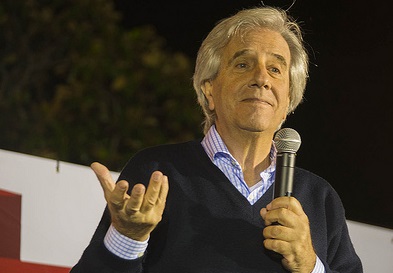
Uruguay’s elections on October 26 – once seen as a sure bet for the ruling Frente Amplio’s presidential candidate, former president Tabaré Vázquez (2005-2010) – have become a tight race, perhaps signaling challenges for other left-leaning Latin American governments as well.  The FA’s slight slip in the polls since the beginning of 2014 has been matched by sustained growth by the Partido Nacional, led by Luis Lacalle Pou, the son of a former president.  While Vázquez still holds a ten-point lead, he’s well below the absolute majority needed to avoid a run-off election, whose numbers look even bleaker for the ruling party.  In February, Lacalle Pou was running twenty-five points behind Vázquez in a head-to-head matchup, but the latest polls now show him only two points back.  Lacalle Pou will need the support of his party’s long-time rival, the Colorado Party, to win a second round against the FA, but Colorado candidate Pedro Bordaberry has thus far refused to concede the first round to the PN despite trailing them by 17 points.  Nonetheless, Vázquez was defeated by just such a second-round alliance in 1999.  Complicating things for him, polling strongly suggests that FA could lose control of both houses of the national legislature this fall.

The Lacalle Pou campaign has focused on public security and education.  Uruguay’s homicide rate remains one of the lowest in the region, but a modest increase in crime in recent years has spurred both urban and rural Uruguayans to rank security as the principal problem facing the nation – well ahead of the second leading concern, education.  The October elections will coincide with a referendum on lowering the age of criminal responsibility from 18 to 16 for serious offensives, with polls showing Uruguayans closely divided but leaning toward approval.  On the education front, the FA’s Plan Ceiba has helped provide laptops to every student, but 2012 assessment data from the Organization for Economic Cooperation and Development still place Uruguay’s students well below the international average in math, science, and reading.

The FA’s political situation is paradoxical: it has presided over major socioeconomic improvements in the last decade and won international acclaim, but earned a more tepid response at home.  Uruguay’s decision to legalize marijuana was widely celebrated abroad as a step toward a more progressive drug policy in the region, but polls continue to show that a majority of Uruguayans oppose legalization, and it has not won the FA much support even among proponents of cannabis, who have resisted the creation of a registry of buyers.  (Vázquez recently suggested the registry would be used to develop rehabilitation programs.)  The FA seems to have not yet figured out how to respond effectively to the perception of insecurity, nor has it overseen a decided improvement in education, which is central to long-term development prospects.  With Brazil’s Partido dos Trabalhadores facing an uncertain future, and political crises in Argentina and Venezuela simmering, the FA may be the first case of a larger regional rollback of the first wave of 21st century leftwing movements.

September 30, 2014

El Salvador: The Maras, Community Action, and Social Exclusion

By Mario Zetino Duarte, Larissa Brioso, and Margarita Montoya

Photo Courtesy of FLACSO-El Salvador

Photo Courtesy of FLACSO-El Salvador

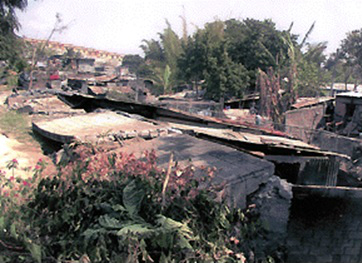
Maras and gangs in El Salvador have become social actors with great power in communities suffering from a high level of social exclusion. They have been linked to violence and organized crime, and they have been blamed for the highest number of homicides, organized criminal actions, and the generalized insecurity in which the country lives. They have brought a sense of isolation to the communities in which they live, as well as a reputation that increases the communities’ exclusion. According to a study being conducted in crime-ridden communities of Santa Tecla (near San Salvador) and Sonsonate (64 km. west of the capital), the maras’ power derives from their ability to cause fear and terror among inhabitants as a result of their effective and organized criminal actions. Their influence has a strong psychological impact and broad influence over people’s lives. The criminal activities of the gangs in the community are generally rejected by inhabitants because they put families at risk, make neighborhoods the target of police operations, and taint both the community and its residents socially – making it hard for people to get or keep jobs.

Nonetheless, many citizens in these communities have a positive assessment of the maras when it comes to providing important neighborhood security, due to a lack of national or local authority. In Santa Tecla and Sonsonate, the Salvadoran government, the municipality, international organizations, and other institutions have invested heavily in programs to stem the tide of mara violence, with mixed results. These communities suffer from low levels of employment, education, and social security, particularly among women. Afraid of retribution, citizens in these communities do not turn to state institutions to report crimes or to request protection, and they instead approach the maras to take actions regarding conflicts with neighbors and situations related to domestic violence. The void in institutional services, which has been permanent in some communities, is being filled by the maras and their members, making them the primary support for the local Asociaciones de Desarrollo and implementers of development plans.

Changes in the community philosophy of the National Civilian Police (PNC) in one of the communities of the study offers a useful example of how new approaches can help improve citizens’ lives. The PNC’s new approach to the community and its underlying social and security problems has also led to the evolution of the maras’ role as community actors and their legitimacy in the people’s eyes, primarily based on the fear they instill. This has benefited some communities.  Likewise, international cooperation – which has played an essential role – and the recent implementation of community policing practices as a model within the national security strategy to reduce gang criminality have driven debate on how communities can confront violence and crime in a sustained manner. The problems are far from resolved, but the gangs, the police, and the state each appear to be redefining strategies and roles. It remains to be seen whether these actions are sustainable and applicable in other territories – and whether the maras’ involvement in development programs can help create conditions for citizens to cope with the violence and social exclusion that plague their communities.

* Mario Zetino Duarte, Larissa Brioso, and Margarita Montoya are researchers at FLACSO-El Salvador.  Their study is funded by the International Development Research Centre.

Children and Migrant Teens: Trapped with No Way Out

By Ursula Roldán Andrade*

Alaks / Flickr / Creative Commons Attribution-NonCommercial-ShareAlike 2.0 Generic (CC BY-NC-SA 2.0)

Alaks / Flickr / Creative Commons Attribution-NonCommercial-ShareAlike 2.0 Generic (CC BY-NC-SA 2.0)

The 56,000 Central American children involved in the humanitarian crisis along the Mexico-United States border are trying to reach the United States not only to reunite with their families.  They are also driven by poverty, social exclusion and violence in their home countries of northern Central America.  The response of U.S. and Central American authorities, however, seems to be only to strengthen the barriers to migration – not only along the Mexico-United States border but also between Mexico, Guatemala, El Salvador, and Honduras.  The United States has emphasized immediate deportation, and its request for funding includes an increase in the number of courts to expedite deportations and in enhanced border security with military and police forces.  The Obama Administration also seeks resources to address the consequences of emigration in Central America, where the governments have done little more than begin criminal prosecutions against the “coyote” network.  In Guatemala there are rumors that parents responsible for migrating children could face criminal charges.  Caring for would-be migrants is a much lower priority; there are only two shelters, of a capacity of less than 80 children, in charge of the Social Work Program of the Office of the First Lady of Guatemala (SOSEP), which has also proposed the improvement of child reception conditions.

A mass media campaign in Guatemala promotes the idea of children staying to fulfill the “Guatemalan Dream” rather than risk their lives attempting to live the “American Dream.”  Yet, the “Guatemalan Dream” that authorities are referring to is lacking.  The Human Rights Office of the Archbishop of the Catholic Church of Guatemala (ODHAG), which has tracked human rights for children in the nation for the past 15 years, reported in 2011 that simply being alive in Guatemala means surviving health risks, food insecurity, and violence.  The report’s most revealing data show that over 48 percent of Guatemalan children suffer from chronic malnutrition.  According to ODHAG, 51 percent of the deaths of minors in 2011 were teenagers between the ages of 13 and 17.  The report called on the state to take preemptive measures to protect children and adolescents from malnutrition, hunger, violence, abuse, and human trafficking networks, but the government still spends only 3.1 percent of GDP on this population, whereas other Central American countries invest 6 percent.

Central American children are caught in the crossfire of political discourse in the United States – a migrant population that either gains protection or is cast aside, sometimes with xenophobic or even racist overtones.  Partisan politics, interest in cheap labor, and other factors short-circuit debate, creating conditions for exploitation of migrants without recognition of their citizenship, families, or rights.  The Guatemalan government neglects its vulnerable population, is rife with political corruption, and is cursed with the narrow-mindedness of its economic elite, which does not, in the least, attempt to change the structural conditions that exclude and eventually expel their countrymen.  Solutions to the resulting humanitarian crisis will remain elusive as long as Central American governments do not guarantee fundamental rights and undertake policies aimed at the defending the higher interests of children and adolescents. 

* Dr. Roldán Andrade specializes on migration issues at the Center for Research and Policy Management (INGEP) at the Universidad Rafael Landívar in Guatemala.

Prison Reform in Latin America: Lessons from Costa Rica

By Geoff Thale and Adriana Beltran*

Steven and Darusha / Flickr / Creative Commons Attribution-NonCommercial-ShareAlike 2.0 Generic (CC BY-NC-SA 2.0)

Steven and Darusha / Flickr / Creative Commons Attribution-NonCommercial-ShareAlike 2.0 Generic (CC BY-NC-SA 2.0)

Prison overcrowding is a widespread problem in Latin America, primarily because of harsh drug-sentencing laws and inadequate budgets, but Costa Rica may be setting a useful example for dealing with it.  In most countries, guards control the perimeter, but groups of prisoners or criminal gangs organize and control life inside the prison compound.  Rehabilitation and re-integration programs are limited.  Not surprisingly, there is little political leadership for prison reform; the issue wins few points with the general public.  Even dramatic events – like prison riots in Venezuela or prison fires in which hundreds of young men die as in Honduras – don’t generate interest in prison reform.  A key component of the criminal justice system – as a deterrent, a punishment, and as a provider of rehabilitation and reintegration services that will reduce recidivism – the prisons are often neglected.

While Costa Rica faces growing drug-related problems, a multi-country analysis by the Washington Office on Latin America of persistent criminal justice and prison problems in Latin America – aimed at identifying strategic solutions – indicates that the country stands out as having undertaken at least modest reforms of its prisons to prevent them from becoming the breeding grounds for increasingly hardened criminals and gangs.  Prison conditions in Costa Rica have not been among the worst in Latin America, although the U.S. State Department said in its Human Rights Report for 2013 report that they were “harsh” and that “overcrowding, inadequate sanitation, difficulties obtaining medical care, and violence among prisoners remained serious problems.”  Until very recently, when new drug sentencing laws and tough anti-crime measures pushed the prison population up, the system generally did not exceed capacity.  Even today, the system is at 140 percent of capacity – far less than the 200-300 percent seen in other countries.  Prison conditions also seem less abusive than those seen in other countries.  An external oversight body was created to protect the rights of prisoners.  Moreover, the government, with support from the Inter-American Development Bank (IDB), is reaching out to local businesses to support vocational training programs for inmates.

This process has been driven by reformers inside the government and prison system, in contrast to most reforms elsewhere in the hemisphere driven by international donors.  This is a rare example of how reformers inside and outside the system worked to achieve institutional changes that increase citizen security while respecting human rights.  In this case, long-standing mid-level and senior staff of the penitentiary system, with the support of successive Ministers of Justice appointed by President Laura Chinchilla, played a key role in resisting pressures from legislators who want to toughen sentencing, which would increase prison populations.  They have advocated measures to ease overcrowding and ensure proportionality in sentencing.  At the same time, they have also used the IDB loan to both defend and expand the rehabilitation and re-insertion programs in the prison system.  Every country’s situation is unique, and Costa Rica has advantages — a relatively low crime rate, a relatively strong state structure, a relatively well-established respect for the rule of law – that others lack, but San José has shown that reform in this difficult, politically sensitive area is possible.

*Geoff Thale and Adriana Beltran, of the Washington Office on Latin America (WOLA), recently led a small delegation to visit Costa Rican prisons.

Drug Dealing in Costa Rica: A Perverse Path toward Social Inclusion

By Rodolfo Calderón Umaña*

Antonio / Flickr / Creative Commons Attribution-NonCommercial-ShareAlike 2.0 Generic (CC BY-NC-SA 2.0)

Antonio / Flickr / Creative Commons Attribution-NonCommercial-ShareAlike 2.0 Generic (CC BY-NC-SA 2.0)

Central America’s emergence as a principal transit route for illicit drugs from South America to the U.S. has given rise to local retail markets supplying users within the region.  A study of three Costa Rican communities – one in greater San José and two along the Caribbean coast – highlights several factors that determine the scale and consequences of these local markets.  Among the most important are the high levels of social exclusion experienced by households in these localities and residents’ motivation to become involved in the business because it offers resources (money, power and prestige) that cannot be achieved through the legitimate channels of education or quality employment.  Other factors include the proximity of the communities to drug trafficking routes and the extent of previously existing demand from local consumers.

One of the most significant characteristics of local drug markets in these communities, as elsewhere, is that they are socially and territorially bounded because trust is the key factor shaping relationships between suppliers, sellers and consumers.  Some local suppliers maintain direct ties to cartels, but they operate their businesses independently.  Youth are assigned the most vulnerable tasks and are thus disproportionately represented among those arrested and convicted of crimes.  Violence serves as the principal instrument for controlling and regulating the drug trade, and the result is that for youth in these settings violence becomes normalized as a routine form of behavior.  This spawns a generalized climate of fear and insecurity, and the typical response of community residents is to retreat from public space and to isolate themselves inside their homes.

These findings support calls for new responses to the drug trade at the community level.  Central American governments, encouraged to a significant degree by U.S. programs, have tended to emphasize repressing and “combatting” the scourge of drug trafficking, yet where this approach has been implemented – particularly in Central America’s Northern Triangle — social problems have only gotten worse.  In Costa Rica, it’s not too late to undertake a comprehensive strategic review of policies in this domain and to bolster programs to stabilize affected areas.  Particularly if designed and implemented from the bottom up, programs can identify and reach out to vulnerable residents before they are drawn into drug micro-markets as vendors, consumers, or both.  Vocational training programs matched to real employment opportunities are absolutely fundamental – to reduce residents’ social exclusion.  Our research findings indicate that enhancement of public spaces where community residents can congregate and initiatives focused on building trust between communities at risk and representatives of the state can also be highly productive.  Costa Rica is at a critical juncture: it can either sustain and expand the participatory policy frameworks that buttress community cohesion and resilience or run the risk of falling into the devastating spiral of delinquency and violence that has plagued its neighbors in the Northern Triangle.

*Dr. Calderón Umaña is a researcher at FLACSO-Costa Rica.  The study is being conducted by FLACSO-Costa Rica with funding from the International Development Research Centre.

Private Security Filling a Void in the Dominican Republic

By Maribel Vásquez

Photo credit: Harry Pujols / Foter / Creative Commons Attribution 2.0 Generic (CC BY 2.0)

Photo credit: Harry Pujols / Foter / Creative Commons Attribution 2.0 Generic (CC BY 2.0)

Criminality and violence often translate into fear and institutional distrust in Latin American contexts – and give rise to private security companies (PSCs) that play an increasingly important role in public security with little or no civilian oversight.  In the Dominican Republic, for example, PSCs are proliferating as surveys indicate a widespread perception that the Ministry of Interior and Police (MIP) is woefully inadequate in scale and capabilities.  According to a study by the Latin American Public Opinion Project (LAPOP) and the UNDP in 2012, over 50 percent of Dominicans said that they believed that the National Police was involved in criminal or illicit activity. More troublesome, of all countries surveyed*, the Dominican Republic, with 64.8 percent, reported the highest percentage of people who believe that security is deteriorating in the country.

With such levels of public disorder and perceived police ineffectiveness, the Dominican Republic has experienced a boom in PSCs.  The Geneva-based Small Arms Survey in 2011 reported that PSCs employed 30,000 people in the Dominican Republic – and the number has surely grown since then.  The country has 29,357 formally registered police officers, yielding a ratio of 1.02 private security agents for each police officer.  Often, PSCs are better equipped in the country than security forces.  In the Dominican Republic, PSCs are under the jurisdiction of the Superintendence of Private Security (SPS), a branch of the armed forces – a fact that causes tension with the civilian companies and the police in whose jurisdiction they operate.  This absence of the MIP – the state institution directly responsible for citizen security – from the oversight process has inhibited coordination between the PSCs and the police, and diminished the government’s ability to provide public security.

The traditional definition of national defense in the Dominican Republic and other Latin America countries has included citizen security and entailed deep military involvement – and often abuses – in matters now considered best handled by civilians.  The continuing shadow of the Dominican military in security affairs has weakened the National Police.  President Danilo Medina last year deployed soldiers to patrol the streets alongside the police to combat crime.  Such practices make the police less legitimate in the eyes of the public – and further drive popular demand for PSCs.  Reforming the public security landscape in the Dominican Republic will require great political will.  More effective civilian participation in security affairs, through oversight and professionalization of the National Police, must take place to ultimately strengthen democratic accountability.  The PSCs should be brought under civilian control.  

*LAPOP-PNUD (2012). Countries surveyed: Argentina, Bolivia, Brasil, Chile, Colombia, Costa Rica, Ecuador, El Salvador, Guatemala, Honduras, México, Nicaragua, Panamá, Paraguay, Perú, República Dominicana, Uruguay, Venezuela.

Social Exclusion and Societal Violence: The Household Dimension

By Juan Pablo Pérez Sáinz*

A street in Pacuare, Costa Rica—one of the FLACSO project's research sites  Photo credit: d.kele | Foter | CC BY-NC-SA

A street in Pacuare, Costa Rica—one of the FLACSO project’s research sites
Photo credit: d.kele | Foter | CC BY-NC-SA

Ongoing research in Central America increasingly points to citizens’ exclusion from basic markets, especially the workforce that receives certain social guarantees, as the cause of societal violence in the region.  Their lack of access to the labor, capital, land and other markets, in which almost all income is generated, leads to an extreme disempowerment – a primary exclusion – that reverberates through citizens’ lives.  Analysts of Latin American societies often focus on poverty and income inequality as important elements in violence, but a study by FLACSO-Costa Rica and FLACSO-El Salvador indicates that social exclusion is the underlying cause of these problems and, therefore, is the more reliable indicator of a country’s vulnerability to societal violence.  The processes of social exclusion may be responsible for the epidemic of violence that plagues urban spaces across the isthmus and elsewhere in Latin America.

In Central America, labor markets are increasingly important drivers of primary exclusion.  These are societies riven by endemic unemployment and generalized job precariousness, and much of the population is relegated to the kinds of self-employment that offer no prospects of ever moving beyond satisfying the survival imperatives of households.  Numerous South American governments in recent years have helped neutralize citizens’ exclusion through carefully designed social programs, but when the state lacks the capacity or will to supply access to such “citizenship,” as has been the case in much of Central America, exclusion only deepens.  A least two basic narratives establish clear linkages between social exclusion and violence, especially among youth.

  • First, when the state abandons marginal urban territories, these fall under the control of youth gangs that establish themselves as new authorities and obtain a monopoly on the instruments of violence.
  • Second, precarious employment – the inability of citizens to generate incomes sufficient to satisfy minimal aspirations of consumption – leads to lifestyles in which the line between legal and illegal becomes murky.

FLACSO’s study of several urban communities in Costa Rica and El Salvador has identified a possible third link between social exclusion and violence – in the household.  The domestic sphere, typically glorified as the sole space of security amidst the external insecurity that these communities find in public spaces, can also become a source of exclusion-driven violence.  Male unemployment, especially that of heads of household, is expressed not only in violence among adults but also violence by adults against children.  That violence in turn is projected outward, toward other members of the community, as victims of violence within households become perpetrators of violence outside them.  The complex chain of different types of violence, beginning with the structural violence that society generates through social exclusion, passing through the household unit, and then rebounds outward toward the community.  If this is in fact what is occurring, it suggests that efforts to overcome primary exclusion are imperative to reduce all levels of violence.

*Juan Pablo Pérez Sáinz is a senior researcher for the Latin American Social Science Faculty in San José (FLACSO-Costa Rica) and lead researcher in this project supported by the IDRC.  For a description of the project please click here.