U.S.-Colombia: Launching “Peace Colombia”

By Eric Hershberg and Fulton Armstrong

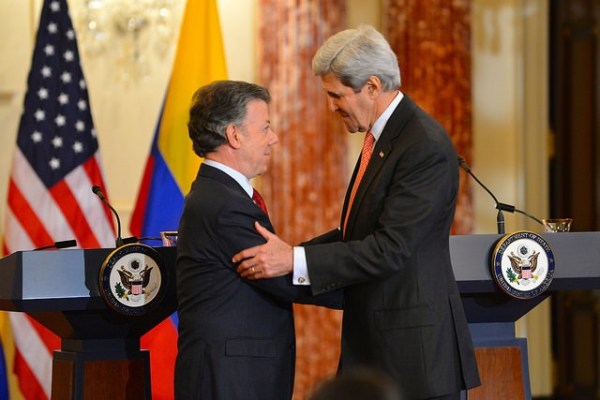
Kerry Santos

Photo Credit: U.S. Department of State / Flickr / Public Domain

The United States, buoyed by good feelings about what President Obama called Colombia’s “remarkable transformation,” last week pledged $450 million a year in continued aid for the next five years, but it’s not clear yet whether “Peace Colombia” will be very different from Plan Colombia, to which the United States contributed some $10 billion.  The new spending includes unspecified amounts to support the reintegration of FARC combatants who lay down their arms as part of a peace accord expected next month, but much of the emphasis appears to be on old priorities, such as “consolidating and expanding progress in security and counternarcotics.”

  • Obama and Colombian President Santos announced the new program in Washington events marking the 15th anniversary of the launch of Plan Colombia. Amid the many remarks about Colombia’s progress, indicators such as homicide rates (down 50 percent since 2002), kidnapping rates (down 90 percent), economic growth (averaging 4.3 percent), and poverty and unemployment (down slightly) stand out.  By most accounts, moving around core regions of Colombia is easier and safer than it’s been in decades.

Some of these gains of the past 15 years remain tenuous, and “Peace Colombia” will face new challenges as well.  In speeches and backgrounders, government officials have acknowledged that coca eradication and crop substitution programs have failed to reverse Colombia’s role as the world’s biggest producer of coca.  Moreover, programs supporting the demobilization of the FARC will be more difficult to implement than those given to the rightwing paramilitaries in 2002-2006.  Tens of thousands of former paramilitaries are now active in bandas criminales (BACRIMs), which President Santos recently referred to as “2,500 miniscule criminal organizations scattered throughout the country.”  Changing economic circumstances could also complicate efforts to advance peace.  During the years of Plan Colombia, the country got a healthy bump from both domestic and foreign investment – because of the improved security environment as well as the external economic environment, including the U.S.-Colombia Free Trade Agreement and Chinese demand for commodities.  Investment remains strong, but the export boom is over, which is lowering growth and squeezing government budgets.

The creation of economic opportunity is at least as important to the success of Peace Colombia as continued support for the Colombian military and security system, although last week’s speeches and press releases did not shed much light on that.  Achieving peace and building democracy will also require addressing infrastructure deficits, educational inequality, inadequate job training, and poverty.  Several Florida congressmen, arguing that “Peace Colombia” supports an accord that’s overly generous to the FARC, say they’ll oppose Obama’s pledged aid.  The assistance will almost certainly advance, however, because of the strong Washington consensus that Colombia is its biggest (if not only) success worldwide in beating back irregular armed groups.  Moreover, as President Santos and U.S. Secretary of State Kerry emphasized in a press conference, there are no conditions on the new assistance – which should assuage Congressional opponents’ concerns that the relationship will get held up by investigations into alleged human rights violations in the past.  The Presidents spoke of pulling Colombia back from the “verge of collapse” in the 2000s to the “verge of peace” now.  A broadening of strategies in both capitals, including a reassessment of the emphasis on military options, could push the country toward becoming a more inclusive democracy, which ultimately may be what is required in order to achieve lasting peace.

February 8, 2016

Honduras: The Need to Differentiate among the Gangs

By Steven Dudley

Photo Credit: InSight Crime

Photo Credit: InSight Crime

Honduras street gangs – often inaccurately lumped into a single category – are a complex, deep-rooted social and criminal phenomenon that is driving violence and migration in record numbers. InSight Crime, after investigating them for most of 2015, found that the catch-all term “maras” is at once ominous and ill-defined. The two largest gangs – the Mara Salvatrucha (MS13) and Barrio 18 – have similar criminal revenue streams, but different approaches to obtaining those proceeds. Recognizing these differences is an important part of undermining their power and influence.

  • Extortion is a critical source of funding for both groups. This includes the public transportation system and taxi cooperatives in the largest urban areas, which account for a huge percentage of the gangs’ earnings. InSight Crime talked to one member of a bus cooperative that was paying four gangs extortion fees and was being pestered by a fifth.
  • The groups’ approach to local extortion targets – small businesses, shops, or local delivery services – is different. The MS13 does not extort where they operate; the Barrio 18 does, with huge implications for the gangs’ relations with the neighborhood’s residents and local police. The Barrio 18 is seen as predatory; the MS13 is often seen as a protector.
  • The MS13 is more focused on local drug sales, which allows it to forgo the easy extortion proceeds. Because it meddles less with residents, the MS13 has better relations with the local police, who, in turn, target the Barrio 18 with more resources and vigor. This also positions MS13 for better relations with community leaders and politicians, and it reportedly can, in some cases, act as the unofficial social services operator in cases of child or spousal abuse. In one area InSight Crime visited, the MS13 gives accused abusers a warning after the first report, a beating after the second, and banishment (or worse) after the third.
  • While they may operate under a single umbrella, the MS13 and the Barrio 18 also vary widely in sophistication and reach, wherewithal, and infrastructure. They are semi-autonomous and prone to violent spasms that have wide-reaching implications for the communities in which they operate. The Barrio 18 appears to be less disciplined and less focused on bigger goals than the elements of the MS13 InSight Crime studied. Barrio 18 members give the impression that their struggle is more about human survival than expansion in the underworld. They live by “codes,” such as “respect the barrio,” that are evoked as a pretext for nearly any action, violent or otherwise, against outsiders and fellow gang members alike.
  • The violent ethos that guides the Barrio 18 and the MS13 is shared by their rivals, who include offshoots of the two main gangs, vigilantes, and soccer hooligans. Almost all live from the same income sources – extortion and local drug peddling. Some days they are allies; other days they are enemies.

The repercussions of oversimplifying the situation – treating all gangs as the same – are not trivial. Honduras continues to struggle with record levels of violence, and the United States is grappling with record levels of asylum applicants from gang-riddled countries like Honduras. There are times for a hammer, with criminal groups that only seem to understand force. But there are also moments when negotiation, accommodation, and social programs are more persuasive, and long-lasting, than simply sending in more troops and arresting more youths with tattoos. The trick is to know the difference, but we can only do that if we start to see these groups as complex and dynamic organizations with different criminal economies, social relations, and political ambitions.

December 14, 2015

*Steven Dudley is co-Director of InSightCrime, which is co-sponsored by CLALS. The full report “Gangs in Honduras” is available in English here and in Spanish here.

Colombia’s National Policing Model: Real Success?

By Kenneth Sebastian Leon*

Photo Credit: Policía Nacional de los colombianos / Flickr / Creatives Commons

Photo Credit: Policía Nacional de los colombianos / Flickr / Creatives Commons

Colombia’s new policing model – called the National Quadrant Surveillance Model, or MNVCC – has been implemented for almost five years, but assessments of its impact vary widely. Commonly referred to as “Plan Cuadrantes” or “Modelo Cuadrantes,” it was introduced in 2010 as a law enforcement operational strategy for the Colombian National Police (CNP) combining elements of the “hot spots” and community policing models.  The MNVCC emphasizes modern technological and data-driven methods for deploying patrol officers according to locale-specific needs, while also prioritizing community-citizen relations.  The model applies spatial geographic informations system (GIS) technology to public safety-related data to define geographic quadrants for allocating personnel and resources .  In areas of high crime density, for example, the quadrants are smaller to allow for a higher concentration of deployed officers.  Community policing aims to improve relations and collaboration between police officers and the citizens they serve.  On the street, the MNVCC model specifies that six officers be assigned per quadrant, and that all officers be visible, approachable, and recognizable to the residents and commercial establishments.

There is no consensus on how well the model is working.  Fundacion Ideas Para La Paz (FiP), a research and policy institution contracted by the CNP, in 2012 released an evaluation of the first eight cities (including Bogotá and Medellín) that found an 18 percent decrease in homicides, 11 percent in personal assaults, and 22 percent in vehicle thefts.  Another research organization specializing in measuring and monitoring quality of life indicators in major cities in Colombia and abroad, Cómo Vamos, assessed in 2013 that Bogotá ranks second to last nationwide in perception of safety – with only 21 percent of residents feeling safe in the city.  A survey conducted last year by El Centro de Estudio y Análisis en Convivencia y Seguridad Ciudadana found that 71 percent of respondents in the capital are either “very dissatisfied” or “dissatisfied” with the police service.  It also calculated that both total number and population rates of homicide increased between 2013 and 2014.  CNP officials privately maintain that the MNVCC is successful and that these contradictory reports are a matter of perception.  Indeed, a CNP general told El Tiempo newspaper that the perception is caused by “increases in reporting to the police, and that shows increased trust in the police.”

While the data on MNVCC effectiveness obviously need further research, anecdotal information does yield some positive lessons from a community policing perspective.  Smartphone apps and the CNP website provide users with a “find your quadrant” feature, linking them to local-level officers and patrol stations, and WhatsApp messaging allows citizens to connect directly with “quadrant officers.”  Additionally, a Puerta-a-puerta initiative provides information that helps the citizen more effectively reach out to law enforcement.  Call boxes at strategic points in neighborhoods, and a Frente a la Comunidad  neighborhood watch-style program distributes radios to contact local police.  Despite discrepancies in crime statistics and perception surveys, the sixth year of the MNVCC model appears to be creating an infrastructure and a culture in targeted communities that could – with further investments and adjustments – mark a strategic watershed in Colombian policing. 

October 2, 2015

*Kenneth Sebastian Leon is a PhD student in American University’s Department of Justice, Law, and Criminology with a dual emphasis in sociolegal studies and criminology.

Maduro Cites Security to Suspend Rights on the Border

By Michael M. McCarthy*

Photo Credit: Globovisión / Flickr / Creative Commons

Photo Credit: Globovisión / Flickr / Creative Commons

The Maduro government’s closure of a key border crossing into Colombia and declaration of a state of emergency in nearby towns mark not only a low in relations with Colombia but also in efforts to manipulate the playing field ahead of legislative elections slated for December 6.  President Maduro blamed Colombian “paramilitaries” for an August 19 firefight in which three Venezuelan soldiers were wounded.  He announced the deployment in the area of the “Operations for the Liberation and Protection of the People” (OLP), which are heavily armed military and police units specially created to force out alleged paramilitaries, and security forces swept through the area forcibly deporting more than a thousand undocumented Colombians.  Last week, the pro-government coalition of the Venezuelan National Assembly called for expanding the emergency measures to two other important border states.  The two countries’ foreign ministers met on August 26 for what Colombian Minister Holguin called a “positive, frank and realistic” exchange, but there was no agreement to reopen the border.

Maduro’s objectives seem to go far beyond stemming border violence.  Two reputable polls put his popularity in the lower 20s and project the opposition as likely to win a Congressional majority in the December 6 legislative elections.  His Chavista political movement is bleeding supporters amid a mounting economic crisis. Skyrocketing inflation and acute shortages of basic goods and services have created daily hardships for the popular sectors that once served as Chavismo’s base.  The opposition coalition Mesa de Unidad Democrática called the state of emergency a diversionary tactic – “to cause a situation of intense conflict and internal confusion” – and claimed that the maneuvering shows Maduro fears the election and may suspend it.  The state of emergency in Táchira, which is a renewable in 60 days, restricts the right to public assembly and gives Maduro powers to seize assets and limit the sale of basic goods and services.  The value of the annual illegal border trade is estimated to have grown to roughly $5 billion.  The order may become a mechanism for intensifying government controls over industry, which Maduro regularly accuses of waging war against the government.

Maduro’s political objectives in declaring the state of exception are obvious to reset the political agenda in line with a government narrative of external threats.  This security rationale appears greatly exaggerated, suggesting he’s more interested in scapegoating Colombia for the sorry state of affairs in Táchira than in sparking a diversionary armed conflict.  He also recently escalated an historic border dispute on his eastern flank with Guyana after Exxon discovered oil in Guyanese territory claimed by Venezuela.  So far, Maduros actions have not seemed to threaten the soft truce between Washington and Caracas, which has led to a toning down of mutual recriminations.  Over the weekend, the U.S. State Department issued a mild statement that noted “continuing concern about the situation along the border between Venezuela and Colombia,” although Washington did take him to task for the deportations.  The real implications of the emergency decree are internal to Venezuela. Maduro’s state of emergency not only raises human rights concerns in the affected territories; it suggests the specter that the government will resort to increasingly desperate measures to maintain control as its credibility, like the economy, collapses.

August 31, 2015

* Michael McCarthy is a Research Fellow with the Center for Latin American and Latino Studies.

Colombia’s Peace Talks: Back from the Brink

By Aaron T. Bell

"Colombia somos todos/We are all Colombia" Photo Credit: Juan Carlos Pachón / Flickr / Creative Commons

“Colombia somos todos/We are all Colombia” Photo Credit: Juan Carlos Pachón / Flickr / Creative Commons

Peace negotiations are back on track in Colombia – for now – after renewed violence put years of progress at risk.  The unilateral cease-fire declared by the FARC last December survived the Colombian military’s continued prosecution of the war for several months, including the killing in March of José David Suarez, the head of the wealthy (and drug-trade-affiliated) 57th Front.  But it was proven unsustainable after a guerrilla attack in April killed eleven soldiers, and Colombian military aerial bombardment of FARC camps in May killed 40 guerrillas, including two who had participated in the peace negotiations in Havana.  The FARC formally revoked its cease-fire and resumed attacks on military and energy infrastructure targets, making June the most active month of the FARC insurgency since negotiations began two and a half years ago.  At the urging of international supporters of the peace process, however, the FARC will implement a new unilateral cease-fire this week.  President Santos stated that the Colombian military will de-escalate as well, but – responding to polls by Gallup and Datexco reflecting public skepticism that a negotiated settlement is possible – he has also pledged to review the situation in four months and decide whether to continue negotiations.  While Santos has appointed a new Defense Minister whose public statements and record as a member of the government negotiating team indicate support for the peace talks, the President has also shaken up the military high command, promoting combat-experienced hawkish officers as commanders.

A renewed sense of urgency among negotiators appears to be emerging.  Both sides have agreed to put all of the pending issues – disarmament and demobilization, compensation for victims, and transitional justice – on the table, rather than deal with them one at a time.  This comes after several positive steps during the hiatus in talks:

  • In late May, while airstrikes on guerrilla camps were resuming, units of the FARC and the Colombian military collaborated in several operations to remove land mines. Colombia is the second most deadly country for land mines, behind only Afghanistan, with over 2,000 people killed and another 11,000 maimed since 1990.  A video on the web last week provided a dramatic example of the need for such measures – a Blackhawk helicopter exploding after landing in a minefield last month.
  • On June 4 negotiators agreed on the makeup of a post-accord Truth Commission. Eleven members will have three years to identify collective (rather than individual) responsibility for abuses.  It will have no mandate to recommend or impose punishment, leaving that instead for an as yet to be agreed upon transitional justice tribunal.
  • Both the FARC and coca growers have called on the government to begin implementing the preliminary agreement on the illicit drug trade, including crop substitution and voluntary eradication. (Recent reports from the United Nations Office on Drugs and Crime and the White House Office on National Drug Control Policy, which use different raw numbers and data-gathering methodologies, show that coca production in Colombia rose significantly in 2014.)  Even though, as InsightCrime has noted, the initiative will be hindered by the lack of a bilateral cease-fire and firm plans for demobilization, it’s a positive step.

Despite the skepticism implicit in the review it will make in four months, the Santos administration appears to be inching toward the bilateral cease-fire that the FARC has long called for.  The government formerly insisted that a bilateral cease-fire would only take place after accords were signed, but has said it would consider one so long as it is “serious, bilateral, definitive and verifiable.”  On the other side of the table, the FARC shows some sign of bending on the thorny matter of transitional justice.  After adamantly opposing jail time for its leaders, FARC negotiators say they will consider some form of confinement for a reduced time period so long as military officials and civilian supporters of right-wing paramilitaries face similar standards of justice.  This may be difficult to swallow for a Colombian military whose culpability in war crimes is bubbling to the surface, such as in a recent report by Human Rights Watch on the extrajudicial killing of thousands of civilians.  The ever-present threat of military opposition to a negotiated accord, coupled with rising public skepticism, suggest the time to make concrete progress toward an accord is now.  The window will not stay open long.

July 21, 2015

Brazil: Jailing the Youth

By Paula Orlando*

Brazilian Penitentiary System.  Photo Credit: Marcelo Freixo / Flickr / Creative Commons

Brazilian Penitentiary System. Photo Credit: Marcelo Freixo / Flickr / Creative Commons

A push for legislation to lower the age of criminal responsibility to 16 years could worsen court backlogs and overcrowding in Brazil’s notorious prisons.  According to the International Center for Prison Studies (ICPS), the country’s jails now hold the fourth largest prison population in the world, behind the United States, China, and Russia.  The Brazilian inmate population has doubled in the past ten years – from 296,919 people in 2005 to over 615,000 now – boosted by arrests of young and black people.  The Map of Incarceration, a study released this month by researchers at the Federal University of Sao Carlos (UFSCAR), shows that prisoners are increasingly between the ages of 18 and 29 (54.8 percent) and black (60.85 percent), with a growing presence of females (from 4.35 percent in 2005 to 6.17 percent in 2012).  The study also notes that the main reasons for arrest are crimes against property and “involvement in drug trafficking.”  Further, on average 38 percent – or four in every ten inmates – are awaiting trial.  According to a report by the OAS’s Inter-American Commission on Human Rights, the wait times may vary from months to years – sometimes longer than the actual sentence for the crime committed.  Of the total jail population, over 18 percent would be eligible for alternative sentences, but they either haven’t gone to trial yet or the judges have opted for heavier sentences.

A group of hardline conservative legislators – the “bullet caucus” – is pushing aggressively for a law that would lower the age of criminal responsibility from 18 to 16 and consequently place more youth in the already overcrowded adult jails.  Currently, the Child and Adolescent Statute (ECA) establishes that those between 12 and 17 years of age who committed a crime should be sent to juvenile centers, and for a maximum of three years.  The proposal to lower the age has received overwhelming popular support. This support is generally based on the perception that minors commit more violent crimes because they are not currently accountable as adults – and that harsher sentences would deter them.  However, official data shows that, among those in the juvenile system, only 9 percent committed violent crimes.  On the other hand, homicide is the leading cause of death of young people between the ages of 15 and 29.  Out of the 56,000 yearly homicides, 30,000 victims are young.  By crossing data from the Ministry of Justice and the 2014 Map of Violence, the report also debunks the popular perception that more arrests lead to safer cities.  On the contrary, just as incarceration grows, homicide rates have also steadily risen in the country.  According to press reports and other observers, there’s a good chance the legislation will move forward in the next few weeks.

Since the bill amends the Brazilian Constitution, it must pass both the Chamber of Deputies and the Senate with at least two-thirds of the votes.  In addition to increasing youth incarcerations, if passed, the initiative will undermine the 1990 Child and Adolescent Statute, considered a landmark by children’s rights advocates.  It will further remove the state from its responsibility for the protection and education of the youth, essentially eliminating any chance of youths’ rehabilitation while broadening the “school-to-prison pipeline” that envelopes many.   Moreover, passage of this reform, under the banner of law and order, will strengthen the ultra-conservative sectors – including some religious leaders and representatives of agribusiness – who already dominate the Brazilian Congress in an open crusade against social welfare policies and minority rights. 

 June 29, 2015

*Paula Orlando is a CLALS fellow and a PhD candidate at the School of Communication at American University.

Violence and Risky Responses in El Salvador

By Héctor Silva

PresidenciaRD and US Embassy San Salvador / Flickr / Creative Commons

PresidenciaRD and US Embassy San Salvador / Flickr / Creative Commons

Salvadoran President Sánchez Cerén, facing a surge in gang-related violence, is grasping at risky solutions.  The 481 murders last month – about 16 per day – broke a 10-year record and represented a 52 percent increase over the same month in 2014.  The soaring murder rate has deep roots going back to well before Sánchez Cerén and his FMLN predecessor, President Funes, came to power in 2009, but its immediate cause is the end last year of the three-way truce between the country’s two biggest gangs – the MS13 and Barrio 18 – and the government.  Negotiated by the Funes administration in 2012, the truce provided a respite that, according to many observers, was doomed to fail because it split gang leaders, with those outside prison expanding their power, and allowed both gangs to expand their territorial control largely unfettered.  Another factor is weak leadership and low morale among public security forces, especially the National Police, which has gutted confidence among the rank and file and prompted some frustrated commanders to take matters into their own hands.  Extrajudicial executions of gang members in retaliation for the loss of police comrades have further driven up the death toll.  Observers increasingly refer to El Salvador’s current situation as a “low-intensity conflict.”

Sánchez Cerén has tried an array of sometimes contradictory tactics in response to the gang problem and the violence, creating an appearance of incoherence and ineffectiveness.  Without disputing estimates of the spiraling death toll, he has blamed the right wing and the media for creating a crisis atmosphere.  Over the past 10 months, he has attempted – and failed – to implement “community policing” strategies, which languish due to inadequate funding and planning, and he recently led several hundred thousand people in a march for “life, peace, and justice.”  With mounting pressure on the President to adopt hardline approaches, he has pledged greater resources to arm and deploy special anti-gang units, and last week he announced intent to supplement the 7,000 military troops already dedicated to law-enforcement duty with the creation of three new “Gang Cleanup Battalions.”  The government says that these 1,200 elite Army troops, strikingly reminiscent of the “Immediate Reaction Infantry Battalions” (BIRIs) that committed grave human rights abuses when deployed during the civil war, will be under civilian police control.

The President’s moves are fraught with danger.  His zigzags signal weakness to his ambitious political opponents and the gangs alike, and his political liabilities will only mount if, as almost all observers expect, the new battalions escalate the war in a manner that fuels extrajudicial killings and other human rights violations.  Criticism from advocates of dialogue with the gangs, including negotiators involved in the previous truce, further weaken him.  The fact is that the gangs, taking advantage of decades of state neglect of key sectors of society, have established strong bases of support in areas where the state’s presence and credibility are already nil or worse.  The shift toward a militarized strategy, moreover, runs counter to the tragic lessons learned in Honduras and Guatemala.  Going after the maras will entail battle in marginalized urban and rural areas that should be Sánchez Cerén’s and his FMLN party’s natural constituencies.  In a lose-lose situation, Sánchez Cerén may be opting for the surer loss.

April 23, 2015

Brazilian Truth Commission Looks at Police Violence

By Paula Orlando

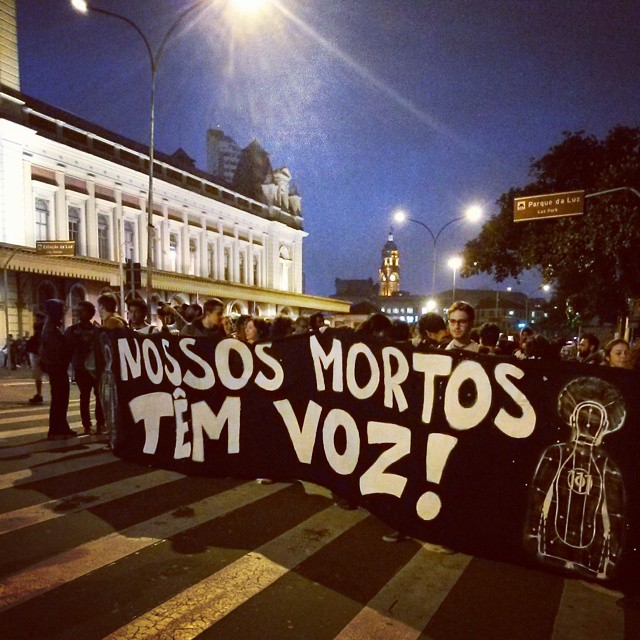
March in commemoration of the 22nd anniversary of the Carandiru massacre in 2014. Photo credit: veredaestreita / Flickr / CC BY-NC-SA

March in commemoration of the 22nd anniversary of the Carandiru massacre in 2014. Photo credit: veredaestreita / Flickr / CC BY-NC-SA

A new truth commission is about to investigate Brazil’s legendary police brutality and, for the first time, attempt to bring some public accountability for the crimes committed by the state. Police kill an estimated six people per day. Civil society organizations persuaded the Sao Paulo Legislative Assembly (ALESP) to establish the commission, the first to focus on human rights violations in the post-dictatorship period. It will hear testimony from witnesses and survivors of police brutality, and examine documents and other evidence related to major cases of police violence in the city and state in the last decades. The initiative follows the recent release of reports by the National and Sao Paulo State Truth Commissions on human rights violations during the military dictatorship (1964-1985). In fact, the reports suggested that present-day violence should be understood as a legacy of the lack of accountability for past violations.

The “Truth Commission of Democracy Maes de Maio” – named after a prominent movement of family members of victims of police violence that fights for justice and changes in security policies – held its first hearing on March 21. Parents of some of those killed in May 2006, when at least 493 civilians were killed in a period of 10 days, testified. (The National Truth Commission had accounted for 434 people killed during the 21 years of military rule.) The violence in May 2006 took place in the context of a conflict between the police forces and the “First Command of the Capital” (PCC) – a criminal organization formed within the detention system, and was justified as part of a “war on crime.” A study conducted by the International Human Rights Clinic of the Harvard Law School and the Brazilian Human Rights Organization Justiça Global contends that at least 122 deaths were directly linked to the police, and many of these bodies showed signs of execution. Four other civilians remain missing after nine years, and nearly all the cases have been archived without a resolution. With the participation of representatives designated by the National Secretariat of Human Rights, legislators, and members of social movements, the new commission will also examine other massacres, such as one at the Carandiru penitentiary in 1992 and the nighttime slaughter – also linked to police officers – of several people who were sleeping near the Sé Cathedral, in downtown Sao Paulo, in August of 2004.

The truth commission is more than a symbolic step towards recognizing and bringing some degree of state accountability in human rights violations; it shows the growing pressure of the movement against anti-police violence and in favor of justice and reparations for victims. Deputy Adriano Diogo, a major proponent of the panel, has warned that the way ahead “will be difficult; this is a discussion that the Brazilian government does not accept to have.” Insofar as the truth commission succeeds, it will not only create an institutional space linked to the state to clarify cases of police violence; it will stimulate an important discussion of the legitimization of police brutality in the context of “fighting crime.” In addition, it could contribute to the understanding that unlawful police violence is a form of political violence that no democratic society should endure.

April 6, 2015

Argentina: Who killed Alberto Nisman?

By Fulton Armstrong

March for Nisman on January 19, 2015, Buenos Aires, Argentain. Photo Credit: jmalievi / flickr / Creative Commons

March for Nisman on January 19, 2015, Buenos Aires, Argentain. Photo Credit: jmalievi / flickr / Creative Commons

Conspiracy theories, accusations, and counteraccusations – usually driven by personal prejudices and political agendas – are not uncommon in Argentina, but the death of special prosecutor Alberto Nisman on January 18 has brought them to a crescendo.  Each theory probably contains a grain or more of truth, but none adequately explains how this respected man, who had spent 10 years investigating the bombing of a Jewish community center in Buenos Aires 20 years ago that killed 85 and injured hundreds, wound up dead on his bathroom floor with a bullet in his head just hours before he was to testify before Congress.  Three main scenarios have emerged.

Scenario A:  Nisman was a national hero whose assiduous investigation of the AMIA attack, aided by Argentina’s intelligence agency (SIDE), had conclusively demonstrated an Iranian role in planning and funding Hezbollah’s execution of the bombing.  He was about to request the arrest of President Cristina Fernández de Kirchner (CFK) and Foreign Minister Héctor Timerman on charges of colluding with Tehran to cover up Iran’s role – and they or unidentified loyalists ordered his murder to stop him.  Under this scenario, a stealth team working on behalf of the President suborned or sneaked by the 10 body guards placed around Nisman’s apartment to enter and – using a 22-caliber pistol that he’d borrowed from an aide – killed him.

Scenario B:  Nisman was a zealot manipulated by disgruntled SIDE officials and got in over his head in a plot to bring down the President and her government.  Nisman had charged Presidents with coverups before – accusing President Carlos Menem in 2006 of taking a $10 million bribe from Iran to keep investigations from leading to its operatives – and his distaste for CFK was well known.  In December, she fired long-time SIDE chief, Antonio Stiusso, who (according to this theory) sought revenge by helping Nisman make his case.  (Officials close to President made the unsubstantiated and dubious claim that the man who lent Nisman the gun, Diego Lagomarsino, was also an intelligence agent.)  Under this scenario, accepted by very few Argentines, Nisman took his own life.

Scenario C:  In the house of mirrors that is Argentine intelligence, power plays are shrouded in intrigue and hard to divine.  Under this scenario, persistent rumors suggest a struggle between pro- and anti-Stiusso factions in which Prosecutor Nisman was collateral damage, perhaps because of his eagerness to do the dismissed SIDE director’s bidding.  Precious little information is available to label the factions – pro- or anti-CFK, or pro- or anti-Israel, or even pro- or anti-Iran – but there’s a consensus that something was rotten in SIDE.  Eight days after Nisman’s death, CFK announced an effort to dissolve it and set up a replacement agency, and the Congress has already begun to take action.

However much partisans of one perspective or another want to believe these scenarios and their variants, information is too weak or contradictory to give much credibility to any.  CFK and Timerman’s advocacy of trade with Iran – primarily swapping Argentine grain for Iranian oil – and their negotiation on a joint investigation of the bombing weren’t secret.  The exchanges were the subject of numerous public statements since 2013, and a number of Argentine officials, including Stiusso and other senior SIDE officers, were involved in both initiatives.  Interpol officials, moreover, deny that either CFK or Timerman had ever requested suspension of arrest warrants for any of the Iranian suspects.  But the President’s attacks on Nisman before and after his death have been strident and personal – clearly crossing the line for a chief executive talking about a prosecutor – and her public statements, including flip-flopping on whether the death was a suicide, do have a certain odor that create the impression that, as Shakespeare’s Queen Gertrude in Hamlet might say, “the lady doth protest too much, methinks.”  The poisonous political climate in Buenos Aires over el caso Nisman appears likely to drag on – yet another crisis the country can ill afford.

February 9, 2015

Invisibility and Violence in Brazil

By Paula Orlando

Anistia Internacional Brasil / Flickr / CC BY-NC 2.0

Anistia Internacional Brasil / Flickr / CC BY-NC 2.0

Staggering statistics of violence in Brazil continue to make headlines in the country and abroad, but the invisibility of the victims and indifference toward them blunt the impact of the numbers.  According to the 2014 Map of Violence published by FLACSO-Brazil sociologist Julio Jacobo Waiselfisz, 30,000 people between the ages of 15 and 29 – 77 percent of whom are black – are murdered in Brazil every year.  Additionally, the annual report of the widely respected Brazilian Public Security Forum indicates that in 2008-2013 the police killed at a rate of six people per day, while a research group at the Federal University of Sao Carlos (UFSCAR) found recently that 61 percent of those killed by the police in Sao Paolo State are black.  The absence of popular outrage over these facts is being addressed by a range of initiatives, and social media – of which Brazilians are avid users – are an important tool to this end.

  • Amnesty International’s newly launched campaign, Jovem Negro Vivo, uses social media to raise consciousness about the rates of violence and societal responses to it. One of the main parts of the campaign is a video showing a black teen traveling through his neighborhood and city, successively encountering other invisible people.  At the end, the teen faces a similar fate – death and invisibility.  The campaign questions the trivialization of violent deaths and society’s silence about it.  The campaign asks: “84 homicides per day.  Do you care?” And adds: “More shocking than this reality, just indifference.”
  • Rede Jovem, an internationally acclaimed NGO created in 2000, is conducting Projeto Wikimapa with collaborative technologies to identify neighborhoods, streets and services in communities that are invisible – that is, not shown on official maps – even though many are heavily populated. A number of local projects are redrawing the maps of various cities, including Belo Horizonte, Rio de Janeiro, and Sao Paulo.  The resulting maps, which can be accessed on the Web and handheld devices, expose communities’ rich social structures to the world.  Some of this work is presented in a new released documentary, Todo mapa tem um discurso – “Every map has a discourse.”

In a society in which significant numbers of communities and individuals are still invisible to the state and fellow citizens, violence is not surprising.  During the recent and run-off campaigns Dilma Rousseff met with grassroots leaders who demanded urgent action to end systematic violence against poor youth and police abuse.  She promised them that she would push further implementation of specific youth programs such as Juventude Viva, while also recognizing the need to continue confronting racism and start taking serious measures against police abuse.  Human rights organizations and community activists have pledged to hold her to her word.  Communication and technology tools – which activists used during protests last year to gather evidence of police abuse through crowdsourcing – can provide a boost to citizens and activists in reclaiming public spaces and demanding better social services. Creating inclusive and participatory maps, for example, facilitates postal service, the allocation of resources, and the implementation of programs such as cultural and after-school activities that help protect vulnerable youth.  Further, the use of collaborative media technologies has the potential – over time – to reduce invisibility and bring society closer to dealing with the tragedy of the violent deaths of thousands of people every year.

November 25, 2014