U.S.-Latinx: Might Trump Prompt “Statistical Disobedience”?

By Stephan Lefebvre*

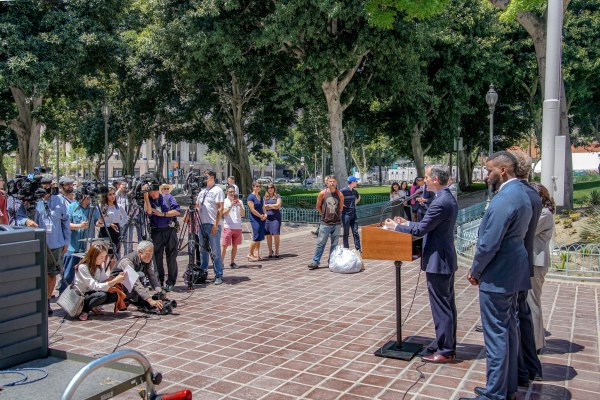
Eric Garcetti at a press conference

Los Angeles Mayor Eric Garcetti gives a press conference on the 2020 Census. Garcetti leads a coalition of over 160 U.S. mayors that oppose adding a question about citizenship on the census. / Office of Eric Garcetti / Flickr / Creative Commons

The Trump administration’s plans to add a citizenship question to the 2020 U.S. Census have set the stage for confrontation between Latino/a/x individuals and the U.S. government.  Community groups, civil rights organizations, a group of 18 U.S. states, and others are challenging the administration in court – oral arguments for the first of six legal challenges began last Friday.  Grassroots organizing around Latinx statistical disobedience is also under way, urging individuals to respond to the citizenship question randomly, without regard to their own status, to make the results unusable.

  • The legal challenges have yielded documents revealing the discriminatory intent of the citizenship question. Kris Kobach, the Secretary of State of Kansas known for his anti-immigrant views and inaccurate claims about voter fraud, wrote to Commerce Secretary Wilbur Ross in July 2017 advocating the citizenship question.  Kobach said – falsely – it was necessary to deal with the “problem that aliens who do not actually ‘reside’ in the United States are still counted for congressional apportionment purposes.”  Several months later, the U.S. Justice Department issued a “formal request” to the acting director of the Census Bureau to include the citizenship question to attain data “critical to the Department’s enforcement of Section 2 of the Voting Rights Act and its important protections against racial discrimination in voting.”  Claiming the measure is necessary to prevent “vote dilution” among minority groups, it is very different from the alleged problem Kobach identified.  Representation in the U.S. Congress is based on total population, not total voting population, as confirmed in 2016 unanimously by the Supreme Court in Evenwel v. Abbott.
  • It is still not clear where the idea for a citizenship question on the 2020 Census came from, but its purpose – to weaponize the census to be used against Latina/o/x and other undocumented communities – has been clear from the start. Kobach has said that his advocacy was informed by conversations with Steve Bannon, the far-right activist and former senior advisor to President Trump.  Secretary Ross initially testified to Congress that the proposal for a citizenship question was initiated by the Justice Department, but he later issued a memo contradicting this when documents came to light showing his earlier involvement.

Census Bureau testing of the 2020 Census questionnaire indicates that there is deep concern among the undocumented and Latinx communities.  Field staff conducting interviews report many red flags.  In presentations made during a meeting of the National Advisory Committee on Racial, Ethnic and Other Populations, Census Bureau documents quote one interviewer saying, “There was a cluster of mobile homes, all Hispanic. I went to one and I left the information on the door.  I could hear them inside.  I did two more interviews, and when I came back, they were moving. … It’s because they were afraid of being deported.”  In another case, a Spanish-speaking respondent said, “The possibility that the census could give my information to [U.S. government] internal security, and immigration could come and arrest me for not having documents terrifies me.”  In response, community-engaged scholars like Angelo Falcón of the National Institute for Latino Policy are calling for “statistical disobedience,” the willful misrepresentation of one’s legal status.

If the six legal challenges to the citizenship question fail, the prospects of statistical disobedience will be high.  Falsifying responses on the census is a punishable offense, but some community leaders have argued that if the Latinx statistical disobedience is widespread, enforcement will be highly unlikely.  This is not unlike other acts of historical civil disobedience.  The grassroots campaign behind statistical disobedience not only helps prevent the citizenship question from being used to target undocumented and Latinx communities; it can also drive up participation and awareness of the 2020 Census by Latinx communities who have been historically under counted.  Community leaders want to be ready.

August 21, 2018

* Stephan Lefebvre is a Ph.D. student in Economics at American University studying stratification economics.  His forthcoming article in the journal Diálogo is titled “Bold Policies for Puerto Rico: A Blueprint for Transformative, Justice-Centered Recovery.”

Nicaragua:  Tensions Mount

By Kenneth M. Coleman*

1024px-Protestas_en_Managua,_Nicaragua_de_2018_(1)

Protesters convene in Managua, Nicaragua last month. / Voice of America / Wikimedia / Creative Commons

President Daniel Ortega’s increasing reliance on turbas, the masked and hooded supporters mobilized to beat back protests, suggests he’s confident that he can tough out the challenge posed by growing demands that he and his wife, Vice President Rosario Murillo, resign, or, at a minimum, agree to early elections – increasing the prospect of a prolonged, unequal struggle ahead.  According to Nicaraguan press reports, turbas and police sharpshooters killed at least 15 marchers in May 30 Mother’s Day protests.  Approximately 100 protesters have been killed in street protests since April 18.  A delegation of the Inter-American Human Rights Commission of the OAS issued a preliminary report after four days of in-country hearings expressing “shock” at the extent and depth of human rights violations.

  • An attempt at national dialogue mediated by the Nicaraguan Catholic Bishops Conference (CEN) was initially suspended after the government delegation, headed by Foreign Minister Denis Moncada, claimed an agenda proposed by the bishops was the route to a golpe de estado, and was once again suspended after the Mothers’ Day killings. Death threats have been issued over social media against Cardinal Leopoldo Brenes and the Auxiliary Bishop of Managua, Silvio Báez.  Báez in particular has pushed for discussion of democracy in the dialogue.  The government has firmly refused to discuss protesters’ demand – endorsed implicitly by the Church – for an expedited election calendar (sooner than the currently scheduled presidential election of 2021).  Bishop Abelardo Mata, the Secretary of the CEN, has taken the position that Daniel and Rosario must go – as popular anger is such their own lives may be at risk.

The protesters, who are generally university students, have refused to respond with force to the turbas’ aggression, although there have been isolated reports of burned vehicles and occasional use of home-made mortars.  They have established tranques (roadblocks) on national highways leading into and out of major cities, including Managua.  Initially opened every hour or two so that traffic could move – and even suspended when a tentative agreement with the government was reached – the tranques have been stiffened to include total blockages of traffic on major routes in response to turba attacks.  Some roadblocks have been thrown up by peasants still angry about the government’s now-defunct deal with Chinese investors to build the “Grand Canal” across the country.  Independent media reports indicate that citizens are blaming Ortega and Murillo for the resulting inconvenience, and previously unpoliticized people are calling for them to step down.

  • While resisting violence, protesters are not engaged in “civil disobedience” a la Gandhi or Martin Luther King, as no one willingly goes to jail. To be taken away by the turbas or the Policía Nacional is to greatly increase the probability that one’s body will turn up in the morgue, according to local observers.  Timely intervention by individual priests has saved some lives, but the Catholic Church increasingly finds itself threatened too.

The Catholic Church’s leadership has been key and benefits from the quiet but crucial support of the business community, including the strongest private sector organization, COSEP.  Many of the dynamics in today’s confrontation are similar to those leading to the collapse of the Somoza government 40 years ago, with one glaring difference: the lack of an opposition martyr on a par with revered journalist Pedro Joaquín Chamorro, who was assassinated in January 1978, 16 months before President Somoza fled into exile.  Ortega is clearly willing to escalate the intimidation of his opponents, but – should an oppositionist of Chamorro’s stature assume leadership of the current protests – the president would probably not wish to see him martyred, assuming the president still controls the forces he has unleashed. Given recent events, it is unclear if the president wishes to see any dialogue reconvened.  If he does, he will probably need to look outside the country for mediation, as the CEN has increasingly sided with protesters over the government.

  •  If the crisis drags on and on, Ortega could conceivably agree to early elections, but the opposition would still be leery of any deal that did not include a wholly new Consejo Supremo Electoral and a commitment to allow all parties to register, which are demands that probably cross a red line for Ortega. As Nicaragua mourns its dead, the anger is unlikely to subside – and an unequal struggle between the government and a generally nonviolent opposition is likely to fester if not explode.

June 1, 2018

* Kenneth M. Coleman is a political scientist at the Association of American Universities who directed the 2014 AmericasBarometer national survey in Nicaragua.

Nicaragua: Approaching an Inflection Point?

By Kenneth M. Coleman*

Protesters burn a large pink metal tree

On Saturday, April 21, 2018, Nicaraguan protesters burned an “Árbol de la Vida” (Tree of Life), one of several monumental statues that are considered representations of President Daniel Ortega’s government. / Jan Martínez Ahrens / Wikimedia / Creative Commons

The street protests that wracked Nicaragua last week may or may not recede after President Daniel Ortega backed off a controversial increase in social security taxes, but the damage to his image of invincibility will linger and could turn out to be a watershed in his and his wife’s grand plan for one-party rule.  Ortega mobilized the police, which have teamed up with young thugs over the years to intimidate those who protest government policies, to repress what started last week as peaceful protests against the increased taxes but evolved into a challenge of the authoritarian nature of the regime.  The government closed four television stations that were covering the street protests; shock troops from his party’s Juventud Sandinista burned down a radio station in León; and journalists faced harassment, one having been killed.  Local press estimates 20-30 deaths, with surely well over a hundred injured.

The street protesters were not alone in their struggle.  The Superior Council of Private Enterprise (COSEP) and American Chamber of Commerce in Nicaragua (AMCHAM) – which for years had become silent accomplices in the efforts of Ortega and his wife, Rosario Murillo, to consolidate their power – called for solidarity with the popular protests.  For the first time in the current Ortega era (2007-2018), they openly called for street marches to resume today.  More importantly, they used hard language – condemning the use of fuerzas de choque by the government – and issued a set of conditions before a “dialogue” with the government can begin.  Specifically, they demanded that students, university communities, and the Bishops Conference of the Catholic Church be included in any dialogue, surrendering their previous role as privileged interlocutor with the government.  (The Catholic Church provided respite and support – both moral and physical – to student protesters.)

Mass movements can start from little sparks and grow into society-wide convulsions.  The outcome of these new confrontations with the Ortega-Murillo government cannot be foreseen at this point, but the parallels with other governments on their last legs are striking.  The use of excessive force by Mexican police in 1968 triggered massive street protests that directly questioned the legitimacy of a seemingly well-established Mexican one-party state – legitimacy that was ultimately resurrected only by opening the system to genuinely democratic competition.  While the process took two decades, it did lead to an opposition victory in the 1990 presidential election.  In Nicaragua, the fall of Anastasio Somoza in 1979 accelerated when the business community eventually abandoned his dictatorship.

  •  Ortega’s party, the Frente Sandinista de Liberación Nacional (FSLN), for many years has been able to isolate, contain, and discredit those abandoning it, including a former Sandinista Vice President and former members of its National Directorate. Grumbling within the party is already growing louder because of a succession plan bringing Rosario Murillo to power upon the illness or death of Ortega in a manner that far exceeds her status as vice president.  Local press reports indicate that one police commander and her unit of 50 officers have been jailed due to their unwillingness to confront and repress protesters in the streets.  The excessive application of force against peaceful protesters last week and, potentially, in coming days might lead to a more serious rupture, making last week’s events a potential inflection point for Nicaragua – with potentially dire consequences for Ortega and Murillo’s political ambitions.

April 23, 2018

* Kenneth M. Coleman is a political scientist at the Association of American Universities who directed the 2014 AmericasBarometer national survey in Nicaragua.

Brazil: Will Marielle’s Murder Help Build Consensus on How to Reduce Violence?

By Marcus Rocha*

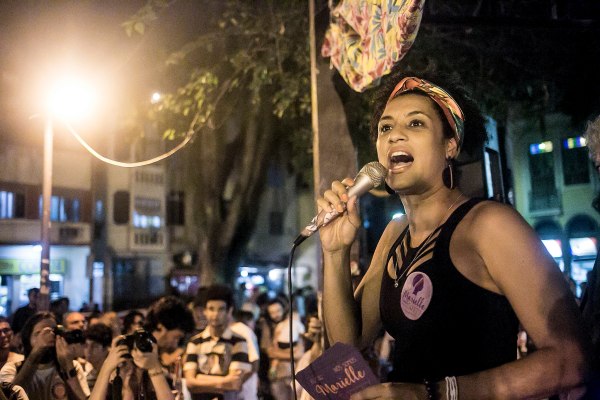
A woman with a microphone stands in front of a crowd

Marielle Franco campaigning in 2016. / Mídia NINJA / Wikimedia

The murder in March of Marielle Franco – a popular 38-year-old black, gay city councilor in Rio de Janeiro – has stirred outrage across Brazil, but debate over how to increase security has been stifled by political agendas and fake news.  Marielle and her driver were shot dead on March 14 in what press reports characterized as a professional hit job.  Some commentators have speculated it may have been retaliation for her outspoken criticism of the police and military deployments in the cities and favelas.  One of her final posts on Twitter called attention to police violence, citing the case of a young man gunned down by authorities while leaving church.

  • Tens of thousands of mourners took to the streets in Rio and other cities to protest. MC Carol, a black funk singer from favelas near Rio, reflects the popular anger with her immediate hit song entitled “Marielle Franco,” in which she sings:  “You [the system] want to kill us, control us / But you won’t silence us / even bleeding we gonna make it / marching and screaming / I’m Marielle, Claudia, I’m Marisa.”  (Original Portuguese below.)  Claudia and Marisa were women killed during police operations in favelas.

There is no consensus, however, over the meaning of Marielle’s death within a broader agenda of solutions to curb violence in Rio de Janeiro amid an escalation in federal intervention in the state, now entering its second month.  Proponents of President Michel Temer’s push to mobilize the military and other federal assets claim the Councilor’s murder justified the policy.  Opponents argue that Marielle’s assassination and other high-profile murders underscore that the mobilization has not worked, and, indeed, the deaths have fueled widespread skepticism.

  • A poll conducted by Folha de São Paulo newspaper shows these mixed feelings. Seventy-nine percent of interviewees say they support the federal intervention, but 71 percent believe that nothing has changed since it started.  Moreover, 22 percent of people living in affected communities fear the police more than they do drug dealers (16 percent).  Some 15 percent have more fear of milícias– the gangs, which often include former and current police that control much of people’s lives in these communities – and 13 percent of general criminals.  Of those polled, 28 percent say fear all of them equally.  Criminal activities like car theft and robbery have shown no sign of decline.
  • Complicating discussion of Marielle’s murder has been the torrent of fake news about her. Through Facebook pages and Whatsapp messages, far-right groups have spread unsubstantiated allegations that she had links to organized crime.  One Facebook page shows a woman and a man, supposedly Marielle and Marcinho VP, a famous drug dealer, as a couple.  Marco Feliciano, a rightwing preacher turned lawmaker, said during a radio program that Marielle’s death was “just another number” and offered a crude joke.  “They shot a leftist in the head in Rio de Janeiro,” he said.  “It took a week to die because the bullet didn’t find the brain.”  Brazilian justice directed Facebook and YouTube to remove some of the offensive profiles and videos, but fake news is still being shared through social networks.

President Temer’s official announcement that he intends to run for reelection in October deepens the political dimension of his militarized solution to the violence problem.  The federal intervention in Rio de Janeiro has become a key issue on his agenda, but the lack of results is undermining his efforts to shore up his historically low, single-digit approval ratings.  Investigations into Marielle’s murder haven’t identified any suspects yet, and there’s no discussion about changes to security laws or any other measure other than putting more army troops in the streets.  Despite the general outrage, the window for change opened after Marielle’s murder is closing fast.  The Brazilian political system is looking straight to general elections in October, and the speed and depth of the politicization of the assassination, aggravated by fake news, suggest prospects for serious discussion are nil.

[Excerpt from MC Carol’s “Marielle Franco”]

Vocês querem nos matar, nos controlar
Vocês não vão nos calar
Mesmo sangrando a gente vai tá lá
Pra marchar e gritar
Eu sou Marielle, Cláudia, eu sou Marisa

April 5, 2018

*Marcus Rocha is a CLALS Research Fellow.

Haiti: Increasingly Alone

By Fulton Armstrong

A bird's eye view of a residential neighborhood in Haiti

A residential neighborhood in Port-au-Prince, Haiti. / UNICEF Canada / Flickr / Creative Commons

Haiti’s international backers are increasingly leaving the impoverished Caribbean country to its own devices, but Port-au-Prince remains woefully ill-prepared to face its many challenges alone.  Competing priorities and distractions seem to be the main causes of the international retrenchment.  Perceptions that international aid, particularly the billions of dollars in assistance since the 2010 earthquake, has been squandered – as well as general “donor fatigue” worldwide – appear to be secondary factors.

  • The United Nations, two months after the inauguration of Haitian President Jovenel Moïse in February 2017, determined that Haitian institutions were sufficiently strong for the UN to withdraw last October the remaining 2,300 peacekeepers in the Stabilization Mission in Haiti (MINUSTAH) that had been deployed since the 2004 military coup. In its place, the UN is establishing this April a small “Mission for Justice Support” (MINUJUSTH), meant to strengthen the justice system, policing, and human rights protections – leaving all security responsibilities to Haiti’s 15,000-man police force.
  • International support for UN efforts to stem the cholera epidemic caused by UN peacekeepers after the devastating earthquake in 2010 has been lacking. About 10,000 Haitians (of an estimated 817,000 infected) have died, including 159 (of 14,000 new cases) reported in 2017.  The UN Office for the Coordination of Humanitarian Affairs (OCHA) reported last month that only $4.8 million out of the $34.5 million requested for cholera response has been funded.
  • The United States, Haiti’s biggest benefactor (having disbursed at least $3.9 billion in post-2010 earthquake aid), is pulling back in disruptive ways. The administration of President Donald Trump, who while campaigning in 2016 pledged to be Haiti’s “biggest champion,” in November announced suspension of Temporary Protected Status (TPS) for 59,000 Haitians living legally in the United States since the earthquake – giving them until March 19 to leave the country or face deportation.  Trump’s reported reference to Haiti and Africa as “shitholes” during a meeting with U.S. Congressmen last month also infuriated Haitians.
  • Food aid continues to flow, but donors have come through with less than half of the $56 million the UN urgently called for in the wake of Hurricane Matthew last October. The World Food Program reports that 50 percent of Haiti’s 10.7 million people are undernourished – including 1.3 million in “Phase 3 crisis” and 3 million in “Phase 2 stress.”
  • Even international partners have disappointed Haiti as well. Reports that Oxfam personnel held sex parties and paid for sex have prompted admissions that some staff’s behavior was “totally unacceptable.”  The group’s Haiti country director has conceded that he made “mistakes” by having a sexual relationship with a woman and was aware of the parties and prostitutes.  Other reports indicate that Medicins Sans Frontieres (MSF) repatriated 17 employees for “misconduct” that the organization is not willing to discuss.

President Moïse, who two weeks ago completed his first year in office, has had few options for dealing with these challenges.  His appeals for international support are falling on deaf or distracted ears.  It is by now well established that the international community’s “pledges of aid” invariably fall short of stated commitments, but defending his poor but proud nation from being called obscenities by the U.S. President is a task that his hapless predecessors did not have to deal with.  To prepare for the withdrawal of MINUSTAH, he has reconstituted a Haitian National Army – a force of 3,000-5,000 whom he promises will “help the people … not be an army of repression” – but the move has reopened fresh wounds from years of military abuses.  He has condemned the “sexual predator” international staff who exploit “needy people in their moment of greatest vulnerability,” but he needs to maintain good relations with NGOs in general, since they have often become the sole suppliers of public goods that ideally would be provided by the state.  Haitians’ frustration was palpable last week when a fire destroyed much of Port-au-Prince’s famous Marché en Fer (Iron Market), a historic symbol of popular commerce rebuilt after the earthquake which has become a profitable tourist destination – another sign that fate is simply not on their side.

February 20, 2018

Prospects for Reproductive Rights Dim with End of “Left-Turn”

By Merike Blofield and Christina Ewig*

A large group of women and men gather in front of statue in a plaza.

A demonstration against abortion in Córdoba, Argentina, shortly after President Mauricio Macri’s election. / Marco Camejo / Flickr / Creative Commons

The end of Latin America’s “pink tide” suggests the region will make little progress in protecting reproductive rights in coming years and may even face some policy reversals.  With five Latin American governments slated to elect new leaders in 2018, and with recent elections of right-leaning governments in Chile and Argentina, Latin America may well be concluding the left-turn that has characterized the region’s politics since the early 2000s.

  • The past two decades of pink tide governments coincided with a flurry of legislative activity on abortion policy – in sharp contrast to previous decades of policy stasis, when high rates of clandestine abortions coexisted with restrictive laws. Since the turn of the millennium, abortion laws have been revised by Latin American legislatures and courts on 11 separate occasions in eight different countries.  Even in countries where legal reforms did not go through, legislatures debated bills at a prevalence not seen before.
  • Several left governments have carried through liberalization in response to public opinion and social mobilization. Last August, for example, the Chilean Supreme Court upheld its Congress’ liberalization of abortion law – to allow for abortion under three circumstances (threat to life; fatal fetal defect; rape) – overturning the absolute prohibition that had been in effect since the last days of the Pinochet military regime in 1989.  Some left governments went even further:  Uruguay legalized abortion in 2012, and Mexico City did so even earlier, in 2007.

Yet left governments have not been unequivocally liberal; some have actively upheld or enacted conservative laws, even absolute prohibitions.  In 2006, the Sandinista Party in Nicaragua reversed course from allowing therapeutic abortion to supporting absolute prohibition, while Ecuadoran President Rafael Correa in 2013 rejected a provision allowing abortion in the case of rape.  The FMLN in El Salvador has doggedly, even brutally, enforced a total prohibition, to the detriment of many (primarily poor) women’s lives.  In a recent study (published in Social Politics), we show this split in policy roughly follows the “institutionalized” vs. “populist” typology of lefts.

  • Institutionalized parties – like those in Chile and Uruguay – have channels in place for civil society organizations, including feminist ones, to have bottom-up influence. Given their respect for the rules of the game, however, the institutionalized lefts are also likely to face well-organized conservative opposition, which slow down reform, shape final legislation, or even veto it altogether.  In Uruguay and Chile, feminists had a voice, but conservatives were also are able to block, slow down, and water down liberalization.  This is why the Uruguayan reform took so long and why in both cases the final legislation is less liberal than the original proposals.
  • By contrast, populist governments, like those of Nicaragua under Daniel Ortega and Ecuador under Rafael Correa, often see advocates for liberalization as political threats – particularly feminists who also represent more general claims for individual autonomy and pluralism. Moreover, an issue like abortion, where the practical costs of a restrictive stance are born almost exclusively by low-income women, is likely to be used by populist leaders as a pawn in a power struggle with well-organized, influential religious forces.

Although we systematically analyzed only abortion politics, we found that sex education, contraceptive access, and other reproductive health policies more broadly have followed similar dynamics in Ecuador, Nicaragua, Chile, and Uruguay.  For example, the Uruguayan left government expanded sex education after assuming power in 2006, while in Ecuador, leaders appointed in health bureaucracies sought to reduce access to publically provided reproductive health services.  Nicaragua, on the other hand, has the highest rate of teenage pregnancies outside sub-Saharan Africa.

As Latin America’s left shift appears to be coming to a close, reproductive health policies promise to remain contentions – and abortion continues to be a public health crisis across most of Latin America even with the limited liberalizations of the past decade.  The Alan Guttmacher Institute recently estimated that 6.5 million abortions are annually performed in the region.  The vast majority are still done in clandestinity, resulting in high maternal mortality and tens of thousands of annual hospitalizations, which affect low-income women the most.  While it is unlikely that recent changes will be reversed in the more institutionalized settings, the rightward shift that is occurring among especially these countries does not bode well for further liberalization and resolution to the abortion crisis.

 January 18, 2018

 * Merike Blofield is Associate Professor of Political Science at the University of Miami.  Christina Ewig is Professor of Public Affairs and Director of the Center on Women, Gender and Public Policy at the Humphrey School of Public Affairs, University of Minnesota.

Mexico: Migrants Getting Political but Not Driving Reform

By Michael S. Danielson*

A large group of people gathers in an airport.

Returning Mexican migrants are greeted upon their arrival in Mexico by Mexican President Enrique Peña Nieto. / Presidencia de la República Mexicana / Flickr / Creative Commons

Mexican migrants who currently live in the United States or have returned home after spending many years abroad have become an important social and political constituency in the Mexican polity, but they do not uniformly enhance local democracy.  A growing body of research indicates that migrants affect the politics of their home towns and home countries through both direct and indirect channels.  Their departure releases pressure on prevailing authorities to reform, and the prospect of future migration causes citizens to disengage from the political process.  Friendships, alliances, and other contacts allow migrants to become intimately involved in their home communities from abroad as they communicate their attitudes and ideologies among themselves and friends and relatives back home.  Returning home with accumulated social, political, and economic capital also enables them to become influential leaders there.

  • Analysis of the municipalities to which U.S.-based migrants provide financial support, for example, shows that migrants are more likely to contribute where migrant civil society has become more deeply institutionalized at the state level and in municipalities and states with longer histories of migration.
  • A survey of more than 400 mayors in Oaxaca shows that migrants returning to their home communities who become mayors are more likely to be members of the popular classes than their non-migrant counterparts, suggesting that migration might be a pathway to power for non-elite individuals. But the same data also show that migrant mayors are just as likely to align with dominant political groups as with opponents of the status quo, suggesting the limits of their transformative and democratizing potential.

Field research shows different outcomes in different states.  In Oaxaca – where the exclusion of migrants from influence has alienated them from the governing party (an attitude further fueled by their experiences of exploitation and resistance as migrants in Mexico and California) – returnees tend to enter the political fray in opposition to dominant powers.  In contrast, the returning migrants who have been most influential in the states of Guanajuato and Zacatecas have tended to be mobilized by and act in support of the dominant parties in their states.  The institutionalization of the state-migrant relationship in these states facilitates migrant social and political engagement with governing parties.

  • Ethnographic data in 12 high-migration municipalities in Oaxaca, Guanajuato, and Zacatecas indicate, moreover, that the political engagement of returning migrants resulted in increased political competition that, in all but one case, caused factionalism and a divided opposition at best and deep, violent social conflict at worst. In the remaining six municipalities, dominant political actors either incorporated migrants into the prevailing system by establishing neocorporatist equilibria or successfully blocked the influence of migrant actors all together, despite high levels of migration.

Returning migrants’ political influence will only increase.  The historic flow – some 16 million Mexicans entered the United States in the 50 years since 1965 – has been reversed, as more migrants are returning to Mexico than entering the United States.  The economic, social, cultural, and political ties forged between communities on both sides of the border are growing, and the futures of the two countries are more intertwined than ever.  The economic and social importance of migration in some municipalities helps migrant political actors gain influence back home, and it can open up a pathway to local power for historically excluded social groups, even if – as in the cases that I have examinedthis influence has only rarely translated into fundamental changes in the way that politics are done.  The engagement of millions of Mexican migrants in their home towns has not resulted in thousands of political earthquakes, but rather the Mexican political system is incorporating these new actors without instituting fundamental changes to the way that politics are done.

 January 4, 2018

*Michael S. Danielson is CLALS Research Fellow and Visiting Professor at the University of California Washington DC Program.  His new book, Emigrants Get Political: Mexican Migrants Engage Their Home Towns, was published by Oxford University Press.  He has also participated in CLALS’ North America Research Initiative as a Pastor Scholar.

Nicaragua: Protest Abstention, Dedazos and Electoral Farce

By Kenneth M. Coleman*

A group of people holding Nicaraguan flags and banners protest outside

Organized by the Sandinista dissident group Movimiento Renovador Sandinista (MRS), protesters took to the streets last year ahead of the general elections to demand recognition of their party, and free and open elections. Many members of MRS will abstain from voting in the upcoming elections. / MRS / Flickr / Creative Commons

The surge in protest abstentionism in Nicaragua’s presidential election last November appears likely to worsen in elections this November 5 – undermining the legitimacy of the Daniel Ortega government but not threatening its control.  The  Supreme Electoral Council, dominated by the ruling Sandinista Party (FSLN), proclaimed that 68 percent of the registered electorate had voted last November 6, but two more credible estimates – that of independent observers (closer to 30 percent) and post-election public opinion polls (50 percent) indicated a much lower turnout.  Non-voters come in at least two variants: the disinterested, disengaged, and poorly informed; and protest abstainers.  The evidence points to the latter reason.

  • Critics of the now-autocratic FSLN had nowhere meaningful to go electorally. In June 2016, the FSLN-controlled Supreme Court of Justice (CSJ) withdrew recognition of the Partido Liberal Independiente (PLI) from Eduardo Montealegre, a prior presidential nominee who had finished second to Daniel Ortega in 2006, and recognized Pedro Reyes, a political non-entity soon booted from party leadership.  Years before, in 2008, the government withdrew recognition from the Movimiento Renovador Sandinista, which included most of the well-known Sandinista dissidents (including author Sergio Ramírez, once Daniel Ortega’s Vice President, and several surviving members of the Sandinistas’ original nine-person National Directorate).
  • Focus groups organized by scholars at Florida International University (FIU) and follow up studies confirmed high abstention rates driven by unhappiness with the election. Interviewees said, for example, “There was no candidate who fulfilled my expectations for making the country better … none … capable of taking the country forward.”

Protest abstentionism appears likely to be equally high or even higher in the municipal elections on November 5, reflecting frustration from an unexpected source:  loyal Sandinistas opposing the imposition of candidates by President Daniel Ortega, and his wife and vice president, Rosario Murillo.  Adapting Mexican political discourse, many FSLN nominees for mayors, vice-mayors, and municipal councilors are now criticized as representing dedazos, candidates “fingered” from above.  Two unhappy Sandinistas told the opposition paper Confidencial on August 29 of their discontent.  “It hurts me … but that is what [the party] has left me… not to vote in the municipal elections,” said one in Masaya.  “They didn’t take the party loyalists into account [in picking candidates], so the party loyalists will not take the party into account in the elections in November,” said a former FSLN supporter in Corinto.

  • Associates of the old PLI, reconstituted as Ciudadanos por Libertad (CxL), have been granted legal registration – and intend to compete as long as the Organization of American States observes the elections. The OAS role remains unclear, however, prompting the initial CxL candidate for Mayor of Managua to resign his candidacy earlier this month.

What the opposition proclaimed an “electoral farce” last November seems likely to be repeated on November 5.  Ortega has taken steps to allow “same-day registration” of voters on election day – apparently to counter abstentionism – and recent reports of distributing cédulas (national identity cards necessary for voting) to minors have surfaced in La Prensa, presumably also with an intent to increase electoral turnout.  However, anger over dedazos may be deep enough to keep many members of the FSLN away from the polls.  In spite of high abstention levels, the Ortega family enjoys control over all branches of government – National Assembly, Judiciary, and Electoral Council – and continues to enjoy an implicit corporatist accord with COSEP, the leading business organization, while having long proven adept at undermining potentially competitive leaders.  Overreaching via the dedazos may have caused visible cracks in the partisan foundation of the dynasty – strengthening party dissidents’ portrayal of Daniel and Rosario as usurpers – but no leader capable of undermining their grip over governmental structures is yet visible or appears likely to emerge in the near term.

September 18, 2017

* Kenneth M. Coleman is a political scientist at the Association of American Universities who directed the 2014 AmericasBarometer national survey in Nicaragua.

Mexican Government Under Attack for Electronic Spying

By Fulton Armstrong

34318983244_1716737126_k

Mexican President Enrique Peña Nieto. / Presidencia de la Republica Mexicana / Flickr / Creative Commons

Revelations of Mexico’s use of state-of-the-art software to spy on domestic critics and OAS human rights experts have dealt another devastating blow to the credibility of President Enrique Peña Nieto and the Mexican government.  Targeted in the cyberattacks were dozens of individuals and nongovernmental groups from various backgrounds, including leaders of the opposition PAN party investigating corruption allegations; anti-obesity activists lobbying for a tax on sweet carbonated soft drinks that the government opposed; and the Interdisciplinary Group of Independent Experts (GIEI) sent by the Inter-American Commission on Human Rights (IACHR) to investigate the disappearance of the 43 students in Iguala in 2014.

  • The software – known as Pegasus and estimated to cost between $32 million and $80 million – sent the targets personalized text messages with links that, when pressed, led to the total compromise of their smart phones. The messages falsely alerted victims to family emergencies, for example, and said further information was available at a link in the text.  Some purported to be from the U.S. Embassy, providing a link for updates on visa applications.  The link downloaded spyware that allowed the perpetrators full access to all voice and data communications and allowed remote control over the microphone and camera on the affected device.

Confronted with evidence developed by University of Toronto-based Citizen Lab and corroborated by the New York Times, Peña Nieto admitted in late June that his government purchased Pegasus but denied that it was used to target opponents and investigators.  He said that all of the government’s efforts have been “to maintain the internal security of the nation, fight organized crime, to generate security for all Mexicans.”  The Israeli company NSO Group, producer of Pegasus, claims it sells the software only to governments and only for specific anti-terrorism, anti-crime purposes.  The President threatened to investigate those who “have raised false accusations” – a statement his spokesman retracted several hours later – but he did acknowledge the need for an investigation.  The office of the Attorney General (PGR), which was involved in the Pegasus program, was charged with looking into the matter, drawing cries of foul from critics.

  • Officials at the UN Office of the High Commissioner on Human Rights have called on Mexico to allow a full investigation by independent experts. For the same agency that bought Pegasus to investigate its use, they said, was not credible.  An OAS official has stated publicly that the allegations “should be investigated.”

The internal spying scandal is yet another blow to the credibility of the Mexican government on human rights – whether the spying and harassment was approved by Peña Nieto or was the work of rogue agencies.  The President’s credibility has been battered by scandals involving his family and administration, and corruption by state governors from his ruling Institutional Revolutionary Party (PRI) has deepened perceptions of impunity at all levels.  Violence is also creeping back to levels experienced during the term of Peña Nieto’s predecessor, Felipe Calderón.  Among his most corrosive failures, however, has been the lack any progress investigating the brutal killing of the Iguala students.  The government’s claims that it was unable to bring anyone to justice for Iguala – while spending tens of millions of dollars to spy on and harass international experts investigating the incident – has deepened popular cynicism about the President.  Even if he accedes to an independent inquiry, the damage has been done, and he seems likely to limp, at best, toward general elections scheduled for mid-2018.  InSight Crime (a CLALS-sponsored foundation) has also called the scandal “a massive self-inflicted wound in [Mexico’s] fight against organized crime” because it compromised anti-crime operations and undermined the government’s credibility.

July 24, 2017

Migrants Make Family Back Home Critical of Government

By Clarisa Pérez-Armendáriz and David Crow*

9017797074_eccf684eb1_b

A mural depicting the transnational migrant experience. / Max Herman / Flickr / Creative Commons

Latin American citizens who discuss politics and belong to a transnational household – a household in which at least one member lives abroad – are more critical of their democracy than those who discuss politics but have no household members abroad.  In our recently published report, we use data from 2006-08 Americas Barometer surveys in 20 Latin American countries to demonstrate that among transnational household members (THMs) with an emigrant living in the United States, assessments of how democratic their country is, satisfaction with their country’s currently existing democracy, and pride in their democratic system all decline as discussions about politics become more frequent.

THMs talk about politics with their emigrant household members across international borders.  When they hear about the political and social system in the U.S., they become more aware that they have reason to be critical of their system’s performance, and judge their own democracy more harshly.  Skeptics counter that migrants and their children – particularly ethnoracial minorities – are marginalized, second-class members of receiving societies, which would logically alter the impact of their communications with THMs.  Public opinion polls show, however, that immigrants embrace and adopt their host country’s political beliefs and behaviors within as little as two years and that their social, political, and religious organizations give them a feeling of civic engagement they did not have back home.  Furthermore, even when conditions abroad are difficult, civil liberty protections in the U.S. enable immigrants to mobilize politically and to demonstrate a greater sense of personal efficacy – two traits that THMs respect.

  • Even absent cross-border political discussions, having a household member abroad shifts THMs’ sense of political community to include co-nationals living both at home and abroad. In turn, THMs expect their government to deliver the goods of democracy to its citizens wherever they live.  Data from the Mexico, the Americas, and the World survey in 2014 provide initial support for this claim.  Among Mexican THMs, 65 percent described “protecting nationals abroad” as a very important foreign policy objective, compared to 52.8 percent of non-THMs.  Furthermore, this policy emphasis indirectly influenced negatively their feelings toward President Enrique Peña Nieto, giving him a slightly lower “thermometer score.”
  • To the extent that THMs’ everyday talk (with other THMs or non-THMs living in Latin America) about politics revolves around this transnational sense of community (in contrast to the narrower national identity of non-THMs) THMs become aware that they have even more reasons to be critical of their government’s performance than do fellow citizens without migrant connections. Our analysis of this rests entirely on the case of Mexico, but we believe it holds elsewhere in Latin America since, of all the countries in the region, Mexico provides the most extensive range of services to its citizens abroad.

The 2006-08 Americas Barometer data that we used predates major shifts in U.S. immigration policy during President Obama’s term and, in particular, the hard shift in rhetoric, roundups of undocumented migrants, and deportations during these first months of the Trump Administration.  The sense of political efficacy that democratic rights to mobilize and protest produces among immigrants may decline in impact if, as reported, migrants are keeping a low profile out of fear of capture or harassment.

July 5, 2017

 *Clarisa Pérez-Armendáriz is an Assistant Professor at Santa Clara University. Her research, which focuses on how immigrants influence politics in their origin countries, has appeared in Comparative Political Studies and Studies in Comparative International Development.  She is also a participant in the Robert A. Pastor North America Research Initiative.

*David Crow is an Associate Professor of International Studies at CIDE (Mexico City). He is co-PI (and past director) of the Americas and the World survey on international relations and the Human Rights Perceptions Polls, and formerly Associate Director of the Survey Research Center at UC Riverside.  His research has appeared in Comparative Politics, Comparative Political Studies, Political Psychology, Human Rights Quarterly, and elsewhere.