Mexico: Peña Nieto’s Big Push

By CLALS Staff

President Enrique Peña Nieto / Photo credit: Eneas / Foter / CC BY

President Enrique Peña Nieto / Photo credit: Eneas / Foter / CC BY

President Peña Nieto’s reformist agenda wins kudos from the business and financial class, but both a recalcitrant leftist opposition and mass organizations previously aligned with his party are taking to the streets in protest – raising serious doubts about its prospects.  In his first state of the nation speech, delivered last week, Peña Nieto pledged to plow ahead with “transformational” reforms, giving flesh to the PRI’s slogan that it is Transformando a México. In education, he’s proposed a more rigorous system for hiring, evaluating, promoting and firing teachers who have resisted change despite evidence that the current system is not equipping Mexican youth for employment.  In the energy sector, he wants to open up the oil and gas industry to foreign investment, an idea that was strictly off-limits in the past even though lagging investment has caused production in Mexico’s leading export industry to decline steadily.  He is also pursuing tax reforms that, although watered down when announced on Sunday, entail political risk and, tellingly, raise marginal rates by 2 percent for higher earners and impose a levy on capital gains.  In June, he picked a fight with powerful business leaders over control of the country’s telecommunications industry, an oligopolistic structure that imposes excess costs on consumers and producers alike, diminishing Mexico’s economic competitiveness.

The teachers unions, whose symbiosis with the PRI in the past ensured cooperation, mobilized huge protests in Mexico City, forcing Peña Nieto to delay his speech by a day and then causing monstrous traffic jams during it.  The President cloaked his announcement of the energy reform in nationalistic rhetoric, and PEMEX, the oil company, followed it up with predictions of positive results – huge increases in oil investment and production that purportedly would help to create 500,000 new oil-sector jobs by 2018 and 2.5 million by 2025. But opposition to the reform has been strident, and tens of thousands filled the Zócalo on Sunday to protest it as a “covert privatization.”  Opposition leaders are already pledging demonstrations to oppose taxes, though the likelihood of this may be diminished because the long rumored reform unexpectedly left untouched the value-added tax exemption for food and medicines, which would have been a major rallying point for the Left.

Some Mexican commentators say Peña Nieto’s leadership is already losing its shine and that his Pacto por México, the loose coalition he engineered in Congress, is at risk of falling apart.  He prevailed in his congressional showdown over the long overdue education reforms, but success in transforming the underperforming education sector appears uncertain, as the teachers are threatening more protests.  The arrest of narco bosses from the Gulf Cartel and the Zetas have not given him a bounce on the security front; indeed, Mexican press reports indicate that kidnapping, extortion and other crimes that more directly affect citizens’ lives continue to rise. Further complicating Peña Nieto’s life is news last month that the economy is slowing down.  The first contraction in four years has forced the government to cut its 2013 GDP growth forecast in half, to 1.8 percent.  The administration will undoubtedly point to data showing that PEMEX production has fallen by about a quarter in the past decade because of low investment, and will emphasize that this makes modernization of the oil sector all the more imperative.  But Mexicans have heard promises before, during NAFTA debates and since, that economic reforms and greater openness to trade and investment will massively improve their lives.  Whether there is any fuel left in that rhetorical tank remains to be seen.
What Can Be Learned from the Humala Government?

By Rob Albro

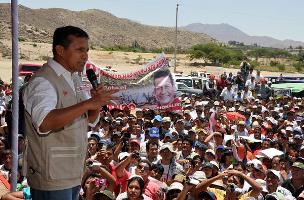
President Humala inaugurating electric power in the rural district of Moro - Ancash Photo credit: Presidencia Perú / Foter.com / CC BY-NC-SA

President Humala inaugurating electric power in the rural district of Moro – Ancash Photo credit: Presidencia Perú / Foter.com / CC BY-NC-SA

As a candidate in Peru’s 2006 presidential election, one-time military coup plotter and current president Ollanta Humala presented himself as an anti-business socialist and nationalist happy to be a member of the “family” of left-leaning Latin American governments led by Venezuela’s Hugo Chávez.  In his second successful bid for office in 2011, Humala sharply changed direction and embraced a combination of pro-business and anti-poverty measures reminiscent of Brazil’s center-left Lula.  Humala’s shifts are a sign of the times in the Andean region:  a non-ideological search for how best to build democracies and grow national economies, while effectively redistributing wealth.

Driven by its mining sector and a commodity export boom, Peru’s economy has tripled in size over the past decade and is currently one of the best performing in the world.  Foreign investment is flooding in, particularly to mining, hydrocarbons, and big infrastructure projects – and Humala is now considered an “investor darling.”  While backing off electoral promises to nationalize water, electricity, mining and other sectors, Humala has created a new Ministry of Development and Social Inclusion and increased the budget for social redistribution and welfare measures to Peru’s poorest by 50 percent.  So far Humala has channeled the budget surplus of Peru’s export boom, including successful negotiation of a $1.1 billion increase in mining royalties in 2011, toward reducing the nation’s poverty rate by 29 percent.  And yet, at present there are more than 250 ongoing social conflicts in Peru, and Humala’s government has been accused of failures of “consultation,” often by grassroots and indigenous protestors opposed to Peru’s mining policies.  In response Humala has reshuffled his cabinet multiple times.  Skeptics suggest that his approval rating – currently 60% – will last only as long as the boom enables his top-down social spending.

Humala’s presidency suggests the limits of viewing current regional leaders through a comparative Chávez-or-Lula lens.  Arguments over the best conditions for “foreign direct investment” in the region often miss the different conditions under which it occurs or purposes to which it might be put.  Humala’s pragmatism demonstrates how distinct parts of government need not reflect a single unifying ideological or normative idée fixe.  Liberal democratic institutions and market freedoms increasingly coexist alongside alternative policies of social redistribution as a part of democratic enfranchisement in the Andes.  When conflict has broken out, however, Humala’s government has been willing to forego consultation with local communities to insure the economic resources it needs to continue its redistributive policies.  The challenge for him to achieve the best balance between competing democratic priorities will continue.  Humala’s government is an opportunity to explore new democratic institutions in Latin America, as with a recent CLALS research project on participatory democracy

The TecnoLatinas: A Start-Up Revolution

Foro de Ahorro de Energía Eléctrica, México | Photo credit: Alejandro Castro | Foter.com | CC BY-NC-SA

Foro de Ahorro de Energía Eléctrica, México | Photo credit: Alejandro Castro | Foter.com | CC BY-NC-SA

Latin America is experiencing a full-fledged start-up movement amid rapid growth of an innovation and information economy.  Over the last several years the region’s online population has grown faster than in any other part of the world – with approximately 255 million internet users as of last year.  Half of the top 10 markets worldwide, ranked by time spent on Facebook and other social media, are in Latin America.  Clusters of innovation start-ups, such as those around Monterrey, Mexico, are springing up with astonishing speed.  In 2012 Mexico was among the largest exporters of information technology services in the world.  Google is currently building a data center in Chile, while Amazon Web Services opened a data center in Sao Paolo last December.  But these are not information-era maquiladoras. Instead, Latin American entrepreneurs are combining the availability of open-source innovation tools and the emergence of cloud computing with effective bridge building in Silicon Valley to bring collaboration, expertise, and capital to their home markets.

  • Latin America offers multiple advantages for tech start-ups: a low cost of development, an educated and growing talent pool with the necessary technical and entrepreneurial skills, and increasingly available and affordable broadband and internet access.
  • In particular, Mexico, Chile, Brazil, Argentina, and Colombia, along with metropolitan areas across the region, are incentivizing the development of a competitive start-up ecosystem – an advantage attracting a growing number of “angel investors.”
  • Start-Up Chile, a national program begun in 2010 with 22 start-ups from 14 countries, offers seed capital, grants, tax protection, space, mentoring, and networking to “accelerate” promising ventures.  Its most recent competition drew 1421 applicants from 60 countries, including from Singapore, London, and San Francisco.

The lack of tech innovation and incentives for start-ups has been an Achilles’ heel of Latin American economies for decades.  If the start-up trend continues, the region could make significant, lasting progress toward narrowing the sizable gap between itself and the most dynamic developing countries, mostly in Asia.  Latin America’s start-up movement is both top-down and bottom-up, with a tech-savvy generation of entrepreneurs not afraid to take risks and to leverage government support, as part of a collaborative business model built on multiple ties to Silicon Valley.  A core challenge will be whether these initiatives are scalable, and whether governments can move away from stale policy debates rooted in antiquated paradigms to move their economies toward the frontiers of innovation of the information age.  Old elites with a lock on traditional industries are poorly positioned to obstruct the phenomenon, but if these emerging innovation hubs are to succeed, at some point they are likely to confront  the entrenched and oligopolistic business practices still prevalent in the region’s energy, telecom, and other sectors.

Cuba: Change in the Wind

Three American University professors recently traveled to Cuba for research and discussions on Cuba’s reform process – called “Updating Socialism” – and the island’s relations with the United States.  Today’s entry looks at the economic changes.

Photo by: Globovisión | Flickr | Creative Commons

Photo by: Globovisión | Flickr | Creative Commons

In offices, shops and on the street in Havana, “change” seems to be one of the most commonly used words.  Billboards proclaim “The changes in Cuba are for more socialism” and “Updating socialism is the answer.”  But the words “reform” and – in some conversations – “privatization” pop up with significant frequency.  Party members previously reluctant to talk about change now speak of introducing “elements of capitalism” to make Cuba a “mixed economy” patterned closely after the “Vietnam model,” with its economic loosening but one-party rule.  Previous reforms have brought better, if sometimes expensive, food to many Cuban dinner tables, but the strong consensus in and outside the party is that a lot more needs to be done.

  • The law-decree on “non-agricultural cooperatives” provides a politically correct way ahead for the formation of small and medium private enterprises.  Cuentapropistas were given a prominent place in the May Day parade, and some are being nominated for office on the Communist Party slate.
  • The government is making another run at tearing down the barriers between hard-currency and peso purchases, with an eye to unifying the currency in the future.  Price tags at at least one major Havana store list prices in both convertible and national currency, at a 23-to-one conversion rate.
  • The law already allows Cubans to hire workers – a right previously given only to the state – and a draft labor law will further legalize private workers’ activities and integrate them into the economy.
  • Some 200-plus state enterprises are being put on a sink-or-swim program in which new management selected by the workers will be given a year to transform the firms into businesses closely resembling private cooperatives.
  • In January, the National Assembly will take up amendments to foreign investment laws.  Under consideration are direct foreign sales to non-state cooperatives and the direct hiring, firing, and paying of Cuban workers by foreign companies.
  • The travel reform law that goes into effect on January 14, ending the necessity for an exit visa and removing restraints on most Cubans from obtaining a passport, will also stimulate interaction with foreign countries.

The macro situation is still a mess, and the reforms have a long way to go to attain even the level of Vietnam’s prosperity.  Cuban stores sell Vietnamese cookies, not vice versa.  As the rhetoric indicates, the government – long expert at managing popular expectations – continues to emphasize continuity as the changes proceed.  But while no one is expecting a fast shift to capitalism, many middle-aged and elderly Cubans have a renewed sense of hope that life ahead will be better, which has political benefits and risks for the government.  One thing for sure is that the socialism that is being “updated” is a far cry from the communism that Cuba attempted in the 60s, 70s and 80s.

Argentina Foreign Policy – National Pride or Domestic Consumption?

Photo by Jonathan Huston

The stridency of Argentina’s foreign policy over the past two years suggests an effort by President Cristina Fernández de Kirchner to capitalize on elements of authentic nationalism and harness them into a durable political tool at home.  Buenos Aires has dialed up the pressure on the Falklands-Malvinas dispute with the United Kingdom by seeking regional support and calling for a boycott.  The nationalization of the holdings of Spain-based oil giant Repsol has also soured relations with several European states.  Recently, the Argentine government has assailed the impounding of an historical frigate, the Libertad, in Ghana by agents of an investment fund that owns defaulted Argentine sovereign debt, labeling them “vultures.”  Argentina has ramped up criticism of U.S. restrictions on its agricultural exports, as the two countries trade accusations in the World Trade Organization.

The conventional wisdom in Washington has been that President Fernández de Kirchner is picking fights abroad to distract attention from economic and political problems at home.  Following its record $100 billion default in 2001, Argentina remains locked out of most international financial markets despite deals to discount and reschedule much of that debt.  Inflation is high and capital flight is so serious that the government has imposed strict controls on sending dollars out of the country – a measure unpopular with the middle and upper classes.  These problems have taken a toll on the president’s popularity, as have intimations that she might change the Constitution to permit her to run for a third term.

The view from Washington misses a couple key points.  Many of these nationalist moves have been wildly popular – above all the Repsol decision.  To attribute them to President Fernández de Kirchner alone ignores deep feelings in Argentina that the country deserves greater respect than it gets, as well as the fact that since the peso crisis, rejection of the sort of “carnal relations” that President Carlos Menem had with Washington (in his own words) in the 1990s has grown strong.  The current foreign policy orientation harkens to a much longer tradition, from Peronism and beyond.  There is little chance that issues such as the Malvinas or the Libertad are going to make Argentines forget about everyday economic challenges.  Rather, they are a manifestation of an Argentine narrative in which the country is denied its rightful place in international politics and trade – and in which it is being held unfairly in the penalty box for the peso crisis.  The United States support for the billionaire investors and hedge fund managers who bought deeply discounted bonds but are demanding full payment, and Washington’s subsequent vote against loans Buenos Aires needs from international financial institutions, are playing into nationalist themes.  Fernández de Kirchner’s foreign policy rhetoric taps into resentment; she is hardly responsible for creating it.

Brazil’s Protest: If You Get QE3, We Get Tariffs

Photo by “SqueakyMarmot” | Flickr | Creative Commons

For two years Brazilian voices have complained that U.S. policies of near-zero interest rates and “quantitative easing” have been damaging its economy.  Lax monetary policies in the U.S. and Japan are blamed for the high valuation of the Brazilian real, which further suppresses Brazil’s  languishing manufacturing sector.  Tensions escalated following the September 2012 announcement of the U.S. Federal Reserve’s third round of quantitative easing.  Now the debate has spilled over into discussions about Brazilian restrictions on trade.  As Finance Minister Guido Mantega warns of a “currency exchange war,” Brazil is increasing tariffs on U.S. goods and foresees the imposition of taxes on inflows of foreign capital, which further inflate the Real.  Writing in Folha de São Paulo, Luiz Carlos Bresser-Pereira argues that Brazil is acting in self-defense.  The tariffs Brazil is contemplating are by his account not protectionist but simply an effort to compensate for the unfair advantage that the U.S. seeks to achieve through its monetary policy.

The tension is spreading beyond Brazil, as currency appreciation is portrayed as a drag on manufacturing in much of South America.   In an interview with CNN, Chilean President Sebastián Piñera criticized “QE3,” asserting that “printing money” would not solve U.S. economic woes.  So far, Andean countries are responding by purchasing dollars and cautiously reducing interest rates, but the Brazilians, in particular, present protectionist measures as counter-cyclical tools of their own, necessitated by American attempts to “drive down” the dollar.

The Brazilian and South American claims may be overdrawn somewhat; many experts believe that overvaluation is primarily a consequence of Chinese demand for South American commodities and the decision by most Latin American countries to maintain high interest rates in order to forestall inflation.  But U.S. policies meant to boost job growth are indeed having unintended consequences in the hemisphere.  There has been little thought in the United States of the external implications of Fed policy—beyond a belief that a reinvigorated U.S. economy would be good news for everyone.  Brazil has been the first, and most vocal, challenger of a stance that always frowns on tariffs while presenting monetary policy as a purely domestic matter.  It is a bit much for Brazilians to expect that U.S. monetary policy should be crafted with an eye to its impact on the region, particularly when conventional fiscal policy measures are thwarted by Congressional dysfunction, but Washington should not be surprised when efforts to tamp down its currency – not unlike Chinese policies that Washington condemns  – are seen abroad as aggressive threats to competition.

Cuban National Assembly Takes Modest Steps on Reforms

Photo by Nathan Laurell via Flickr http://www.flickr.com/photos/nglklm/7146331353

Speaking to the two-day semi-annual session, President Raúl Castro reiterated the leadership’s commitment to undertaking the reforms outlined in the Sixth Party Congress last year.  He didn’t explicitly address concerns reported in international media that implementation of the reforms has been halting, but he announced several concrete steps to be undertaken this year.  Among them is the creation of non-agricultural cooperatives – allowing a new form of private enterprise in 222 business areas and announcing government loans for them – and greater decision-making autonomy for state enterprises.  The Assembly passed a new tax law, details of which have not yet been published.

Castro was a little defensive about the lack of an “updating of migration policy” – widely understood to include lifting the requirement for exit visas – while “ratifying the will of the Party and State leadership to carry out the reformulation.”

From the beginning of the current round of reforms, Raúl Castro and the Communist Party have cautioned that the changes will be introduced gradually and adjusted during implementation.  The credible reports of frustration with the pace of change notwithstanding, the National Assembly appears to have validated that getting the reforms “right” is more important than doing them fast.  The government probably calculates that the new cooperatives and tax law are important elements of an infrastructure for change, but slow or partial implementation will undermine them.  The perennial question remains whether the government’s concern with control discourages important energy among the individuals it is counting on building the new limited private sector.

Fiscal Policies Worsen Security Crisis in Central America

From left to right: Aaron Schneider, Maynor Cabrera and Hugo Noe Pino at the June 5 event on Central American fiscal policy.

Economists are warning that Central America – unlike some South American countries and Mexico – has still not rebounded from the 2007 global economic crisis, and that current fiscal policies dim prospects for improvement.  After making progress reducing poverty prior to 2007, the subregion has been stymied by static tax policies, insufficient investment in physical infrastructure, corruption, and natural disasters induced by climate change.  This is the assessment of Hugo Noe Pino, Ricardo Barrientos and Maynor Cabrera, economists from the Central American Institute on Fiscal Studies (ICEFI), and Aaron Schneider, Professor of Tulane University, who presented their work at a CLALS-sponsored seminar at the Woodrow Wilson Center on June 5.

The specialists’ research indicated that political resistance to fiscal reform is strong and comes from both new and traditional political and economic interests.  Elites have not found common ground with the middle and lower class in most of Central America – a key element of Costa Rica’s success prior to the financial crisis.  Absent an enduring fiscal pact, countries in the region are likely to remain plagued by persistently slow growth and unusually skewed income distribution.

Violence and security dominate Washington’s agenda on Central America, but this focus largely misses the underlying dynamic between economic decline and crime throughout the subregion.  Elites favor policies that discourage effective state‑building – including investment in security forces paid well enough that they are less vulnerable to corruption – and that exacerbate social inequalities.  Political fragmentation and low citizen confidence in government institutions have dire consequences for national security, and countries get caught in the Catch‑22 of being unable to attract investment from abroad and encourage development from within as long as fiscal policies fail to promote an educated, healthy and skilled workforce.

CLALS currently has a program investigating how traditional, renewed and emerging elites shape the political and economic landscape of Central America.  For more information click here.  And click here for a video of the ICEFI presentation and discussion at the Woodrow Wilson Center.

Nicaragua: Government-Private Sector Tactical Cooperation

Leaders of Nicaragua’s private sector and political opposition have teamed up with the government to press Washington not to go overboard with sanctions in response to flawed elections last November.  Their traditional allies in Congress, including the Cuban-Americans who dominate the Obama Administration policy toward Latin America, are pressing for suspension of two waivers to U.S. laws that suspend bilateral and multilateral aid to Nicaragua.  One waiver depends on progress on fiscal “transparency,” and the other on the resolution of property disputes from the 1980s.  The former, which would affect several million US dollars in bilateral aid (apparently for an AIDS program), is doomed, according to insiders.  But a decision on the property waiver – suspension of which would require the United States to oppose Nicaraguan loans from the Inter-American Development Bank, World Bank and IMF worth more than $200 million in 2011 – has not yet been made.

In public and private appearances, leaders of the Nicaraguan business community and political opposition, including Nicaraguan Liberal Alliance standard-bearer and Presidential Candidate Eduardo Montealegre, have forcefully stated their differences with the government of President Daniel Ortega, particularly regarding the conduct of elections and the lack of “institutionality” – i.e., the politicization of government institutions.  But the business community has pleaded for U.S. flexibility.  They estimate that suspension of the property waiver would threaten $1.4 billion in development assistance, deal a serious blow to their own prospects, and thrust Nicaragua into deep crisis.  Montealagre said he would lobby “neither for nor against” the waiver, but his participation in the delegation signaled a clear preference for Washington to be cautious.  Ortega’s personal emissary for foreign investment, Alvaro Baltodano, has emphasized the growing commercial links between the two countries and the benefit it provides directly to the Nicaraguan people.

The private sector and opposition are in the odd position of trying to persuade their own friends in Washington to be practical – not to be more anti-Sandinista than they.  Suspension of the property waiver would not only hurt them in the pocketbook; it would give a propaganda boost to President Daniel Ortega and make the population even more dependent on his social programs, heavily subsidized by Venezuela.  All of the U.S. aid and most of the multilateral aid provides direct benefit to the Nicaraguan people.  Ortega’s opponents do not want U.S. sanctions to close the business and political operating space they have enjoyed in recent years, despite Ortega’s excesses.