CICIG: Model for Northern Triangle

By Fulton Armstrong and Héctor Silva

Photo Credit: Mike Gifford and Nicolas Raymond / Flickr / Creative Commons

Photo Credit: Mike Gifford and Nicolas Raymond / Flickr / Creative Commons

Guatemalan President Pérez Molina’s announcement two weeks ago that he would seek another two-year renewal of the Comisión Internacional Contra la Impunidad en Guatemala (CICIG) has been well received everywhere except in neighboring countries, which would benefit greatly from similar outside assistance.  A broad array of leading Guatemalans have welcomed the move, as have the UN and the United States.  U.S. Secretary of State Kerry said it “is a major step forward in the fight against organized crime … and will advance the goals of Guatemala and the United States as articulated in the Plan of the Alliance for Prosperity in the Northern Triangle.”  First created in 2007 to support prosecutions of cases involving corruption and impunity and to strengthen the country’s judicial sector through legal reforms and training, CICIG has been renewed every two years since.  Its commissioner, Colombian jurist Iván Velásquez, said CICIG “commits to the government and society to make every effort in support of Guatemala’s aspirations to consolidate institutions, to offer more analyses, to formulate proposals to strengthen institutions, to continue criminal investigations that we carry out shoulder to shoulder with the Public Ministry, and to continue building the capacity of judicial institutions.”

CICIG’s record shows that, on balance, it has made unique, positive progress to meeting Guatemala’s need for prosecution of impunity and for reform.  The Washington Office on Latin America and other key observers have given CICIG high grades because, as WOLA said in a recent report, it has provided “important investigative tools for the prosecution of organized crime … [and] helped to resolve emblematic cases of corruption and it has dismantled powerful criminal networks deeply embedded in the state.”  Daniel Wilkinson, managing director of the Americas division at Human Rights Watch, told the Guatemalan El Periódico that CICIG has “almost been a miracle.”  While it’s made some mistakes, he said, “The surprising thing is everything that CICIG has achieved in these years” in high-profile cases.  InSight Crime notes that the recent case against extortionist Byron Lima, who had suborned the head of the prison system, was impressive.  InSight Crime and others also say, however, that CICIG “has proved unable to sufficiently reform the country’s judicial system.”  InSight Crime reported that, despite its $12 million a year budget, the body is still struggling to train and foster an independent judiciary – that is, encouraging Guatemalan justice to work on its own.

Velásquez and his team will face tough challenges in the new mandate.  There are rumors that President Pérez Molina – who previously said he wouldn’t extend CICIG under the “threat of blackmail” – intends to rein the body in, and the retrial of former dictator Ríos Montt, currently projected to be in 2017, looms on the horizon as a further test of Guatemalan resolve to deal with impunity.  Nonetheless, CICIG is nearly universally seen as providing assistance that all three countries of the “Northern Triangle” of Central America need – to foment rule of law, build confidence in justice, and clean up state institutions – and it has achieved reforms when the political will was sustained.  CICIG’s status as an advisory body in support of the government has enabled it to finesse the legal and political need to fully respect sovereignty.  Honduran and Salvadoran leaders have made statements suggesting openness to the idea but, apparently for different reasons, don’t want independent investigators upsetting the applecart.  Salvadoran President Sánchez Cerén has less to fear from examination of his administration and his predecessor’s record on impunity and organized crime, but he may be concerned that a CICIG-style unit would dangerously aggravate his opponents, who retain intimidating power through many sectors.  The failure to push for CICIG to realize its full potential in Guatemala and for similar mechanisms in El Salvador and Honduras will only slow the sort of reforms the Northern Triangle needs to overcome its political, social, and economic challenges crises.

May 4, 2015

Honduras: Dare Anyone Criticize?

By Fulton Armstrong

Hernandez Honduras

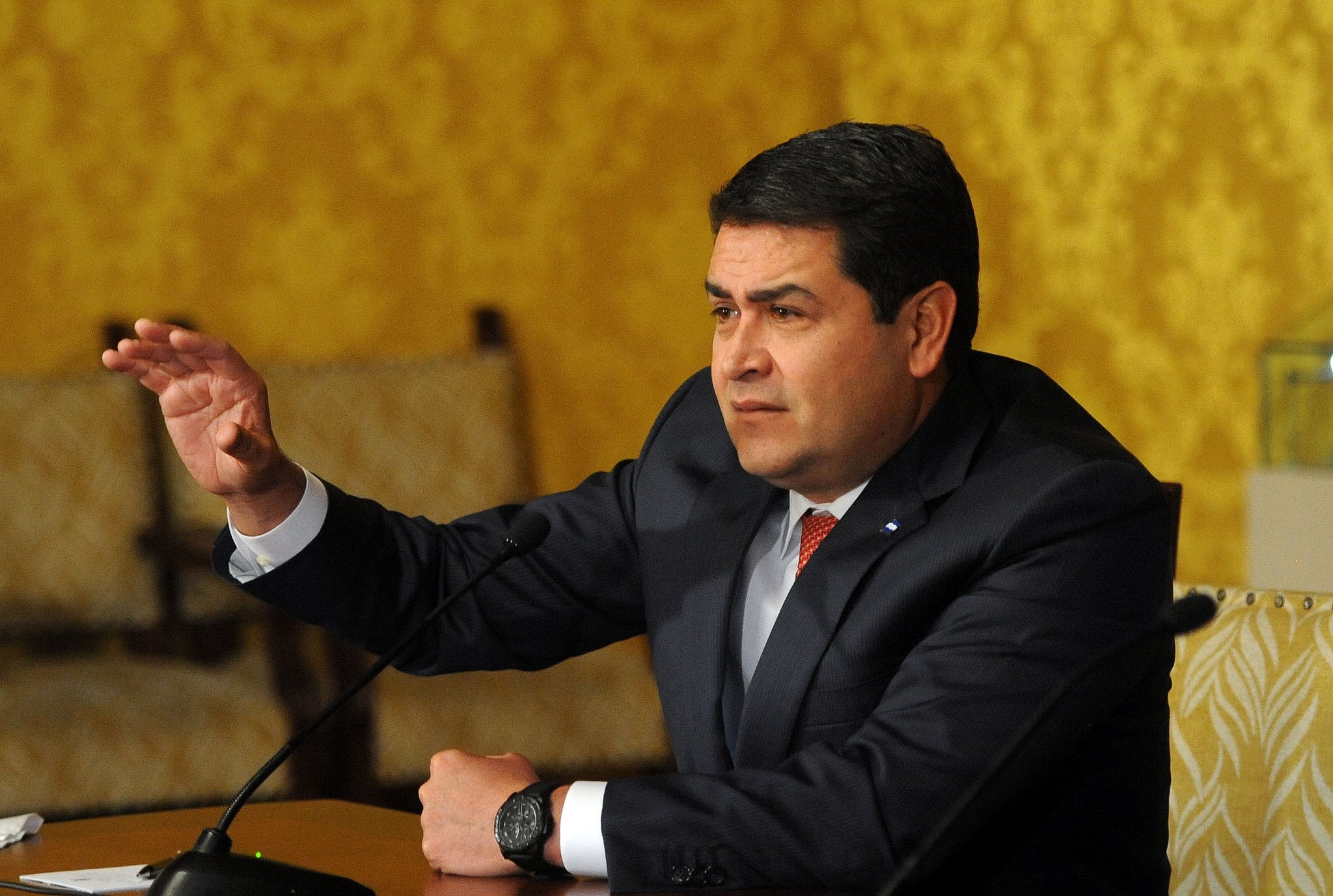
Honduran President Juan Orlando Hernandez. Photo Credit: Presidencia de la Republica del Ecuador / Flickr / Creative Commons

The decision last week by the Constitutional Chamber of the Honduran Supreme Court to legalize presidential reelection appears to have benefited a man – current President Juan Orlando Hernández – whose political fortunes got a shot in the arm from the 2009 coup that removed President Mel Zelaya for proposing a constitutional assembly to consider just such an action.  A Liberal Party magistrate said he wanted to recant his vote the next day, but the ruling party published the decision in the Gaceta Oficial before he could.  The Supreme Court, ruling in favor of petitions by former Nationalist President Rafael Callejas and several members of Hernández’s National Party, repealed two key articles of the Honduran Constitution, including one that says “the citizen who has served as the head of the executive power cannot be president or presidential candidate.”  Callejas immediately announced that he was resurrecting his Callejista movement, called MONARCA, which won him the presidency in 1990, and his campaign literature appeared in the streets of Tegucigalpa soon after.

The Court did not explicitly overturn Article 4 of the Constitution, which states that an “alternation in the exercise of the presidency of the republic is obligatory.”  That action reportedly will fall to the National Party-led Congress, but President Hernández is almost universally seen as the big winner from the Court decision, culminating his effort to continue as President.  After the coup that removed Zelaya from power, Hernández had a hand in congressional strategies to give a constitutional and legal framework – widely debunked – to Zelaya’s military ouster and later, while serving as president of the Honduran Congress and while campaigning for president, Hernández engineered the removal of four of the five justices of the constitutional chamber of the Supreme Court and replaced them with more sympathetic judges.  He subsequently had a role in selecting a replacement for the fifth, who became Attorney General – making for a court unanimously indebted to him.  (He was sworn in as national President in January 2014.)  Reacting to the court decision last week, Hernández noted that “reelection is something that is a general rule around the world … Prohibition of it is the exception … [and] Honduras has to make progress.”  His opponents have vowed to fight the repeal.  Leaders of the Partido de Libertad y Refundación (LIBRE) have accused the justices of “betrayal of the fatherland.”  One said the court “guaranteed the impunity” of the Hernández government, but the opposition’s legislative strategies have failed before.

Representing Central America’s most violent and most corrupt nation, President Hernández is seen in Washington as essential to success of U.S. policy in Central America and initiatives such as the “Alliance for Prosperity of the Northern Triangle.”  With a request for a billion dollars on its way to the U.S. Congress, the Obama administration can ill afford to point out Hernández’s hypocrisy for doing what he condemned former President Zelaya for trying to do in 2009.  Political inconveniences aside, the political cynicism and tensions that his and former President Callejas’s maneuvering will incite in violence-ravaged Honduras can hardly be seen as helpful to the goals of good governance and democratic consolidation that all profess.  When Nicaraguan President Daniel Ortega engineered a similar judgment by his Supreme Court in 2009, allowing him to run for an additional term, the State Department did not mince words about its “concern” for its implications.  Hernández, in contrast, was in Washington securing support for funding when his court announced its decision.  The U.S. Southern Command’s new task force of some 250 Marines is expected to arrive in Honduras and begin training of security forces involved in “fighting the drug traffickers.”

May 1, 2015

Corruption in Chile and Brazil

By Luciano Melo

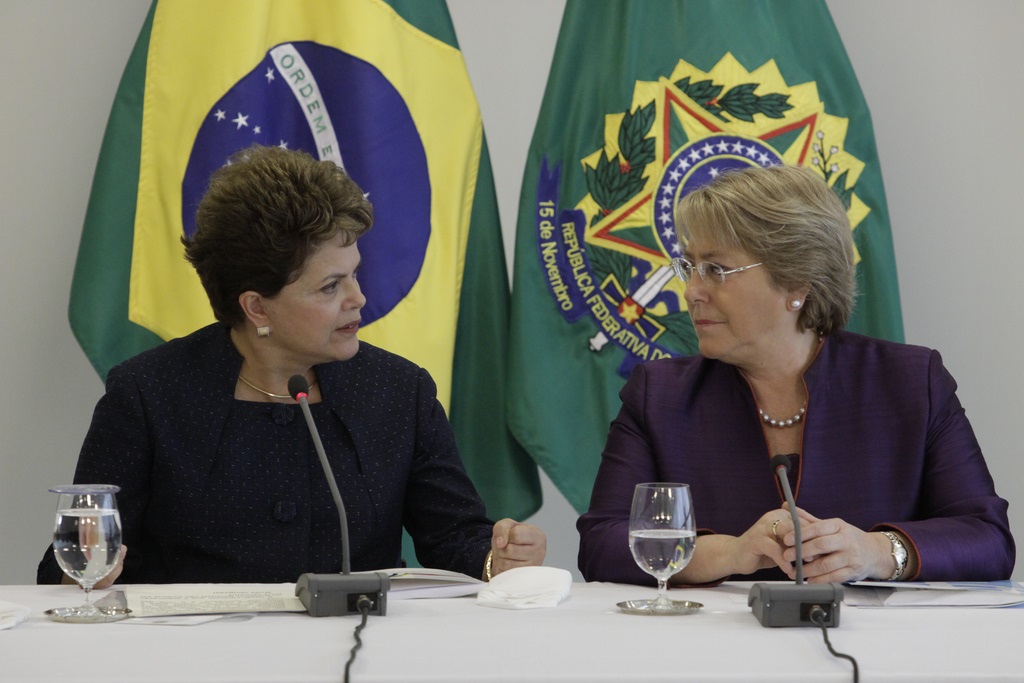
Brazilian Pres. Rousseff (l) and Chilean Pres. Bachelet. Photo Credit: UN Women / Flickr / Creative Commons

Brazilian Pres. Rousseff (l) and Chilean Pres. Bachelet. Photo Credit: UN Women / Flickr / Creative Commons

A growing perception of corruption in Latin America, most recently in Brazil and Chile, is eroding confidence in two of the region’s most dynamic presidents – Dilma Rousseff and Michelle Bachelet.  The Chilean and Brazilian corruption cases are both serious, but differing perceptions and expectations in the two countries suggest the scandals will have different impacts.

  • Chile has long been the darling of economists and political scientists (and U.S. policymakers) in terms of democratic maturity, economic development, and transparency. The use of political influence to secure millions of dollars in sweetheart loans there has pulled the country down from its high perch, and since the issue directly touched President Michelle Bachelet’s own family members, it has become a huge deal in and outside Chile.
  • Although among the six main economies in the world and alone among the BRIC countries in boasting a stable democratic system, Brazil, by contrast, has repeatedly been tainted by corruption scandals that would lead to the fall of most Scandinavian governments in a matter of days. Former President Lula’s son became a millionaire while his father was in power, yet this fact hardly stained the ex-President’s popularity.  The scandals weighing down President Dilma Rousseff are different.  Brazilian citizens customarily have thought of Petrobras, one of the few remaining state enterprises after the wave of privatizations under President Cardoso during the 1990s, as a great source of national pride, and this sentiment was encouraged by the PT government, never a fan of the neoliberal predilections of its predecessor.  So when the scandal touched almost all of the party’s leaders, in addition to the prized national oil company, even Brazilians inured to corruption felt pain. Moreover, Lula and Dilma’s party, the PT, had promised to do politics in a different way.  As a union leader and a woman who fought against the dictatorship, respectively, they represented the rise to power of leaders based entirely outside the traditional parties and their murky ways of doing business.  Now, some of Dilma’s disillusioned supporters are demanding her impeachment, and many famous artists who once endorsed the PT are feeling betrayed.

Latin American voters have long manifested contrasting expectations of their presidents – cynicism about their venal nature coincided, as Latin America specialist Guillermo O’Donnell once said, with hope that they be “acclaimed saviors.”  Within the codependent relationship between citizens and politicians, trust is impaired once betrayal surfaces, but the marriage normally continues.  In some cases of rupture, as happened with impeached President Fernando Collor in 1992, it hasn’t meant the end of the political affair.  In the October 2014 elections Collor was reelected as Senator for the state of Alagoas.  Dilma and Bachelet have already said they will not resign, and that they intend to implement a comprehensive cleanup.  The road will be easier for Bachelet.  The Chilean scandal is still small and remains manageable, and although the decline in commodity prices has already  affected the country’s economy, further taxing Bachelet’s popularity, Chile has a sovereign reserve fund to cushion any blows.  For Dilma the conjuncture is considerably bleaker.  She was on the board of Petrobras while its executives were engaged in costly shenanigans, and it is now known that the fraudulent scheming also involved the Health Ministry and the state-owned bank Caixa Economica Federal.  And in Brazil, in contrast to Chile, the fiscal situation is sufficiently tight as to constrain the president’s room to maneuver as the commodity-driven economy stagnates.  At this point both women appear likely to survive their challenges, but the road ahead looks a lot tougher for Dilma than for Bachelet.

April 16, 2015

Brazilian Truth Commission Looks at Police Violence

By Paula Orlando

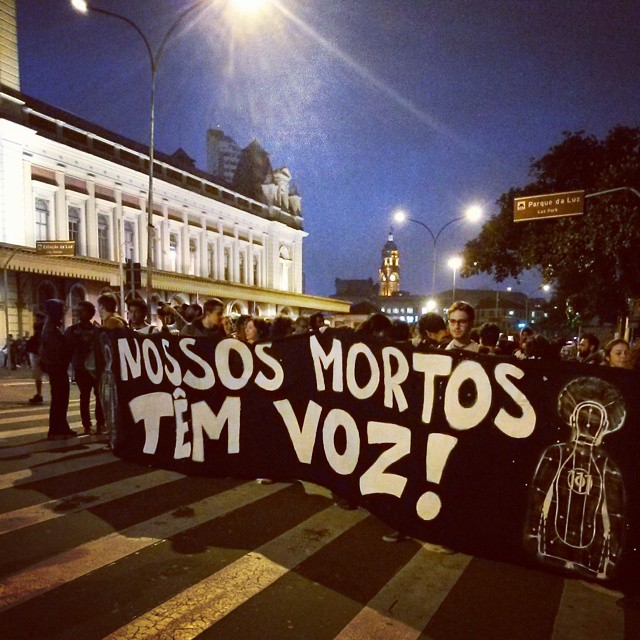
March in commemoration of the 22nd anniversary of the Carandiru massacre in 2014. Photo credit: veredaestreita / Flickr / CC BY-NC-SA

March in commemoration of the 22nd anniversary of the Carandiru massacre in 2014. Photo credit: veredaestreita / Flickr / CC BY-NC-SA

A new truth commission is about to investigate Brazil’s legendary police brutality and, for the first time, attempt to bring some public accountability for the crimes committed by the state. Police kill an estimated six people per day. Civil society organizations persuaded the Sao Paulo Legislative Assembly (ALESP) to establish the commission, the first to focus on human rights violations in the post-dictatorship period. It will hear testimony from witnesses and survivors of police brutality, and examine documents and other evidence related to major cases of police violence in the city and state in the last decades. The initiative follows the recent release of reports by the National and Sao Paulo State Truth Commissions on human rights violations during the military dictatorship (1964-1985). In fact, the reports suggested that present-day violence should be understood as a legacy of the lack of accountability for past violations.

The “Truth Commission of Democracy Maes de Maio” – named after a prominent movement of family members of victims of police violence that fights for justice and changes in security policies – held its first hearing on March 21. Parents of some of those killed in May 2006, when at least 493 civilians were killed in a period of 10 days, testified. (The National Truth Commission had accounted for 434 people killed during the 21 years of military rule.) The violence in May 2006 took place in the context of a conflict between the police forces and the “First Command of the Capital” (PCC) – a criminal organization formed within the detention system, and was justified as part of a “war on crime.” A study conducted by the International Human Rights Clinic of the Harvard Law School and the Brazilian Human Rights Organization Justiça Global contends that at least 122 deaths were directly linked to the police, and many of these bodies showed signs of execution. Four other civilians remain missing after nine years, and nearly all the cases have been archived without a resolution. With the participation of representatives designated by the National Secretariat of Human Rights, legislators, and members of social movements, the new commission will also examine other massacres, such as one at the Carandiru penitentiary in 1992 and the nighttime slaughter – also linked to police officers – of several people who were sleeping near the Sé Cathedral, in downtown Sao Paulo, in August of 2004.

The truth commission is more than a symbolic step towards recognizing and bringing some degree of state accountability in human rights violations; it shows the growing pressure of the movement against anti-police violence and in favor of justice and reparations for victims. Deputy Adriano Diogo, a major proponent of the panel, has warned that the way ahead “will be difficult; this is a discussion that the Brazilian government does not accept to have.” Insofar as the truth commission succeeds, it will not only create an institutional space linked to the state to clarify cases of police violence; it will stimulate an important discussion of the legitimization of police brutality in the context of “fighting crime.” In addition, it could contribute to the understanding that unlawful police violence is a form of political violence that no democratic society should endure.

April 6, 2015

Honduras: Charter Cities Lurch Forward

By Fulton Armstrong

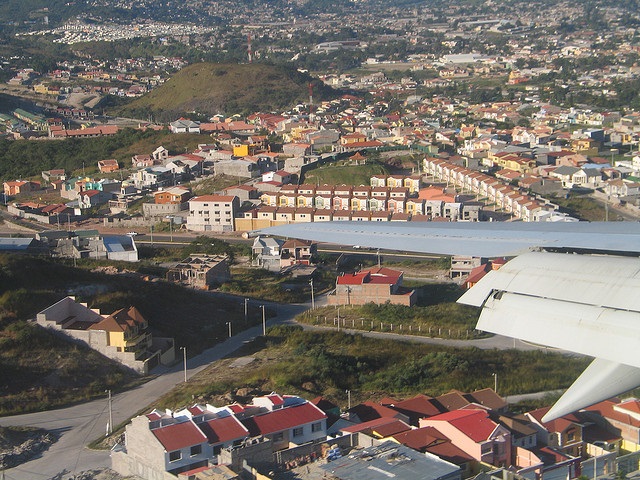
Choluteca, Honduras Photo Credit: Jonathan D. / Flickr / Creative Commons

Choluteca, Honduras Photo Credit: Jonathan D. / Flickr / Creative Commons

The Honduran government expects to get the green light this month from a Korean consulting firm for a master plan to hand governance of several small communities over to private investors to develop them, but concerns about the plan run deep and appear unlikely to fade.  Called ZEDEs – the Spanish acronym for “Employment and Economic Development Zones,” the specially designated areas are also called by their proponents charter cities, model cities, and startup cities.  The first tranche of towns facing conversion are in the southern Honduran departments of Valle and Choluteca, with a new port built on the Gulf of Fonseca.  The government says that the affected communities will remain an “inalienable part of the Honduran state,” but amendments to the Constitution, laws, and regulations permit their governing body – which is unelected – to establish “policies and regulations” and their own police and other public services.  Called the “Committee for the Adoption of Best Practices,” the board is dominated by representatives of Honduran millionaires and an even greater number of non-Hondurans of predominantly libertarian ideology.  Among them are American anti-tax crusader Grover Norquist; former President Reagan’s son Michael; and Michael Strong, chief executive of Radical Social Entrepreneurs.  The ZEDEs’ guiding principle is to liberate communities from government taxation, oversight, and corruption in order to attract investment and stimulate prosperity.

The ZEDEs initiative has been plagued by opposition since its inception, however.  Numerous reports underscore that the affected communities were never consulted, and demands for a referendum have repeatedly been rebuffed.  Honduran implementation of the model has been rejected by the U.S. economist who proposed it, Paul Romer (formerly of Stanford University; currently at New York University).  He withdrew because of the lack of Honduran transparency, including secret deals with interested U.S. parties.  The Honduran Supreme Court initially voted 4-to-1 against a Constitutional amendment allowing creation of ZEDEs in 2012, but the Congress impeached the four dissenters and replaced them with supporters who voted unanimously in favor.  There are numerous reports of intimidation of local civil society leaders, who deem them credible in view of clashes between wealthy businessmen and campesinos in other areas resulting in hundreds of deaths in recent years.

Honduras has a desperate need for economic growth – two-thirds of the population lives below the poverty line – and its model of national governance, riddled with corruption and non-transparency, is indeed in crisis.  But there’s no evidence that fighting one form of corruption with another non-transparent system will help anyone but the big investors.  Indeed, Honduras has ranked among the most violent countries in the world for several years, with the term “failed state” looming darkly over it – making it perhaps the worst place to experiment with provocative new models of governance without popular consultation or support.  Critics seem to have a good case: real reform and economic stimulus would focus on cleaning up the government and holding accountable the elites that have brought the country to ruin and now are trying to impose this model on their fellow citizens, rather than usurping the affected communities’ sovereignty.

March 19, 2015

Argentina: Who killed Alberto Nisman?

By Fulton Armstrong

March for Nisman on January 19, 2015, Buenos Aires, Argentain. Photo Credit: jmalievi / flickr / Creative Commons

March for Nisman on January 19, 2015, Buenos Aires, Argentain. Photo Credit: jmalievi / flickr / Creative Commons

Conspiracy theories, accusations, and counteraccusations – usually driven by personal prejudices and political agendas – are not uncommon in Argentina, but the death of special prosecutor Alberto Nisman on January 18 has brought them to a crescendo.  Each theory probably contains a grain or more of truth, but none adequately explains how this respected man, who had spent 10 years investigating the bombing of a Jewish community center in Buenos Aires 20 years ago that killed 85 and injured hundreds, wound up dead on his bathroom floor with a bullet in his head just hours before he was to testify before Congress.  Three main scenarios have emerged.

Scenario A:  Nisman was a national hero whose assiduous investigation of the AMIA attack, aided by Argentina’s intelligence agency (SIDE), had conclusively demonstrated an Iranian role in planning and funding Hezbollah’s execution of the bombing.  He was about to request the arrest of President Cristina Fernández de Kirchner (CFK) and Foreign Minister Héctor Timerman on charges of colluding with Tehran to cover up Iran’s role – and they or unidentified loyalists ordered his murder to stop him.  Under this scenario, a stealth team working on behalf of the President suborned or sneaked by the 10 body guards placed around Nisman’s apartment to enter and – using a 22-caliber pistol that he’d borrowed from an aide – killed him.

Scenario B:  Nisman was a zealot manipulated by disgruntled SIDE officials and got in over his head in a plot to bring down the President and her government.  Nisman had charged Presidents with coverups before – accusing President Carlos Menem in 2006 of taking a $10 million bribe from Iran to keep investigations from leading to its operatives – and his distaste for CFK was well known.  In December, she fired long-time SIDE chief, Antonio Stiusso, who (according to this theory) sought revenge by helping Nisman make his case.  (Officials close to President made the unsubstantiated and dubious claim that the man who lent Nisman the gun, Diego Lagomarsino, was also an intelligence agent.)  Under this scenario, accepted by very few Argentines, Nisman took his own life.

Scenario C:  In the house of mirrors that is Argentine intelligence, power plays are shrouded in intrigue and hard to divine.  Under this scenario, persistent rumors suggest a struggle between pro- and anti-Stiusso factions in which Prosecutor Nisman was collateral damage, perhaps because of his eagerness to do the dismissed SIDE director’s bidding.  Precious little information is available to label the factions – pro- or anti-CFK, or pro- or anti-Israel, or even pro- or anti-Iran – but there’s a consensus that something was rotten in SIDE.  Eight days after Nisman’s death, CFK announced an effort to dissolve it and set up a replacement agency, and the Congress has already begun to take action.

However much partisans of one perspective or another want to believe these scenarios and their variants, information is too weak or contradictory to give much credibility to any.  CFK and Timerman’s advocacy of trade with Iran – primarily swapping Argentine grain for Iranian oil – and their negotiation on a joint investigation of the bombing weren’t secret.  The exchanges were the subject of numerous public statements since 2013, and a number of Argentine officials, including Stiusso and other senior SIDE officers, were involved in both initiatives.  Interpol officials, moreover, deny that either CFK or Timerman had ever requested suspension of arrest warrants for any of the Iranian suspects.  But the President’s attacks on Nisman before and after his death have been strident and personal – clearly crossing the line for a chief executive talking about a prosecutor – and her public statements, including flip-flopping on whether the death was a suicide, do have a certain odor that create the impression that, as Shakespeare’s Queen Gertrude in Hamlet might say, “the lady doth protest too much, methinks.”  The poisonous political climate in Buenos Aires over el caso Nisman appears likely to drag on – yet another crisis the country can ill afford.

February 9, 2015

Oil Scandal Besets Brazilian Politics … Drip-by-Drip

By Matthew Taylor and Luciano Melo*

Nestor Galina  / Flickr / CC BY-NC 2.0

Nestor Galina / Flickr / CC BY-NC 2.0

Brazil’s oil scandal – the largest corruption scheme in Brazil’s history – probably won’t bring down the government of President Dilma Rousseff but will keep it in constant peril.  Since March 2014 the Brazilian Federal Police have been investigating the disappearance of tens of billions of dollars allegedly siphoned from the national oil company, Petrobras.  The company is a national symbol, founded by legendary President Getúlio Vargas in 1953, and a powerful economic force, especially in light of the discovery of massive deepwater oil off Brazil’s coast and the massive investments that have been undertaken to develop those fields.  No image captured Brazil’s triumphant resurgence over the past decade than a famous 2006 shot of President Lula holding up his hand covered in oil at a ceremony celebrating Brazil’s oil self-sufficiency.  (The picture itself was a takeoff on an iconic photo of Vargas.)

President Dilma Rousseff – who had close ties to the company as chairwoman of its board (2003-2010) and Minister of Mines and Energy (2003-2005) – is now confronting the dark underside of Brazil’s oil dream.  She is respected for her personal probity; nobody has suggested that she gained personally from the brazen corruption within Petrobras.  But critics point out that she was either cognizant of corruption or woefully incompetent.  As a result, the scandal weakens her considerably, just as she faces a revitalized opposition, a restive group of political allies, an economy grinding to a near halt, and a very real possibility that Brazilian debt will be downgraded to junk status.  Indeed, the scandal increases the chances of each of those four outcomes considerably.

The good and bad news from Dilma’s perspective is that the courts are very slow in Brazil.  If this case moves as quickly as the vote-buying mensalão scandal of 2005 – which was actually relatively efficient and effective by the standards of the Brazilian court system – final legal resolution of the case is unlikely before 2021.  Furthermore, for now there seems to be little appetite among the opposition for impeachment, possibly in part because some opposition members are rumored to be implicated as well.  So Dilma seems likely to survive politically, even as the scandal threatens to remain part of the political geography for the remainder of her second term.  This will be excruciating, as each week brings further revelations.  Indictments against a host of politicians are expected as soon as next month.  Perhaps most damaging in the long-term, though, will be the realization that nearly a decade after the mensalão scandal, legislative coalitions continue to be held together by the glue of pervasive corruption, and campaign finance appears deeply rooted in the misappropriation of public resources.

*Matthew Taylor is an associate professor at American University’s School of International Service and currently a fellow at the Woodrow Wilson Center for International Scholars.  Luciano Melo is a Ph.D. student in the School of Public Affairs.

January 22, 2014

Mexico: Is Peña Nieto Missing the Point?

By Fulton Armstrong

Rodrigo Barquera / Flickr / CC BY

Rodrigo Barquera / Flickr / CC BY

The disappearance and apparent massacre of 43 students from a city in Mexico’s Guerrero state is a rude reminder to President Peña Nieto that economic reform and increased foreign investment aren’t enough to help the country overcome the scourge of narcotics-fueled violence.  Federal and State prosecutors agree that the police in Iguala – who, along with the city’s mayor, have strong ties to the Guerreros Unidos cartel – handed the students over to the narcos after a confrontation during a student protest turned violent, already leaving six students dead.  Residents on a nearby ridge noted an increase in police and truck traffic soon after the showdown, but the dozens of bodies uncovered by searchers at mass graves in the area so far have not been the students’.  The mayor and police chief are in hiding, but Federal authorities say three dozen police and accomplices have been arrested and many have confessed.  None apparently has identified where the bodies were dumped.

As the scope of the crime, which occurred three weeks ago, has become clearer, the President’s rhetoric has been increasingly forceful, committing to investigate and bring the perpetrators to justice.  The Federal police have been directed to take control of security in the area and nearby municipalities.  The government announced last Friday, that the “supreme leader” of the Guerreros Unidos has been arrested, while another committed suicide after a standoff with police.  But critics point out the federal authorities’ own problems with corruption, and criticism of Peña Nieto’s efforts to stem the violence has been growing, especially in the wake of his administration’s many self-congratulatory statements about progress in the security area.  A new 5,000-strong national civilian gendarmerie he rolled out in August was ridiculed as too little, too late.  His continuation of his predecessor’s emphasis on arresting drug kingpins – resulting this year in the spectacular arrests of Joaquín “El Chapo” Guzmán Loera (of the Sinaloa cartel), Héctor Beltrán-Leyva (of the Beltrán-Leyva Organization), Fernando Sánchez Arellano (of the Arellano Félix cartel), and others – has failed to eliminate the underlying systems of the drug trade.

During the presidential campaign in 2012, Peña Nieto promised to reduce violence, and his decision not to obsess over the problem – as his predecessor, President Calderón, had – may have given him a respite.  But his administration apparently ignored clear signals of trouble – such as indications that in Guerrero state and elsewhere the cartels’ were expanding and consolidating their influence over government – and the problem seems to be roaring back with a vengeance.  The President’s focus on reforming the economy and attracting foreign investment makes strategic sense, but its long timeline doesn’t help him fight the fires of violence that envelop parts of the country.  There’s also merit in creating something like the gendarmerie and other institutional tools, but that approach seems to ignore that the rot of corruption has deep roots at all levels – federal, state, and local – that must be dealt with and that an elite unit tied to a federal capital hundreds of kilometers away can do little in places like Guerrero.  Calderón had shown the challenge wouldn’t be easy, but Peña Nieto has not yet shown that he – and Mexican society – are up to it either.

October 21, 2014

Building State Capacity in Brazil

By Katherine Bersch, Sérgio Praça, and Matthew M. Taylor*

Photo Credit: Metrix X / Foter / Creative Commons Attribution-NonCommercial-NoDerivs 2.0 Generic (CC BY-NC-ND 2.0)

Photo Credit: Metrix X / Foter / Creative Commons Attribution-NonCommercial-NoDerivs 2.0 Generic (CC BY-NC-ND 2.0)

As the World Cup fades out and Brazilians turn their focus to the October elections, public debate will shift back to economic growth, social services, corruption, and – central to them all – the role of the state.  Is the federal government too big, inefficient and meddlesome, as the opposition argues, or does it need to be strengthened to play a leading role in Brazil’s state capitalist economy, as the incumbent Workers Party has sought?  In a recent paper (click here for draft), based on publicly available data of about 326,000 civil servants working within the 95 most important federal agencies in Brazil, we found a very diverse federal government, with agencies distributed widely on both capacity and autonomy.

Our findings empirically confirm a long literature that highlights the coexistence of so-called “islands of excellence,” with high capacity and high autonomy, alongside low-capacity, low-autonomy laggards.  “Islands of excellence” include Brazil’s Foreign Ministry (Itamaraty), the Central Bank, the Finance Ministry, the Justice Ministry, and the relatively young Comptroller General’s Office (CGU), created in 2001.  Laggards include almost all of the infrastructure agencies, as well as the Ministry of Sports, perhaps helping to explain the recent World Cup construction snafus.  Also interesting are the agencies with high capacity and low autonomy (such as the Federal Highway Police, which most state governors seek to empower and control within their own states), as well as agencies with low capacity and high autonomy, which few politicians seek to control (such as the Public Defenders Office).

We found solid evidence that agency corruption – one of the driving forces behind last year’s political angst and popular protests – is correlated with lower capacity and lower autonomy.  This finding could help frame debate in the upcoming campaigns and beyond: the keys to reducing corruption are to build agencies’ capacity and increase their autonomy from political partisans.  The debate over the role of the state has been ongoing since the return to democracy in the 1980s.  No matter who wins the October elections, the expansion of this data set and measurement effort will provide useful empirical data to more realistically evaluate the evolving performance of the Brazilian state, as well as to recognize the enormous differences and best practices within that state. 

*Katherine Bersch is a doctoral candidate at the University of Texas at Austin.  Sérgio Praça teaches Public Policy at the Federal University of the ABC in São Paulo.  Matthew Taylor, a regular contributor to AULABLOG, teaches at American University.

Guatemala: The War of Paz y Paz

By Steven Dudley*

CLALS Paz y Paz

Law professor and human rights attorney Claudia Paz y Paz’s selection as Guatemala’s first woman attorney general was a surprise, but strident opposition to her reappointment from the dark interstices of the political spectrum is not.  More hippy professor than government bureaucrat, she’s a woman who defied the odds when she took office in 2010.  Paz y Paz speaks with a soft, gentle tone to the point where she almost needs a microphone to run a staff meeting.  Yet, from nearly the moment she walked into the attorney general’s office, she made a difference.  She and her team arrested previously untouchable figures such Juan López Ortiz, alias Chamale, and dozens of members of the feared Mexican criminal group, the Zetas.  The country’s murder and impunity rates fell.  Paz y Paz also prosecuted former military officers, including former military dictator Ríos Montt and others allegedly involved in atrocities in the 1980s, and helped set up special offices to deal with violence against women.

Paz y Paz also demonstrated how, employing best practices, Guatemalan judicial institutions can excel.  Her office’s reliance on forensic evidence, telephone intercepts and video analysis made for stronger cases.  This took the onus off of eyewitness testimony, a notoriously unreliable means of fighting powerful criminal groups, especially those who have deeply penetrated the state.  Paz y Paz also widened the investigative net, looking at entire criminal structures, rather than focusing on single criminal acts.  She won praise from a broad array of international partners and pro-democracy forces inside Guatemala.  She was a 2013 Nobel Peace Prize nominee.

In spite of – or because of – these accomplishments, Paz y Paz is struggling to keep her job for another four-year term.  She has to be approved by a “postulation commission” made up of 14 lawyers who select the final six candidates, from which the president picks one.  Special interest groups, using shady brokers (some with ties to organized crime), are maneuvering to make sure that her attempt to reform Guatemala’s Attorney General’s Office ends sooner rather than later.  She has opened up many wounds and frightened Guatemala’s traditional elite, some of whose members worked with the Army during the civil war and believe they could be next on Paz y Paz’s list.  Efforts to block Paz y Paz’s second term underscore that Guatemala is a country that is still struggling to deal with its past civil war and its forever lopsided power structure.  Despite ending a nearly four-decade-old conflict in 1996, Guatemala is still at war –though the battles now take place in the courts – and the elites don’t want a formidable player like Paz y Paz to be in the game.

*Steven Dudley is co-Director of InSightCrime, which is co-sponsored by CLALS.  Click here for the full investigation of “The War of Paz y Paz.”