Political Participation in Latin America Expanding

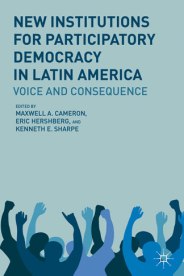
participatory democracy coverFrom local citizen initiatives to national referenda, mechanisms of direct political participation have been spreading with astonishing vigor throughout Latin America in recent years. Some of these mechanisms are new and unprecedented in the way they involve citizens in politics, such as frequently touted participatory budgeting systems at the municipal level in numerous countries.  Other initiatives, such as the National Policy Conferences that consult the citizenry regarding an array of issues in Brazil, are less widely known. In most Andean countries and to some extent elsewhere, these forms of participation often emerge where established representative institutions, such as party systems, have collapsed, or where legislatures have fallen into disrepute.  Yet they also proliferate alongside strong parties, legislatures, and interest associations, as we see in Brazil and Uruguay.

A recent CLALS-sponsored book* examines these new forms of participation and analyzes when they promote, and when not, the consolidation and deepening of representative institutions. The participatory innovations vary along a number of key dimensions, including how they interact with political parties and established institutions, their focus on collective versus individual rights and, perhaps most importantly, their autonomy from political and economic elites.  These differences and their implications are analyzed in detail in case studies on seven Latin American countries: Bolivia, Brazil, El Salvador, Mexico, Nicaragua, Uruguay and Venezuela.

When new forms of political participation emerge spontaneously and independently – as a natural reaction to an unfulfilled need at a local or national level – their voices are authentic and tend to enhance democratic rule.  Brazil’s National Policy Conferences and Uruguay’s referenda to enhance accountability are examples of the incorporation of new voices in policy formulation – to the benefit of the constituencies driving them and the nation as a whole.  We also find instances where participation has exacerbated and reinforced longstanding patterns of clientelism (including in Mexico and Brazil), and autocratic leaders have sought to create or capture such voices to bypass representative institutions (including in Nicaragua and Venezuela).  A valuable lesson of this research, however, is that, once in place, these spaces may become increasingly autonomous. Venezuela’s community councils are an important case to watch: created to reinforce the Chavista project as defined by the Casa Rosada, they may take on a life of their own when the politicians who sponsored them relinquish their positions of power or pass away.

New Institutions of Participatory Democracy: Voice and Consequence, published by Palgrave Macmillan 2012, resulted from a multi-year project co-organized by CLALS and the University of British Columbia’s Andean Democracy Research Network.  More information on the project can be found here .  (The volume has also been published in Spanish by FLACSO-Mexico, Nuevas instituciones de democracia participativa en América Latina: la voz y sus consecuencias)

Honduras: What is U.S. policy?

The sustained surge in crime and violence in Honduras – including more than 60 politically motivated murders in the past year – is raising doubts about the viability of the government and its institutions.  The term “failed state” is often abused, but there’s no doubt that Honduras falls short of the rhetoric about its stability and democracy that the Obama Administration recited when arguing for the country’s readmission to the OAS after the 2009 coup that removed President Mel Zelaya.  Indeed, the coup set the country on a downward spiral from being a weak democracy to one struggling for basic credibility.  The U.N. Office on Drugs and Crime says Honduras has the world’s highest murder rate – 91.6 murders per 100,000 inhabitants in 2011.

Undersecretary of State María Otero has spent time and energy trying to establish a policy toward Honduras.  During a visit to Tegucigalpa last month, she signed an agreement with Foreign Minister Corrales that “sets the stage for results-oriented action towards our shared objective of a safe Honduras that respects the rule of law and human rights,” and she announced that the United States would provide an additional $1.8 million in aid to help counter gang activity in Honduras.  Despite her efforts, the State Department and the U.S. Embassy in Tegucigalpa have failed to go beyond ready-made programs and put in place a framework for a comprehensive policy.  Programs are not policy.  The Administration appears reluctant to admit that its Honduras policy, which has failed, needs an overhaul.

Multimillion-dollar programs will not succeed until they take into account that the Honduran “partners” upon which they depend are themselves at the core of the problem.  Three years after the coup, the Obama Administration still fails to see that its allies in the struggle against transnational and local gangs, as well as its efforts to build judicial institutions, are the same people who mocked the rule of law, overthrew the previous president, and re-politicized the military and police to serve their own purposes.  (The reasons for Washington’s unwillingness to help fund a “Commission for Security Reform” approved by the Honduran Congress are unclear, but this may be a factor.)  There are strong suspicions in many sectors of Honduran society that members of the country’s political-economic elite are the sponsors of the sicarios (hired gunmen) who have killed dozens of citizens whose offense was to demand an end to government impunity.  Given the challenge that the growing popularity of the country’s new political party, LIBRE, poses to traditional powerbrokers, informed observers expect violence to increase in the run-up to elections next year.  Absent public explanation of U.S. policy, it is fair to ask why Washington hasn’t seen these patterns – obvious to Hondurans – and why it hasn’t offered sustained support from the FBI and other U.S. law enforcement to investigate the assassinations and trace them back to the power bosses.  It is also fair to ask Assistant Secretary of State Brownfield and others who espouse the militarized approach to dealing with organized crime how this strategy, which has failed elsewhere, will succeed in Honduras.  Why hasn’t the Obama Administration supported the sort of U.N.-sanctioned investigative capacity that has proven effective with the International Commission Against Impunity in Guatemala?  Why has Washington not even pushed for meaningful implementation of the recommendations of the Truth and Reconciliation Commission released last year?  If Washington wants to make its rhetoric about Honduras into reality, it needs to do more than just to funnel funds into programs run by questionable partners.