Colombia’s Elections: With New Comes Old

By Julián Silva*

Two men sit in white chairs during an interview

Iván Duque (left), appears to be the frontrunner in Colombia’s May 27 presidential election. / Casa de América / Flickr / Creative Commons

The first round of Colombia’s presidential election on May 27 has raised the profile of independent voices but does not appear likely to bring significant changes.  Most of the nine candidates represent new political forces, but the strongest are allied with the traditional elites that ruled under Liberal and Conservative banners during most of the 20th century.

  • Since the 1991 Constitution opened space for new competition to the Liberal and Conservative Parties, “independent” groups have shown increasing willingness to take the presidency for themselves. The old clientelistic machines, associated with the land-owning elites and those parties, have lost popularity in the urban-dominated country, and the rejection of the more traditional families seems to have prompted a certain “rebranding” by their heirs.  This year, only the Liberal Party presented a candidate – former minister, vice president, and peace negotiator Humberto De la Calle – but current polls indicate that he is unlikely to reach one of the two spots heading into the second round.  The youngest of the candidates seem to hold the lead: Iván Duque (42 years old) is pulling 38 percent; Gustavo Petro (58) has 29 percent support; Sergio Fajardo (61) has 12.8 percent; German Vargas Lleras (56) has 8.2 percent; and De la Calle (71) has 3.2 percent.

Several ostensibly independent candidates actually have close ties to well-established local and national elites.  Iván Duque, a fairly new figure in the Colombian political landscape, is aggressively supported by former President and current Senator Álvaro Uribe Vélez, who had deep roots in the Liberal Party and Antioquia Department elite before founding Centro Democrático in 2013.  The party is closely tied to land-owning oligarchs, big corporations, and the military, which gives Duque prospects for victory no truly independent candidate could have.  German Vargas Lleras, grandson of former President Alberto Lleras, is running on a new ticket called “Coalición Mejor Vargas Lleras,” which receives support from his old party, Cambio Radical, as well as stalwarts of the Conservative party and his family’s Liberal allies.

  • Several independents deserve the label. Gustavo Petro, a former guerrilla and mayor of Bogotá, occupies a more leftist space on the political spectrum that was usually excluded by the traditional parties during most of the 20th century.  Former Mayor of Medellín and Governor of Antioquia Sergio Fajardo promises to bring an “academic” perspective to the presidency if elected.
  • In addition to airing complaints about the candidates, social media users have been extremely critical of links that most candidates have to the traditional Colombian political class. Provocateurs mix truthful information with fake news to mislead the electorate and, protected by anonymity and authorities’ loose control over the virtual space, even issue threats of violence.  An unidentified projectile shattered a window of the car in which Gustavo Petro was heading to a rally in the city of Cúcuta.  The Matador, a political cartoonist working for El Tiempo, received death threats after he depicted Ivan Duque as a pig in one of his drawings.

With a little more than three weeks until the first round, the table seems to be set for Colombians to choose between leaders with significantly different political bases.  Current polls suggest they will stick with the neoconservative elite that has improved security and driven economic growth during the last few decades but has been tolerant of corruption, inequity, and even violence in some parts of the country.  But support for a different formula that promises to address some of these chronic problems is not inconsequential, even if the new leaders’ effectiveness is still unproven on a national level.  Colombians will also have a chance to decide if social media will be a vehicle for amplifying the old politics of threats and violence – or perhaps channel legitimate popular voices to demand accountability that exposes “fake news” and hate-mongering for what they are.  On that, too, the old practices and characters seem to have the advantage as they pursue a strategy that creates an image of change to ensure that everything remains the same.  The appearance of change in Colombia probably portends more of the same.

May 2, 2018

* Julián Silva is a CLALS Research Fellow, a Ph.D. Candidate in History at Universidad de los Andes, and Professor of International Relations at several Colombian universities.

South America: Is UNASUR Dead?

By Stefano Palestini Céspedes*

Three men sit at a table with microphones and two flags behind them.

President pro tempore of UNASUR, Bolivian Foreign Minister Fernando Huanacuni (middle), held a press conference last week to discuss the suspended participation of six member countries. / UNASUR SG / Flickr / Creative Commons

The decision of UNASUR’s six center-right members to suspend their participation in the group underscores the immense challenges the regional organization faces but may also lead to its effective reform.  In a letter last Friday to the Foreign Minister of Bolivia, current President pro tempore of UNASUR, his colleagues from Argentina, Brazil, Chile, Colombia, Paraguay, and Peru communicated their decision to suspend participation and budget support for UNASUR immediately.  In the past, single governments have unilaterally withdrawn from a regional organization when they considered it was not serving their interests, but a collective – albeit temporary – exit is unprecedented for an international organization in Latin America.  UNASUR now has only six fully participating members.

  • Although considered by some a left wing organization, UNASUR grew out of an idea that can be traced back to Brazilian President Fernando Henrique Cardoso’s first South American Summit in 2000. Institutionalized under the leadership of Presidents Lula da Silva and Hugo Chávez in 2008, UNASUR successfully grouped together Bolivarian, center-left, and center-right governments during its first 10 years of existence.  Under the leadership of Chilean President Michelle Bachelet, it helped avert a presidential crisis in Bolivia in 2008 and mediated in a conflict between Colombia and Ecuador.  Two years later, it adopted a democracy clause that has been applied once, in Paraguay in 2012.  UNASUR agencies such as the South American Defense Council, the South American Health Council, and the Council for Planning and Infrastructure have enjoyed broad participation and delivered regional public goods.

The six dissenting foreign ministers explained in their letter that their decision was motivated by the “need to solve the anarchy (acefalia) of the organization.”  They referred explicitly to the vacancy of the post of Secretary General since January 2017.  In fact, the organization’s requirement that decisions be by consensus perennially complicates decision-making.  The candidate with majority support – Argentine José Octavio Bordón – was vetoed by Venezuela, which the six believe is in violation of the organization’s democratic commitment.  Venezuela is currently suspended from Mercosur; was not invited to the Summit of the Americas in Lima; and has been singled out by a Resolution of the OAS.  As the application of UNASUR’s democracy clause against President Maduro is also blocked by the consensus rule, the six seemingly had few courses of action to exercise their voice.

  • Some observers say the six– all center-right governments – seek to destroy UNASUR because it is supposedly leftist or Bolivarian. However, the dissenters have not initiated formal procedures to withdraw from UNASUR, which would have de facto started its dissolution.  Indeed, there are different stances among the six signatories of the letter, with some in favor of the dissolution and others in favor of overhauling UNASUR.  The prevailing position seems to be to press the remaining countries, mainly Bolivia, Ecuador, and Uruguay, to convince Venezuela to lift its veto of Bordón.

The impasse may provide opportunities to transform UNASUR into a more effective organization.  A first positive indicator has been the political leadership of the Bolivian foreign minister; instead of overreacting to the letter, he has convened all foreign ministers (including the six signatories) to a meeting to solve the impasse.  The Chilean foreign minister and others have urged reform, which in theory could be achieved by introducing a majority-voting mechanism to overcome the sort of deadlocks that hamper the organization.  The risk is obvious:  Bolivia could fail to persuade Maduro to drop his veto, in which case at least a couple of the dissenters would probably withdraw from UNASUR.  Some of these governments have never been enamored with South American multilateralism and believe their interests are best served by cultivating relations with the United States and China bilaterally.  But bilateralism cannot provide regional public goods – such as peace, infrastructure, and economic stability – and hardly ever results in a balanced global economic insertion because it benefits the party in the stronger position.  As several South American countries – including some of the six dissenters – are facing domestic turmoil, breaches of the rule of law, and threats to good governance, a strong regional organization in which all South American states sit as members is more necessary than ever.

April 27, 2018

* Stefano Palestini Céspedes is a former CLALS Research Fellow and Postdoctoral Fellow at the Department of Political and Social Sciences at the Freie Universität Berlin, where he specializes in international organizations and regional governance.

Nicaragua: Approaching an Inflection Point?

By Kenneth M. Coleman*

Protesters burn a large pink metal tree

On Saturday, April 21, 2018, Nicaraguan protesters burned an “Árbol de la Vida” (Tree of Life), one of several monumental statues that are considered representations of President Daniel Ortega’s government. / Jan Martínez Ahrens / Wikimedia / Creative Commons

The street protests that wracked Nicaragua last week may or may not recede after President Daniel Ortega backed off a controversial increase in social security taxes, but the damage to his image of invincibility will linger and could turn out to be a watershed in his and his wife’s grand plan for one-party rule.  Ortega mobilized the police, which have teamed up with young thugs over the years to intimidate those who protest government policies, to repress what started last week as peaceful protests against the increased taxes but evolved into a challenge of the authoritarian nature of the regime.  The government closed four television stations that were covering the street protests; shock troops from his party’s Juventud Sandinista burned down a radio station in León; and journalists faced harassment, one having been killed.  Local press estimates 20-30 deaths, with surely well over a hundred injured.

The street protesters were not alone in their struggle.  The Superior Council of Private Enterprise (COSEP) and American Chamber of Commerce in Nicaragua (AMCHAM) – which for years had become silent accomplices in the efforts of Ortega and his wife, Rosario Murillo, to consolidate their power – called for solidarity with the popular protests.  For the first time in the current Ortega era (2007-2018), they openly called for street marches to resume today.  More importantly, they used hard language – condemning the use of fuerzas de choque by the government – and issued a set of conditions before a “dialogue” with the government can begin.  Specifically, they demanded that students, university communities, and the Bishops Conference of the Catholic Church be included in any dialogue, surrendering their previous role as privileged interlocutor with the government.  (The Catholic Church provided respite and support – both moral and physical – to student protesters.)

Mass movements can start from little sparks and grow into society-wide convulsions.  The outcome of these new confrontations with the Ortega-Murillo government cannot be foreseen at this point, but the parallels with other governments on their last legs are striking.  The use of excessive force by Mexican police in 1968 triggered massive street protests that directly questioned the legitimacy of a seemingly well-established Mexican one-party state – legitimacy that was ultimately resurrected only by opening the system to genuinely democratic competition.  While the process took two decades, it did lead to an opposition victory in the 1990 presidential election.  In Nicaragua, the fall of Anastasio Somoza in 1979 accelerated when the business community eventually abandoned his dictatorship.

  •  Ortega’s party, the Frente Sandinista de Liberación Nacional (FSLN), for many years has been able to isolate, contain, and discredit those abandoning it, including a former Sandinista Vice President and former members of its National Directorate. Grumbling within the party is already growing louder because of a succession plan bringing Rosario Murillo to power upon the illness or death of Ortega in a manner that far exceeds her status as vice president.  Local press reports indicate that one police commander and her unit of 50 officers have been jailed due to their unwillingness to confront and repress protesters in the streets.  The excessive application of force against peaceful protesters last week and, potentially, in coming days might lead to a more serious rupture, making last week’s events a potential inflection point for Nicaragua – with potentially dire consequences for Ortega and Murillo’s political ambitions.

April 23, 2018

* Kenneth M. Coleman is a political scientist at the Association of American Universities who directed the 2014 AmericasBarometer national survey in Nicaragua.

A Summit in Search of the Americas

By Carlos Malamud*

A large round table encompasses a room with various heads of state from the Americas

Last week’s Summit of the Americas in Lima, Peru. / U.S. State Department / Public Domain

The Summit of the Americas in Lima last weekend has left its organizers and principal participants with a bittersweet feeling, leaning to the bitter.  The absence of Donald Trump, Raúl Castro, and Nicolás Maduro reflects only the existing difficulties.  The bigger problems relate to the impossibility of achieving general consensus about the big hemispheric issues, such as corruption or Venezuela, and – of even greater concern – the lack of clarity and substance of the Latin America policy of the United States.

  • The Summits initially were linked to Washington’s efforts to create the Free Trade Area of the Americas (FTAA), but since that project’s failure they have represented the United States’ ongoing interest in Latin America and the Caribbean. That explains why, since the Summit process was created in 1994, no resident of the White House has missed a Summit – regardless of how complicated national and international situations have been.  That was until Donald Trump gave priority to the conflict in Syria over his relationship with Latin American counterparts.

The disturbing thing is not just Trump’s conflict with Mexico, or his hostility toward Cuba and Venezuela.  Neither is the deterioration of the image of the United States in Latin America since President Obama’s term ended.  The fundamental problem is the lack of clear indications from the Trump Administration about its intentions and objectives in the region.  This is the case even with the closest countries.  For example, several South American countries’ exports to the United States could be affected by the trade war between Beijing and Washington.  But no one has clear answers about the policies driving these events, and no one is taking steps to reduce the impact of them or of Washington’s lack of policy.

  • Even though the official theme of the Summit was “Democratic Governance against Corruption,” it was impossible for the participants to go beyond good words and advance any global solutions. Without a doubt, this is good evidence of the weakness of regional integration.  In their Final Declaration, the leaders were unable to include either a condemnation of Venezuela or a call to disregard its Presidential elections on May 20.  Instead, what we got was a statement by the Grupo de Lima plus the United States expressing extreme concern for the situation in Venezuela.  Despite the decline of the Bolivarian project and Maduro’s isolation, Bolivia, Cuba and some Caribbean states dependent for oil on Petrocaribe remain capable of blocking hemispheric consensus.

This probably will not be the last Summit of the Americas, but the future of these hemispheric meetings depends in great part on the capacity of the governments in the hemisphere, beginning with the United Sates, to redefine continental relations and find anew the essence of the Americas.  This means more than just responding to the growing Chinese role; it means putting on the table the real problems that affect the continent and going beyond mere rhetoric about them.  For now, with hemispheric relations buffeted by the unpredictable slams issuing in the form of Trump’s tweets, it will be difficult to get there.

April 17, 2018

*Carlos Malamud is Senior Analyst for Latin America at the Elcano Royal Institute, and Professor of Latin American History at the Universidad Nacional de Educación a Distancia (UNED), Madrid.  A version of this article was originally published in El Heraldo de México.

Brazil: Is Democracy Under Threat?

By Marcio Cunha Filho*

A large group of Brazilians wave the Brazilian flag

A rally supporting former president Luiz Inácio Lula da Silva in October 2017. / Eduardo Figueiredo / Midia NINJA / Flickr / Creative Commons

Brazil’s ongoing political turmoil hit a new peak last weekend – resulting in former President Luiz Inácio Lula da Silva’s decision to turn himself in to be imprisoned – and strongly suggests that the country’s democracy is in deeper trouble than previously thought.  Lula said he was a victim of political persecution by both prosecutors and the courts, including the six Supreme Court justices who ruled that he not be allowed the courtesy of remaining free during his appeals to Brazil’s higher courts on his conviction on corruption charges.

  • Lula’s Worker’s Party (PT) claims that the decision is part of a campaign against leftwing forces that has intensified since Dilma Rousseff’s impeachment in August 2016. Supporters say that Lula’s imprisonment at a time that he is leading in presidential polls is the culmination of a strategy aimed at making sure that the PT – the only party to have won the presidency in elections since 2002 – remains out of power.  Most mainstream media and some rightwing lawyers have argued that Lula’s arrest obeyed all legal procedures, but PT supporters are not alone in their allegation of impropriety.  José Afonso da Silva, one of the most prominent non-partisan constitutional law professors in Brazil, has written a legal opinion against Lula’s imprisonment.  Other experts claim that Lula’s imprisonment order was strangely rushed (jurist Celso Antônio Bandeira de Mello), while others have expressly criticized the Supreme Court for denying Lula Habeas Corpus (Prof. José Geraldo da Silva Júnior).
  • While proof remains elusive, strong circumstantial evidence of conspiracy persists. The lawsuit against Lula was tried much more rapidly by Judge Sérgio Moro than most cases, and the guilty verdict was reaffirmed by the regional court just in time to keep Lula out of the presidential election scheduled for October 7.  Moreover, the accusations against Lula are fragile:  Moro argues that the former president received a $1 million remodeled beach apartment as a bribe from a construction company in exchange for political favors, but there is no evidence that the apartment was Lula’s or that he used it in any way.  Neither is there evidence that the construction firm received any favors.

Other indications that Brazil is experiencing an “open season” against the left are emerging.  Civil society leaders have reported repressive practices against them, including violent protests at their public events.

  • The assassination of a Rio de Janeiro municipal legislator is widely thought to have been carried out by rightwing elements. At a recent political rally, unidentified gunmen shot at Lula’s vehicle.  A wealthy São Paulo night club owner is offering a reward for anyone willing to murder Lula in prison.  Radical and angry political movements such as Movimento Brasil Livre are gaining strength by angrily advocating and celebrating through social media the imprisonment of political opponents.  Congressman Jair Bolsonaro, a former military officer who praises the military dictatorship, has become the new frontrunner in the presidential race.
  • Another troubling sign was a tweet from the Armed Forces – issued the day before the Supreme Court’s judgment against Lula – that it will not tolerate impunity. It has been widely interpreted as the most direct threat to the Court since the end of military dictatorship.
  • Freedom of expression and academic freedom are under pressure as well, according to many observers. Local, state, and federal legislators are trying to ban the teaching of gender issues in public schools, claiming gender issues are a leftwing ideology should not be taught to young children.  At the university level, in Rio Grande do Sul a local congressman filed a complaint to the Public Prosecutor’s Office asking that a course entitled “The 2016 Coup d’état” – referring to the removal of Dilma Rousseff and inauguration of President Michel Temer – be disallowed.

Democracies rarely die as a result of the acts by one or even a small group of political leaders, but rather as the outcome of repressive actors’ manipulation of popular confusion and anxiety about the country’s direction.  Lula may not have been perfect – he was not – but he deserved fair treatment by the government and fair enforcement of the law.  Democracies cannot endure when one group or another uses government institutions, even with significant popular support, to impose its views on others, often violently.  We should not forget that, in its early stages, the military coup in Brazil was supported by the media (at least by the biggest TV network in the country, Rede Globo), by civil society institutions (such as the Ordem dos Advogados do Brasil), as well as by much of the political leadership.  Radicalization, inability to dialogue, and unwillingness to make political compromises are the factors that made Brazil descend in 1964 into two decades of repression.  We might now be slipping down this same path, and witnessing the rebirth of institutionalized and popularly-supported repression and intolerance.

April 10, 2018

* Marcio Cunha Filho is a Ph.D. candidate at the University of Brasília; federal auditor in Brazil’s Office of the Comptroller General; and former CLALS Research Fellow.

Brazil: Will Marielle’s Murder Help Build Consensus on How to Reduce Violence?

By Marcus Rocha*

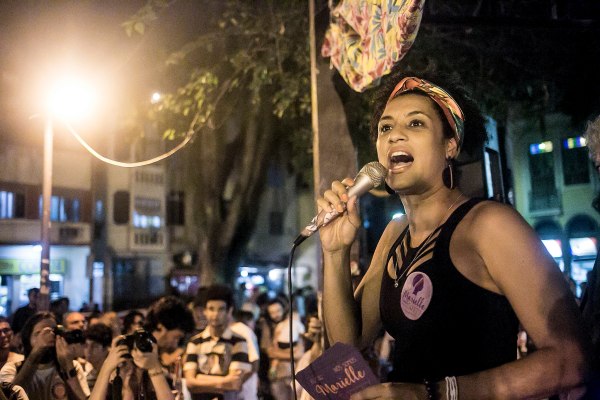
A woman with a microphone stands in front of a crowd

Marielle Franco campaigning in 2016. / Mídia NINJA / Wikimedia

The murder in March of Marielle Franco – a popular 38-year-old black, gay city councilor in Rio de Janeiro – has stirred outrage across Brazil, but debate over how to increase security has been stifled by political agendas and fake news.  Marielle and her driver were shot dead on March 14 in what press reports characterized as a professional hit job.  Some commentators have speculated it may have been retaliation for her outspoken criticism of the police and military deployments in the cities and favelas.  One of her final posts on Twitter called attention to police violence, citing the case of a young man gunned down by authorities while leaving church.

  • Tens of thousands of mourners took to the streets in Rio and other cities to protest. MC Carol, a black funk singer from favelas near Rio, reflects the popular anger with her immediate hit song entitled “Marielle Franco,” in which she sings:  “You [the system] want to kill us, control us / But you won’t silence us / even bleeding we gonna make it / marching and screaming / I’m Marielle, Claudia, I’m Marisa.”  (Original Portuguese below.)  Claudia and Marisa were women killed during police operations in favelas.

There is no consensus, however, over the meaning of Marielle’s death within a broader agenda of solutions to curb violence in Rio de Janeiro amid an escalation in federal intervention in the state, now entering its second month.  Proponents of President Michel Temer’s push to mobilize the military and other federal assets claim the Councilor’s murder justified the policy.  Opponents argue that Marielle’s assassination and other high-profile murders underscore that the mobilization has not worked, and, indeed, the deaths have fueled widespread skepticism.

  • A poll conducted by Folha de São Paulo newspaper shows these mixed feelings. Seventy-nine percent of interviewees say they support the federal intervention, but 71 percent believe that nothing has changed since it started.  Moreover, 22 percent of people living in affected communities fear the police more than they do drug dealers (16 percent).  Some 15 percent have more fear of milícias– the gangs, which often include former and current police that control much of people’s lives in these communities – and 13 percent of general criminals.  Of those polled, 28 percent say fear all of them equally.  Criminal activities like car theft and robbery have shown no sign of decline.
  • Complicating discussion of Marielle’s murder has been the torrent of fake news about her. Through Facebook pages and Whatsapp messages, far-right groups have spread unsubstantiated allegations that she had links to organized crime.  One Facebook page shows a woman and a man, supposedly Marielle and Marcinho VP, a famous drug dealer, as a couple.  Marco Feliciano, a rightwing preacher turned lawmaker, said during a radio program that Marielle’s death was “just another number” and offered a crude joke.  “They shot a leftist in the head in Rio de Janeiro,” he said.  “It took a week to die because the bullet didn’t find the brain.”  Brazilian justice directed Facebook and YouTube to remove some of the offensive profiles and videos, but fake news is still being shared through social networks.

President Temer’s official announcement that he intends to run for reelection in October deepens the political dimension of his militarized solution to the violence problem.  The federal intervention in Rio de Janeiro has become a key issue on his agenda, but the lack of results is undermining his efforts to shore up his historically low, single-digit approval ratings.  Investigations into Marielle’s murder haven’t identified any suspects yet, and there’s no discussion about changes to security laws or any other measure other than putting more army troops in the streets.  Despite the general outrage, the window for change opened after Marielle’s murder is closing fast.  The Brazilian political system is looking straight to general elections in October, and the speed and depth of the politicization of the assassination, aggravated by fake news, suggest prospects for serious discussion are nil.

[Excerpt from MC Carol’s “Marielle Franco”]

Vocês querem nos matar, nos controlar
Vocês não vão nos calar
Mesmo sangrando a gente vai tá lá
Pra marchar e gritar
Eu sou Marielle, Cláudia, eu sou Marisa

April 5, 2018

*Marcus Rocha is a CLALS Research Fellow.

“New Transnationalisms” in Latin American Cinemas

By Dolores Tierney*

Guillermo del Toro speaks on a panel

Mexican director Guillermo del Toro, who won the Oscar for Best Director last month. / Gage Skidmore / Flickr / Creative Commons

When Mexican film director Guillermo del Toro won the Oscar for Best Director for The Shape of Water last month, it was another example of the “new transnationalism” of contemporary Latin American cinemas.  Working across cultures while preserving his Mexican creative identity, del Toro follows in the footsteps of his compatriots, Alejandro González Iñárritu (Best Director for Birdman in 2014 and The Revenant in 2015) and Alfonso Cuarón (Best Director for Gravity, 2013).  An examination in my recent book of these and three other Latin American directors – Brazilians Walter Salles and Fernando Meirelles, and Argentine Juan José Campanella – finds that their work is part of a broader shift toward transnational filmmaking: films made in one country produced with capital, creative input, or paradigms borrowed from another, and actors and directors making films in nations other than their own.

  • To a certain extent, Latin American filmmaking has always involved the use of personnel, equipment, and cinematographic styles from Europe and the United States. This comingling has become more radical, however, since the early 1990s, when neoliberal policies in the three major filmmaking nations – Mexico, Brazil, and Argentina – in particular led to a withdrawal of government financial support for the industry.  State-owned film infrastructures, including film institutes, distribution companies, and theater chains, were dismantled.  Production numbers fell from close to 100 annually in each country to less than ten, and Hollywood films increasingly dominated box offices.  In Mexico, government patronage still contributed to Cuarón and del Toro’s first features, respectively Sólo con tu pareja (1991) and Cronos (1993), but large numbers of directors, cinematographers, and actors left to look for work in the United States film industry.

At the turn of the century, however, production shifted toward a new model of transnational production.  Mexican cinema experienced a box office and critical renaissance because deregulation of movie ticket prices encouraged investment in new U.S.-style multiplex theatres situated in upscale shopping malls and neighborhoods.  Among the hits were Amores perros; Y tu mamá también; El crimen del padre Amaro; and Sexo, pudor y lágrimas.  The new multiplex-goers welcomed a range of Hollywood-derived genre films (romantic comedies, teen films), narratives, and practices (tie-in soundtracks) that reflected Mexicans’ own evolving tastes – finding common ground between Mexican and U.S. culture even if, quantitatively, “Hollywood” films still dominated.  In the same general time period, moreover, Mexican state support shifted toward a new model of privately and transnationally financed filmmaking that includes funds from European countries, other Latin American countries, and the United States.  Iñárritu, Cuarón and del Toro straddled two markets and two cultures, and excelled in both.

  • A similar evolution took place in Argentina and Brazil, with state withdrawal in the early 1990s and then a push to filmmaking in a reformed model of co-production in more recent years. Brazil and Argentina’s most successful domestic films are made with a combination of funds from the state (or state-owned businesses such as Petrobras) and private companies working with foreign partners, such as the Spanish Telefe and U.S.-based Disney affiliate Miravista (in Argentina), and a consortium of foreign firms partnered with Globo in Brazil.

Latin American film critics often lament that the region’s transnationalized cinemas borrow too much from the aesthetic models of the north – the genre templates of the crime film, melodrama, and romantic comedy among others.  But closer analysis shows that, while such artistic appropriation and the international co-producers’ distribution muscle are important, the films’ success also depends on their strong elements of “local exceptionality.”  Transnationally funded artists whose films circulate successfully in Europe and North America have leverage to tackle important sociopolitical aspects of their respective national histories.  Argentine director Lucrecia Martel (La ciénaga, La niña santa, La mujer sin cabeza, Zama) and Peruvian Claudia Llosa (Madeinusa, La teta asustada) are able to get around funding bodies’ prescriptive demands to make films that challenge stereotypes of developing nations.  In his recent Oscar-winning film, The Shape of Water, del Toro has made an English-language adult fairy tale with nods to science fiction, spy thrillers, and the musical, but it is much more than a product of U.S. industry.  It is a transnational film that reflects what del Toro refers to as the contradictions of his Mexican identity – a mixing of the “dark” and the “good” – and explores how Latin American and Latinness function in the U.S. political and racial imaginary.  His transnational film doesn’t diminish his Mexican voice; it enhances it.

 April 2, 2018

* Dolores Tierney is Senior Lecturer in Film Studies at the University of Sussex and former CLALS Fellow.  Her book, New Transnationalisms in Contemporary Latin American Cinemas, was published by Edinburgh University Press last month.

Peru: Challenges to the Summit of the Americas

By Fulton Armstrong

Men and women standing in Peruvian congressional chamber

Martín Vizarra’s inauguration as President of Peru on March 23, 2018. / Twitter: @prensapalacio / Creative Commons

The resignation of Peruvian President Pedro Pablo Kuczynski (PPK) last weekend marks not only a deepening of the crisis of governance in that country; it also signals the greatest threat yet to the credibility of the Summit of the Americas process begun in 1994.

  • The 2016 election of PPK, a technocrat with international experience, business acumen, and a stated commitment to attacking corruption, appeared at the time to reaffirm Peru’s preference for competent, if unglamorous, government. Allegations of inappropriate dealings with the Brazilian construction giant, Odebrecht, when he was a government minister in the 2000s and as a consultant prior to the last election – which he blamed on business partners – were his undoing.  He dodged charges, fought back, made deals (including releasing former President Fujimori from prison), and reportedly deployed his allies to buy votes to oppose his impeachment – all to no avail.  Vice President Martín Vizcarra, sworn in last Friday to succeed him, had been spirited off to Canada to be Peru’s ambassador last September when allegations of malfeasance as Transportation Minister led to calls for his impeachment.  But last week he pledged to make anticorruption and transparency top priorities.
  • PPK is not the only tainted politician, or even the worst, in this drama. Two of his predecessors – Alejandro Toledo (2001-06) and Ollanta Humala (2011-16) – have been indicted for offenses involving Odebrecht.  The Congress that hounded PPK out of office is itself reportedly riddled with corruption.  Odebrecht officials have testified that PPK’s congressional nemesis, Keiko Fujimori, took $1.2 million from them in the 2011 presidential race.  The respected GFK poll indicates that, at 82 percent, Congress has a worse disapproval rating (by 1 percent) than PPK did last week – with the body’s corruption being a major factor.

The crisis comes just weeks before the eighth Summit of the Americas scheduled to be held in Lima on April 13‑14, with the overarching theme of “Democratic Governance against Corruption.”  Vizcarra has directed the Peruvian foreign ministry to proceed with preparations.  The event’s anticorruption focus could produce deeply embarrassing moments for a number of hemispheric heads of state in addition to the Peruvian hosts.  Odebrecht and the Lava Jato investigations loom large over Brazilian President Michel Temer (who, despite support in the single digits, last week announced his intention to run for reelection in October).  U.S. President Trump is engaged in warfare against the Department of Justice, FBI, and special prosecutor looking into allegations that he or his campaign colluded with Russians suspected of intervening in U.S. elections.  Mexican President Enrique Peña Nieto has stumbled from scandal to scandal.  Honduran President Juan Orlando Hernández remains under a cloud because of persistent questions about the vote count in his reelection in November.  Venezuelan President Maduro would be an obvious outcast – for both his corruption and poor governance – but his peers’ own baggage would force some restraint on their condemnations.

Other than newly inaugurated President Vizcarra’s anticorruption pledge, the conditions for a successful summit around the theme of corruption and democratic governance are obviously absent, and going ahead with it risks rendering the event a laughing stock.  Changing the theme would undermine its credibility and raise the troubling questions of what meaningful topics – trade, democracy, inequality, infrastructure investment, or counternarcotics – could replace it.  There are also tempting reasons to postpone the event, including the fact that several countries – Mexico, Brazil, and Colombia among them – will be electing new presidents this year and could bring fresh, validated ideas to a meeting next year or beyond.  Postponing the event, however, would risk braking what little momentum the Summit process has and would leave open when, if ever, the perfect summit could be held.  Crises driven by corruption (and, in the case of Venezuela, the collapse of decency) have a tendency to go on for years.  Either way, Summit organizers are going to have to scale back their expectations – with a protocolary event that sacrifices substance in April, or create a pretext for postponement and hope for a more propitious moment in the future.  The Ibero-American Summit, which includes Spain but excludes the United States and Canada, is scheduled to meet in Guatemala in November under the theme of “A Prosperous, Inclusive, and Sustainable Ibero-America.”  Perhaps that event’s timing and theme will help get regional discussions back on track.

March 26, 2018

Presidential Elections in Mexico: Tough Campaign, Tougher Challenges Ahead

By Daniela Stevens*

Andrés Manuel López Obrador stands at a microphone

Frontrunner candidate in Mexico’s 2018 presidential elections, Andrés Manuel López Obrador, speaks to the press. / ANDES / Micaela Ayala V / Flickr / Creative Commons

Campaigning for Mexico’s July 1 presidential election officially begins next week, and no candidate appears to have an insurmountable advantage over the others.  Polls vary, but Andrés Manuel López Obrador (MORENA) appears to be the frontrunner, with 35 to 44 percent of support.  He is followed by PAN-PRD coalition candidate Ricardo Anaya, who has between 24 and 31 percent of the vote.  The PRI candidate, José Antonio Meade, seems a third option, at about 20 to 26 percent, and Margarita Zavala, the only independent candidate who officially obtained registry, lags far behind.  It is too early to see if voters will base their decisions on party loyalty or on perceptions of the candidates.

  • López Obrador (widely known by his initials, “AMLO”) has broad name recognition – 84 percent of Mexicans are familiar with him for better or for worse – but Anaya, Meade, and Zavala have an important opportunity to build new images and attract voters. Indeed, AMLO sometimes seems to be in a race against himself; his rhetoric is often harsh, and his disregard for international free trade alienates a large sector of the business world and the media.  His mixed signals regarding a “review” of the contracts made in conjunction with energy reforms have fostered distrust and uncertainty.
  • Ricardo Anaya’s strategy appears likely to be open confrontation with PRI candidate Meade, aiming to attract PRI voters who see him as the candidate best positioned to prevent an AMLO victory. Anaya’s focus has been on winning the endorsement of key figures in states that constitute large electoral strongholds, such as Jalisco.  However, Anaya’s alleged involvement in a money laundering scandal stands to undermine his support.   PRI Secretary General Claudia Ruiz Massieu tried to tar him in an international context last week by giving the OAS a file with evidence she claimed substantiates the charges against him.  Anaya has cried foul.
  • José Antonio Meade, a highly skilled and seasoned technocrat associated with both PRI and PAN presidencies, is being held back by his association with the very unpopular incumbent President Enrique Peña Nieto. He is trying to cast himself as a PRI “sympathizer,” rather than as a party “militant” responsible for recent years’ weak performance.  To distance himself from his party’s image of electoral fraud, corruption, and crony capitalism, he has emphasized his commitment to transform the PRI.  The party is cooperating, framing him as a “citizen candidate.”

While candidates are immersed in the customary personal attacks against each other, violence appears to be playing into electoral politics with renewed intensity.  The Second Report of Political Violence in Mexico, prepared by the risk assessment firm Etellekt, documents 141 attacks against politicians and public servants since the start of the pre-campaign period last September.  Over 50 of these attacks have been assassinations of officials, incumbents, and candidates at all levels of government.  Violence is worst in Guerrero, Veracruz, the State of México, and Puebla, all states with significant organized crime.

Public insecurity is certain to join organized crime, corruption, inequality, and redistribution of income as central in the Mexican landscape as elections approach, and each candidate will pledge to make those issues his or her top priority.  As in other Latin American countries, the election also appears likely to signal the deepening discredit and low representation of the traditional party system.  Voters could very well select a candidate who, while not an outsider, presents him- or herself as committed to attacking the corruption of the major parties.  While running on a law-and-order slate, the candidates will also likely promise new approaches on the “war on drugs” that, led by both PAN and PRI, has devastated the country – with little or no prospect of avoiding the same pitfalls as predecessors.  Winning the election on July 1 will not be easy for any of the declared candidates; governing once in office will be even harder.

March 23, 2018

* Daniela Stevens is a Ph.D. candidate in Political Science in the School of Public Affairs at American University.

Latin America: Evangelical Churches Gaining Influence

By Carlos Malamud*

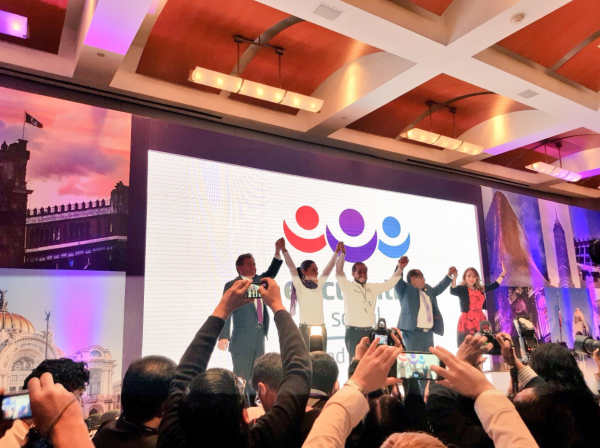
Five people stand up in front of a screen with their arms raised

The evangelical political party Partido Encuentro Social (PES) held a rally earlier this month in Mexico City. / Twitter: @PESoficialPPN / Creative Commons

The line between religion and politics is getting increasingly blurred in Latin America as evangelical churches grow in strength and candidates try to curry the support of – or at least avoid confrontation with – the faithful.  Tensions over mixing religion and politics have historic roots in Europe and Latin America and persisted throughout the 20th century, but we are witnessing a new phenomenon in Latin America now.  In much of the region, evangelical churches are showing an increased political presence and institutional representation in partisan politics.

  • In Mexico, the secular Movimiento de Regeneración Nacional (MORENA) and the Partido del Trabajo (PT) have struck an alliance with the evangelical Partido Encuentro Social (PES) to back presidential candidate Andrés Manuel López Obrador. Guatemalan President Jimmy Morales is an evangelical, and Costa Rica – if current polls prove correct – could soon have Fabricio Alvarado, an evangelical pastor, as President.  In Brazil, presidential aspirant Jair Bolsonaro has been building popular support by, among other things, appealing to the an evangelical base, even though most Brazilian evangelical churches aren’t reaching for executive power but rather support parties concentrated on building local, provincial, and congressional influence.
  • The evangelical churches’ membership has grown steadily but unevenly in recent decades. About 20 percent of all Latin Americans are evangelicals.  In Mexico, they account for more than 10 percent of the population.  In Peru, Ecuador, Colombia, Venezuela, Argentina, and Panama, observers estimate more than 15 percent.  In Brazil and Costa Rica, the number reaches 20 percent, while in Guatemala, Honduras, and Nicaragua it surpasses 40 percent.

The evangelical churches’ political agenda is centered on defense of family values – basically opposition to abortion, same-sex marriage, divorce, euthanasia, and what they erroneously call “gender ideology.”  On these topics on certain occasions, there’s a striking convergence with the Catholic hierarchy, Social-Christians, and conservative parties.  The evangelicals do not usually take positions, however, on other issues in which the government has a strong role, such as the economy or international relations.

The evangelical phenomenon reflects a double dynamic:  the unstoppable surge in non-Catholic faithful poses an enormous challenge for the region’s deeply rooted bishops conferences, and the growing distrust for political leaders and parties has facilitated the emergence of new options, including evangelicals, with barely articulated platforms.  The faithful who profess the tenets of evangelicalism are disciplined, and pastors’ positions have a lot of influence over them.  Even if not linked directly to candidates through the parties, voters’ evangelical affiliation and their churches’ recommendations have a strong influence over them.  The evangelical vote, moreover, is highly desired by all candidates and at least indirectly influences campaigns.  Candidates in Colombia, Brazil, or Mexico, as in other Latin American countries, are making that increasingly obvious as elections approach.

March 20, 2018

*Carlos Malamud is Senior Analyst for Latin America at the Elcano Royal Institute, and Professor of Latin American History at the Universidad Nacional de Educación a Distancia (UNED), Madrid.  A version of this article was originally published in El Heraldo de México.